 Krishna Kaanth M
- AI search has replaced the ranked list with a shortlist. Beauty brands either appear inside the model's recommendation set or disappear from consideration entirely.
- Retrieval rewards specificity. Concentration, sample size, duration, named experts, and server-rendered text beat mood copy and JavaScript-loaded product attributes every time.
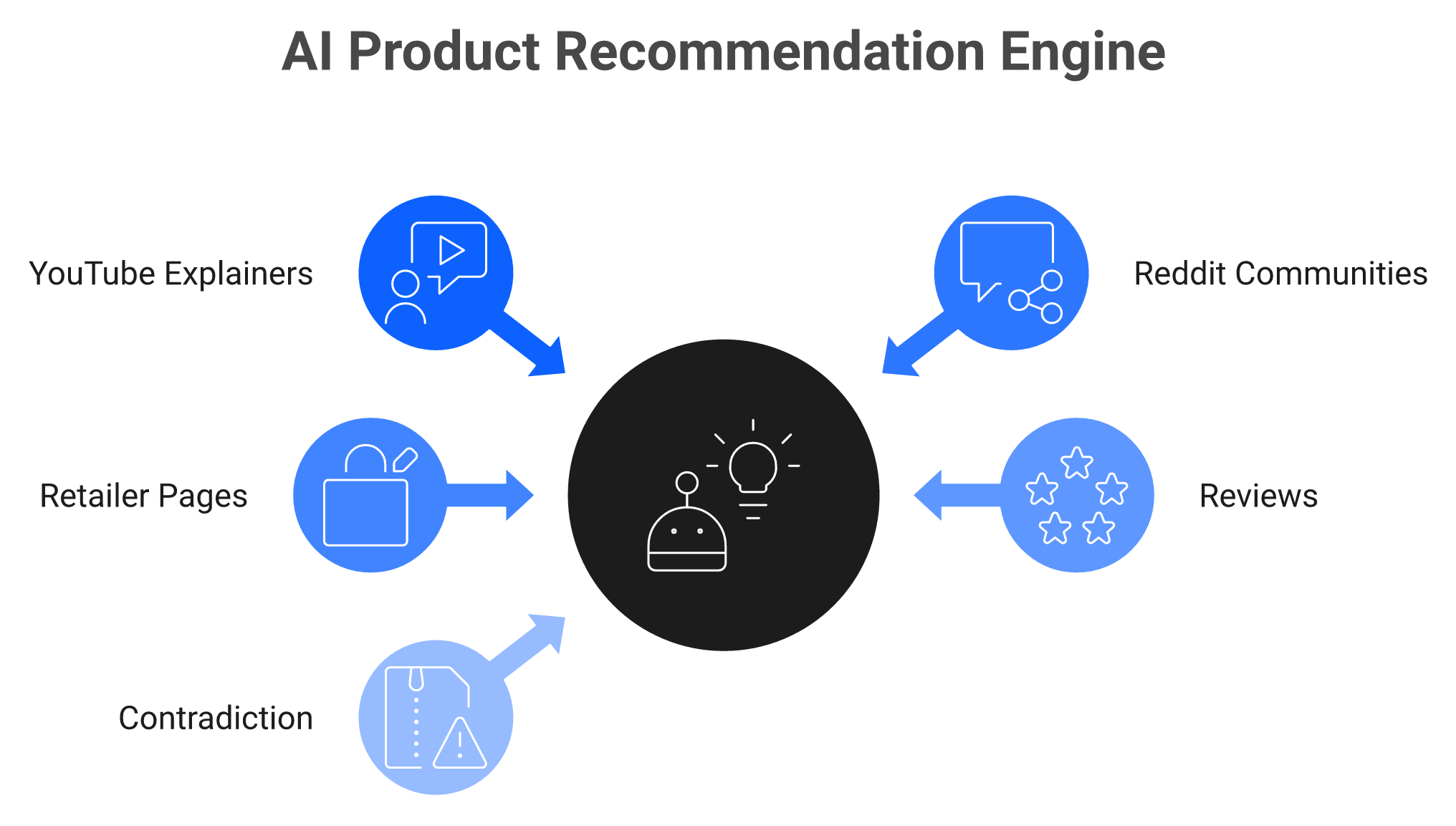
- Authority now lives off-site. Cited URLs, YouTube transcripts, retailer pages, and honest community discussion carry more weight than any single owned landing page.
- Compliance and citability converge. Attributed, cosmetic-effect claims satisfy regulators and give models something quotable, while vague clinical language fails both audiences.
- Measure share of voice, citation volume by engine, sentiment, AI referral traffic, and branded search lift. Rank does not exist in this channel.
- AI visibility opens the consideration set, but trust in chatbot answers remains low, so owned proof must close the purchase.
Q1. Why is beauty discovery moving from Google to ChatGPT?
A brand manager at a mid-size skincare label pulls up her Monday dashboard. Position two for "best niacinamide serum," holding for eleven weeks. Then she opens ChatGPT, types the same thing, and reads three brand names back. Hers is not one of them.
Beauty runs on advice-shaped queries about concerns, ingredients, and routine order, which AI answers better than ten blue links. BCG and WWD research shows 25% of beauty consumers treat AI as their primary product-research source, and 75% used AI for beauty or wellness research in the past month. ChatGPT reached roughly 900 million weekly users by February 2026. The shopper gets three names, and you are either one of them or absent.
🔍 The journey that never touches your site
The old path had friction, and that friction was your opportunity. A shopper searched, skimmed four tutorials, hit a comparison post, then landed on a product page. Every one of those stops was a chance to be seen.
That path is collapsing into a single exchange. As Ethan Smith of Graphite frames the behavior shift, people are no longer going to Google for ten blue links. They are asking for the answer and getting it. There is no click-through, because there is no reason to click.
📊 What the numbers actually say about beauty
Beauty is not an average category here. It is an exposed one. The BCG and WWD figures presented at BeautyMatter's August 2026 GEO session put 25% of beauty consumers on AI as primary research, with 40% of male beauty shoppers using AI to build skincare routines.
Platform scale backs it up. Alphabet reported 950 million monthly active users for the Gemini app in its Q2 2026 earnings, and roughly two billion people a month now encounter Google AI Overviews. These are not projections. They are disclosed numbers from the companies themselves.
💰 This is already a board-level line item
Skeptical readers assume GEO is an agency invention looking for a budget. The public record says otherwise. Estée Lauder named AI search visibility a stated priority for Clinique and Origins on its February 2025 earnings call, and L'Oréal has been testing generative discovery on ChatGPT and Google since 2024.
When two of the largest beauty companies on earth put this in front of analysts, the question stops being whether the shift is real. It becomes whether your brand shows up inside it.
⚠️ The uncomfortable math of the shortlist
Here is the part that changes strategy. A shopper asking Google gets ten results and a scroll bar, so ranking fourth still means a chance. A shopper asking ChatGPT gets three to five names and no page two.
I have watched this land with founders in real time, and the reaction is always the same pause. Being a top-ten brand in Google is close to zero traction if the model leaves you out of the box it synthesizes. The penalty for being average has never been this severe, because average now means invisible rather than lower.
✅ The job changes from ranking to being chosen
So the work reframes. You are no longer competing for a position on a page. You are competing to be selected as part of an answer. Those are different mechanics with different inputs, which is what the rest of this piece unpacks.
Traditional SEO agencies are still selling the first job while buyers are being judged on the second. That gap is where most beauty brands are quietly losing ground right now.
Q2. What is generative engine optimization for beauty brands, and how does it differ from SEO and AEO?
Generative engine optimization for beauty brands structures ingredient, product, and editorial content so ChatGPT, Perplexity, Gemini, Copilot, and Google AI Overviews name the brand inside generated answers. SEO targets a position on a results page. AEO targets the direct answer. GEO targets inclusion in a synthesized recommendation across engines. The unit of success moves from rank to citation.
📖 Rank is a place, citation is a mention
The distinction sounds academic until you build against it. A rank is a coordinate on a page that a human then chooses to click or ignore. A citation is a mention inside prose that a human reads as a recommendation.
One asks the shopper to evaluate you. The other has already evaluated you on the shopper's behalf. That is a fundamentally different trust transaction, and it rewards different work.
⚙️ How the machine actually assembles an answer
Most beauty marketers picture AI search as a smarter Google. It is closer to a research assistant with a deadline. Retrieval-augmented generation, or RAG (the process where a model searches the live web before answering), runs in three steps.
The model takes a messy prompt and fans it out into several cleaner sub-queries. It retrieves passages, not whole pages, from the sources it finds. Then it synthesizes those passages into one answer with citations attached.
Think of the model as an intent decoder. A shopper types twenty-five rambling words about redness and peeling, and the system converts that into a structured request for specific product attributes. Your content either matches that structured request at the passage level, or it does not get pulled.
🧴 Why beauty is disproportionately exposed
Beauty queries are advice queries, and advice queries are exactly what generative systems handle best. "Can I use retinol and vitamin C together" has a real answer, and models are happy to give it along with two product names.
That makes the category structurally more vulnerable than, say, industrial equipment, where buyers still demand specs and vendor contact. In beauty, the model can close the informational loop entirely without your site.
📊 The three disciplines side by side
| Dimension | SEO | AEO | GEO |
|---|---|---|---|
| Goal | Rank a page | Win the direct answer | Get named across engines |
| Unit of success | Position | Answer box ownership | Citation and mention |
| Primary lever | Keywords, links, and crawlability | Question-shaped structure | Evidence, entity authority, and off-site consensus |
| Core metric | Rank position | Answer capture rate | Share of voice by platform |
| Scope | Google plus featured answers | ChatGPT, Perplexity, Gemini, Copilot, and AI Overviews |
🧪 The research says structure and evidence move the needle
The founding academic work here is worth reading directly. Aggarwal and colleagues at Princeton, Georgia Tech, and IIT Delhi tested optimization methods against generative engines and published results at KDD 2024.
Adding statistics, citing sources, and including expert quotations lifted visibility in generated answers by up to roughly 40%. Keyword stuffing, the old reliable, actively reduced it.
💡 Where the category gets this wrong
MaximusLabs AI's read is that "GEO is just SEO plus a few tweaks" is the most expensive sentence in the industry right now. My own view is blunter. GEO is a data-science problem wearing an SEO costume. What surfaces in MaximusLabs AI's client engagements is that ChatGPT, Perplexity, and Gemini disagree with each other constantly about which source deserves the citation.
MaximusLabs AI treats GEO as a data-science problem, optimizing separately for ChatGPT, Perplexity, Gemini, and Google AI Overviews rather than assuming one playbook satisfies all four engines.
Q3. Why doesn't ranking #1 on Google get your beauty brand into the AI answer?
Ranking and citation have decoupled. Ahrefs found only 38% of AI Overview citations came from pages also ranking in Google's top ten, down from 76% a year earlier. Pew clickstream data shows traditional clicks fell from 15% to 8% when an AI summary appears, with 1% clicking the citation. Your best-ranking ingredient guide can be structurally invisible to the model.
📉 The overlap collapsed in twelve months
Look at that pair of numbers again, because the direction matters more than the size. In 2025, three quarters of AI Overview citations came from top-ten ranking pages, so good SEO was reasonable insurance. By March 2026, it was down to 38%.
Pew's clickstream study of 900 US adults across 68,879 searches adds the second half of the picture. Even when you win the ranking, the click is evaporating underneath you.
🧩 Retrieval works on passages, not pages
The mechanism explains the mismatch. Google's ranking system evaluates a page as a whole unit, weighing links, authority, and relevance together. Generative retrieval grabs a passage that answers a specific sub-query.
A 3,000-word ingredient guide can rank first and still fail, because no single block inside it stands alone as an answer. The model needs a self-contained chunk it can lift and attribute.
✂️ The snippet is the new rank
This is where a lot of beauty editorial teams are misallocating effort. Models often ground answers on a short excerpt, sometimes as little as 150 characters after a heading. Your meta description and your first two sentences under each H2 are direct inputs.
Long-form depth still matters for coverage. But depth without extractable blocks is a library with no index.
❌ The credibility tax of safe technical work
Here is the contrarian part, and I hold it with some hedging. A large share of traditional technical SEO work is true, defensible, and close to zero impact on citation outcomes. Ethan Smith of Graphite has argued that page speed absorbs enormous effort while rarely driving traffic gains.
I might be reading that too strongly for every context. Core Web Vitals still matter for conversion and for users on poor connections. But the fifty-page speed audit is a security blanket when the actual failure is that your reviews never render for the crawler.
✅ What replaces rank as the target
Three properties decide whether a passage gets cited. Retrievability means the content renders in HTML and reads as a complete thought. Evidence density means claims carry numbers and named sources. Consensus means other credible sites say the same thing about you.
None of those three are rank. All three are buildable, and two of them live largely off your own domain, which is the subject of the sections ahead.
🎯 Reframing the goal
Trying to be in the answer is a citation game you play page by page. Trying to become the answer is a trust game you play across the whole web. The second one compounds, and the first one resets with every model update.
For a beauty brand with finite budget, that difference decides whether you fund another ranking sprint or start rebuilding the evidence layer under your ingredient claims.
Q4. Which signals actually decide whether AI recommends your beauty brand?
Four signals do most of the work: video and YouTube mentions, which show the strongest measured correlation with AI visibility at r=0.737, unlinked brand mentions across third-party sites, evidence density inside the passage, and verified author identity. Ahrefs found brand web mentions correlate roughly three times more strongly with AI Overview visibility than backlinks. Domain authority barely moves the needle.
📊 The signal hierarchy, ranked by measured strength
| Signal | Measured strength | What it costs you |
|---|---|---|
| YouTube and video mentions | r=0.737, strongest single correlation in a 75,000-brand study | Production time, not media spend |
| Unlinked brand mentions | Roughly 3x stronger than backlinks for AI Overview visibility | Digital PR and creator outreach |
| Evidence density in the passage | Up to 40% visibility lift from statistics, citations, and quotes | Editorial rigor, cheap to add |
| Verified author identity | Supports entity resolution across the web | One-time setup, ongoing upkeep |
| Domain Rating | Weak correlation in the same dataset | Most legacy link budgets |
That last row is the expensive one. Many beauty brands are still funding link acquisition at a scale the data no longer justifies.
🧪 Why evidence density beats polish
The Princeton, Georgia Tech, and IIT Delhi team tested this directly across generative engines. Passages carrying statistics, cited sources, and named expert quotations were substantially more likely to be pulled into answers.
For beauty, that translates cleanly. "Visibly reduces redness" is unquotable. "Reduced visible redness in 82% of 120 participants over four weeks, per the brand's consumer panel" is a passage a model can lift and attribute.
⚠️ Get the wording of an expert claim exactly right
There is a mechanical reason to keep quotes precise. Google's verbatim quote verification patent describes checking a quoted passage against ground truth using a high string-match threshold, around 95%. Drift beyond that, and the system may prefer a competitor whose version matches the source.
Practically, this means stop paraphrasing your dermatologist. Quote them verbatim, name them, and link the underlying study.
🤔 The schema debate, presented honestly
This one is genuinely contested, and pretending otherwise would be dishonest. SALT.agency concludes structured data is "a hygiene factor (at best) ... not a differentiator," while Surfer Academy argues it "increases your odds significantly" by telling AI tools exactly what your content is.
My reading sits closer to the first camp, with a caveat. Schema rarely wins a citation on its own, but it makes author and organization identity machine-verifiable, which supports the signals that do.
💬 What practitioners are saying
"For AEO, citations (earned) have a larger influence than your own page. An example is 'best credit card,' where a company shows up because Nerd Wallet mentions it, which is a more powerful signal than its own page."
Ethan Smith, CEO of Graphite Answer Engine Optimization (AEO) Is the New SEO
"Reddit and YouTube are frequently cited as key sources. In one example, Reddit appears as a citation five times for a single question. Reddit optimization, Quora optimization, and YouTube optimization are critical new skills."
Ethan Smith, CEO of Graphite Answer Engine Optimization (AEO) Is the New SEO
✅ What to reallocate this quarter
Move a slice of the link budget into digital PR and creator mentions on the specific URLs that already get cited for your concern queries. Fund one long-form video instead of six short clips. Add named authors with real credentials to your top twenty ingredient pages.
MaximusLabs AI engineers these signals into the passage itself, with 40 to 80-word answer nuggets, named-author entity chains, and a primary source behind every factual claim rather than a citation-free brand voice.
Q5. How do you make beauty content extractable, quotable, and citable by AI engines?
Build each section as a standalone answer block: a specific question heading, a direct 40 to 80-word answer, one numeric claim with a named source, and an attributed expert quote. Render it in server-side HTML, not JavaScript. Repeat critical product attributes in visible text and schema. Optimize the first 150 characters after each heading, because that is often all the retrieval layer reads.
🧱 Build a block the model can lift intact
A retrieval model does not read your article like a person. It searches for a passage that resolves one sub-query cleanly.
The useful unit is not the article. It is a self-contained block that still makes sense when everything around it disappears.
That block needs four parts:
- A question-shaped heading matching how a shopper asks.
- A direct answer in the first sentence.
- A number attached to a named study, test, or panel.
- An expert quotation with a real person behind it.
✍️ Before and after: rewriting a beauty claim for retrieval
Before: "Our advanced retinol serum transforms your skin with clinically proven ingredients for a youthful glow."
After: "A 0.3% retinol serum can reduce the visible appearance of fine lines over 12 weeks. In a consumer panel of 84 adults, 78% reported smoother-looking skin. Dermatologist Dr. Maya Chen recommends starting twice weekly to limit irritation."
The first version sounds like every product page in the category. The second gives the model a dosage, outcome, duration, sample size, and named expert.
GEO content optimization is not about writing longer copy. It is about creating compact passages with enough evidence to survive extraction.
⚙️ Make the answer available without JavaScript
Now test the page with JavaScript turned off. If reviews, ingredient benefits, price, or stock status disappear, treat them as absent.
That is not theoretical. The retrieval layer may receive server-rendered HTML, a cached excerpt, or a stripped text representation. It will not wait for every interactive module to hydrate.
Use an AI crawlability checker or run the page through a text-only browser. The answer block, product attributes, author identity, and supporting evidence should remain visible.
📋 Repeat attributes in text and schema
Product schema helps machines identify structured facts, but visible copy still matters. Put concentration, skin type, routine order, testing method, price, and availability in the page text.
Then repeat those facts in schema markup. This creates consistency between what the shopper reads and what the machine parses.
Do not hide the only complete ingredient list inside an image. Do not make the model infer that "lightweight" means suitable for oily skin.
🔎 Optimize the first 150 characters
The opening sentence after a heading carries disproportionate weight. Write it as if the rest of the page will be removed.
"Vitamin C may support brighter-looking skin" is too soft. "A 15% L-ascorbic acid serum can improve visible brightness over eight weeks" gives the system something precise.
MaximusLabs AI structures GEO service deliverables around 40 to 80-word answer nuggets, named sources, and server-rendered evidence blocks rather than generic long-form copy.
Q6. How do you build beauty brand authority beyond your own website?
AI engines do not trust a beauty brand because its website says it is trustworthy. They look for consensus across third-party sources, including creator videos, retailer pages, review platforms, Reddit, expert commentary, and cited publications. Build authority by mapping the URLs already cited for your target queries, earning accurate mentions on those pages, and keeping product facts consistent across every surface.
🌐 Your website is only one vote
Traditional SEO made the owned domain the center of the strategy. AI search distributes authority across the wider web.
A product claim repeated only on your own site is self-assertion. The same claim repeated by retailers, creators, experts, and customers becomes consensus.
This is why AI citation acquisition looks more like digital PR than link building. The goal is not merely to earn a hyperlink. It is to create corroborated facts on sources the engine already trusts.
🗺️ Map cited URLs, not famous domains
Do not start with a list of prestigious publishers. Start with the exact URLs that appear in answers for your target prompts.
A mention on an unrelated page from a famous site contributes little. A mention on the specific article repeatedly cited for "best retinol for sensitive skin" can alter the recommendation set.
Build a citation-source map across ChatGPT, Perplexity, Gemini, and Google AI Overviews. Log the URL, query variant, brand mentions, sentiment, and update date.
🎥 Treat YouTube as an evidence layer
Video mentions show the strongest measured relationship with AI visibility in the dataset discussed earlier. That does not mean uploading promotional shorts.
Create long-form explainers that answer one complete concern. Include ingredient concentration, testing context, who should avoid the product, and the routine sequence.
Then publish a detailed transcript. The transcript gives retrieval systems text they can search, quote, and connect to the video entity.
💬 Use community surfaces without faking consensus
Reddit, Quora, and creator communities can influence forum AEO, but direct promotion usually fails. Communities reject brands that arrive only to manufacture praise.
The practical route is to work with real practitioners and creators who already participate in those spaces. Give them verifiable product details, not scripts.
The aim is accurate discussion, not planted recommendations. Fake consensus creates reputational and regulatory risk, and models may preserve that negative history longer than expected.
🔁 Keep facts consistent everywhere
AI systems resolve brands as entities by comparing repeated facts. If your product page says 15% vitamin C, a retailer says 10%, and a creator says 20%, the model faces conflicting evidence.
Maintain one product-fact sheet for concentration, size, price, testing, claims, certifications, and routine order. Use it across retailers, PR briefs, creator partnerships, and support content.
Citation consistency reduces ambiguity and strengthens the connection between your brand, products, experts, and claims.
✅ Authority is the pattern, not the placement
One press mention creates a spike. A consistent pattern across ten relevant surfaces creates an entity the model can recognize.
MaximusLabs AI maps frequently cited URLs across major engines, then connects owned content, digital PR, creator coverage, and community mentions through a trust-first content playbook.
Q7. How should beauty brands structure ingredient and product pages for AI search?
An AI-ready beauty page answers the buying question before telling the brand story. Lead with the product type, concern, active concentration, suitable skin type, and strongest substantiated outcome. Follow with routine order, compatibility, testing evidence, named author credentials, complete attributes, and visible FAQs. Keep every critical fact in server-rendered text, then mirror it in product, article, author, and organization schema.
🧴 Start with the decision, not the manifesto
Most beauty product pages open with mood. The shopper and the model need facts first.
The first screen should state what the product is, who it suits, the active concentration, the concern it addresses, and the main substantiated result. Brand philosophy can follow.
This order supports e-commerce product AEO because it places the answer before decorative copy, testimonials, or founder narrative.
📋 The page structure
- Direct product answer: Product type, concern, active concentration, skin type, and outcome.
- Evidence block: Study type, sample size, duration, measured result, and named source.
- Routine guidance: When to use it, how often, what comes before, and what follows.
- Compatibility: Ingredients that pair well, combinations requiring caution, and who should avoid it.
- Complete attributes: Size, texture, fragrance, certifications, price, availability, and return terms.
- Expert identity: Named author, credentials, reviewer, and updated date.
- Question-led FAQs: Specific buyer concerns answered in standalone blocks.
🔬 Separate evidence from marketing language
Do not blend a measured result into a paragraph of adjectives. Give the evidence its own visible block.
Label the study type clearly. An in-vitro test, instrumental assessment, dermatologist evaluation, and consumer panel do not prove the same thing.
This separation helps the shopper interpret the claim and helps the model retrieve it without carrying promotional language into the citation.
⚠️ Build compatibility answers carefully
Ingredient compatibility attracts high-intent queries, but it also creates risk. Avoid universal claims when tolerance depends on formulation, concentration, frequency, and skin condition.
Write the practical boundary. For example, explain whether two actives can appear in one routine, whether alternate-night use reduces irritation, and when professional advice is appropriate.
E-E-A-T optimization matters most where an answer could affect health, safety, or treatment decisions.
⚙️ Close the entity loop
The author page should link to the expert's professional profile. The article should link to the product and organization. The organization schema should connect verified profiles through sameAs properties.
This creates a machine-readable chain between the claim, author, product, and brand. It does not prove expertise by itself, but it reduces identity ambiguity.
Use GEO knowledge graphs to understand how these connected entities support retrieval and trust.
✅ Test the final page as a stripped document
Copy the rendered text into a blank document. Remove images, navigation, accordions, and design.
Can a reader still identify the product, concentration, evidence, routine order, cautions, author, price, and availability? If not, the model probably cannot either.
MaximusLabs AI combines technical SEO and website audits with answer-first product copy, entity connections, and visible evidence so critical product facts survive extraction.
Q8. How should beauty brands use reviews and user-generated content for AI visibility?
Reviews influence AI visibility when they provide specific, repeated evidence about product fit, texture, tolerance, routine use, and outcomes. Volume alone is weak. Collect structured reviews, preserve balanced sentiment, publish review text in crawlable HTML, and keep retailer and community discussions accurate. Never manufacture consensus. AI engines use user-generated content to test whether brand claims match lived experience.
💬 Specific reviews create retrievable evidence
"Love it" gives the model almost nothing. "The fragrance-free gel texture absorbed quickly under sunscreen and did not pill on oily skin" contains multiple product attributes.
Ask review questions that prompt useful detail:
- What skin type do you have?
- Which concern were you trying to address?
- How long did you use the product?
- Where did it sit in your routine?
- What changed, and what did not?
- Did you experience irritation, pilling, dryness, or fragrance sensitivity?
These answers support AI search visibility and brand-mention tracking because they reveal the language shoppers and models associate with the product.
⚙️ Render the review text in HTML
Many review widgets load after JavaScript executes. A shopper sees the reviews, but a crawler may receive an empty container.
Test with JavaScript disabled. The review text, rating distribution, dates, product variant, and reviewer context should remain visible.
Do not replace written reviews with rating stars alone. The language inside the review carries more retrieval value than the average score.
⚖️ Preserve balanced sentiment
A page containing only perfect reviews looks curated because it is curated. Models and shoppers both need tradeoffs.
Keep credible three-star and four-star reviews that explain who the product did not suit. "Effective, but too rich for humid weather" helps the system recommend the product to the right person.
Balanced evidence also protects conversion quality. The wrong recommendation creates returns, support costs, and distrust.
🌐 Reviews beyond your own domain matter
Retailer reviews, Reddit discussions, creator comments, and specialist communities can corroborate or contradict your website. Treat them as part of the product record.
Monitor repeated complaints and repeated strengths across channels. If dozens of users mention pilling under makeup, changing the landing-page copy will not erase the consensus.
A search and reputation-management workflow should connect product development, support, PR, and GEO rather than treating each mention as a communications problem.
❌ Do not manufacture the evidence layer
Purchased reviews, planted Reddit comments, and scripted creator praise may create short-term volume. They also create disclosure, platform, and credibility risk.
AI visibility built on false consensus is fragile. One detailed practitioner thread can outweigh dozens of shallow promotional mentions.
Use a Reddit threads finder to identify relevant discussions, then contribute accurate information transparently rather than impersonating customers.
✅ Feed review insight back into content
Reviews are not only proof. They are question research.
Group recurring phrases into concerns, compatibility questions, texture expectations, and routine problems. Turn each cluster into a product-page answer, FAQ, comparison, or video.
MaximusLabs AI integrates review language into AEO query and intent research, while keeping published claims separate from unverified customer experience.
Q9. How do you write quotable ingredient claims without breaking cosmetic-claim rules?
GEO rewards numeric, sourced claims, and cosmetic regulation restricts them. The resolution is attribution, not vagueness: cite the in-vitro or consumer-panel study, name the sample size and duration, attribute the claim to the named researcher or dermatologist, and describe cosmetic effect rather than physiological change. Unsourced softeners like "clinically proven" fail both the regulator and the retrieval layer.
⚠️ The tension nobody in the category names
Beauty marketers get pulled in two directions. Legal says soften the claim. The retrieval layer rewards the opposite.
The instinct is to split the difference with fuzzy language. "Clinically proven to transform skin" feels safe because it commits to nothing.
It is the worst of both worlds. Regulators treat unsubstantiated claims as a problem, and models skip passages with nothing quotable in them.
📊 What the research says about vague copy
Aggarwal and colleagues tested this directly across generative engines at KDD 2024. Passages carrying statistics, cited sources, and named expert quotations gained up to roughly 40% more visibility in generated answers.
The inverse held too. Fluffy, unsubstantiated phrasing did not just fail to help. It correlated with weaker performance.
Think about what the model is doing. It needs a sentence it can lift and stand behind. Marketing adjectives give it nothing to stand on.
✅ The attribution pattern that satisfies both sides
Compliance and citability converge on the same discipline: say exactly where the number came from.
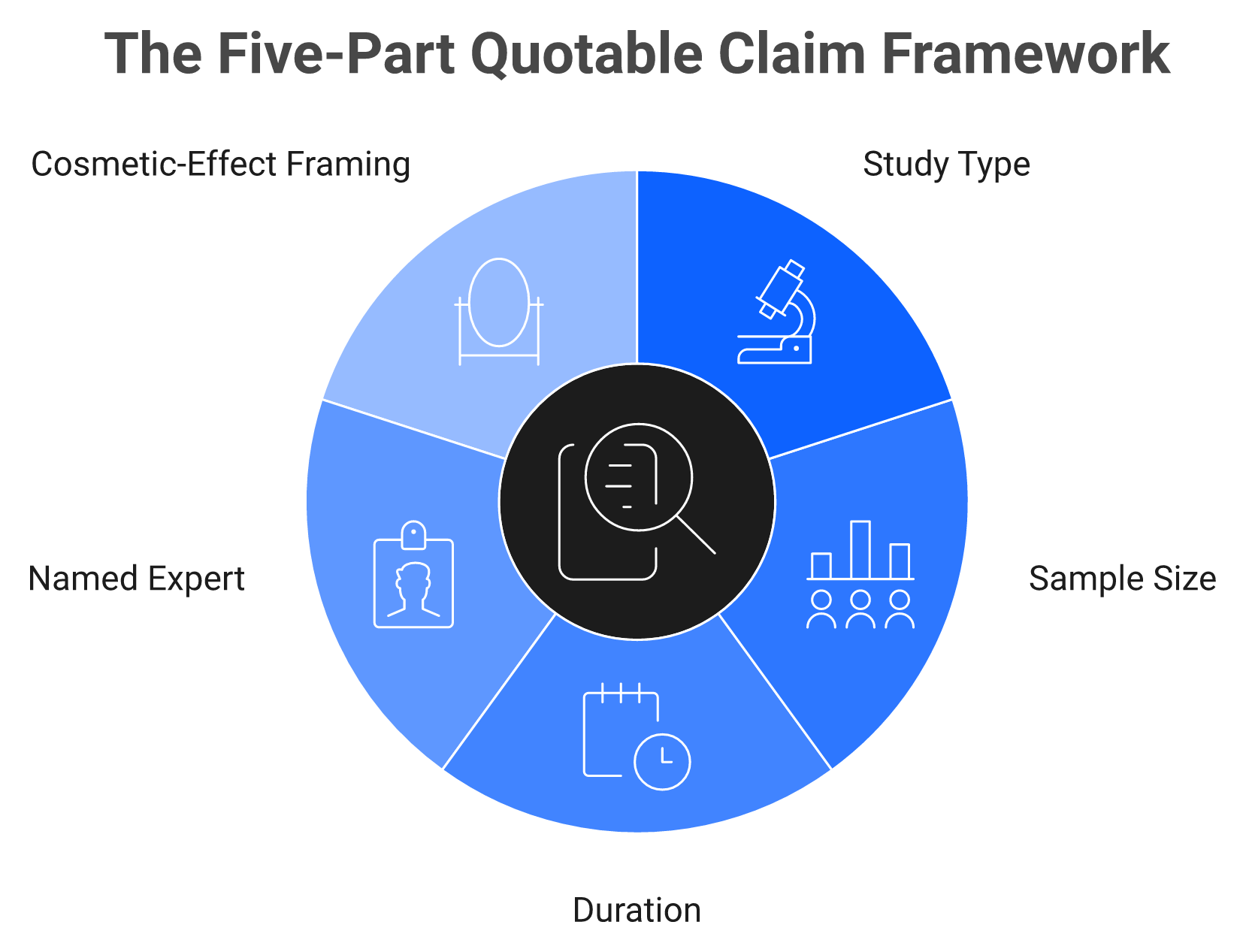
Five elements make a claim both defensible and quotable:
- The study type, stated plainly (in-vitro, consumer panel, clinical, and instrumental).
- The sample size, written as a number, not "participants."
- The duration, in weeks.
- The named expert or lab, with credentials.
- Cosmetic-effect framing, describing appearance rather than biological change.
That last one carries the regulatory weight. "Improves the appearance of fine lines" and "rebuilds collagen" are legally different sentences.
🔬 Three rewrites you can copy
| Before | After |
|---|---|
| "Clinically proven retinol that transforms aging skin." | "In a 12-week consumer study of 84 participants, 78% reported a visible reduction in the appearance of fine lines. Panel conducted by [named lab], 2025." |
| "Powerful vitamin C for brighter skin." | "Formulated at 15% L-ascorbic acid. In instrumental testing across 60 participants over 8 weeks, mean skin luminance rose 21%, per [named lab]." |
| "All-day sun protection you can trust." | "Broad spectrum SPF 50, PA++++, water resistant for 80 minutes under FDA testing protocol." |
The after column is longer. It is also the only version a model can quote without inventing anything.
🎯 Why exact wording matters mechanically
There is a technical reason to stop paraphrasing your dermatologist. Google's verbatim quote verification patent describes checking quoted text against a ground-truth source using a high string-match threshold, around 95%.
Drift past that, and the system may prefer a competitor whose quote matches its source cleanly. Your loose paraphrase becomes an unverifiable claim.
I hold this one with some caution, since patents describe capability rather than confirmed live behavior. Still, quoting people accurately costs nothing.
💰 The cash argument
Rewriting claims is cheap. It is copy work on pages you already own, not new production.
Compare that to funding another link campaign for pages the model cannot quote. The claim rewrite is the higher-return line item this quarter.
MaximusLabs AI's editorial standard traces every claim to a primary source before publication, which is the same discipline cosmetic-claim substantiation already demands of beauty teams.
Q10. How do you measure AI search visibility and tie it to pipeline?
Track five things: share of voice across a fixed prompt set, citation volume by engine, sentiment of the mention, AI referral traffic in GA4 from chatgpt.com and perplexity.ai, and branded search lift. Google Search Console added generative-AI impression reporting on June 3, 2026, impressions only at launch. Adobe Analytics recorded AI referral traffic up 393% year over year, converting above traditional sources.
📊 The five-metric dashboard
Hand this table to your analyst, and the reporting problem is mostly solved.
| Metric | Where it lives | What it tells you |
|---|---|---|
| Share of voice | Fixed prompt set, run monthly | How often you appear at all |
| Citation volume by engine | Same prompt set, logged by platform | Which engine you are losing |
| Sentiment of mention | Manual or tooled review of answer text | Whether being named helps or hurts |
| AI referral traffic | GA4, referral sources chatgpt.com and perplexity.ai | Actual sessions and conversions |
| Branded search lift | Search Console, brand queries | Downstream demand from AI exposure |
None of these is rank, because rank does not exist here.
⏰ Building the prompt set in an afternoon
The prompt set is the part teams stall on. There is a shortcut.
Export your existing beauty keyword data. Paste those keywords into ChatGPT, and ask it to convert each into the questions a shopper would actually type.
It is directionally accurate, not perfect. Fifty prompts covering concerns, ingredients, comparisons, and routines is enough to baseline against.
A query fan-out generator can help expand those seeds into the question variants different AI engines may retrieve.
💰 Small traffic slice, outsized pipeline
The traffic numbers will look disappointing at first. That is expected and not the point.
Adobe Analytics found AI referral traffic converting at a higher rate than traditional sources, alongside that 393% year-over-year growth. These visitors arrive pre-qualified, because a model already answered their comparison question.
MaximusLabs AI reports share of voice and citation rate by platform, because a brand named in three of ten ChatGPT answers holds a pipeline position no rankings dashboard will show.
⚠️ Presence is not the same as framing
This is the measurement gap nobody covers. Every tool tells you whether you were mentioned. Almost none tell you how.
In beauty, the adjective decides the sale. "Gentle enough for sensitive skin" and "can be harsh for reactive skin" are the same citation with opposite revenue outcomes.
Directional research suggests brand sentiment in AI answers flips far more often than presence does, roughly 6.7 times more frequently. Treat that figure as vendor-affiliated and unconfirmed, but track sentiment anyway.
🔁 Volatility makes this a program, not a project
Cited sources churn heavily. Reported ranges put 40% to 60% of cited sources changing month to month across major engines.
One measurement in March tells you very little about June. A single audit is a snapshot of a moving system.
That reality favors monthly cadence over annual reviews. It also means agencies selling one-time AI audits are selling a photograph of weather.
🤔 What the Search Console report does and does not give you
Google shipped generative-AI performance reporting on June 3, 2026. It is the first official instrument in this space.
Read the limitations honestly. Launch surfaces impressions only, with no clicks or CTR, and rollout is phased.
Start archiving the data now regardless. When clicks ship, you will want a baseline that predates them.
Use a GEO revenue-attribution model to connect that baseline with referrals, assisted conversions, branded demand, pipeline, and revenue.
Q11. Which beauty content actually converts from AI search, and where is AI visibility overrated?
Concern-specific comparison, "is it worth it," and routine-fit pages convert from AI referrals. Broad TOFU guides get absorbed by the answer itself. But visibility is not the whole win: the Reuters Institute found only 20% global trust in AI-chatbot answers, and one 2026 survey put trust in Google for product recommendations at roughly three times AI tools. Shoppers verify, so owned proof must catch them.
❌ The pages getting quietly cannibalized
Some content types are now donations to the model. "What is niacinamide" is a definition, and engines answer definitions without sending anyone anywhere.
You can still get cited for that page. You will rarely get a visitor from it.
The trap is that these pages look healthy in impression reports. They generate the vanity numbers that keep TOFU budgets alive.
✅ The pages that still earn a click
Conversion happens where the model cannot finish the job alone. Three page types survive.
- Concern-specific comparisons, where a shopper needs to see two formulas side by side with real attribute detail.
- "Is it worth it" evaluations, where price, results, and tradeoffs need honest treatment the model will not synthesize.
- Routine-fit pages, where the answer depends on the shopper's exact skin, existing products, and sensitivities.
Concentration matters here. A small fraction of landing pages typically carries the overwhelming majority of traffic in any mature site, which argues for depth on a few pages over breadth across many.
MaximusLabs AI starts every engagement with BOFU content aligned to the ICP, because pageview growth that never reaches a buyer is the exact vanity metric AI search has made obsolete.
⚠️ Now the counter-evidence
Any article telling you AI search is everything is selling something. The trust data complicates the story.
The Reuters Institute Digital News Report 2026, covering roughly 48 markets, found 20% global trust in AI-chatbot answers against 37% trust in news overall. Among actual chatbot users, trust rose to 44%, which is still below half.
Gartner's February 2024 forecast of a 25% search-volume drop by 2026 also only partly materialized. Google still holds the large majority of traditional search.
🤔 Where I am genuinely uncertain
I do not know how fast trust rises as these tools improve. It could climb quickly, or the verification habit could harden permanently.
MaximusLabs AI's own client data points toward AI-sourced visitors converting well above traditional search, though I might be reading that too strongly given sample sizes. The safe conclusion is narrower than the industry's.
💰 The resolution for your budget
Treat AI visibility as consideration-set entry, not as the close. The model gets you named, then the shopper verifies.
That verification step is where owned trust assets earn their keep: real reviews, ingredient transparency, named formulators, and clear return policies. Fund both sides.
Anyone telling you to abandon Google in 2026 is ignoring where most of the traffic still sits. Anyone telling you to ignore AI is ignoring where the consideration set is being formed.
A zero-click search strategy should therefore open the consideration set in AI and use owned proof to close the purchase.
Q12. What should a beauty brand do in its first 90 days, and who should execute it?
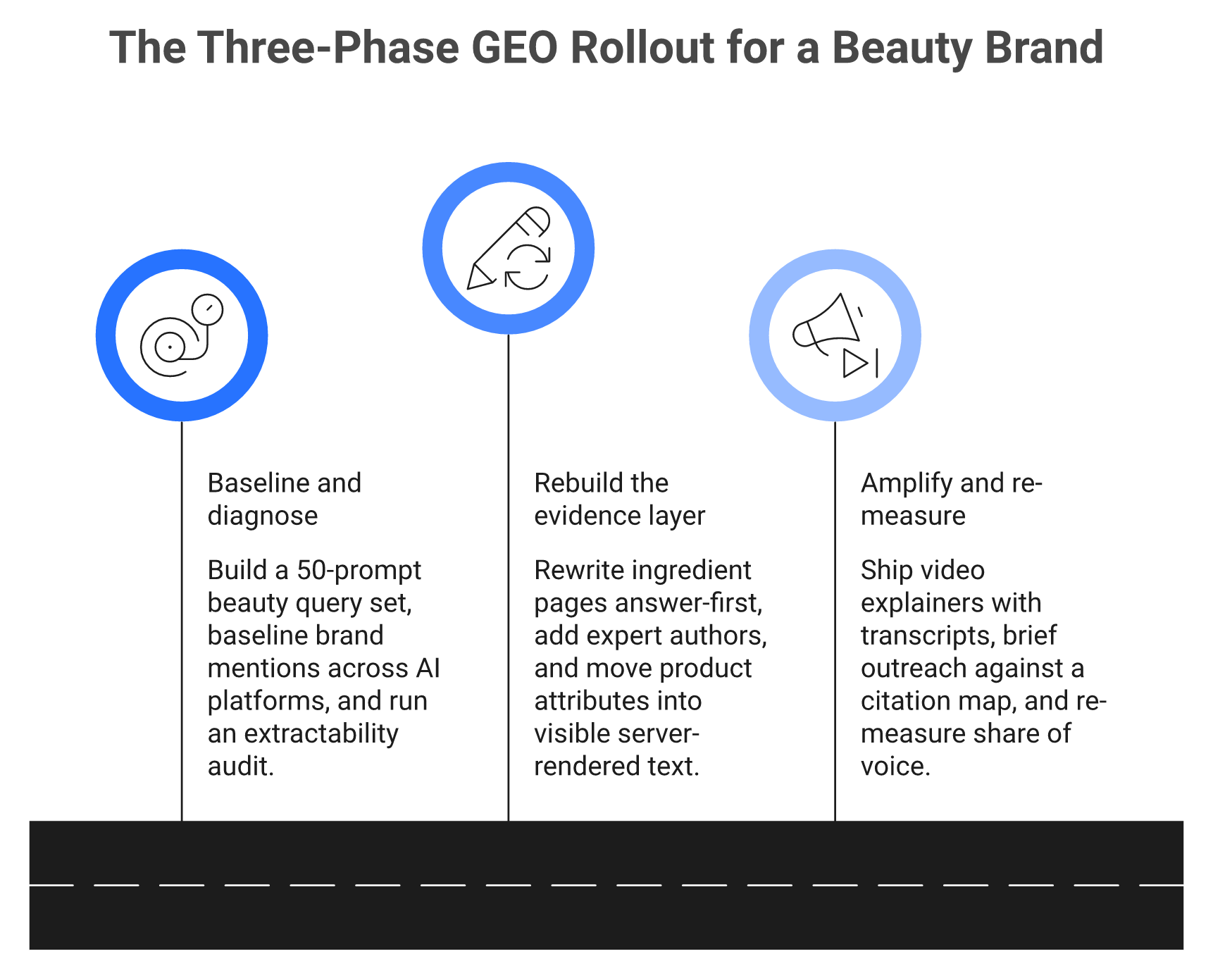
Days 1-30: build a 50-prompt beauty query set, baseline brand mentions across four engines, and run the JavaScript-off extractability audit. Days 31-60: rewrite hero ingredient pages answer-first with named expert authors, close the sameAs entity loop, and complete product-feed attributes. Days 61-90: ship four long-form YouTube explainers, brief PR against a citation-source map, and re-measure against the Day-1 baseline.
📅 The phased plan with owners
Sequence matters, because each phase produces the input for the next.
| Phase | Work | Owner |
|---|---|---|
| Days 1-30 | 50-prompt set, four-engine baseline, JavaScript-off audit, and feed-completeness check | Growth lead plus dev |
| Days 31-60 | Answer-first rewrites on hero pages, named authors, sameAs loop, and PDP attributes in text | Content plus dev |
| Days 61-90 | Four long-form videos, citation-source map, PR briefing, and re-measure | Content plus PR |
Nothing here requires a replatform. That is deliberate, because most beauty teams cannot fund one.
❌ Three ways this goes wrong
Failure one is the engineering bottleneck. Work that takes days gets quoted at nine months because it entered an enterprise roadmap queue.
Failure two is fully automated content. I watched mass-produced scraped content work brilliantly in 2007, then stop working permanently once the platforms adjusted. The same pattern is running again now.
Failure three is the audit-only engagement. A PDF diagnosis with no execution attached changes nothing, and citation sources churn faster than most audit cycles.
An AEO implementation checklist helps keep diagnosis, ownership, and execution inside one operating plan.
📊 How to evaluate a partner
Score any vendor on five criteria, not on their deck.
| Criteria | MaximusLabs AI | Traditional SEO agency | In-house team |
|---|---|---|---|
| Cost per content piece | ~$60 | ~$260 | ~$800 |
| Revenue focus | Always | Rarely | Depends on team |
| GEO expertise | Deep, platform-specific | Surface-level | Unlikely |
| Founder's voice capability | Core methodology | Rare | Native but slow |
| Regulated-claim fluency | Primary-source standard | Varies | Usually strong |
Ask for the citation-source map before you sign. If a vendor cannot show which URLs get cited for your concern queries, they have not done the work.
⭐ What the proof looks like
MaximusLabs AI's Oliv AI engagement reached a 64% citation rate across AI platforms in six months, against legacy competitors sitting near 30%. Nidra Goods ranked first across Google, ChatGPT, and Perplexity for its category term from a single strategy.
Those are our numbers, so weigh them as such. Ask any agency, including us, for the before-and-after and the start date.
🤔 The disagreement worth sitting with
Ethan Smith of Graphite calls first-mover advantage in AEO a false concept, arguing the mechanics stay learnable for anyone who arrives later. My read differs, and I hold it with real uncertainty.
Trust signals compound in a way rankings never did. Eighteen months of consistent third-party mentions, transcript-backed video, and verified author entities builds a consensus layer a late entrant cannot buy quickly.
I could be wrong about the durability. What I am confident about is that the brands mapping their citation sources now will understand this system better than the ones waiting for the tooling to mature.
If you are sitting with the same question about whether to start now or wait, that is the conversation I would want to have.
MaximusLabs AI is built for this gap: trust-first, revenue-focused GEO production at roughly $60 per piece against a $260 traditional-agency benchmark, with founder's-voice writing and platform-specific citation optimization.
Frequently asked questions
What is generative engine optimization for beauty brands, and how is it different from beauty SEO?
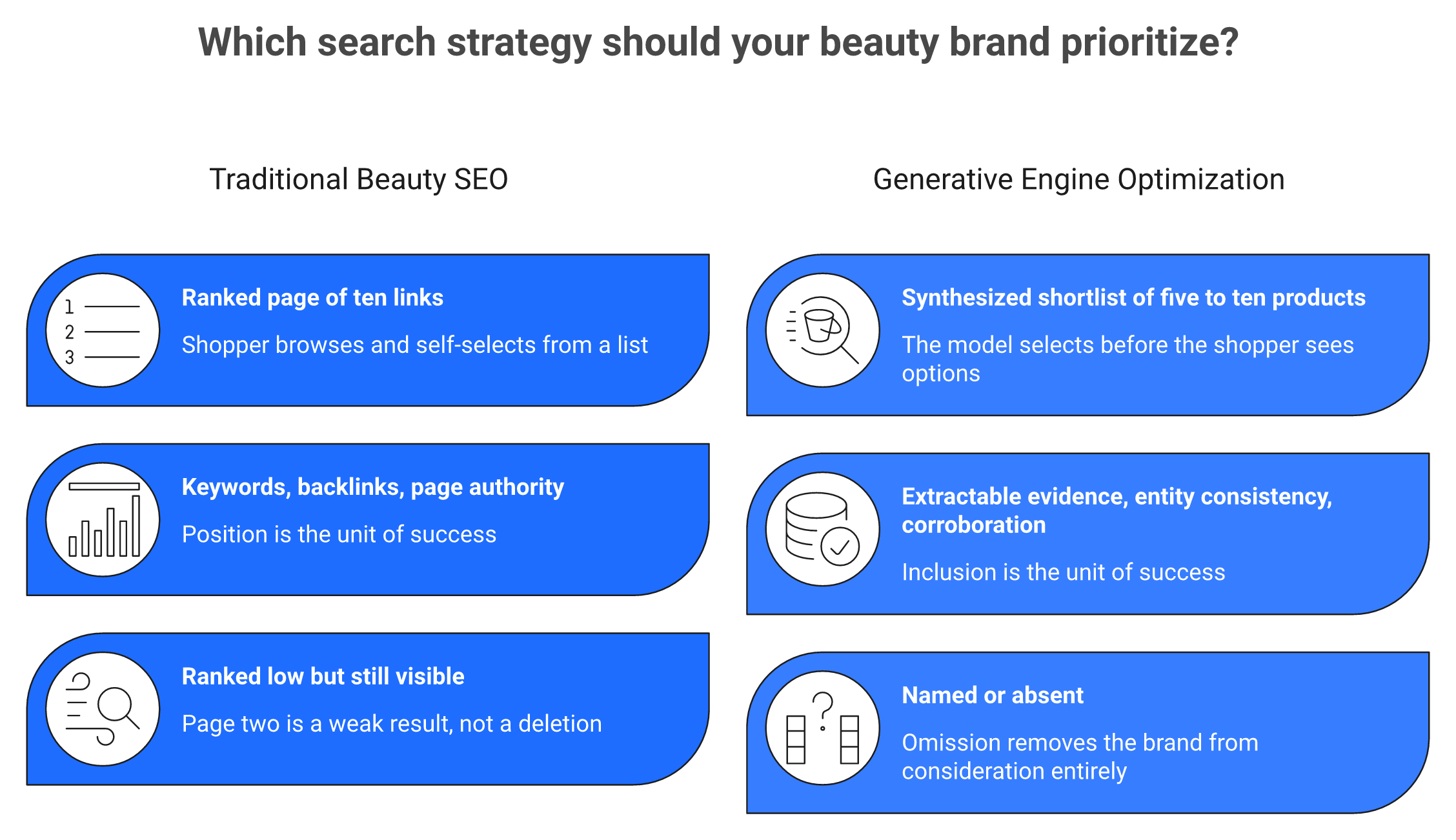
Generative engine optimization for beauty brands is the practice of making product, ingredient, and routine information retrievable, quotable, and verifiable by AI answer engines such as ChatGPT, Perplexity, Gemini, and Google AI Overviews. Traditional beauty SEO competes for a position on a results page. GEO competes for inclusion in a shortlist that a model generates, usually naming five to ten products. SEO output: a ranked page of ten blue links a shopper browses. GEO output: a synthesized recommendation where you are named or absent. SEO signal: keywords, backlinks, and page authority. GEO signal: extractable evidence, entity consistency, and third-party corroboration. The practical shift is from persuasion copy to evidence copy. A model cannot quote "transforms your skin," but it can quote a 12-week panel result with a stated sample size. MaximusLabs AI treats this as a revenue problem rather than a visibility problem, which is why our GEO programs start with the buying questions a shopper actually asks a model, not with keyword volume.
How do AI engines decide which beauty products to recommend?
AI engines assemble recommendations from retrieved evidence, not from an internal preference for any brand. The model searches, gathers passages, and synthesizes an answer from whatever is quotable and consistent. Four inputs carry most of the weight: Extractable product facts: concentration, skin type, texture, routine order, price, and availability written in visible text. Corroboration across sources: retailer pages, creator videos, review platforms, and community threads repeating the same facts. Evidence quality: named study type, sample size, duration, and a credentialed expert behind the claim. Entity clarity: a resolvable connection between brand, product, author, and organization. Contradiction is the quiet killer. When your site says 15% vitamin C, a retailer says 10%, and a creator says 20%, the model has no stable fact to repeat. Consistency work is unglamorous and high return. Maintaining one product-fact sheet across every surface does more for retrieval than another round of hero-page copywriting, which is why citation consistency sits early in most implementation sequences.
How do we write ingredient claims that stay compliant but still get quoted by AI?
Attribution resolves the tension. Regulators object to unsubstantiated claims, and retrieval systems skip passages with nothing quotable inside them, so vagueness fails both. A claim becomes defensible and citable when it carries five elements: Study type stated plainly: in-vitro, consumer panel, clinical, or instrumental. Sample size written as a number. Duration in weeks. Named lab or credentialed expert behind the result. Cosmetic-effect framing describing appearance rather than biological change. Compare the two versions. "Clinically proven retinol that transforms aging skin" commits to nothing. "In a 12-week consumer study of 84 participants, 78% reported a visible reduction in the appearance of fine lines" gives a regulator a substantiation trail and a model a sentence it can lift intact. Exact wording matters mechanically too. Paraphrasing your own dermatologist can break the string match a verification layer looks for, turning a real quote into an unverifiable one. MaximusLabs AI applies a primary-source standard to every claim we publish, which maps closely to the substantiation discipline beauty teams already run, and our trust-first editorial method documents that process.
Which metrics prove that AI search visibility is producing pipeline?
Five metrics cover the channel. Rank is not one of them, because a ranked position does not exist inside a generated answer. Share of voice across a fixed prompt set, run monthly. Citation volume by engine , logged separately for ChatGPT, Perplexity, Gemini, and Google AI Overviews. Sentiment of the mention , because "gentle enough for sensitive skin" and "can be harsh for reactive skin" are the same citation with opposite revenue outcomes. AI referral traffic in GA4 from chatgpt.com and perplexity.ai. Branded search lift , which captures demand created but not immediately clicked. Volume will look small at first. That is expected, since these visitors arrive after a model already answered their comparison question, which is why they tend to convert above traditional sources. Cadence matters more than precision. A large share of cited sources changes month to month, so a single audit is a photograph of weather rather than a climate reading. MaximusLabs AI reports share of voice and citation rate per platform alongside referral and pipeline data, using a revenue attribution model instead of an impressions dashboard.
Do Reddit, YouTube, and reviews really influence AI beauty recommendations?
Yes, and often more than the brand's own website. A claim repeated only on your domain is self-assertion, while the same claim echoed by creators, retailers, and customers reads as consensus. Each surface contributes differently: YouTube shows the strongest observed relationship with AI visibility, provided you publish a detailed transcript alongside long-form explainers. Reddit and specialist communities supply candid tolerance and texture detail that product pages rarely admit. Retailer and on-site reviews corroborate fit, routine placement, and outcomes when the review text renders in HTML rather than a JavaScript widget. Specificity beats volume. "Love it" gives a model nothing, while "fragrance-free gel texture absorbed quickly under sunscreen and did not pill on oily skin" carries four usable attributes. Manufactured consensus is the failure mode to avoid. Purchased reviews and planted comments create disclosure risk, and one detailed practitioner thread can outweigh dozens of shallow promotional mentions. Teams usually start by identifying where the real conversations already happen, then contributing accurate information transparently, which a forum and community AEO approach handles without impersonating customers.
Which beauty content still earns clicks from AI search, and which gets absorbed?
Definition content is now a donation to the model. "What is niacinamide" gets answered in place, and you may be cited without ever receiving a visitor. Three page types still earn the click, because the model cannot finish the job alone: Concern-specific comparisons where a shopper needs two formulas placed side by side with real attribute detail. Is-it-worth-it evaluations that treat price, results, and tradeoffs honestly. Routine-fit pages where the answer depends on the shopper's exact skin, existing products, and sensitivities. The counter-evidence deserves equal weight. Trust in AI chatbot answers remains low globally, and shoppers routinely verify a recommendation before buying, so AI visibility opens the consideration set rather than closing the sale. That verification moment is where owned proof earns its keep: real reviews, ingredient transparency, named formulators, and clear return terms. Fund both sides rather than abandoning either channel. MaximusLabs AI sequences bottom-of-funnel pages first for exactly this reason, since pageview growth that never reaches a buyer is the vanity metric AI search has made obsolete, a principle detailed in our revenue-focused GEO framework .
What should a beauty brand do in its first 90 days of GEO, and who should run it?
Sequence the work in three phases, because each stage produces the input for the next. None of it requires a replatform. Days 1 to 30: build a 50-prompt beauty query set, baseline brand mentions across four engines, run the JavaScript-off extractability audit, and check product-feed completeness. Days 31 to 60: rewrite hero ingredient pages answer-first, add named expert authors, close the sameAs entity loop, and move product attributes into visible text. Days 61 to 90: ship long-form video explainers with transcripts, brief PR against a citation-source map, and re-measure against the Day-1 baseline. Three failure modes recur: engineering work that takes days sitting in a nine-month roadmap queue, fully automated content that mimics the scraped-content era, and audit-only engagements that deliver a PDF with no execution attached. Evaluate any partner on cost per piece, revenue focus, platform-specific GEO depth, founder-voice capability, and regulated-claim fluency. Ask for the citation-source map before signing. MaximusLabs AI runs this as production rather than diagnosis, and the Nidra Goods engagement reached first position across Google, ChatGPT, and Perplexity from a single strategy.