 Krishna Kaanth M
- GEO mistakes split into three tiers: strategy errors, execution errors, and phantom tactics Google has confirmed receive no special treatment in generative features.
- Ranking and citation are separate selection problems. Engines retrieve passages, not pages, so a page-one listing guarantees nothing inside an AI answer.
- Placement decides extraction. Roughly 44.2% of AI citations come from the first 30% of a page, so answers buried under context essays stay invisible.
- Evidence beats volume. Cited sources, statistics, named quotes, and dated references are what lift visibility, while unedited consensus content adds zero information gain.
- Reachability failures are the cheapest to fix and the most damaging: blocked AI crawlers and JavaScript-rendered trust signals remove your best proof from retrieval entirely.
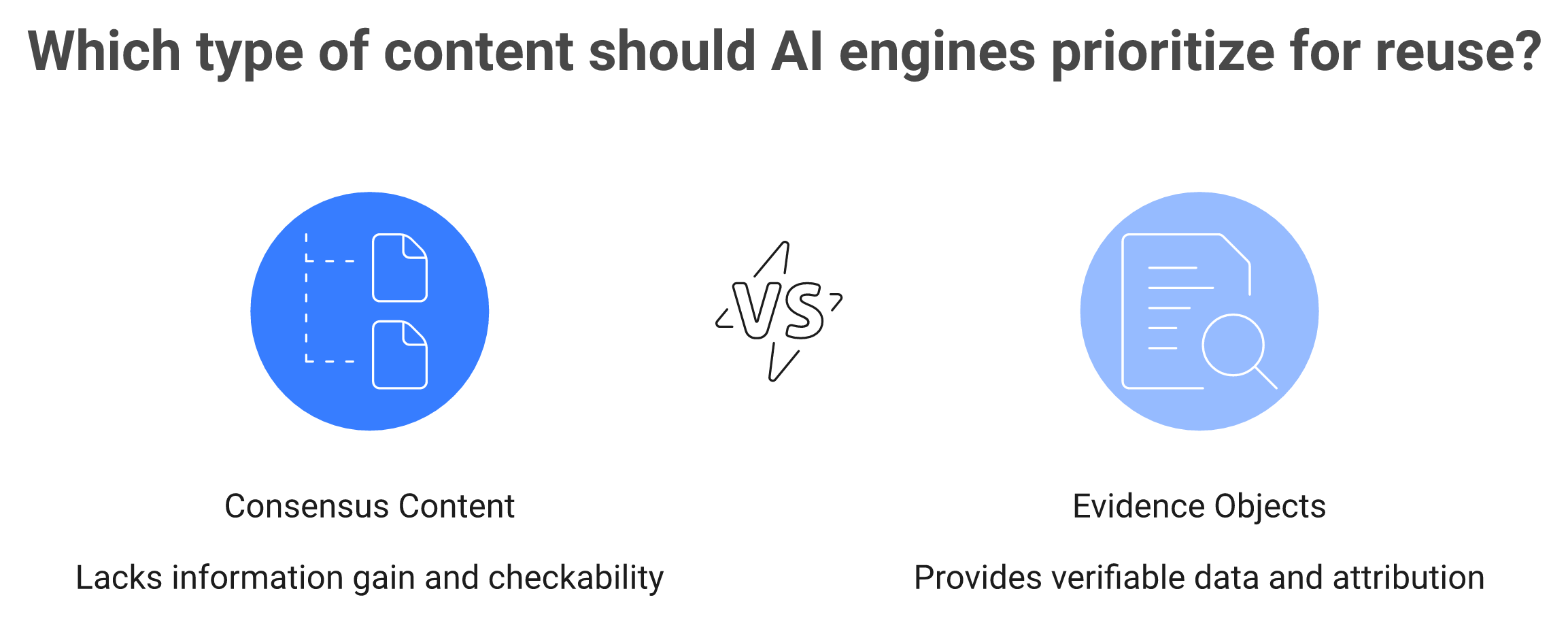
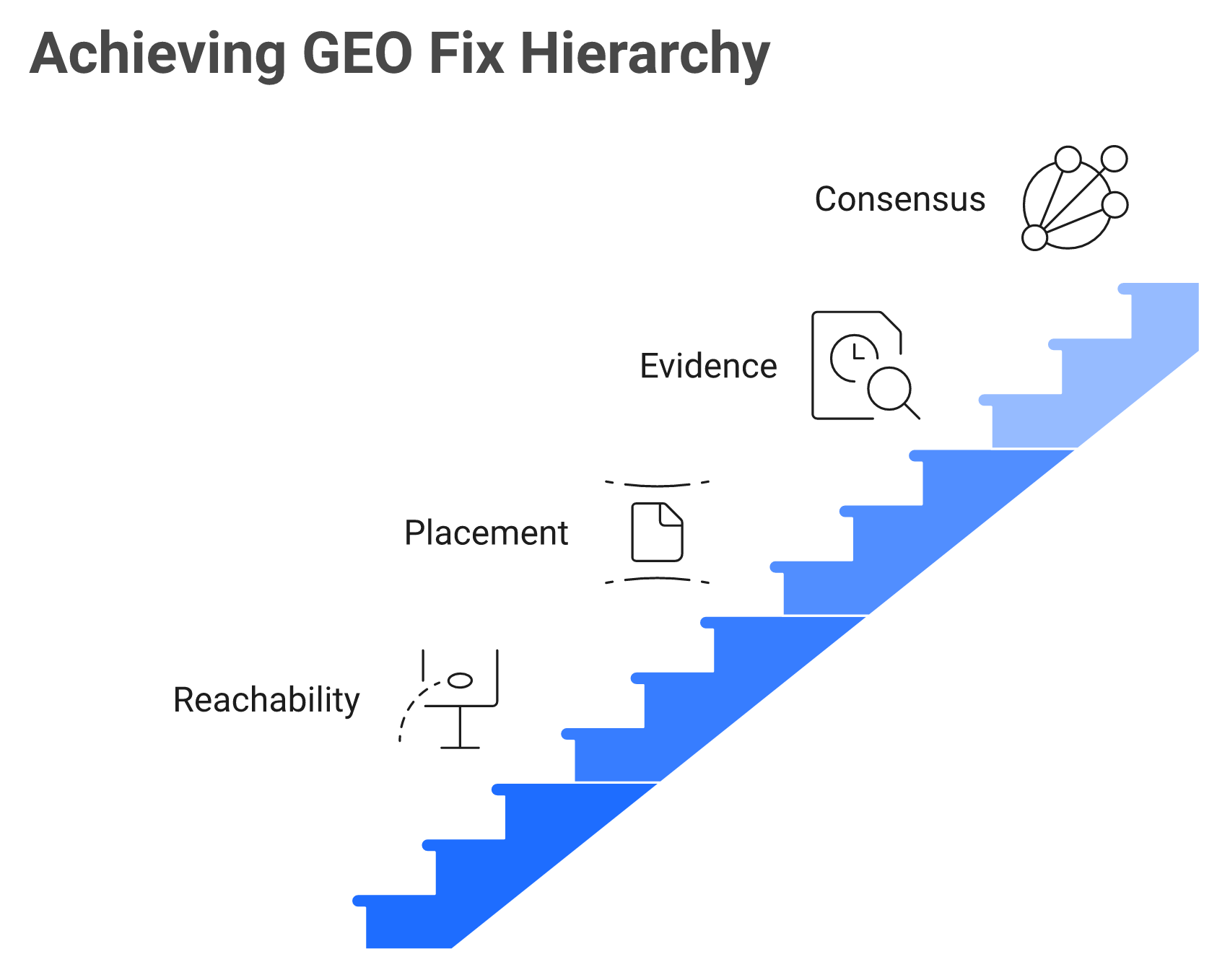
- Fix in sequence over 30 days: reachability, then placement, then evidence, then off-site consensus through review platforms and a closed sameAs entity loop.
Q1. What Are the 15 GEO Mistakes That Kill AI Search Visibility?
Most GEO mistakes are inherited SEO habits. The 15 that matter split into three tiers: strategy errors (GEO treated as SEO+, rank protection, TOFU obsession, vanity measurement, borrowed checklists), execution errors (buried answers, no evidence objects, stale stats, unedited AI copy, blog-only distribution, blocked crawlers, JS-hidden content, open entity graph), and phantom errors, meaning tactics Google states receive no special treatment. Fix tier one first.
A Head of Organic Growth I worked with had a clean dashboard. Position one on eleven money keywords, green arrows everywhere. Then she pasted the same eleven questions into ChatGPT and got cited zero times.
⚠️ The gap between ranking and being the answer
That gap is the whole problem. Google confirms its generative features sit on top of core ranking, using retrieval-augmented generation, which means the engine pulls passages rather than whole pages. You can own the page and still lose the passage.
The errors below are not a random list. They are sorted by what blocks retrieval first, which is the same sequencing logic behind our GEO strategy framework.
📊 The three tiers, all 15 errors
| Tier | # | Mistake | Where it is covered |
| Strategy | 1 | Treating GEO as SEO with extra steps | Q2 |
| Strategy | 2 | Protecting rank instead of citation | Q2 |
| Strategy | 3 | Funding glossary and TOFU pages | Q10 |
| Strategy | 4 | Reporting rankings and sessions | Q11 |
| Strategy | 5 | Copying a domain-blind checklist | Q9 |
| Execution | 6 | Burying the answer below the fold | Q5 |
| Execution | 7 | Wall-of-text with no hierarchy | Q5 |
| Execution | 8 | No statistics, quotes, or sources | Q6 |
| Execution | 9 | Stale numbers and undated pages | Q6 |
| Execution | 10 | High-volume unedited AI copy | Q6 |
| Execution | 11 | Blog-only distribution | Q8 |
| Execution | 12 | Blocked GPTbot and OAI-SearchBot | Q7 |
| Execution | 13 | Key content rendered in JavaScript | Q7 |
| Execution | 14 | Open entity graph, unverified brand facts | Q8 |
| Phantom | 15 | llms.txt, chunking, AI rewrites, schema variants | Q3 |
📍 Why placement beats polish
Citation distribution analysis shows 44.2% of all AI citations come from the first 30% of the page. Content buried under a long contextual essay is effectively invisible to retrieval.
The snippet is the new rank. That single reframe kills five of the fifteen errors on its own, and it sits at the centre of how we approach GEO content optimization.
🎯 How to read the rest
Read by tier, not in order. Strategy errors are free to fix and change what you fund next quarter.
Execution errors cost engineering hours, so sequence them. Phantom errors cost nothing to stop doing, which makes them the fastest money you will save this month.
MaximusLabs AI catches strategy errors during Prompt 1 intent research and execution errors during Prompt 3 QA, before a single word ships to a client site. That ordering exists because a beautifully written page behind a blocked crawler earns nothing.
Q2. Why Does Ranking #1 on Google No Longer Get You Cited by AI?
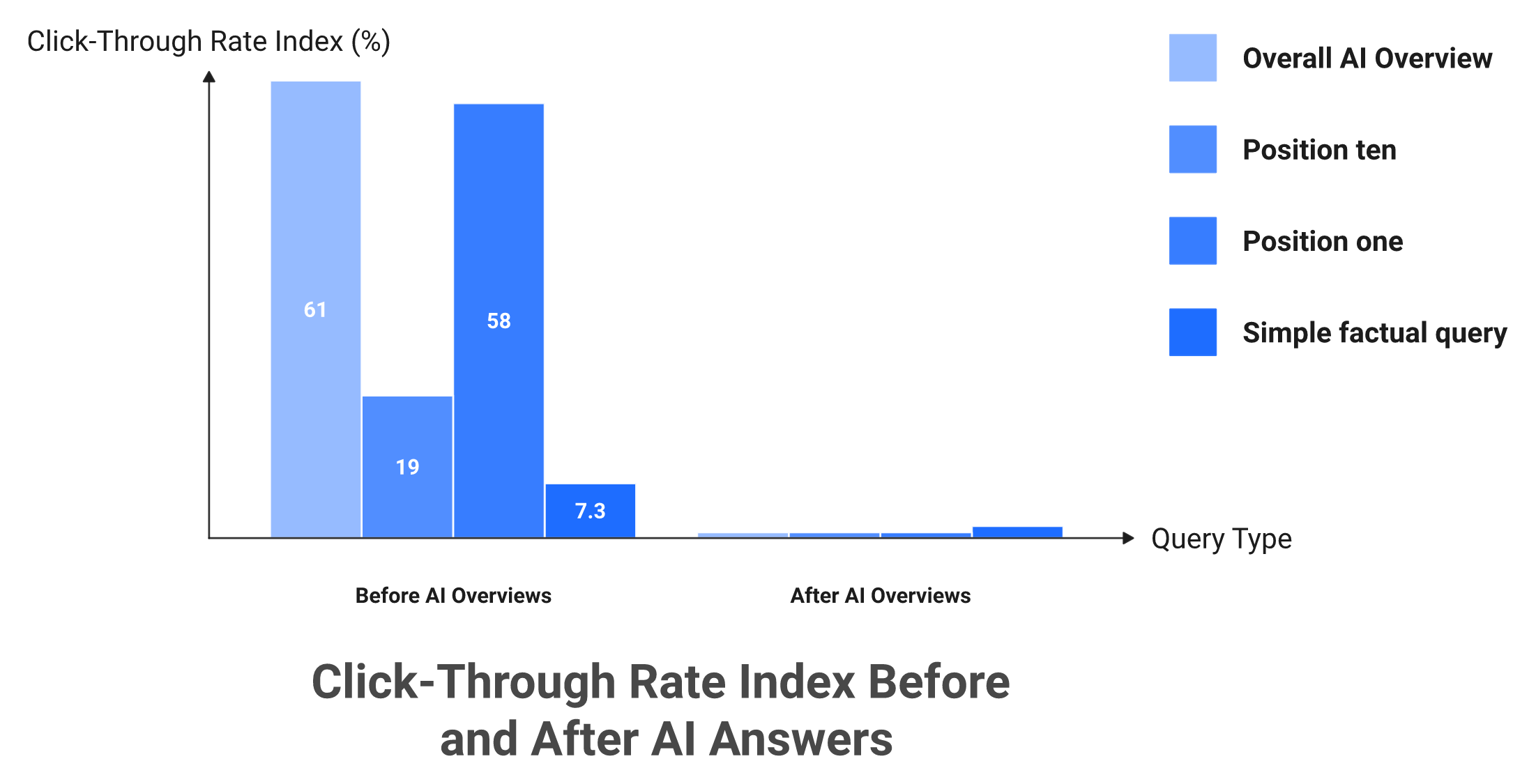
Ranking and citation are different selection problems. Google's generative features run on core ranking plus retrieval-augmented generation with query fan-out, so engines shop for passages, not pages. Ahrefs found AI Overview CTR fell 61% overall, with position one down 58% and position ten down 19%. MaximusLabs AI measures citation share instead, because cited brands earn roughly 35% more clicks.
📈 The situation: your dashboard still looks fine
Rankings hold. Impressions hold. Nothing in a standard SEO report tells you that the answer above your listing already satisfied the buyer.
That is the quiet part. The reader gets the answer, and there is no reason to click through to read your article, which is the core of the difference between GEO and traditional SEO.
🔎 The complication: retrieval is a math gate, not a craft gate
Query fan-out breaks one prompt into several sub-queries. Each sub-query retrieves passages that clear a semantic similarity threshold, with Microsoft documenting a cosine gate above 0.7 for grounded retrieval.
Your page does not compete as a document there. It competes as a set of chunks, each one either close enough to the vector or not. You can see how the split happens using a query fan-out generator.
⚠️ Damage scales with how well you rank
Here is the part nobody frames as a mistake. The Ahrefs study of 300,000 keywords shows the CTR loss is worst exactly where you are strongest.
| Position | CTR change on AI Overview queries |
| 1 | Down 58% |
| 3 | Down 46% |
| 10 | Down 19% |
Your best rankings are your fastest-depreciating assets. Defending them is not a strategy; it is a slow write-down.
💰 Why the smaller channel carries the bigger number
AI referral volume is small next to Google. The conversion behaviour is not. Practitioner data points to roughly a 6x conversion difference between LLM traffic and Google search traffic, because the buyer arrives pre-sold.
MaximusLabs AI's read is that the standard advice gets this backwards. Agencies protect the rank because the rank is what the old report measures, though I hold that loosely, since the effect size varies a lot by category.
✅ The resolution: audit at passage level
Take your top 20 revenue pages. For each, run the target question through ChatGPT, Perplexity, and Gemini, and record whether you are cited, not where you rank.
Then re-baseline the forecast on citation share. It is a harder number to report and a more honest one, and it is exactly what our GEO metrics and KPIs framework tracks.
There is no page two in an AI answer. When a buyer asks for the best tool in your category, five to ten names appear, and everyone else is outside the evaluation set entirely.
MaximusLabs AI took Oliv AI to a 64% citation rate across AI platforms in six months, ahead of decade-old billion-dollar competitors sitting near 30%. The work was not ranking harder. It was rebuilding passages so retrieval could find them, as documented in the Oliv AI case study.
Q3. Which GEO Tactics Are Phantom Work That Google Says Does Nothing?
Google states four popular GEO tactics get no special treatment: llms.txt files (discovered, but treated as any other text file), content chunking (systems extract passages from multi-topic pages unaided), AI-specific keyword rewriting (synonyms are understood), and special schema or Markdown page versions. Other engines may use llms.txt, so test it. Just stop billing it as Google visibility work.
💸 The 50-page audit problem
Most technical AEO audits land as a PDF nobody implements. They are thorough, expensive, and mostly measure things that do not move citations.
I have watched this pattern for fifteen years and never once seen Core Web Vitals drive a traffic increase. Technical polish is a security blanket. AI engines want extractable evidence objects.
📋 Myth versus what Google actually published
| Sold as required | What Google's May 2026 guide says |
| llms.txt for AI discovery | Crawler may find it, treats it like any other text file, no preferred indexing path |
| Chunk content into micro-pages | Unnecessary, systems extract relevant passages from multi-topic pages |
| Rewrite copy for AI long-tail phrasing | Unnecessary, AI features already understand synonyms |
| Ship Markdown or AI-specific schema versions | Not required for inclusion in generative features |
| Buy mentions to seed AI answers | Inauthentic mention-seeking is unlikely to help, spam safeguards still apply |
⚖️ Where the evidence is genuinely split
Schema is the honest grey zone. SALT.agency concludes it is "a hygiene factor (at best) … not a differentiator". Surfer argues it "increases your odds significantly" by telling tools exactly what the content is.
Both are practitioner reads, not platform statements. MaximusLabs AI's data points toward hygiene rather than lift, though I might be reading our sample too strongly, because our clients ship schema markup and answer restructuring in the same sprint.
✅ What to fund instead this month
Redirect the phantom hours into three things that are documented to matter.
- Crawler access, meaning GPTbot, OAI-SearchBot, PerplexityBot, and Google-Extended unblocked in robots.txt.
- Server-side rendering for any content carrying a trust signal.
- Answer placement inside the first 30% of every priority page.
None of those need a new standard or a new file. They need an afternoon and someone with repository access, or a technical SEO and website audit that actually prioritises reachability.
⏰ The cost of the wrong sequence
Phantom work is not just neutral. It consumes the exact quarter you needed for reachability fixes, and model updates do not wait for your roadmap.
MaximusLabs AI's technical audit scope covers robots.txt configuration and JavaScript minimization, not speed-score theatre. The llms.txt question stays on the experiment list, never on the invoice as a Google visibility deliverable.
Q4. Is Keyword Stuffing Penalized by AI Engines, or Just Useless?
It measurably underperforms. Keyword stuffing scored roughly 10% worse than baseline in Perplexity.ai testing, a finding specific to Perplexity rather than universal. Google separately states its AI features understand synonyms, so keyword-variation rewriting adds nothing. MaximusLabs AI scores drafts on entity richness instead, checking whether the products, people, standards, and competitors an engine expects actually appear.
📉 The number, with its limits stated
The honest version of this stat matters more than the stat. Stuffing cost about 10% of baseline visibility in one engine's testing, and that is all the data supports.
Most listicles quote it as a universal law across ChatGPT, Gemini, and Claude. It is not. Scoping a finding correctly is itself a trust signal, and buyers who check sources notice.
🧪 What Princeton actually tested
The founding GEO paper from Princeton and IIT Delhi tested nine content tactics against a benchmark of diverse queries. Visibility rose up to 40%, but not from every tactic.
The winners were evidence-shaped: adding cited sources, statistics, and quotations. The losers were the ones that manipulated wording rather than adding information. Efficacy also varied by domain, which is why a borrowed checklist underperforms in your category.
✅ Entity coverage, in plain terms
An entity is a specific named thing: a product, a person, a standard, a company, or a document. Density counts words. Coverage counts things the engine already associates with your topic.
If you write about AI crawler access and never name GPTbot, OAI-SearchBot, PerplexityBot, or robots.txt, the passage reads as topical but not authoritative.
🎯 The Monday version of this fix
Take your top 20 revenue pages and run one pass each.
- List the ten entities a buyer would expect on that page, including two competitors you would rather not mention.
- Check which are missing, then add them inside real sentences, not a keyword block.
- Delete every phrase that exists only to repeat the target term.
- Confirm each claim has a named source, a year, and a number where one exists.
That is an hour per page, and it replaces a density target with something an engine can verify. An AI content optimizer can flag the gaps faster than a manual read.
⭐ Why the old habit is so hard to drop
Density was measurable, and measurable things feel safe. Entity coverage feels subjective until you score it consistently.
MaximusLabs AI scores every draft on factual density and entity richness across a 10-dimension scorecard, and anything below 70 out of 100 does not publish. The scorecard exists because "this reads well" was never a retrieval signal.
Q5. Where Must Your Answer Sit on the Page to Get Extracted?
In the first 30% of the page. Citation distribution analysis shows 44.2% of AI citations come from that opening block, so an answer buried under a 400-word context essay is invisible to retrieval. MaximusLabs AI writes every H2 to open with a 40 to 80 word standalone answer, then breaks the rest with H3s and tables, and states each claim in exactly one canonical place.
📍 Why long-form essays lose the citation
Most B2B articles warm up. Two paragraphs of context, a stat about market growth, then the actual answer at word 450.
Retrieval does not read that way. It pulls passages, and the passages it pulls skew heavily toward the top of the document. The snippet is the new rank, so a beautifully argued page can lose to a thinner one that answered in sentence one, which is why answer structure now outranks prose quality.
✅ What a nugget actually needs
An answer nugget is a short block written to survive extraction with zero surrounding context. Four rules make it work.
- 40 to 80 words, complete on its own, no setup sentence before it.
- No anaphora, meaning no "this", "that", or "as mentioned above" pointing at text the engine will not have.
- The subject named explicitly, so the block still makes sense with the H1 removed.
- One number or one named source inside it, because verifiable blocks get reused more often.
MaximusLabs AI treats the nugget as non-negotiable in every client H2, since it is the single most-extracted block on any page we publish.
⚠️ The advice that backfired
Standard guidance says repeat your answer in the intro, the body, and the FAQ. Exposure Ninja's CEO ran repeated first-party tests and found the opposite.
Duplicated answers confused generative engines about which text pattern to trust. In some tests, a section that had previously been cited was dropped entirely once a duplicate was added elsewhere on the page.
I hold that finding loosely, because it is agency testing rather than a platform statement. What surfaces in MaximusLabs AI's client audits points the same direction, though our sample is not large enough to call it settled.
🎯 One claim, one canonical home
The fix is boring and cheap. Every claim gets exactly one place on the page where it is stated in full.
Everywhere else, you reference it rather than restate it. Your FAQ answers questions the body does not cover, instead of paraphrasing the body in weaker words, a discipline covered in our content formatting guide for AI search.
| Structure choice | What it does to retrieval |
| Answer at word 450 | Sits outside the highest-citation zone |
| Answer in first 30% | Lands where 44.2% of citations come from |
| Same answer in three places | Risks pattern confusion and dropped citations |
| One canonical answer per claim | Gives the engine a single unambiguous target |
| Wall of text, no H3s | No clean passage boundaries to extract |
⏰ The 20-minute version
Open your five highest-value pages. Scroll to where the actual answer appears, and count the words above it.
If that number is over 150, move the answer up and push the context down. That single edit is the cheapest GEO fix available to most teams.
MaximusLabs AI structures every section around a five-part shape that begins with the nugget and ends with proof. The structure exists because retrieval happens at block level, and a block with no self-contained answer has nothing to offer an engine.
Q6. Why Do Unverifiable, Stale, or AI-Generated Pages Lose Citations?
Because engines cite verifiable evidence, not prose. Princeton found cite-sources, statistics, and quotation-style additions among the tactics lifting visibility up to 40%. Stale numbers get discounted and undated pages lose re-citation. Google stresses valuable, unique, non-commodity content and applies spam safeguards to generative features. MaximusLabs AI traces every published claim to a primary source for exactly this reason.
💸 The situation: 40 posts a month, zero citations
This is the most common intake conversation I have. The content calendar is full, the freelancer bench is deep, and the AI visibility number has not moved in two quarters.
The team assumes the problem is volume. It is almost never volume.
❌ The complication: consensus content has no information gain
Information gain means the amount a page adds beyond what already exists on the topic. Summarise the top ten results and your gain is zero, so an engine has no reason to prefer you over the sources you summarised.
AI-assisted drafting made that sameness the internet's default setting. Ethan Smith of Graphite presents correlation data showing human-written content ranks higher than AI-generated content, and argues the ecosystem cannot survive summaries of summaries.
I lived the earlier version of this. In 2007 I built scraped-content sites that worked beautifully until Google's quality filters landed, and every company doing it disappeared. The penalty for average has never been this severe.
✅ Evidence objects beat word count
The Princeton and IIT Delhi team tested nine tactics against a benchmark of queries. The ones that lifted visibility were evidence-shaped, not style-shaped.
- Cited sources, meaning outbound links to primary material.
- Statistics with real numbers attached to real datasets.
- Direct quotations from named people with stated credentials.
- Authoritative phrasing backed by something checkable.
MaximusLabs AI runs a research-first source hierarchy where academic papers, patents, and official documentation outrank blog citations, because "studies show" is the exact phrasing an engine has no reason to reuse. That hierarchy is the backbone of our trust-first content playbook.
⏰ Freshness is a citation signal, not a vanity badge
A 2023 statistic on a 2026 page is a reason to skip you. Engines discount stale numbers, and undated pages struggle to earn repeat citations.
Two habits fix most of it. Put a visible Last Updated date on the page, and date every statistic inline, as in "Ahrefs, February 2026" rather than "recent research". Scheduled GEO content refresh cycles are how that stays true at scale.
📊 Practitioner signal from the field
Agency operators are converging on the same conclusion in public. A widely-discussed r/SEO post from July 2026 documenting a B2B SaaS client's AI invisibility fix reported that structural and evidence changes, not volume increases, were what moved citations.
Separately, a three-month study of AI bot crawling behaviour on client sites, posted to r/SEO in April 2026, examined which page elements bots actually consume versus ignore. Both are practitioner reports, so treat them as directional rather than definitive.
🎯 What to do with next month's budget
Cut the post count in half. Spend the saved hours adding one original number, one named quote, and three dated primary sources to each remaining piece.
MaximusLabs AI's read is that most content operations are optimised for output when the constraint is evidence. Volume was the right answer in 2015, and it is the expensive answer now, which is why our content marketing scope is built around evidence objects rather than post counts.
Q7. Are You Accidentally Hiding Your Best Content From AI Crawlers?
Probably yes. Turn JavaScript off and reload a key page. Whatever disappears is likely invisible to AI retrieval, and asynchronously loaded reviews, spec tables, and filter-driven attributes are the usual casualties. MaximusLabs AI runs this test plus a robots.txt audit in week one of every engagement, because a blocked GPTbot or OAI-SearchBot keeps your strongest trust signals out of the answer entirely.
⚠️ The situation: a giant brand, invisible reviews
I audited a multi-billion-dollar retailer with genuinely world-class review volume. Thousands of verified reviews per product, the kind of social proof most brands would trade a quarter's budget for.
Then I turned JavaScript off in the browser and reloaded a product page.
❌ The complication: the trust signals vanished
The reviews were gone. So were the material specs and the closure details, all loaded asynchronously after the initial page render.
The brand's single strongest differentiator was invisible to any crawler that did not execute scripts. They were being summarised by engines that had never seen the proof.
Filter-driven attributes are the same trap. If "waterproof" only exists as a filter parameter and never as text in a heading or body sentence, it does not exist for retrieval.
🕐 Why speed decides inclusion
Grounding pipelines run on tight latency budgets. Microsoft documents its Web IQ grounding layer at 164ms p95 for the full pipeline, roughly 2.5x faster than the nearest alternative.
Pages that need seconds of script execution get cut from real-time generation. Not penalised, just skipped, which is worse because nothing shows up in a report. A technical GEO implementation pass is what surfaces those silent exclusions.
🚫 The blunter failure: blocking the bots
Some sites never get that far. A February 2026 r/marketing discussion cited data suggesting 27% of websites are accidentally blocking AI crawlers, mostly without anyone on the marketing team knowing.
Cloudflare's managed robots.txt has been flagged by practitioners in May 2026 for silently blocking GPTBot and ClaudeBot on sites that never chose to. Check the live file, not the version in your repository, or run an AI crawlability check against the production domain.
The practitioner debate on r/TechSEO is genuinely split on training bots versus search bots. One useful distinction from that thread: AI search crawlers like OAI-SearchBot return clickable citations, while pure training crawlers offer no referral path.
| Crawler | What it does | Blocking cost |
| GPTBot | OpenAI crawling and training | Reduced ChatGPT presence |
| OAI-SearchBot | Indexes for ChatGPT search | Direct loss of cited answers |
| PerplexityBot | Perplexity indexing | Loss of Perplexity citations |
| Google-Extended | Gemini and AI training | No effect on Google Search ranking |
✅ The 20-minute audit
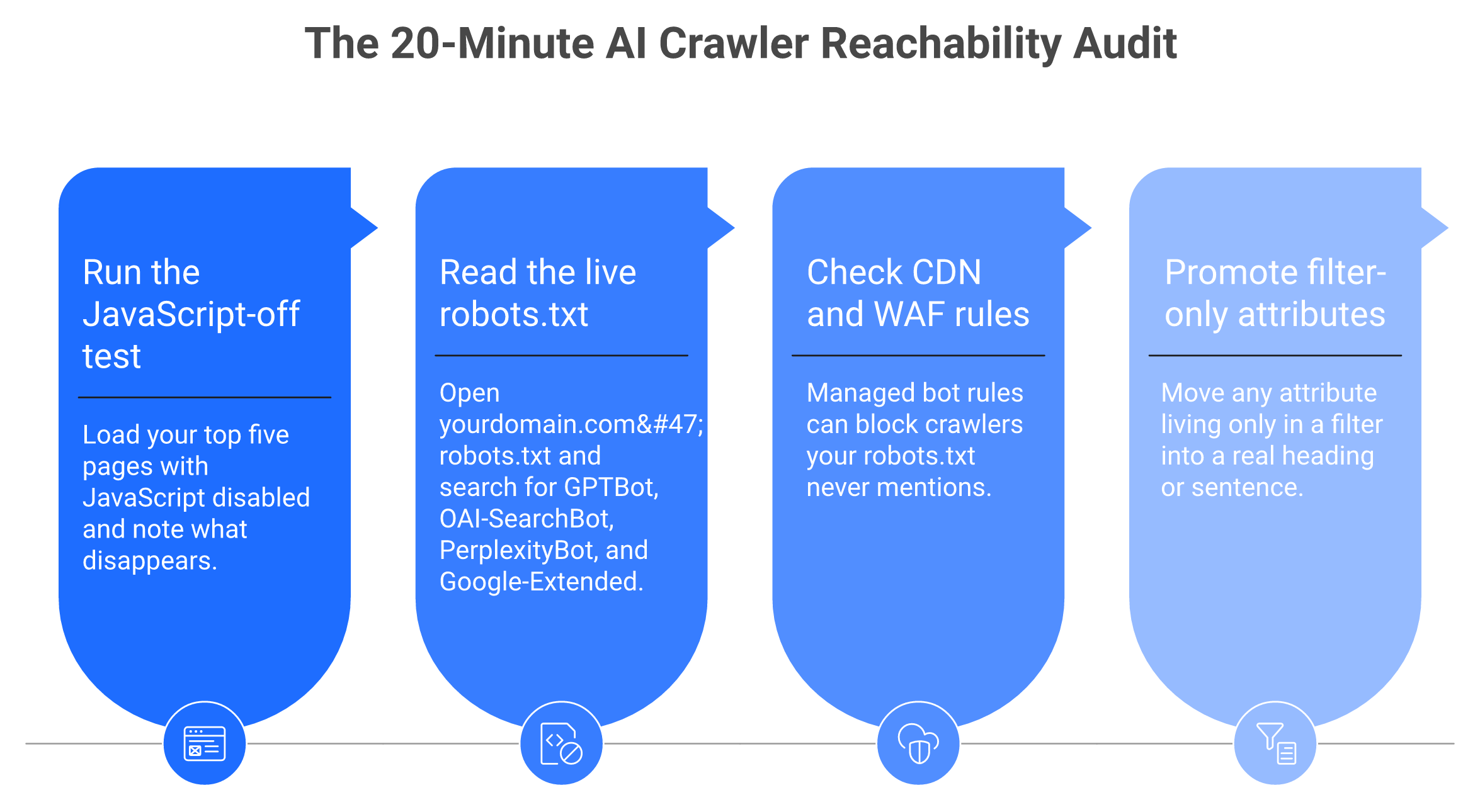
Four checks, no engineering ticket required to start.
- Load your top five pages with JavaScript disabled and note what disappears.
- Open yourdomain.com/robots.txt and search for GPTBot, OAI-SearchBot, PerplexityBot, and Google-Extended.
- Check whether your CDN or WAF adds bot rules your robots.txt does not show.
- Move any attribute living only in a filter into a real heading or sentence.
MaximusLabs AI's technical scope in week one covers robots.txt configuration and JavaScript minimization for trust-signal content. No content strategy survives a page the engine cannot reach, so we sequence reachability before writing.
Q8. Why Does Blog-Only GEO Fail While Earned Mentions Win?
Because engines weight web-wide consensus over self-published claims. Head-level questions are dominated by third-party citations from Reddit, YouTube, review platforms, and analyst pages, not your blog. MaximusLabs AI builds G2, Capterra, and Gartner Peer Insights profiles as standard scope, then closes the sameAs loop from website to Wikidata to LinkedIn to Crunchbase and back. Google warns that inauthentic mention-seeking will not help.
🔎 The situation: Perplexity invented our credentials
Perplexity summarised one of our articles and described the authors as Oxford researchers. None of us attended Oxford, unfortunately.
The engine was not reading our byline. It was hunting the wider web for mentions that would tell it who we were, and when it found gaps, it filled them by guessing.
❌ The complication: an open entity graph gets guessed at
An entity graph is the set of verified connections between your brand and other confirmed records about it. Leave it open and the model interpolates.
That is the honest mechanism behind most brand hallucinations. It is not malice, it is missing consensus data, and knowledge graph work is what closes it.
📊 Earned beats owned on the questions that matter
Ethan Smith's AEO framework splits this cleanly. Head questions like "best CRM" are decided almost entirely by citations from third parties, while long-tail feature questions are where your own content wins.
Reddit and YouTube now appear repeatedly as sources in single AI answers, and Reddit and Quora visibility in Google grew several times over within six months. A blog-only footprint simply has no surface area on the head questions where deals start, which is the case for forum and community AEO.
MaximusLabs AI maps the most-cited URLs per query across ChatGPT, Perplexity, Gemini, and Claude, because the target is the specific citing page, not the domain.
⭐ Review platforms are retrieval infrastructure
Practitioners are testing this directly. An October 2025 r/SaaS thread reported correlation data linking higher G2 review counts to increased AI visibility, and a follow-up discussion the same month asked whether teams were optimising G2 listings specifically for AEO rather than SEO.
A May 2026 discussion framed G2 and Capterra as silent nodes in AI search optimisation. These are practitioner observations, not controlled studies, so weigh them accordingly, and track the outcome with brand mention tracking rather than assumption.
✅ Closing the loop, step by step
The sameAs property in Schema.org markup lets you declare that your website and an external profile refer to the same entity. Traversal is the point.
- Add sameAs links from your site to LinkedIn, Crunchbase, G2, and Wikidata.
- Make each of those profiles link back to your primary domain.
- Keep founder name, company name, and category description identical across all of them.
- Build past 10 reviews on each major review platform, since thin profiles rarely get cited.
- Publish where your buyers already argue, meaning Reddit, Quora, and YouTube.
⚠️ Where this goes wrong
Google's May 2026 guidance states plainly that seeking inauthentic mentions to influence AI answers is unlikely to help, and that spam systems still apply to generative features.
That rules out purchased mention packages and astroturfed threads. Communities reject direct promotion anyway, so the working approach is authentic participation and genuine customer review requests.
MaximusLabs AI's read is that earned citation acquisition is the least glamorous line item and the one that moves head-term citations most. Owned content alone cannot manufacture consensus, because consensus is by definition something other people say about you.
Q9. Why Do Generic GEO Checklists Fail in Your Category?
Because retrieval behaviour is not universal. Princeton found GEO tactic efficacy varies materially by domain and called for domain-specific methods. Semrush clickstream data shows ChatGPT enabled web search on only about 34.5% of queries in February 2026, down from 46%. MaximusLabs AI runs prompt sets per client category across four engines, because what Perplexity rewards is not what ChatGPT rewards.
😐 The situation: you did the work and nothing moved
You added FAQ blocks. You shipped schema. You restructured the top of every page and waited a quarter.
The citation count barely moved. Most teams conclude GEO is hype at this point, and they are wrong for a specific reason.
⏰ The complication: most answers never crawl your site
Semrush analysed over a billion lines of US clickstream data from October 2024 to February 2026. Only about 34.5% of ChatGPT queries triggered a live web search by February 2026, down from roughly 46% in late 2024.
The rest ran on model memory and brand consensus. Your Tuesday publish cannot influence an answer that never fetched a page.
That makes publish-to-citation lag structural, not a sign of bad execution. It also explains why off-site presence outperforms on-site polish for head-level questions, a pattern documented in our citation pattern research across ChatGPT, Perplexity, and Gemini.
🧪 Domain variance is in the founding research
The Princeton and IIT Delhi team tested nine tactics against GEO-bench and reported visibility lifts up to 40%. The finding everyone skips is the next one.
Efficacy varied across domains. A tactic that lifted legal content did not reliably lift ecommerce content, which is why the paper explicitly calls for domain-specific optimisation, and why verticalized GEO for AI SaaS looks different from the ecommerce version.
Every ranking listicle presents one universal checklist anyway. MaximusLabs AI's read is that the borrowed checklist is the mistake, not the individual tactics inside it.
📊 The tooling reality check
Practitioners are hitting the same wall publicly. A June 2026 r/SEO discussion argued that AI share of voice is broken as a standalone metric and proposed narrower measures instead.
A February 2026 review of more than 20 AI visibility tools noted that most track presence without explaining which prompts and sources produced it. Treat both as practitioner opinion, useful for direction, not proof, and compare against a structured review of GEO tools and platforms.
✅ The resolution: a three-by-three test
Stop scaling untested tactics. Run a controlled experiment instead.
- Pick three pages that carry real pipeline, not three convenient blog posts.
- Pick three tactics only, for example evidence objects, answer placement, and entity coverage.
- Build 30 to 50 question variants per page, using your existing keyword list turned into questions.
- Record citation frequency per engine before the change, then again at 30 and 60 days.
- Scale only the tactic that moved your vertical.
There is no query-volume truth set for AI questions yet. Converting high-volume keywords into natural questions is directionally accurate, and it is what most serious teams are doing while better data does not exist. A ChatGPT search query extractor shortens that step considerably.
MaximusLabs AI's AI Source Analysis maps the most-cited URLs per query across ChatGPT, Perplexity, Gemini, and Claude before any content plan is written. The mapping exists because the citation set for your category is the only checklist that matters.
Q10. Why Do Glossary Pages and TOFU Content Waste Your GEO Budget?
Because the model already knows the definition and the reader has no reason to click through to yours. Position-one CTR on simple factual queries fell from 7.3% to 1.6% under AI Overviews. Definition content is the most commoditized, least revenue-linked asset you can fund. MaximusLabs AI opens engagements with BOFU pages instead, meaning comparison, pricing, and implementation content tied to ICP pain.
💸 The situation: the 200-term glossary on the roadmap
Someone always proposes it. Two hundred definitions, one per week, building topical authority for the category.
It looks like a plan because it has a spreadsheet. It is really a coverage strategy in a market that stopped paying for coverage.
❌ The complication: definition queries no longer produce clicks
I would spend no time at all on glossary definitions. When someone asks what a term means, the intent is knowing, not buying, and the engine now answers that in place.
Ahrefs measured the damage across 300,000 keywords. On simple factual queries, position-one CTR collapsed from 7.3% to 1.6%, so even winning the query returns almost nothing. That collapse is the core of the AI search click-through rate problem.
The r/SEO consensus in April 2026 ran the same way, with practitioners reporting that AI answers are eating top-of-funnel clicks while generic content struggles.
📈 Concentration beats coverage
Traffic distribution has always been brutally uneven. In most site audits I have run, roughly 19 of 20 landing pages carry about 85% of total traffic.
Adding 200 thin pages does not change that curve. It adds maintenance cost, dilutes internal linking, and produces content the model can already generate without you.
⚖️ Where the budget should sit
| Approach | What gets funded | What it produces |
| Traditional agency calendar | Volume, glossary, TOFU explainers | Impressions, pageviews, thin AI citations |
| MaximusLabs AI sequencing | BOFU comparison, pricing, implementation pages | Citations on queries where products get named |
That table is a real difference in sequencing, not a claim about quality. Plenty of traditional agencies execute their model well. It was built for a Google-only world where TOFU traffic eventually converted downstream, which is the distinction our revenue-focused GEO framework is built on.
✅ How to filter your question list
Ethan Smith's framing is the cleanest test I have found. Filter your question research to queries where a product can actually be named in the answer.
- Keep: "best X for Y", "X vs Z", "X pricing", "how to implement X".
- Cut: pure definition queries where no product appears in the AI answer.
- Keep: comparison questions about competitors they have not answered themselves.
- Cut: broad awareness topics with no path to a clickable product.
If the AI answer for a query contains zero product mentions, being cited there earns you nothing. That is the whole filter, and it is the starting point for serious AEO keyword and question research.
⭐ What I am still unsure about
MaximusLabs AI's data points toward BOFU-first for nearly every SaaS client we take on. I might be over-applying it, because a few categories with genuinely novel concepts may still need definitional groundwork to establish the entity.
MaximusLabs AI skips TOFU by design and ships BOFU articles first, since AI engines already answer "what is X" without anyone's glossary. Founder money is finite, and it should sit where buyers make decisions.
Q11. Are You Measuring GEO With the Wrong Scoreboard?
If your GEO report shows rankings and sessions, you are measuring the old game. MaximusLabs AI tracks four numbers instead: share of voice across thousands of question variants, citation frequency per engine, sentiment of mentions, and pipeline influenced. There is no single rank inside an AI answer, only how often you appear, on which engines, and with what framing.
📊 The four-metric replacement scoreboard
Share of voice means the percentage of your tracked question variants where your brand appears in the answer. It replaces rank because rank does not exist here.
| Metric | What it answers | Old-world equivalent |
| Share of voice | How often do we appear at all | Average position |
| Citation frequency by engine | Which engines actually cite us | Rank by search engine |
| Sentiment of mention | Are we named as leader or afterthought | None, this is new |
| Pipeline influenced | Did any of it produce revenue | Sessions and conversions |
MaximusLabs AI runs these across ChatGPT, Perplexity, Gemini, and Claude, because a brand can hold 60% share on one engine and near zero on another. Our GEO measurement approach reports each engine separately for that reason.
🔧 Fix your attribution before your dashboard
Most AI referral traffic lands in Direct and disappears. Semrush recorded 206% year-over-year growth in ChatGPT referrals comparing January 2025 to January 2026, with roughly 170,000 referred domains by February 2026.
Build a named AI channel group in GA4 covering chatgpt.com, perplexity.ai, gemini.google.com, and copilot.microsoft.com. Do it before you promise anyone a number, because you cannot report a channel you are not capturing.
💰 Why citation share is a revenue indicator
Cited brands earn roughly 35% more organic clicks than uncited top-10 peers. That makes citation share a leading indicator, not a vanity metric, and the basis for honest GEO revenue attribution.
The conversion side is stronger still. Practitioner data points to roughly a 6x conversion difference between LLM traffic and Google search traffic, because the buyer arrives already recommended.
I would treat that multiple as a range rather than a constant. It varies hard by category, and the sample sizes behind most published versions are small.
⚠️ Where share of voice breaks down
A June 2026 r/SEO thread made a fair criticism: share of voice alone is a hollow number if it is not tied to prompts that matter commercially. Tracking 5,000 irrelevant question variants produces a beautiful chart and no pipeline.
The fix is prompt selection, not metric replacement. Track the questions your ICP actually asks before a purchase, then weight by deal value, which is exactly how the B2B SaaS buyer journey in AI search should be instrumented.
✅ The Monday reporting template
Five lines a VP can take to a board without translation.
- Share of voice this month versus last, by engine.
- Top 10 questions where a competitor is cited and you are not.
- Sentiment split, meaning recommended, mentioned, or absent.
- AI-sourced sessions from the GA4 channel group.
- Opportunities and pipeline touched by AI-sourced visits.
MaximusLabs AI's read is that most GEO reporting still exists to look good in a dashboard. Clicks and impressions were always vanity metrics, and AI search just made that harder to hide.
Q12. What Should You Fix First, and What Can Wait?
Fix reachability first, placement second, evidence third, consensus fourth. Week one: unblock AI crawlers and run the JavaScript-off test. Week two: move answers into the first 30% of every priority page. Week three: add first-party data, named authors, and dated sources. Week four: close the sameAs loop and rebuild review profiles. MaximusLabs AI ships the first article live by day four using this order.
🎯 The ordering logic in one line
Unreachable beats unreadable beats unremarkable. A page the crawler cannot fetch scores zero regardless of how good the writing is.
That is why evidence work sits in week three, not week one. Great content behind a blocked bot is a rounding error, so start with managing AI crawlers like GPTBot and Google-Extended.
📅 The 30-day sequence
| Week | Fix | Errors addressed | Owner | Effort |
| 1 | Unblock GPTBot, OAI-SearchBot, PerplexityBot, Google-Extended | 12 | Dev | 1 hour |
| 1 | JavaScript-off test, move trust signals to server-rendered HTML | 13 | Dev | 1 to 2 weeks |
| 2 | Answer nuggets in first 30% of top 20 pages | 6, 7 | Content | 1 hour per page |
| 2 | De-duplicate repeated answers to one canonical location | 7 | Content | Half day |
| 3 | Add stats, named quotes, dated primary sources | 8, 9 | Content | 2 hours per page |
| 3 | Author bios with credentials, visible Last Updated dates | 10 | Content | 1 day |
| 4 | sameAs loop across LinkedIn, Crunchbase, G2, Wikidata | 14 | Marketing | 1 day |
| 4 | Review generation on G2 and Capterra, past 10 each | 11 | CS | Ongoing |
| Never | llms.txt, chunking, AI rewrites, schema variants as deliverables | 15 | Nobody | Zero |
Reassign strategy errors 1 through 5 to the next planning cycle. They cost budget decisions, not sprint hours, and they belong in a GEO strategy framework review rather than a sprint board.
⏰ Speed is the actual constraint
I have watched teams scope a robots.txt change into a nine-month engineering roadmap. The fix itself takes twenty minutes.
MaximusLabs AI keeps an in-house Webflow team specifically to bypass that queue, because a technical fix that lands after the next model update was never a fix. It was a ticket.
🔮 What comes after this list
Google's May 2026 guide added a section on agentic experiences, referencing emerging standards including the Universal Commerce Protocol and WebMCP. Agents will take actions directly from search results rather than sending a visitor to your page, a shift mapped in our agentic web stack report.
Nobody knows how big that gets or how fast. My working hypothesis is that the same reachability and evidence work compounds there too, since an agent needs structured, fetchable facts even more than a chatbot does.
The version that worries me is the ghost kitchen outcome. Your content feeds the answer, the agent completes the transaction elsewhere, and you never see the buyer, which is why agentic commerce readiness is already on the roadmap for our e-commerce clients.
MaximusLabs AI runs the technical audit, plan, and keyword approval inside the first seven days, with the first article live by day four. That pace exists because the ordering above only helps if it actually ships.
Which part of this sequence is stuck in your organisation right now, the crawler access or the content restructure? Those two fail for completely different reasons, and the fix depends on which one you are facing.
Frequently asked questions
What are the most common GEO mistakes brands should avoid in 2026?
Most GEO mistakes are inherited SEO habits applied to a system that does not work like Google. They fall into three tiers, and the tier decides the fix order. Strategy errors: treating GEO as SEO with extra steps, defending rankings instead of citations, funding glossary and TOFU pages, reporting sessions, and copying a domain-blind checklist. Execution errors: burying the answer, wall-of-text pages with no hierarchy, missing statistics and sources, stale undated numbers, unedited AI copy, blog-only distribution, blocked crawlers, JavaScript-hidden content, and an open entity graph. Phantom errors: tactics Google states receive no special treatment, including llms.txt, manual content chunking, AI-specific keyword rewriting, and separate Markdown or schema page versions. The ordering matters more than the list. Strategy errors cost nothing to fix and change what you fund next quarter. Execution errors cost engineering hours, so they need sequencing. Phantom errors cost nothing to stop doing, which makes them the fastest saving available this month. MaximusLabs AI catches strategy errors during intent research and execution errors during pre-publish QA, and we apply the same tiering inside every GEO strategy framework engagement, because a well-written page behind a blocked crawler earns nothing.
Why does ranking number one on Google no longer get you cited by AI engines?
Ranking and citation are different selection problems. Google's generative features sit on top of core ranking and use retrieval-augmented generation with query fan-out, which means the engine breaks one prompt into sub-queries and retrieves passages that clear a semantic similarity threshold. Your page does not compete as a document in that process. It competes as a set of chunks, each either close enough to the query vector or not. The commercial damage scales with how well you rank. Ahrefs measured 300,000 keywords and found AI Overview CTR fell 61% overall, with position one down 58% and position ten down only 19%. Your strongest rankings are your fastest-depreciating assets. There is no page two inside an AI answer, so five to ten brands appear and everyone else is outside the evaluation set. Cited brands earn roughly 35% more organic clicks than uncited top-ten peers. AI referral volume is smaller, but the buyer arrives pre-sold, which changes conversion behaviour sharply. MaximusLabs AI took Oliv AI to a 64% citation rate across AI platforms in six months, ahead of decade-old competitors sitting near 30%, and the full case study shows the work was passage rebuilding, not ranking harder.
Is llms.txt actually required for AI search visibility, or is it phantom work?
Google's May 2026 guidance is explicit on this. Its crawler may discover an llms.txt file, but it treats it like any other text file, and there is no preferred indexing path attached to it. Three other widely sold tactics carry the same verdict. Content chunking into micro-pages: unnecessary, because systems already extract relevant passages from multi-topic pages. Rewriting copy for AI-specific phrasing: unnecessary, because generative features already understand synonyms. Shipping Markdown or AI-specific schema versions: not required for inclusion in generative features. That does not make llms.txt worthless everywhere. Other engines may treat it differently, so it belongs on an experiment list. It does not belong on an invoice as a Google visibility deliverable. Schema is the honest grey zone. Practitioner reads are genuinely split between hygiene factor and meaningful lift, and neither position is a platform statement. MaximusLabs AI keeps llms.txt in testing rather than in scope, and we redirect those hours into crawler access, server-side rendering, and answer placement, which are the three fixes documented to move citations.
How do I check whether AI crawlers can actually see my best content?
Run two checks, and both take under twenty minutes. Neither needs an engineering ticket to start. First, the JavaScript-off test. Disable JavaScript in your browser and reload your five highest-value pages. Whatever disappears is likely invisible to AI retrieval, and the usual casualties are asynchronously loaded reviews, spec tables, and filter-driven product attributes. We audited a multi-billion-dollar retailer with world-class review volume. With scripts disabled, the reviews, material specs, and closure details all vanished, so engines were summarising the brand without ever seeing its strongest proof. Second, the robots.txt audit. Open yourdomain.com/robots.txt on the live domain, not the version in your repository. Search for GPTBot, OAI-SearchBot, PerplexityBot, and Google-Extended. Check whether your CDN or WAF adds managed bot rules your file does not show. Move any attribute that exists only as a filter parameter into a real heading or sentence. MaximusLabs AI runs both checks inside week one of every engagement as part of our technical audit , because no content strategy survives a page the engine cannot reach.
Should we still build glossary pages and TOFU content for AI search?
Generally no, and the numbers are blunt about why. Ahrefs found position-one CTR on simple factual queries collapsed from 7.3% to 1.6% under AI Overviews, so even winning a definition query returns almost nothing. The model already knows the definition. The reader has no reason to click through to yours. Definition content is the most commoditized, most zero-clicked, least revenue-linked asset a content budget can fund. Traffic concentration makes it worse. In most audits, roughly 19 of 20 landing pages carry about 85% of total traffic, so adding 200 thin glossary pages does not change the curve. It adds maintenance cost and dilutes internal linking. A cleaner filter for question research is this: keep only queries where a product can actually be named in the AI answer. Keep: best X for Y, X versus Z, X pricing, and how to implement X. Cut: pure definition queries where no product appears in the generated answer. MaximusLabs AI opens engagements with BOFU comparison, pricing, and implementation pages tied to ICP pain, an approach we document in the revenue-focused GEO framework . Founder money is finite and belongs where buyers decide.
What metrics should replace rankings and sessions in a GEO report?
There is no single rank inside an AI answer, only how often you appear, on which engines, and with what framing. Four metrics replace the old scoreboard. Share of voice: the percentage of tracked question variants where your brand appears in the generated answer. Citation frequency by engine: reported separately, because a brand can hold strong share on one engine and near zero on another. Sentiment of mention: whether you are named as the recommendation, a passing option, or absent. Pipeline influenced: the only number a board actually asks about. Fix attribution before the dashboard. Most AI referral traffic lands in Direct and disappears, so build a named AI channel group in GA4 covering chatgpt.com, perplexity.ai, gemini.google.com, and copilot.microsoft.com. Share of voice does have a real weakness. Tracking thousands of commercially irrelevant question variants produces a beautiful chart and no pipeline, so prompt selection matters more than the metric itself. MaximusLabs AI tracks these across ChatGPT, Perplexity, Gemini, and Claude using the approach in our GEO measurement guide , and we weight prompts by deal value rather than volume.
Why do earned mentions on Reddit and G2 beat your own blog in AI answers?
Because engines weight web-wide consensus over self-published claims. Head-level questions like best CRM are decided almost entirely by third-party citations from Reddit, YouTube, review platforms, and analyst pages. Your own content wins the long-tail feature questions, not the category ones. Perplexity once summarised one of our articles and described the authors as Oxford researchers. None of us attended Oxford. The engine was hunting the wider web for mentions to establish who we were, and it filled the gaps by guessing. That is the honest mechanism behind most brand hallucinations. An open entity graph gets interpolated rather than verified. Closing it is a checklist, not a campaign. Add sameAs links from your site to LinkedIn, Crunchbase, G2, and Wikidata, and make each profile link back. Keep founder name, company name, and category description identical everywhere. Build past 10 reviews on each major review platform, since thin profiles rarely get cited. Google warns that seeking inauthentic mentions will not help, so purchased packages are out. MaximusLabs AI treats review platforms as retrieval infrastructure inside earned citation acquisition , not as an upsell.