 Krishna Kaanth M
- Ranking and citation are now separate outcomes. A page can hold position one and still never appear inside the AI Overview above it.
- Google requires only indexing and snippet eligibility. Four silent blockers disqualify pages: robots.txt disallow, nosnippet or noindex, canonical conflict, and JavaScript-only rendering.
- Princeton GEO research measured 30% to 40% visibility lift from citing sources, adding attributed quotes, and adding sourced statistics. Keyword stuffing produced nothing.
- Place a self-contained 40 to 80 word answer under every question-shaped H2, since 44.2% of AI citations come from the first 30% of a page.
- Roughly 62% of appearances are ghost citations where the link shows but the brand is never named. Embed the brand inside the claim sentence.
- AI Overviews average 9.2 sources, so most seats are third-party. Measure with a 40 to 60 prompt set scored as cited, mentioned, both, or neither.
Q1. Why is getting cited in AI Overviews a different job from ranking #1?
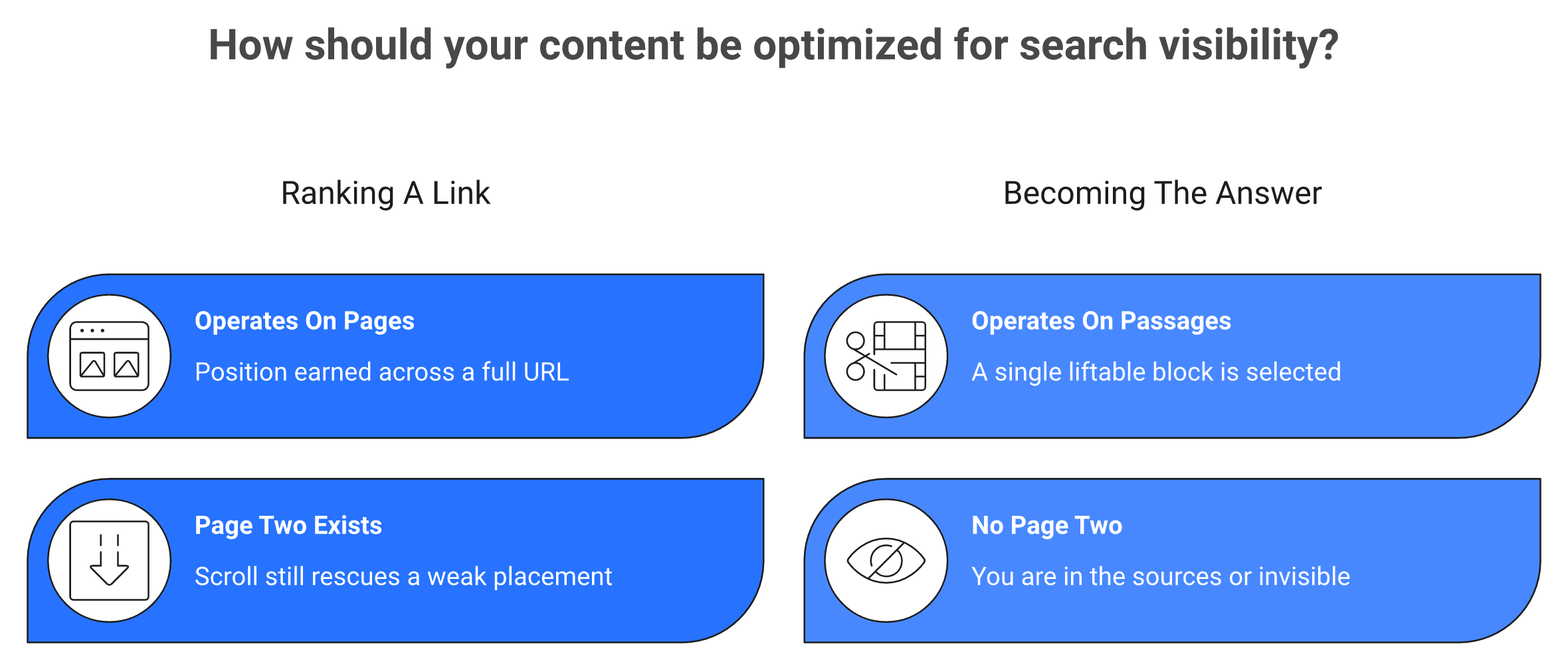
Ranking and citation are now separate outcomes. A page must be indexed and snippet-eligible to qualify, but selection happens through retrieval and synthesis, not position. After Gemini 3 became the AI Overviews default model on January 27, 2026, reliance on top-10 organic results collapsed sharply. The job shifted from ranking a link to becoming the answer an engine quotes.
⚠️ The seat you won is not the seat you need
Rank one is a position on a page. A citation is a slot inside a generated answer. Those two things used to move together, and through 2025 most teams could treat them as one number.
They came apart fast. MaximusLabs AI runs a prompt-set audit before any rank report, mapping which domains actually get quoted for a client's buying questions across Google AI Overviews, ChatGPT, Perplexity, and Gemini. What we keep finding is a roster that only partly overlaps with page one, which is why our generative engine optimization work starts there.
📊 What January 27, 2026 actually changed
Google made Gemini 3 the default model behind AI Overviews worldwide on that date. This was a model swap, not a ranking update, so most SEO dashboards showed nothing unusual.
The citation roster moved anyway. One February 2026 analysis found roughly 42% of previously cited domains dropped out of AI Overviews after the switch, while the average number of sources per answer rose by about 32%. More seats at the table, and four in ten of the old guests uninvited, a shift covered in depth in our breakdown of Gemini's impact on AI search.
🔍 Retrieval is not ranking
Here is the mechanic underneath. AI Overviews break your query into sub-queries, retrieve passages for each one, then synthesize an answer with links to what informed it. Retrieval operates on passages. Ranking operates on pages.
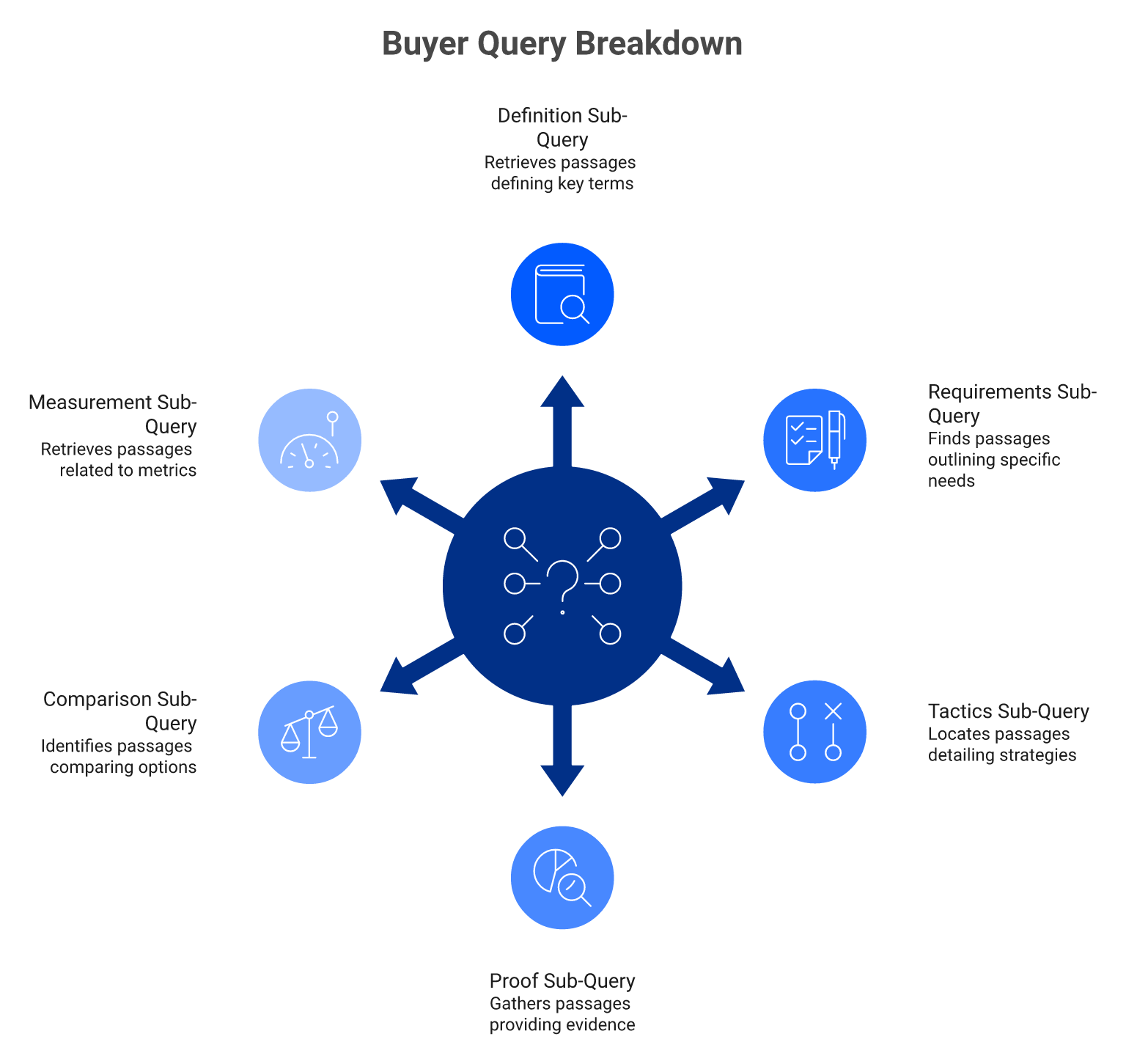
That distinction is the whole ballgame. Gemini 3 reportedly weighs heading hierarchy, structured answer blocks, specific data points, and cross-web brand mentions when selecting what to quote. A page can satisfy every classic ranking factor and still offer no clean passage to lift, a gap we map in our comparison of GEO and traditional SEO.
✅ Two line items, not one
Krishna's position, and I hold it firmly, is that this is a data science problem wearing an SEO costume. You are not tuning a page for a crawler. You are trying to clear a retrieval threshold inside a model you cannot see.
There is no page two in an AI answer. Either your brand is in the five to ten sources the engine surfaces, or the buyer never learns you exist. MaximusLabs AI plans citation work and ranking work as separate line items with separate metrics, because a single organic number now hides two very different failures.
MaximusLabs AI treats AI Overview citation as a retrieval problem, which is why every engagement opens with a prompt-set audit of who is currently being quoted rather than a rank report. Ranking tells you where your link sits. The audit tells you whether the answer above it has ever heard of you.
Q2. What does Google actually require for AI Overview eligibility, and what is myth?
Google requires only that a page be indexed and eligible to appear in Search with a snippet. There are no additional technical requirements for AI Overviews. Four silent blockers disqualify pages anyway: a robots.txt disallow, a noindex or nosnippet directive, a conflicting canonical, or content that never renders as text. Everything past that floor is correlation, including llms.txt, which Google has never documented as a signal.
✅ The documented floor, in Google's own words
Google's guidance is blunt: "there's nothing special you need to do, and no additional requirements, to appear in AI Overviews or AI Mode". You do not need AI-only text files. You do not need special schema.
The fundamentals it does name are ordinary. Crawlable robots.txt, internal links for discovery, core content delivered as text, structured data that matches visible content, and genuine E-E-A-T sourcing.
⚠️ Four blockers that disqualify pages quietly
Eligibility is a gate, and the gate fails silently. MaximusLabs AI runs this four-check pass in week one of every engagement, before a single word gets rewritten, because a rewrite cannot rescue a page the system will not consider. It is the first step in every technical SEO and website audit we scope.
| Check | What kills eligibility | How to test it |
| Crawl access | Googlebot disallowed in robots.txt or blocked at the CDN | Fetch as Googlebot, review CDN rules |
| Snippet directives | nosnippet, data-nosnippet, or noindex on the page | Grep the rendered head and body |
| Canonical conflict | Canonical points elsewhere, so your URL is not the indexed one | URL Inspection, compare declared and Google-selected canonical |
| Rendering | Core content only appears after JavaScript executes | Compare raw HTML against rendered HTML |
The nosnippet case is the cruel one. It strips your ordinary search snippet too, so a legal or brand team that applied it in 2024 removed you from AI Overviews without anyone filing a ticket.
❌ Three claims Google has never made
Being honest about the unproven is worth more than another confident checklist. Google has published no requirement or recommendation for llms.txt as an AI Overviews signal. Treat it as an experiment, not a fix, and read our full assessment of what llms.txt does and does not do.
FAQ rich results were retired on May 7, 2026, so building FAQ blocks to win a rich result is chasing a feature that no longer displays. Write FAQs because they map to fan-out sub-queries, which is a different and still valid reason.
💰 The page speed argument, honestly
Krishna's line here annoys people: in fifteen years he has never watched Core Web Vitals produce a traffic increase. I would hedge it slightly. Speed matters for users, and Google names crawlability, not milliseconds, in its AI features guidance.
MaximusLabs AI's read is that the standard advice inverts the order. Teams spend a quarter shaving 400ms while a stale staging directive keeps forty pages out of the index entirely.
MaximusLabs AI configures robots.txt so AI crawlers stay unblocked and clears the four eligibility checks inside the first week, because the cheapest citation win is usually a directive somebody forgot to remove.
Q3. Which optimization tactics actually move citations, ranked by measured lift?
Three tactics carry the measured lift. In the Princeton GEO study (KDD 2024, roughly 10,000 queries across nine datasets), Cite Sources, Quotation Addition, and Statistics Addition each raised Position-Adjusted Word Count by 30% to 40%. Keyword stuffing produced no gain. MaximusLabs AI sequences rewrites in that order, cite, quote, quantify, before touching anything else.
⭐ The three that actually won
The GEO paper from Princeton, IIT Delhi, and Georgia Tech tested nine optimization methods against a benchmark of about 10,000 queries. Overall visibility gains reached 40%.
The winners were unglamorous. Adding credible citations, adding attributed direct quotes, and adding sourced statistics each delivered the top-tier lift, with Subjective Impression rising 15% to 30%.
| Tactic | Measured lift | How to verify you did it |
| Cite Sources | +30% to 40% Position-Adjusted Word Count | Count sourced claims per 1,000 words |
| Quotation Addition | +30% to 40% PAWC | Count attributed direct quotes per section |
| Statistics Addition | +30% to 40% PAWC | Count dated, sourced numbers per section |
| Keyword stuffing | No measurable gain | Not applicable, stop doing it |
❌ Why the ten-step lists fail you
Every competing playbook lists roughly the same ten steps with no weighting. That is comfortable to read and useless to schedule. A marketing manager with twelve hours a month needs to know which two things to do.
Krishna puts it sharply, and the data backs him: most SEO work is true but carries zero impact. MaximusLabs AI measures tactic priority by published effect size first, then by client-side citation movement, rather than by how complete an audit document looks. That prioritization logic sits at the centre of our GEO strategy framework.
📊 Domain variance is the real caveat
The paper is explicit that efficacy varies by domain. Statistics Addition performed strongly in some verticals and weakly in others.
So import the method, not the result. Run one cohort of pages with the cite-quote-quantify rewrite, hold a matched cohort unchanged, and re-score both against the same prompt set monthly.
✅ What the sequence produced in practice
In MaximusLabs AI's work with Oliv AI, that sequencing helped move the brand to a 64% citation rate across AI platforms in six months, against legacy competitors sitting near 30%. Those competitors were billion-dollar companies with ten-year head starts, and the full numbers sit in the Oliv AI case study.
I want to be careful about what that proves. It is one engagement, in one category, and share of voice is influenced by brand mentions we do not fully control. My read is that the sequencing accelerated something the product and positioning already earned.
MaximusLabs AI prioritizes by measured lift rather than checklist length, which is why cite, quote, and quantify come before schema, speed, or a redesign in every content plan we ship.
Q4. How should you structure a page so the model can extract it?
Place a self-contained 40 to 80 word answer directly under every question-shaped H2, then expand. Retrieval operates on passages, so each chunk must survive being stripped of context. Placement matters as much as phrasing, since 44.2% of AI citations come from the first 30% of the page. MaximusLabs AI makes the answer nugget mandatory in every H2 it publishes.
⭐ Write blocks that survive amputation
Assume every block gets lifted alone, with no title, no byline, and nothing around it. If your answer starts with "this," "that approach," or "as mentioned above," it is already dead on extraction.
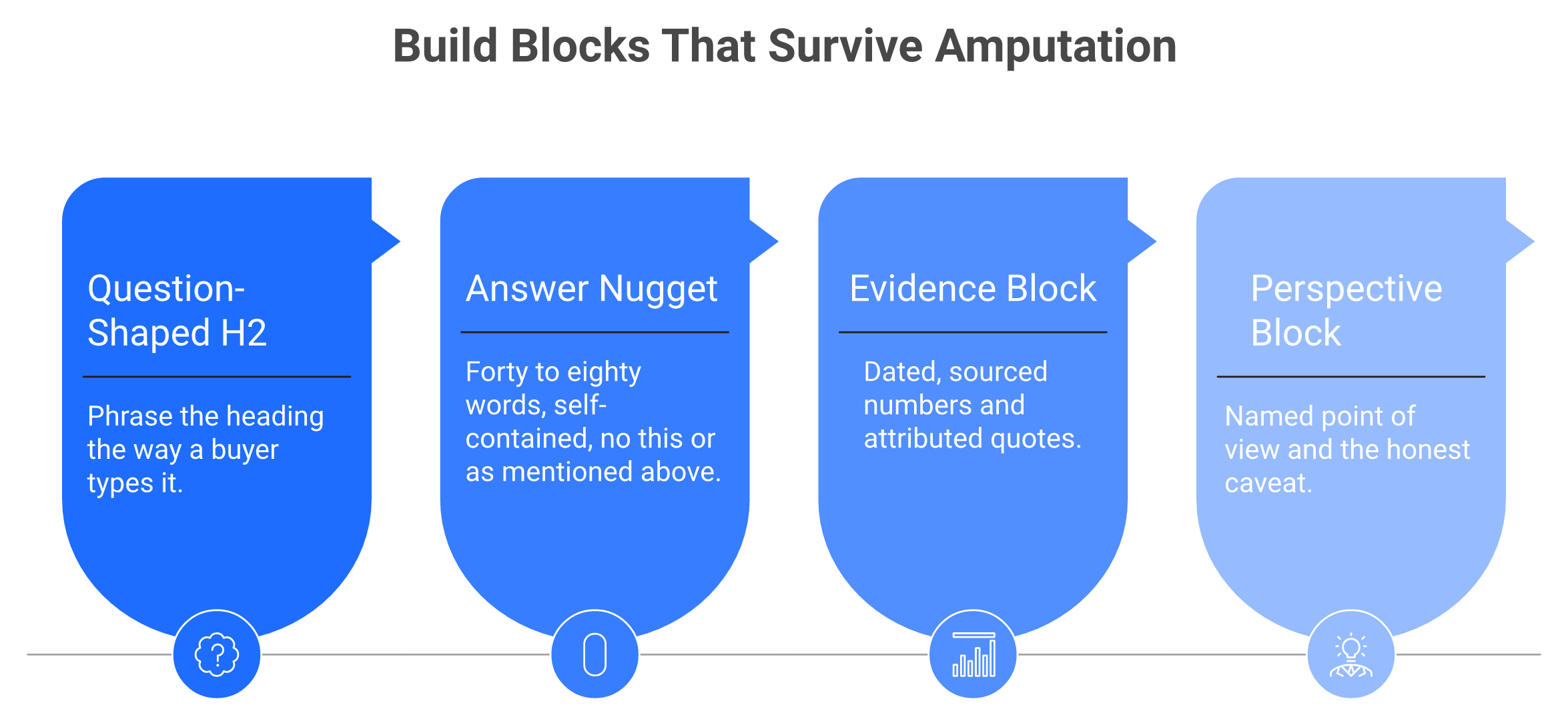
Google's own guidance says to place a clear, direct-answer paragraph near the top of the page for question and long-tail queries. Gemini 3 reportedly pulls inline answers from content positioned near matching headings. Forty to eighty words is the working range, long enough to be complete and short enough to quote whole.
📊 The ski-ramp problem
Citation distribution is heavily front-loaded. With 44.2% of AI citations coming from the first 30% of a page, your best material cannot sit at the bottom of a 3,000 word essay.
This kills the classic long build-up. MaximusLabs AI structures every H2 as answer first, then evidence, then perspective, which puts the quotable sentence inside the retrieval window instead of eleven paragraphs past it. The same rules govern our content formatting standards for AI search.
⚠️ The JavaScript attribute trap
Agents cannot click your filters. Product attributes buried behind a JavaScript facet, closure type, fabric, neck style, integration list, pricing tier, simply do not exist to a retrieval system.
Move them into text. A short section with those attributes as headings and plain sentences makes the data reachable. This is the single most common fix in MaximusLabs AI's technical GEO implementation passes on ecommerce and SaaS product pages, and it usually takes a developer under a day.
✅ Before and after, on one paragraph
Weak block: "Our platform helps teams improve their AI search visibility through a variety of proven methods and best practices."
Strong block: "MaximusLabs AI scores client visibility monthly across Google AI Overviews, ChatGPT, Perplexity, and Gemini, marking each prompt as cited, mentioned, both, or neither." The second one names an entity, states a method, and stands alone.
💡 Readability is an eligibility factor
Keep sentences under 22 words. Keep paragraphs to three sentences. Aim for Flesch 65 or above, because Perplexity in particular favors readable prose with visible sourcing.
Tables and ordered lists get parsed and cited more readily than prose. I would not over-index on that, but structured formats cost nothing and remove ambiguity.
MaximusLabs AI treats the 40 to 80 word answer nugget as non-negotiable in every section it ships, since a block that cannot stand alone will never be quoted, no matter how good the paragraph after it is.
Q5. How do query fan-out and featured snippets feed AI Overview citations?
Google decomposes one query into sub-queries, retrieves separately for each, then synthesizes. Pages answering the full fan-out compete for several slots instead of one. Featured snippets are the on-ramp, since analyses report the overwhelming majority of AI Overview sources already held a snippet, and People Also Ask appears on roughly 81% of AIO queries. Harvest the live AIO, PAA, and related searches into dedicated H3 answers.
⭐ One query becomes a dozen questions
Fan-out means Google splits your query into related sub-queries before answering. It retrieves passages for each one, then stitches them together.
So a search for "AI Overviews optimization" quietly becomes a dozen smaller asks. What is it. Does schema help. How do I measure it. Each sub-query pulls its own sources, which is why we run every target term through a query fan-out generator before outlining.
❌ Why single-keyword pages lose the math
A page built for one keyword can win one of those sub-slots. A page built for the whole fan-out can win five.
That is the entire structural disadvantage. MaximusLabs AI's read is that most content teams still plan at keyword level while the retrieval system has already moved to question level, and the gap shows up as thin citation counts.
The average AI chat prompt runs around 25 words, not three. Buyers type full sentences with context, budget, and constraints attached. Short head terms describe how people search Google, not how they talk to an engine, a distinction we unpack in our guide to AEO keyword and question research.
✅ Snippets are the cheapest on-ramp
Here is the resolution. Featured snippets and AI Overview citations overlap heavily, with one 2026 analysis finding that 99.5% of AI Overview sources held a featured snippet. Another study measured a 0.9 correlation between snippet decline and AIO growth.
That gives you a sequencing rule. Win the snippet first, because the same extractable passage feeds both surfaces. AIO SERPs also trigger 849% more featured snippets than non-AIO queries, so the opportunity density is higher exactly where you need it, and our citation optimization guide walks the full sequence.
| Step | What you do | Where to pull it from |
| 1 | Read the live AI Overview for your term | Note every sub-question it answers |
| 2 | Scrape the PAA box | Present on roughly 81% of AIO queries |
| 3 | Log related searches and autocomplete | Captures phrasing variants |
| 4 | Add sales call and support ticket questions | Real buyer language, not tool language |
| 5 | Assign each question one H3 with a standalone answer | 40 to 80 words, no context dependency |
💡 Harvest from humans, not just tools
MaximusLabs AI builds its question set from search data, recorded sales calls, support tickets, and Reddit threads before an outline exists. Keyword tools miss the questions buyers are slightly embarrassed to ask out loud.
Those are often the ones with no good answer online. I ran an agent against one client's outline last quarter, and it surfaced a pain point nobody on the team had listed, because it appeared in comments rather than in search volume.
⚠️ A caveat worth stating
Correlation between snippets and citations is not proof of causation. Both may simply reward the same clean, extractable passage structure.
MaximusLabs AI treats snippet ownership as a leading indicator rather than a guarantee, and tracks both separately so a snippet win that produces no citation gets flagged instead of celebrated.
MaximusLabs AI maps every phrasing an ICP might use before an outline is written, so the finished page answers the fan-out rather than a single keyword. That is the difference between competing for one retrieval slot and competing for six.
Q6. Does schema markup and entity structure actually help?
Schema does not create eligibility. Google requires only indexing and snippet eligibility, and requires structured data to match visible text. The industry is genuinely split: SALT.agency calls schema "a hygiene factor (at best), not a differentiator," while Surfer Academy argues it meaningfully improves odds. Treat schema as disambiguation infrastructure, Article, Organization, and Person with sameAs, and note FAQ rich results were retired on May 7, 2026.
⚠️ What Google actually documents
Google's AI features guidance names structured data as a fundamental, not a requirement. The instruction is narrow: use it where it fits, and make sure it matches what a human sees on the page.
Nothing in that documentation says schema improves your odds of being cited. It says schema helps Google understand the page. Those are different claims, and the industry blurs them constantly, which is why we keep our schema markup guidance deliberately conservative.
❌ The disagreement nobody resolves
SALT.agency's position is that schema is a hygiene factor at best, not a differentiator. Surfer Academy's position is that it significantly increases your odds by telling AI tools exactly what your content is.
Both camps are reading the same absent evidence. There is no published study isolating schema as a causal variable in AI Overview citation selection, which is why the argument keeps recycling.
My read sits closer to SALT. Schema removes ambiguity, and removing ambiguity helps at the margin. It does not manufacture authority you have not earned elsewhere.
✅ What schema is genuinely good at
The real job is identity. Retrieval systems need to know that the "MaximusLabs" on your homepage, your LinkedIn page, and your G2 profile are one entity.
MaximusLabs AI builds the sameAs loop first in technical engagements: website to Wikidata to LinkedIn to Crunchbase to G2 and back to website. Unambiguous identity is what stops the hallucinated attributions that show up in live AI answers, and it underpins our approach to citation consistency across AI search.
I have watched Perplexity summarize an article and credit the authors as Oxford researchers. None of them attended Oxford. The model filled an identity gap with a plausible guess, which is exactly what a closed sameAs loop prevents.
| Schema type | What it disambiguates | Priority |
| Organization with sameAs | Which company you are, across the web | High |
| Person with credentials | Who wrote this and why they qualify | High |
| Article with dateModified | Freshness and authorship | High |
| BreadcrumbList | Where the page sits in your topic structure | Medium |
| VideoObject | Makes video assets retrievable | Medium |
| FAQPage | Sub-question coverage, not rich results | Low |
💰 Where the FAQ myth costs you
FAQ rich results were retired on May 7, 2026. Building FAQ blocks to win a rich result is spending developer hours on a feature that no longer displays.
Keep writing FAQs anyway, for a different reason. They map cleanly onto fan-out sub-queries, and each one becomes a separately retrievable passage.
⏰ The honest sequencing
MaximusLabs AI runs schema after eligibility and content structure, never before, because markup on a page with no extractable answer just describes an empty room. Order matters more than coverage here.
MaximusLabs AI builds the sameAs loop first in every technical engagement, since unambiguous identity is what stops the hallucinated attributions we keep finding in live AI answers. Schema will not win you a citation. Missing identity will absolutely cost you one.
Q7. What E-E-A-T signals do AI Overviews use to pick sources?
AI Overviews favor pages carrying verifiable authorship and sourcing. Five elements do the work: a named byline with credentials and Person schema, first-hand experience such as original data or screenshots, every numerical claim externally sourced, a visible last-updated date, and consistent brand identity across Wikidata, LinkedIn, and G2. Anonymous, undated content is structurally disadvantaged regardless of formatting quality.
⭐ The five signals, in priority order
E-E-A-T stands for Experience, Expertise, Authoritativeness, and Trustworthiness, Google's framework for judging content quality. It is not a score you can check in a tool.
Reporting on Google's March 2026 core update indicates E-E-A-T became the dominant factor in AI Overview source selection. That reframes it from a rater guideline into an operational checklist, and our E-E-A-T optimization guide treats it exactly that way.
| Signal | What ships on the page | Effort |
| Named author with credentials | Byline, bio, Person schema, sameAs links | Low |
| First-hand experience | Original data, screenshots, tested results | High |
| Sourced claims | Footnote per number, named study and year | Medium |
| Freshness | Visible last-updated date, dated statistics | Low |
| Entity consistency | Same identity across Wikidata, LinkedIn, and G2 | Medium |
✅ Experience is the one nobody can fake
Three of those five are cheap. Bylines, dates, and citations take an afternoon.
Experience is different. It requires having actually run the thing you are describing, which is precisely why it separates sources. MaximusLabs AI treats original data as the highest-value asset in any content plan, because a number nobody else has is both the proof and the citation magnet.
The Princeton GEO research supports this indirectly. Adding sourced statistics and credible citations delivered 30% to 40% lifts in generative visibility, while surface-level tactics delivered nothing.
⚠️ Trust signals extend past your own site
Krishna's framing is that AI-generated content has flooded the internet, so trust signals are now the primary filter. Engines cannot verify claims, so they lean on who is making them.
That means your author's credentials need to exist somewhere Google can verify them. A LinkedIn profile, conference talks, published research, or a Crunchbase entry. An unverifiable expert reads as no expert, a pattern documented in our trust-first content playbook.
I would hedge this slightly. MaximusLabs AI's audits point strongly toward entity verification mattering, though isolating it from brand mention volume is genuinely difficult, and I might be crediting it more than the data strictly supports.
⏰ A 30-day sequencing plan
Week one: add bylines, credentials, Person schema, and last-updated dates across your top 25 pages. This is the cheapest trust lift available.
Week two and three: replace every vague claim with a dated, sourced number. Hunt for "many companies," "studies show," and "most teams" and kill each one.
Week four: close the identity loop and publish one piece of original data, even a small internal benchmark. MaximusLabs AI runs this exact order because the low-effort signals compound while the original research is still being produced.
💡 What this does not do
E-E-A-T will not rescue a page blocked by a nosnippet tag or buried in JavaScript. It operates after eligibility, not instead of it.
MaximusLabs AI engineers trust signals into every article rather than bolting them on afterward, because an engine staking its own credibility on a recommendation checks who stands behind the claim. That check is now the gate.
Q8. Why do brands get cited but never named?
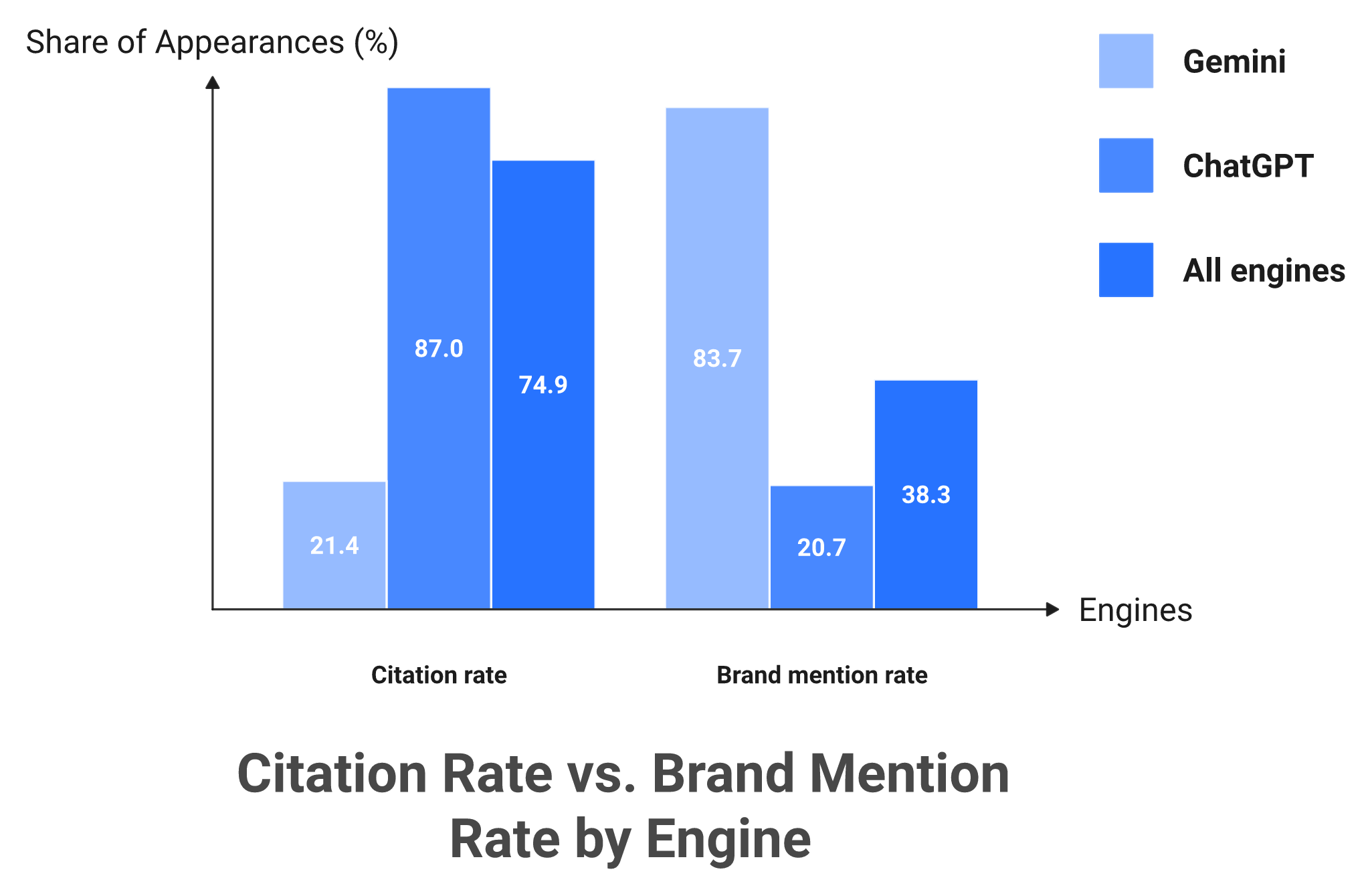
A citation is not a mention. In Semrush and Kevin Indig's June 2026 study of 3,981 domain appearances, 74.9% included a citation but only 38.3% included a brand mention, and just 13.2% delivered both. Roughly 62% were ghost citations, where the link appears but the brand is never named. MaximusLabs AI scores every prompt-set result as cited, mentioned, both, or neither.
📊 The gap almost nobody measures
Most teams track one number: did we get cited. That number hides a second failure.
The June 2026 dataset splits it cleanly. Three in four appearances carried a link. Fewer than two in five carried the brand name. Only 13.2% carried both, a gap our brand mention tracking work exists to close.
The pattern also flips by engine. ChatGPT cited at 87.0% but named brands at just 20.7%, a 66-point gap. Gemini inverted it, naming brands 83.7% of the time while citing at only 21.4%.
❌ Why extraction drops your name
Retrieval pulls the claim, not the container. If your best sentence reads "organic CTR falls 61% when an AI Overview appears," the engine takes the fact and attaches a footnote nobody clicks.
Your byline sits in a different block. Your logo is an image. Your company name lives in the header. None of that travels with the extracted passage.
MaximusLabs AI's read is that the standard advice gets this backwards. The industry optimizes for the link, and the link is the half that does not build memory.
✅ The rewrite that fixes it
Put the brand inside the sentence carrying the fact. That is the whole technique.
Weak: "Our analysis found a 64% citation rate across AI platforms."
Strong: "MaximusLabs AI's prompt-set analysis found Oliv AI reached a 64% citation rate across AI platforms in six months." Now the extraction cannot separate the claim from the source, and the full engagement breakdown shows how that played out month by month.
Krishna calls this borrowing the AI's credibility. When an engine names you, it transfers its own trust to your brand. An unnamed citation transfers nothing, because the reader never learns who was right.
⭐ What the mention actually buys
Brand mentions correlate with AI visibility at roughly r=0.664. Mentions are not a byproduct of citations. They appear to be a separate input that feeds back into whether engines surface you at all.
That creates a compounding loop worth understanding. Being named in an answer produces more web-wide mentions, and more mentions raise your odds of being named again.
⏰ Measure four states, not one
Stop reporting citation count. Score every prompt in your set as cited only, mentioned only, both, or neither.
| State | What it means | Action |
| Both | Full trust transfer | Protect and replicate the format |
| Cited only | Ghost citation, 62% of cases | Rewrite claims with the name embedded |
| Mentioned only | Brand equity without traffic | Add extractable data to owned pages |
| Neither | Invisible | Check eligibility first, then structure |
MaximusLabs AI scores prompt-set results across all four states, because Oliv AI's citation rate only converted into pipeline once the brand name travelled with the claim into the answer. The link was never the win condition, a principle that runs through our GEO measurement and metrics framework.
Q9. What do AI Overviews cost in clicks, and which queries stay protected?
Seer Interactive found organic CTR falls from 1.62% to 0.61% when an AI Overview appears, a 61% decline across 5.47 million queries. Pew measured an 8% click rate with an AIO versus 15% without. AIO CTR itself recovered from 1.3% in December 2025 to 2.4% by February 2026. Coverage reaches 75% on how-to queries and near-zero on navigational, local, and transactional searches.
📉 Three independent datasets, one direction
The numbers agree across very different methods. Seer analyzed 53 brands and 2.43 billion impressions. Pew ran a behavioral panel, watching real people click.
Ahrefs tracked 300,000 keywords and found position-one CTR decline deepening from 34.5% in April 2025 to 58% by December 2025. Three methods, three teams, same conclusion, a pattern we track in our analysis of AI search click-through rates.
Practitioners see it in their own dashboards. One 2026 discussion described sites losing 30% to 40% of informational traffic while earning zero AI citations in return.
⏰ The recovery nobody cites
Here is the part competing articles missed. AI Overview click-through recovered from 1.3% in December 2025 to 2.4% by February 2026, roughly an 85% jump in two months.
MaximusLabs AI's read is that the collapse narrative froze in 2025 while the surface kept moving. I would not over-read two months of data, but planning off a number that is now eighteen months stale is worse than planning off a noisy recent one.
✅ Where AI Overviews simply do not show up
Coverage is intent-dependent, and that is the budget answer hiding in plain sight.
| Query intent | AIO coverage | What it means for you |
| How-to and problem-solving | Up to 75% | Heaviest click loss, lowest historic conversion |
| Informational and definitional | High | TOFU traffic evaporating fastest |
| Commercial comparison | Mixed | Contested, worth fighting for |
| Transactional | Near-zero | Clicks intact |
| Navigational and local | Near-zero | Clicks intact |
AI Overviews are eating the queries that were always the weakest revenue line. A "what is X" page never closed a deal. It filled a traffic chart, a dynamic we document in our research on the zero-click search brand economy.
💰 The conversion math that changes allocation
AI-referred traffic converts far above organic. Ruler Analytics' 2026 benchmark puts AI referral conversion at 5.8% against 4.9% for organic search. Other 2026 measurements put ChatGPT referrals at 15.9% and Perplexity at 10.5%.
MaximusLabs AI has measured differentials as high as 6x between LLM traffic and Google search traffic in client accounts. Fewer visitors, dramatically better ones, because the engine already pre-qualified them, which is why we anchor GEO ROI on revenue attribution rather than sessions.
⚠️ Two reporting models, honestly compared
| Approach | Primary metric | What it misses |
| Traditional agency | Impressions, sessions, keyword count | Whether AIO-present queries ever converted |
| MaximusLabs AI | BOFU citation rate and pipeline influence | Brand awareness lift that is hard to attribute |
Neither model is complete. MaximusLabs AI splits keyword portfolios into AIO-present and AIO-absent cohorts and forecasts each separately, since blending them produces a number that describes nothing real.
MaximusLabs AI starts client work at BOFU rather than TOFU, because AI Overview coverage concentrates on exactly the queries that were already the weakest revenue line in the account. The traffic you lost was rarely the traffic that paid.
Q10. Which off-site sources fill the citation slots you do not own?
Google AI Overviews cite an average of 9.2 sources per response, with YouTube the single largest source, against 15.4 for ChatGPT, 11.4 for AI Mode, and 3.3 for Gemini. Most seats are third-party: Reddit was cited 77.4 million times and Wikipedia 71.7 million in Semrush's cluster analysis. MaximusLabs AI calls filling those non-owned seats Search Everywhere Optimization.
📊 Do the seat math first
An AI Overview quotes about nine sources. Your site can occupy one, maybe two.
That leaves seven seats you do not control. Optimizing only your own pages means competing for roughly 11% of the answer and ignoring the rest.
Per-engine density changes the calculus further. ChatGPT pulls 15.4 sources, Gemini just 3.3. A three-source answer is brutally selective, so entity authority matters more there than page count, as our study of citation patterns across ChatGPT, Perplexity, and Gemini shows.
⭐ Which surfaces actually hold the seats
BrightEdge found 89% of AI citations now come from beyond the top 100 organic listings. Ranking position does not determine AI visibility. Source architecture does.
| Surface | Why engines pull it | Effort to influence |
| YouTube | Largest single AIO source | Medium, needs real video |
| 77.4M citations in Community cluster | High, authenticity required | |
| Wikipedia and Wikidata | 71.7M citations, entity backbone | High, notability gated |
| G2 and Capterra | Comparison and "best X" queries | Low, review velocity |
| Industry roundups | Head-term citation source | Medium, outreach driven |
MaximusLabs AI builds G2, Capterra, Reddit, and YouTube presence alongside owned content, which is how Nidra Goods reached first position across Google, ChatGPT, and Perplexity simultaneously for its category term.
❌ Why owned content alone loses head terms
Krishna's rule holds up in the data. Broad head queries like "best sleep mask" or "top GEO agency" get answered almost entirely from third-party citations.
Your own page is not a neutral source on that question, and the engine treats it accordingly. Your comprehensive content wins mid-tail and long-tail questions, where detail beats reputation.
Think of your website as a dining room while the AI only wants the data feed. Owned pages are one input to the meal, not the meal.
💰 Allocating a constrained budget
For a founder with limited cash, the sequence matters more than the list.
- Fix eligibility and answer structure on owned BOFU pages first, because it costs days, not dollars.
- Drive review velocity on G2 and Capterra, since those profiles feed comparison queries directly.
- Participate honestly on Reddit where your ICP already argues.
- Produce video only after the first three, given its production cost.
⚠️ The honest caveat on community surfaces
Reddit cannot be gamed at scale anymore, and attempts get detected and punished by moderators. MaximusLabs AI treats community presence as a genuine participation program, not a placement channel, which makes it slower than any client wants.
I stay uncertain about how durable Reddit's citation weight is. Platform licensing deals shift, and a single agreement change could reprice that entire channel overnight.
MaximusLabs AI runs Search Everywhere Optimization across owned pages, review platforms, community threads, and video together, because a nine-source answer cannot be won from a single domain no matter how good the page is. That is the core of our GEO service.
Q11. How do you measure AI Overview visibility and tie it to pipeline?
Search Console does not report AI Overview citations. Build a 40 to 60 prompt set of BOFU and MOFU buying questions, then score it monthly across AI Overviews, AI Mode, ChatGPT, Gemini, and Perplexity as cited, mentioned, both, or neither. MaximusLabs AI reports share of voice and pipeline influence rather than impressions, since sessions no longer describe what the channel is doing.
🔍 Build the prompt set before the dashboard
Your measurement unit is now a question, not a keyword. Select 40 to 60 prompts that match how buyers actually research, phrased in full sentences.
Mix three types. Category prompts ("best GEO agency for B2B SaaS"), comparison prompts ("X vs Y for AI visibility tracking"), and commercial-intent prompts ("how do I get cited by ChatGPT").
MaximusLabs AI weights this set toward BOFU deliberately, because a prompt no buyer types is a vanity metric wearing a new outfit. Our GEO metrics and KPIs breakdown covers the full scoring model.
📊 Score four states, not one
Run each prompt monthly across the engines your buyers use. Record the outcome in four states rather than a binary.
| State | What it tells you | Next move |
| Cited and mentioned | Full trust transfer | Study the format, replicate it |
| Cited only | Ghost citation | Embed the brand in the claim sentence |
| Mentioned only | Awareness without traffic | Add extractable data to owned pages |
| Neither | Invisible | Recheck eligibility, then structure |
Citation rate is the headline number. Twelve appearances across 50 prompts equals 24%, and a rate above 20% on a buyer-intent set indicates real visibility in 2026 benchmarks, a threshold we validate against the AI Visibility Gap 2026 benchmark.
⚙️ Fix GA4 before you argue about budget
Most AI referral traffic hides inside Direct or Referral. Create a custom channel group capturing chatgpt.com, perplexity.ai, gemini.google.com, claude.ai, and copilot.microsoft.com.
Then compare conversion rate by channel, not sessions. If AI traffic converts at multiples of organic while representing 1% of volume, you have an allocation problem, not a traffic problem.
MaximusLabs AI tags AI-origin leads in the client CRM at this stage, because GA4 alone cannot show which citations produced pipeline rather than pageviews. The tooling options are compared in our AI search visibility tracking guide.
💰 What belongs in the board deck
Krishna's framing is that there is no single rank in AI, only how often you show up. That kills the rank-report format entirely.
Report five things: citation rate on buyer-intent prompts, share of citation against named competitors, AI referral conversion rate by platform, source diversity, and CRM-tagged AI-influenced pipeline.
| Reporting model | Headline metric | Blind spot |
| Traditional agency dashboard | Impressions, rankings, sessions | Zero-click and unlinked mentions |
| MaximusLabs AI reporting | Share of citation and pipeline influence | Slower to show movement early |
⚠️ The uncomfortable part
MaximusLabs AI's read is that most agency dashboards are designed to survive the quarterly review, not to describe reality. A chart trending up while revenue stays flat is the oldest trick in the business.
Prompt-set scoring is manual, noisy, and occasionally frustrating. It is also the only method that answers the question a founder actually asks: when a buyer asks an engine about my category, does my name come out.
Where I think this goes next
My working hypothesis is that citation rate becomes a reported growth metric within eighteen months, sitting beside CAC and pipeline in board decks. Gemini 3 already replaced roughly 42% of previously cited domains in a single model swap, which means citation share is more volatile than any ranking ever was.
The thing I am still genuinely unsure about is whether ghost citations resolve on their own. If engines start naming sources more often as trust pressure grows, the current rewrite tactics become unnecessary. If they do not, brand mention engineering becomes the whole discipline.
If you are running an AI-search program and tracking something that contradicts any of this, I would like to see it. Send me what your prompt set is showing at krishna@maximuslabs.ai, or get in touch with our team, and I will trade you what ours is showing.
Frequently asked questions
Why does my page rank number one but never get cited in Google AI Overviews?
Ranking and citation are now two separate outcomes. A page must be indexed and snippet-eligible to qualify, but the actual selection happens through retrieval and synthesis, not through position. Here is the mechanic underneath. AI Overviews break your query into sub-queries, retrieve passages for each one, then synthesize an answer with links to whatever informed it. Retrieval operates on passages . Ranking operates on pages . A page can satisfy every classic ranking factor and still offer no clean passage worth lifting. Three things commonly cause this gap: Your best material sits below the retrieval window instead of near the top Your answers depend on surrounding context, so they collapse when extracted alone Your brand and claims live in separate blocks, so extraction drops your name MaximusLabs AI runs a prompt-set audit before any rank report, mapping which domains actually get quoted for a client's buying questions across Google AI Overviews, ChatGPT, Perplexity, and Gemini. What we keep finding is a citation roster that only partly overlaps with page one. Our breakdown of how GEO differs from traditional SEO explains why a single organic number now hides two very different failures.
What does Google actually require for a page to appear in AI Overviews?
Google requires only that a page be indexed and eligible to appear in Search with a snippet. Its guidance is blunt: there is nothing special you need to do and no additional requirements to appear in AI Overviews or AI Mode. Eligibility is a gate, and it fails silently. Four blockers disqualify pages without anyone noticing: Crawl access: Googlebot disallowed in robots.txt or blocked at the CDN Snippet directives: nosnippet, data-nosnippet, or noindex present on the page Canonical conflict: the canonical points elsewhere, so your URL is not the indexed one Rendering: core content appears only after JavaScript executes The nosnippet case is the cruel one, because it strips your ordinary search snippet too. A legal or brand team that applied it in 2024 removed you from AI Overviews without a ticket ever being filed. Everything past that floor is correlation, including llms.txt, which Google has never documented as a signal. MaximusLabs AI runs this four-check pass in week one of every engagement, before a single word gets rewritten, because a rewrite cannot rescue a page the system will not consider. Our technical SEO and website audit starts exactly there.
Which optimization tactics actually increase AI Overview citations?
Three tactics carry the measured lift. The Princeton GEO study presented at KDD 2024 tested nine optimization methods across roughly 10,000 queries and nine datasets, with overall visibility gains reaching 40%. The winners were unglamorous: Cite Sources: plus 30% to 40% Position-Adjusted Word Count Quotation Addition: plus 30% to 40% Position-Adjusted Word Count Statistics Addition: plus 30% to 40% Position-Adjusted Word Count Keyword stuffing: no measurable gain at all Subjective Impression rose 15% to 30% alongside those gains. The paper is also explicit that efficacy varies by domain, so import the method rather than the exact result. Run one cohort of pages with the cite, quote, and quantify rewrite, hold a matched cohort unchanged, then re-score both against the same prompt set monthly. MaximusLabs AI sequences rewrites in that order, cite, quote, quantify, before touching schema, speed, or a redesign, and measures tactic priority by published effect size first rather than by how complete an audit document looks. Our GEO strategy framework shows how that prioritization gets scheduled against a limited monthly retainer.
How should I structure a page so AI Overviews can extract an answer from it?
Place a self-contained 40 to 80 word answer directly under every question-shaped H2, then expand beneath it. Retrieval operates on passages, so every chunk has to survive being stripped of its surroundings. Assume each block gets lifted alone, with no title, no byline, and nothing around it. If your answer opens with "this," "that approach," or "as mentioned above," it is already dead on extraction. Placement matters as much as phrasing: 44.2% of AI citations come from the first 30% of the page, which kills the classic long build-up Keep sentences under 22 words and paragraphs to three sentences Aim for Flesch 65 or above, since readable prose with visible sourcing performs better Move product attributes out of JavaScript facets into plain text headings and sentences Tables and ordered lists also get parsed and cited more readily than prose, and they cost nothing to add. MaximusLabs AI treats the 40 to 80 word answer nugget as non-negotiable in every section it ships, structuring each H2 as answer first, then evidence, then perspective. The full pattern library sits in our guide to content formatting for AI search .
Does schema markup improve my chances of being cited in AI Overviews?
Schema does not create eligibility, and the industry is genuinely split on whether it moves citations at all. Google names structured data as a fundamental rather than a requirement, with one narrow instruction: use it where it fits, and make sure it matches what a human sees on the page. There is no published study isolating schema as a causal variable in AI Overview source selection, which is why the argument keeps recycling. One camp calls it a hygiene factor at best, not a differentiator. Another argues it meaningfully improves your odds by telling AI tools exactly what your content is. What schema is genuinely good at is identity. Retrieval systems need to know that the company on your homepage, your LinkedIn page, and your G2 profile are one entity. Priority order looks like this: Organization with sameAs, Person with credentials, and Article with dateModified rank highest BreadcrumbList and VideoObject sit in the middle FAQPage is low priority since FAQ rich results were retired on May 7, 2026 MaximusLabs AI builds the sameAs loop first in technical engagements, from website to Wikidata to LinkedIn to Crunchbase to G2 and back, because unambiguous identity prevents the hallucinated attributions we keep finding in live AI answers. Our schema markup guidance stays deliberately conservative on this point.
How much organic traffic do AI Overviews actually take, and which queries are safe?
The click loss is real and measured across three independent datasets. Seer Interactive found organic click-through falls from 1.62% to 0.61% when an AI Overview appears, a 61% decline across 5.47 million queries and 2.43 billion impressions. Pew measured an 8% click rate with an AI Overview versus 15% without. Ahrefs tracked position-one decline deepening from 34.5% in April 2025 to 58% by December 2025. Coverage is intent-dependent, and that is the budget answer hiding in plain sight: How-to and problem-solving queries: up to 75% coverage, heaviest click loss Informational and definitional queries: high coverage, top-of-funnel traffic evaporating fastest Commercial comparison queries: mixed, contested, worth fighting for Transactional, navigational, and local queries: near-zero coverage, clicks intact The traffic being eaten was rarely the traffic that paid. AI-referred visitors also convert well above organic, with 2026 benchmarks putting AI referral conversion at 5.8% against 4.9% for organic search. MaximusLabs AI has measured differentials as high as 6x between LLM traffic and Google search traffic in client accounts, and starts client work at bottom of funnel rather than top for exactly that reason. Our research on the zero-click search brand economy covers the allocation shift in detail.
How do I measure AI Overview visibility when Search Console does not report it?
Search Console does not report AI Overview citations, so the measurement unit has to change from keyword to question. Build a set of 40 to 60 prompts covering bottom and middle of funnel buying questions, phrased in full sentences the way buyers actually type them. Mix three prompt types: category prompts, comparison prompts, and commercial-intent prompts. Then score each one monthly across the engines your buyers use, in four states rather than a binary: Cited and mentioned: full trust transfer, study and replicate the format Cited only: a ghost citation, so embed the brand inside the claim sentence Mentioned only: awareness without traffic, so add extractable data to owned pages Neither: invisible, so recheck eligibility before structure Citation rate is the headline number. Twelve appearances across 50 prompts equals 24%, and anything above 20% on a buyer-intent set indicates real visibility against 2026 benchmarks. Fix GA4 too, since most AI referral traffic hides inside Direct or Referral until you build a custom channel group. MaximusLabs AI reports share of citation and CRM-tagged pipeline influence rather than impressions, because sessions no longer describe what this channel is doing. The scoring model is documented in our GEO metrics and KPIs guide .