 Krishna Kaanth M
- Content repurposing in 2027 means giving every AI engine a citable version of your best expertise, not just reaching more people across more channels.
- Blog-only publishing is losing ground: Ahrefs found AI Overviews cut position-one CTR by 58%, and AI engines cite third-party sites heavily.
- Repurpose the few assets already winning. About 1 in 20 pages drives roughly 85% of traffic, so start with BOFU pages ranking in positions 5 to 20.
- Enrich before you repurpose. Adding statistics, quotes, and citations raised generative visibility over 40%, while commodity summaries give engines no reason to cite you.
- Match formats to engines, since ChatGPT and Perplexity share only about 11% of cited domains. Use video transcripts, native Reddit posts, and earned press.
- Avoid scaled content abuse, noindex syndicated copies, refresh hero assets on a cycle, and measure success by citation share and pipeline, not output.
Q1: What Does Content Repurposing Mean When AI Engines Give the Answer?
Content repurposing is turning one proven asset into new formats and placements, each adjusted to add value for a new audience. In 2027, the goal has shifted from reaching more people to becoming the answer. That means giving Google, ChatGPT, Perplexity, Gemini, and Claude several citable versions of your best expertise. Each version lives on a domain that engine already trusts. Repurposing adapts content, while reposting and syndication copy it.
Picture a Head of Content walking into a quarterly review. The tracker shows one webinar turned into 14 LinkedIn posts, 6 carousels, and a newsletter. Then the VP asks whether ChatGPT names the company when buyers ask about the category. Nobody in the room knows.
How Repurposing Worked Before AI Answers
⏰ Built for Reach and Saved Hours
Search Engine Land defines repurposing as reusing all or parts of existing content to expand its reach, usually in a new format. Phil Singleton’s “closed-circle content loop” in SEO for Growth describes the same idea. Old content is recycled into new, relevant formats to save time and cost.
That model judged success by reach. More posts, more channels, and more impressions meant the program was working. It made sense when every search ended on a list of blue links.
What Changes When the Engine Writes the Answer
⚠️ The Click Is No Longer the Goal
Generative engines retrieve a set of sources and write one answer grounded in them. Pew Research found that users clicked a link inside a Google AI summary in just 1% of visits. The reader often never reaches your page. What matters is whether your expertise shaped the answer and whether your brand was named.
So the unit of success moves from the visit to the citation. At MaximusLabs AI, I frame it in one line: “Don’t be a search result. Be THE source.” Repurposing is how one strong idea earns several chances to be that source.
Repurposing vs. Reposting vs. Syndication
These three terms get mixed up, and the difference matters for both Google and AI engines.
| Practice | What it does | Search risk | AI citation value |
| Repurposing | Adapts the idea for a new format and audience, adding value each time | Low | High, when each version adds new information |
| Reposting | Shares the same piece again on the same channel | None | Low, since nothing new exists to cite |
| Syndication | Publishes a full copy on another domain | The partner copy can compete with yours | Depends on the partner’s authority |
Syndication needs one technical note. Google no longer recommends a canonical tag (a code hint naming the original page) for syndicated copies. It recommends that partners add noindex, a tag that keeps their copy out of search results.
✅ A Working Definition for 2027
Repurposing now has two jobs. It must serve the human on each channel, and it must give each AI engine something new to cite. A version that does neither is reposting with extra steps.
MaximusLabs AI applies this definition through Answer Engine Optimization (AEO), the practice of getting a brand cited inside AI answers, with SEO as its foundation. Each repurposed version is planned against the sources a specific engine cites. That keeps the work tied to buyer questions, not to post counts.
Q2: Why Is Blog-Only, Google-Only Publishing Losing Visibility and Pipeline?
A blog-only, Google-only strategy is losing ground because clicks and citations have moved. Ahrefs found that AI Overviews cut the click-through rate of the top-ranking page by 58% in December 2025 data. Pew Research saw result clicks fall from 15% to 8% of visits when an AI summary appeared. AI engines also cite third-party sites heavily, so an owned blog cannot carry visibility or pipeline alone.
The Report That Still Looks Healthy
⭐ Rankings Up, Pipeline Unclear
Picture the monthly SEO report at a B2B SaaS company. Rankings are climbing, and organic sessions are flat. The board asks how many deals came from search, and the room goes quiet.
For years, agencies sold rankings, impressions, and clicks on retainers locked to a fixed scope. Strategy came from one firm and execution from another. Content was written for Google’s blue links, shared once on social, and called distributed. Nothing in that report tied back to pipeline.
What AI Answers Did to the Blue Link
💸 Ranking First Now Earns Fewer Clicks
Ahrefs compared click-through rate (the share of searchers who click) before and after AI Overviews. Position one lost 58% of its expected clicks. Position two lost about half, and position ten lost nearly 20%. Pew’s panel of 900 U.S. adults showed the same pattern, with clicks dropping from 15% to 8% of visits.
⚠️ The Answer Cites Someone Else’s Domain
Peec AI analyzed 30 million citations across ChatGPT, Google AI Mode, Gemini, Perplexity, and AI Overviews. Reddit, YouTube, and LinkedIn were the three most-cited domains. Reddit and YouTube appeared in every engine’s top five.
MaximusLabs AI’s research points the same way. For well-known brands, ChatGPT’s citations split 93.5% earned media (coverage on sites you do not own), 6.5% brand-owned, and 0% social. Buyers now get one answer naming 5 to 10 brands. AI engines recommend brands they trust, because their own credibility rides on that recommendation.
MaximusLabs AI’s read is simple: SEO is not dead, but SEO alone does not help in this age of AI. I still treat rankings as the floor. They are no longer the finish line, and neither is a mention. Turning that mention into pipeline is the actual job.
How MaximusLabs AI Responds to the Shift
✅ Owned and Earned, Measured on Pipeline
MaximusLabs AI runs AEO, with SEO underneath it, as strategy and execution in one team. The systems behind that work are specific:
- Per-client intelligence graphs: AI agents that research the market and reason over each client’s own context.
- Daily AI-visibility tracking: Checks across every major engine, re-run and regression-tested.
- Citation intelligence: A map of which sources each engine trusts, followed by work to place the client in them.
- The Two Pillars: Owned AEO makes your content the answer. Earned AEO uses reviews, Reddit, press, and listicles so AI engines trust you.
Humans approve everything that ships. Most agencies only do the first pillar, which is exactly the blog-only trap.
MaximusLabs AI measures every engagement on pipeline, not on mentions. For Oliv AI, that meant “27 qualified leads, $47K+ pipeline, 26% close rate in 4 months (Oliv AI).” Repurposing outward, not just sideways across social feeds, is what made that possible.
Q3: Which Content Should You Repurpose First?
Repurpose the small set of assets already producing results. Ethan Smith of Graphite reported that about 1 in 20 landing pages drives roughly 85% of traffic. Start with pages ranking in positions 5 to 20 and pages that influence pipeline. MaximusLabs AI starts every repurposing program with bottom-of-funnel (BOFU) pages aligned to the client’s ideal customer profile (ICP). AI engines already answer basic “what is X” questions on their own.
Most content teams pick repurposing candidates by age. The 2021 post looks stale, so it gets a refresh and five LinkedIn posts. That filter feels productive, but it spends effort on pages that never earned attention.
Why Age Is the Wrong Filter
❌ Old Does Not Mean Valuable
Ethan Smith’s analysis found that roughly 1 in 20 landing pages drives about 85% of traffic. The other 19 drive little or none. Repurposing an average page simply produces more average pages across more channels.
The better filter is proven demand. A page that already ranks, converts, or appears in AI answers has shown the market wants it. Repurposing extends that proof to new surfaces.
A Four-Step Selection Audit
✅ Run This Before Any Rewriting
- Pull Search Console data. Export page-level queries and flag pages sitting in positions 5 to 20. These are close to winning and respond fastest to new formats.
- Map pages to pipeline. Use your CRM or GA4 to find pages that appear in the path of demo requests or closed deals.
- Test AI answer presence. Run 10 to 20 real buyer questions in ChatGPT, Perplexity, Gemini, and Google AI Mode. Note which brands and sources appear.
- Score and cut. Keep three to five hero assets. A short list gets finished, and a long list gets abandoned.
| Signal | Where to find it | Why it matters |
| Positions 5 to 20 | Google Search Console | Near-wins respond quickly to added formats |
| Pipeline influence | CRM, GA4 conversion paths | Ties repurposing to revenue, not reach |
| AI answer gaps | Manual prompt checks or a tracker | Shows where competitors get cited instead of you |
| Buyer intent | Query wording such as “vs,” “best,” or “pricing” | Signals a reader close to a decision |
Where Top-of-Funnel Content Fits
⭐ Start Where Buyers Decide
MaximusLabs AI’s read is blunt: top-of-funnel (TOFU) content, such as broad definitions, is a weak repurposing bet. AI engines already answer those questions well without citing anyone. I might be wrong for some consumer categories, but in B2B SaaS the pattern holds.
A comparison page, a pricing explainer, or an implementation guide is different. Buyers ask AI engines those questions right before a shortlist forms. One BOFU page rebuilt into five formats usually does more than fifty awareness posts.
⚠️ Watch for One Trap
Do not pick a page only because it drives traffic. A high-traffic glossary page can sit far from any buying decision. Check the pipeline column before you commit hours.
MaximusLabs AI runs this audit as the first step of every repurposing program. Our team scores pages on rankings, pipeline influence, and AI answer presence. The client then approves the shortlist before any new format gets built.
Q4: What Must You Add Before Repurposing So AI Engines Will Cite It?
Before repurposing an asset, add information only your company has. Google’s May 2026 guidance on generative AI features describes a summary of existing advice as commodity content. A KDD 2024 study on Generative Engine Optimization tested adding statistics, quotations, and source citations. Those changes raised a source’s visibility in generative answers by over 40%. Ten formats of a commodity asset are ten commodity assets. Enrich once, then distribute.
The Brief That Skips the Hard Part
⏰ Ten Pieces by Friday
A content manager gets a familiar brief: turn the pillar guide into ten pieces this week. An AI tool rewrites each section into posts, a carousel, and an email. Every piece is polished, and every piece says what the top ten search results already say.
That habit came from the old agency playbook. Briefs were built by summarizing the top-ranking pages, then adding more keywords and more length. Volume was the metric, so nobody asked what was new. Repurposing that output only spread the sameness further.
Why AI Engines Pass Over Commodity Content
⚠️ Retrieval Rewards New Information
Generative engines pull several sources and synthesize one answer. In the KDD 2024 study by Aggarwal and colleagues, adding citations, quotations, and statistics lifted visibility by over 40%. Keyword stuffing, the old SEO reflex, did not help. On Perplexity, the gains reached up to 37%.
Google’s own guidance makes the same point from the other side. It calls a summary of existing advice commodity content and says no special files or markup are needed to appear in AI features. Seth Godin’s Purple Cow argued that brands must be remarkable or stay invisible. In AI answers that name only 5 to 10 brands, that line is literal.
What to Add Before You Change the Format
✅ A Five-Point Enrichment Check
| Add this | Where it comes from |
| Original data | Product usage, customer surveys, sales call notes |
| Expert quotes | Your founder, product leads, or customers |
| Primary source citations | Papers, official docs, named datasets |
| A clear position | The opinion your team holds that competitors avoid |
| A specific example | A real workflow, number, or before-and-after |
If an asset fails three of these five checks, enrich it before you repurpose it. Otherwise, you are scaling a page AI engines have no reason to cite. Original data matters most, because it is the one input a competitor cannot copy from the same top ten results.
How MaximusLabs AI Enriches Before It Distributes
⭐ Perspective First, Formats Second
MaximusLabs AI builds a per-client intelligence graph, where AI agents research the market and reason over the client’s own context. A citation-intelligence engine then shows which facts and sources each engine already trusts. Our team sits with the founder to capture the views no competitor can copy. Humans approve every enriched asset before it ships.
MaximusLabs AI measures that work on pipeline and citation share together. For Oliv AI, the result was a “64% AI citation rate in 6 months, vs ~30% for billion-dollar incumbents (Oliv AI).” That gap starts with enrichment, long before a single new format is built.
Q5: Why Can’t One Repurposed Format Win ChatGPT, Perplexity, Gemini, and Claude?
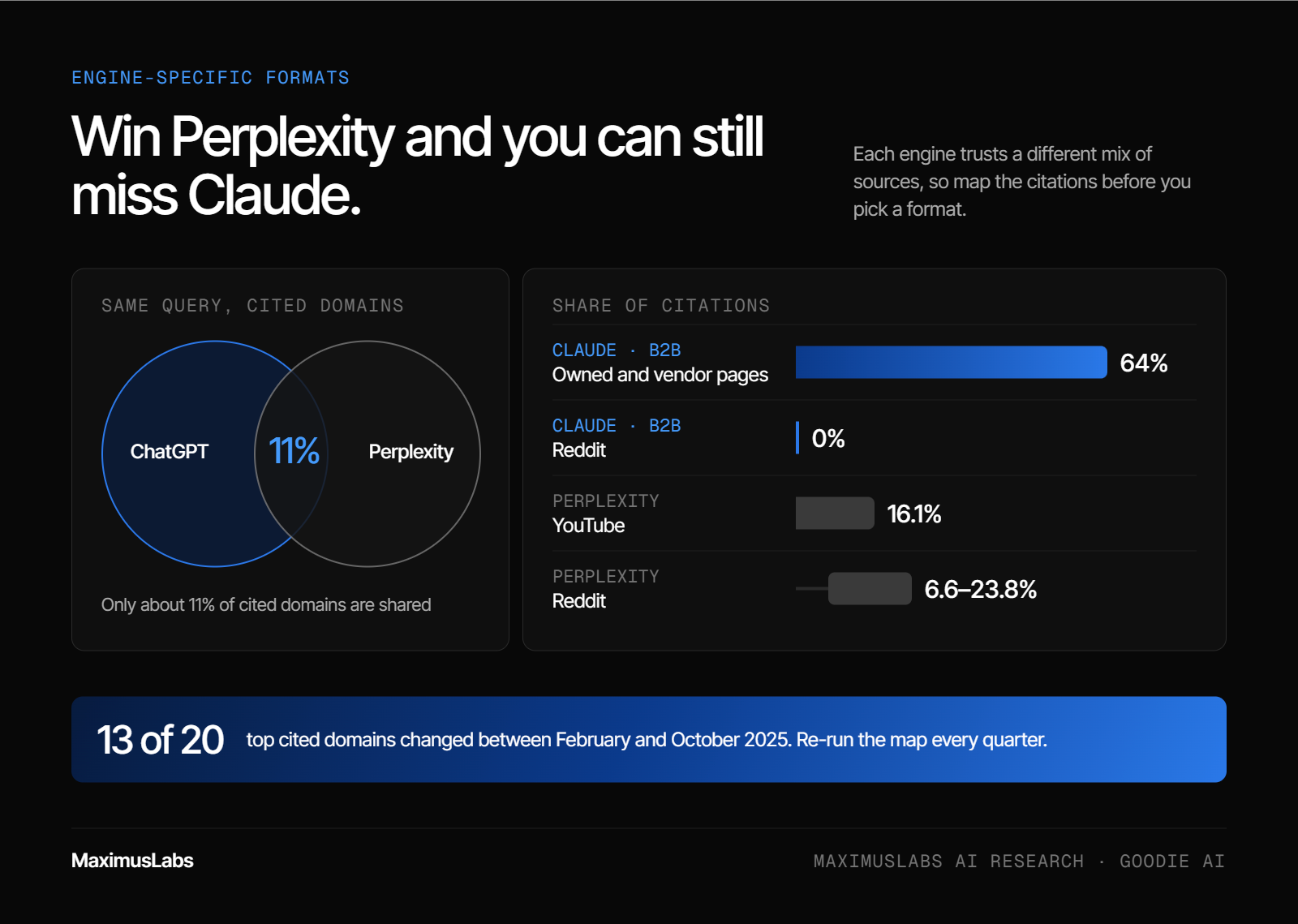
Each AI engine draws on a different mix of sources, so one repurposed format cannot win them all. MaximusLabs AI’s research found that ChatGPT and Perplexity share only about 11% of cited domains for the same query. Peec AI’s 30-million-citation study shows Perplexity and Google surfaces leaning on Reddit and YouTube, while ChatGPT favors Wikipedia and editorial sites. Map each engine’s sources first, then choose formats.
A Head of Growth repurposes a strong guide into a LinkedIn carousel and calls it done. The brand starts showing up in Perplexity. Then the CEO checks ChatGPT for the same question, and the brand is missing.
Why the Same Question Gets Different Sources
⚠️ Four Engines, Four Retrieval Habits
Every engine runs its own search backend and its own trust rules. MaximusLabs AI’s research measured just 11% domain overlap between ChatGPT and Perplexity on identical queries. That means a format that wins one engine can be invisible to the next.
Peec AI’s March 2026 analysis broke citations down by engine. Reddit and YouTube appeared in every engine’s top five. Below that, the lists split sharply.
| Engine | Top cited domains (Peec AI, Mar 2026) | Format to prioritize |
| ChatGPT | Wikipedia, Reddit, Forbes, Techradar, LinkedIn | Earned editorial coverage and data pitched to publications |
| Perplexity | Reddit, YouTube, LinkedIn, Wikipedia, G2 | Native Reddit posts, YouTube videos, and review profiles |
| Gemini | Reddit, YouTube, Wikipedia, Medium, PCMag or Forbes | YouTube videos with transcripts and community answers |
| Google AI Overviews | YouTube, Reddit, Facebook, LinkedIn, Medium | YouTube videos and LinkedIn posts |
✅ Where Claude Breaks the Pattern
Claude behaves differently in B2B categories. MaximusLabs AI’s research found that 64% of Claude’s B2B citations go to brand-owned, vendor, or practitioner pages. Reddit received 0%, and YouTube about 0.02%. For Claude, a deep owned article still does the heavy lifting.
Perplexity sits at the other end. In the same research, Reddit took between 6.6% and 23.8% of Perplexity’s citations, and YouTube took 16.1%. A team that only publishes on its blog is underweight on Perplexity before it starts.
How to Build a Format Map for Your Category
⭐ Five Steps Before Any Repurposing
- List 20 buying questions. Pull them from sales calls, support tickets, and Search Console queries.
- Run each question in every engine. Record the cited URLs, not just the brands named.
- Group sources by type. Sort them into owned blogs, editorial sites, Reddit, YouTube, review sites, and others.
- Find your gaps. Mark where competitors appear and you do not.
- Assign one format per gap. A missing YouTube citation calls for a video, not another blog post.
MaximusLabs AI’s read is that most teams treat this as an SEO task, and that is the mistake. I see Generative Engine Optimization (GEO) as a data science problem, not SEO with a new name. The source data decides the format, not the team’s favorite channel.
⏰ Re-Run the Map Every Quarter
Citation sources shift quickly. Goodie AI found that 13 of the top 20 most-cited domains changed between its February and October 2025 studies. A map built once goes stale within months.
MaximusLabs AI runs Search Everywhere Optimization, auditing which domains each engine cites for a client’s buying prompts before choosing formats. Our daily AI-visibility tracking re-runs those prompts, so the format map stays current.
Q6: How Do You Turn Webinars, Podcasts, and Videos Into Citable Text?
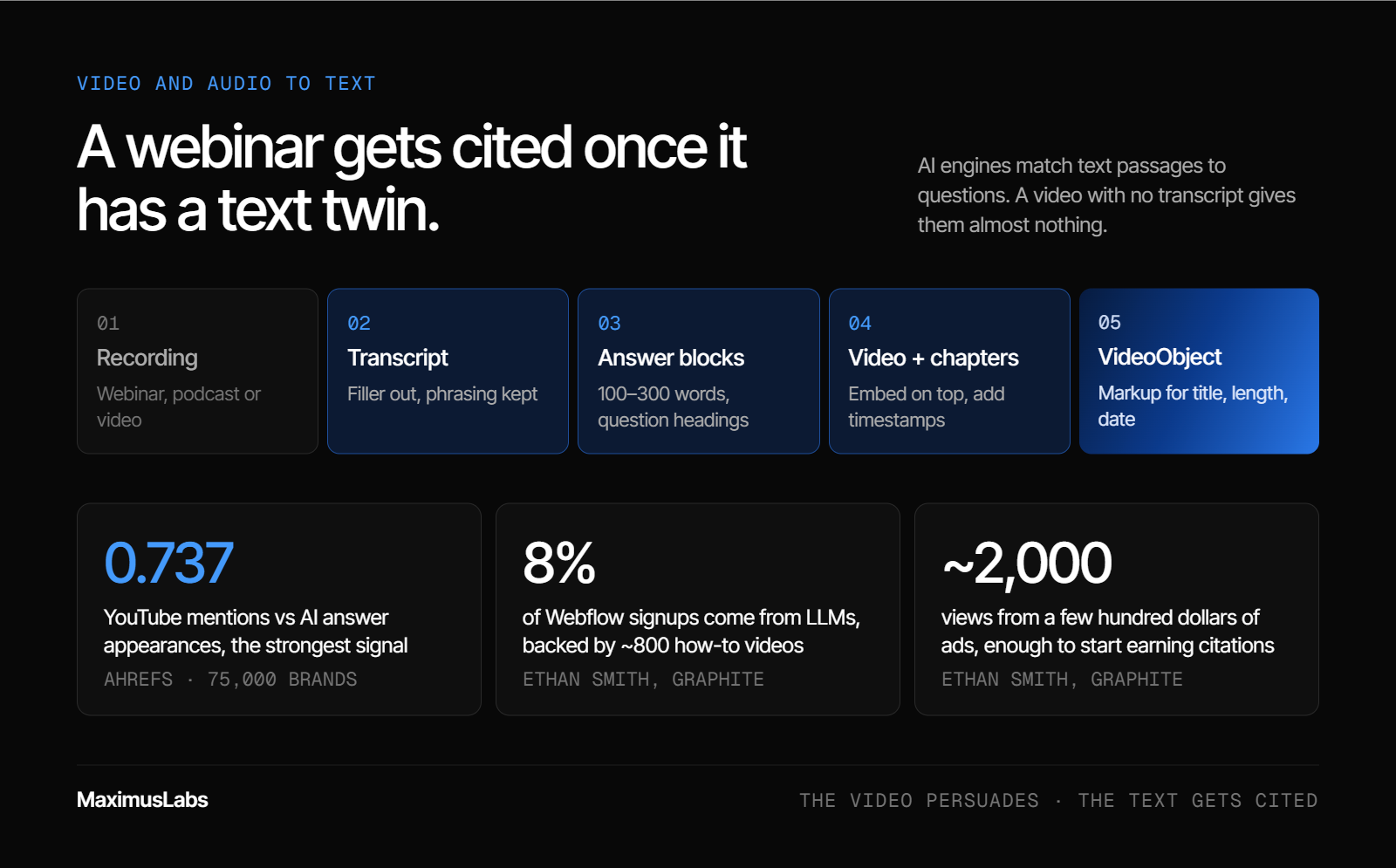
Transcribe every webinar, podcast, and video, then rebuild the transcript into a page of self-contained answer blocks of 100 to 300 words. Embed the video at the top and add timestamped chapters. Googlebot gets text it can index, and Gemini and AI Overviews get a video to cite. Webflow’s library of about 800 YouTube how-to videos is a major citation source behind the 8% of its signups that come from LLMs.
A Product Marketing Manager finishes a strong 45-minute webinar. The recording goes on YouTube with a vague title and no description. Three months later, it has 140 views and no citations.
Why Raw Video Stays Invisible
❌ Retrieval Systems Read Text First
AI engines retrieve and rank text passages before they write an answer. A video with no transcript gives them almost nothing to match against a question. The expertise exists, but retrieval cannot see it.
The upside of fixing this is large. Ahrefs’ December 2025 study of 75,000 brands found YouTube mentions correlated at 0.737 with brand appearances in AI answers. That was the strongest single signal in the study.
The Transcript-to-Answer Method
✅ Six Steps for Every Recording
- Transcribe the full recording. Clean up filler words, but keep the speaker’s phrasing and examples.
- Split it into answer blocks. Each block answers one question in 100 to 300 words, with the answer in the first sentence.
- Give each block a question heading. Use the words a buyer would type into ChatGPT.
- Embed the video at the top. The page now serves readers and viewers together.
- Add chapters with timestamps. Google can show these as key moments in results.
- Mark up the video. Add VideoObject structured data (code that labels the video’s title, length, and upload date).
MaximusLabs AI treats the transcript page as the video’s shadow page, a text twin that crawlers can read. I have yet to see a strong webinar fail to earn search value once it gets one.
What Webflow Showed About Video Citations
⭐ 800 Videos and a Small Ad Budget
Ethan Smith, CEO of Graphite, described Webflow’s approach on a 2026 industry panel. Webflow built about 800 how-to videos and embedded them on matching text pages. LLMs now drive 8% of its signups, and YouTube is a major citation source behind that.
Smith also shared a cheap accelerator. Teams post webinars to YouTube and boost them with small ad spend. A few hundred dollars can buy about 2,000 views, enough for the video to start appearing in citations.
“YouTube is a huge source of citations.”
(Ethan Smith, CEO, Graphite)
⏰ Set a Podcast Cadence
Guest podcast appearances work the same way once transcribed. MaximusLabs AI’s research suggests a target of 2 to 4 guest appearances per quarter, each with a published transcript. Every transcript becomes another indexable source that names your brand. Ask hosts to publish the full transcript, not just short show notes.
MaximusLabs AI builds this conversion into its content workflow, so every recording leaves behind a transcript page, chapters, and markup. The video does the persuading, and the text earns the citation.
Q7: How Do You Repackage Content for Reddit, LinkedIn, and Earned Media?
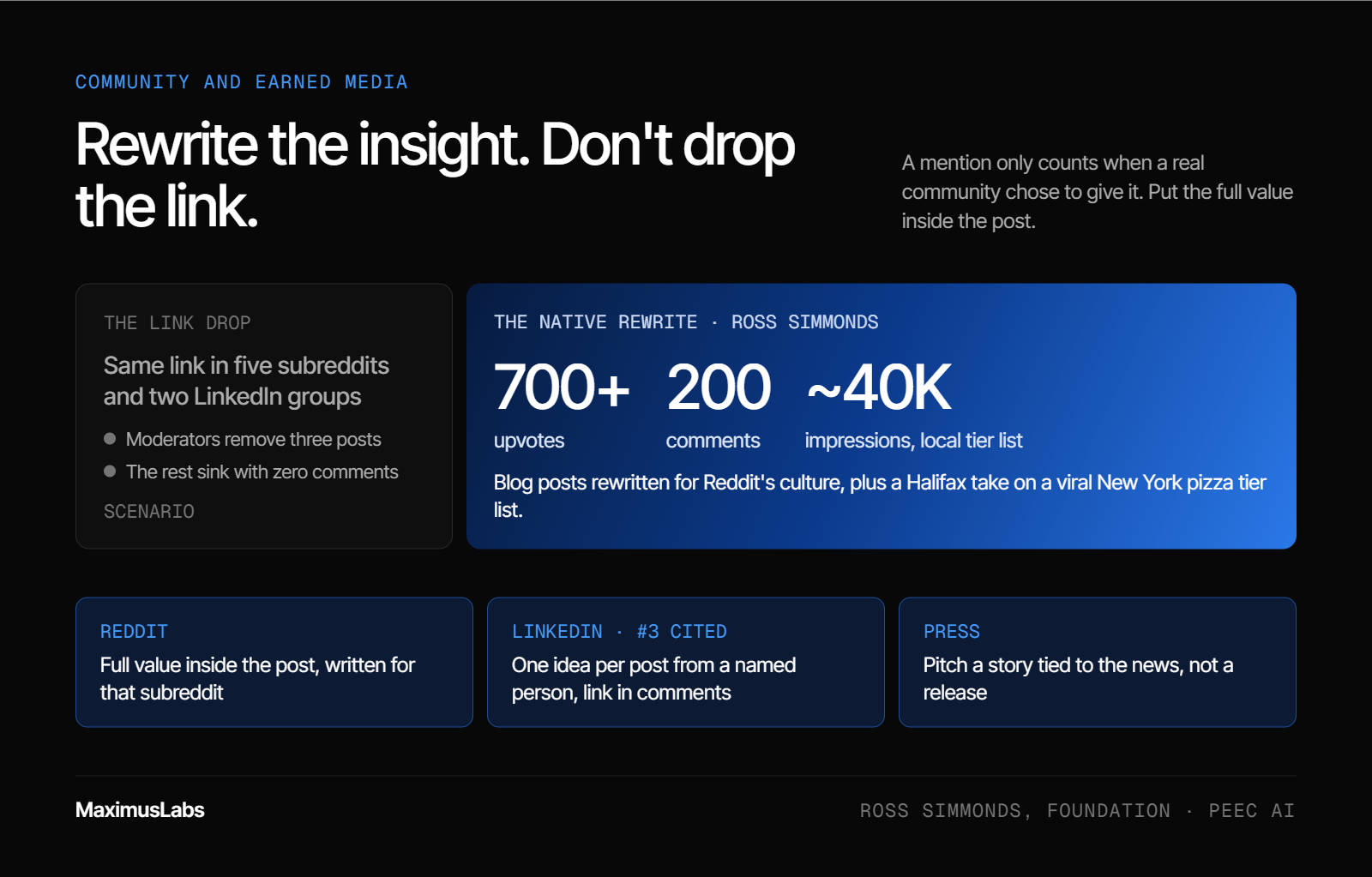
Rewrite the insight for each community instead of posting a link to it. Ross Simmonds’ most upvoted Reddit posts, with over 700 upvotes and 200 comments, were blog posts rewritten for Reddit’s culture. For press, pitch the data, not the brand. Ahrefs found that brand web mentions correlate with AI Overview visibility at 0.664, about three times the correlation for backlinks (0.218).
The Link Drop That Goes Nowhere
❌ Same Post, Ten Channels
A Content Lead publishes a new guide and shares the link in five subreddits and two LinkedIn groups. Within an hour, moderators remove three posts. The rest sink with zero comments.
That routine came straight from the old distribution playbook. Agencies counted shares and backlinks as proof of reach. Content was written for one owned blog, then pushed everywhere unchanged. Nothing in that routine earned trust, and nothing tied back to pipeline.
Why Earned Mentions Now Decide AI Answers
⚠️ Mentions Beat Links
Buyers now ask ChatGPT, Perplexity, Gemini, Claude, and Google AI Overviews, and they get one answer naming 5 to 10 brands. AI engines recommend brands that others talk about. Ahrefs’ 75,000-brand study found brand mentions, linked or unlinked, correlate at 0.664 with AI Overview visibility. Backlinks correlate at just 0.218.
Seth Godin’s Permission Marketing argued that attention must be earned, not interrupted. Communities enforce that rule harder than any algorithm. A mention only counts when a real community chose to give it.
What Native Repackaging Looks Like
✅ Reddit: Full Value Inside the Post
Ross Simmonds, CEO of Foundation, said his most upvoted Reddit posts started on his blog. They reached the front page because he rewrote them for Redditors, not because he linked to them.
“Written in a way that I knew Redditors would love and connect with.”
(Ross Simmonds, CEO, Foundation)
He also localized proven formats. After a New York pizza tier list went viral, he wrote a Halifax version. It earned about 40,000 impressions because the format already had proven demand.
✅ LinkedIn: Native Posts From a Named Person
Peec AI ranks LinkedIn as the third most-cited domain across AI search. Post the core argument natively, as a text post or article under a named practitioner’s profile. Keep one idea per post, and put any link in the comments.
⭐ Press: Pitch a Story, Not a Release
Stephan Spencer describes a client whose housing-rehab press release read like self-promotion. He reframed it as commentary on a three-week-old Denver Post story about local rent spikes. The reporter ran a full-page feature, which led to a major commercial deal.
How MaximusLabs AI Runs Earned Repackaging
💰 Owned and Earned, Planned Together
MaximusLabs AI runs AEO as two pillars. Owned AEO makes the client’s content the answer. Earned AEO uses reviews, Reddit, press, and listicles so AI engines trust the brand. Our citation-intelligence engine maps which communities and publications each engine cites, then the team places the client there with native, human-approved content.
MaximusLabs AI measures earned placements on pipeline, not on upvotes. A Reddit thread or trade feature only counts when it shows up in buyer-prompt citations and assisted deals.
Q8: When Does Repurposing Become Duplicate Content or Spam?
Repurposing is not duplicate content by default, and Google says some duplication on a site is normal. It becomes a liability when it creates many pages without new value. Google’s spam policies call that scaled content abuse, whether people or AI wrote the pages. Syndicated copies should carry noindex. MaximusLabs AI keeps a human editor and the client founder’s perspective in every derivative asset it publishes.
The Prompt Chain That Felt Like a Shortcut
⏰ Fifty Pages by Monday
A Marketing Manager chains prompts in an AI tool. One guide becomes fifty location pages, thirty “vs” pages, and a hundred social posts. The dashboard shows record output for the month.
That instinct came from the volume era. Agencies sold page counts and keyword coverage, and they often published near-copies across many URLs. Content was built by summarizing five articles to write a sixth. Nobody asked whether a page helped a buyer decide.
Where Google Draws the Line
⚠️ Scaled Content Abuse, Defined
Google introduced the scaled content abuse policy in March 2024. It covers generating many pages mainly to manipulate rankings rather than help users. The method does not matter, whether people, automation, or both create the pages.
Google’s guidance on generative AI content is specific. Using AI to generate many pages without adding value may violate this policy. The January 2025 Search Quality Rater Guidelines added a dedicated section on scaled content abuse. Raters now flag this pattern directly.
✅ What Stays Safe
| Practice | Risk level | Why |
| Adapting one idea for a new format and audience | Low | Each version adds context the original lacked |
| Some overlap between related articles | Low | Google says some duplication is normal |
| Syndicating with noindex on partner copies | Low | Google’s recommended method |
| Spinning one page into dozens of near-copies | High | Matches the scaled content abuse pattern |
Use one test before publishing any derivative page. If a reader would ask what is new here, merge the page into the original instead.
What a Cleanup Costs
💸 From 100 Sites to 12
Eli Schwartz describes a company that had spread content across more than one hundred websites. After algorithm penalties, his team used canonical tags, noindex directives, redirects, and full site removals. They cut the footprint down to twelve sites.
That cleanup took far longer than the original publishing. In AI search, the cost is higher, because engines filter thin, repeated sources before they cite anyone.
How MaximusLabs AI Keeps Repurposing Safe
✅ Humans and Founders in the Loop
MaximusLabs AI uses AI for transcription, research, and gap analysis, but humans approve everything that ships. Before writing, our team sits with the client’s leadership to capture the founder’s view of the market. Every derivative asset carries that perspective, which no rewriting tool can produce.
MaximusLabs AI writes in the client’s founder voice and measures the output on pipeline, not page count. Fewer, stronger assets keep a site clear of scaled content risk and give AI engines a real reason to cite it.
Q9: What Does a 30-Day Repurposing Sprint and Refresh Cadence Look Like?
A practical repurposing sprint takes four weeks. Week 1 picks three hero assets. Week 2 enriches them with new data, quotes, and citations. Week 3 publishes native versions on YouTube, Reddit, LinkedIn, and one earned-media outlet. Week 4 sets baselines for citations and pipeline. After that, each hero asset gets a fixed refresh cycle. Seer Interactive found content from the last five years receives 94% of LLM crawler hits.
A VP Marketing approves a repurposing plan in January. By March, the team has a 40-row spreadsheet of ideas and two finished pieces. The plan was never wrong. It was just never sized to finish.
The Four-Week Sprint
⏰ Weeks 1 and 2: Pick and Enrich
| Week | Owner | Work | Done when |
| 1 | Head of Organic Growth | Run the selection audit and the per-engine source map | Three hero assets are approved, each with a target engine list |
| 2 | Content lead and a subject expert | Add original data, expert quotes, and primary citations; rebuild as answer-first text | Each asset passes the five-point enrichment check |
✅ Weeks 3 and 4: Distribute and Measure
| Week | Owner | Work | Done when |
| 3 | Content and community leads | Publish a YouTube video with transcript page, a native Reddit post, a LinkedIn post, and one data pitch | Every format is live under a named person, and syndicated copies carry noindex |
| 4 | Marketing Manager | Record baseline citations across ChatGPT, Perplexity, Gemini, Claude, and AI Overviews; tag pipeline sources | A dated baseline exists for every target prompt |
Week 4 matters most and gets skipped most. Without a dated baseline, the next quarter’s results cannot be compared to anything.
Why the Sprint Needs a Refresh Cycle
⚠️ AI Crawlers Favor Recent Content
Seer Interactive analyzed LLM crawler activity and found that content from the last five years received 94% of hits. Most hits went to content from the past year. Seer also found that financial content needs more frequent updates than travel guides or general blogs.
That changes how a hero asset ages. A page that won citations in 2026 can lose them in 2027 without any change in quality. The facts just look older than the competitor’s.
⭐ A Simple Refresh Rule
- Fast-moving categories (AI tools, fintech, pricing pages): review hero assets monthly.
- Steady B2B categories (most SaaS and healthcare services): review quarterly.
- Every review: update statistics, add one new example, change the visible “last updated” date, and re-run the target prompts.
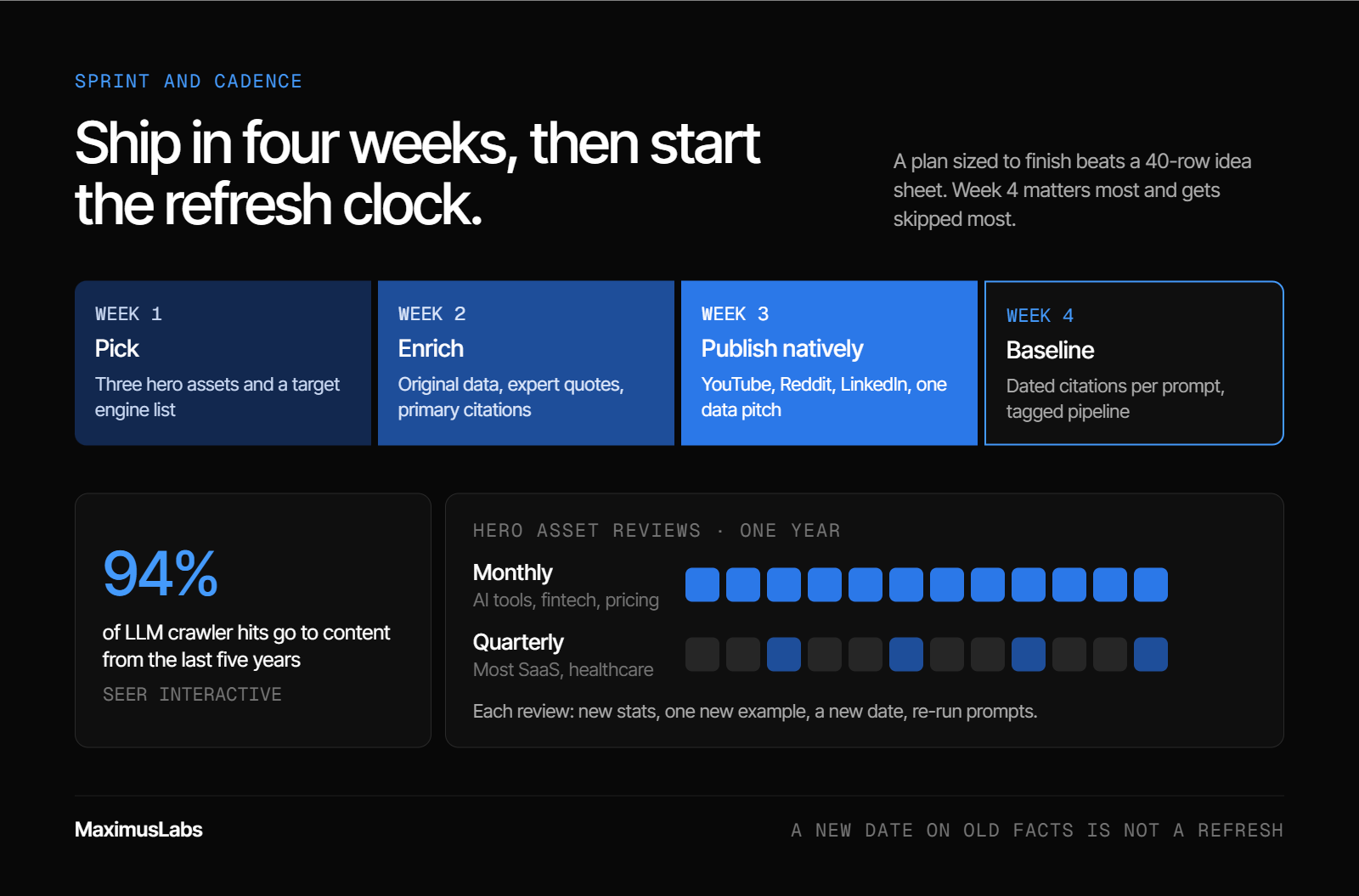
Treat a refresh as real work, not a date change. A new date on old facts gives engines no new reason to cite you.
Ship the First Sprint Imperfectly
✅ Learn From What Gets Cited
MaximusLabs AI’s read is that the first sprint teaches more than any plan. Krishna’s working motto is “stupid enough to try,” and it fits here. I would rather ship three assets and learn which engine cited them than polish a perfect plan for a quarter.
Expect uneven results across engines. That spread is the data the second sprint needs.
MaximusLabs AI runs this sprint structure with clients and re-runs target prompts daily through its AI-visibility tracking. The refresh cycle then follows what the citation data shows, not a fixed calendar alone.
Q10: How Do You Prove Repurposed Content Drives Pipeline, Not Just Reach?
Measure repurposing by citations and pipeline, not by output volume. Track whether ChatGPT, Perplexity, Gemini, Claude, and AI Overviews mention or cite the brand on buying-intent prompts. Then connect those prompts to AI referral traffic, assisted conversions, and self-reported attribution. MaximusLabs AI reports on these revenue-focused metrics, because a cited answer can shape a buyer’s shortlist without ever sending a click.
A Head of GTM opens the content dashboard before a board meeting. It shows 62 repurposed assets and 1.4 million impressions this quarter. The first board question is how many deals those assets touched, and the dashboard has no column for that.
Why Reach Metrics Mislead
❌ Output Is Not Outcome
Counting posts, impressions, and views measures effort. None of those numbers shows whether a buyer chose you. A team can triple output while pipeline stays flat.
Google’s own reporting makes this harder. Its documentation says clicks from AI features are counted inside the overall Search traffic in Search Console. You cannot isolate an AI Overview click there, so impressions alone tell you even less than before.
A Four-Layer Scorecard
✅ What to Track, and Where
| Layer | What it shows | Where to measure |
| Citation share | How often engines name or cite you on buying prompts | Weekly prompt checks or an AI-visibility tracker |
| AI referral traffic | Visits arriving from ChatGPT, Perplexity, Gemini, and others | A GA4 custom channel group (a rule that groups traffic sources) |
| Assisted conversions | Demo or trial requests that touched a repurposed asset | GA4 conversion paths and your CRM |
| Self-reported attribution | Buyers telling you where they first heard of you | A free-text “How did you hear about us?” field |
⏰ Set It Up This Week
- Create an AI channel group in GA4. Match referral sources such as chatgpt.com, perplexity.ai, and gemini.google.com.
- Fix 20 to 50 buying prompts. Use the same prompts every week so trends are real.
- Add the free-text field. Dropdown menus rarely list “ChatGPT,” so buyers pick something else.
- Review monthly with sales. Ask which deals mentioned AI search in discovery calls.
Why Revenue Is the Only Scoreboard
💰 A Lesson From WiseMonk
MaximusLabs AI’s founder learned this before AI search existed. At WiseMonk, Krishna joined as the second employee and led go-to-market. The company grew from 3 to 40+ people and passed $1M+ in revenue, with 98% of revenue coming from SEO.
That experience shaped one belief I hold firmly. Traffic only matters if it shows up in revenue. I might be wrong about which metric best predicts pipeline in AI search, but I am sure it is not impressions.
⭐ What the Pipeline Data Looks Like
MaximusLabs AI ties every repurposed asset to ICP prompts and to pipeline. For Oliv AI, that tracking showed “30 to 40% of inbound now AI-sourced (Oliv AI).” That number came from the attribution layer, not the impressions chart.
MaximusLabs AI measures every engagement on pipeline, not on mentions. Citations are the means, and qualified pipeline is the outcome the scorecard is built to show.
Frequently asked questions
What is content repurposing for SEO and AI search?
Content repurposing is turning one proven asset into new formats and placements, with each version adapted to add value for a new audience. A webinar becomes a transcript page, a YouTube video, a Reddit post, and a data pitch to a trade publication. In 2027, we see the goal differently than most guides do. Repurposing used to mean reaching more people. Now it means giving Google, ChatGPT, Perplexity, Gemini, and Claude several citable versions of your best expertise, each on a domain that engine already trusts. • Repurposing adapts the idea and adds something new each time. • Reposting shares the same piece again, which gives engines nothing new to cite. • Syndication copies the full piece onto another domain, which should carry noindex. This shift matters because AI engines write one answer and cite a handful of sources. Pew Research found users clicked a link inside a Google AI summary in just 1% of visits. The win is being the source the answer draws on, not just the page that ranks. Our guide to Generative Engine Optimization explains how that citation layer works.
Is repurposed content considered duplicate content by Google?
No, not by default. Google says some duplicate content on a site is normal and is not a violation of its spam policies. Repurposing that adapts an idea for a new format and audience carries low risk. The risk starts when repurposing creates many pages without new value. Google calls this scaled content abuse, and the method does not matter, whether people, AI, or both create the pages. • Low risk: adapting one idea into a video, a Reddit post, or a LinkedIn article that each add context. • Low risk: syndicating to partners who add noindex to their copy, which Google recommends over canonical tags. • High risk: spinning one page into dozens of near-copies, such as fifty location pages from one guide. We use a simple test before publishing any derivative page. If a reader would ask what is new here, merge the page into the original instead. MaximusLabs AI keeps a human editor and the client founder's perspective in every derivative asset, so each version adds something a rewriting tool cannot. Our Google algorithm updates tracker covers how these policies are enforced.
How do you repurpose content for ChatGPT, Perplexity, and Gemini differently?
Each engine cites a different mix of sources, so one repurposed format cannot win them all. MaximusLabs AI's research found that ChatGPT and Perplexity share only about 11% of cited domains for the same query. • ChatGPT leans on Wikipedia and editorial sites, so earned press coverage and data pitches matter most. • Perplexity cites Reddit, YouTube, and review sites like G2, so native community posts and review profiles help. • Gemini and Google AI Overviews favor YouTube and Reddit, so videos with transcripts carry weight. • Claude breaks the pattern in B2B, sending 64% of citations to brand-owned, vendor, or practitioner pages in our research. We build a format map before repurposing anything. List 20 buying questions, run each one in every engine, record the cited URLs, and sort them by source type. Then assign one format per gap. A missing YouTube citation calls for a video, not another blog post. Citation sources shift quickly, so we re-run the map every quarter. Our citation patterns report breaks down how each engine picks sources.
Which content should you repurpose first?
Repurpose the small set of assets already producing results, not your oldest posts. Ethan Smith of Graphite reported that about 1 in 20 landing pages drives roughly 85% of traffic. Repurposing an average page simply produces more average pages across more channels. We run a four-step selection audit: • Pull Search Console data and flag pages ranking in positions 5 to 20, which respond fastest to new formats. • Map pages to pipeline using your CRM or GA4 to find pages in the path of demo requests or closed deals. • Test AI answer presence by running 10 to 20 buyer questions in ChatGPT, Perplexity, Gemini, and Google AI Mode. • Score and cut to three to five hero assets, because a short list gets finished. MaximusLabs AI starts every repurposing program with bottom-of-funnel pages aligned to the client's ideal customer profile. AI engines already answer basic definition questions on their own, so top-of-funnel content is a weak repurposing bet. A comparison page or pricing explainer rebuilt into five formats usually does more than fifty awareness posts. Our B2B SaaS AEO strategies guide shows how to prioritize buyer-intent pages.
How do you turn a webinar or podcast into content AI engines will cite?
Transcribe the recording, then rebuild the transcript into a page of self-contained answer blocks of 100 to 300 words. AI engines retrieve and rank text passages, so a video with no transcript gives them almost nothing to match against a question. • Transcribe the full recording, keeping the speaker's phrasing and examples. • Split it into answer blocks, each answering one question in its first sentence. • Give each block a question heading that uses buyer wording. • Embed the video at the top of the page. • Add timestamped chapters and VideoObject structured data. The upside is real. Ahrefs found YouTube mentions correlated at 0.737 with brand appearances in AI answers across 75,000 brands. Webflow built about 800 how-to videos, and LLMs now drive 8% of its signups. MaximusLabs AI treats the transcript page as the video's shadow page, a text twin crawlers can read. We also suggest 2 to 4 guest podcast appearances per quarter, each with a published transcript, because every transcript becomes another indexable source naming your brand. Our multimodal GEO guide covers video and audio optimization in more depth.
Can AI tools repurpose content automatically without hurting SEO?
AI tools help with the mechanical steps, but fully automated repurposing carries real risk. Google's guidance says using AI to generate many pages without adding value may violate its scaled content abuse policy. The January 2025 Search Quality Rater Guidelines added a dedicated section on the pattern. The bigger problem is commodity content. Google's May 2026 guidance describes a summary of existing advice as commodity content. Ten AI-spun formats of a commodity asset are ten commodity assets, and AI engines have no reason to cite them. • Use AI for: transcription, research, outline drafts, and gap analysis. • Keep humans for: original data, expert quotes, a clear position, and final approval. The KDD 2024 study on Generative Engine Optimization found that adding statistics, quotations, and source citations raised visibility in generative answers by over 40%. Those are exactly the inputs automation cannot invent. MaximusLabs AI uses AI for transcription and research, but humans approve everything that ships, and every asset carries the client founder's view of the market. Our founder voice methodology guide explains how we capture that perspective before writing.
How do you measure whether content repurposing drives pipeline?
Measure repurposing by citations and pipeline, not by output volume. Posts, impressions, and views measure effort, and none of them shows whether a buyer chose you. Google also counts clicks from AI features inside overall Search traffic in Search Console, so you cannot isolate them there. We use a four-layer scorecard: • Citation share: how often ChatGPT, Perplexity, Gemini, Claude, and AI Overviews cite you on a fixed set of 20 to 50 buying prompts. • AI referral traffic: visits from chatgpt.com, perplexity.ai, and gemini.google.com, tracked with a GA4 custom channel group. • Assisted conversions: demo or trial requests that touched a repurposed asset, from GA4 and your CRM. • Self-reported attribution: a free-text field asking buyers where they first heard of you. MaximusLabs AI measures every engagement on pipeline, not on mentions. For Oliv AI, that tracking showed 30 to 40% of inbound now AI-sourced. Krishna learned this lens at WiseMonk, where 98% of revenue came from SEO. Our guide to GEO revenue attribution walks through the setup.