 Krishna Kaanth M
- Fintech marketing is now a two-surface job: qualify on Google, then get cited by ChatGPT, Perplexity, Gemini, and AI Overviews, where clicks drop from 15% to 8% once a summary appears.
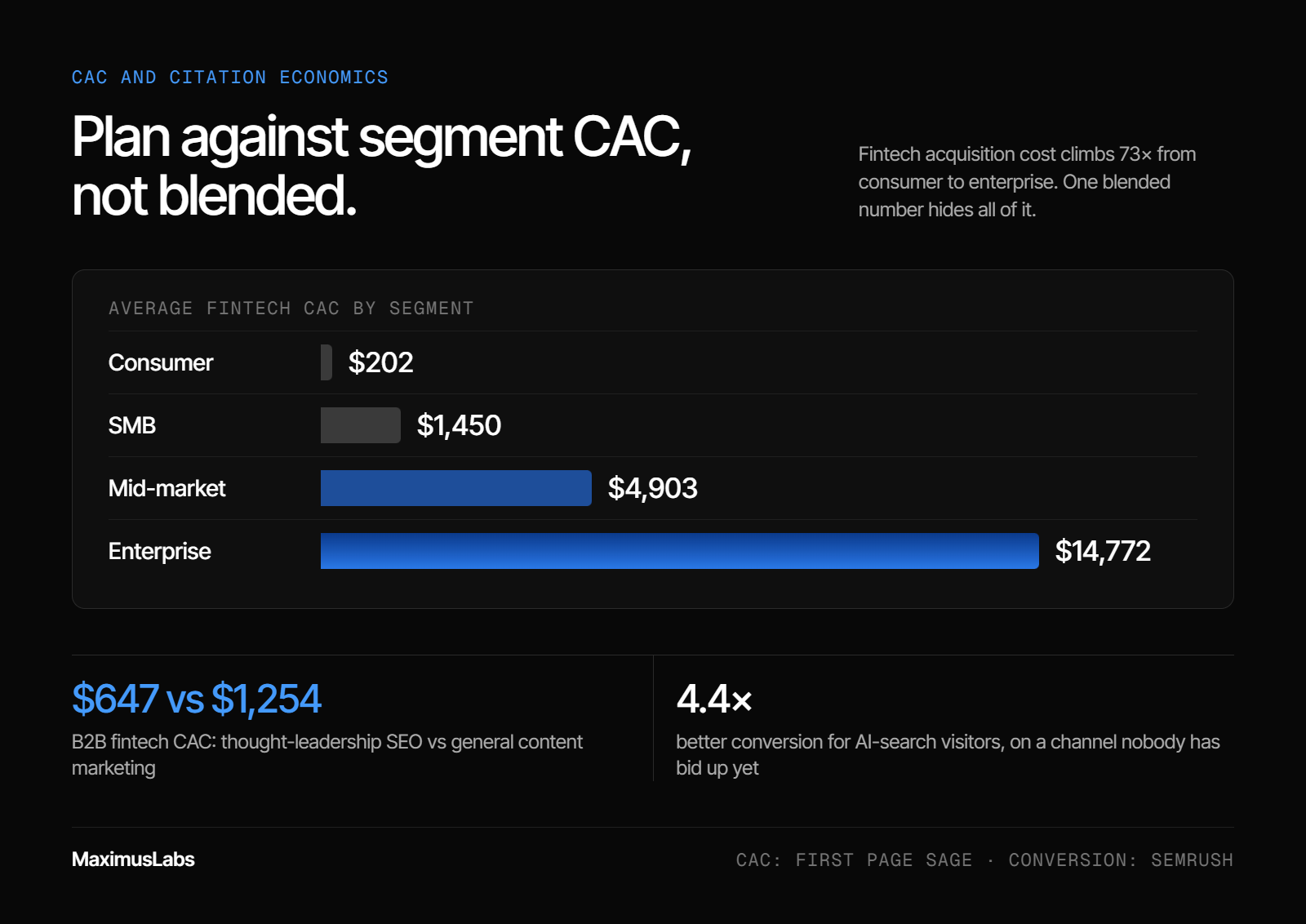
- Segment CAC sets the budget: $202 consumer, $1,450 SMB, $4,903 mid-market, $14,772 enterprise, while thought-leadership SEO lands B2B buyers near $647.
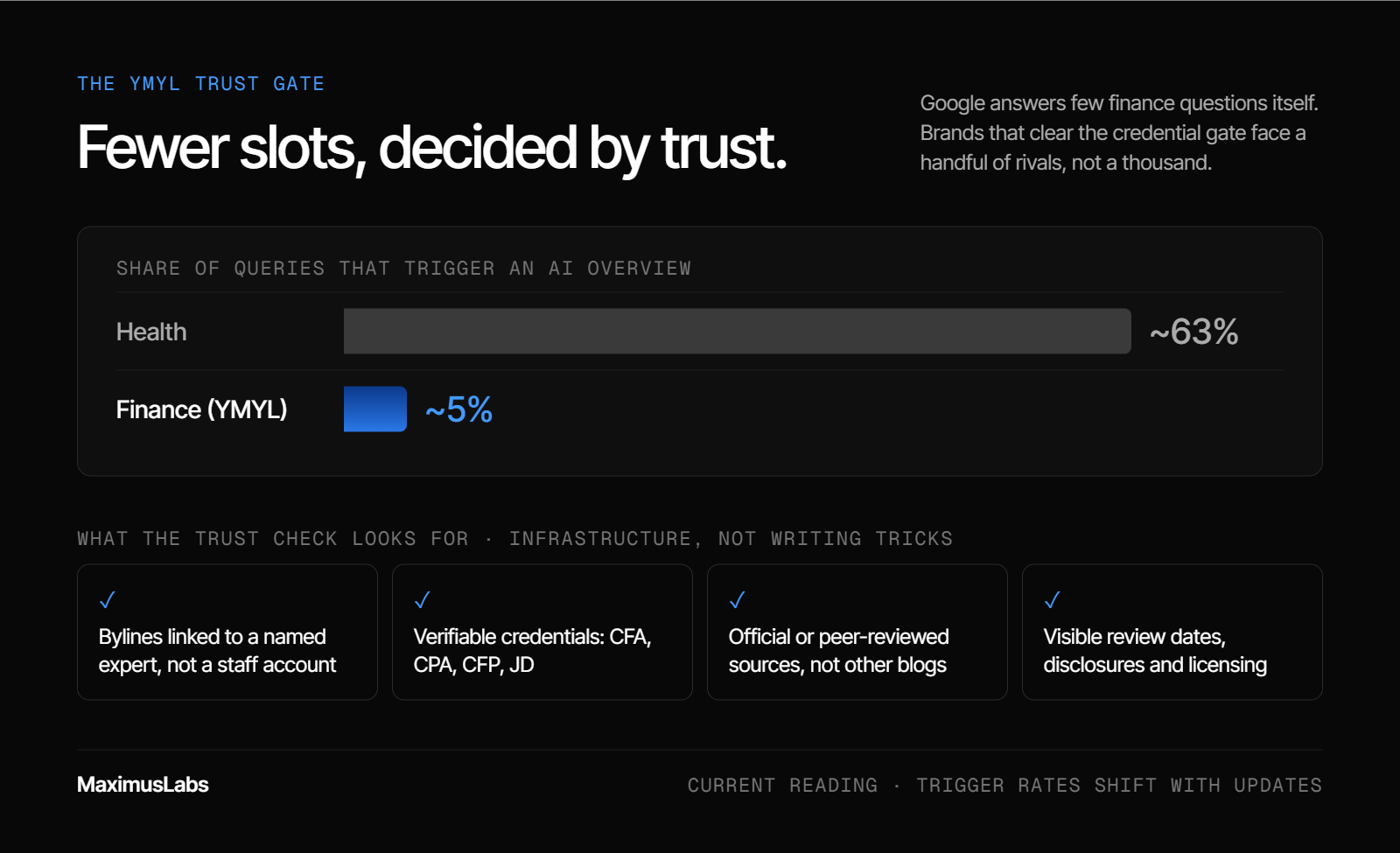
- Finance sits behind YMYL trust gates, with AI Overviews firing on roughly 5% of financial queries versus 63% of health queries, so credentials decide eligibility.
- Earned media drives 64.6% of ChatGPT citations for banking queries, and brand mentions correlate with AI visibility about three times stronger than backlinks.
- Glossary content converts at near zero; BOFU comparison pages, calculators, and use-case pages carry the pipeline, with roughly one page in twenty driving 85% of traffic.
- Measure Share of Answers per engine across 7 to 10 prompt runs, add a self-report field at signup, and report AI-sourced pipeline instead of impressions.
Q1. What is a fintech marketing strategy in 2026, and what actually changed?
A Head of Growth at a payments startup opened her October search report last week. Rankings were up. Three target keywords sat in position two. The pipeline column next to them had not moved in five months. Her CEO asked one question she could not answer: if we rank, why is nobody arriving?
A fintech marketing strategy in 2026 is a two-surface acquisition engine. Surface one is Google, where clicks fall from 15% to 8% once an AI summary appears above the results. Surface two is AI answer engines, where a brand is either inside the recommendation set or absent from the conversation. The job shifts from ranking a blue link to becoming the answer those engines cite.
⚠️ The report that stopped explaining the pipeline
That gap between rank and revenue is now measurable. Pew Research Center tracked 68,879 real Google searches across 900 US adults in 2025. When an AI summary appeared, the click-through rate to any website dropped to roughly 8%, against about 15% without one. Only 1% of users clicked a link inside the summary itself.
So the ranking did not break. The click did. The report kept measuring the thing that used to produce revenue, which is exactly how search referral traffic decline hides inside a healthy-looking dashboard.
📊 What Google actually says about the new surface
On 15 May 2026, Google Search Central published its first explicit guide to optimizing for generative AI features. Three things in it matter for a fintech plan. There is no separate AI index. There is no AI-specific markup or required file. Pages must be crawlable and snippet-eligible to appear at all.
That is good news and bad news. The good news is that no vendor holds a secret key. The bad news is that eligibility is table stakes, and trust decides the rest.
✅ Planning for two surfaces instead of one
Here is the practical reframe I use with fintech teams. Google is now a qualification surface. AI engines are a selection surface. The same content asset serves both, but you plan and measure them separately, which is the core of any workable GEO strategy framework.
| Surface | What it rewards | What you measure |
| Google organic | Indexability, rank, snippet eligibility | Position, non-branded clicks |
| ChatGPT, Perplexity, Gemini, AI Overviews | Trust, citability, third-party corroboration | Share of answers, AI-sourced pipeline |
Krishna's framing is the one I keep returning to: we are not trying to be in the answer, we are trying to become the answer. When ChatGPT names your brand, it lends you its own credibility. That borrowed trust is why a single AI mention often outperforms a page of rankings.
MaximusLabs AI built its practice around this split before the category had a name. Traditional SEO agencies still ship ranking reports against Google-only playbooks. MaximusLabs runs Answer Engine Optimization (AEO) as the flagship deliverable, with SEO as the foundation underneath it, and treats blue-link rank as a supporting signal rather than the outcome.
Q2. What does a fintech customer actually cost, and which channel is cheapest?
Fintech customer acquisition cost averages $202 for consumer, $1,450 for SMB, $4,903 for mid-market, and $14,772 for enterprise, per First Page Sage's eight-year client dataset. Thought-leadership SEO lands B2B fintech customers at $647, against $1,254 for general content marketing. Semrush found AI-search visitors convert roughly 4.4x better than traditional organic traffic. On that math, citation share is the cheapest marginal pipeline source available to a fintech right now.
💰 The benchmark table your board already uses
Start every budget conversation with the segment number, not the channel number.
| Segment | Average CAC | Healthy LTV:CAC |
| Consumer fintech | $202 | 4:1 |
| SMB fintech | $1,450 | 4:1 |
| Mid-market | $4,903 | 4:1 |
| Enterprise | $14,772 | 4:1 |
Enterprise crypto reaches $17,249 and payment processing $15,665. At those levels, a 12-month payback target forces a hard look at which channels compound and which only rent attention, and it is the same math behind calculating ROI for GEO initiatives.
💸 Where the waste actually sits
Ethan Smith of Graphite describes the structural problem in B2B finance plainly. A Director of Finance is not changing their bank every week. They are not searching for your product today. They are online, reading, and will eventually make a decision. His verdict on the gap between those two facts: the biggest problem in B2B is waste.
That waste has a shape. Teams buy traffic from people who will never buy, then report the traffic.
⭐ Why citation share prices so well
AI referral volume is still small. Semrush put AI traffic at roughly 0.14% of total visits while ChatGPT outbound referrals grew 206% during 2025. Small volume plus a 4.4x conversion advantage produces an unusual CAC curve. The channel is cheap because almost nobody has bid it up yet.
Three things follow for a founder allocating scarce budget on Monday. Rebuild the plan against segment CAC, not blended CAC. Fund BOFU assets that an engine can cite when a buyer finally asks, which is the whole point of revenue-focused GEO work. Report revenue per AI session alongside cost per click.
MaximusLabs AI scopes engagements by expected pipeline contribution rather than deliverable volume, and measures every engagement on pipeline, not mentions. Its own published Oliv AI result is the clearest version of that claim: 30 to 40% of inbound is now AI-sourced.
Q3. Why do only ~5% of financial queries trigger an AI Overview?
Google produces AI Overviews for roughly 5% of financial YMYL queries, against about 63% of health queries. The answers it does return are brief, heavily disclaimered, and thinly cited. Finance sits behind chunk-level trust classifiers. Fewer slots exist, so brands that clear the credential gate capture disproportionate share instead of competing against an entire SERP.
⚠️ Scarcity is not the same as safety
Most fintech teams read that 5% number as permission to ignore AI search. I read it the opposite way. A low trigger rate means Google has decided most finance questions are too consequential to answer itself.
The gate is explicit in Google's own documentation. Its systems give more weight to content aligning with strong E-E-A-T for topics that could significantly affect financial stability, which Google calls Your Money or Your Life.
🎯 What the classifier is actually checking
The September 2025 Quality Rater Guidelines update added examples for evaluating AI Overviews, and kept high E-E-A-T non-negotiable for YMYL pages. In practice, the checks that matter are mundane and mostly non-editorial.
Author bylines linked to a named subject-matter expert, not a staff account
Credentials that resolve somewhere verifiable (CFA, CPA, CFP, JD)
Citations to official or peer-reviewed sources rather than other blogs
Visible review dates, disclosures, and licensing references
Nothing on that list is a writing trick. It is infrastructure, and it maps directly to E-E-A-T optimization.
✅ What this changes in a VP Marketing's forecast
Flip the planning order. On a 63% trigger surface like health, keyword volume still drives the forecast. On a 5% surface, the filter drives it. You model how many of your pages can clear credential review, then forecast visibility against that number.
The upside is real. Fewer eligible publishers means a credentialed fintech competes against a handful of names, not a thousand. My honest hedge: I have seen this hold across financial services engagements, though trigger rates move with each update, so treat 5% as a current reading rather than a constant.
MaximusLabs AI treats the YMYL gate as a design constraint, not a disclaimer at the bottom of the page. Every fintech content system it ships starts with credential architecture, named SME reviewers, and primary-source citation, because in a 5% environment the filter decides who appears.
Q4. How do you publish fast without triggering a YMYL penalty?
A financial site running mostly unedited AI-generated content lost 99.3% of its rankings after the November 2023 E-E-A-T core update. Speed was not the problem. Unverified authorship was. The control system is a credentialed human review gate, primary-source citation on every money claim, and visible trust infrastructure (byline, review date, licence references, disclosures) on every page.
⚠️ The fear nobody writes in the content brief
Every fintech marketing lead I talk to has the same unspoken worry. One update, one Tuesday, and the organic revenue line goes flat. The anxiety is rational, because the failure mode is not gradual.
Eric Enge documented the 99.3% case directly, and his explanation is the useful part: AI-generated content does not usually exhibit strong E-E-A-T, so human editors have to judge whether a page clears the bar.
✅ The review gate, step by step
This is the sequence I would run on a fintech blog on Monday morning. It costs velocity in week one and buys survival afterwards.
Assign a named credentialed reviewer to every money-related topic cluster.
Require one primary source (regulator, official doc, or first-party dataset) per factual claim.
Block publication until byline, credentials, review date, and disclosure are on the page.
Add Person schema with knowsAbout and sameAs pointing to LinkedIn and any regulatory registry.
Re-review anything older than 12 months before it gets internal links.
⏰ The same update, the other outcome
Here is the part that reframes the risk. On the My First Million podcast, an operator described a credit card affiliate site that made nothing for three years, then hit roughly $30 million in revenue after a Google update, because they followed best practices while competitors were wiped out.
Same algorithm. Opposite editorial discipline. The update did not create winners and losers; it revealed them. That is why trust-first content outlasts volume plays in regulated categories.
MaximusLabs AI's trust-first methodology exists because of that asymmetry. It scales verifiable review capacity instead of word count, pairing SME sign-off and primary-source citation with AI-assisted production, so volume never trades against survival during a core update. Humans approve everything that ships.
Q5. Does repositioning beat more marketing spend?
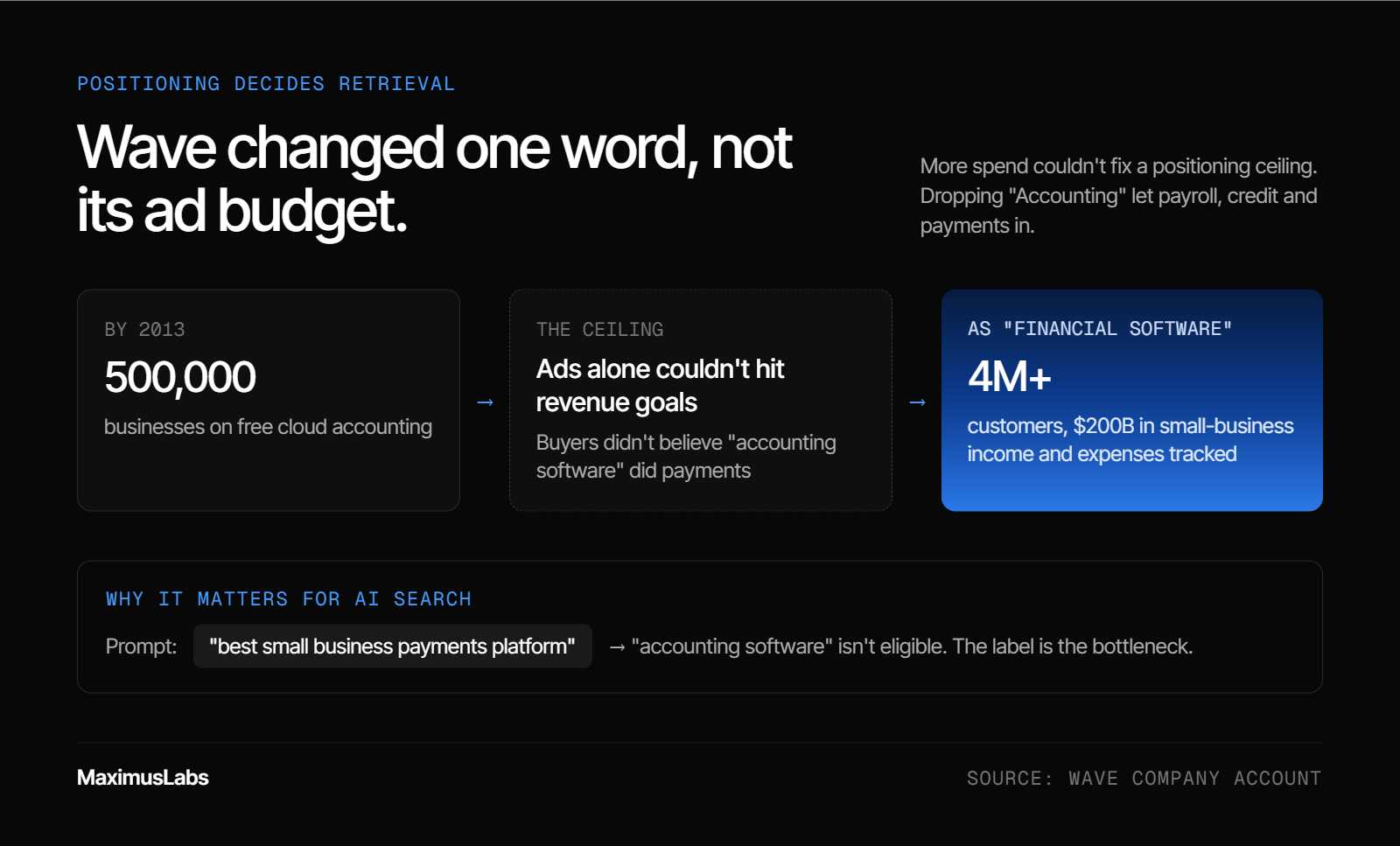
Wave reached 500,000 businesses on free cloud accounting, then found that advertising alone could not hit its revenue goals. Dropping "Accounting" from its identity and repositioning as "financial software" let it embed payroll, credit, and payments. The company grew past 4 million customers tracking $200 billion in small-business income and expenses. Category language is a retrieval decision. It sets which AI answers a brand is even eligible to appear in.
⚠️ The ceiling nobody budgets for
Wave did everything right on acquisition. Small business owners loved a free tool that replaced shoeboxes and spreadsheets. By 2013, half a million businesses were using it.
Then the ceiling arrived. Ad revenue could not carry the business, and more spend was not going to fix a positioning problem. That is the part most fintech teams misdiagnose as a channel problem, and it is why GEO competitive positioning comes before media planning.
💰 What the repositioning actually solved
Kirk Simpson, Wave's CEO, described the friction in plain terms. When the company was "accounting software," customers struggled to understand that it also offered payroll and payments. The label capped what buyers believed the product could do. (Wave, company account)
Changing the label changed the product roadmap and the revenue model together. Transaction-based payroll, credit, and payment processing moved inside the app. The outcome was 4 million customers and $200 billion in tracked transactions.
✅ Why category language is now a retrieval decision
Here is the GEO consequence that did not exist in 2013. AI engines retrieve against the category a buyer names in the prompt. A fintech positioned as "accounting software" does not surface for "best small business payments platform," no matter how good the payments feature is.
So your category copy is not branding garnish. It decides your prompt eligibility, which makes entity optimization a positioning task rather than a technical one.
| Category you claim | Prompts you become eligible for | Prompts you lock yourself out of |
| Accounting software | "best free accounting tool" | "best SMB payments platform" |
| Financial software for small business | "best all-in-one finance tool for SMBs" | Narrow accounting-only comparisons |
| Payroll software with global EOR | "payroll software with Argentina EOR" | Generic bookkeeping queries |
I use this test with fintech founders. Write the five prompts your best customers would type into ChatGPT. If your current category label does not appear in any of them, the label is the bottleneck, not the budget. A question-research approach makes that list concrete.
⭐ The speed claim AI engines can verify
One positioning move works unusually well in finance. Position against institutional slowness, not against feature lists. A nimble lender promising approval in minutes competes on something a buyer can feel and a reviewer can confirm.
The catch is verification. AI engines corroborate speed claims through third-party coverage, reviews, and community threads, not your homepage. A claim with no outside evidence reads to a model as marketing copy.
MaximusLabs AI positions the product exactly the way the client wants it, then builds the content system around that positioning rather than around whatever keyword volume looks tempting. In our fintech and B2B SaaS work, positioning gets locked before a single page is scoped, because the category label decides which prompts the content can ever win.
Q6. Which fintech content converts, and which is pure waste?
Financial glossary content converts at close to zero. Ethan Smith of Graphite puts it bluntly: the definition of payroll has a zero conversion rate, every time. Roughly 19 of 20 landing pages drive little traffic, while one drives about 85% of it. Fintech budget belongs in the middle and at the end of the buyer journey. That means problem-solution pages, interactive calculators, and competitor comparisons, not definitions AI engines already answer themselves.
❌ The glossary habit, and why it survives
Glossaries survive because they are easy to brief and easy to count. Fifty definitions look like progress in a content report. They rank, sometimes well, and they produce almost no revenue.
Smith's advice is to spend no time on glossary definitions or low-intent content, and to focus on the end and middle of the journey. (Ethan Smith, CEO of Graphite, recorded talk) I agree, with one caveat I will state honestly. A handful of glossary terms earn their place when your product name sits inside the definition.
📊 The distribution math behind the verdict
The 19-of-20 pattern is the real argument. Content output is not a steady return machine. It is a power law, where a small number of pages carry nearly all the result.
That changes how you brief. You are not writing 50 pages hoping for an average. You are hunting for the few pages that compound, which are almost always the ones a buyer reads with a credit card decision pending. That is the logic behind revenue-focused GEO planning.
✅ The three archetypes that actually produce pipeline
These are the page types I would fund first in a fintech content plan.
| Archetype | Example page | Why it converts |
| Problem-solution use case | "How to set up payroll in Argentina" | Matches an operational task with a deadline attached |
| Interactive tool | "Employee cost calculator for California" | Produces a number the buyer needs, then captures intent |
| Comparison page | "[Your tool] vs [Competitor]" with feature and pricing tables | Catches buyers in active evaluation |
Structure them as a cluster, not as scattered posts. One pillar page explains the job, and each archetype page handles a specific variant of it. Internal links point inward to the comparison and calculator pages, because those carry the conversion, which is exactly how GEO topic clusters are built.
⏰ The buying rhythm nobody designs for
Ethan Smith describes the structural reality of financial B2B buying. A Director of Finance is not changing banks every week, and is not searching for your product today, but will eventually make a decision. The waste comes from paying for attention during the long gap.
So build for the decision moment, then let the engines handle the definitions. My hypothesis, tested across fintech and B2B SaaS AEO content plans, is that a 10-page BOFU cluster outperforms a 60-page glossary on pipeline within two quarters.
MaximusLabs AI starts content planning at the bottom of the funnel and works upward, with Answer Engine Optimization (AEO) as the flagship and SEO underneath it. Comparison, use-case, and objection-handling pages ship first, because those are the queries where a brand mention turns into pipeline instead of a pageview.
Q7. Why do AI engines cite NerdWallet instead of your product page?
For banking queries in ChatGPT, 64.6% of citations come from earned media, 34.1% from brand-owned content, and 1.2% from social. Brand web mentions correlate with AI Overview visibility at r=0.664, roughly three times stronger than backlinks at r=0.218, and brands are about 6.5 times more likely to be cited through third-party content than their own site. Head terms need earned placement. Long-tail product queries are winnable on your own domain. (iQuanti GEO Research Study for BFSI, June 2026)
📊 The citation mix, read honestly
Those percentages explain a frustration I hear constantly. A fintech ranks page one for "best business checking," then watches ChatGPT recommend NerdWallet, Forbes, and Bankrate instead.
The engine is not ignoring you. It is following its own trust pattern, which favors sources that review many options over sources that sell one. In fintech specifically, more than 60% of AI citations come from publishers, affiliates, and expert reviews rather than brand domains. (upGrowth Fintech AI Visibility Benchmark Report, February 2026)
⭐ Mentions now outrank links
The correlation gap is the part that should change a budget. Unlinked and linked brand mentions track AI visibility at r=0.664, while backlinks sit at r=0.218.
For a decade, link acquisition was the off-site program. The data now says the off-site program is mention acquisition, and a link is a nice side effect. Reddit presence shows the same pattern, with fintechs active there earning noticeably more ChatGPT citations than absent ones, which is why Reddit and forum AEO now sits inside the core plan.
✅ The decision rule by query type
Do not run one off-site strategy. Split it by where the query sits.
| Query type | Example | Winning strategy | Who owns it |
| Head | "best business checking account" | Earned: publisher, affiliate, review platform placement | PR plus partnerships |
| Mid-tail | "payroll software for 50-person startups" | Mixed: comparison pages plus review profiles | Content plus customer marketing |
| Long-tail | "payroll software with Argentina EOR integration" | Owned: product, docs, and use-case pages | Content plus product marketing |
Krishna's framing of the stakes is the one that lands with founders. The list an AI returns becomes the sample set. If your company is not on that list, you are not in the buying conversation at all, however good the product is. Closing that gap is the whole job of AI citation acquisition.
⚠️ Where most agency scopes stop
This is the honest comparison. Traditional SEO agencies optimize the client's domain, which covers roughly a third of where fintech citations actually come from. Some GEO specialists name earned media in the pitch, then ship owned content only. A fintech AEO agency should be accountable for both.
MaximusLabs AI runs both pillars by design: Owned AEO, where your content becomes the answer, and Earned AEO, where reviews, Reddit, press, and listicles make engines trust you. Our citation-intelligence work maps which sources each engine already trusts, then targets those sources, and every engagement is measured on pipeline rather than mentions.
Q8. Which technical signals actually get fintech content cited?
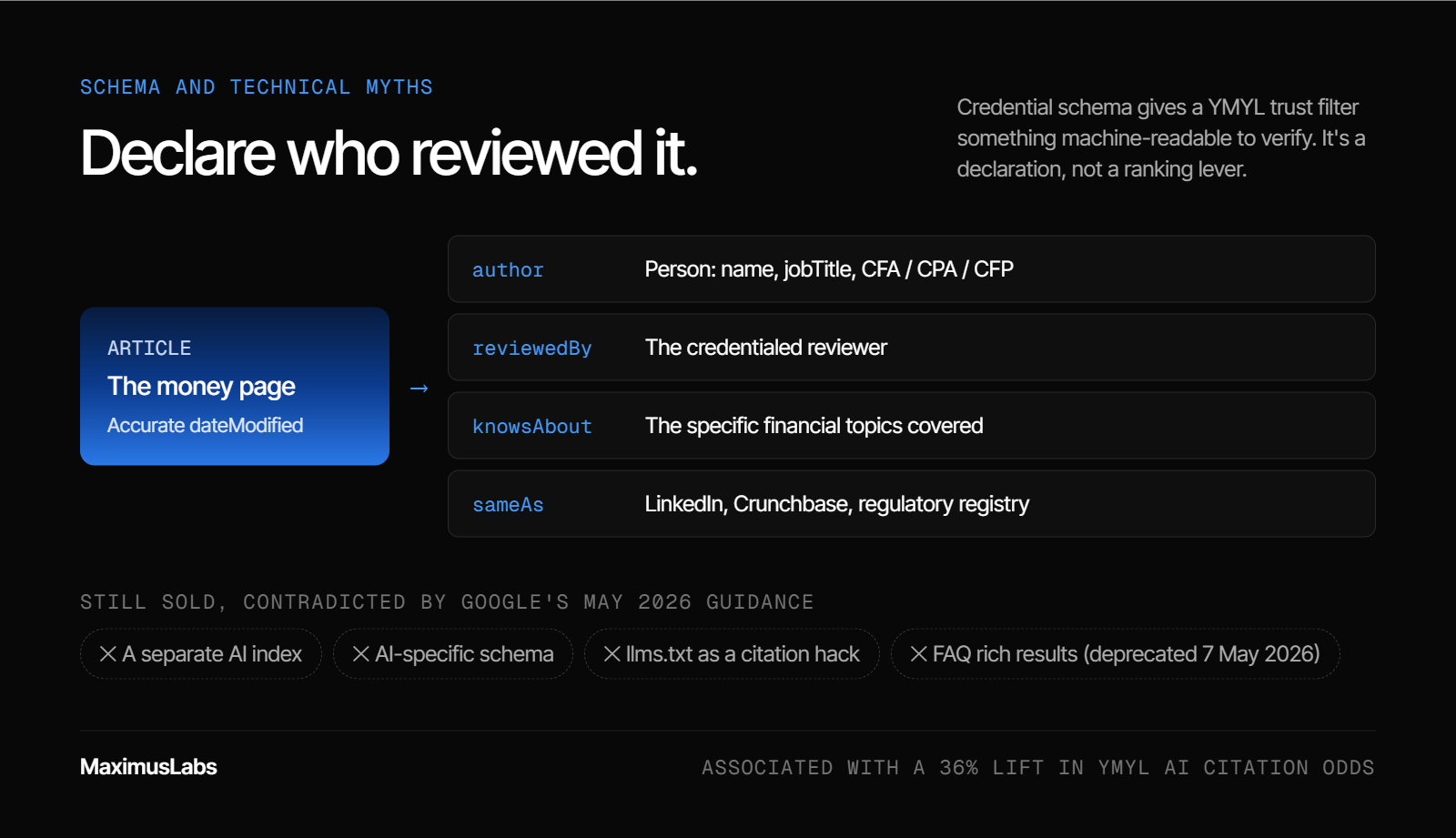
Google's May 2026 generative AI guidance is explicit. There is no separate AI index, no AI-specific markup, and no required llms.txt file. FAQ rich results were deprecated on 7 May 2026. What does appear to move YMYL citation odds is credential declaration. Schema using reviewedBy linked to a credentialed expert, plus Person schema carrying knowsAbout and sameAs, has been associated with a 36% lift in AI citation probability on YMYL topics. (Google Search Central)
❌ The three myths still being sold
I have reviewed fintech SEO proposals this year that priced all three of these as deliverables. Google's own documentation contradicts each one.
"We will get you into the AI index." There is no separate AI index.
"You need AI-specific schema." No such markup type exists.
"An llms.txt file makes you citable." It is not required or used by Google Search.
Crawlability and snippet eligibility are the actual prerequisites. Those are hygiene, not strategy, and an AI crawlability check settles them in an afternoon.
⚠️ The contested evidence, stated fairly
Schema's effect on ranking is genuinely disputed, and I will not pretend otherwise. The null-result view from agencies like SALT.agency is that schema does not lift organic rank, and that high-authority sites simply deploy it more consistently.
The YMYL view is narrower and more credible to me. Schema that declares who reviewed the content, and what they are qualified in, gives a trust filter something machine-readable to verify. That is a different job from ranking, and it mirrors what works in other YMYL categories.
✅ The markup to deploy, field by field
This is the implementation I would hand a fintech developer on Monday. Schema.org documents each property, so nothing here is proprietary.
Article with author pointing to a Person, not an organization or a staff alias.
Person with name, jobTitle, and credentials such as CFA, CPA, or CFP.
Person with knowsAbout listing the specific financial topics covered.
Person with sameAs pointing to LinkedIn, Crunchbase, and any regulatory registry entry.
reviewedBy on money-related pages, linked to the credentialed reviewer.
Organization with licence identifiers and regulator references where applicable.
Product and Review markup on comparison pages, where rich results still apply.
dateModified kept accurate, since review recency is part of the trust read.
Keep the visible page and the markup in agreement. A byline in schema that does not appear on the page is a trust defect, not a shortcut. Our technical GEO implementation notes walk through each property in order.
💰 Where the budget should actually go
My read, and MaximusLabs AI's data points the same way, is that technical schema work is cheap, fast, and finite. It takes a sprint, not a retainer. The expensive, compounding work is earning the credentials and the third-party corroboration that the schema points to.
So treat markup as the declaration layer and trust as the asset. If the credential behind reviewedBy is thin, the markup just declares that fact more clearly.
MaximusLabs AI ships credential schema as standard and refuses to scope it as an AI-ranking shortcut. The framing goes into client scopes as a trust-verification signal, not a ranking lever, which is where we part ways with GEO vendors still selling llms.txt as a citation hack.
Q9. Why is boring YouTube the most underpriced fintech channel?
Nobody makes YouTube videos about asset management software. People make them about travel and cooking. That absence is the arbitrage. High-LTV, low-entertainment financial categories carry almost no video competition, and video now gets pulled into Google AI Overviews and Gemini answers. A plain screen recording of a multi-entity consolidation workflow can own a query no blog post will ever win.
⚠️ Everyone is fighting over the same twelve keywords
Open any fintech content calendar and you see the same cluster. Best payroll software. Payment gateway comparison. Embedded finance guide. Forty competitors publish against each one every quarter.
Meanwhile the video surface sits empty. Ethan Smith of Graphite makes the point with a question worth sitting with: how many YouTube videos exist about asset management software? Maybe one. Maybe none. (Ethan Smith, CEO of Graphite, recorded talk)
💸 The absence is the opportunity
Smith's conclusion is counterintuitive and correct. The most interesting products to film are the least entertaining ones, because nobody has crowded them.
Here is the mechanism that makes it pay in 2026. AI engines pull from YouTube because video transcripts are dense, structured explanations of a specific task. When one video exists on a query and it is yours, you are not competing for the citation. You are the only candidate, which is the point of multimodal GEO.
✅ Three formats worth filming first
I would start with these, in this order, and keep every one of them unglamorous.
| Format | Example title | Why engines pick it up |
| Workflow walkthrough | "How asset management platforms handle multi-entity consolidation" | Answers a task question with visible steps |
| Setup explainer | "Setting up payroll for a contractor in Argentina" | Matches long-tail operational prompts |
| Honest comparison | "Reconciliation in [Tool] vs [Competitor], side by side" | Feeds evaluation-stage queries |
No studio. No b-roll. Screen recording, a real workflow, and a person who has actually done the task. Eight minutes is plenty, and the transcript doubles as citation-worthy content.
⭐ Why the speaker matters more than the production
One thing I have gotten wrong before. I assumed polish mattered, so an early video got scripted into something smooth and generic. It performed badly. The next one was the founder talking through the product with pauses and corrections, and it got cited.
Credibility in finance video comes from fluency, not lighting. A viewer, and increasingly a model, can tell when the speaker has done the task and when they are reading a brief.
MaximusLabs AI scripts these walkthroughs in the founder's own voice rather than handing clients a generic template. Our Founder's Voice work exists for exactly this reason: the founder's perspective carries the explanation, which is what makes an unglamorous eight-minute walkthrough credible enough for an engine to cite.
Q10. How do you measure AI-search visibility, and should you buy a tool for it?
Large language model outputs are stochastic, meaning the same prompt returns different answers each time. One check proves nothing. Run 7 to 10 repetitions per prompt to build a real Share of Answers distribution, and score it per engine, because median fintech brand visibility swings about 2.4 times between platforms. Close the attribution gap with a "How did you hear about us?" field at signup, plus GA4 segments for chatgpt.com, perplexity.ai, and gemini.google.com. On tooling, over 60 trackers perform the same ping-and-chart job. (LoudFace Fintech AI Visibility Index, July 2026)
📊 The 7-to-10 run rule
Most teams check ChatGPT once, see their brand missing, and panic. Or they see it present and relax. Both readings are noise.
Repetition turns a single answer into a measurement. Ask the same buyer question 7 to 10 times, log whether your brand appears, in what position, and alongside whom. That distribution is your Share of Answers, and it is the only AI-visibility number worth reporting, which is why AEO measurement metrics differ from rank tracking.
⚠️ Why GA4 undercounts AI influence
AI search influences buyers who never click. They read the answer, then search your brand name or type the URL directly. GA4 files that as Direct or branded organic, so the channel that created demand gets no credit. (Google Analytics 4 traffic-acquisition documentation)
The fix is low-tech and it works. Add a required "How did you hear about us?" field at signup or demo request. Then build GA4 explorations filtered to the AI referrer domains and attach your key conversion events. Search Console reports AI Overview impressions inside overall Search totals rather than as a separate line, so do not expect a clean breakout there. (Google Search Central) Pairing that with GEO measurement and metrics closes most of the gap.
💰 Build, buy, or skip the tracker
Ethan Smith's team built their own tracker for a few cents per question, after cataloguing 60-plus tools that all do the same thing. His forecast is blunt: in two years you will probably be using Ahrefs anyway.
Two more facts belong in the decision. Most tracking platforms query vendor APIs rather than scraping live logged-in interfaces, and API responses return a different citation mix than real users see. And knowing your rank does not cause an outcome. Our breakdown of AEO tools covers the trade-offs in detail.
| Option | Real cost | Honest limitation |
| Commodity AEO tracker | Hundreds per month | API-based readings drift from live user answers |
| In-house prompt runner | Cents per question | Needs engineering time to maintain |
| Incumbent SEO suites | Bundled | Feature depth still catching up |
⏰ Google rank is not a proxy
The last argument against shortcuts is overlap. On investment queries such as "How do I invest in stocks," ChatGPT and Google share only around 12% of the same URLs. Google leans toward brokerages and government pages. ChatGPT leans toward explainers.
So a page-one ranking tells you almost nothing about whether an engine will cite you. You have to measure the engines directly, and the citation patterns across ChatGPT, Perplexity, and Gemini diverge further every quarter.
MaximusLabs AI reports Share of Answers per engine alongside pipeline, not impressions, with daily AI-visibility tracking that is re-run and regression-tested. We deliberately do not resell tracking dashboards, because the measurement layer is cheap and client budget belongs in earning the citation. Every engagement is held to pipeline, not mentions.
Q11. What does the first 90 days of a fintech GEO rollout look like?
Days 1 to 30: baseline segment CAC, build a 50-prompt tracked set per engine, audit author credentials and indexability, and agree the legal review SLA. Days 31 to 60: ship BOFU comparison and use-case pages with SME bylines and Person schema, then instrument GA4 AI-source segments and a self-report field. Days 61 to 90: run earned-citation placement, Reddit and LinkedIn sentiment work, and report Share of Answers against pipeline. (NP Digital FinTech AI Visibility Index, 2026)
✅ The 90-day sequence, with owners
Credentials come before volume. That ordering is the whole plan.
| Window | Work | Owner | Gate before next phase |
| Days 1-30 | CAC baseline, 50-prompt tracked set, credential and indexability audit | Head of Organic Growth | Legal review SLA signed |
| Days 31-60 | BOFU comparison, use-case, and calculator pages with SME bylines and Person schema | Content lead plus SME reviewer | Every page carries byline, review date, and disclosure |
| Days 61-90 | Earned placement, review profiles, Reddit and LinkedIn sentiment work | Growth plus partnerships | Share of Answers reported against pipeline |
Resist the urge to publish in week two. A fintech page without a credentialed reviewer fails the trust filter, so it burns production budget for no citation. A fintech SEO and AEO partner should hold that gate rather than ship around it.
⚠️ The sentiment workstream nobody scopes
This is the part most plans miss. Engines read the whole internet about you, not just your site. Krishna describes the work directly: alongside bottom-of-funnel optimization, his team ran sentiment analysis, then performed pinpoint surgeries on Reddit and LinkedIn to lift overall brand sentiment, because AI references a wide set of resources, not only your page.
Three concrete moves for days 61 to 90. Audit what the top five AI engines currently say about your brand. Find the threads shaping that answer with a Reddit threads finder. Contribute honestly where your team has real expertise, with disclosure, which is the core of SEO online reputation management.
📊 What to report at day 90
Pick metrics a CFO will accept. Three work well.
Share of Answers per engine, from your 50-prompt set, run 7 to 10 times each.
AI-sourced pipeline, pulled from your self-report field and GA4 AI segments.
Cost per citation-driven opportunity, compared against your segment CAC benchmark.
Impressions and mentions belong in the appendix. They are inputs, not outcomes.
⏰ What I expect to shift next
My honest uncertainty sits here. Engine citation behavior in finance moves with every model and policy update, so the 50-prompt set needs re-running monthly rather than quarterly. I also expect earned surfaces to get more crowded through 2027, which means the arbitrage window on review platforms and community threads is open now, not forever. If you want that window mapped for your category, talk to our team.
MaximusLabs AI runs this exact sequence in financial services and B2B SaaS: BOFU first, credentials before volume, sentiment work across Reddit and LinkedIn, then pipeline-attributed Share of Answers reporting. Our published Oliv AI result shows what the sequence produces: 27 qualified leads, $47K+ pipeline, 26% close rate in 4 months (Oliv AI).
Frequently asked questions
What is a fintech marketing strategy in 2026?
A fintech marketing strategy in 2026 is a two-surface acquisition engine rather than a single SEO plan. • Surface one is Google, where clicks to any website fall from about 15% to 8% once an AI summary appears above the results. • Surface two is AI answer engines, where a brand is either inside the recommendation set for a prompt or absent from the buying conversation entirely. Both surfaces reward the same underlying asset: verifiable trust attached to a named expert. Neither rewards volume for its own sake. MaximusLabs AI treats the split as two separate planning and measurement tracks, with Answer Engine Optimization as the flagship deliverable and SEO as the foundation beneath it. We plan Google work around indexability, rank, and snippet eligibility, then plan engine work around citability and third-party corroboration. The practical shift for a founder or VP Marketing is the target metric. Ranking a blue link no longer predicts revenue in a regulated category, so the goal becomes becoming the answer engines cite, then tracing that citation to pipeline. Everything else in a fintech plan, from content architecture to compliance review, follows from that reframe.
What does a fintech customer actually cost to acquire?
Fintech customer acquisition cost varies sharply by segment, so blended CAC hides the decision you actually need to make. • Consumer fintech: around $202 per customer • SMB fintech: around $1,450 • Mid-market: around $4,903 • Enterprise: around $14,772, with enterprise crypto near $17,249 and payment processing near $15,665 Channel matters just as much. Thought-leadership SEO lands B2B fintech customers at roughly $647, against roughly $1,254 for general content marketing, and a healthy LTV:CAC target sits near 4:1 with a 12-month payback. The newer variable is AI search. AI referral volume is still small, close to 0.14% of total visits, yet those visitors convert roughly 4.4 times better than traditional organic traffic. Small volume plus high conversion produces an unusually cheap marginal channel, because almost nobody has bid it up yet. MaximusLabs AI scopes engagements by expected pipeline contribution rather than deliverable count, which is why our GEO ROI and revenue attribution work starts with segment CAC instead of keyword volume. Rebuild the plan against the segment number, fund the assets an engine can cite, and report revenue per AI session alongside cost per click.
Why do so few financial queries trigger an AI Overview?
Google produces AI Overviews for roughly 5% of financial YMYL queries, compared with about 63% of health queries. Finance sits behind chunk-level trust classifiers, and the answers Google does return tend to be brief, heavily disclaimered, and thinly cited. Google's own guidance explains the reasoning: its systems give more weight to content aligning with strong E-E-A-T when a topic could significantly affect a person's financial stability, which Google calls Your Money or Your Life. Read that scarcity as an opportunity rather than a reason to deprioritise AI search. Fewer eligible slots means a credentialed fintech competes against a handful of names instead of an entire SERP. The checks that decide eligibility are mundane and mostly structural: • Author bylines tied to a named subject-matter expert, not a staff account • Credentials that resolve somewhere verifiable, such as CFA, CPA, CFP, or JD • Citations to official or peer-reviewed sources rather than other blogs • Visible review dates, disclosures, and licensing references Every fintech content system MaximusLabs AI ships begins with that credential architecture before production starts, because E-E-A-T optimization is what clears the filter. In a 5% trigger environment, the filter decides who appears, not the keyword.
Can fintech teams publish AI-assisted content without a YMYL penalty?
Yes, but only with a review gate in place. A financial site running mostly unedited AI-generated content lost 99.3% of its rankings after the November 2023 E-E-A-T core update. Speed was never the problem. Unverified authorship was. The control system is straightforward to run and costs velocity only in the first week: • Assign a named credentialed reviewer to every money-related topic cluster • Require one primary source, such as a regulator, official document, or first-party dataset, per factual claim • Block publication until byline, credentials, review date, and disclosure appear on the page • Add Person schema with knowsAbout and sameAs pointing to LinkedIn and any regulatory registry • Re-review anything older than 12 months before it earns internal links The same algorithm update that destroyed one publisher rewarded another. A credit card affiliate site that earned nothing for three years reached roughly $30 million in revenue after an update, because it followed best practices while competitors were wiped out. MaximusLabs AI built its trust-first content methodology around that asymmetry, scaling verifiable review capacity instead of word count. We pair SME sign-off with AI-assisted production, and humans approve everything that ships.
Why do AI engines cite NerdWallet instead of a fintech product page?
Because the citation mix in finance is dominated by earned media. For banking queries in ChatGPT, 64.6% of citations come from earned sources, 34.1% from brand-owned content, and 1.2% from social. Two more findings reset the off-site playbook. Brand web mentions, linked and unlinked, correlate with AI Overview visibility at roughly r=0.664, about three times stronger than backlinks at r=0.218. And brands are around 6.5 times more likely to be cited through third-party content than through their own site. So split the strategy by query type instead of running one program: • Head queries such as "best business checking account" need earned placement across publishers, affiliates, and review platforms • Mid-tail queries reward comparison pages plus active review profiles • Long-tail product queries such as payroll with a specific country integration are winnable on your own domain MaximusLabs AI runs both pillars deliberately: Owned AEO, where your content becomes the answer, and Earned AEO, where reviews, Reddit, press, and listicles make engines trust you. Our citation acquisition work maps which sources each engine already trusts, then targets those sources.
Does schema markup or llms.txt get fintech content cited?
Google's May 2026 generative AI guidance is explicit on the myths. There is no separate AI index, no AI-specific markup type, and no required llms.txt file for Google Search. FAQ rich results were deprecated on 7 May 2026. Crawlability and snippet eligibility are the real prerequisites, and those are hygiene rather than strategy. What does appear to help on YMYL topics is credential declaration. Schema using reviewedBy linked to a credentialed expert, plus Person schema carrying knowsAbout and sameAs, has been associated with a 36% lift in AI citation probability. The contested view deserves stating too: several agencies report null results for schema on organic rank, arguing high-authority sites simply deploy it more consistently. A workable deployment order looks like this: • Article with author pointing to a Person, never a staff alias • Person with jobTitle, credentials, knowsAbout, and sameAs links • reviewedBy on every money-related page • Organization with licence identifiers, plus accurate dateModified MaximusLabs AI ships credential schema as standard and scopes it honestly as a trust-verification signal rather than a ranking lever, which is where our technical GEO implementation parts ways with vendors selling llms.txt as a citation hack.
How do you measure AI search visibility and connect it to pipeline?
Start by accepting that large language model outputs are stochastic, meaning the same prompt returns different answers each time. One manual check proves nothing. • Run 7 to 10 repetitions per prompt to build a real Share of Answers distribution, logging whether your brand appears, in what position, and beside whom • Score per engine, because median fintech brand visibility swings roughly 2.4 times between platforms • Add a self-report field such as "How did you hear about us?" at signup, since GA4 files most AI-influenced visits as Direct or branded organic • Build GA4 segments for chatgpt.com, perplexity.ai, and gemini.google.com with key events attached Do not treat Google rank as a proxy. On investment queries, ChatGPT and Google share only around 12% of the same URLs. On tooling, more than 60 trackers perform the same ping-and-chart job, most of them querying vendor APIs rather than live interfaces, so readings drift from what real users see. MaximusLabs AI reports Share of Answers per engine alongside pipeline rather than impressions, using daily tracking that is re-run and regression-tested. Our AEO measurement approach exists so budget goes into earning citations, not renting dashboards.