 Krishna Kaanth M
- AEO competes for the citation slot inside a generated answer, while SEO competes for a click on a results page.
- SEO, AEO, and GEO are three dependency layers, not three names: SEO makes you eligible, GEO makes you considered, AEO makes you quoted.
- Analysis of 177 million citation instances found 44.2% of AI citations come from the first 30% of a page, so front-load every answer.
- Semrush found 65% to 85% of ChatGPT prompts match no keyword in a 27-billion-query database, so keyword tools cannot build your prompt set.
- Gartner's 25% search-volume drop forecast is contradicted by clickstream data showing Google grew roughly 21.6% in 2024, around 373 times ChatGPT's volume.
- Start Monday with entity resolution and a sameAs loop across Wikidata, LinkedIn, Crunchbase, and G2, then report citation share against pipeline.
Q1. What Is Answer Engine Optimization, and Why Did an Entire Vocabulary Appear in 24 Months?
Answer Engine Optimization (AEO) is the practice of structuring content so AI answer engines (ChatGPT, Perplexity, Gemini, Copilot, and Google AI Overviews) extract, attribute, and cite it inside generated answers. SEO competes for a click on a results page. AEO competes for the citation slot inside the answer. The vocabulary matters because most of it was coined after 2023, and much of it is still contested.
A VP of Marketing pasted a competitor's glossary into Slack last month and asked one question: "Which of these are real terms, and which did a vendor invent to sell a dashboard?" Nobody on the call could answer. That is the actual state of this category.
Why the definitions you are reading are mostly unsourced
Run a search for AEO terms and you get roughly a dozen glossaries. They compete on term count, not accuracy. Titles promise 20 terms, 25 terms, 35 terms, and 60 terms.
Almost none of them cite where a term came from. The word "GEO" has a paper behind it, with named authors and a benchmark. Not one ranking glossary names it.
📄 The paper nobody cites
Generative Engine Optimization was formalized in a 2023 academic paper by Aggarwal, Murahari, Rajpurohit, Kalyan, Narasimhan, and Deshpande. They built a benchmark called GEO-bench and tested optimization tactics across query domains, which remains the source of record for what generative engine optimization actually means.
Their headline finding: the right tactics lifted source visibility in generative answers by up to 40%. The lift varied a lot by domain, which is the part vendors skip.
"There's no reason for someone that's like, oh, just tell me the answer instead of me having to go through and read the articles from those 10 blue links."
That is the reader behavior driving all of this. The searcher stopped wanting a list. They want the synthesis.
🧭 One definition per term is already a simplification
Here is my honest hedge. MaximusLabs AI's client data points one way on this, though I might be reading it too strongly.
What ChatGPT treats as a trustworthy source is not what Google rewards. What Perplexity cites is different again, as the cross-engine citation patterns show. So a single flat definition of "citation" hides three different mechanisms.
How this glossary is organized
MaximusLabs AI applies a fixed source hierarchy to every definition here: academic papers first, then patents, then official platform documentation, then original datasets, with secondary blogs last. Terms that have no source of record are labeled as practitioner conventions, not standards.
The terms sit in seven tiers.
| Tier | What it covers |
| Foundational | AEO, GEO, answer engine, citation, extraction |
| Retrieval mechanics | RAG, grounding, chunking, embeddings, query fan-out |
| Entity and authority | Entity, knowledge graph, sameAs, earned-media bias |
| Legacy SERP carryover | Zero-click, featured snippet, People Also Ask, voice |
| Platform | ChatGPT, Perplexity, Gemini, Copilot, Claude, AI Mode |
| Measurement | Prompt inventory, AI Share of Voice, citation rate |
| Revenue and GTM | BOFU prompt coverage, ICP-prompt alignment |
⚠️ Read this as a reference, not an essay
Nobody reads a glossary end to end. Jump to the tier you need. Each term carries its source of record and one action you can take this week.
MaximusLabs AI traces every foundational term on this page to the paper, patent, or platform doc that defined it, because unsourced definitions are exactly what AI engines now discount when weighing which source to quote.
Q2. AEO vs GEO vs SEO: What Actually Separates the Three Disciplines?
SEO optimizes pages for ranked links and is measured in rankings and clicks. AEO optimizes on-page formatting for extraction, wins the citation slot inside a generated answer, and is measured by citation rate. GEO optimizes entities, authority, and earned media across generative engines, measured by AI Share of Voice. Some vendors call GEO and AEO synonyms, and that collapse loses the distinction that matters.
The situation: three acronyms, no agreed boundary
Every buyer conversation now includes all three letters. Sales decks use them interchangeably. Procurement teams cannot tell whether they are buying one service or three.
The complication: the category contradicts itself
One published glossary defines GEO as a synonymous term for AEO. Others draw a firm line between on-page answer formatting and off-site entity work.
Both cannot be right. A reader comparing two vendor pages gets two incompatible answers, which is a trust problem before it is a taxonomy problem.
🔍 Where the research actually lands
A 2025 controlled study across verticals, languages, and query paraphrases found something the synonym camp cannot explain. AI search shows a systematic and heavy bias toward earned media, meaning third-party authoritative sources, over brand-owned content.
Google's mix is far more balanced. So the off-site work behaves differently from the on-page work. That difference deserves its own word.
The resolution: three layers, not three names
| Discipline | What it optimizes | Where it wins | How it is measured |
| SEO | Crawlability, relevance, links | Google results page | Rankings, clicks, CTR |
| AEO | Extractable on-page answers | The citation slot inside an answer | Citation rate, answer share |
| GEO | Entities, authority, earned media | Whether the engine considers you at all | AI Share of Voice, citation position |
Read the table top to bottom as a dependency chain. SEO makes you eligible. GEO makes you considered. AEO makes you quoted, and the full breakdown of AEO versus SEO differences sits alongside this glossary.
🧪 The contrarian read
"Many people tell me GEO is SEO+, but I have a contrary view. Generative Engine Optimization is more of a data science problem. We need to exactly know how these LLM algorithms work to be present in the answers."
That is my position, and I will own it. Treating GEO as a renamed SEO retainer is the single most common mistake I see in vendor pitches.
MaximusLabs AI's read is that the standard advice gets this backwards. Agencies sell GEO as an add-on line item, then run the same keyword workflow underneath it, which is why the comparison between GEO and traditional SEO matters before you sign anything.
⚖️ How the three approaches compare in practice
- ✅ Traditional SEO agencies still deliver real value on technical crawl health and site architecture.
- ✅ They have mature reporting and years of Google-specific pattern knowledge.
- ❌ Their playbooks optimize the website only, which leaves the earned-media layer untouched.
- ✅ Newer GEO specialists correctly identify that citations matter more than rank.
- ❌ Many of them measure share of voice without publishing the prompt set behind the number, so the figure cannot be audited.
MaximusLabs AI runs answer engine optimization and generative engine optimization as separate workstreams for the same client, because on-page extraction and off-site entity authority fail for different reasons and need different fixes.
Q3. Which Foundational AEO Terms Should Every Team Define First?
The ten foundational AEO terms are: answer engine, generative engine, AI Overview, AI Mode, citation, answer nugget, extraction, source of record, question research, and share of voice. Learn these ten and most AI-search conversations become readable. Every other term in this glossary is a specialization of one of them.
The ten terms, defined
🧩 Terms 1 to 5: the surfaces and the output
Answer engine. A system that returns a synthesized answer instead of a list of links. Practitioner convention, no formal standard. Action: list the three answer engines your buyers actually use.
Generative engine. Formal term from the 2023 GEO paper for a search system that synthesizes answers from multiple retrieved sources using a language model. Action: use this term in technical docs, where precision matters.
AI Overview. Google's generated summary block above organic results. Google Search Central documentation is the source of record. Action: check which of your money queries trigger one.
AI Mode. Google's fully conversational search surface, separate from AI Overviews. Action: test your top ten prompts in both, because the answers differ.
Citation. A named or linked reference to your content inside a generated answer. Being named without a link still counts, and it still carries influence. Action: track named mentions, not just clickable links, using a structured citation optimization approach.
📐 Terms 6 to 10: the craft and the scoreboard
Answer nugget. A 40 to 80 word standalone block placed directly under a heading, written to survive extraction with no surrounding context. MaximusLabs AI treats this block as non-negotiable in every section it publishes. Action: audit whether your first paragraph makes sense alone.
Extraction. The step where an engine lifts a passage from your page for use in its answer. Action: read your page as isolated 80-word chunks.
Source of record. The original paper, patent, standard, or platform doc that first defined a term or established a finding. Action: replace one secondary blog citation this week.
Question research. Mapping the many phrasings buyers use, replacing keyword research as the planning unit. Ethan Smith of Graphite frames the shift plainly: answer optimization is the new SEO. Action: pull twenty real questions from sales calls, then expand them with a query fan-out generator.
Share of voice. How often your brand appears across a defined set of question variants, compared with competitors. It replaces a single rank position, because answers change per run. Action: fix your prompt set before you measure anything.
🎯 Why question research is the real shift
The unit of planning changed, not just the tactic. Keyword volume tells you what people typed into a box. It tells you very little about a 30-word conversational prompt.
Smith's framing is useful here. One well-built page can serve thousands of question variants, the same way one SEO page once served thousands of keywords, which is the premise behind AEO keyword and question research.
MaximusLabs AI builds prompt sets from recorded sales objections rather than volume tools, because the questions that precede a purchase decision rarely appear in a keyword database at all.
Q4. How Do AI Engines Retrieve Content, and What Do RAG, Grounding, Chunking, and Query Fan-Out Mean?
Retrieval-Augmented Generation (RAG) is where an engine searches, retrieves passages, and generates an answer grounded in them. Grounding ties the answer to retrieved sources rather than model memory. Chunking splits your page into passages, embeddings turn them into vectors, and retrieval selects by similarity. Query fan-out expands one prompt into many sub-queries. If your passage never clears the similarity threshold, nothing else matters.
The pipeline, in order
A prompt arrives. The engine decides whether to search at all. If it searches, it expands the prompt into sub-queries, retrieves candidate passages, ranks them, and writes an answer over the winners.
Five stages, and your content only enters at stage four. Everything upstream is out of your control.
🧮 Chunking, embeddings, and the similarity gate
Chunking splits your page into passages of a few hundred tokens. Embeddings convert each passage into a vector, which is just a list of numbers representing meaning.
Retrieval then compares your vector to the query vector. Passages below roughly a 0.7 cosine similarity threshold typically never enter the candidate pool. That is a mathematical gate, not an editorial preference.
⏰ Why latency shapes what gets retrieved
Grounding layers run under hard time budgets. Microsoft's Web IQ grounding layer reports a 164ms p95 full pipeline, around 2.5 times faster than its nearest alternative.
At that budget, an engine cannot wait for a page that renders slowly or hides text behind scripts. Cheap-to-parse sources win by default, which is why a crawlability check belongs at the start of the work, not the end.
The blind spot nobody defines
Every glossary defines RAG and grounding. None of them mention how often retrieval actually fires.
Semrush's April 2026 clickstream analysis, drawn from over a billion lines of United States panel data, found web search was enabled on only 34.5% of ChatGPT queries as of February 2026, down from 46% in late 2024.
🧠 What that means for your Monday
Most answers about your category are generated from model memory, not from a live crawl of your site. Publishing faster does not fix that.
Persistent mentions across the wider web do. This is the strongest practical argument for the earned-media and citation acquisition work covered later in this glossary.
🔀 Query fan-out and passage ranking
Query fan-out means one user prompt becomes several machine sub-queries. Your page might be retrieved for a sub-query you never targeted.
Passage ranking then scores individual chunks, not whole pages. A weak page with one excellent passage can beat a strong page with none.
✅ The three changes worth making
Front-load your claim in the first sentence under every heading. Keep each passage self-contained, so it survives being read alone. Define jargon inline, because the chunk may travel without your introduction, a rule covered in depth in the content formatting guide for AI search.
MaximusLabs AI tests client passages against retrieval thresholds before publication, because a definition that never clears the similarity gate stays invisible however well it reads to a human.
Q5. What Do Entity, Entity Authority, Earned-Media Bias, and the sameAs Loop Mean?
An entity is a uniquely identifiable thing an engine resolves against a knowledge graph. Entity authority is cross-verified evidence that your entity is real and consistent. Triples express facts as subject-predicate-object. Earned-media bias is the documented preference of AI search for third-party sources over brand-owned content. MaximusLabs AI closes the sameAs loop (site to Wikidata, LinkedIn, Crunchbase, G2, and back) before publishing client content.
The situation: engines fill gaps with guesses
An engine that cannot resolve who you are does not stop. It infers.
That inference comes from whatever the wider web says about your name, not from your About page.
🧩 The Oxford incident
A team watched Perplexity summarize their own article. The summary described them as Oxford researchers. None of them attended Oxford.
The detail was invented from surrounding web mentions. The agent was looking for corroboration, found something adjacent, and used it.
That is the whole lesson. Self-published facts lose to web-wide consensus.
The complication: the bias is measurable
A 2025 controlled study across verticals and languages found AI search shows a systematic, heavy preference for earned media (third-party authoritative sources) over brand-owned and social content.
The same work documented a big-brand bias that niche players must actively work against. Google's source mix is far more balanced by comparison.
📊 What correlates with visibility
Brand mentions correlate with AI visibility at roughly r = 0.664. That is a strong relationship for a marketing dataset, though correlation is not causation and the sample framing matters.
MaximusLabs AI's engagement data points the same direction, though I might be reading it too strongly given how young this set of AI visibility metrics still is.
The resolution: build a closed verifiable graph
The goal is a loop an AI crawler can traverse without exiting into ambiguity.
The sameAs traversal checklist:
- Add Organization schema on your homepage with a sameAs array.
- Point sameAs to Wikidata, LinkedIn, Crunchbase, and G2.
- Confirm each of those profiles links back to your canonical domain.
- Match your legal name, founding year, and location across all four.
- Add Person schema for your founder with their own sameAs links.
- Re-crawl and confirm the loop closes with no dead ends.
Schema.org's sameAs property is the source of record here, and the wider schema markup fundamentals sit alongside it.
⭐ Why the loop matters more than the schema
Schema alone is a hygiene factor. The loop is the differentiator, because it lets the engine verify a claim from two independent directions.
In MaximusLabs AI's client work, Oliv AI reached a 64% citation rate across AI platforms while decade-old billion-dollar incumbents sat near 30%.
🧠 Entity authority is brand building in machine-readable form
Here is the part the category avoids saying. Entity work is not a technical trick. It is brand building, expressed in a format a retrieval system can parse.
If you are genuinely known in your space, the graph closes easily. If you are not, schema will not fake it, which is why knowledge graph work precedes markup.
⚠️ Triples, plainly
A triple states one fact as subject, predicate, and object. "MaximusLabs AI" (subject) "is a" (predicate) "GEO agency" (object).
Write declarative sentences in that shape on your key pages. Engines extract them cleanly, and ambiguity drops.
MaximusLabs AI closes the sameAs loop before writing a single client article, because an engine cannot cite a brand it cannot resolve.
Q6. Zero-Click, Featured Snippets, and Voice Search: Which Legacy SEO Terms Still Apply?
Zero-click search is a query resolved on the results page with no click to any site. Featured snippets, answer boxes, People Also Ask, conversational search, and voice search are its older cousins, all answer-extraction surfaces. Ahrefs measured a 58% lower position-one click-through rate where AI Overviews appear, and Pew found only 8% of searches with an AI summary produced any website click.
The six carryover terms
Zero-click search. A query answered on the results page, with no visit to any website.
Featured snippet. An extracted passage shown above organic results, sourced from a single page.
Answer box. Google's broader family of direct-answer modules, including calculators and definitions.
People Also Ask. An expandable set of related questions, each with its own extracted answer.
Conversational search. Multi-turn querying where each follow-up assumes the previous context.
Voice search. Spoken queries returning a single spoken answer, with no visible list of options.
🔄 Why these still matter
Every one of them is an answer-extraction surface. They are earlier versions of the same mechanic AEO now targets.
If your team already won featured snippets, the muscle transfers. The format spec barely changed.
The uncomfortable data
Ahrefs compared 150,000 keywords with AI Overviews against 150,000 informational keywords without them, using aggregated Search Console data. Position-one click-through rate fell roughly 58% versus forecast by December 2025, up from 34.5% in April 2025.
Pew Research analyzed 68,879 real Google searches from 900 United States adults. Only 8% of searches with an AI summary produced a click to any site, against 15% without. Just 1% clicked a link inside the summary, which is the core of the referral traffic decline.
💸 The honest concession
"I would spend no time at all really on glossary definitions and low intense stuff. Even if you asked me five years ago, should you do glossary terms, I would still probably say no, because there's no intent to know the definition. The intent is buying it."
I am publishing a glossary while broadly agreeing with that. It would be dishonest to pretend definitional queries drive pipeline.
They do not. The click economics above make that clear enough, and the zero-click brand economy is the frame that replaces them.
✅ So why publish one at all
Two reasons, and neither is traffic.
First, a definition page teaches engines what your brand means when it discusses this category. That is entity work, not acquisition.
Second, it is an internal-linking spine. Definition pages feed authority into the bottom-of-funnel pages that actually convert.
⚠️ How to measure it correctly
Do not report sessions on a glossary. You will look bad, and you will be measuring the wrong thing.
Report whether the page gets cited, and whether it passes link equity to money pages. Those are the jobs it actually has.
MaximusLabs AI publishes definitional assets as entity infrastructure rather than traffic plays, and reports them against citation share instead of pageviews.
Q7. How Do ChatGPT, Perplexity, Gemini, Copilot, and Claude Differ as Answer Engines?
Each answer engine cites differently. Perplexity averages roughly 21.9 citations per question against ChatGPT's 7.9, about 2.8 times more sources. Copilot and Gemini lean on official vendor documentation, while Perplexity, ChatGPT, and Claude lean heavily on community discussion. MaximusLabs AI optimizes per platform rather than for "AI" generically, because one strategy cannot serve all five equally.
Why platform-specific vocabulary exists
A single word like "citation" behaves differently on each surface. On Perplexity it means one of twenty visible sources. On ChatGPT it may mean one of eight.
Treating them as one channel produces averaged advice that fits nowhere, as the cross-engine citation pattern research shows.
📊 How the five engines diverge
| Engine | Citation density | Source preference | What it rewards |
| Perplexity | Highest (~21.9 per question) | Community and recent web | Freshness, source transparency |
| ChatGPT | Lower (~7.9 per question) | Concentrated top domains | Comprehensive Q&A depth |
| Gemini | Moderate | Official docs, Google surfaces | Structured data, E-E-A-T |
| Copilot | Moderate | Vendor documentation | Clean, parseable technical pages |
| Claude | Moderate | Long-form, academic | Methodology and citation transparency |
Density figures come from a 118,000-answer citation study. Source-preference patterns come from 2026 cross-engine benchmarking.
⚠️ Do not treat any engine as ground truth
Claude Opus 4.5 has been measured at 77% fact-check accuracy. That is competent, and it is nowhere near reliable enough to accept unverified.
An independent audit of four generative search engines found roughly 16% of cited sources were themselves likely AI-generated, with Copilot highest at 27.8%.
🎯 The origin insight
What ChatGPT considers important is not what Google considers important, and neither matches Perplexity. That gap is the reason this discipline exists at all.
MaximusLabs AI was built on exactly that observation, and my honest read is that most agencies still average across it rather than working engine by engine.
Pick one engine first
Do not optimize for five surfaces simultaneously on a limited budget. That spreads effort thin and produces no clear signal.
Find out which engine your buyers actually use. Ask on your next ten discovery calls, then go deep with a single platform-level optimization guide.
⭐ What coordinated work looks like
Platform-specific does not mean five separate content programs. It means one asset, tuned for the retrieval behavior of each surface.
In MaximusLabs AI's client work, Nidra Goods ranked first across Google, ChatGPT, and Perplexity simultaneously off one coordinated strategy.
💰 The budget consequence
Every engine you add multiplies measurement cost, not content cost. Tracking twenty prompts across five engines is a hundred observations per run.
Start with two engines. Add the third when the first two show stable movement.
MaximusLabs AI optimizes per platform rather than for "AI" generically, because the trust signals each engine weights are genuinely different and averaging them wastes budget.
Q8. How Is AEO Measured? Prompt Sets, AI Share of Voice, and Citation Rate Defined
AI Share of Voice is the percentage of tracked answers in a defined prompt set that mention your brand. Citation Rate is the percentage where you are linked, not just named. Average Citation Position is your mean placement among cited sources. Citation Gap is where competitors are cited and you are not. MaximusLabs AI reports these against fixed BOFU prompt sets, because without a stated denominator the numbers mean nothing.
The problem with every dashboard you have seen
A vendor shows you 34% share of voice. Ask one question: share of what?
Most tools will not tell you the prompt set, the run count, or the date range. A percentage with no denominator is a decoration, a gap the AEO measurement metrics guide works through in detail.
🧾 The prompt vocabulary first
Prompt inventory. The fixed, documented list of questions you track. This is your denominator.
Prompt volume. How often a phrasing is actually used. Largely unmeasurable today, unlike keyword volume.
Unmapped prompt surface. The prompts your buyers use that no keyword tool contains.
Semrush found that 65% to 85% of ChatGPT prompts match no keyword in a 27-billion-query database. Keyword tools cannot build this list for you, though a ChatGPT search query extractor gets you closer.
🧮 The four formulas
| Metric | Formula | Cadence |
| AI Share of Voice | Answers mentioning you ÷ total tracked answers | Monthly |
| Citation Rate | Answers linking you ÷ total tracked answers | Monthly |
| Avg. Citation Position | Mean rank among cited sources when present | Monthly |
| Citation Gap | Prompts where a competitor is cited and you are not | Quarterly |
Run each prompt at least three times per engine. Answers vary between runs, so a single pull is noise.
⚠️ Fix the denominator before you measure
Lock the prompt set for a full quarter. If you add prompts mid-quarter, every trend line becomes uninterpretable.
MaximusLabs AI measures citation share against a frozen quarterly prompt inventory built from recorded sales objections, not from volume tools.
Why narrow prompt sets beat broad ones
Tracking 500 prompts feels rigorous. It mostly generates noise.
Roughly 19 out of 20 landing pages drive about 85% of traffic in most accounts. Concentration is the normal state, and your prompt set should reflect it.
💰 The conversion argument
LLM-referred traffic has shown around a 6x conversion rate difference against Google search traffic in practitioner datasets. Fewer visits, far better intent.
That is the case for tracking thirty buying-intent prompts instead of five hundred informational ones, and it is the premise of the revenue-focused GEO framework.
✅ Your monthly protocol
Pull twenty objections from recorded discovery calls. Convert each into a natural prompt.
Run them across your two priority engines, three times each. Log mentions, links, and position.
Then segment GA4 by AI referrer hostname (chatgpt.com, perplexity.ai, and gemini.google.com) and tie the two datasets to pipeline, not sessions, using brand mention tracking tools for the citation half.
MaximusLabs AI reports citation share on BOFU prompt sets rather than impressions, because boards ask about pipeline movement, not dashboard movement.
Q9. What Are the Technical AEO Terms: Schema, llms.txt, Speakable, and the Snippet Layer?
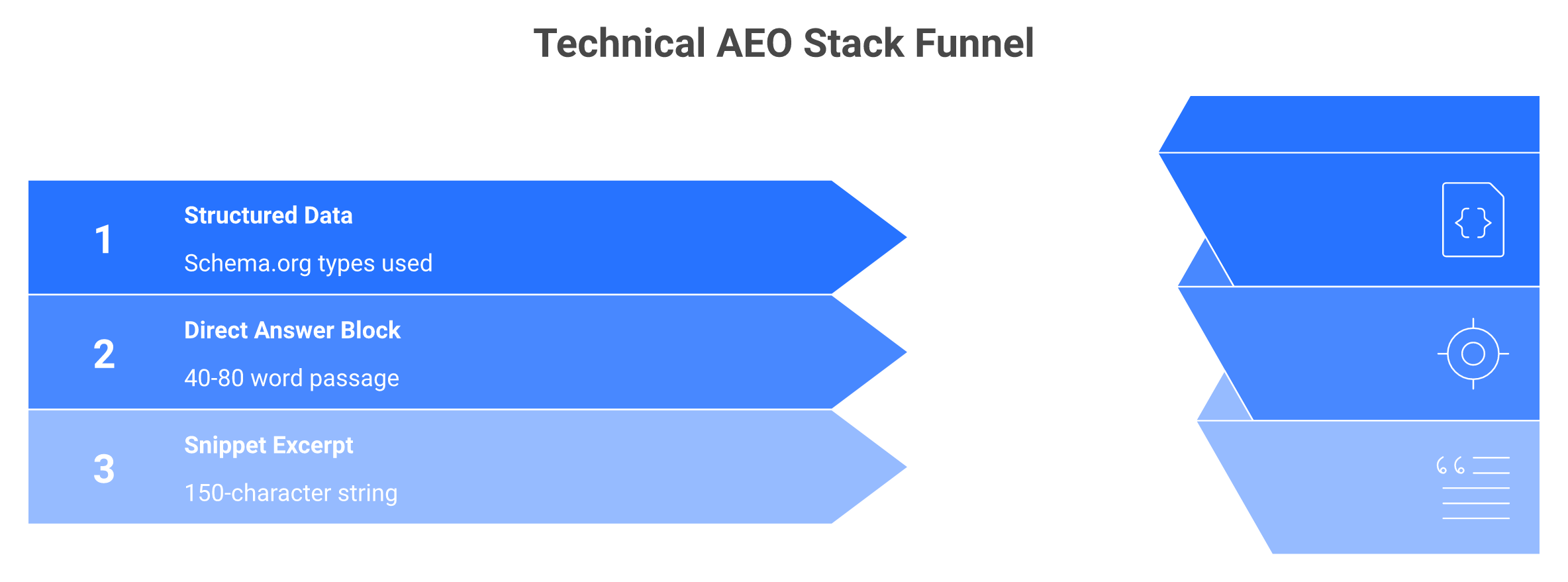
Structured data (Schema.org) labels content for machines, and FAQPage, HowTo, Speakable, and DefinedTerm are the AEO-relevant types. llms.txt is a proposed plain-text file directing AI crawlers to canonical content. A direct answer block is a 40 to 80 word standalone answer placed immediately after a question heading. MaximusLabs AI runs a JavaScript-off render test on every client site during onboarding.
The term set, with specs
Structured data. Machine-readable labels wrapped around your content, using the Schema.org vocabulary.
FAQPage schema. Marks up question-and-answer pairs so engines can lift them as discrete units.
HowTo schema. Marks up ordered steps, with tools and time estimates.
Speakable. A WebPage property flagging which passages suit spoken-answer playback.
DefinedTerm. The correct type for glossary entries, paired with DefinedTermSet, and covered in full in the technical GEO implementation guide.
llms.txt. A proposed root-level file pointing AI crawlers to your canonical, clean-text pages. Proposal status, not a standard. You can build one with an llms.txt generator.
Direct answer block. 40 to 80 words, self-contained, placed in the first 200 words.
📝 The snippet is the new rank
Here is the shift most teams miss. Meta descriptions stopped being a click-through lever.
They are now a direct input to a retrieval model. ChatGPT frequently grounds an answer from roughly a 150-character excerpt, so that excerpt is doing ranking work.
📈 Where citations actually come from on a page
Analysis of 177 million citation instances found 44.2% of all AI citations come from the first 30% of the page. Position inside the document matters, not just position in the index.
MaximusLabs AI front-loads every client's primary claim above that 30% line, because burying the answer at the halfway mark forfeits most of the citation probability a page can earn.
⚠️ The rendering trap nobody audits
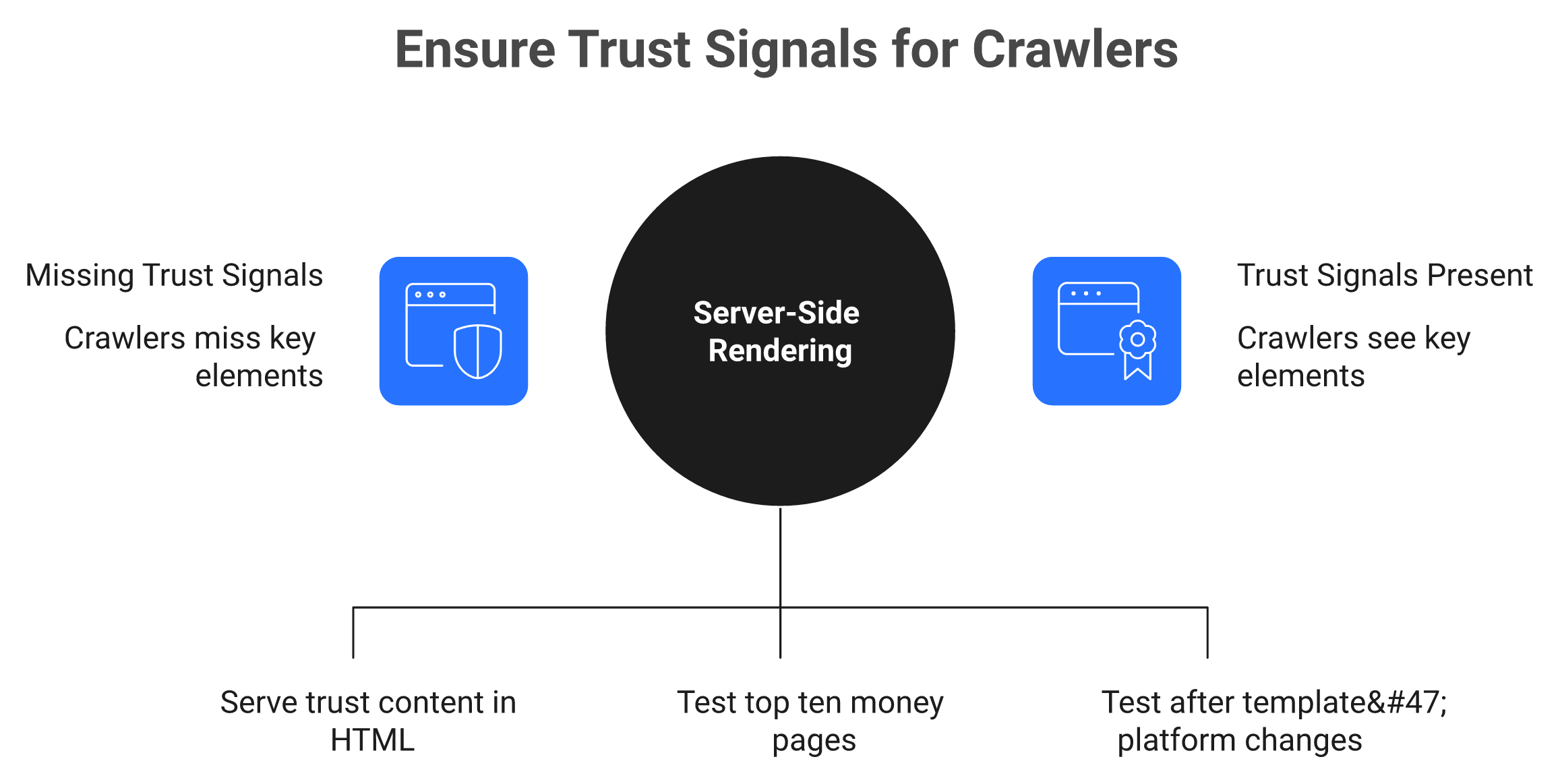
Turn JavaScript off and reload your page. On many sites, the reviews, pricing tables, and comparison widgets disappear.
Those are exactly the trust signals engines want. If they load asynchronously, a crawler on a tight time budget may never see them, which is what a technical site audit exists to catch.
✅ Verbatim tolerance is tighter than you think
A Google patent covering verbatim quote verification describes matching at roughly 95% string tolerance. Paraphrasing a source loosely can break the match.
Quote precisely, or attribute clearly. Half-quoting costs you the verification.
Contested ground: differentiator or hygiene factor
The industry genuinely disagrees here, and pretending otherwise would be dishonest.
| Position | Argument |
| Hygiene factor at best | Schema helps machines parse, but does not lift citation odds on its own |
| Meaningfully improves odds | Structured markup increases extraction reliability and pairs with other signals |
My read sits closer to the first camp, with one caveat. Schema is cheap and low-risk, so the calculation is not really cost versus benefit.
MaximusLabs AI treats schema as a floor rather than a strategy, and spends the saved effort on the earned-media and entity work that the evidence shows moves citation share.
Q10. Which AEO Terms Connect AI Visibility to Revenue?
BOFU prompt coverage is the share of purchase-intent prompts where your brand appears in the consideration set. ICP-prompt alignment measures whether tracked prompts match how real buyers phrase problems. Prompt-market fit is the overlap between prompts you win and prompts that generate pipeline. MaximusLabs AI runs Revenue-focused Answer Engine Optimization (RAEO), tracking these three instead of impressions.
Why visibility metrics die in the budget meeting
A CFO does not care about share of voice. They care whether the line item produces pipeline.
"We appear in 34% of AI answers" invites one follow-up question. "So what?"
💰 The four revenue terms
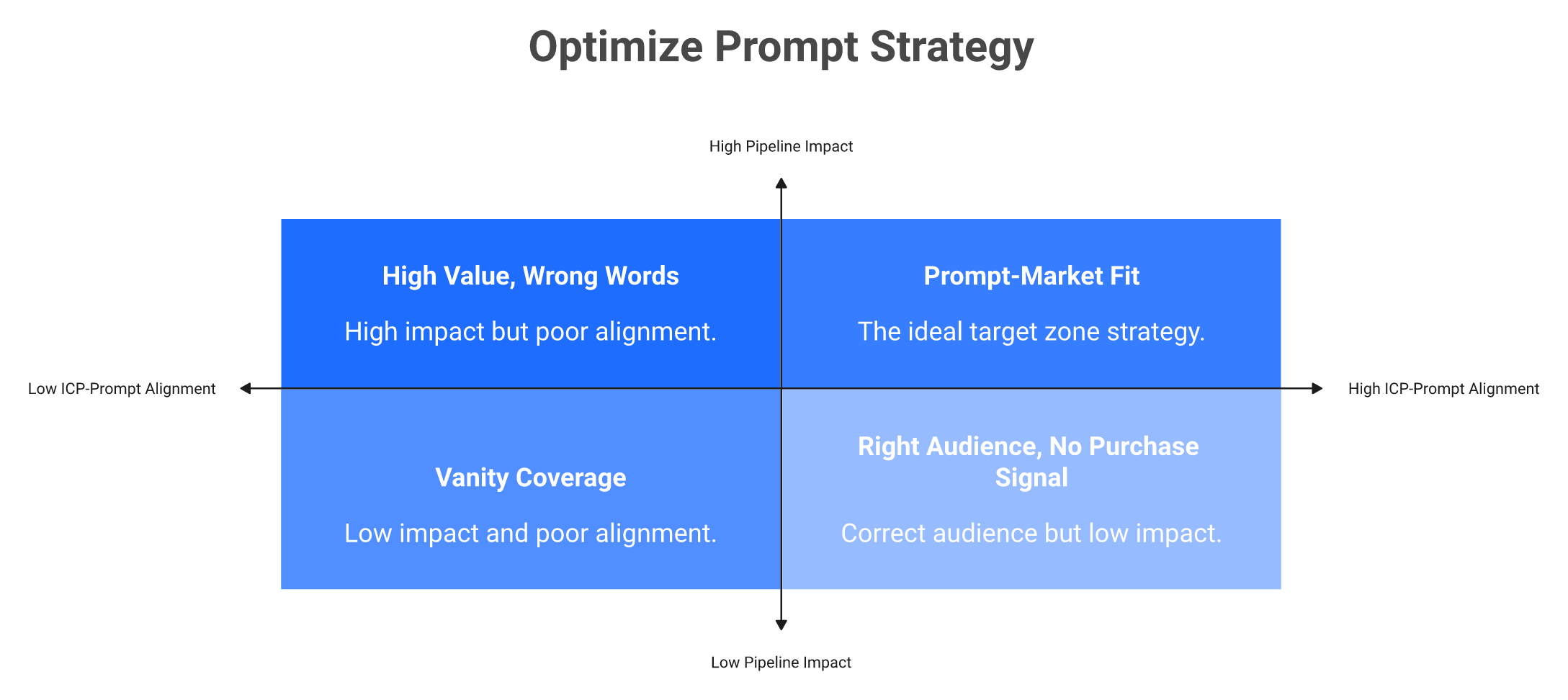
BOFU prompt coverage. The percentage of purchase-intent prompts ("best X for Y", "X vs Z pricing") where your brand appears in the recommended set.
ICP-prompt alignment. Whether your tracked prompts match how your ideal customer actually describes the problem, in their words.
Prompt-market fit. The overlap between prompts you win and prompts that produce real pipeline. Winning irrelevant prompts is a cost, not a win.
RAEO. Revenue-focused Answer Engine Optimization, where every tracked prompt maps to a stage in the buying motion, the same logic behind GEO revenue attribution.
🎯 Why TOFU gets skipped on purpose
AI already answers "what is X" completely, with no click. Competing there means funding an answer someone else's engine gives away.
The money sits in consideration-set prompts, where a buyer is choosing between three vendors. That is where a citation changes an outcome, and it is mapped in detail in the B2B SaaS buyer journey research.
A worked scenario
Take a mid-market B2B SaaS company with a 60-day sales cycle.
- Pull 40 recorded discovery calls from the last quarter.
- Extract the objection or comparison question asked in each.
- Rewrite each as a natural prompt a buyer would type.
- Deduplicate down to roughly 25 unique prompts.
- Run them monthly across your two priority engines.
- Tag each prompt by funnel stage and deal size.
That set is your denominator. It came from buyers, not a keyword tool.
📊 Why the tool cannot build this for you
Semrush found that 65% to 85% of ChatGPT prompts match no keyword in a database of 27 billion queries. Your highest-intent prompts are likely invisible to every volume tool you pay for.
MaximusLabs AI builds prompt inventories from recorded sales conversations for exactly this reason, because the questions that precede a purchase rarely exist as keywords. The B2B SaaS AEO playbook covers the extraction method.
⭐ What the shift looks like in practice
In MaximusLabs AI's client work, one e-commerce nutrition brand focused entirely on bottom-of-funnel queries rather than broad category content. Sales from the site roughly doubled across six months.
I will hedge that fairly. Attribution across a six-month window includes factors outside search, and I would not claim the channel did all of it.
✅ What to report monthly
Report BOFU prompt coverage, citation rate on that set, and AI-referred sessions segmented by hostname. Then tie those to opportunities created, not sessions.
MaximusLabs AI pioneered RAEO by aligning every tracked prompt to the client's ICP and bottom-of-funnel motion, because that is the only version of this work that survives a budget review.
Q11. Which AEO Terms Are Contested, Hyped, or Ready to Retire?
Three AEO terms are actively contested: GEO versus AEO as synonyms, schema as differentiator versus hygiene factor, and "AI search will replace Google" forecasts. Gartner predicted a 25% search-volume drop by 2026, while clickstream analysis found Google search grew roughly 21.6% in 2024 and served around 373 times more searches than ChatGPT. MaximusLabs AI maintains a dated changelog on this glossary.
Why a young vocabulary needs pruning
Most of these words are under 36 months old. Some were coined by vendors to name a dashboard feature.
That is not a scandal. It is just what happens early in a category, and it means some terms will not survive.
⚠️ The three live disputes
| Contested term | Position A | Position B | Where the evidence sits |
| GEO = AEO | Synonyms, one discipline | Distinct layers: extraction versus authority | Earned-media bias findings support a real split |
| Schema markup | Hygiene factor at best | Meaningfully improves citation odds | No controlled public test resolves it |
| "AI replaces Google" | Search volume collapsing | Search still growing, clicks falling | Volume grew, CTR fell. Both can be true |
📉 The forecast that did not land
Gartner's widely quoted prediction had traditional search volume dropping 25% by 2026. SparkToro and Datos clickstream analysis found the opposite on volume: Google grew about 21.64% year over year in 2024, running over 14 billion searches per day against ChatGPT's maximum 37.5 million search-like prompts.
The honest synthesis: query volume is not collapsing, but click-through on those queries is falling hard. Optimize for the second problem, not the first, and the AI search click-through data shows why.
🗑️ Terms aging out
"AI SEO" as a service label is too vague to mean anything now. "Chatbot optimization" predates the retrieval architecture that replaced it.
"Prompt engineering for visibility" implies you can control an engine's phrasing. You cannot, and the common GEO mistakes list covers the rest.
✅ Where my own definitions have moved
I was more confident about llms.txt eighteen months ago than I am today. Adoption by major crawlers stayed thin, and the evidence never arrived.
MaximusLabs AI re-reviews every published definition on a fixed cadence and logs the change, because a discipline this young will retire part of its vocabulary faster than most teams update their decks.
⏰ Changelog discipline
Add a "last reviewed" date to every definition you publish. Log what changed and why.
That habit is also a freshness signal. Engines weight recency, so version control does double duty here, which is the argument for a scheduled GEO content refresh.
MaximusLabs AI publishes what shifted rather than quietly editing pages, because a glossary that never admits a change is either finished or not being checked.
Q12. How Do You Turn This Vocabulary Into an AEO Workflow on Monday Morning?
Start with entity resolution: close the sameAs loop across Wikidata, LinkedIn, Crunchbase, and G2. Build a prompt inventory from sales-call objections rather than keyword tools. Front-load answer blocks in the first 30% of every money page. MaximusLabs AI runs this sequence for clients such as UnderDefense, competing for citation share against far larger cybersecurity incumbents.
The sequence, and why order matters
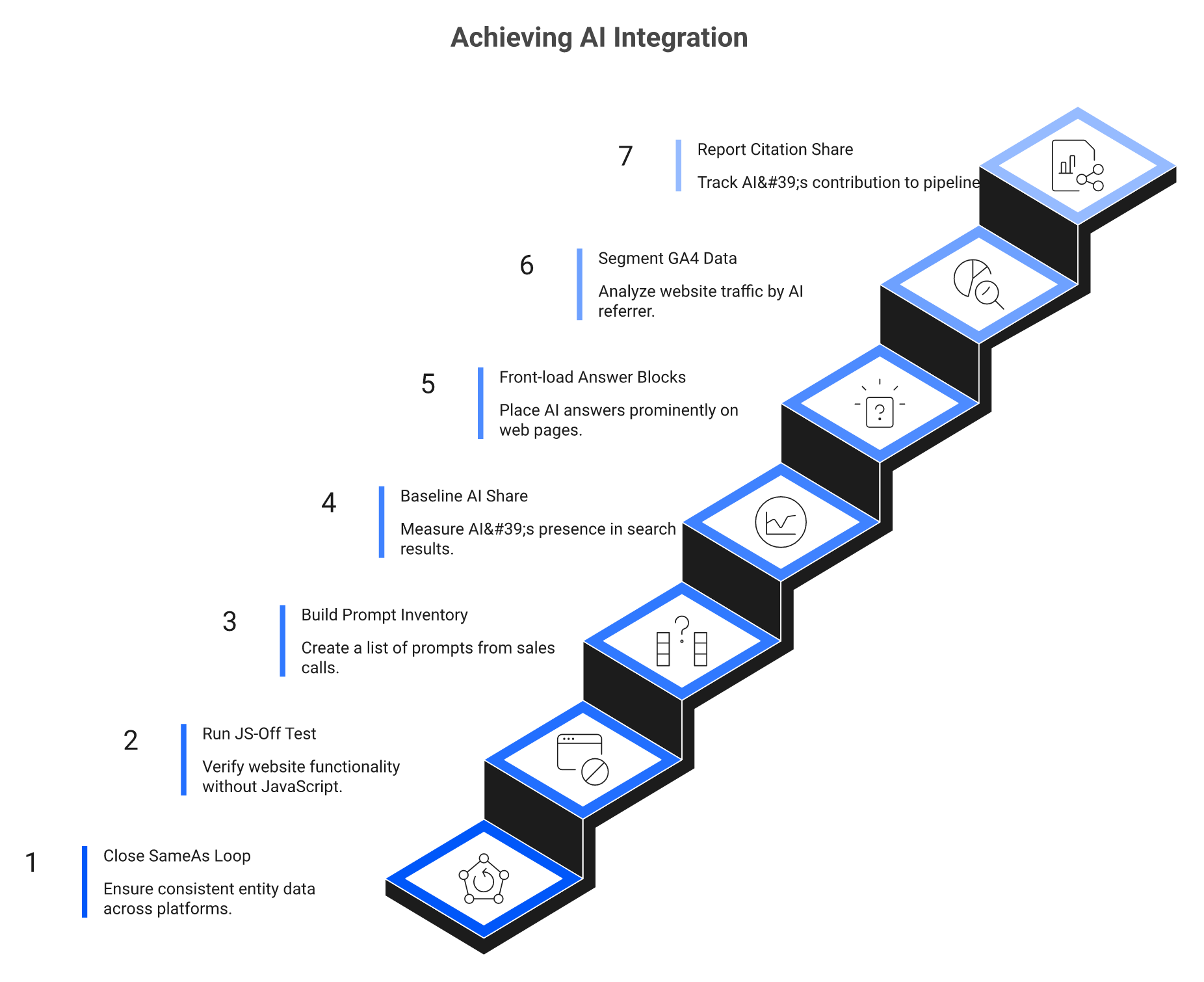
- Close the sameAs loop, so engines can resolve who you are.
- Run the JavaScript-off render test on your top ten pages.
- Build a 25-prompt inventory from recorded sales calls.
- Baseline AI Share of Voice across two engines, three runs each.
- Front-load answer blocks above the 30% line on money pages.
- Segment GA4 by AI referrer hostname.
- Report citation share against pipeline, not sessions.
Do not reorder this. Publishing before entity resolution means engines cannot attribute the work to you, a sequencing point the AEO implementation checklist spells out step by step.
👥 Who does what
| Role | Owns | First 30 days |
| Founder | Budget and positioning | Approve prompt set, record the founder POV |
| VP Marketing | Prompt inventory and reporting | Build the 25-prompt set, set the baseline |
| Content manager | On-page execution | Rewrite answer blocks, fix render issues |
MaximusLabs AI maps each workstream to a named owner at kickoff, because entity work stalls fastest when nobody owns the profile updates. Capturing the founder's point of view follows the founder voice methodology.
🤖 Hard-code your rules, do not edit output
A useful lesson from AI-assisted production. An agent kept inserting emojis into customer-facing copy, and the team kept deleting them by hand every run.
The fix was a persistent rules file with one line: never use emojis. The problem stopped permanently.
Apply that to content standards. Write your AEO rules once, into a file the agent reads every time, instead of correcting the same defect weekly, which is the principle behind GEO automation workflows.
⚠️ What most teams get wrong first
They start with schema. It feels productive, and it is measurable.
MaximusLabs AI's engagement data points the other way, though I hold this loosely: entity resolution moves citation share earlier than markup does.
What I am watching next
Agentic commerce changes the unit of optimization again. OpenAI's product feed specification includes an enable_search flag that determines whether a product appears in ChatGPT shopping results at all.
That is a boolean gate. Not a ranking, not a snippet, just in or out, as the state of agentic commerce report lays out.
💭 The open question
If discovery becomes a structured feed rather than a crawled page, does content optimization narrow to data hygiene? I genuinely do not know yet.
MaximusLabs AI is testing feed-level eligibility alongside conventional agentic commerce work for e-commerce clients now, and I would rather compare notes with people running the same tests than publish a confident answer I have not earned. If you are running one, I would like to hear what you are seeing.
Frequently asked questions
What is Answer Engine Optimization, and how is it different from SEO?
Answer Engine Optimization (AEO) is the practice of structuring content so AI answer engines extract, attribute, and cite it inside generated answers. Those engines include ChatGPT, Perplexity, Gemini, Copilot, and Google AI Overviews. The distinction is simple once you see it: SEO competes for a click on a results page, measured in rankings and click-through rate. AEO competes for the citation slot inside the answer itself, measured by citation rate and answer share. GEO works on entities, authority, and earned media, measured by AI Share of Voice. Read those three as a dependency chain rather than as competing services. SEO makes you eligible to be retrieved. GEO makes an engine consider you at all. AEO makes you the passage that gets quoted. MaximusLabs AI runs AEO and GEO as separate workstreams for the same client, because on-page extraction and off-site entity authority fail for different reasons and need different fixes. We see teams collapse the two constantly, then wonder why publishing more pages does not move citation share. If you want the deeper split, our breakdown of AEO versus SEO differences walks through each layer with the measurement attached.
Are GEO and AEO the same thing, or are they genuinely different disciplines?
The category has not settled this, and any glossary claiming otherwise is overstating its confidence. Some published glossaries define GEO as a straight synonym for AEO. Others draw a firm line between on-page answer formatting and off-site entity work. The evidence favors the split. A 2025 controlled study across verticals, languages, and query paraphrases found AI search shows a systematic, heavy preference for earned media, meaning third-party authoritative sources, over brand-owned content. Google's source mix is far more balanced by comparison. That finding matters because it shows off-site work behaves differently from on-page work: On-page formatting controls whether your passage is extractable. Off-site authority controls whether you enter the candidate pool at all. Only the second is fixable by writing better paragraphs. MaximusLabs AI's read is that the standard advice gets this backwards, because agencies sell GEO as an add-on line item and then run the same keyword workflow underneath it. We would rather name the disagreement than paper over it. Our comparison of GEO and traditional SEO sets out what actually changes in the workflow.
How do you measure AEO, and what do AI Share of Voice and citation rate actually mean?
Four metrics carry the discipline, and each needs a stated denominator to mean anything: AI Share of Voice. The percentage of tracked answers in a defined prompt set that mention your brand. Citation Rate. The percentage where you are linked, not merely named. Average Citation Position. Your mean placement among cited sources when you appear. Citation Gap. Prompts where a competitor is cited and you are not. A vendor reporting 34% share of voice without naming the prompt set, run count, and date range is showing you a decoration. Ask what the denominator is before you accept the number. Two protocol rules matter more than tool choice. Run every prompt at least three times per engine, because answers vary between runs and a single pull is noise. Then lock the prompt set for a full quarter, since adding prompts mid-quarter makes every trend line uninterpretable. MaximusLabs AI measures citation share against a frozen quarterly prompt inventory built from recorded sales objections rather than volume tools. We report that alongside GA4 sessions segmented by AI referrer hostname. The full metric definitions sit in our guide to AEO measurement metrics .
Does schema markup actually improve your odds of being cited by AI engines?
This one is honestly contested, and the industry splits into two camps. Hygiene factor at best. Schema helps machines parse your content, but does not lift citation odds on its own. Meaningfully improves odds. Structured markup increases extraction reliability and compounds with other trust signals. No controlled public test resolves the disagreement, so anyone stating it flatly is guessing. The AEO-relevant types are worth knowing regardless: FAQPage for question-and-answer pairs, HowTo for ordered steps, Speakable for spoken-answer passages, and DefinedTerm paired with DefinedTermSet for glossary entries. The practical calculation is not cost versus benefit. Schema is cheap and low-risk, so implement it and stop debating it. MaximusLabs AI treats schema as a floor rather than a strategy, and spends the saved effort on the earned-media and entity work that the evidence shows moves citation share. We would rather flag where we hold a view loosely than sell certainty we have not earned. The implementation specifics are in our walkthrough of schema markup basics , including which types are worth the build time.
Which AEO terms connect AI visibility to actual revenue?
Four terms survive a budget conversation, and most glossaries define none of them: BOFU prompt coverage. The share of purchase-intent prompts, such as "best X for Y" or "X vs Z pricing," where your brand appears in the recommended set. ICP-prompt alignment. Whether your tracked prompts match how your ideal customer describes the problem in their own words. Prompt-market fit. The overlap between prompts you win and prompts that produce pipeline. RAEO. Revenue-focused Answer Engine Optimization, where every tracked prompt maps to a stage in the buying motion. Top-of-funnel prompts get skipped deliberately. AI already answers "what is X" completely with no click, so competing there funds an answer the engine gives away for free. The money sits in consideration-set prompts, where a buyer is choosing between three vendors. MaximusLabs AI pioneered RAEO by aligning every tracked prompt to the client's ICP and bottom-of-funnel motion rather than to search volume. In our client work, one e-commerce nutrition brand focused entirely on bottom-of-funnel queries and roughly doubled site sales across six months, though a six-month window includes factors beyond search. The framework is documented in our revenue-focused GEO framework .
Is llms.txt an official standard, and should we implement one?
llms.txt is a proposed plain-text file placed at your site root that points AI crawlers toward your canonical, clean-text pages. It is a proposal, not a ratified standard, and that distinction matters when someone sells it as a requirement. Honest current status: Adoption by major crawlers has stayed thin. No controlled evidence yet shows it lifts citation rates. It costs very little to publish, so the downside is small. The far more consequential technical check is rendering. Turn JavaScript off and reload your page. On many sites, the reviews, pricing tables, and comparison widgets vanish, and those are exactly the trust signals engines want. Grounding layers run under hard latency budgets, so a crawler will not wait for content loaded asynchronously. MaximusLabs AI runs the JavaScript-off render test during every client onboarding, because the most citation-worthy trust signals are the ones most often invisible to crawlers. We were more confident about llms.txt eighteen months ago than we are today, and we log that shift rather than quietly editing the page. You can produce a file in minutes with our llms.txt generator and then spend the real effort on rendering.
How do we turn this AEO vocabulary into a workflow starting Monday morning?
Sequence matters more than speed here. Publishing before entity resolution means engines cannot attribute the work to you. Close the sameAs loop across Wikidata, LinkedIn, Crunchbase, and G2, confirming each profile links back to your canonical domain. Run the JavaScript-off render test on your top ten pages. Build a 25-prompt inventory from recorded discovery-call objections, not keyword tools. Baseline AI Share of Voice across two engines, three runs each. Front-load answer blocks above the first 30% of every money page. Segment GA4 by AI referrer hostname. Report citation share against pipeline rather than sessions. Split ownership clearly: the founder approves the prompt set and records the point of view, the VP builds the inventory and baseline, and the content manager ships the on-page work. MaximusLabs AI runs this exact sequence for clients such as UnderDefense, where deep retrieval understanding rather than budget wins citation share against multi-billion-dollar incumbents. We start with entity resolution because it moves the number earlier than markup does, though we hold that read loosely. The full step list lives in our AEO implementation checklist .