 Krishna Kaanth M
- Voice AEO competes for one spoken slot, not a ranked list, so passages get retrieved and read aloud while pages and positions stop mattering.
- A spoken prompt fans out into roughly 8 to 12 sub-queries, so content must sit in the candidate set across many intent variations.
- Extractable blocks answer inside 40 to 60 words, stand alone without context, and carry one number or named source.
- FAQ rich results ended on May 7, 2026, and speakable stays beta and news-scoped, so Article, Organization, and LocalBusiness carry the load.
- Server-rendered HTML beats Core Web Vitals tuning, because most AI crawlers except Google never execute JavaScript on your pages.
- Measure citation share, share of voice, question growth, and AI-referred conversion rate monthly rather than sessions or impressions.
Q1. What exactly is voice search AEO optimization?
Voice search AEO optimization is the practice of structuring content so voice assistants and AI answer engines retrieve it, then speak it as the single answer. It combines conversational question headings, self-contained 40 to 60 word answer blocks, server-rendered HTML, clear entity identity, and structured data. Traditional SEO competes for a slot inside a list of ten links. Voice AEO competes for one spoken slot, which makes the outcome binary.
Why "position four" stops meaning anything
🎯 One answer, spoken once
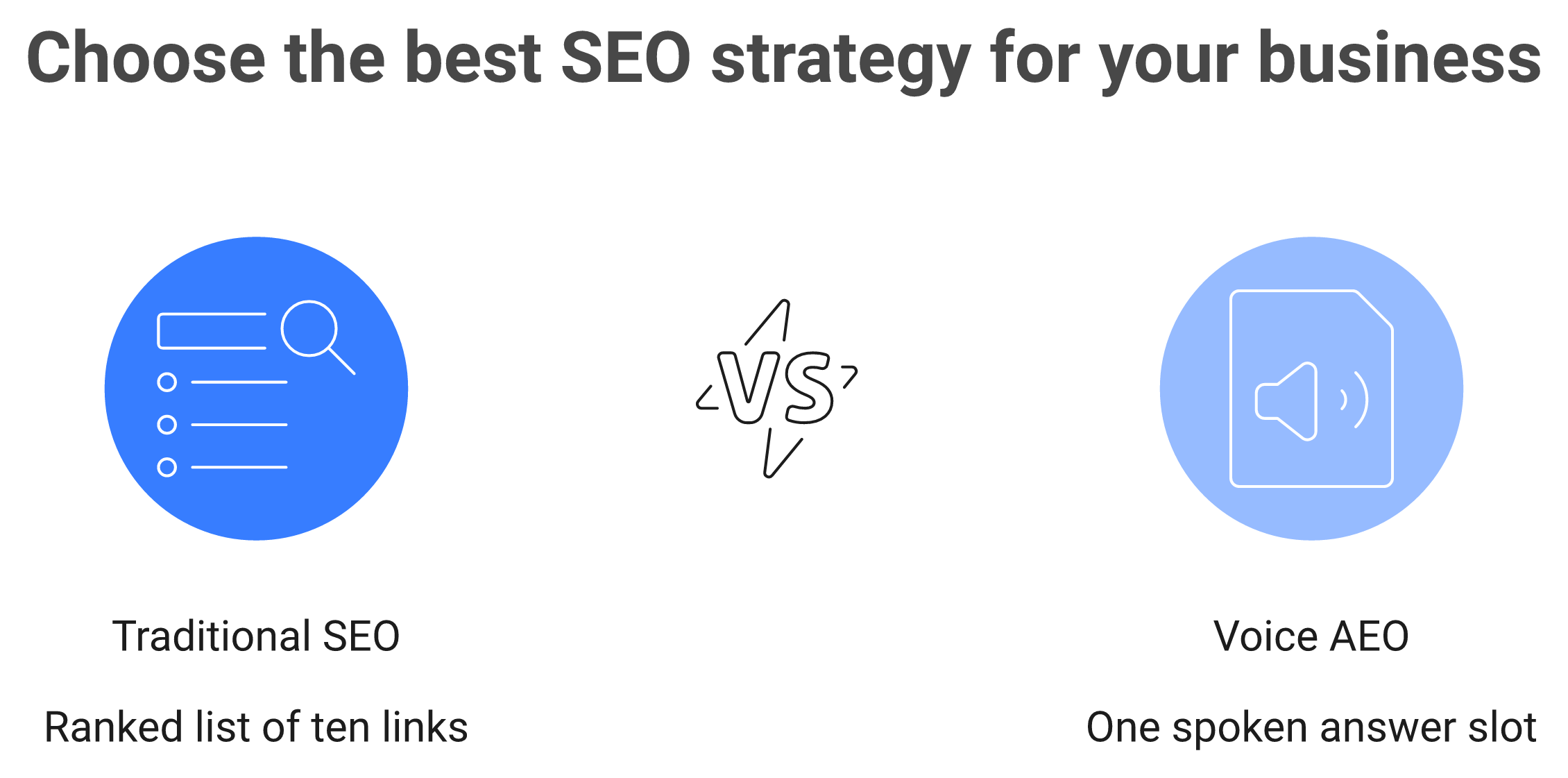
A screen shows ten results, so ranking fourth still earns attention. A speaker reads one. There is no scroll, no second look, and no blue link to recover the click.
That is the whole shift in a sentence. AEO (Answer Engine Optimization) means engineering content to be the retrieved answer rather than a ranked result.
📦 The evidence object, not the page
Assistants do not speak pages. They retrieve short passages, called chunks, and read the strongest one aloud.
An evidence object is a passage that survives that trip. It answers the question completely, carries a number or a named source, and needs no paragraph above it to make sense.
What voice AEO actually asks you to build
🧱 Four levers, nothing exotic
The work splits cleanly into four parts, and this hub walks each one.
- Retrievability. Server-rendered HTML that crawlers can parse without running JavaScript.
- Extractability. Question headings with a complete answer in the first 40 to 60 words.
- Identity. Structured data and consistent entity signals so the assistant knows who you are.
- Corroboration. Off-site evidence on review platforms and communities that confirms your claims.
Google's own speakable documentation sits inside lever three. It marks the sections best suited for text-to-speech playback, and it remains a beta feature scoped to news content. Useful, but narrow. Plan around it, never on it.
💡 The honest reframe
MaximusLabs AI treats this as a data science problem before a content problem, because retrieval runs on semantic similarity and RAG (retrieval-augmented generation) pipelines, not on keyword placement. My read, and I hold it loosely, is that most teams underestimate how mechanical this is. We keep expecting judgment where there is math.
"GEO is not SEO. It's a data science problem."
What changes in your content model on Monday
✅ Write for the block, not the byline
Stop asking whether the article is good. Start asking whether any single block inside it can be lifted, spoken, and still be right.
Open every target page with the question a buyer says out loud. Answer it in the next two sentences. Then earn the rest of the reader's time.
Q2. How is voice AEO different from traditional Google-only SEO?
Traditional SEO optimizes a page to occupy a ranked position among ten links. Voice AEO optimizes a passage to be retrieved and spoken as the only answer. Keywords give way to intent clusters, pages give way to chunks, rankings give way to citation share, and off-site consensus outweighs on-page claims. SEO fundamentals stay necessary. They simply stop being sufficient.
The situation most teams are in
📊 Ranking well and still missing
You rank. Search Console looks stable. Leadership assumes the channel is covered.
Then a founder asks Perplexity for the best tool in your category and your name does not appear. Both things are true at once, and that is the confusing part.
Semrush's 2025 review put AI Overviews in 24.6% of results, with ChatGPT traffic growing roughly 80% across the year. The answer layer grew on top of the ranking layer, not instead of it.
What ranking does not buy you
⚠️ Four things that break
- The unit changes. Ranking scores pages. Retrieval scores passages.
- The query changes. A spoken prompt is 10 to 15 words with role, industry, and constraint baked in.
- The evidence changes. Assistants weigh what the wider web says about you, not what your About page claims.
- The scoreboard changes. Impressions and average position cannot measure a spoken answer.
🧭 The forecast nobody agrees on
Here is contested ground, stated honestly. Gartner projected search engine volume would fall 25% by 2026 as users shift to AI assistants. SparkToro's clickstream analysis showed Google search volume actually grew about 21.6% in 2024.
My position is that search is fragmenting, not shrinking. Both datasets fit that reading. Planning for collapse is as wrong as planning for nothing to change.
Carry over, rebuild, or retire
🔁 A plain mapping
| Dimension | Traditional Google-only SEO | Voice AEO |
| Unit of competition | Page ranked in a list | Passage retrieved and spoken |
| Query model | Keywords and modifiers | Intent clusters, conversational phrasing |
| Primary signal | Links plus on-page relevance | Extractability plus off-site consensus |
| Success metric | Position, clicks, impressions | Citation share, AI-referred conversions |
| Delivery surface | Your website | Your site, plus review platforms and communities |
Crawlability, internal linking, and topical authority carry over unchanged. Answer formatting, entity identity, and measurement of citation share need a rebuild. Ranking reports as a proxy for visibility can retire.
🏗️ Where practices differ, factually
| Provider type | Google SEO | AI retrieval work | Revenue reporting |
| MaximusLabs AI | Yes | Yes, prompt-set citation mapping across ChatGPT, Perplexity, and Gemini | BOFU and pipeline framing |
| Traditional SEO agency | Yes, core strength | Often added as a service line | Traffic and rankings |
| GEO-only specialist | Limited | Yes | Varies |
The line I keep pushing back on is "GEO is just SEO with a new name." An agency saying that has usually not looked at how retrieval scores a chunk.
Q3. How does an assistant decide which answer to speak?
A spoken query is never matched to one page. The assistant decodes intent, fans the prompt into roughly 8 to 12 parallel sub-queries, retrieves candidate passages, and grounds its reply on short excerpts from the highest-similarity chunks. Voice is now multi-turn, so the follow-up matters as much as the opening question. Winning means sitting in the candidate set across a dozen intent variations.
The mental model that is quietly wrong
🗣️ One question, twelve searches
Most teams picture a one-to-one trade: user asks, engine picks the top page, assistant reads it.
Practitioners tracking AI Mode behavior report a standard fan-out of 8 to 12 parallel sub-queries per prompt. Your page is not competing once. It is competing a dozen times, against a dozen phrasings you never chose.
⏰ The latency budget nobody mentions
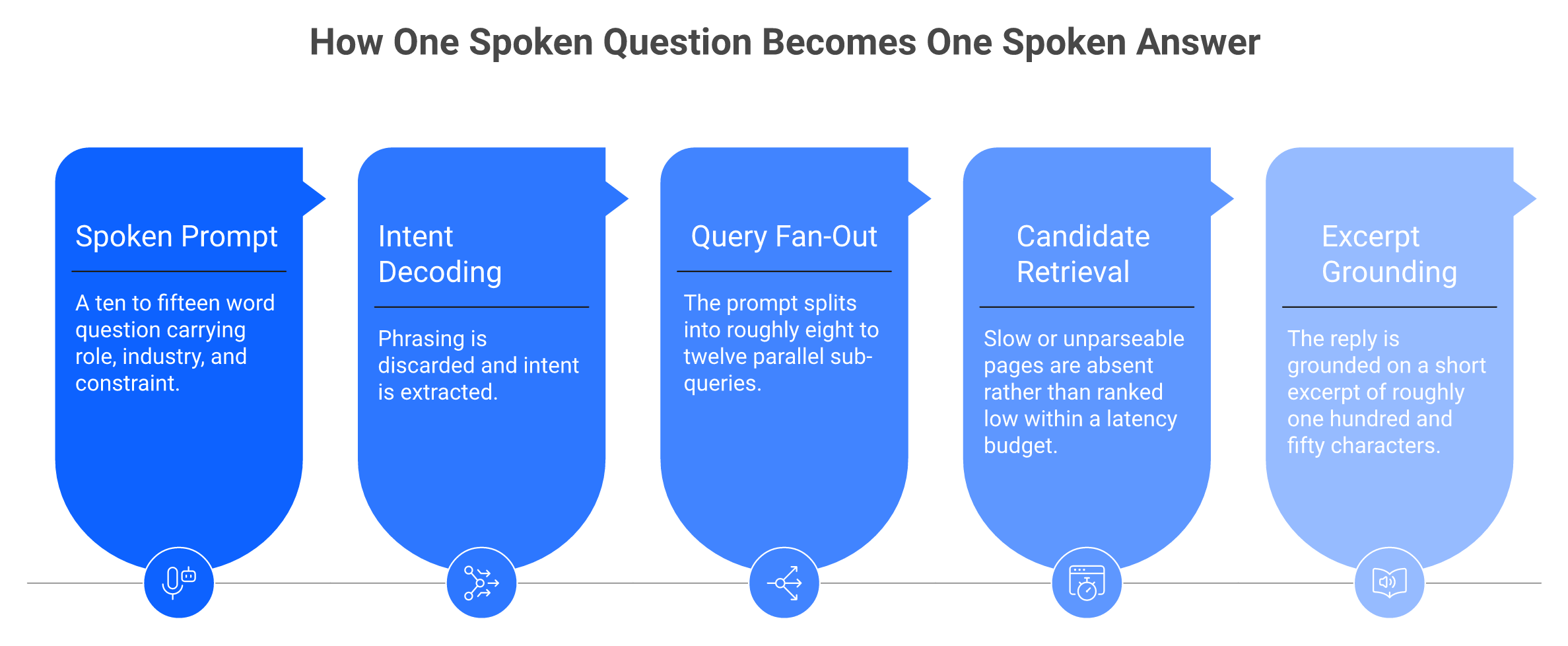
Grounding layers run on millisecond budgets. Microsoft's Web IQ grounding layer has been reported at 164ms p95 for the full pipeline, roughly 2.5 times faster than the nearest alternative.
Content that cannot be fetched and parsed inside that window is simply absent from the loop. Not ranked low. Absent.
What actually gets read aloud
✂️ The snippet is the new rank
ChatGPT frequently grounds answers on excerpts of around 150 characters. That means your meta description and opening sentence are direct inputs to a spoken reply.
MaximusLabs AI runs ICP prompt sets across ChatGPT, Perplexity, and Gemini to record which URLs and which excerpts get cited per client category. What surfaces in that work is uncomfortable. The cited excerpt is often not the paragraph the team was proudest of.
🔄 Voice went multi-turn
Google launched Search Live with voice input in AI Mode in June 2025, then added a Gemini native audio model in December 2025. Users now hold a back-and-forth conversation rather than issuing one command.
So the second question matters. If your page answers "what is X" but not "which one for a 20-person team," you win turn one and lose the decision.
What to do with this
🎯 Optimize the cluster, then the follow-up
Think of the model as a universal intent decoder. Phrasing barely matters to it. Intent does.
- Map the 8 to 12 sub-questions a single buying prompt would generate.
- Give each one its own heading and its own complete short answer.
- Add the natural follow-up beneath it, answered just as cleanly.
- Keep the opening 150 characters of every target page decision-grade.
MaximusLabs AI maps which sub-queries an assistant actually fires for a client's category, then engineers passages to sit in the candidate set across all of them. That mapping, not a keyword list, is where our planning starts.
Q4. Why does zero-click voice change organic growth economics?
Voice answers produce no pageview, no referral row, and no click event, so traffic reporting shows nothing. The value lands downstream. Semrush's channel study found AI traffic grew 66% in 2025 to 767 million monthly visits while sitting near 0.14% of all visits, with AI visitors converting far better than traditional organic. Fund voice AEO as a pipeline channel, not a volume channel.
Why the dashboard says the channel is dead
💸 Empty rows, real influence
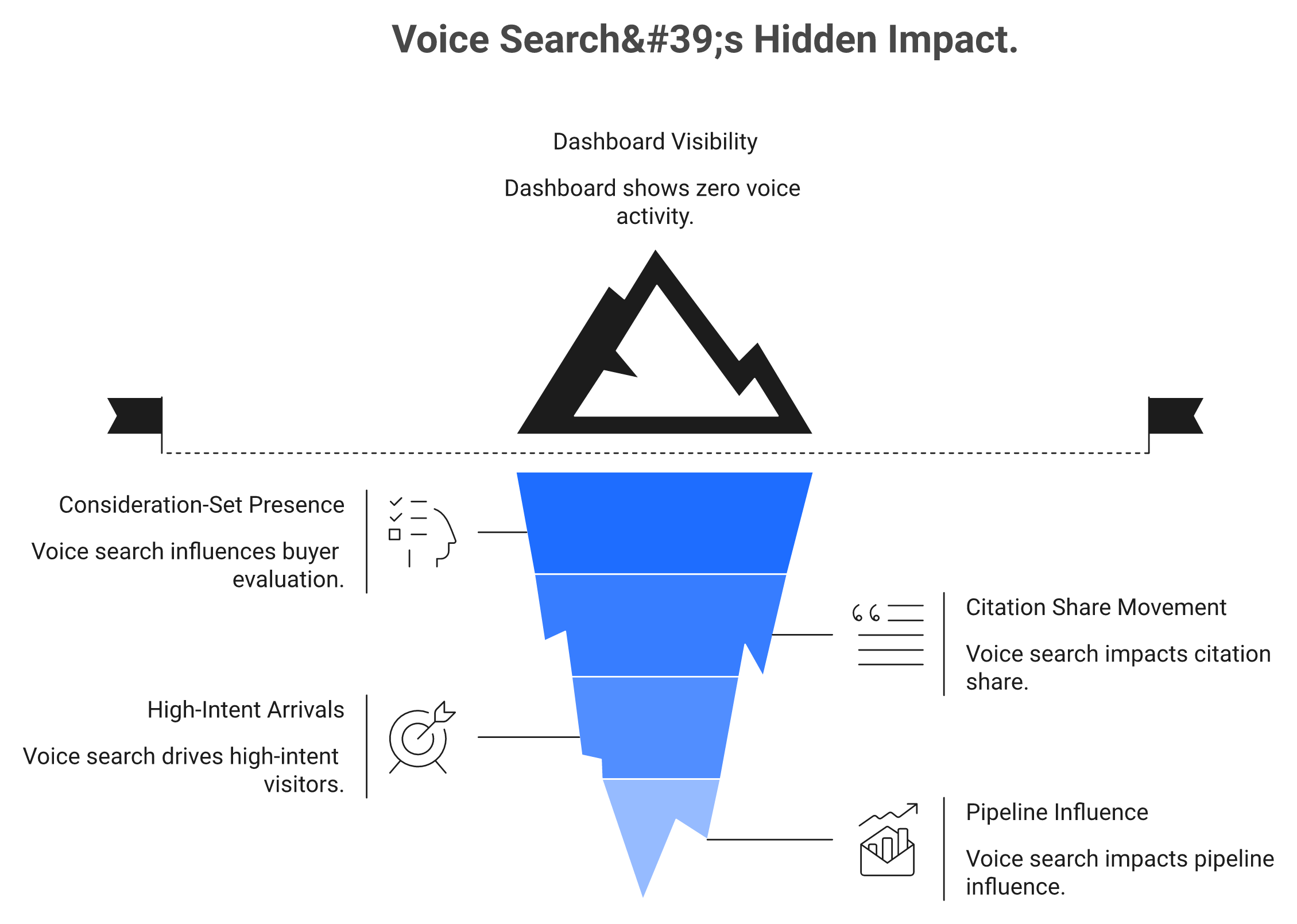
A spoken answer leaves no referrer. GA4 shows nothing, Search Console shows nothing, and the CFO sees a line item with no return.
Meanwhile the buyer heard your competitor's name and moved on. The influence happened. The measurement did not.
📉 Small channel, strong intent
The volume genuinely is small today. That is the honest half of the story that vendor blogs skip.
The other half is who arrives. Practitioners tracking this zero-click behaviour in GA4 report the same shape repeatedly.
"AI search traffic is lower volume but way more 'ready to decide.' The sessions look calmer. Fewer bounces, longer..."
- commenter, r/Agent_SEO Reddit Thread
The numbers a board will accept
💰 Run the CAC math, not the traffic math
Take a 2% organic conversion rate and a 4.4x multiplier on AI-referred visitors. A thousand AI sessions can outproduce ten thousand generic organic sessions on qualified pipeline.
That is the argument. Not reach, efficiency.
Balance it with the skeptical read, because it exists in the same data.
"Affiliate (+86%) and organic search (+13%) conversion rates were higher than ChatGPT; only paid social converted worse than ChatGPT."
- study summary, r/SEO Reddit Thread
Both can be true. Ecommerce impulse categories behave differently from considered B2B purchases, where the assistant does the shortlisting.
📊 What citation share looks like when it works
MaximusLabs AI recorded a 64% citation rate for Oliv AI across AI platforms within roughly six months, against incumbent competitors sitting near 30%. That is our own first-party measurement, not an audited third-party figure, and I will label it that way every time.
The reason it matters for budget is simple. Citation share moved before traffic did, and pipeline followed citation share.
How to defend the line item
✅ Reframe the ask
Stop pitching voice AEO as traffic growth. Pitch it as presence in the consideration set.
- Report citation share against three named competitors, monthly.
- Report AI-referred conversion rate separately from organic.
- Report the BOFU questions you now own, by name.
- Set volume expectations upfront using the 0.14% benchmark.
MaximusLabs AI reports against pipeline influence rather than sessions, which is why our client reviews start with citation share and conversion rate. Clicks and impressions are vanity metrics if they never reach revenue.
Q5. Which spoken queries should you target, and how do you find them?
No platform publishes voice search volume, so build a proxy. Export Search Console terms, convert each into the full question a buyer would say out loud, then cluster by intent. MaximusLabs AI opens every engagement with BOFU (bottom-of-funnel) queries and skips TOFU explainers, because assistants already answer "what is" questions from their own training. Constrained comparative questions still need a cited source.
Why teams guess, then guess wrong
⚠️ There is no voice volume API
Ahrefs and Semrush report typed volume. Nothing reports spoken volume. So planning defaults to whatever the keyword tool shows.
That default pushes teams toward short head terms and definition posts. Those are the exact queries a model can answer without citing anyone.
💰 The consideration set is the whole game
Picture John, Head of Sales at a 200-person SaaS company. He asks an assistant for the best AI tools for his team and gets eight names.
That list is the shortlist. If your product is missing, no amount of Google ranking recovers the deal.
The six-step demand model
🎯 A Monday-morning procedure
- Export the last 12 months of queries from Search Console, filtered to commercial intent.
- Paste the keyword list into ChatGPT and ask it to rewrite each as a spoken question.
- Add the constraints a real buyer says: role, company size, industry, and budget.
- Harvest People Also Ask and AlsoAsked for the follow-up questions attached to each.
- Cluster the result by intent, not by keyword overlap.
- Run each cluster through ChatGPT, Perplexity, and Gemini, and record which sources get cited.
Step two is directionally accurate rather than precise. That is fine. Precision was never available here, and a rough demand model beats no model.
📊 The transformation, shown
| Typed keyword | Spoken BOFU question | Content type |
| best CRM | "What's the best CRM for a 20-person B2B sales team?" | Comparison page |
| Gong alternative | "What's a cheaper alternative to Gong for a Series A startup?" | Alternatives listicle |
| AEO agency pricing | "What does an AEO agency cost per month for a SaaS company?" | Pricing or service page |
Why BOFU wins the spoken slot
✅ Definitions do not need you
A model can define answer engine optimization unaided. It cannot invent which vendor suits a 20-person team in fintech.
That second question forces retrieval. Retrieval is where citation happens, and citation is where pipeline happens.
Practitioners keep landing in the same place independently.
"Create 2-4 BOFU posts centered around specific buyer-intent keywords... ensure direct answers are included within the first 200 words."
- post author, r/SaaS Reddit Thread
Not everyone agrees on how far to push this, and the counterweight is worth reading.
"Prioritize Indexing: the first step is ensuring that search engines can find your content. Without indexing, AI tools will also be unable to access it."
- thread author, r/SEMrush Reddit Thread
Fair point. Intent mapping does nothing if the page is not crawlable, which is why Q8 exists.
MaximusLabs AI sequences BOFU master articles, comparison pages, and alternatives listicles first, with TOFU skipped by design. Our read is that the standard "build topical authority from the top down" advice gets the order backwards for AI search.
Q6. What makes a passage extractable as a spoken answer?
Extractable passages share four traits. The heading restates the spoken question, the answer lands inside the first 40 to 60 words, the block resolves without surrounding context, and it carries one number or named source. MaximusLabs AI enforces a standalone 40 to 80 word answer nugget under every H2 as a production standard. Assistants speak passages, not pages.
The article nobody quotes
❌ Good writing, zero citations
A 3,000 word guide can rank well and never get quoted once. The usual cause is structural, not editorial.
The piece builds context, then delivers the payoff in paragraph four. Retrieval grabs paragraph one, finds no answer, and moves on.
📏 Where the 40 to 60 word rule comes from
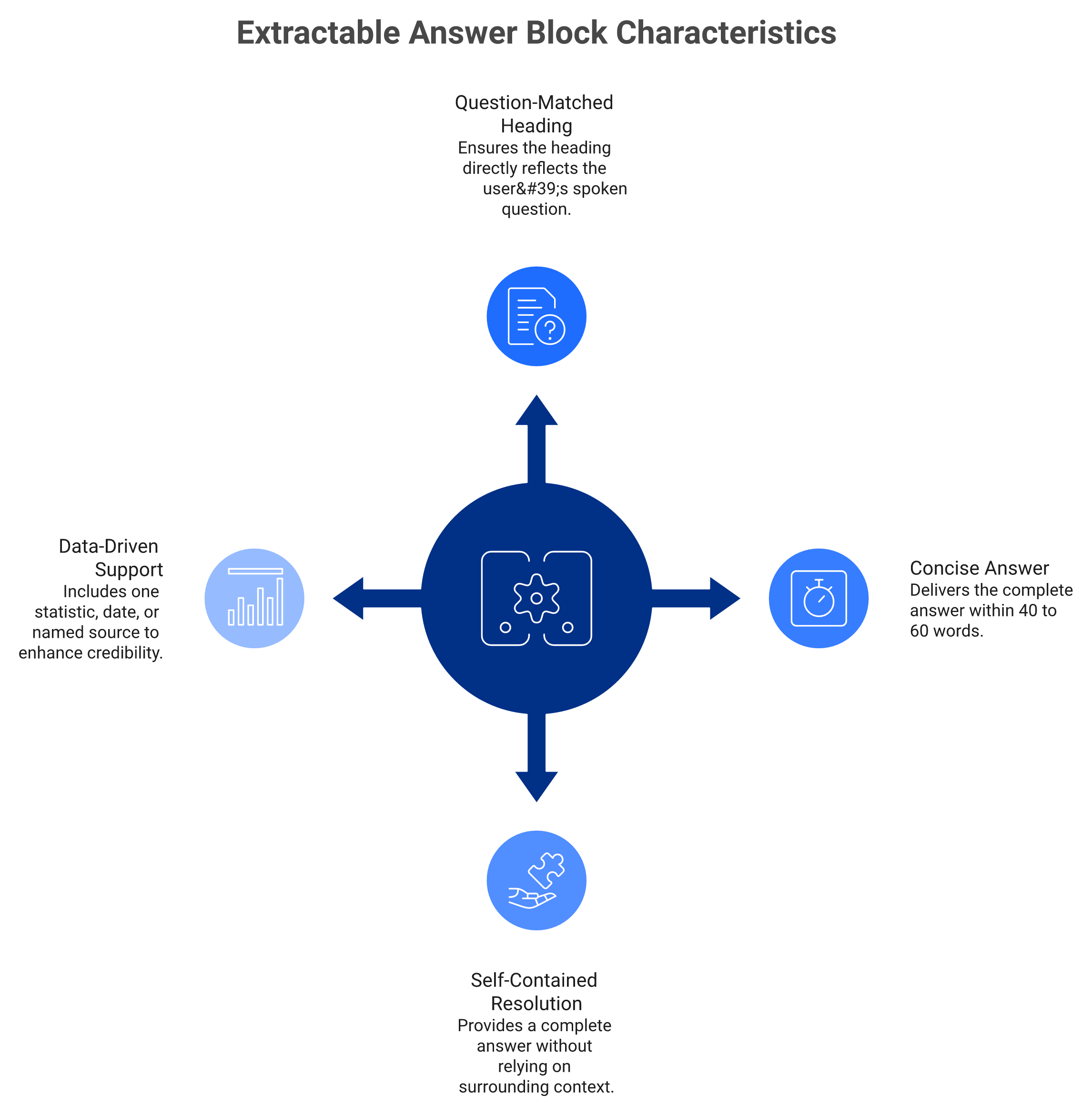
It is not a style preference. It matches the block size that speakable markup and sentence-level citation APIs handle cleanly.
Say a 55 word block out loud. It runs about 20 seconds, which is roughly the attention window for a spoken reply.
What the research actually measured
⭐ Princeton's GEO benchmark
Aggarwal and colleagues tested nine optimization tactics across 10,000 queries in GEO-bench. Citing sources, adding quotations, and adding statistics lifted visibility by 30% to 40%.
Two findings matter more than the headline. Keyword stuffing performed about 10% below the unoptimized baseline. Lower-ranked pages gained the most, with position-five pages seeing lifts up to 115%.
That second point is the challenger's argument. Retrieval is less winner-take-all than ranking, if your passages are built right.
🔁 Before and after
Before: "Voice search has grown significantly over the past few years, and marketers have had to adapt their strategies accordingly. There are several factors to consider when thinking about how assistants surface content."
After: "Voice assistants read one answer aloud, not ten links. Passages of 40 to 60 words that carry a named source get retrieved most often, according to Princeton's 2024 GEO study, which measured a 30% to 40% visibility lift from citation and statistics additions."
Same information. One is quotable.
The rewrite checklist
✅ Five checks per block
- Does the heading match the words a buyer would say?
- Is the complete answer inside the first 60 words?
- Would this block make sense with everything around it deleted?
- Does it name a source, a number, or a date?
- Are there orphan pronouns like "this" or "as we saw" chaining it to the block above?
Operators arrive at the same list through trial and error.
"Lead with the answer: previously, I would build up to the conclusion with extensive context. Now, I present the answer within the first 50 words."
- post author, r/seogrowth Reddit Thread
"For a page to be effective, it should contain at least 3 to 5 statistics per 1,000 words."
- post author, r/DigitalMarketing Reddit Thread
MaximusLabs AI treats information gain as the real constraint here. Every block should carry one fact the other nine articles on the topic do not have, which is the core of answer structure that earns citations. I might be overweighting this, but sameness looks like the fastest route to being ignored.
Q7. Which schema still matters after FAQ rich results were retired?
FAQ rich results stopped appearing in Google Search on May 7, 2026, and Search Console reporting was removed, so FAQPage is no longer a SERP goal. The markup still helps machines parse your questions. Speakable remains beta and news-scoped in Google's documentation. The durable voice stack is Article with dateModified, HowTo, Organization, Person with credentials, and LocalBusiness.
The advice that went stale
⚠️ Most guides are still selling 2021
Search "voice search optimization" and you will find FAQ schema recommended as a core tactic. That recommendation is now wrong on the SERP side.
Google restricted FAQ rich results to government and health sites in August 2023. It removed the feature entirely on May 7, 2026, with Search Console reporting ending in June and API support ending in August.
🧾 What that does and does not mean
The feature died. The markup did not.
FAQPage is still valid Schema.org markup, and Google has said it continues processing the markup to understand page content. Keep it for parsing clarity. Stop forecasting clicks from it.
Practitioners split on what to do next, which is worth showing honestly.
"The feature that was eliminated pertains to the display of SERP results and the related reporting in Search Console, but the markup itself remains unaffected."
- post author, r/TechSEO Reddit Thread
"Speakable schema: has no impact, so it's best to avoid it."
- post author, r/DigitalMarketing Reddit Thread
The current status table
📋 What to keep, what to retire
| Schema type | Current Google status | Voice AEO use |
| Article with dateModified | Active | Freshness signal for retrieval |
| HowTo | Rich result deprecated | Still parseable for step content |
| FAQPage | Rich result removed May 2026 | Entity clarity only, no SERP feature |
| Speakable | Beta, news-scoped | Marks text-to-speech sections |
| Organization and Person | Active | Entity identity and credentials |
| LocalBusiness | Active | Powers local spoken answers |
Where I land on the schema debate
🎯 A hygiene factor, not a growth lever
One camp calls schema a hygiene factor at best. Another calls it a meaningful inclusion signal. Both camps have data, and neither has a controlled experiment.
My position is simple. Ship it, because parsing clarity is cheap. Never bill it as growth, because no dataset supports that.
⏰ Sequence it before content
MaximusLabs AI ships full schema optimization in a Week 1 dev sprint, before any article publishes. That ordering exists because retrofitting markup across 40 live pages costs more than doing it once on the template.
The reallocation is the real action item. If a client report still forecasts CTR lift from FAQ markup, rebuild it around Article, Organization, and Product this month.
Q8. Which technical work actually moves voice visibility?
Meet the baseline first: mobile-first, LCP under 2.5 seconds, CLS under 0.1, and INP under 200 milliseconds. Then stop optimizing it. MaximusLabs AI prioritizes two items instead, server-rendered HTML, because no standalone AI crawler except Google executes JavaScript, and the 150-character excerpt that feeds the grounding answer. Toggle JavaScript off; whatever vanishes is invisible to assistants.
The audit that changes nothing
📑 Fifty pages, no movement
A technical audit lands. It flags 340 issues, colour-coded by severity. The team spends a quarter clearing them.
Citations do not move. Rankings barely move. The audit measured what tools can measure, not what retrieval needs.
✅ State the baseline honestly
Core Web Vitals still matter for users and for Google's page experience signals. LCP under 2.5 seconds, CLS under 0.1, INP under 200 milliseconds are the published thresholds.
Hit them. Then treat them as hygiene, not strategy. In fifteen years of this work, I have never seen Core Web Vitals alone produce a traffic increase.
The sixty-second diagnostic
🔍 Turn JavaScript off
Open DevTools, disable JavaScript, and reload your highest-value page. Watch what disappears.
On product and comparison pages, reviews, specs, and pricing tables often load asynchronously. They vanish. That is exactly the content an assistant needs to recommend you.
❌ Who can actually see it
Google renders JavaScript. Most AI crawlers do not. OpenAI documents GPTBot and OAI-SearchBot as separate crawlers with separate behaviour.
So a page can rank on Google and be functionally blank to ChatGPT. That gap explains a lot of "we rank but we are not cited" confusion.
MaximusLabs AI ships critical content and metadata in rendered HTML on every client build, and unblocks GPTBot and OAI-SearchBot in robots.txt during the same sprint. A crawler that cannot parse a page cannot cite it, which you can confirm with an AI crawlability check.
The punch list
🛠️ Three things, in order
- Server-render the content that sells. Reviews, specs, pricing, comparison tables. Client-side rendering hides them.
- Own the first 150 characters. That excerpt is a direct input to spoken answers, so write it as an answer, not a teaser.
- Check crawler access. Confirm robots.txt allows GPTBot, OAI-SearchBot, PerplexityBot, and Google-Extended if you want citations.
⏰ What to defer
Defer image compression sprints, minor CLS tuning, and full site redesigns. Defer anything whose success metric is a score rather than a citation.
The honest caveat: this ordering reflects what surfaces in MaximusLabs AI's client audits, not a controlled study. If your site is genuinely slow, fix speed first, because nothing else works from behind a timeout.
Q9. How do you stop assistants from getting your brand facts wrong?
Assistants describe your brand using web-wide consensus, not your About page. Close the sameAs loop so a crawler can traverse website to Wikidata to LinkedIn to Crunchbase to G2 and back. MaximusLabs AI treats verified G2, Capterra, and Gartner Peer Insights profiles with ten or more reviews as a launch requirement. Spoken answers show no visible source, so a buyer cannot sanity-check a hallucination.
The comfortable assumption
🏠 Your About page is not the record
Teams write the About page carefully, then assume that settles the facts. It does not.
Retrieval pulls from wherever the web agrees. If Crunchbase says one thing and LinkedIn says another, the model picks, or it invents.
⚠️ The Oxford moment
A builder once watched Perplexity summarize his team's article and describe them as Oxford researchers. Nobody on the team attended Oxford.
The model was not reading the byline. It was reading mentions elsewhere and stitching a plausible story. That is the failure mode in one example.
Closing the loop
🔗 The traversal path
Organization schema with sameAs links is the mechanism, and it sits at the centre of entity disambiguation for AI search. The goal is a closed circuit a crawler can walk without ambiguity.
- Homepage Organization schema with legal name, founding date, founders, and sameAs links.
- Wikidata entry, if you qualify, pointing back to the site.
- LinkedIn company page with matching name and description.
- Crunchbase profile with matching founding details.
- G2 and Capterra profiles with the same category language.
- Every profile linking home again.
Add disambiguatingDescription if a similarly named company exists. That single field prevents a lot of blended answers, which is the core of citation consistency across platforms.
Operators describe the same maintenance burden.
"In my view, the best approach is to keep your website as current as possible for when AI performs web searches."
- post author, r/AI_SearchOptimization Reddit Thread
"Increase your citations by utilizing directory listings, creating sponsored posts that showcase your business, and seeking endorsements on forums."
- commenter, r/SEO Reddit Thread
Corroboration is the real defence
⭐ Where assistants go for a second opinion
G2, Capterra, and Gartner Peer Insights are the standard corroboration layer for B2B software claims. Reddit threads carry the "what do people actually think" queries, which makes forum visibility part of the same job.
Local surfaces matter too. Google Business Profile, Apple Maps, and Bing Webmaster Tools feed platform-specific spoken answers.
✅ The Monday version
Ask MaximusLabs AI, or your own team, to run this sequence. It takes an afternoon.
- Ask ChatGPT, Perplexity, Gemini, and Claude "what is [brand]" and log every error.
- Trace each error to a source: stale page, wrong directory, or missing profile.
- Fix the source, not the chatbot. There is no edit button.
- Re-run the same prompts in 60 days and compare.
MaximusLabs AI verifies review-platform profiles and pushes for ten or more credible reviews per platform before content ships, which is how trust signals get built off-site. My honest caveat: correction timelines vary a lot by platform, and I have seen fixes land in weeks and in months with no clear pattern.
Q10. How do you measure voice AEO visibility when there are no clicks?
Track four metrics: citation frequency across ChatGPT, Perplexity, Gemini, and AI Overviews for a fixed prompt set; share of voice against named competitors; long-tail question growth in Search Console; and AI-referred conversion rate in GA4. Run the prompt set monthly with identical wording so results stay comparable. Voice visibility is measurable. It is simply not measurable in sessions or impressions.
The meeting where reporting breaks
💸 The CFO asks a fair question
Six months of investment. The analytics view shows almost nothing from AI sources.
The honest answer is that spoken and summarized answers leave no referrer. The dishonest answer is to blame attribution and move on.
📊 What replaces sessions
| Metric | What it captures | How to collect it |
| Citation frequency | How often you appear in answers | Fixed prompt set, run monthly |
| Share of voice | You versus three named rivals | Same prompt set, count mentions |
| Question growth | Long-tail spoken phrasing | Search Console query report |
| AI-referred conversion | Revenue quality of the channel | GA4 acquisition, AI sources segmented |
Build the prompt set first
🎯 Fixed wording, fixed cadence
Pick 30 to 50 prompts that map to real buying questions. Include "best X for Y," "alternatives to competitor," and "is X worth it."
Then never change the wording. Changing prompts mid-quarter destroys comparability, which is the most common mistake I see in AEO measurement programmes.
Manual tracking still beats most tooling at this stage, and practitioners say so plainly.
"For the time being, a manual approach remains the most dependable method. I recommend dedicating around twenty minutes each month to run brand and top three through Chat, Perity, Google AI."
- post author, r/SEO Reddit Thread
"Regularly querying ChatGPT or Perplexity with the same questions and documenting the results can uncover changes that automated tools might miss."
- post author, r/DigitalMarketing Reddit Thread
Paid trackers start around $29 to $79 per month for small prompt sets and climb past $250 for multi-engine coverage. Spend there only after the manual baseline exists, and compare options against a current brand mention tracking shortlist.
⏰ A cadence that survives a board deck
- Monthly: run the prompt set, screenshot, log citations and competitors.
- Monthly: pull GA4 conversion rate for AI-referred sessions separately.
- Quarterly: pull Search Console question-phrase growth.
- Quarterly: report which BOFU questions you now own by name.
Tie every prompt to money
💰 Visibility is not the deliverable
A tracked prompt with no revenue behind it is a vanity metric wearing a new outfit. Drop it.
MaximusLabs AI tracks share of voice across thousands of question variants rather than single rankings, and reports it beside pipeline attribution. Nidra Goods reached first position across Google, ChatGPT, and Perplexity under that tracking, which is our own measurement rather than an audited third-party figure.
Q11. What should you ship in the first 30 days of voice AEO?
Week 1: run the JavaScript-off test and fix client-rendered content. Week 2: convert your top 20 BOFU keywords into spoken questions, then rewrite each target page's opening block to 40 to 60 words. Week 3: close the sameAs loop and verify review profiles. Week 4: baseline your prompt set across four AI platforms. MaximusLabs AI runs this as a Week 1 dev sprint, before any article publishes.
Sequence matters more than effort
🛠️ Retrievability before authority
Authority work is slower and more expensive. It also produces nothing if crawlers cannot read the page.
So fix parsing first, formatting second, identity third, measurement fourth. Any other order wastes the first month, which is why the implementation checklist runs in that sequence.
⏰ The four-week table
| Week | Ship this | Owner |
| 1 | Server-render key content, unblock AI crawlers | Engineering |
| 2 | Spoken-question rewrite of top 20 BOFU pages | Content |
| 3 | Organization schema, sameAs loop, review profiles | Marketing ops |
| 4 | Prompt-set baseline across four engines | Analytics |
What kills the timeline
❌ Engineering queues, not strategy
The blocker is rarely the plan. It is the sentence "the engineering team says nine months."
Most of this work is template-level and takes days. If your CMS cannot ship a schema change in a week, that is the real problem to solve first.
Buyers describe the same friction from the agency side.
"A reputable agency will honestly inform you that effective SEO requires a minimum of 3 to 6 months to yield significant results."
- commenter, r/DigitalMarketing Reddit Thread
"Paid an SEO agency for 6 months and got nothing. Here's what I wish someone had told me before signing."
- post author, r/IndiaBusiness Reddit Thread
Both are true at once. Results take months. Shipping should not.
Who executes this
⭐ An honest comparison
| Execution model | Speed to first ship | AI retrieval depth | Reporting basis | Cost per asset |
| MaximusLabs AI | Days (first asset possible day 4) | Prompt-set citation mapping across four engines | Citation share plus pipeline | From roughly $60 |
| GEO specialist | Weeks | Varies by firm | Visibility metrics | Varies |
| Traditional SEO agency | Weeks to months | Usually an added service line | Rankings and traffic | Around $260 |
| In-house team | Months | Depends on hires | Mixed | Around $800 |
Cost figures are MaximusLabs AI's own published comparison, not third-party audited data. Treat them as our claim, and ask any vendor including us for the working behind theirs.
What I am sitting with
💡 The open question
Google's Search Live moved voice from single answers to real conversations, then added a native audio model in December 2025. My hypothesis is that turn two and turn three become the competitive surface within a year, and almost nobody is writing for multi-turn conversational search yet.
I could be early on this. If you run your prompt set across four engines this month, send me what you find at krishna@maximuslabs.ai, especially the results that contradict me.
Frequently asked questions
What is voice search AEO optimization, and how is it different from traditional SEO?
Voice search AEO optimization is the practice of structuring content so voice assistants and AI answer engines retrieve it, then speak it as the single answer. Traditional SEO competes for a slot inside a list of ten links. Voice AEO competes for one spoken slot, which makes the outcome binary. Four things change when the answer is spoken rather than displayed: The unit. Ranking scores pages, retrieval scores passages, so the chunk becomes the asset. The query. Spoken prompts run 10 to 15 words with role, industry, and constraint baked in. The evidence. Assistants weigh what the wider web says about you over what your own pages claim. The scoreboard. Impressions and average position cannot measure a spoken answer at all. SEO fundamentals stay necessary. Crawlability, internal linking, and topical authority carry over unchanged. They simply stop being sufficient once the assistant reads one answer instead of showing ten. MaximusLabs AI treats this as a data science problem before a content problem, because retrieval runs on semantic similarity and RAG pipelines. If you want the side-by-side breakdown, our team maps it in detail in our comparison of GEO versus traditional SEO .
How does a voice assistant decide which answer to speak aloud?
A spoken query is never matched to one page. The assistant decodes intent, fans the prompt into roughly 8 to 12 parallel sub-queries, retrieves candidate passages, and grounds its reply on short excerpts from the highest-similarity chunks. Three mechanics drive selection: Query fan-out. Your page competes a dozen times against phrasings you never chose. Latency budgets. Grounding layers run on millisecond windows, and content that cannot be fetched and parsed inside that window is absent rather than ranked low. Excerpt grounding. ChatGPT frequently grounds on excerpts of around 150 characters, which makes your meta description and opening sentence direct inputs to a spoken reply. Voice also went multi-turn. Google launched Search Live with voice input in AI Mode in June 2025, then added a Gemini native audio model in December 2025. Users now hold a conversation, so the follow-up question matters as much as the opener. MaximusLabs AI runs ICP prompt sets across ChatGPT, Perplexity, and Gemini to record which URLs and excerpts get cited per client category. Teams that want to model the fan-out themselves can start with our query fan-out generator .
How long should a voice search answer block be, and what makes it extractable?
Answer inside the first 40 to 60 words. That range matches the block size that speakable markup and sentence-level citation APIs handle cleanly, and a 55 word block runs about 20 seconds when spoken aloud. Extractable passages share four traits: The heading restates the question a buyer would actually say. The complete answer lands in the opening sentences, before any context building. The block resolves fully with everything around it deleted. It carries one number, date, or named source. Peer-reviewed evidence supports this. Princeton's 2024 GEO study tested nine tactics across 10,000 queries and found that citing sources, adding quotations, and adding statistics lifted AI visibility by 30% to 40%, while keyword stuffing scored roughly 10% below the unoptimized baseline. Lower-ranked pages gained the most, with position-five pages seeing lifts up to 115%. MaximusLabs AI enforces a standalone 40 to 80 word answer nugget under every H2 as a production standard, which is why client pages get quoted verbatim. The full formatting method sits in our guide to AEO answer structure and writing .
Is FAQ schema still worth implementing for voice search in 2026?
FAQ rich results stopped appearing in Google Search on May 7, 2026, and Search Console reporting was removed shortly after. FAQPage is no longer a SERP goal. The markup itself remains valid Schema.org and still helps machines parse your questions, so keep it for entity clarity and stop forecasting clicks from it. The durable voice stack looks like this: Article with dateModified. Active, and a freshness signal for retrieval. HowTo. Rich result deprecated, still parseable for step content. Speakable. Beta and news-scoped in Google's own documentation, so treat it as a supporting signal. Organization and Person. Active, and the backbone of entity identity and author credentials. LocalBusiness. Active, and it powers local spoken answers. Our position on the wider schema debate is deliberately unglamorous. Ship it, because parsing clarity is cheap. Never bill it as growth, because no controlled dataset supports that claim. MaximusLabs AI ships full schema optimization in a Week 1 dev sprint before any article publishes, since retrofitting markup across dozens of live pages costs far more. Start with the fundamentals in our primer on schema markup for AI discoverability .
Which technical work actually moves voice and AI answer visibility?
Two items decide it. First, server-rendered HTML, because no standalone AI crawler except Google executes JavaScript. Second, the opening 150 characters, because that excerpt feeds the grounding answer directly. Run this sixty-second diagnostic before anything else. Open DevTools, disable JavaScript, and reload your highest-value page. On product and comparison pages, reviews, specs, and pricing tables often load asynchronously and vanish. That is exactly the content an assistant needs in order to recommend you. Meet the baseline, then stop optimizing it: Mobile-first rendering across all templates. LCP under 2.5 seconds, CLS under 0.1, INP under 200 milliseconds. robots.txt access for GPTBot, OAI-SearchBot, PerplexityBot, and Google-Extended. Core Web Vitals still matter for users and page experience, but they are hygiene rather than strategy. A page can rank on Google and be functionally blank to ChatGPT, which explains most of the "we rank but we are not cited" confusion we hear from growth teams. MaximusLabs AI ships critical content and metadata in rendered HTML on every client build. You can verify your own exposure in minutes with our AI crawlability checker .
How do you measure voice AEO visibility when there are no clicks to track?
Voice answers produce no pageview, no referral row, and no click event, so traffic reporting shows nothing. Replace sessions with four metrics and run them on a fixed cadence. Citation frequency. How often you appear in answers across ChatGPT, Perplexity, Gemini, and AI Overviews for a fixed prompt set. Share of voice. Your mentions against three named competitors on the same prompts. Question growth. Long-tail spoken phrasing surfacing in the Search Console query report. AI-referred conversion rate. GA4 acquisition with AI sources segmented separately from organic. Build a set of 30 to 50 prompts mapped to real buying questions, then never change the wording. Changing prompts mid-quarter destroys comparability, which is the most common reporting mistake we see. Manual tracking beats most tooling at the baseline stage, and paid trackers only earn their place once that baseline exists. MaximusLabs AI tracks share of voice across thousands of question variants rather than single rankings, and reports it beside pipeline rather than beside traffic. The metric definitions and cadence templates live in our breakdown of AEO measurement metrics .
What should a team ship in the first 30 days of voice AEO optimization?
Sequence beats effort here. Fix retrievability before authority, because authority work produces nothing if crawlers cannot read the page. Week 1. Run the JavaScript-off test, server-render key content, and unblock AI crawlers in robots.txt. Week 2. Convert your top 20 BOFU keywords into spoken questions, then rewrite each target page's opening block to 40 to 60 words. Week 3. Close the sameAs loop across your site, Wikidata, LinkedIn, Crunchbase, and G2, then verify review profiles. Week 4. Baseline your prompt set across four AI platforms and log competitor mentions. Defer image compression sprints, minor CLS tuning, and full redesigns. Defer anything whose success metric is a score rather than a citation. The blocker is rarely strategy. It is the engineering queue, and the sentence "that will take nine months." Most of this work is template-level and takes days. MaximusLabs AI runs it as a Week 1 dev sprint before a single article publishes, with the first asset possible by day four. If you want that sequence run against your own site, our team can scope it through a short strategy conversation .