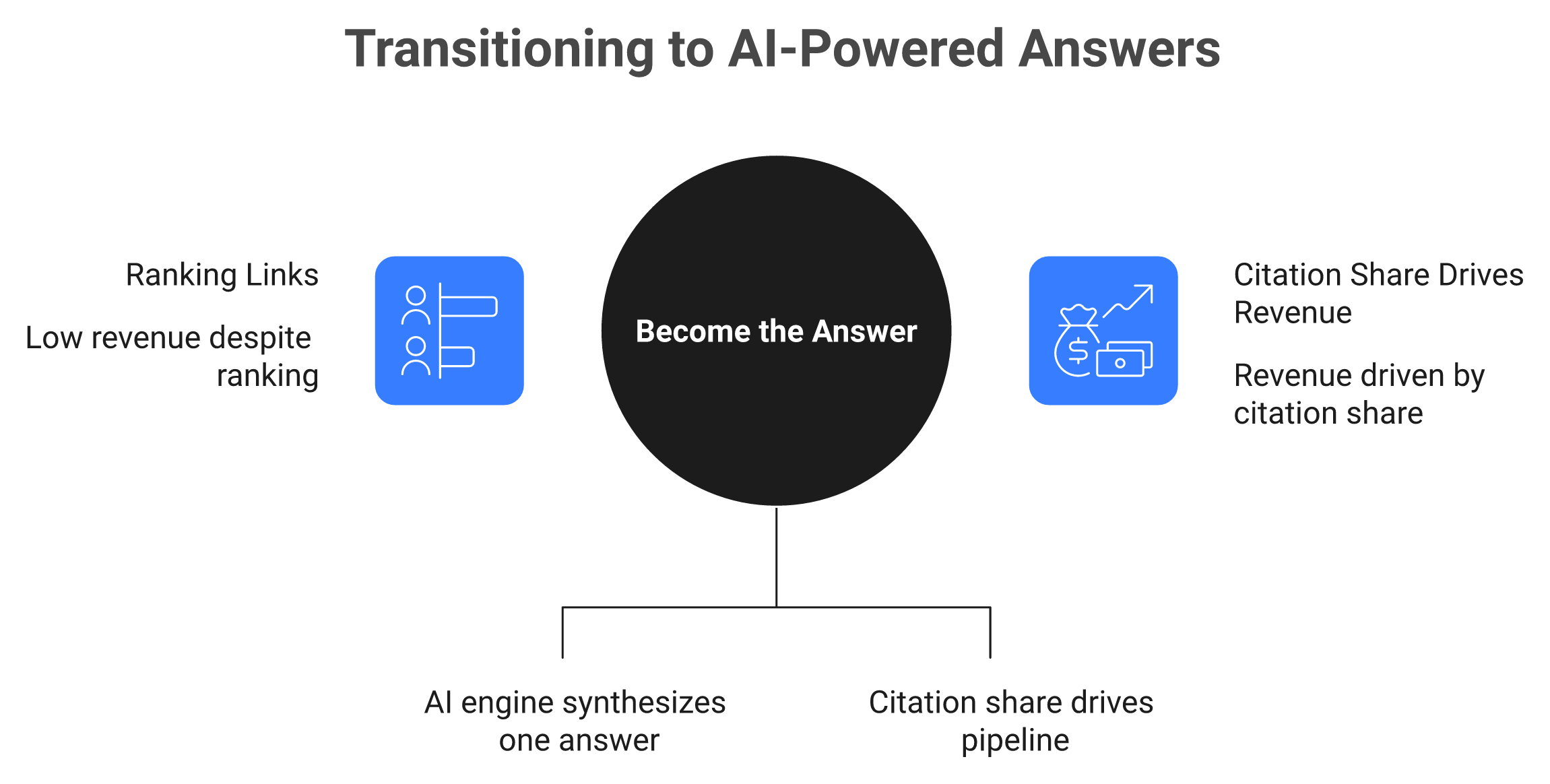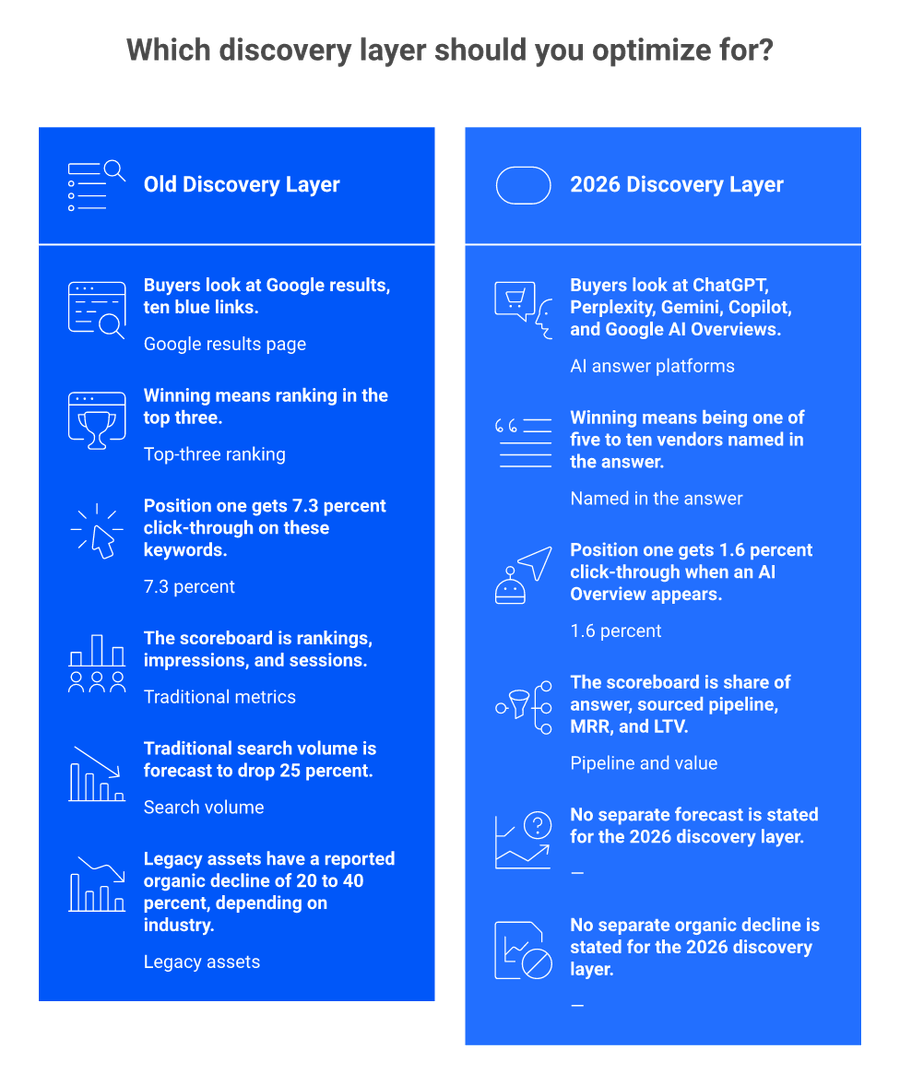
- A content marketing funnel maps content to awareness, consideration, decision, and retention, but AI search has moved its weight toward middle and bottom stages.
- Pew found Google users clicked a result in 8% of visits with an AI summary versus 15% without, so definition posts now earn few clicks.
- We build BOFU-first: comparison, alternatives, pricing logic, and implementation pages before any awareness content, because AI-referred visitors arrive pre-sold.
- Make every stage citable with answer-first sections, sourced statistics, and earned mentions on review sites and community threads that AI engines trust.
- Measure each stage by what it should cause: AI share of voice, assisted conversions, and pipeline, not pageviews or last-click credit.
- Choose an execution model by cost per piece, launch speed, and revenue focus, because a funnel strategy that never ships produces nothing.
The quarterly review always reaches the same slide. A VP of Marketing points at a blog traffic chart that has climbed for six straight months. Then the CEO asks the question that ends the meeting: "Which of these posts closed a deal?"
Nobody has a clean answer, because the funnel was built for pageviews. It was stuffed with "what is" explainers that once pulled easy clicks from Google. Today, ChatGPT, Perplexity, and Google AI Overviews answer those questions before anyone clicks.
I have lived the other side of that slide. As head of GTM at WiseMonk, SEO drove 98% of the company's revenue, so every page had to earn its place. Here's the thing: the content marketing funnel still works. But its weight has moved down, toward the content buyers read when they are about to choose.
This guide covers the stages, real examples, and the strategy MaximusLabs AI uses to build funnels that end in pipeline, not just traffic.
Q1. What is a content marketing funnel, and does it still work in the age of AI search?
A content marketing funnel is a plan that maps content to each stage of the buyer's journey. Awareness content attracts buyers who are naming a problem. Consideration content builds trust while they compare options. Decision content converts them with proof. The funnel still works in AI search, but its weight has moved. AI answers now absorb many early questions, so the value sits in middle- and bottom-stage content.
How the funnel works in plain terms
🎯 One buyer, three questions
The funnel is a map of the questions a buyer asks on the way to a purchase. Early on, they ask "why is this happening?" In the middle, they ask "how do teams solve this?" At the end, they ask "which vendor should I pick, and what will switching cost me?"
Each question needs a different page. A glossary post cannot answer a pricing question. A case study is wasted on someone who has not named the problem yet, so mapping content to the question is the whole job.
⚠️ Where the old funnel leaked
The traditional SEO playbook filled the top first. Agencies published dozens of "what is X" posts because they ranked fast and lifted traffic charts. Those posts rarely led to a demo request, so the funnel looked busy and produced little pipeline.
That leak is now bigger. Pew Research Center tracked 68,879 Google searches by 900 U.S. adults in March 2025. Users clicked a traditional result in 8% of visits when an AI summary appeared, versus 15% without one. They clicked a link inside the summary in just 1% of visits.
Why the funnel still matters, with a new center of gravity
💰 A revenue funnel, not a traffic funnel
The funnel did not die. Its top got thinner, and its bottom got more valuable. Semrush's July 2025 study found the average AI search visitor is worth 4.4 times a traditional organic visitor, measured by conversion rate. Those visitors did their research inside the chat and arrive ready to compare.
So the funnel's job changes. Clicks and impressions are vanity metrics if they never move revenue. A modern funnel is judged by one thing: how many qualified buyers it moves to a decision. Traffic still counts, but only when it leads somewhere a buyer can act.
✅ What to check on Monday
- Sort your last 50 posts by funnel stage, not by traffic.
- Count how many answer a decision question, such as comparisons, pricing logic, or implementation.
- If most of them sit at the top, the funnel is top-heavy and needs rebalancing.
This is my working test, not a law. Still, every funnel audit I have run started with this count, and it usually explains the flat pipeline line.
🧭 Where MaximusLabs AI starts
MaximusLabs AI builds funnels from the decision stage upward, because that is where AI-referred buyers land. Every engagement is measured on pipeline, not on mentions or pageviews. The top of the funnel still matters, but as a surface AI engines cite, not as a traffic goal.
Q2. How has AI search changed the content marketing funnel?
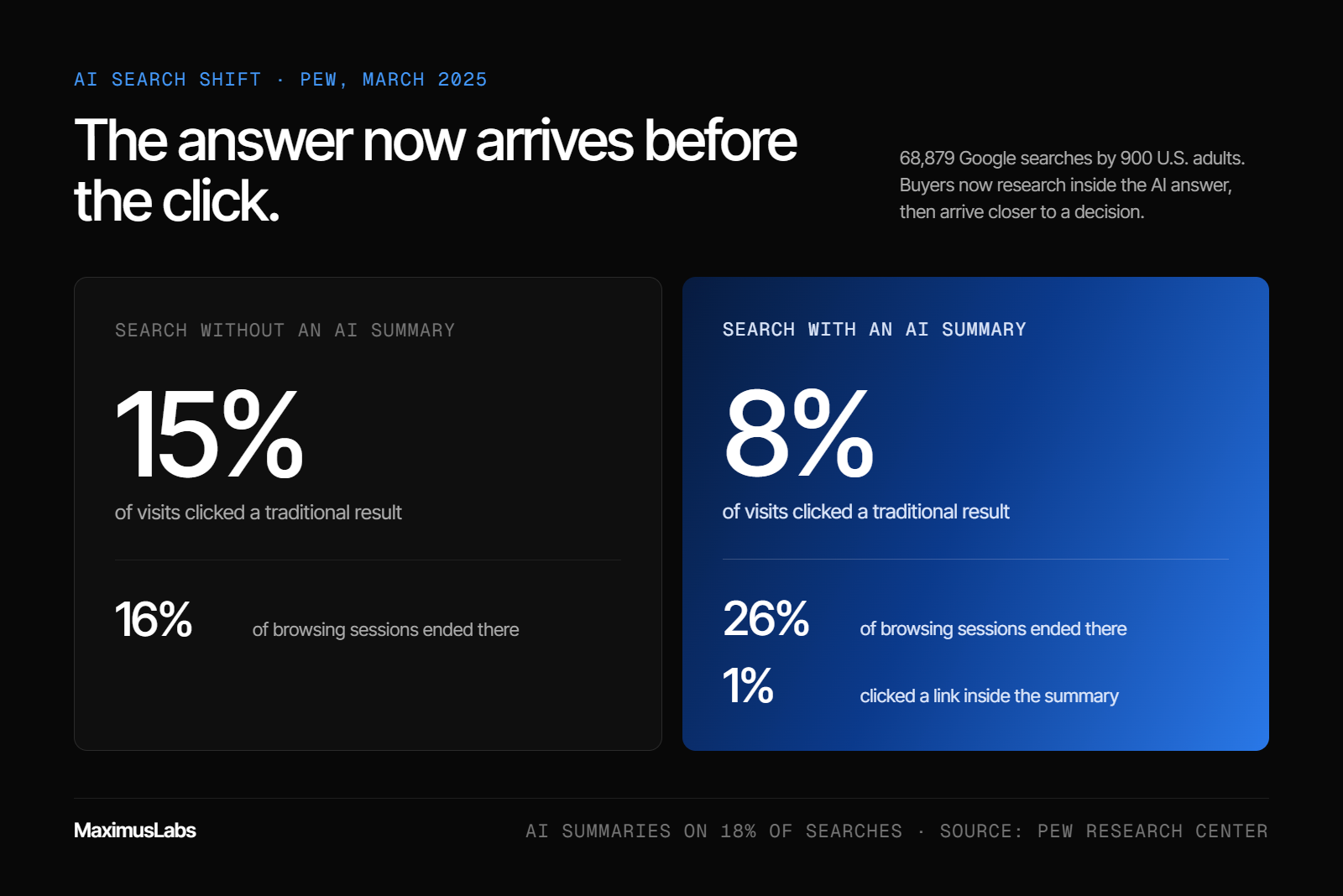
AI search compresses the top of the funnel and pre-sells the bottom. Pew Research Center found Google users clicked a result in 8% of visits with an AI summary, versus 15% without one, in 2025. Buyers now research inside ChatGPT, Perplexity, and Google AI Overviews, then arrive closer to a decision. MaximusLabs AI treats this as a shift from ranking to being cited, because the shortlist now forms inside the AI answer.
Situation: the funnel Google built
📊 How it used to work
For fifteen years, the funnel ran through ten blue links. A buyer typed a query, scanned results, and clicked three or four pages. Each click was a chance to capture an email and nurture that buyer toward a demo.
Traditional SEO agencies optimized for that flow. They sold rankings, impressions, and clicks on fixed retainers. Content was written for Google's results page, and nothing in the monthly report tied back to pipeline.
Complication: the answer arrives before the click
⚠️ Fewer clicks at the top
AI answers now sit above those links. In Pew's sample, AI summaries appeared on 18% of Google searches. Browsing sessions also ended more often after an AI summary, 26% versus 16% without one.
Google's own documentation explains why these answers feel complete. AI Overviews and AI Mode use "query fan-out," which runs several related searches across subtopics to build one response. Google adds that clicks from these result pages are higher quality, with visitors spending more time on the site.
🤝 Buyers want fewer sales calls
B2B buyers were already moving this way. Gartner's 2025 sales survey found 61% of B2B buyers prefer a rep-free buying experience. When the buyer will not book a call, the AI answer and your content do the selling.
Resolution: become the answer, not a blue link
🎯 A smaller, binary shortlist
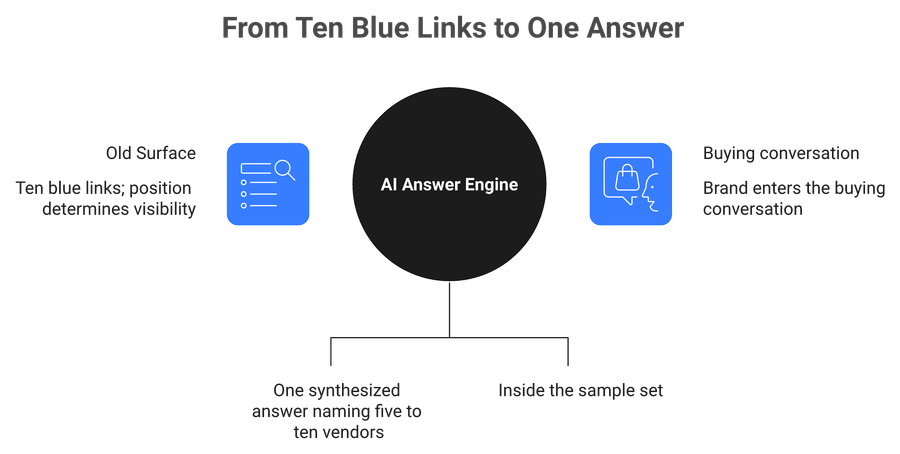
When a buyer asks ChatGPT for the best tools in a category, it names a handful of brands. In MaximusLabs AI's prompt tracking, that list usually holds five to ten names. There is no page two, so a brand is either in the answer or invisible to that buyer.
AI recommendation is also a trust transfer. When ChatGPT names your brand, it stakes its own credibility on you. That is why a cited brand often meets a buyer who is already half sold.
💡 What MaximusLabs AI changed
MaximusLabs AI was built on this shift. Its founder saw brands cited by ChatGPT that were missing from Google's top 10, so each funnel stage is optimized for citation on each platform. MaximusLabs runs Answer Engine Optimization (AEO), with SEO as its foundation, as strategy and execution in one team. Daily tracking re-runs buyer prompts across ChatGPT, Perplexity, Gemini, Claude, and Google AI Overviews.
⭐ Proof that it lands on pipeline
For Oliv AI, MaximusLabs AI's work produced a "64% AI citation rate in 6 months, vs ~30% for billion-dollar incumbents (Oliv AI)." The same work delivered "27 qualified leads, $47K+ pipeline, 26% close rate in 4 months (Oliv AI)." Being cited was the means, and pipeline was the outcome.
Q3. What are the stages of a content marketing funnel?
The content marketing funnel has three core stages and one that most guides skip. Top of funnel (TOFU) is awareness, where buyers name a problem. Middle of funnel (MOFU) is consideration, where they compare approaches. Bottom of funnel (BOFU) is decision, where they pick a vendor. Retention follows the sale and turns customers into reviews, referrals, and mentions that feed the top again.
Stage 1: Awareness (TOFU)
🔍 The buyer is problem-aware
The buyer feels a pain but has not named a fix. They ask broad questions like "why is our trial-to-paid rate dropping?" These are head questions, short and general, and AI engines answer most of them directly.
The goal here is not traffic. It is to be the source an AI engine cites when it explains the problem. Original data and a clear point of view earn that citation better than a definition does.
Stage 2: Consideration (MOFU)
⚖️ The buyer is solution-aware
Now the buyer knows a category of fix exists. They ask mid-tail questions, such as "how do SaaS teams cut onboarding drop-off without adding headcount?" They compare approaches, not vendors yet.
The goal is trust. Frameworks, comparisons of approaches, and templates show that you understand the problem better than the alternatives do. This is also where a buyer first trades an email for something useful, such as a template or a benchmark.
Stage 3: Decision (BOFU)
✅ The buyer is product-aware
The buyer is choosing between named vendors. Questions turn long and specific: integrations, pricing logic, migration effort, and security reviews. MaximusLabs AI's working estimate puts the average AI chat query at about 25 words, and these long prompts are where owned content wins.
This stage carries more weight than it used to. Gartner found 61% of B2B buyers prefer to buy without a sales rep. Decision content now answers the questions a rep used to handle on a call.
Stage 4: Retention and advocacy
🔁 The loop most guides skip
Most funnel guides stop at the sale. That is a mistake in AI search. For broad "best tool" questions, AI engines often lean on third-party sources such as review sites, community threads, and published lists.
Those sources are shaped by customers. Onboarding guides, help docs, and well-timed review requests turn happy users into the earned mentions that feed awareness again.
🧩 How the stages map to AI question types
| Stage | Awareness level | Typical question type | Who usually gets cited |
| TOFU | Problem-aware | Head (broad) | Third-party and data sources |
| MOFU | Solution-aware | Mid-tail | A mix of owned and earned pages |
| BOFU | Product-aware | Long-tail (specific) | Owned pages with real depth |
| Retention | Customer | Post-purchase | Reviews and communities |
🧭 How MaximusLabs AI uses this map
MaximusLabs AI maps every client's keyword and prompt list to these four stages before writing anything. That map sets the order of work: decision pages first, then consideration, with retention feeding earned mentions. It keeps the content calendar tied to pipeline instead of to traffic.
Q4. What content belongs at each stage of the funnel?
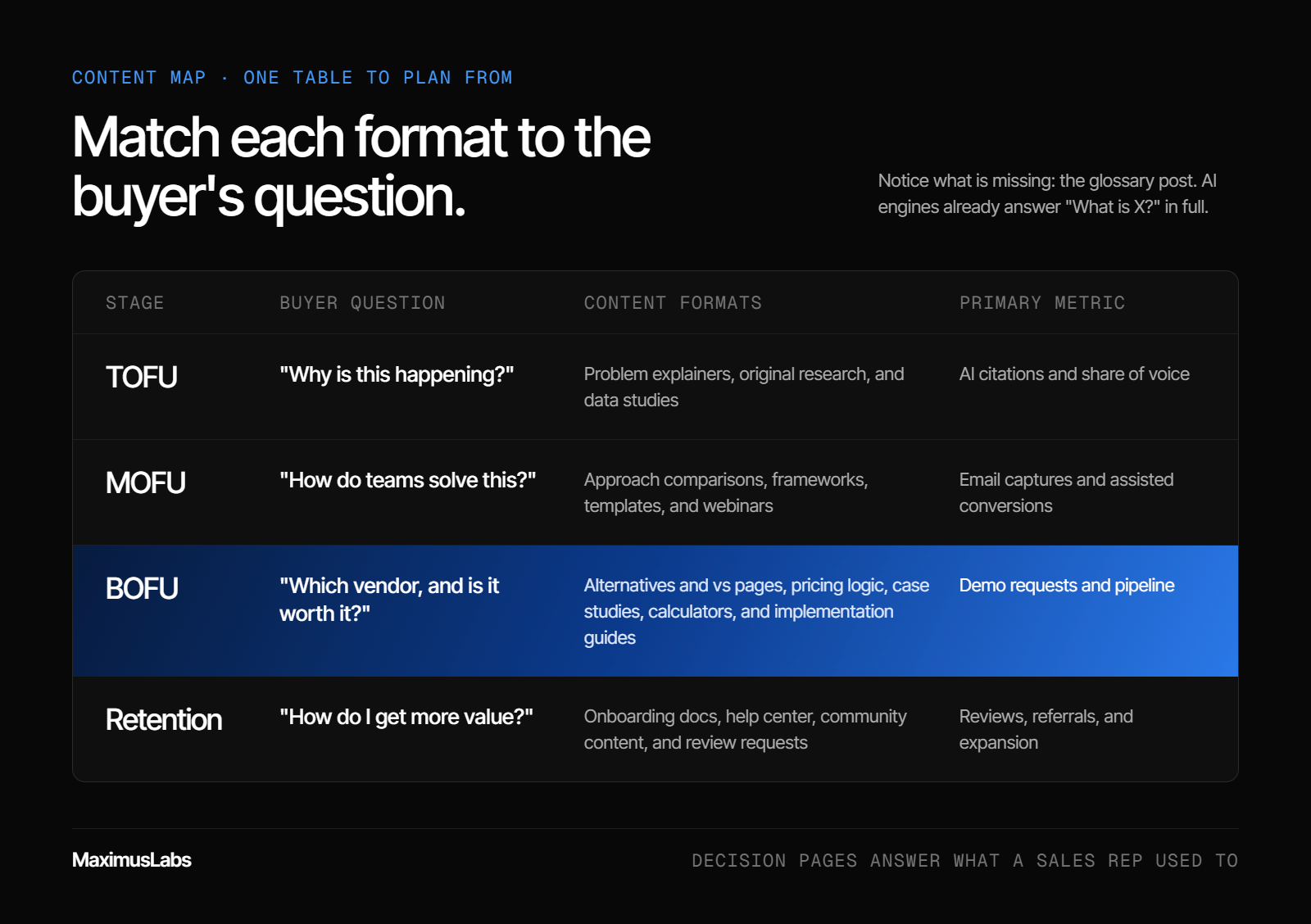
Match each content format to the buyer's question at that stage. Awareness uses problem explainers and original data that AI engines can cite. Consideration uses comparisons, frameworks, templates, and webinars. Decision uses alternatives pages, pricing logic, case studies, calculators, and implementation guides. Retention uses onboarding docs, community content, and review requests. Every decision-stage asset should answer what a sales rep used to answer on a call.
The stage-by-stage content map
🗺️ One table to plan from
| Stage | Buyer question | Content formats | Primary metric |
| TOFU | "Why is this happening?" | Problem explainers, original research, and data studies | AI citations and share of voice |
| MOFU | "How do teams solve this?" | Approach comparisons, frameworks, templates, and webinars | Email captures and assisted conversions |
| BOFU | "Which vendor, and is it worth it?" | Alternatives and vs pages, pricing logic, case studies, calculators, and implementation guides | Demo requests and pipeline |
| Retention | "How do I get more value?" | Onboarding docs, help center, community content, and review requests | Reviews, referrals, and expansion |
Notice what is missing: the glossary post. MaximusLabs AI skips "What is X?" pages on purpose, because AI engines already answer them in full. That budget goes further on pages buyers read right before they choose.
Why decision pages need real product detail
🖥️ Show the product, not just the promise
Common copywriting advice says to sell benefits and skip features. On decision pages, that advice backfires. A buyer comparing three vendors needs integration lists, setup steps, compliance details, and the honest limits of each option.
Product moments help too. A UI screenshot, a two-minute clip, or a working ROI calculator shows the "aha" faster than a paragraph can. Placing these inside comparison and how-to pages shortens the path from reading to a trial.
🤖 Why detail also wins AI citations
Long, specific buyer prompts need specific answers. Google says its AI features run several related searches across subtopics to build one response. A decision page that covers integrations, pricing logic, and setup in one place gives those searches more to retrieve. Thin pages that hide every detail behind a "book a demo" button give the engine nothing to quote.
Content that replaces the sales call
💬 Turn rep questions into pages
Gartner found 61% of B2B buyers prefer a rep-free buying experience. So the questions a rep used to answer need a home on your site.
- "Will it work with our stack?" becomes an integrations page with setup steps.
- "What will switching cost us?" becomes a migration guide.
- "Why you over the other two?" becomes an honest comparison page.
- "Is it secure?" becomes a security and compliance page.
🧭 How MaximusLabs AI builds this list
MaximusLabs AI pulls these questions from sales calls, support tickets, and Reddit threads before drafting a single page. Each question becomes one decision-stage asset with one clear job. That keeps the content map tied to what buyers actually ask, and to the pipeline those answers create.
Q5. Why should you build the funnel from the bottom up?
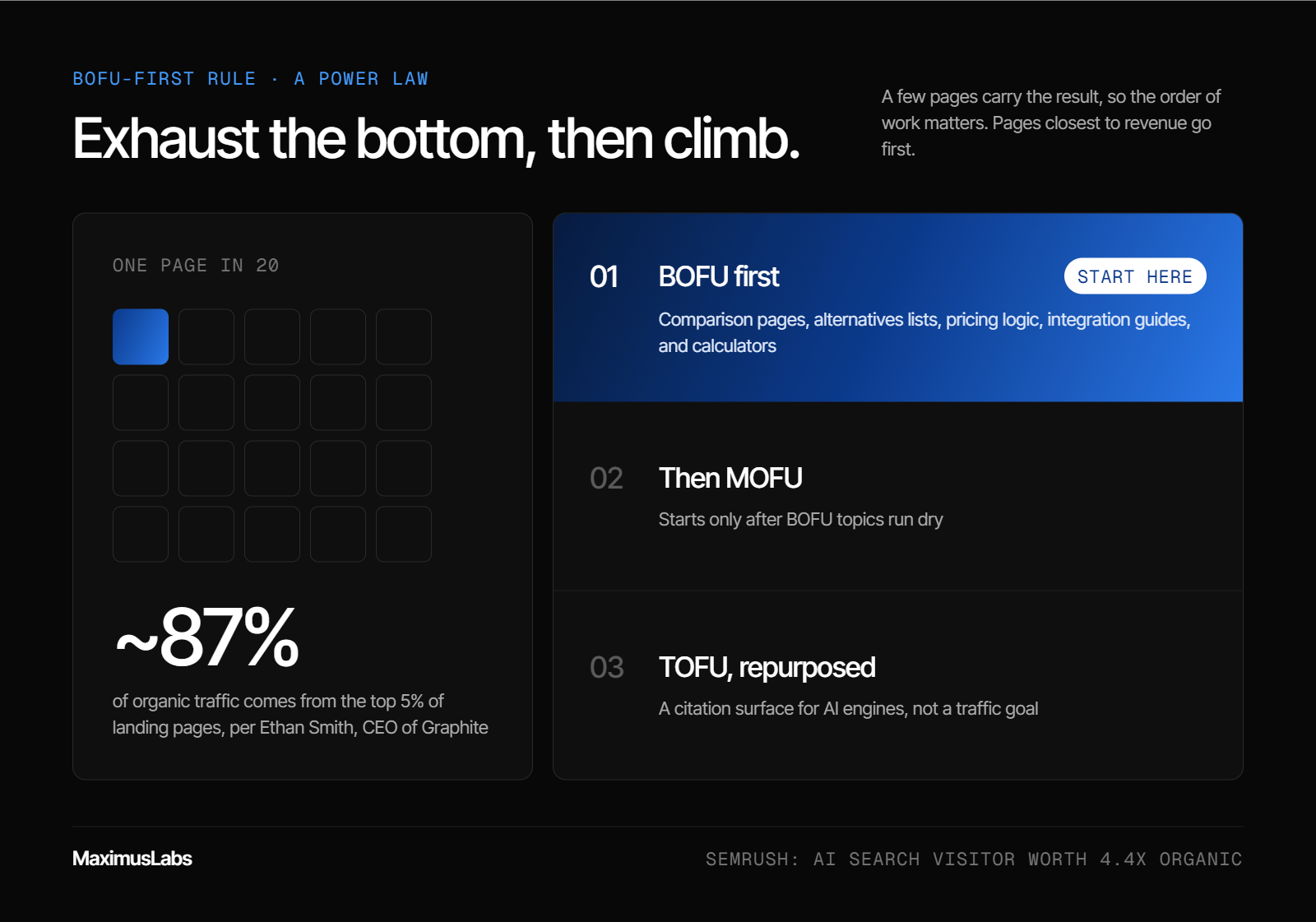
Build the funnel bottom-up because revenue concentrates at the end of the buyer's journey. Ethan Smith, CEO of Graphite, reports that the top 5% of landing pages drive roughly 87% of organic traffic, so most pages contribute little. MaximusLabs AI runs a BOFU-first plan: it covers comparison, alternatives, and implementation topics before moving to MOFU. It treats TOFU as a citation surface for AI engines, not a traffic goal.
Situation: the top-first default
📚 How most content calendars start
Most content plans begin at the top. The logic sounds sensible: build awareness, then nurture, then convert. So the first 30 posts are definitions and beginner guides.
Traditional SEO agencies like this order because top-of-funnel posts rank quickly and lift traffic charts fast. The monthly report looks healthy. The pipeline line stays flat, and the team is told to "give it time."
Complication: the top no longer pays
⚠️ AI answers took the easy clicks
Those early posts now compete with the AI answer itself. As Pew's data in the earlier section showed, clicks on traditional results nearly halve when an AI summary appears. A definition post is exactly the content an AI engine can summarize without sending anyone to your site.
Practitioners who run AI search programs make the same point. Glossary definitions and low-intent pages earn little, because there is nothing left to click once the answer is shown. The effort pays off more at the end and middle of the journey.
📉 A power law, not a bell curve
The returns are also lopsided. Smith reports that the top 5% of landing pages drive roughly 87% of organic traffic, based on audits of hundreds of companies. That is about one page in 20 doing almost all of the work.
When a few pages carry the result, the order of work matters. Pages closest to revenue have the best odds of landing in that top 5%.
Resolution: exhaust the bottom, then climb
✅ The BOFU-first rule
The rule is simple: cover every high-intent decision topic before you write a single awareness post. That means comparison pages, alternatives lists, pricing logic, integration guides, and calculators. Only when those are done do you move up to MOFU.
These pages also meet the most valuable visitors. Semrush found the average AI search visitor is worth 4.4 times a traditional organic visitor, measured by conversion rate. Those buyers arrive pre-sold, so they land on decision pages.
🧭 How MaximusLabs AI sequences the work
MaximusLabs AI aligns every article to the client's ideal customer profile (ICP), meaning the specific buyer the company sells to. Its execution plan spends the first months entirely on BOFU articles, and the first article can go live within four days of signing. MOFU starts only after BOFU topics run dry.
I will admit the trade-off. A BOFU-first funnel looks small on a traffic chart for a while, and some boards find that uncomfortable. In MaximusLabs AI's experience, the conversation changes once the first demo requests trace back to a comparison page.
💡 Where the top still fits
TOFU is not banned. It is repurposed. An original data study can earn AI citations that put your brand in front of buyers early.
MaximusLabs AI treats that top layer as citation surface, not a traffic target. Every engagement is measured on pipeline, so awareness content earns its place only when it feeds the decision pages below it.
Q6. How do you build a content marketing funnel step by step?
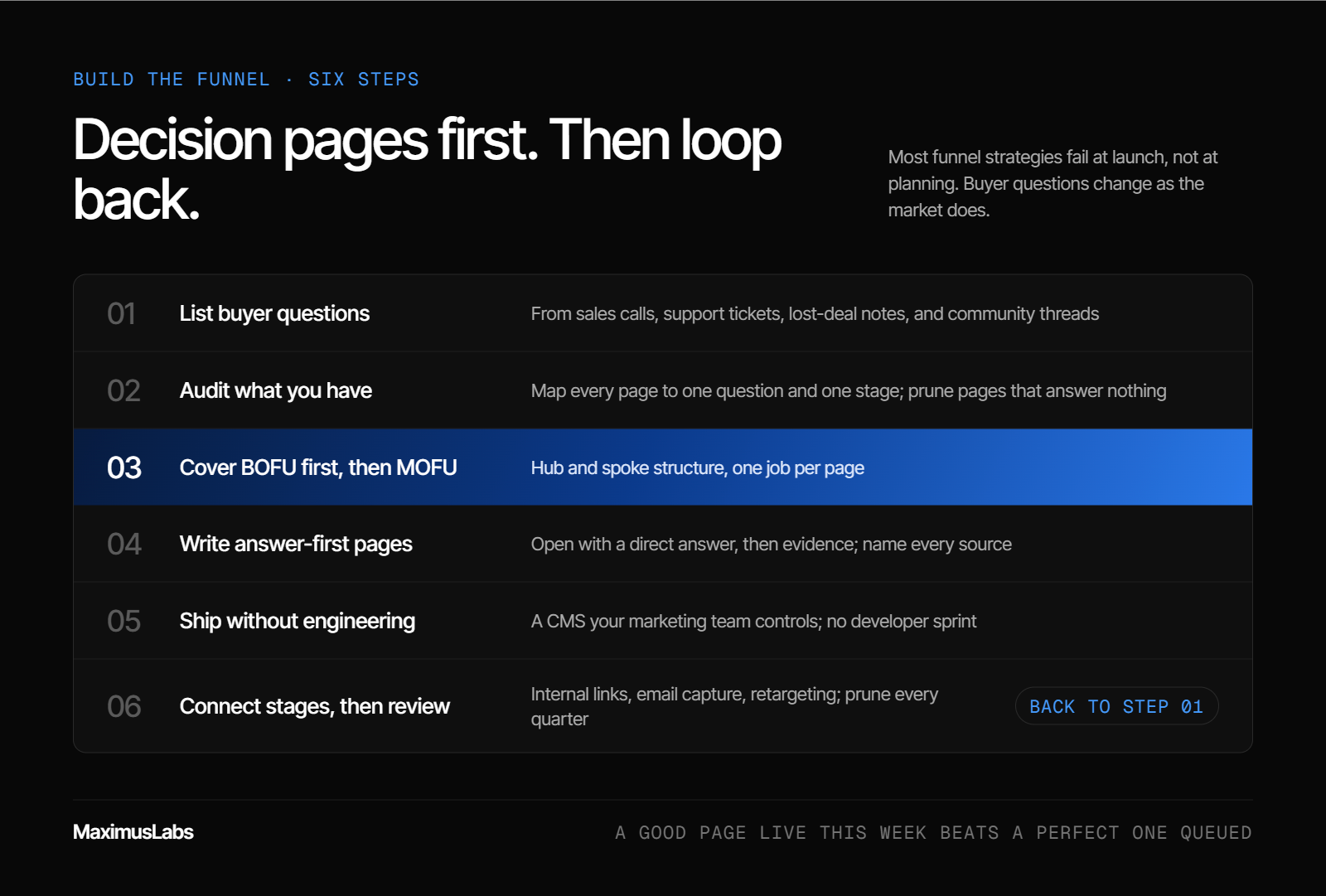
Build a content marketing funnel in six steps. List your ICP's real questions for each stage. Audit existing content against those questions. Cover decision topics first, then consideration. Write answer-first pages with sourced data. Ship pages without waiting on engineering sprints. Connect stages with internal links, email capture, and retargeting, then review each quarter and prune pages that drive nothing.
Step 1: List the questions your buyers actually ask
🗂️ Start from conversations, not keyword tools
Pull questions from sales calls, support tickets, lost-deal notes, and community threads. Sort each one by stage: problem, approach, or vendor choice. Keyword tools add volume data, but they miss the long, specific questions buyers type into ChatGPT.
Step 2: Audit what you already have
🔍 Match pages to questions
Map every existing page to one question and one stage. Pages that answer nothing go on a prune list. Gaps at the decision stage go to the top of the backlog.
Step 3: Cover BOFU first, then MOFU
🎯 Order the backlog by intent
Write decision pages before anything else, as the previous section argued. Then move to consideration content. Use a hub-and-spoke structure: one hub page covers the "what and why," and spoke pages go deep on the "how." Each page gets one job, so pages never compete with each other for the same query.
Step 4: Write answer-first pages with sourced data
✍️ Lead with the answer
Open every section with a short, direct answer, then expand with evidence. Name every source. Google says pages need no special markup or extra files to appear in AI Overviews, only sound SEO fundamentals and indexable text. The citation tactics that go beyond this have their own section below.
Step 5: Ship without waiting on engineering
⏰ Speed beats the perfect plan
Most funnel strategies fail at launch, not at planning. A strategy that waits months in an engineering queue delivers none of its value while it waits.
Use a CMS your marketing team controls. Copy, design, and page builds should not need a developer sprint. A good page live this week beats a perfect page stuck in next quarter's queue.
Step 6: Connect the stages, then review
🔁 Turn one visit into a loop
Link every awareness page to a consideration page, and every consideration page to a decision page. Add email capture on MOFU pages and retarget visitors who read BOFU pages. One visit then becomes several touches.
📅 Prune every quarter
Review each page by the stage metric it was built for. Refresh pages that are close to working and retire pages that drive nothing. Then return to Step 1, because buyer questions change as the market does.
Where MaximusLabs AI fits in this process
🧭 Strategy and execution in one team
MaximusLabs AI runs all six steps as one team, from question research to publishing. Its first week covers a technical audit, a plan, and keyword approval, so pages ship in days instead of sitting in a backlog. Each page is then tracked against pipeline, not pageviews.
Q7. How do you make each funnel stage citable by ChatGPT, Perplexity, and Google AI Overviews?
Make each funnel stage citable by writing for retrieval. Put a 40-to-80-word direct answer at the top of each section. Add sourced statistics and quotations, and cover related sub-questions on one page. The Princeton-led GEO study found these moves lift visibility in AI answers by up to 40%. MaximusLabs AI tracks citations per platform, because ChatGPT, Perplexity, and Google AI Overviews trust different sources.
How AI engines pick what to cite
🤖 Retrieval comes before the answer
Most AI answers run on retrieval-augmented generation (RAG). The engine searches the web, pulls a set of pages, reads passages from them, and writes an answer with citations. Optimization happens at the retrieval step: your passage has to be found, understood, and judged trustworthy.
Google describes a similar pattern for its own features. AI Overviews and AI Mode run several related searches across subtopics, a process it calls query fan-out, to gather supporting pages.
What the research says works
📊 Citations, quotes, and statistics
The clearest evidence comes from "GEO: Generative Engine Optimization," a 2024 paper by Aggarwal and colleagues at Princeton and partner institutions. Adding citations, quotations, and statistics to content raised its visibility in generative engine answers by up to 40%.
The paper found something more useful for smaller brands. Sites ranked lower in traditional results gained more from these methods than sites already at the top. GEO, short for Generative Engine Optimization, rewards the clearest answer, not only the oldest domain.
Stage-by-stage citation tactics
🧩 What to do at each stage
| Stage | What gets cited | Tactic |
| TOFU | Original data and clear explanations | Publish a data study with a quotable headline number |
| MOFU | Frameworks and comparisons of approaches | Answer-first sections, one sub-question per H3 |
| BOFU | Specific product facts | Integrations, limits, pricing logic, and setup steps on one page |
| Retention | Reviews and community threads | Ask happy customers for reviews on the sites engines read |
⚖️ Owned pages versus earned mentions
Your own site wins long, specific questions. Broad "best tool" questions are different. In MaximusLabs AI's prompt tracking, engines lean heavily on review sites, Reddit threads, and third-party lists for those queries.
So a citable funnel has two pillars. Owned AEO makes your pages the answer. Earned AEO puts your brand in the reviews, threads, and lists that AI engines already trust.
What MaximusLabs AI measures
🛰️ Citations per platform, not one rank
I think of GEO as a data science problem more than an SEO one. MaximusLabs AI re-runs buyer prompts daily across ChatGPT, Perplexity, Gemini, Claude, and Google AI Overviews, then maps which sources each engine cites. That map shows where to publish and where to earn mentions.
⭐ Proof across three engines
MaximusLabs AI applied one GEO strategy for Nidra Goods, which ranked #1 for "best sleep mask" on Google, ChatGPT, and Perplexity. The same approach works across funnel stages: answer first, cite sources, and earn trust where each engine looks.
Q8. What do content marketing funnel examples look like in practice?
Strong content funnels share one trait: the content does sales work. HubSpot's founders built a company and a category, inbound marketing, around earning attention with useful content. Donald Miller's Building a StoryBrand makes a related point: pages convert better when they use the customer's words instead of industry jargon. A modern B2B SaaS funnel pairs a problem study, a comparison page, and an implementation guide.
Example 1: HubSpot and the inbound idea
📝 Before: renting attention
Before HubSpot, the standard startup playbook was to hire marketers and buy attention with ads and outbound calls. Dharmesh Shah tried something different. He wrote OnStartups, a blog and community for founders, which grew to reach millions of readers.
🚀 After: a category built on content
Shah and Brian Halligan founded HubSpot around that lesson. The company helped popularize "inbound marketing," the idea of earning attention with useful content instead of interrupting people.
The lesson for a funnel is direct. Content that genuinely helps compounds, while paid attention stops the day the budget does.
Example 2: The jargon rewrite
🔤 Before: words the buyer did not use
Many product pages are written in the team's own vocabulary. An online photography course, for example, might lean on terms like "f-stop" and "depth of field," which beginners rarely use when they describe what they want.
✅ After: the buyer's own words
The fix is to rewrite the page in plain customer language, such as taking photos where the background is blurry, and to cut the clutter. Donald Miller's Building a StoryBrand builds a whole messaging framework on this idea: clear, customer-centered language beats clever jargon.
The words are the lever. That is a decision-stage lesson: buyers convert when the page speaks their language, not yours.
Example 3: A B2B SaaS funnel (illustrative)
🧪 One funnel, three assets
This is an illustrative example, not a client case. Picture a SaaS company that sells customer onboarding software to product-led teams.
- TOFU: A data study on where trial users drop off, built to earn AI citations.
- MOFU: "In-app guides vs onboarding emails: which works better for PLG teams?" with a free checklist behind an email form.
- BOFU: A "[Competitor] alternatives" page, an implementation guide with setup steps, and an ROI calculator.
🔗 How the pieces connect
The study links to the comparison page, which links to the alternatives page and calculator. A buyer who asks ChatGPT for onboarding tools may skip the first two entirely and land on the third. That is fine, because the decision page was built first. Every asset still earns its place by moving the buyer one step closer to a demo.
What these examples have in common
🎙️ The founder's point of view
Each example worked because the content sounded like someone with a real point of view, not a sixth summary of five blogs. MaximusLabs AI builds this into every engagement by sitting with the client's leadership team and capturing the founder's view of the market. The articles then read as if the founder wrote them, which helps both buyers and AI engines trust them.
Q9. How should you measure a content marketing funnel beyond last-click?
Measure each funnel stage by what it should cause, not by pageviews. Track TOFU by AI citations and share of voice, MOFU by email captures and assisted conversions, and BOFU by demo requests, pipeline, and revenue. Last-click models give early organic content no credit, so review assisted conversion paths too. Tag ChatGPT and Perplexity referrals separately, since Semrush found the average AI search visitor worth 4.4 times a traditional organic visitor.
Situation: the report that hides the funnel
📊 Why organic looks cheap and useless
Most marketing dashboards run on last-click attribution. That model hands 100% of the credit for a sale to the final touch before conversion. Usually, that touch is a branded paid ad or a direct visit.
Eli Schwartz, author of Product-Led SEO, has long pointed out what this does to organic content. The blog post a buyer read three weeks earlier gets nothing, even if it started the whole journey. So organic budgets shrink, because the report says those pages never sold anything.
Complication: AI makes the gap wider
⚠️ Visits that arrive without a label
AI search adds a second blind spot. Semrush notes that some AI-referred users arrive without referrer data, so they show up as direct or unknown traffic. Others read an AI answer, then type your brand name into Google days later.
In both cases, the AI answer did the persuading and another channel took the credit. A funnel judged only by last-click will look weaker every quarter, even when it is working.
Resolution: one metric per stage
✅ What to track at each stage
| Stage | What it should cause | Metric to report |
| TOFU | Your brand appears in AI answers | AI citations and share of voice across engines |
| MOFU | Buyers raise their hand | Email captures and assisted conversions |
| BOFU | Buyers ask to talk | Demo requests, pipeline, and closed revenue |
| Retention | Customers vouch for you | Reviews, referrals, and expansion revenue |
Share of voice means how often your brand appears across a large set of buyer prompts, compared with competitors. There is no single rank in AI search. What matters is how often you show up when buyers ask.
🛠️ Set up AI referral tracking
- Create a channel group in your analytics for chatgpt.com, perplexity.ai, gemini.google.com, and copilot.microsoft.com.
- Report that channel's conversion rate beside organic search, not inside it.
- Add a "How did you hear about us?" field to demo forms, with "ChatGPT or another AI assistant" as an option.
- Watch branded search volume, because AI exposure often shows up there first.
💰 What to show the CEO
Skip the traffic chart. Show three numbers each month: pipeline influenced by organic and AI pages, AI share of voice against two rivals, and decision-page demo requests. Those three answer the question from the quarterly review: which content is closing deals.
🧭 How MaximusLabs AI measures it
MaximusLabs AI measures every engagement on pipeline, not on mentions or pageviews. It re-runs buyer prompts daily across ChatGPT, Perplexity, Gemini, Claude, and Google AI Overviews to track share of voice against named competitors. Citations are reported as a leading signal. Pipeline is the number the work is held to.
Q10. Should you run your content funnel in-house, with an agency, or with a growth partner?
Choose an execution model by cost per piece, launch speed, and revenue focus, not by headcount. By MaximusLabs AI's own cost comparison, an in-house team runs about $20,000 a month, or about $800 per piece. A traditional agency runs about $6,500, or about $260 per piece. Freelancers run about $2,500, or about $100 per piece, with no design support. MaximusLabs AI produces GEO content at about $60 per piece with 2-day onboarding.
The four models side by side
💸 Cost, speed, and focus
| Factor | In-house team | Traditional agency | Freelancers | MaximusLabs AI |
| Monthly cost | ~$20,000 | ~$6,500 | ~$2,500 | Varies by plan |
| Cost per piece | ~$800 | ~$260 | ~$100 | ~$60 |
| Start time | Months to hire | Weeks of alignment | Fast, but variable | 2-day onboarding |
| Revenue focus | Depends on team | Rarely | Never | Always, BOFU-first |
| GEO expertise | Unlikely | Surface-level | No | Deep |
Source: MaximusLabs AI's own published cost comparison, based on about 25 content pieces a month.
When each model makes sense
🏢 In-house teams
An in-house team works when you have a real budget, a dedicated project manager, and engineers who are not already booked. It gives you full control and deep product knowledge. The risk is the single generalist hire. One junior marketer asked to run paid, social, and organic search rarely does any of them well.
🏛️ Traditional SEO agencies
- ✅ They bring a repeatable process and experienced writers.
- ✅ They know classic keyword research and on-page SEO.
- ❌ Many still sell rankings, impressions, and traffic on fixed retainers.
- ✅ Some deliver solid technical audits.
- ❌ Strategy often stops at a deck, and execution waits on your team.
That last point is the expensive one. Strategies that wait months in client engineering queues often launch only in part. A plan that never ships produces nothing, which is why evaluating an agency on execution matters as much as strategy.
⚠️ Mass AI generation
The cheapest option is to publish hundreds of AI-written pages with no human review. Google's spam policies name this directly. Using generative AI tools to produce many pages without adding value for users counts as scaled content abuse.
Cheap pages that break that policy can cost you rankings and trust together. AI engines also skip thin pages, because they have nothing new to cite.
Where MaximusLabs AI fits
🧭 Strategy and execution in one team
MaximusLabs AI runs research, writing, and QA as one content pipeline, with an SEO manager and graphic designer included. Hybrid human and AI workflows handle research and drafts, while humans approve everything that ships. That is how the cost per piece stays near $60 without dropping quality.
⭐ What the model is held to
MaximusLabs AI works mainly with B2B SaaS, healthcare services, and financial services companies. For UnderDefense, it is currently helping a focused cybersecurity brand take on multi-deca-billion-dollar cybersecurity companies. The point is the same in every case: a funnel is only worth building if it ships fast and ends in pipeline.
References
- Pew Research Center, "Google users are less likely to click on links when an AI summary appears in the results," July 22, 2025.
- Semrush, "AI search SEO traffic study," Rachel Handley, July 21, 2025.
- Google Search Central, "AI features and your website."
- Gartner, "Gartner Sales Survey Finds 61% of B2B Buyers Prefer a Rep-Free Buying Experience," press release, June 25, 2025.
- Prerender.io, "AI is bigger than you think," recap of Ethan Smith (Graphite), secondary source.
- Aggarwal, P., Murahari, V., Rajpurohit, T., Kalyan, A., Narasimhan, K., and Deshpande, A., "GEO: Generative Engine Optimization," KDD 2024.
- Donald Miller, Building a StoryBrand: Clarify Your Message So Customers Will Listen, HarperCollins Leadership, 2017.
- SaaStr, "Who is Dharmesh Shah: CTO and Co-Founder of SaaS Leader HubSpot."
- Google Search Central, "Spam policies for Google web search."
Questions, answered
7 questionsWhat is the difference between a content marketing funnel and a sales funnel?
A sales funnel tracks deals. A content marketing funnel tracks the questions buyers ask before they ever talk to sales. The two connect, but they measure different things. • Sales funnel: leads, opportunities, proposals, and closed deals, owned by the sales team. • Content marketing funnel: the pages a buyer reads at awareness, consideration, decision, and retention, owned by marketing. In practice, the content funnel feeds the sales funnel. A comparison page or an implementation guide answers the questions a rep used to answer on a call. When buyers prefer to research alone, that content often decides who makes the shortlist before sales hears about the deal. We see a second difference in AI search. Buyers now ask ChatGPT, Perplexity, and Google AI Overviews the same questions they once typed into Google. So the content funnel also has to be visible inside AI answers, not just on your own site. That is why MaximusLabs AI plans content around the B2B SaaS buyer journey in AI search, then hands sales a buyer who already understands the product. The content funnel creates informed demand. The sales funnel converts it.
How long does a content marketing funnel take to generate pipeline?
It depends on where you start. Decision-stage pages usually produce pipeline first, because they meet buyers who are already comparing vendors. Awareness content takes longer, and its value now shows up more in AI citations than in direct conversions. MaximusLabs AI sequences the work to shorten that wait. The first months go entirely to bottom-of-funnel articles, and the first article can go live within four days of signing. Middle-of-funnel content starts only after the decision topics are covered. • Weeks 1 to 4: technical audit, question research, and the first decision pages live. • Months 2 to 3: comparison and alternatives pages begin to earn citations and demo requests. • After month 3: consideration content widens the funnel and feeds the pages below it. We will not promise a fixed date, because results compound with trust and authority over time. For Oliv AI, our work reached a 64% AI citation rate in six months. If you want a realistic timeline for your market, start with a GEO strategy framework that ties each page to a stage and a metric.
What is the right mix of TOFU, MOFU, and BOFU content?
There is no universal ratio, but most funnels we audit are far too top-heavy. They hold dozens of definition posts and only a handful of pages that help a buyer choose. MaximusLabs AI runs a BOFU-first plan. It covers every high-intent decision topic before writing awareness content: • BOFU first: comparison pages, alternatives lists, pricing logic, integration guides, and calculators. • MOFU next: frameworks, approach comparisons, templates, and webinars. • TOFU last: original data studies and points of view that AI engines can cite. The reason is simple. AI answers now absorb many broad "what is" questions, so those pages earn fewer clicks. Meanwhile, visitors who arrive from AI search tend to convert better, and they usually land on decision pages. We judge the mix by outcome, not by count. If decision pages are producing demo requests and pipeline, widen the funnel upward. If they are not, adding more awareness posts will not fix it. Our AI search in B2B SaaS report shows how buyer questions shift across stages.
Do you still need top-of-funnel content if AI answers basic questions?
Yes, but its job has changed. Top-of-funnel content used to be a traffic engine. In AI search, it works better as a citation source. When an AI summary appears on Google, users click traditional results far less often. A glossary post that only defines a term gives an AI engine everything it needs, so the buyer never visits your site. MaximusLabs AI does not write those pages for clients. What still works at the top: • Original data: a study with a clear headline number gives AI engines a reason to cite you by name. • A real point of view: a contrarian take on a common problem is harder to summarize away. • Links down the funnel: every awareness page should point to a consideration page, then a decision page. MaximusLabs AI treats this top layer as a citation surface, not a traffic target. Success means your brand appears when buyers ask broad questions in ChatGPT or Perplexity. We explain this shift in more detail in our GEO vs traditional SEO comparison.
How do you track whether AI search sends buyers into your funnel?
Start by separating AI traffic from organic search. Many analytics setups lump them together, and some AI visits arrive with no referrer at all. • Create an AI channel group: include chatgpt.com, perplexity.ai, gemini.google.com, and copilot.microsoft.com. • Report conversion rate separately: compare AI visitors with organic visitors, not inside the same line. • Ask buyers directly: add "ChatGPT or another AI assistant" to the "How did you hear about us?" field. • Watch branded search: buyers often read an AI answer, then search your brand days later. Then track visibility itself. Share of voice measures how often your brand appears across a large set of buyer prompts, compared with competitors. There is no single rank in AI search, so one screenshot of one answer proves very little. MaximusLabs AI re-runs buyer prompts daily across ChatGPT, Perplexity, Gemini, Claude, and Google AI Overviews. We report citations as a leading signal and pipeline as the outcome. For a step-by-step setup, see our guide to AEO measurement and tracking.
How is a B2B SaaS content marketing funnel different?
A B2B SaaS funnel has longer buying cycles, more people in each decision, and buyers who prefer to research without a sales rep. That changes where the content effort should go. • Decision content does sales work: integration pages, migration guides, security pages, and honest comparisons answer what a rep used to answer. • Product detail matters: buyers need setup steps, limits, and compliance details, not just benefits. • Several readers per deal: a founder, a marketing lead, and an engineer may each need a different page. • AI shortlists form early: when a buyer asks ChatGPT for tools in a category, only a handful of brands appear. MaximusLabs AI works mainly with B2B SaaS companies. We pull buyer questions from sales calls, support tickets, and community threads before writing, then turn each one into a page with one clear job. We also build earned mentions alongside owned pages, because AI engines lean on review sites and community threads for broad buying questions. Our Answer Engine Optimization service covers both pillars, owned content and earned trust, measured on pipeline.
What are the most common content marketing funnel mistakes?
Most funnel failures come from a few repeat patterns. We see them in almost every audit. • Building from the top: dozens of definition posts that AI answers absorb, and too few decision pages. • Measuring pageviews: last-click reports give early organic content no credit, so good pages look useless. • Strategy that never ships: plans stuck in engineering queues produce nothing, however good they are. • Hiding product detail: decision pages that push every question to "book a demo" give buyers and AI engines nothing to quote. • Mass AI generation: publishing many low-value AI pages risks Google's scaled content abuse policy and earns no citations. • Ignoring retention: reviews and community mentions feed the top of the funnel in AI search. MaximusLabs AI avoids these by running strategy and execution in one team, starting BOFU-first, and measuring every engagement on pipeline. Humans approve everything that ships. If you want to check your own funnel, compare it against our list of common GEO mistakes to avoid. Fixing even two of these usually changes what your pipeline report shows.