- An internal linking structure decides which pages crawlers find, how authority flows, and which pages rank. Every page you care about needs links from other pages on your site.
- Google says AI Overviews and AI Mode need no special optimization; findable content through internal links still applies. ChatGPT search relies on OAI-SearchBot, which follows links too.
- Use silos or pillar clusters on a new domain, then add cross-topic mesh links once each cluster ranks on its own.
- Give every priority page 5 to 10 inbound contextual links, keep it within about three clicks of the homepage, and use descriptive, unique anchor text.
- Audit quarterly for orphan pages, broken links, JavaScript-only links, and pages that send many links out while receiving few.
- Route authority from high-traffic informational pages to pricing, comparison, and demo pages, and measure pipeline, not pageviews.
Picture a Head of Growth at a B2B SaaS company opening the monthly SEO report. Rankings are up. Traffic is up. Then the CEO asks one question: why does the pricing comparison page, the one sales sends to every late-stage deal, get almost no organic visits?
The answer usually is not content quality. It is plumbing. That page sits five clicks from the homepage, two blog posts link to it, and both use the anchor "learn more." Google barely knows it matters. ChatGPT's crawler may never reach it.
I have seen this pattern more times than I can count. Teams spend months on backlinks while their own sites hide their best pages. This guide is how I would fix that, for Google and for the AI engines that now decide which brand becomes the answer.
Q1. What is an internal linking structure, and why does it decide which pages rank?
An internal linking structure is the pattern of links between pages on one website. It tells Google and AI crawlers which pages exist, how they relate, and which matter most. Google states that every page you care about should have a link from at least one other page on your site. Pages with few inbound internal links get crawled less, receive less authority, and rarely rank.
The Three Jobs Every Internal Link Does
✅ Discovery, authority, and context
An internal link is a hyperlink from one page on your domain to another page on the same domain. Each one does three jobs at once:
- Discovery: Crawlers (the bots that read the web for search engines) find new pages by following links.
- Authority flow: Link equity, the ranking value a page passes through its links, moves from strong pages to the pages they point at.
- Context: Anchor text, the clickable words of a link, tells engines what the destination page is about.
Google's own guidance is blunt on the first job. It says Google can generally only crawl a link if it is an HTML <a> element with an href, and that every page you care about needs at least one link from another page.
⚠️ What happens when the structure breaks
When those jobs fail, good pages go dark. A page with zero inbound links is an orphan page, meaning nothing on the site points to it. Search engines may never find it, or may treat it as unimportant.
The quieter failure is more common. The page has links, but only from weak pages, deep in the site, with vague anchors. It exists, yet it never earns enough authority to compete.
Why Practitioners Rank It Above Most Technical SEO
⭐ Two operators, one conclusion
Ethan Smith of Graphite has argued that only two things in technical SEO truly move results: your internal links and whether Google can read the page.
Kevin Indig, who has worked on SEO at Shopify and Atlassian, goes further for large sites. He has said that for aggregators, meaning sites that scale through many similar pages, internal linking is likely among the top five ranking signals you can send Google.
Neither claim is a controlled study. They are operator judgments, so I weigh them as strong field evidence, not as law.
💰 The lever you fully control
Here is the part I find most useful for founders with tight budgets. Backlinks depend on other people saying yes. Internal links depend only on you.
You can add, move, or rewrite every internal link on your site this week. No outreach, no approvals, no cost beyond editing time. That makes internal linking the cheapest ranking lever most teams are ignoring.
It also matters for AI search. In my view, SEO best practice has become the floor for Generative Engine Optimization (GEO), the work of getting cited by AI engines like ChatGPT and Perplexity. Internal links are the cheapest part of that floor, because you own every one of them.
Where MaximusLabs AI Starts
MaximusLabs AI runs a technical SEO sprint in the first week of every engagement. A full site architecture audit is part of that sprint, alongside checks that critical content renders in HTML for AI crawlers. The reason is simple: content strategy fails when the structure underneath cannot carry authority to the pages that drive pipeline.
Q2. Does internal linking structure affect AI Overviews and ChatGPT citations?
Yes, indirectly. Google says AI Overviews and AI Mode need no special optimization and recommends making content findable through internal links. ChatGPT search relies on OpenAI's OAI-SearchBot crawler, which finds pages by following links. MaximusLabs AI designs internal links for human readers and AI crawlers together, pointing each topic cluster at one canonical page, so engines see one authoritative answer instead of several competing pages.
The Situation: Ranking Is Worth Less Than It Was
💸 What AI Overviews did to the click
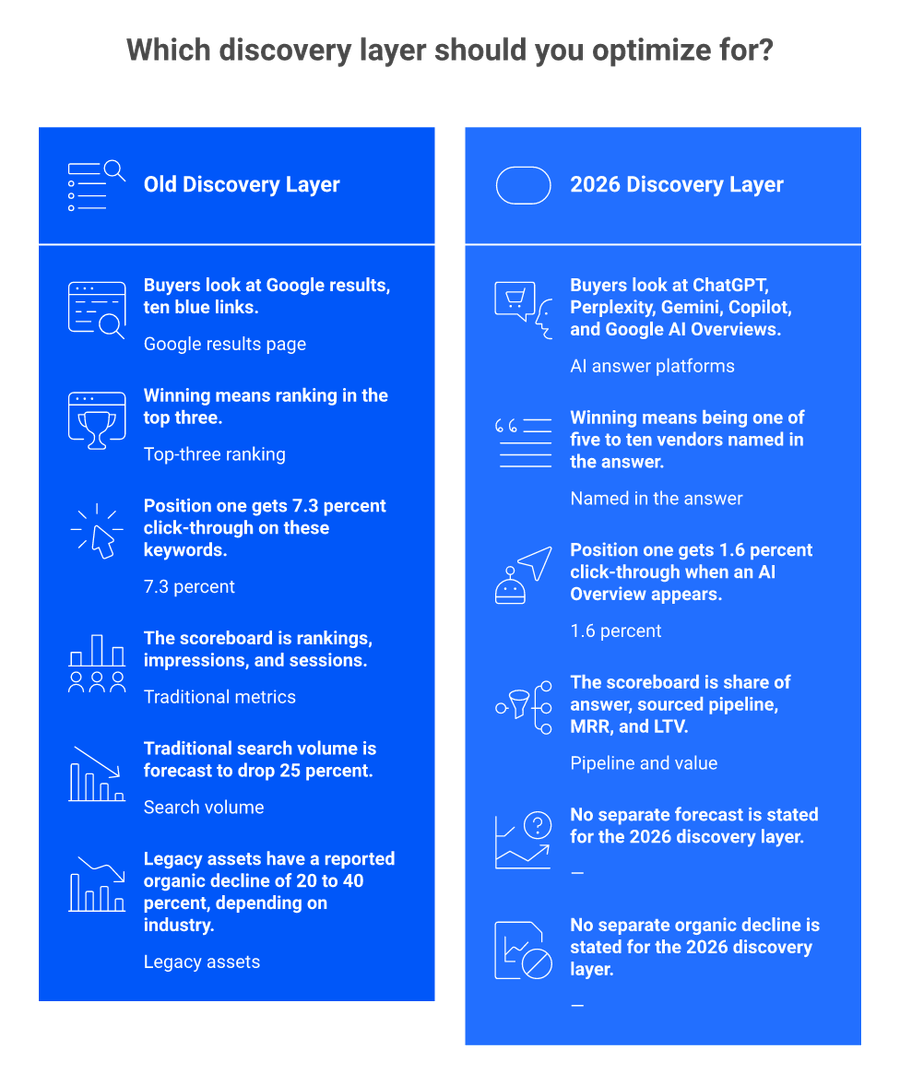
For years, the goal was simple. Rank first, earn the click, and convert the visitor.
AI Overviews broke that chain. In April 2025, Ahrefs found that an AI Overview correlated with a 34.5% lower click-through rate (CTR) for the top-ranking page. CTR is the share of searchers who click a result. Its February 2026 update covered 300,000 keywords with December 2025 data, and the gap grew to 58%.
Ahrefs is careful to call this a correlation, not proof of cause. Still, the direction is clear. A blue link at position one now captures far fewer visits than it used to.
⭐ The new goal: become the answer
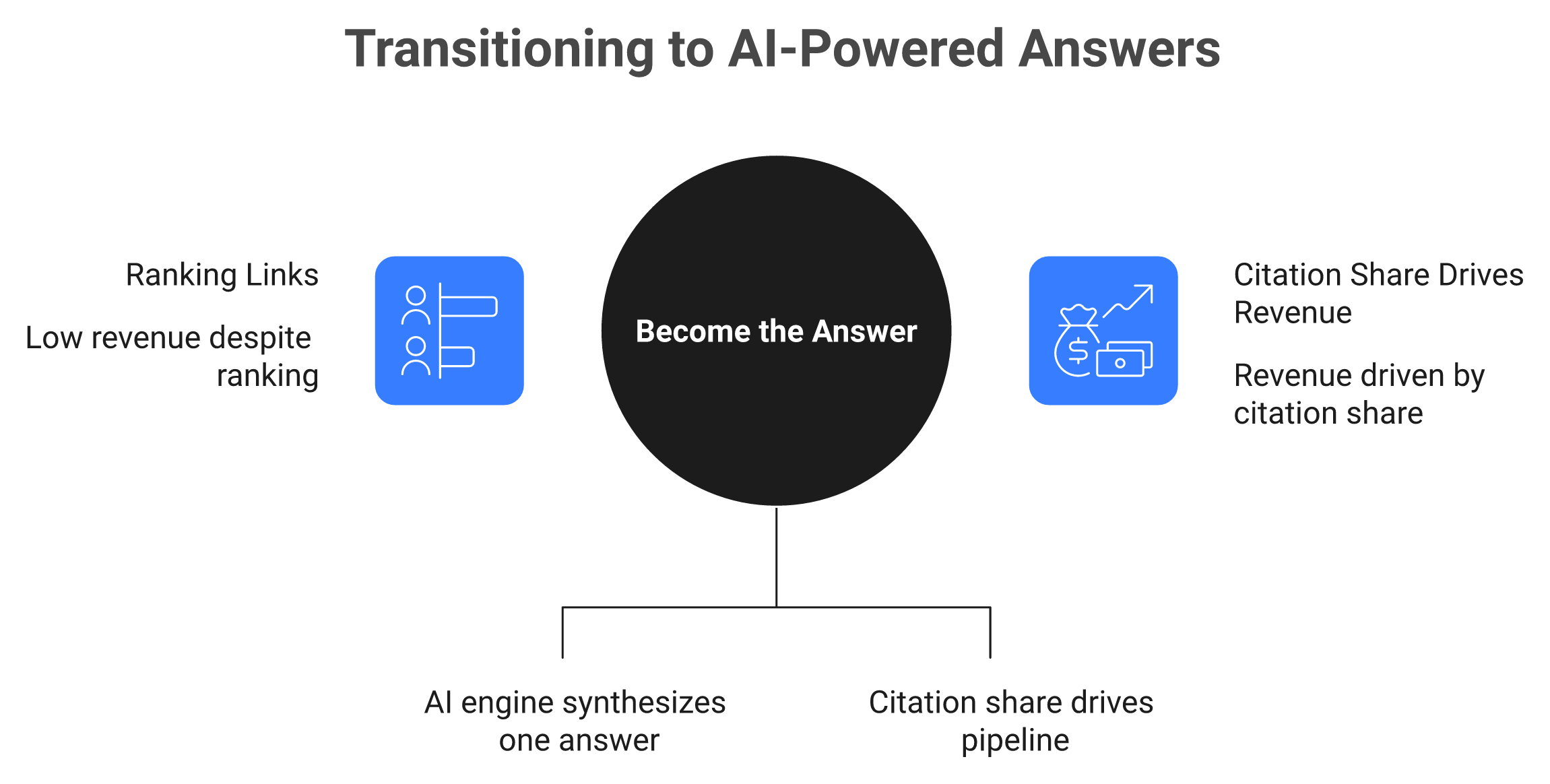
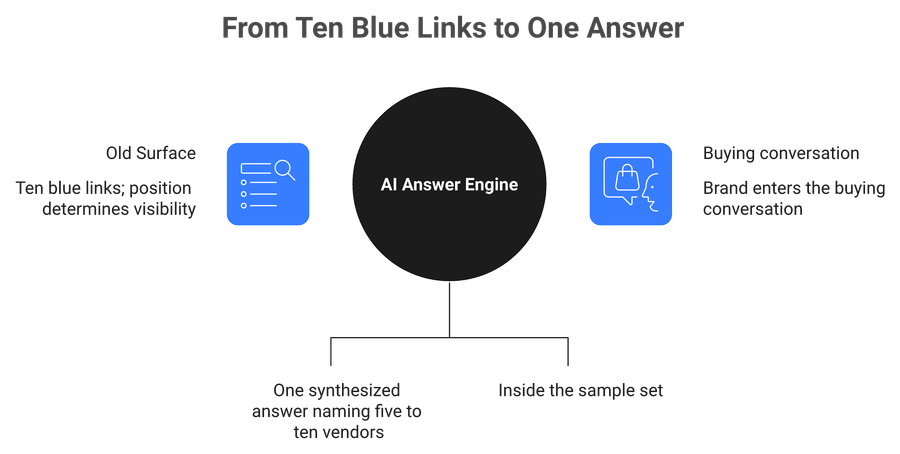
When a buyer asks ChatGPT or Google AI Mode a question, the engine reads sources and writes one answer. A few brands get cited inside it. The rest are invisible.
So the job shifts from ranking to being chosen. I call this becoming the answer, not just being in the results. Google-only SEO stops at the ranking. GEO and Answer Engine Optimization (AEO), the work of earning citations in AI answers, start there.
The Complication: Engines Can Only Cite What They Can Reach
✅ What the official docs actually say
Google's guide for site owners states there are "no additional requirements to appear in AI Overviews or AI Mode." It lists making content findable through internal links as one of the SEO practices that still applies.
OpenAI's documentation says OAI-SearchBot "is used to surface websites in search results in ChatGPT's search features," and recommends allowing it in robots.txt. Crawlers find pages by following links. A page your link graph hides is a page these systems may never read.
⚠️ Where I am less certain
Not every crawler renders JavaScript the way Googlebot does. I cannot verify each AI crawler's rendering behavior, so I assume the worst. Links that appear only after scripts run are a risk, and I would rather put them in the initial HTML.
The Resolution: One Canonical Page Per Topic
💰 Point the cluster at the answer you want cited
Here is the structural move that matters most for AI search. Pick one canonical page per topic, meaning the single page you want engines to treat as your answer. Then point every related page at it with descriptive anchors.
When three similar pages split your internal links, engines see three weak candidates. When one page collects them, engines see one clear authority. A clean link graph is how you tell an engine which page is your answer.
What MaximusLabs AI Has Seen
MaximusLabs AI treats SEO best practice as the base layer for GEO, then structures content for each engine's needs. For Oliv AI, that combined GEO work produced a "64% AI citation rate in 6 months, vs ~30% for billion-dollar incumbents (Oliv AI)." Internal linking was one part of that system, not the whole story, and MaximusLabs measures the work on pipeline, not on mentions alone.
Q3. Hub-and-spoke, silo or mesh: which internal link architecture fits your site?
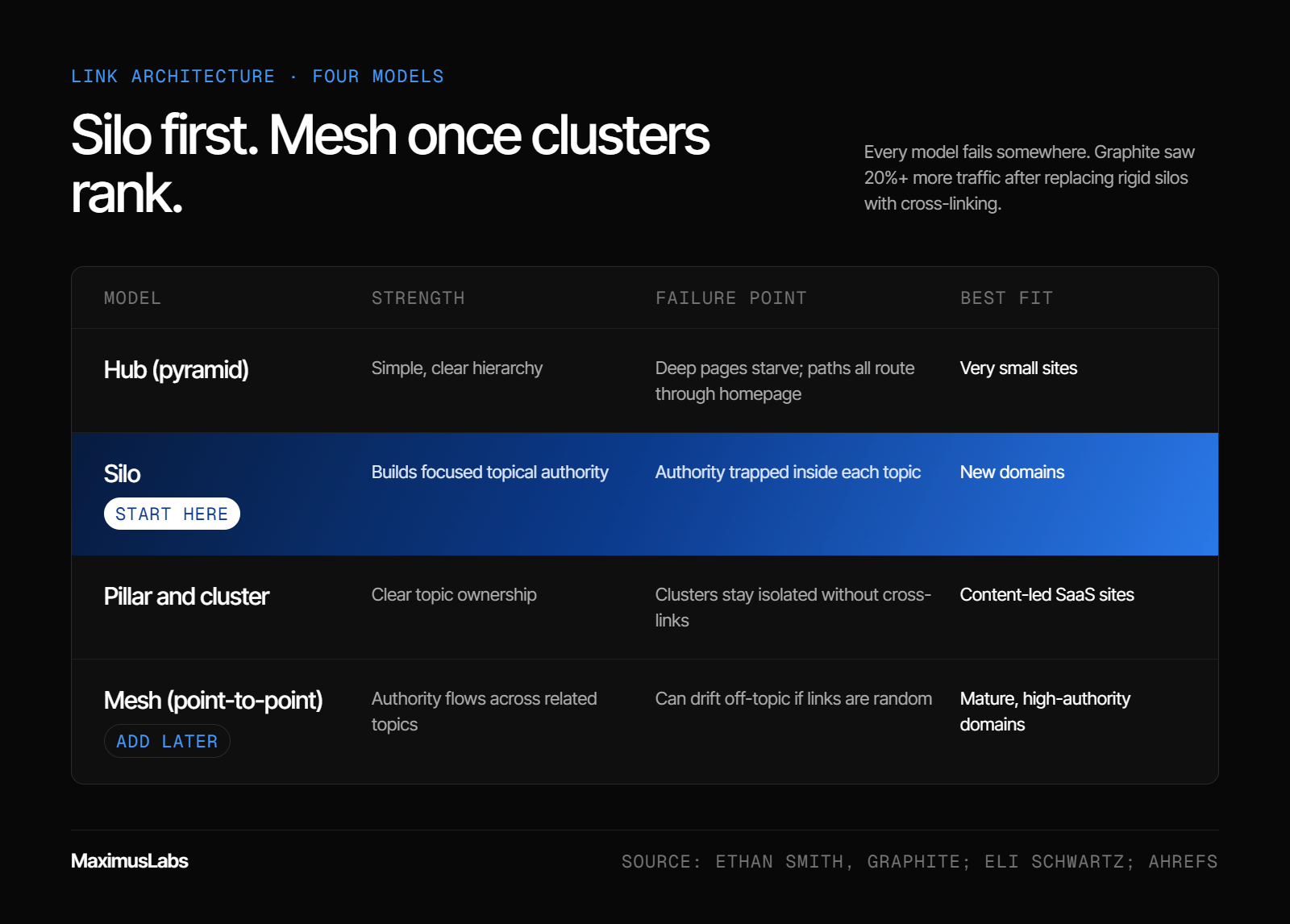
Use silos or pillar-and-cluster hubs to build topical authority on a new domain, then add cross-topic mesh links once the site matures. A pure hub model, where every path runs back through the homepage, buries deep pages. Eli Schwartz compares it to Singapore Airlines' single hub versus Southwest's point-to-point routes. Graphite reported 20%+ more traffic after breaking rigid silos with cross-linking.
The Situation: Everyone Says "Build Silos"
✅ Three models, defined plainly
Most guides recommend one of three architectures:
- Hub (pyramid): The homepage links to categories, categories link to pages, and pages rarely link sideways.
- Silo: Pages are grouped by topic, often under a shared URL folder, and link mainly within their own group.
- Pillar and cluster: One broad pillar page links to detailed cluster pages, and each cluster page links back to the pillar.
Ahrefs, in its March 2026 guide, recommends combining clusters with silos rather than picking one. I agree with that, but the order matters more than the mix.
The Complication: Every Model Fails Somewhere
❌ Where each architecture strands pages
Eli Schwartz frames this with airlines. Singapore Airlines runs one national hub where every flight lands. Southwest runs point-to-point routes, so passengers travel between many cities directly.
A pure hub site behaves like Singapore Airlines. Every crawl path runs back through the homepage, so deep pages sit many hops away. Kevin Indig found app pages at Atlassian sitting 13 clicks deep, despite having valuable backlinks.
Strict silos fix depth inside each topic, but they trap authority there. A strong page in one silo cannot lift a related page in the next one.
| Model | Strength | Failure point | Best fit |
| Hub (pyramid) | Simple, clear hierarchy | Deep pages starve; paths all route through homepage | Very small sites |
| Silo | Builds focused topical authority | Authority trapped inside each topic | New domains |
| Pillar and cluster | Clear topic ownership | Clusters stay isolated without cross-links | Content-led SaaS sites |
| Mesh (point-to-point) | Authority flows across related topics | Can drift off-topic if links are random | Mature, high-authority domains |
The Resolution: Silo First, Mesh Later
⭐ The staged approach I recommend
Ethan Smith reports that Graphite saw an additional 20%+ traffic gain after replacing rigid category silos with spread cross-linking between related topics. That is the case for mesh.
But I would not start there. A new domain needs focused topical authority first, so silos and pillar clusters make sense early. Once the site has authority, add cross-links between topics that share a buyer journey, such as a security guide linking to a compliance comparison.
I might be wrong about the exact moment to switch. My working rule is to mesh once each core cluster ranks on its own.
How MaximusLabs AI Structures It
MaximusLabs AI builds hub pages for the "what and why" (5,000 to 8,000+ words) and spoke pages for the "exactly how" (2,500 to 4,000 words). Each page has a distinct job, so no two compete for the same query. Every hub introduces its spokes with a Deep Dive callout and an internal link, and MaximusLabs plans spoke URLs before those pages go live.
Q4. Which internal links carry the most weight: contextual, navigation, breadcrumb or footer?
In-body contextual links carry the most weight because they sit inside relevant text. Navigation menus and breadcrumbs matter for discovery and hierarchy. Footer and sidebar links repeat sitewide and signal little. The exception is scale: marketplaces and databases with thousands of URLs need automated related-link modules, because manual editing cannot keep up.
The Five Link Types, Ranked
✅ What each type is for
Google does not publish a weighting for link types. The ranking below reflects practitioner consensus, so treat it as field evidence, not official policy.
| Link type | What it is | Main job | Relative weight |
| Contextual | A link inside body text | Relevance and authority | Highest |
| Related content module | A "related posts" or "similar items" block | Scaled distribution | Medium to high |
| Breadcrumb | The "Home > Category > Page" trail | Hierarchy and discovery | Medium |
| Navigation | Main menu links | Discovery of key sections | Medium |
| Footer and sidebar | Links repeated on every page | Utility access | Low |
⭐ Why contextual links win
Kevin Indig and Eric Enge both note that search engines read the text and headings around a link. A link inside a paragraph about pricing models carries that paragraph's meaning with it. A footer link repeated on 2,000 pages carries almost none.
This is why I push teams to stop counting menu links. Your navigation is a map. Your contextual links are recommendations.
✅ Do not skip breadcrumbs
Breadcrumbs earn their place for a different reason. They show crawlers and readers where a page sits in your hierarchy, and every page gets a link back up the chain. Pair them with BreadcrumbList structured data, and search engines can read that hierarchy directly instead of guessing it.
Integrators Versus Aggregators
⚠️ Know which one you are first
Indig splits sites into two groups:
- Integrators build content by hand, like SaaS blogs and editorial sites. Writers can place contextual links with care, so in-body linking should lead.
- Aggregators scale through many similar pages, like marketplaces and listing databases. Manual linking breaks at that size, so automated modules do the heavy lifting.
Most B2B SaaS companies are integrators. If that is you, a related-posts widget is a supplement, not a strategy.
⏰ Stop long-tail pages from going orphan
Aggregators face a specific risk. Old long-tail pages drop out of every module and quietly become orphans. Eli Schwartz suggests a rolling or randomized "recently updated" module, refreshed daily, so deep pages keep getting links.
Integrators face a gentler version. Older posts lose links as new ones publish. A quarterly pass that adds contextual links from new posts to older revenue pages fixes most of it.
Where MaximusLabs AI Fits In
MaximusLabs AI optimizes blog templates for this split. Its template work covers tables of contents, table modules, and schema integration, so structural links exist by default. Contextual links into BOFU pages, the bottom-of-funnel pages where buyers compare and decide, are then placed by hand inside each article.
Q5. How many internal links does a page actually need?
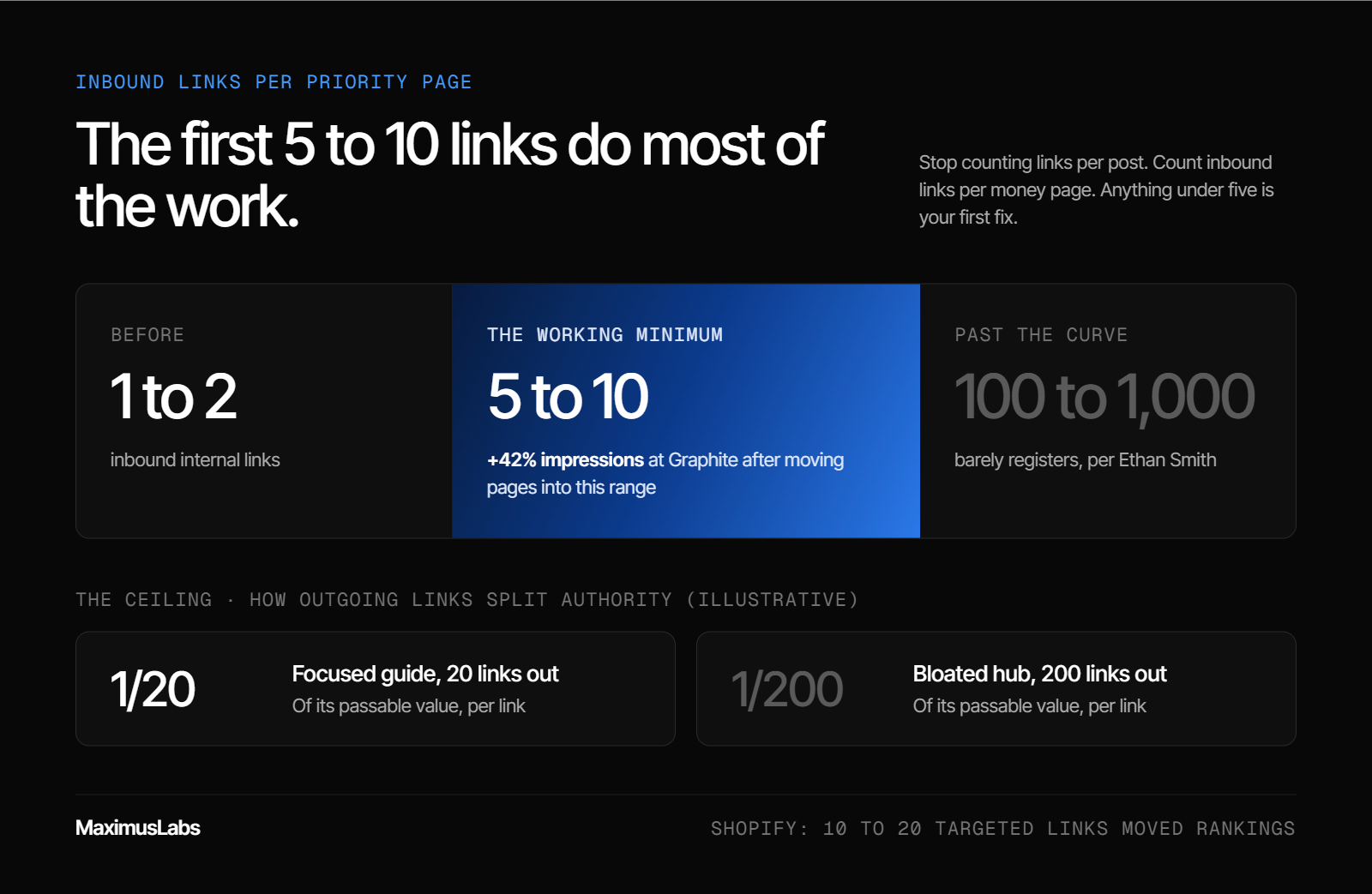
Aim for 5 to 10 inbound contextual links to every page you care about. Graphite reported a 42% rise in impressions after moving pages from 1 or 2 internal links to 5 to 10. Returns flatten after that. Google says there is no ideal number, but a page with 200+ outgoing links splits its authority so thinly that each link passes little.
The Floor: Inbound Links to Your Priority Pages
✅ Five to ten is the working minimum
Most guides answer the wrong question. They tell you how many links to put in a blog post. The better question is how many links point at each page that drives revenue.
Ethan Smith of Graphite recommends at least 5 to 10 internal links per page. In his work, moving pages from 1 or 2 inbound links to that range produced a 42% increase in search impressions. Impressions are how often a page appears in search results.
⚠️ Where the returns flatten
Smith is clear that more is not always better. Going from one link to five or ten makes a large difference, he has said, while going from 100 to 1,000 barely registers.
So the first 5 to 10 links do most of the work. After that, you are adding effort for small gains.
The Ceiling: Outbound Links on Each Page
💸 How a page splits its authority
Google says there is "no magical ideal number" of links per page. It also says that if you think a page has too many links, "then it probably is."
The reason is how authority flows. In the original PageRank model, a page divides the value it passes across all its outgoing links. Here is a simplified example, for illustration only:
| Page setup | Outgoing links | Share passed per link |
| Focused guide | 20 | 1/20 of its passable value |
| Bloated hub | 200 | 1/200 of its passable value |
Google's real systems are far more complex than this. Still, the direction holds. Eli Schwartz and Eric Enge both flag pages with 200 or more links as the point where each link starts to pass very little.
The Proof: Small Numbers, Big Moves
⭐ What 10 to 20 links did at Shopify
Kevin Indig describes Shopify's challenge plainly. The site had so many pages that Google struggled to tell which ones mattered most. Placing just 10 to 20 targeted internal links to a page could move its rankings significantly.
💰 Count inbound links per money page
My rule is simple. Stop counting links per post and start counting inbound links per money page. A money page is any page that directly feeds pipeline, such as a pricing, comparison, or demo page.
Pull a list of those pages this week. Next to each one, note how many contextual links point to it. Anything under five is your first fix, and it usually takes hours, not weeks.
I might be wrong about where the curve flattens for your site. A 50-page startup and a 50,000-page marketplace will not behave the same.
How MaximusLabs AI Applies the Count
MaximusLabs AI starts every engagement with bottom-of-funnel (BOFU) articles, the high-intent pages buyers read before they decide. That makes inbound link counts simple to prioritize. The BOFU pages that carry pipeline get their 5 to 10 contextual links first, and supporting content links into them as it goes live.
Q6. How deep can an important page sit before Google stops finding it?
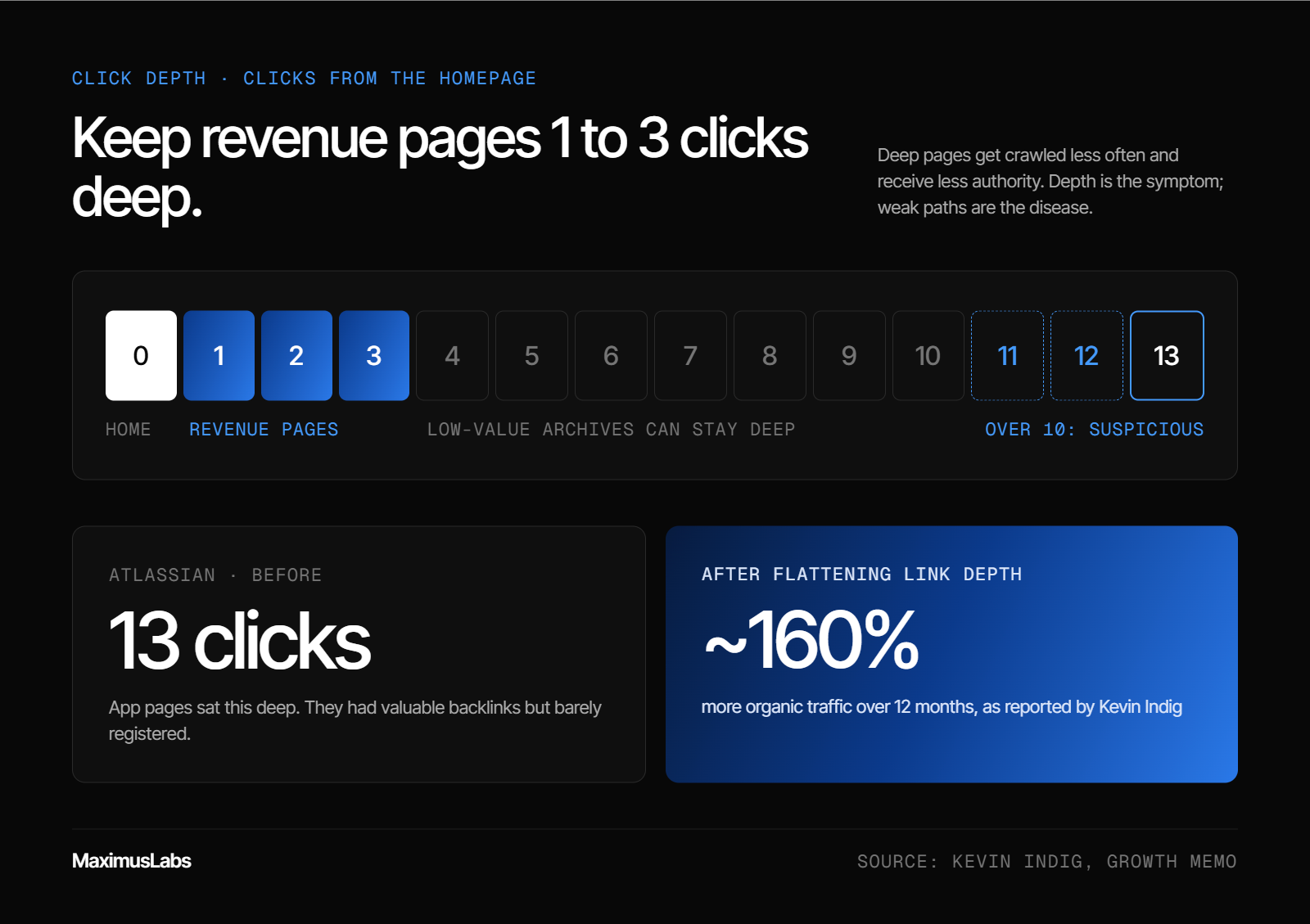
Keep revenue pages within 1 to 3 clicks of the homepage. Click depth is the number of links a crawler follows to reach a page. Deep pages get crawled less often and receive less authority from the homepage. At Atlassian, Kevin Indig found app pages 13 clicks deep. Flattening that link graph preceded roughly 160% more organic traffic over 12 months.
The Situation: The Three-Click Rule Everyone Repeats
✅ What click depth measures
Click depth counts the clicks from your homepage to a given page. A pricing page linked from the main menu sits at depth one. A blog post reached through a category, then a tag, then a page-two archive might sit at depth four or five.
The common advice is to keep everything within three clicks. It is a useful starting point, but it is a rule of thumb, not a Google rule.
⚠️ Why the rule is not the whole story
A 2020 Search Engine Journal webinar recap made the key point well. It said links "only matter as to depth from the previous link." In plain terms, a page three clicks deep through relevant, strong pages can do better than a page two clicks deep through weak ones.
So depth matters, but path quality matters too. Depth is the symptom. Weak paths are the disease.
The Complication: What 13 Clicks Deep Looks Like
❌ The Atlassian case
Kevin Indig describes Atlassian's app marketplace, where specific app pages sat around 13 clicks deep. Those pages had valuable external backlinks. But crawlers had to travel through so many layers that the pages barely registered.
Indig wrote separately that anything "over 10 clicks from the homepage makes me suspicious." That matches what the Atlassian case showed.
⏰ How the fix worked
Indig built a model he calls TIPR, which combines internal links, backlinks, PageRank, and CheiRank to find structural imbalances. CheiRank is the mirror of PageRank: it scores a page by its outgoing links instead of its incoming ones.
The team flattened link depth and redistributed authority. Indig reports roughly a 160% increase in organic traffic over 12 months.
The Resolution: Relevant Paths to Money Pages
💰 What I would do on Monday
I treat depth as a priority filter, not a sitewide target. Here is the order:
- Crawl the site and sort revenue pages by click depth.
- Move any revenue page deeper than three clicks closer, through a hub, breadcrumb, or contextual link.
- Check that the new path runs through related, authoritative pages.
- Leave low-value archive pages deep. They do not need the attention.
The goal is not a flat site. It is a short, relevant path from your strongest pages to the ones that drive pipeline.
Where MaximusLabs AI Checks Depth
MaximusLabs AI runs an in-depth technical audit in the first seven days of an engagement, before any new content goes live. Click depth to revenue pages is part of that audit. Fixing paths first means every new article published afterward lands on a structure that can carry its authority.
Q7. How should you write internal anchor text without over-optimizing?
Write anchors that describe the destination in plain, short words, and avoid "click here." Google asks for anchor text that is descriptive, reasonably concise, and relevant, and warns against cramming keywords. Use one anchor phrase per destination page. When two pages compete for the same phrase, link from the weaker page to the stronger page using the exact target phrase.
Rule One: Describe the Destination
✅ What Google actually asks for
Anchor text is the clickable text of a link. Google says good anchor text is "descriptive, reasonably concise, and relevant to the page that it's on."
Google also says to "resist the urge to cram every keyword" into anchors. Write the anchor a reader would expect, then stop.
⭐ The label on the box
Eli Schwartz uses a Happy Meal analogy for crawling. Imagine buying meal after meal to find one toy, when the box could have just said what was inside.
Anchor text is that label. A clear anchor tells crawlers and readers what is behind the link before anyone opens it.
Rule Two: One Anchor Phrase Per Page
⚠️ Why shared anchors confuse engines
Backlinko advises against using the same anchor text for two different pages. Search engines may think "both pages are on the exact same topic."
That confusion splits your signals. Neither page clearly owns the phrase, so neither ranks as well as it could.
| Anchor | Verdict | Why |
| "click here" | ❌ Weak | Says nothing about the page |
| "internal linking audit checklist" | ✅ Strong | Describes the destination |
| "SEO" on ten different links | ❌ Weak | Too broad, points to many pages |
| "best internal linking tools for SaaS" | ✅ Strong | Specific and unique to one page |
These are illustrative examples, not data from a specific site.
Rule Three: Use Exact Anchors to Settle Cannibalization
💰 The fix when two pages compete
Keyword cannibalization happens when two of your pages target the same phrase. Search engines then struggle to pick one, and both underperform.
Eric Enge's fix is direct. Choose the primary page. From the secondary page, link to the primary page using the exact target phrase as the anchor. That consolidates the signal on the page you want to rank.
⭐ Why this matters more for AI search
My view is that anchors now do double duty. They help Google rank, and they help AI engines decide which page answers which question. A precise anchor pointing at one canonical page is a small, clear vote for the answer you want cited.
Backlinko notes exact-match internal anchors "typically" will not hurt. I still vary them, because a site where every anchor is identical reads as spam to people and machines.
How MaximusLabs AI Writes Anchors
MaximusLabs AI builds question research from sales calls, support tickets, and Reddit threads. That research shapes anchor text too. Anchors match the language buyers actually use, so a link reads naturally to the reader and tells engines exactly what the destination answers.
Q8. How do you build an internal linking structure step by step?
Build it in seven steps: list priority and revenue pages, choose a hub or silo model, map each cluster to one canonical page, add 5 to 10 contextual links into every priority page, keep them within three clicks, confirm links render as crawlable HTML anchors, then audit quarterly. Fix internal links before buying backlinks, because they cost less and you control them.
Step 1: List Priority and Revenue Pages
✅ Start with what drives pipeline
List every page that feeds revenue: pricing, comparisons, use cases, and demo pages. Add your strongest pages by backlinks and traffic. These two lists define where authority comes from and where it should go.
Step 2: Choose Your Architecture Model
Pick silos or pillar clusters for a newer site. Add cross-topic links once each cluster ranks on its own.
Step 3: Map Each Cluster to One Canonical Page
Every topic gets one page you want to rank and be cited. Every related page links to it.
Step 4: Add 5 to 10 Contextual Links per Priority Page
⭐ Place them inside the body
Add the links inside relevant paragraphs, with descriptive anchors. Pull them from your strongest pages first.
Step 5: Keep Priority Pages Within Three Clicks
Use hubs, breadcrumbs, and menu links to shorten paths to revenue pages.
Step 6: Confirm Links Are Crawlable
⚠️ Check the rendered HTML
Google can generally only crawl links built as HTML <a> elements with an href. If JavaScript inserts your links, Google recommends checking them with the URL Inspection Tool. Give paginated archives plain, crawlable next and previous links too, as Ahrefs recommends.
Step 7: Audit Every Quarter
New posts get published, and old pages lose links. A quarterly audit catches orphan pages before they fade.
A Worked Example: A 30-Page SaaS Site
💰 What the map looks like
Here is an illustrative structure, not a real client:
| Page group | Count | Links in | Click depth |
| Homepage | 1 | Sitewide | 0 |
| Pricing and demo | 2 | Menu plus 8 contextual each | 1 |
| Comparison pages | 4 | Hub plus 6 contextual each | 2 |
| Pillar guides | 3 | Menu plus clusters | 1 |
| Cluster posts | 20 | Pillar plus 2 related posts | 2 |
Every cluster post links up to its pillar and across to one comparison page. That routes informational readers toward buying pages.
The Order That Saves Money
⏰ Internal links before backlinks
Kevin Indig's checklist for a page that will not rank runs in a fixed order: title, content intent, internal links, then backlinks. The order follows effort. Internal links are cheaper and faster than earning external ones.
One honest warning. On large custom sites, link changes can wait months in an engineering queue. Get template changes scoped early.
How MaximusLabs AI Runs the Build
MaximusLabs AI runs this in the first seven days of an engagement: technical audit, plan, client keyword approval, then the first article live as early as day four. Spoke URLs are planned before they publish, so links slot in on launch.
Q9. How do you audit internal links for orphans, equity leaks and broken paths?
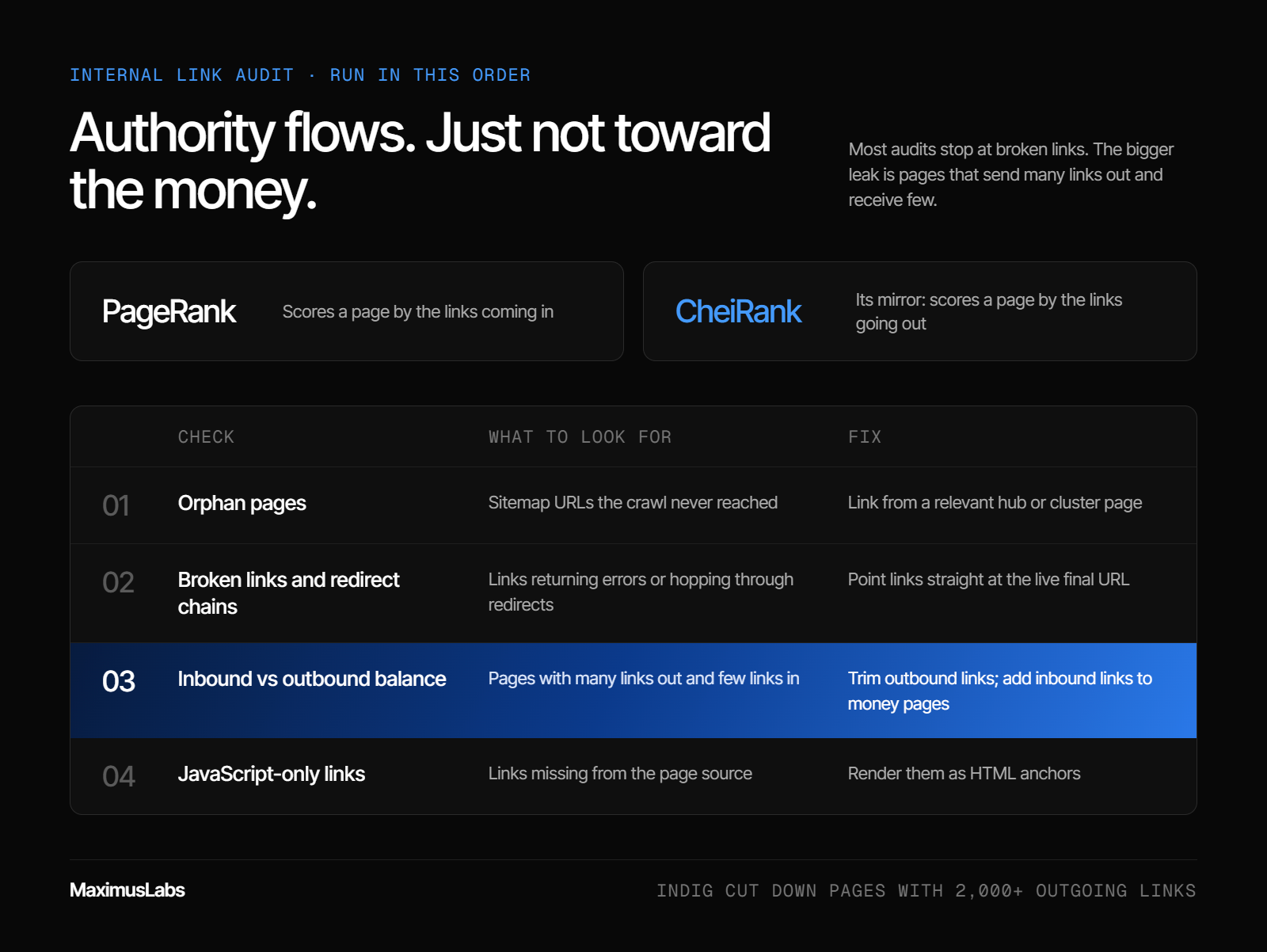
Crawl the site and compare the results with your sitemap to find orphan pages. Then fix broken internal links and redirect chains. Next, compare each page's inbound and outbound internal links. Utility pages with hundreds of outgoing links and almost none coming in act like billionaires handing out money they never had. Rebalance those pages first, starting with the ones that point at revenue pages.
The Situation: Most Audits Stop at Broken Links
✅ What a standard audit catches
Most audits check two things: broken links, which point to error pages, and orphan pages, which no internal link points to.
Both checks matter. Ahrefs puts fixing broken internal links and orphan pages at the center of its own audit process. A broken link wastes authority. An orphan page may never get found at all.
⚠️ How to find orphans properly
A crawler only finds pages it can reach through links. So a crawl alone will never show you an orphan page. You need a second list to compare against.
Compare the crawl with your XML sitemap, the file listing pages you want indexed. Any sitemap URL the crawl never reached is an orphan, so link it from a fitting hub or cluster page.
The Complication: The Leak Nobody Checks
💸 Pages that give more than they get
The bigger problem is balance. Kevin Indig describes using CheiRank alongside PageRank to find it. PageRank scores a page by the links coming in. CheiRank is its mirror: it scores a page by the links going out.
A page with high CheiRank and low PageRank receives little authority but sends links everywhere, like a tag archive. Indig writes that when many pages have only one incoming link, "it's usually a bad sign." He also describes cutting down pages that carried 2,000+ outgoing links and no real content.
❌ Why it hurts revenue pages
At MaximusLabs, we see the same pattern often. Low-value pages hand out links, while the pricing or comparison page that closes deals gets two weak inbound links. Authority flows, just not toward the money.
The Resolution: A Four-Part Audit
⭐ Run it in this order
| Check | What to look for | Fix |
| Orphan pages | Sitemap URLs the crawl never reached | Link from a relevant hub or cluster page |
| Broken links and redirect chains | Links returning errors or hopping through redirects | Point links straight at the live final URL |
| Inbound vs outbound balance | Pages with many links out and few links in | Trim outbound links; add inbound links to money pages |
| JavaScript-only links | Links missing from the page source | Render them as HTML anchors |
⏰ Do not skip the JavaScript check
Google can generally only crawl links built as HTML <a> elements with an href. If scripts insert your links, Google recommends confirming them with the URL Inspection Tool, which shows the page as Google rendered it.
Other crawlers may not render scripts at all. So if a link matters for revenue, put it in the HTML the server sends.
Where MaximusLabs AI Audits
MaximusLabs AI's technical audit includes JavaScript minimization, so critical content and links render in HTML for AI crawlers. It also confirms that robots.txt leaves AI crawlers like OAI-SearchBot unblocked. Fixing the link graph first means new BOFU content inherits authority instead of leaking it.
Q10. How do you route internal links toward revenue pages instead of traffic pages?
Route authority and readers from high-traffic informational pages to the pages that convert: comparisons, use cases, pricing, and demo pages. Link equity is a ranking resource, and it is also a routing system for buyers. MaximusLabs AI plans bottom-of-funnel (BOFU) pages first and links supporting content into them, because visitors from AI search often arrive deep in their research.
The Situation: Traffic Pages Hoard the Authority
💸 Where your equity actually sits
On most B2B sites, the pages with the most backlinks are informational. A glossary entry, a popular guide, or an old industry report collects links for years.
Those pages rank and pull traffic. But they often link only to other blog posts. The authority they earned stays in the top of the funnel, while the pages that close deals get almost none of it.
❌ Why traffic alone misleads
Clicks and impressions look good on a dashboard. They are vanity metrics unless they move pipeline. A guide with 20,000 monthly visits that never sends a reader toward a demo page is a cost center with good optics.
The Complication: Fewer Clicks, Better Visitors
⚠️ The click is shrinking
Ahrefs' February 2026 update found AI Overviews now correlate with 58% lower click-through for the top-ranking page. Informational pages will keep losing visits as AI engines answer simple questions directly.
💰 But the visitors who do arrive are worth more
Google says clicks from results pages with AI Overviews are "higher quality." Semrush found the average AI search visitor is 4.4 times as valuable as a traditional organic visitor, measured by conversion rate. That is a vendor benchmark, not a peer-reviewed study, but the direction matches what I see.
AI-referred buyers arrive pre-sold. The engine already compared options for them. If they land on an informational page with no path to a buying page, you lose them.
The Resolution: Route Equity Toward Pipeline
✅ A four-step routing method
- Find your donors. List the pages with the most backlinks and traffic.
- Name your receivers. List the pages that convert: pricing, demo, comparison, and use-case pages.
- Link at the decision moment. Add a contextual link where a reader would naturally ask, "Which option fits me?"
- Measure pipeline, not pageviews. Track which pages appear in converting buyers' paths.
⭐ An illustrative example
Picture a SaaS guide on choosing an internal linking audit tool, earning steady traffic and backlinks. Today, it links to three other blog posts. After routing, its comparison section links to the company's own comparison page. Its pricing paragraph links to the pricing page, with an anchor that names the plan type a buyer would search for.
Nothing about the guide changes for readers. It simply stops being a dead end.
How MaximusLabs AI Routes It
MaximusLabs AI aligns every article to the Ideal Customer Profile (ICP) and builds BOFU content first. Internal links then carry buyers toward pipeline pages instead of piling authority on pageview content. For Oliv AI, MaximusLabs reports "27 qualified leads, $47K+ pipeline, 26% close rate in 4 months (Oliv AI)," from its combined AEO and SEO work, not internal linking alone.
What I'm Thinking About Next
My hypothesis is that internal linking is about to matter more, not less. As AI engines answer the simple questions, the pages that survive are the ones that engines trust as the single best answer on a topic. A clean link graph is one of the few signals you fully control that tells an engine which page that is.
I am still testing how much AI crawlers weigh internal link structure compared with Googlebot. I might be wrong about the size of the effect. But I would not bet a revenue page on being buried, orphaned, or JavaScript-only.
If you run this audit and find something surprising, I want to hear it: krishna@maximuslabs.ai.
References
- Google Search Central, "Link best practices for Google."
- Ahrefs, "Update: AI Overviews Reduce Clicks by 58%," February 4, 2026.
- Google Search Central, "AI features and your website."
- OpenAI, "Overview of OpenAI Crawlers."
- Chris Haines and Mateusz Makosiewicz, "Internal Links for SEO: An Actionable Guide," Ahrefs, updated March 10, 2026.
- Lenny's Newsletter, "Ethan Smith: The power of internal linking for SEO," August 6, 2024.
- Kevin Indig, "Internal Linking for SEO: best practices, strategies, axioms," Growth Memo, August 18, 2020.
- Brian Dean, "Internal Linking," Backlinko, updated October 24, 2026.
- Brent Csutoras, "Internal Linking: How to Unlock Your Site's Hidden Potential," Search Engine Journal, September 15, 2020.
- Semrush, AI search and SEO traffic study, July 21, 2025.
Questions, answered
7 questionsWhat is the difference between internal links and backlinks?
An internal link points from one page on your site to another page on the same site. A backlink points to your site from a different domain. Both pass authority, but they do different jobs. • Backlinks bring new authority into your domain from outside. You have to earn them, which takes outreach and time. • Internal links decide where that authority goes once it arrives. They also help crawlers discover pages and tell engines what each page is about through anchor text. We think of it like water and pipes. Backlinks fill the tank. Internal links are the pipes that carry it to the rooms that need it. A site with strong backlinks and weak internal links often pools all its authority on the homepage and a few old blog posts. That is why we usually fix internal links before chasing new backlinks. You control every internal link, so changes ship in days, not months. If you are new to how search engines rank pages, our primer on SEO fundamentals explains where both link types fit. One caution: internal links cannot replace backlinks entirely. A site with no external authority has little to distribute. The two work best together, with internal links making sure every earned link actually lifts the pages that drive revenue.
Can too many internal links hurt SEO?
Yes, past a certain point. Google says there is no ideal number of links per page, but also that if a page seems to have too many, it probably does. The problem is dilution, not a penalty. In the original PageRank model, a page splits the value it passes across all its outgoing links. A guide with 20 links passes a larger share through each one than a hub with 200. Google's real systems are far more complex, but the direction holds. Here is how we judge it on a page: • Body links: Each one should help the reader take a next step. If a link exists only for SEO, cut it. • Navigation and footer: Keep them lean. Sitewide link dumps add little and crowd out signal. • Repeated targets: Linking to the same page five times in one article adds clutter, not value. The more common problem we see is the opposite. Priority pages receive too few links, not too many. A pricing page with two weak inbound links will not rank, however tidy the rest of the site looks. Formatting also matters. Links buried in long, dense paragraphs get ignored by readers. Our guide to content writing and formatting for AI search covers how to structure pages so links stay visible and useful.
Where should internal links be placed on a page?
Place your most important internal links inside the main body content, as high on the page as they fit naturally. Search engines read the text around a link, so a link inside a relevant paragraph carries more meaning than one in a footer. We follow a simple placement order: • Inside the opening sections: Readers who leave early still see the links that matter most. • At decision moments: Put a link to a comparison or pricing page where a reader would naturally ask which option fits. • In tables and lists: Linked rows help readers jump straight to the page they need. • In breadcrumbs: They show hierarchy and give every page a link back up the chain. Footer and sidebar links still help crawlers reach key sections. They just carry less weight than contextual links because they repeat on every page. Layout and formatting shape how both people and AI engines read a page. Clear headings, short paragraphs, and descriptive anchors make each link easier to understand out of context. Our guide on content formatting for AI search and SEO goes deeper on structuring pages so key links get seen, clicked, and understood.
How often should you audit your internal links?
We recommend a full internal link audit every quarter, plus a quick check whenever you publish or retire a batch of pages. Link structures drift faster than most teams expect. Here is why. Every new post adds links to recent content. Older pages slowly lose inbound links as navigation modules and related-post widgets cycle them out. Redirects pile up after site changes. Within a few months, pages that used to be well linked can become near-orphans. A quarterly audit should cover four checks: • Orphan pages: Compare your crawl with your XML sitemap and find pages nothing links to. • Broken links and redirect chains: Point links straight at the live final URL. • Inbound vs outbound balance: Find pages that send many links out but receive few. • JavaScript-only links: Make sure important links appear in the HTML the server sends. For fast-growing sites publishing several posts a week, a monthly check of priority pages is worth the time. Focus on the pages that feed pipeline first. A good first step is confirming crawlers can reach your pages at all. Our free AI crawlability checker shows whether AI crawlers can access a page, which catches problems before a full audit.
Does internal linking help a page get cited in ChatGPT and Perplexity?
Indirectly, yes. AI search engines can only cite pages their crawlers find and read. OpenAI says its OAI-SearchBot crawler surfaces websites in ChatGPT search, and crawlers discover pages by following links. A page buried deep or linked only through JavaScript is harder for these systems to reach. Internal links also send a quieter signal. When every page in a topic cluster points to one canonical page, engines see a single clear authority on that topic instead of several weak candidates. MaximusLabs AI treats internal structure as part of the base layer for Generative Engine Optimization, not a separate project. In practice, we: • Point each cluster at one page we want cited. • Use anchors that match how buyers phrase questions. • Keep revenue pages within a few clicks of the homepage. • Make sure links render in plain HTML. We are honest about the limits here. No AI platform publishes how much it weighs internal links, and we are still testing the size of the effect. Strong content and trusted third-party mentions matter too. Each engine also has its own preferences. Our Perplexity optimization guide covers what that platform looks for beyond site structure.
Should internal links be nofollow?
In almost every case, no. Internal links should be standard, followed links. A nofollow attribute tells search engines not to pass authority through a link, which defeats the purpose of linking your own pages together. Teams sometimes add nofollow to internal links for one of three reasons: • Old PageRank sculpting: An outdated tactic to hoard authority on certain pages. It does not work the way people hoped and mainly starves the linked pages. • Login, cart, or account pages: These pages usually do not need to rank. Blocking them through robots rules or noindex is often cleaner than nofollowing every link. • Plugin defaults: Some CMS plugins add nofollow automatically. Check your templates. Ahrefs lists making sure crawlers can follow your links as a core internal linking practice, and we agree. If a page deserves a link, it deserves a link that passes value. At MaximusLabs AI, we check internal link attributes during our technical audits, alongside crawl access for AI bots. If you want a structured approach to these checks, our technical GEO implementation guide walks through the crawl, rendering, and link settings that affect both Google and AI engines.
How does MaximusLabs AI plan internal links for new content?
MaximusLabs AI plans internal links before a page is written, not after it is published. Links are part of the content architecture from day one. Our process works in this order: • BOFU first: We start with bottom-of-funnel pages, such as comparisons and use cases, because they carry pipeline. • Hub and spoke: Hub pages cover the what and why. Spoke pages cover the exactly how. Each page has a distinct job, so none compete. • Planned URLs: We plan spoke URLs before they go live, so hubs can link to them on launch day. • Deep Dive callouts: Each hub introduces its spokes with a callout and an internal link. • Routing: Supporting articles link into BOFU pages at the moments readers make decisions. This matters because retrofitting links across hundreds of pages is slow. Planning them up front means every new article strengthens the structure instead of adding another dead end. We also tie the plan to the Ideal Customer Profile, so anchors and link paths match how real buyers search and ask AI engines. To see how this fits a wider content program, our guide to GEO content optimization covers the full approach, or you can talk to our team about your site.