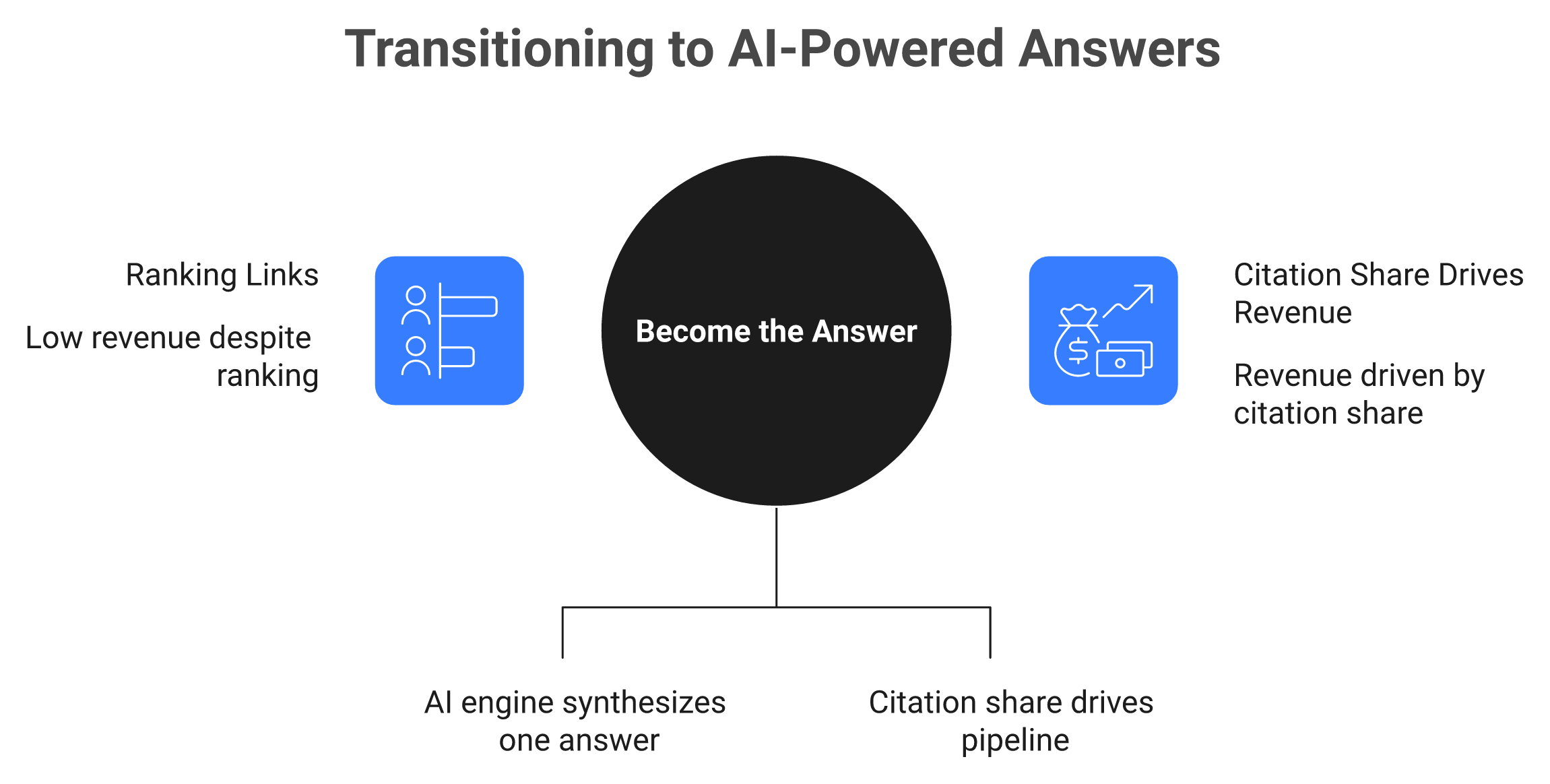
- Bottom of the funnel content serves buyers choosing a vendor: comparisons, alternatives, pricing, case studies, integrations, and demos, judged on demos and pipeline, not traffic.
- AI summaries now absorb top-of-funnel clicks, so budget should move toward decision-stage pages that buyers and AI engines still use to pick a vendor.
- Ten BOFU formats do most of the work, from comparison and pricing pages to ROI calculators and implementation guides, each with one clear next step.
- AI engines cite pages that answer the exact question early and back it with specifics, so money pages need features, limits, pricing logic, and proof.
- Owned pages win narrow questions while review sites, listicles, and forums shape broad shortlists, so BOFU needs presence both on and off your site.
- Measure BOFU by demos, assisted conversions, AI referral segments, and share of voice, and pick a content model that ships pages fast and ties them to revenue.
It is the quarterly board review. The VP of Marketing clicks to the organic slide: sessions up, rankings up, and 200 "What is" posts sitting on page one. Then the CFO asks one question. Which of these pages produced pipeline?
The room goes quiet, because nobody can point to one.
I have watched that silence happen more than once. It is the cost of a content plan built for the top of the funnel. Now there is a second problem on top of it. Google AI Overviews, ChatGPT, and Perplexity answer most of those "What is" questions before anyone clicks.
This guide covers the content that still earns the click and the deal. You will learn what bottom of the funnel content is, how it differs from TOFU and MOFU, and why it matters more in AI search. Then you get 10 real examples, plus how to find, write, place, measure, and staff it. Along the way, I will show where Generative Engine Optimization (GEO) and Answer Engine Optimization (AEO) change the rules.
Q1. What is bottom of the funnel content?
Bottom of the funnel content is content made for buyers who already know their problem and are choosing a vendor. It includes comparison pages, alternatives pages, pricing pages, case studies, integration pages, and demos. Its job is to answer the last questions before a purchase, so it is judged by demos, trials, and pipeline, not by traffic.
🎯 Who BOFU content is written for
The BOFU reader is not browsing. They have a budget, a deadline, and a shortlist of two or three tools. Their questions are narrow and practical: "Does it integrate with HubSpot? What does it cost for 40 seats? How long does onboarding take?"
BOFU content answers those questions directly. Practitioner Matt Kenyon calls these assets "money pages." He argues they should be "as detailed and optimized as possible with the specifics of what you offer." I agree completely, because vague pages lose deals at the last step.
✅ Three tests that make a page BOFU
A page is bottom of the funnel when it passes all three tests:
- Intent: The query names a vendor, a competitor, a price, an integration, or a use case.
- Specifics: The page gives concrete facts, such as features, limits, setup time, and pricing logic.
- One next step: The page ends with a single clear action, such as a demo, a trial, or a pricing calculator.
A "What is CRM?" post is not BOFU, even with a demo button bolted on. A short "Brand vs. Competitor for 20-person sales teams" page usually is. The buyer's question sets the stage, not the page length.
🧪 A five-minute self-check for your own site
Open your sitemap and ask three questions. Do you have a page for every competitor buyers compare you with? Can a buyer estimate their cost without booking a call? Does every major integration have its own page?
If the answer to any of these is no, your BOFU layer has gaps. In my experience, those gaps are where deals quietly stall, because the buyer goes looking elsewhere.
💰 Why BOFU now does the sales rep's job
Buyers increasingly skip the rep. A Gartner survey of 632 B2B buyers found that 61% prefer an overall rep-free buying experience. The same survey found that 69% saw inconsistencies between a supplier's website and what its sellers told them.
That changes what a BOFU page must carry. It now does the work a sales call used to do: comparing options, confirming fit, and explaining cost. If the page and the sales deck disagree, the buyer notices. My rule is simple. Clicks and impressions are vanity metrics unless they move revenue. I judge a BOFU page by one number: how much pipeline it touched.
⭐ Where MaximusLabs AI starts
MaximusLabs AI starts every content engagement with BOFU pages and skips TOFU glossary posts on purpose, because AI engines already answer "What is X?" questions well. Each page is aligned to the client's ideal customer profile (ICP), meaning the exact buyer the company sells to. MaximusLabs measures every engagement on pipeline, not on mentions.
Q2. How is BOFU content different from TOFU and MOFU content?
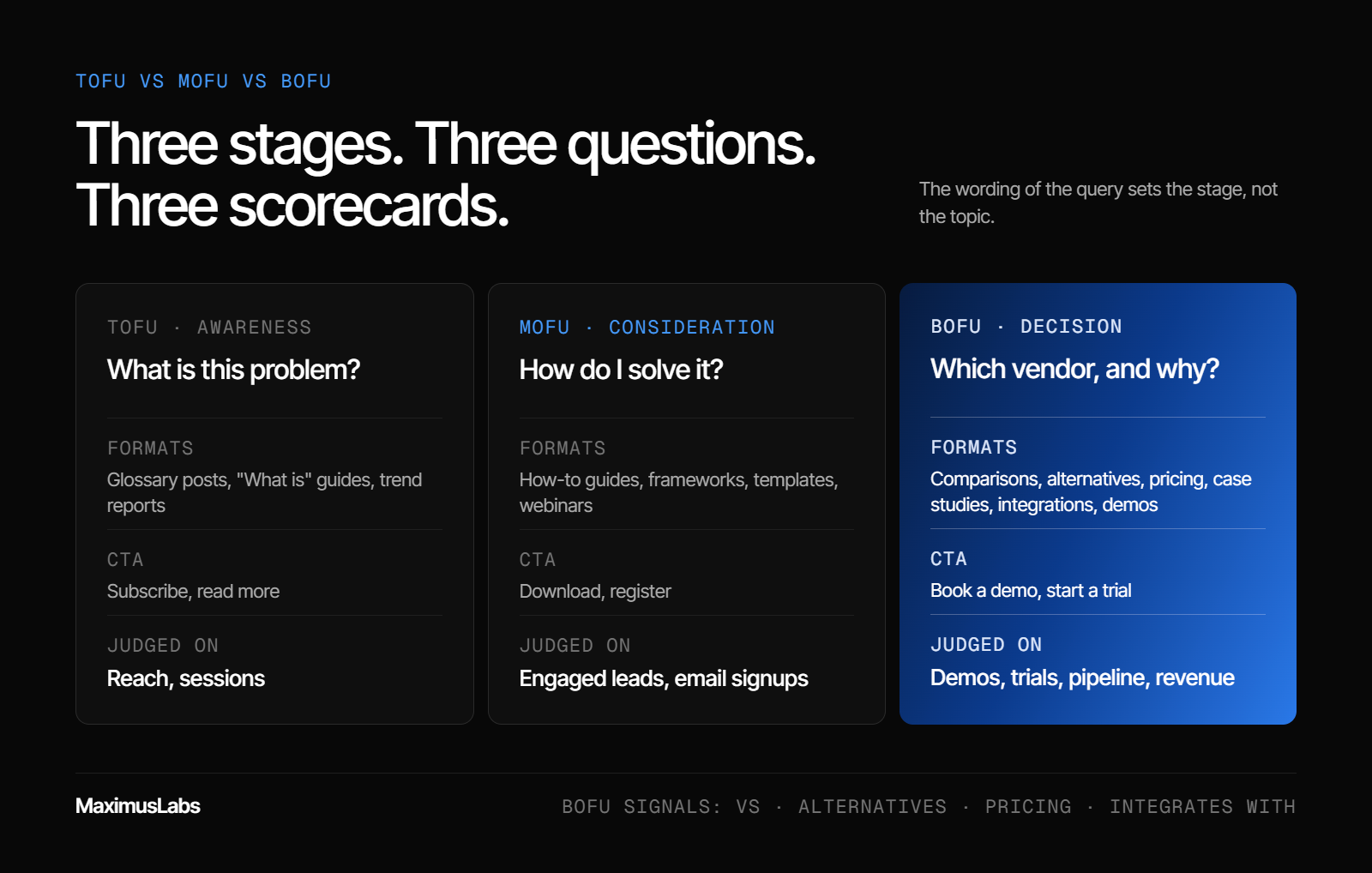
TOFU content answers "what is this problem," MOFU content answers "how do I solve it," and BOFU content answers "which vendor should I pick and why." TOFU is judged on reach, MOFU on engagement and leads, and BOFU on demos, trials, and closed revenue. BOFU pages carry the most specific detail and the most direct call to action.
🧭 Three stages, three different questions
The marketing funnel has three stages. Top of funnel (TOFU) is awareness, when the buyer first names the problem. Middle of funnel (MOFU) is consideration, when they explore ways to solve it. Bottom of funnel (BOFU) is the decision, when they pick a vendor.
Each stage needs a different page, a different call to action (CTA), and a different success metric:
| Stage | Buyer question | Typical formats | Typical CTA | Success metric |
| TOFU | What is this problem? | Glossary posts, "What is" guides, trend reports | Subscribe, read more | Reach, sessions |
| MOFU | How do I solve it? | How-to guides, frameworks, templates, webinars | Download, register | Engaged leads, email signups |
| BOFU | Which vendor, and why? | Comparisons, alternatives, pricing, case studies, integrations, demos | Book a demo, start a trial | Demos, trials, pipeline, revenue |
⚠️ Where the line gets blurry
The same topic can sit at all three stages. "What is a sales engagement platform?" is TOFU. "How to build a five-step outbound sequence" is MOFU. "Best sales engagement platform for a 20-rep team" is BOFU.
The wording of the query sets the stage, not the topic. Brand names, "vs," "alternatives," "pricing," "reviews," and "integrates with" are the clearest BOFU signals. When I audit a content plan, I tag every page by these signals first. The share of BOFU pages is usually far smaller than the team expects.
📉 AI answers now absorb the top stage
The TOFU stage is where AI summaries hit hardest. Pew Research Center tracked the Google searches of 900 U.S. adults in March 2025. Question-style queries produced an AI summary 60% of the time, compared with 8% for one- or two-word searches.
TOFU questions are exactly those question-style queries. Practitioner Ethan Smith says he "would spend no time at all really on glossary definitions and low intent stuff." I mostly agree, with one caveat. A few short category definitions still help AI engines understand what your company does. Keep them few, and keep them short.
💸 Why each stage needs its own scorecard
Measuring BOFU pages by sessions is the fastest way to kill them. A "Brand vs. Competitor" page may get 150 visits a month, while a glossary post gets 15,000. On a traffic report, the glossary wins every time.
On a pipeline report, the picture often flips. That is why the table above pairs each stage with its own metric. Judge TOFU on reach if you keep it, but judge BOFU only on demos, trials, and revenue.
🎯 What the funnel order means for your content plan
MaximusLabs AI covers a client's BOFU questions first and moves to MOFU only after BOFU is exhausted. TOFU is skipped by design. In our engagements, that order means the first pages shipped are the ones closest to a purchase decision, which is where the revenue sits.
Q3. Why does BOFU content matter more now that AI answers the top of the funnel?
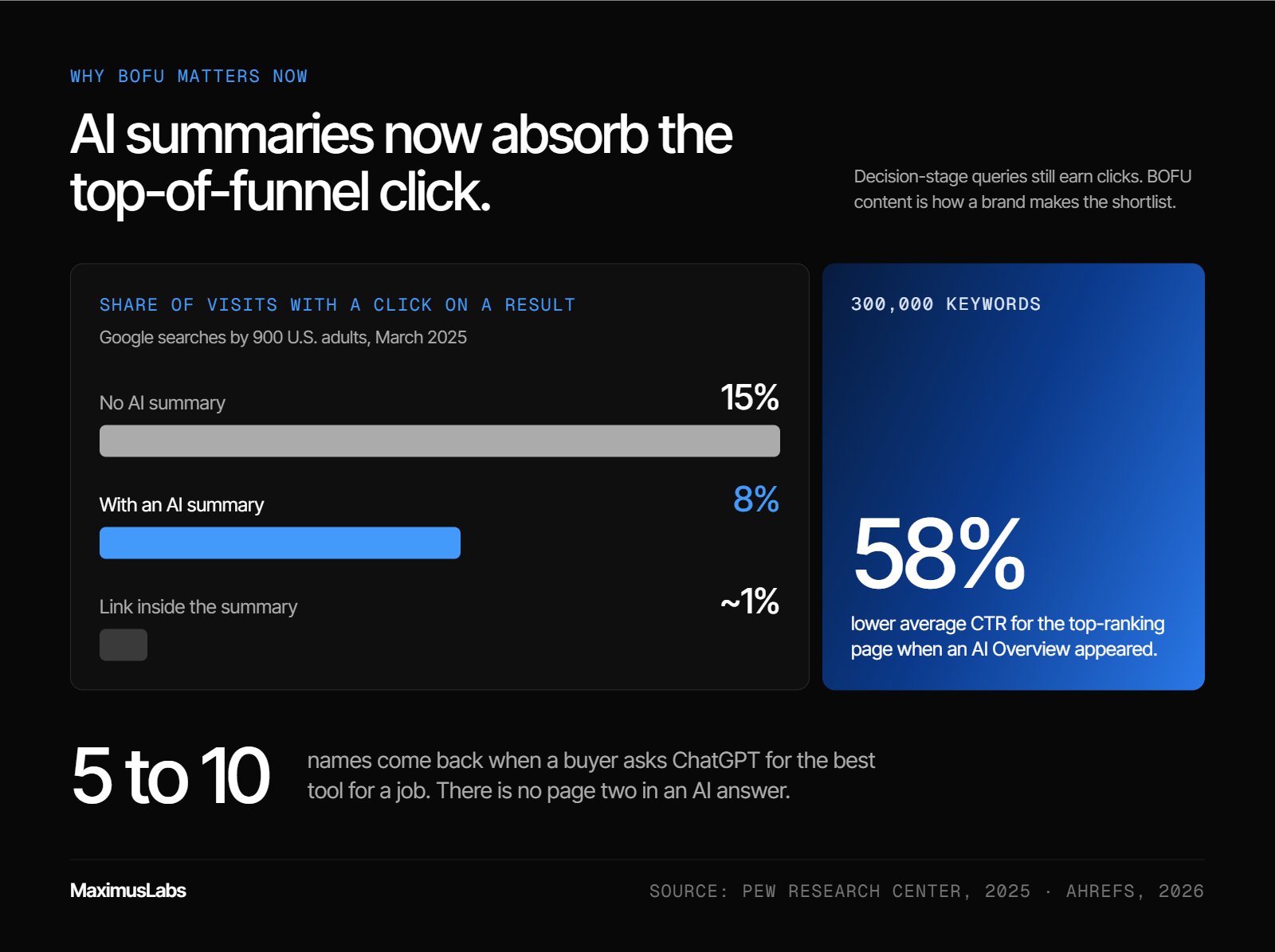
AI summaries now answer most definitional questions on the results page, so TOFU clicks are shrinking. Pew Research Center found users clicked a result on 8% of visits with an AI summary versus 15% without. Decision-stage queries still earn clicks, and AI tools name only a handful of vendors per answer. BOFU content is how a brand becomes the answer on that shortlist.
📊 How TOFU used to feed pipeline
For a decade, the playbook was simple. Publish hundreds of definition posts, rank them on Google, capture emails, and nurture readers toward a demo. Traditional agencies sold this on retainers and reported rankings, impressions, and clicks every month.
It worked while Google sent the click. Nobody had to prove the glossary produced pipeline, because traffic looked like progress. That assumption is now breaking.
❌ What changed when AI started answering
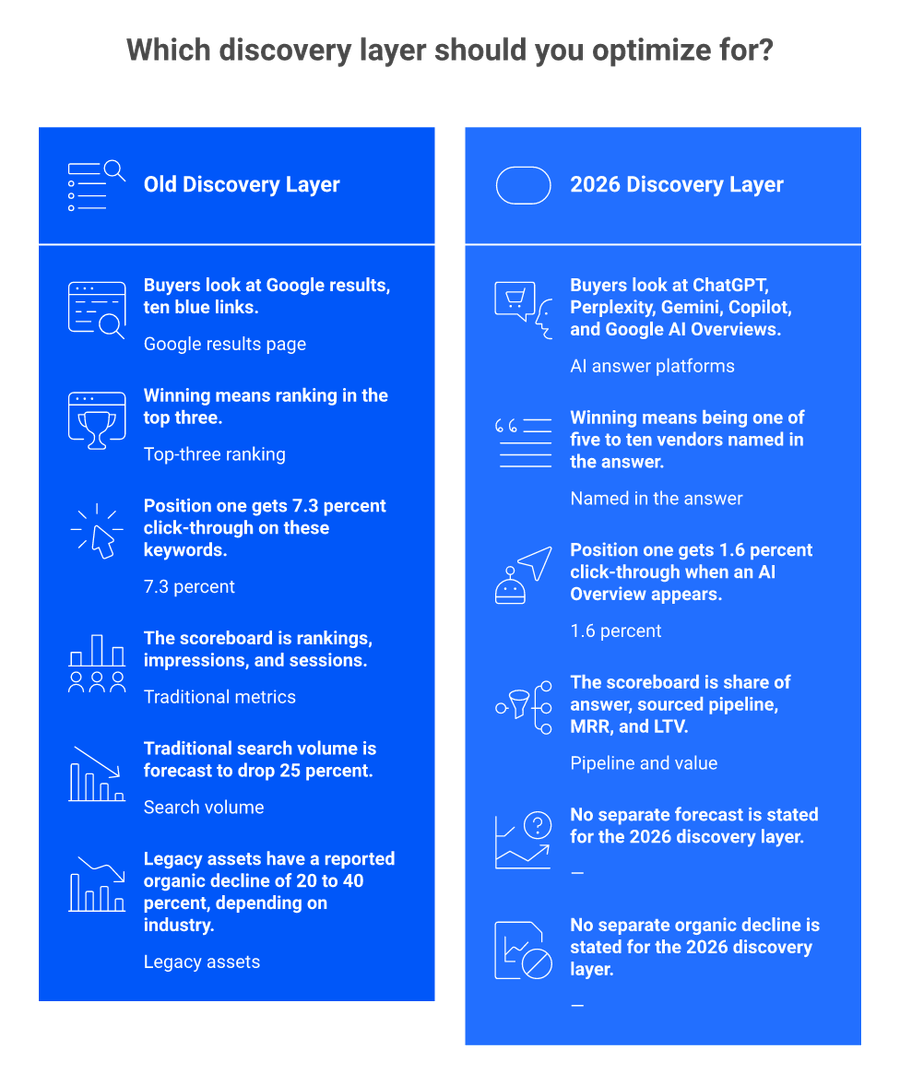
Pew's March 2025 data shows the shift clearly. Users clicked a traditional result on 8% of visits with an AI summary, against 15% without one. Only about 1% of visits included a click on a link inside the summary.
Ahrefs studied 300,000 keywords using December 2025 data. When an AI Overview appeared, the top-ranking page had a 58% lower average click-through rate (CTR), meaning the share of searchers who click. Ranking first for "What is X?" is now worth far less than it was.
🎲 The shortlist problem
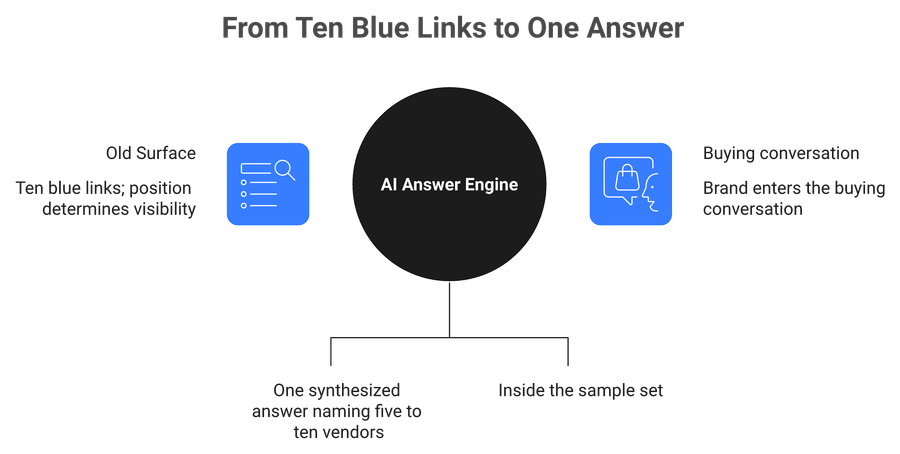
Decision-stage behavior has moved too. A buyer asks ChatGPT for the best tool for a specific job and gets five to ten names. If your brand is not in that sample set, you do not exist for that buyer. There is no page two in an AI answer.
Then the buyer finishes the job alone. Gartner found 61% of B2B buyers prefer a rep-free buying experience. They take the AI shortlist and check each vendor's own pages for proof, pricing, and fit.
🧠 Why AI recommendations raise the stakes
When ChatGPT names your brand, it lends you its own credibility. The buyer did not compare ten blue links and pick you. The AI picked you, and the buyer trusts that pick.
So these visitors often arrive already half-sold, with their research done inside the chat. That makes the BOFU page they land on the last checkpoint before a demo. If it is thin or out of date, the AI's trust is wasted.
🔁 Where the value concentrates
Ethan Smith shared an analysis where one out of 20 landing pages drove roughly 85% of all traffic. In my experience, the pages in that small winning group are rarely glossary posts. They answer a buying question.
So here is the Monday move. Tag every page as TOFU, MOFU, or BOFU. Compare each stage's share of budget with its share of pipeline. Then shift budget toward the decision-stage pages that buyers and AI engines actually use.
✅ What MaximusLabs AI does about it
MaximusLabs AI runs AEO, with SEO underneath, as one team handling strategy and execution. Daily AI-visibility tracking shows which engines name a client. A citation-intelligence engine maps which sources each engine trusts, then works the client into them. For Oliv AI, that work produced 27 qualified leads, $47K+ pipeline, 26% close rate in 4 months.
Q4. Which owned pages count as BOFU content? Examples 1 to 5
Five owned page types do most BOFU work: comparison pages (Brand vs. Competitor), alternatives pages, best-X category listicles, pricing pages, and integration pages. Each answers a question a buyer asks right before choosing, such as which tool fits, what it costs, and whether it works with the current stack. Each should end with one clear next step.
These pages also feed AI search. Google says AI Overviews and AI Mode may use "query fan-out," running several related searches across subtopics. That lets them show a wider set of supporting links. A BOFU page that answers the buyer's next question too has more chances to be one of them.
1. Comparison pages (Brand vs. Competitor)
A comparison page answers "Which of these two fits me better?" Senior living software company Aline publishes an "Aline vs. Eldermark" page aimed at buyers weighing both.
Rule: Admit where the competitor is stronger. A balanced table of features, limits, and best-fit customers earns buyer trust. It also gives AI engines clean facts to extract. Best CTA: a demo or trial framed around the buyer's switch.
2. Alternatives pages
An alternatives page answers "What should I use instead of X?" Mentimeter publishes a page on Kahoot! alternatives for teachers and presenters who are ready to switch.
Rule: Name the real reasons people leave the incumbent, such as price, a missing feature, or poor support. Then show how easy the move is, including data import and setup time. Best CTA: a free trial or migration help.
3. Best-X category listicles
A category listicle answers "What are the best tools for this job?" Zendesk publishes a roundup of the best customer experience software.
Rule: State your ranking criteria and list real competitors honestly. Broad "best X" questions are where AI engines lean most on lists like these, so a fair list carries weight. Best CTA: a link to your own comparison or demo page.
4. Pricing pages
A pricing page answers "What will this cost me?" Clario's pricing page lays out plans along with paid add-ons.
Rule: Show the pricing logic, even if enterprise deals say "contact us." Explain what drives the cost up or down. Keep it identical to what sales quotes, since 69% of B2B buyers notice inconsistencies. Best CTA: start a trial or talk to sales.
5. Integration pages
An integration page answers "Will this work with my stack?" Zapier publishes pages for specific app pairings, such as Google Sheets with QuickBooks Online. Matt Kenyon points out that buyers ask ChatGPT exactly this late in the journey.
Rule: Build one page per major integration. Say what syncs, in which direction, how often, and what does not work yet. Best CTA: connect the integration inside a trial.
🧩 How MaximusLabs AI builds these pages
MaximusLabs AI produces VS pages and alternatives listicles for switchers in the evaluation phase, plus category-level BOFU listicles. Each page is written in the client founder's voice, so the comparison reads the way the founder would explain it on a sales call. MaximusLabs keeps every comparison factual, because AI engines and buyers both punish one-sided pages.
Q5. Which proof and product assets close the deal? Examples 6 to 10
The second group of BOFU content proves the product works: use case pages, case studies, product demo videos, ROI calculators, and buyer's or implementation guides. They remove the last doubts about fit, effort, and payback. The strongest show the product itself, with screenshots, clips, or calculations, so the page sells without a rep in the room.
The owned pages in Q4 answer "which tool?" These five assets answer "will it actually work for us?" That second question is where many deals stall, because the buyer needs proof they can show their boss.
6. Use case pages
A use case page answers "Does this fit how my team works?" Asana publishes pages on specific ways different teams can use the product.
Rule: Write one page per job, not per feature. Name the role, the workflow, and the before-and-after. Best CTA: a template or trial preloaded for that use case.
7. Case studies
A case study answers "Has this worked for a company like mine?" Gong publishes a case study on how Mintel's sales team used its platform.
Rule: Lead with the customer's starting problem and a measurable result. Match the customer's size and industry to your target buyer. Best CTA: talk to sales about a similar setup.
8. Product demo videos
A demo video answers "What does using it actually look like?" A short product clip often does more than a page of copy. Pebl, for example, gives visitors a "Watch Demo" video on its site.
Rule: Keep it under three minutes and show one real task from start to finish. Add a text summary below, because AI engines read text, not video frames. Best CTA: book a live demo.
9. ROI calculators
An ROI (return on investment) calculator answers "Will this pay for itself?" Here is an illustrative example. A tool costs $1,000 a month and saves five reps three hours each per week. At $50 an hour, that is 5 × 3 × $50 × 4 weeks = $3,000 a month in time saved, or a 3x return.
Rule: Show the formula and let buyers change every input. A hidden formula looks like a sales trick. Best CTA: email me this estimate.
10. Buyer's and implementation guides
A buyer's guide answers "What should I check before I buy?" REI's water bottle buying guide is a consumer example of the format. In B2B, the twin is an implementation guide that explains setup steps, timelines, and who does what.
Rule: Be honest about effort. If setup takes six weeks, say so. Best CTA: download a rollout checklist or book an onboarding call.
⚠️ Keep proof consistent with sales
Gartner found 69% of B2B buyers saw inconsistencies between a supplier's website and what its sellers said. That is a trust leak at the worst moment. Every number on these pages should match the sales deck word for word.
These assets also protect you in AI search. When a page shows exactly what the product does, an AI engine has less room to guess or invent missing capabilities. I treat screenshots, clips, and calculators as insurance against wrong answers about your product.
⭐ Proof that MaximusLabs AI ships
MaximusLabs AI builds proof into BOFU pages with screenshots, tables, and worked examples, not adjectives. For Oliv AI, MaximusLabs' GEO work produced a 64% AI citation rate in 6 months, vs ~30% for billion-dollar incumbents. MaximusLabs measures that work on pipeline, not on mentions.
Q6. How do you find BOFU keywords and AI prompts worth targeting?
Start with the questions buyers ask right before buying: competitor names, "vs" and "alternatives" terms, pricing, integrations, and use cases. Pull them from competitor paid search terms, sales call notes, and support tickets. Then rewrite them as the long questions people type into ChatGPT. Low search volume is fine when every visitor is close to buying.
🔍 Where BOFU questions actually come from
Keyword tools are the last place I look, not the first. The best BOFU questions already sit inside your company. Here are five sources, in the order I use them:
- Sales call notes: The objections reps hear every week, word for word.
- Support tickets: Integration and setup questions from new customers.
- Lost-deal reasons: The competitor you lost to and the reason why.
- Competitor paid search terms: Keywords rivals pay for are proven buying terms.
- Review sites and forums: What buyers praise or complain about on G2, Capterra, and Reddit.
💸 Turning paid terms into question clusters
Competitors only bid on keywords that make them money. That makes their paid terms a free list of buying intent. Export them, group them by theme, and feed each group to an LLM (large language model, the tech behind ChatGPT).
Ask it to turn each group into the full questions a buyer would ask. "CRM pricing" becomes "How much does a CRM cost for a 15-person sales team?" Each cluster then becomes one BOFU page.
🧭 Head, mid-tail, and long-tail questions
Not every question needs its own page. I sort them into three types:
| Type | Example | Best home |
| Head | "Best CRM software" | Third-party lists and reviews |
| Mid-tail | "Best CRM for small SaaS teams" | Owned listicles plus third-party mentions |
| Long-tail | "Does this CRM integrate with Slack for lead routing?" | Owned integration or use case page |
Long questions matter more in AI search. Pew Research Center found 53% of Google searches with 10 or more words produced an AI summary, against 8% for one- or two-word searches. MaximusLabs AI plans content around an average AI chat query of about 25 words. That is a full sentence, not a keyword.
⏰ Why search volume is the wrong filter
A keyword tool might show "Brand A vs Brand B" at 90 searches a month. Most teams skip it. But those 90 people are comparing two vendors this week, so even a few demos from them can beat a 10,000-visit glossary post.
My rule is to cover BOFU questions fully before writing a single MOFU post. Volume tells you how many people ask. It does not tell you how close they are to buying, or how much they will spend.
✅ How MaximusLabs AI builds the list
MaximusLabs AI builds each client's BOFU question list from search data, sales calls, support tickets, and Reddit, then maps every question to one page. MaximusLabs also brainstorms the ways an ICP might ask AI agents for a solution, so pages match how buyers really phrase it.
Q7. How do you write a BOFU page that AI engines cite?
AI engines cite pages that answer the exact question early and back it with specifics. Put the direct answer near the top, then list concrete details: features, integrations, limits, pricing logic, and proof. The Princeton GEO study found optimization methods lifted visibility in AI answers by up to 40%. MaximusLabs AI writes a 40- to 80-word answer nugget under every question heading on a BOFU page.
❌ The old advice: sell benefits, skip features
For years, copywriting advice said the same thing. Sell the outcome, not the spec sheet. Write "save time on reporting," not "exports to CSV every Monday at 9 a.m."
Practitioner Matt Kenyon admits he followed that advice too. He now argues it is backwards for AI search. Late-stage buyers ask ChatGPT narrow questions, like whether a tool integrates with their stack. A benefit slogan cannot answer that.
🧠 Why AI engines need specifics
An AI engine builds its answer by retrieving pages and pulling out facts it can quote. If your page says "seamless integrations," there is nothing to quote. If it says "two-way sync with Salesforce every 15 minutes," the engine has a fact.
Research backs this up. Aggarwal and colleagues at Princeton tested ways to improve how often content appears in generative engine answers. Their methods lifted visibility by up to 40%, though results varied by domain. Google says no special markup is needed for AI Overviews. It asks for "helpful, reliable, people-first content."
⚠️ Depth without clutter
There is a real tension here. Donald Miller's StoryBrand framework warns that jargon above the fold makes buyers work too hard, so they leave. Detail-heavy pages can scare people off.
The fix is to layer the page. Keep the top short: one headline, one answer, one CTA. Put the depth below, in tables, FAQs, and spec sections. Buyers skim the top, and AI engines read everything.
✅ A simple BOFU page structure
Use this order for most BOFU pages:
- Question headline: The exact buyer question, such as "Does X integrate with HubSpot?"
- Direct answer: 40 to 80 words that stand alone.
- Specifics: Features, limits, setup time, and pricing logic, in a table where possible.
- Proof: A case study, screenshot, or number with its source.
- One CTA: The single next step.
🔁 Become the answer, not just a link in it
There is a difference between being cited and being the answer. A cited page is one link among five. A page that becomes the answer is the one the AI quotes when it explains the choice to the buyer.
That matters because an AI recommendation is a trust transfer. When ChatGPT names you, it stakes its own credibility on you. Specific, sourced, current pages give it a reason to take that risk again and again.
⭐ How MaximusLabs AI writes these pages
MaximusLabs AI writes every BOFU page through a three-stage pipeline: deep research, writing in the founder's voice, then QA. Each question gets a 40- to 80-word answer nugget built to stand alone. That way, AI engines quote the brand the way its founder would explain it, which turns a citation into a sales conversation.
Q8. Should BOFU content live on your site or on third-party sites?
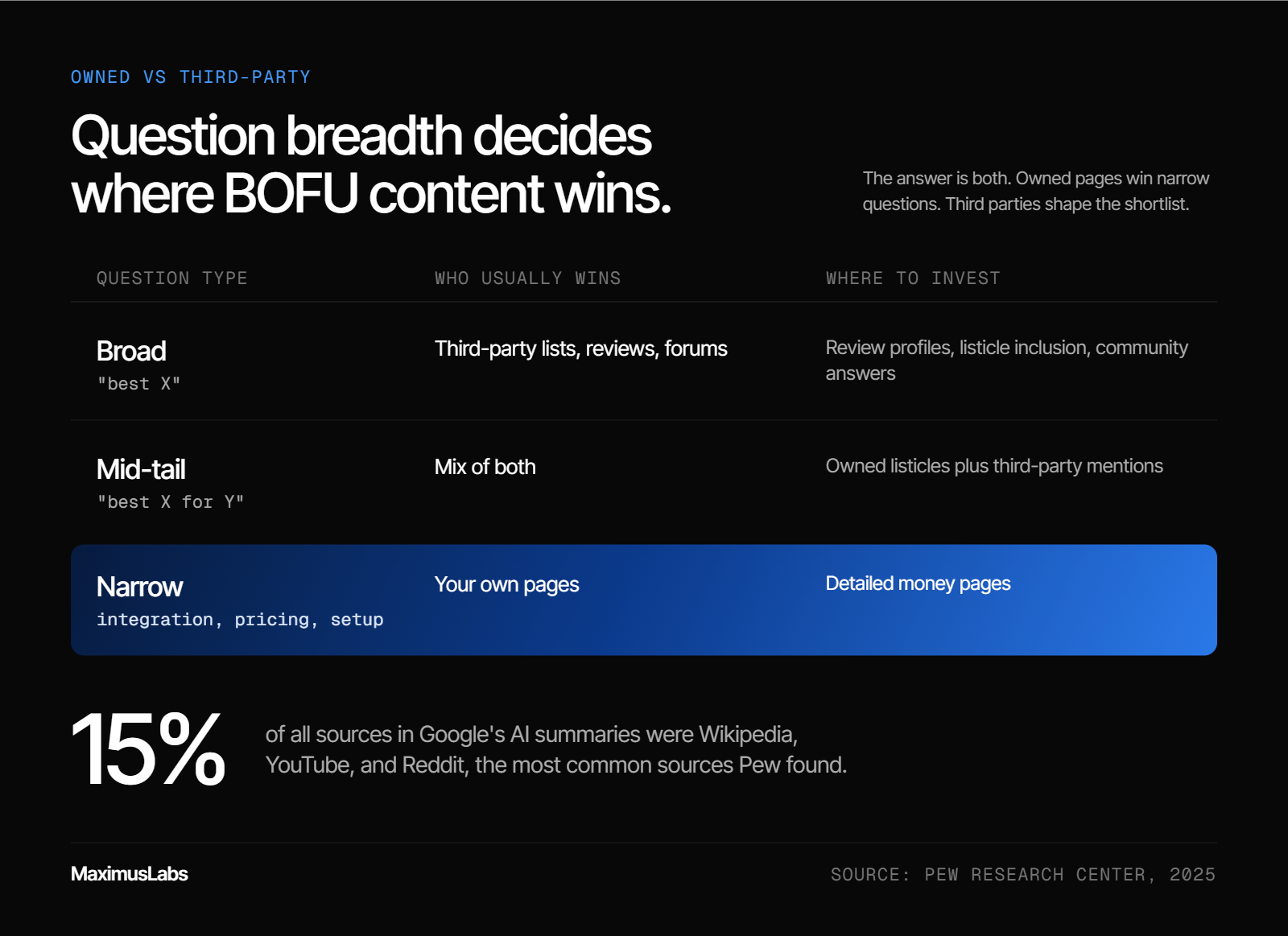
Both. Owned pages answer detailed long-tail questions, while third-party sources such as review sites, independent listicles, and forums decide who makes the shortlist on broad "best X" queries. Pew Research Center found Reddit and YouTube among the most-cited sources in Google's AI summaries. A brand absent from those surfaces can be left out before anyone reads its own site.
🏠 What your own site can win
Your own pages are strongest on narrow questions. "Does this tool support SSO on the starter plan?" has one best answer, and it usually lives on your site. No review site will cover it in that much depth.
That is why Q4 and Q5 matter so much. Integration, pricing, and use case pages win long-tail questions because nobody else has the facts.
🌐 What third-party sites decide
Broad questions work differently. When a buyer asks "What is the best project management tool?", AI engines lean on lists, reviews, and community threads. Pew found Wikipedia, YouTube, and Reddit were the most common sources in Google's AI summaries, making up 15% of all summary sources.
So your own "best X" page is only part of the story. If independent reviewers and forum threads never mention you, the AI may never shortlist you. Your strongest owned page then sits unread.
🔀 Each AI platform trusts different sources
Here is the moment that shaped my thinking. I saw companies appear in ChatGPT answers while missing from Google's top 10. ChatGPT, Google, and Perplexity often cite different sources for the same question.
That means there is no single place to "rank." You need presence everywhere buyers and AI engines look. I call this Search Everywhere Optimization: your own site, review platforms, Reddit, YouTube, and industry lists working together.
| Question type | Who usually wins | Where to invest |
| Broad ("best X") | Third-party lists, reviews, forums | Review profiles, listicle inclusion, community answers |
| Mid-tail ("best X for Y") | Mix of both | Owned listicles plus third-party mentions |
| Narrow (integration, pricing, setup) | Your own pages | Detailed money pages |
✅ A Monday checklist for off-site BOFU
- Claim and complete your G2 and Capterra profiles, with current screenshots and pricing.
- Ask happy customers for honest reviews on each platform.
- Search Reddit for threads comparing you with competitors, and answer helpfully as a named employee.
- List the independent "best X" articles in your category and pitch updates where you are missing.
- Check that every off-site fact matches your own pricing and feature pages.
Then re-ask your top buying questions in ChatGPT, Perplexity, and Google every month. Note which sources each engine cites. That list tells you exactly where to show up next.
⭐ How MaximusLabs AI covers both sides
MaximusLabs AI runs two pillars together. Owned AEO makes the client's own content the answer. Earned AEO builds trust through reviews, Reddit, press, and listicles, including G2 and Capterra profiles with 10+ reviews per site. Most agencies only do the first pillar, which leaves the shortlist to chance.
Q9. How do you measure whether BOFU content drives pipeline?
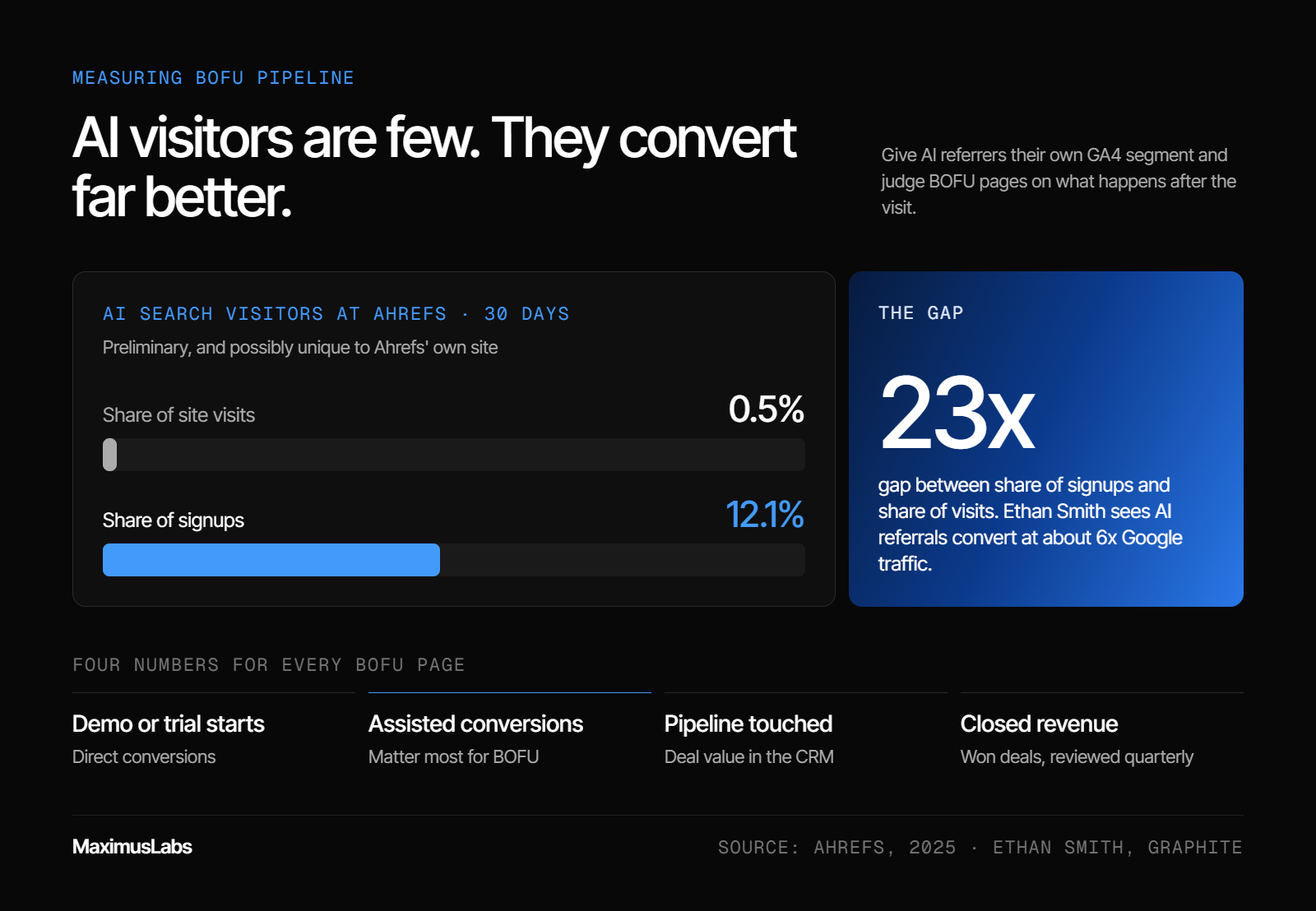
Measure BOFU content by what happens after the visit: demos, trials, assisted conversions, and closed revenue. Segment AI referrers in Google Analytics 4 (GA4), because they are small but convert well. Ahrefs found AI search visitors were 0.5% of its visits but drove 12.1% of signups. MaximusLabs AI tracks share of voice across ChatGPT, Perplexity, and Google AI answers alongside pipeline.
❌ Metrics to drop from the BOFU report
Sessions, pageviews, average position, and time on page all belong on a TOFU report. On a BOFU report, they mislead. A comparison page with 120 visits and nine demos beats a glossary post with 12,000 visits and none.
Rankings mislead too. There is no single rank in an AI answer. Your brand can be named in one chat and missing from the next version of the same question.
✅ Metrics that tie BOFU to revenue
Track these four numbers for every BOFU page:
| Metric | What it tells you | Where to find it |
| Demo or trial starts | Direct conversions from the page | GA4 conversions or your form tool |
| Assisted conversions | Pages a buyer read before converting elsewhere | GA4 attribution reports |
| Pipeline touched | Deal value where the page appears in the journey | CRM, with page data passed in |
| Closed revenue | Won deals that touched the page | CRM, reviewed quarterly |
Assisted conversions matter most for BOFU. Buyers often read a pricing page, leave, and book a demo two days later from an email. A last-click report hides that.
🤖 Segment AI referral traffic
AI visitors behave differently, so give them their own segment. In GA4, build a custom channel group for sources such as chatgpt.com, perplexity.ai, gemini.google.com, and copilot.microsoft.com. Then compare their conversion rate with organic search.
The early data is striking. Ahrefs reported that AI search visitors made up 0.5% of its site visits over 30 days but produced 12.1% of signups, a 23x gap. Ahrefs called this preliminary and possibly unique to its own site. Practitioner Ethan Smith reports a similar pattern, with 8% of signups from AI referrals converting at about 6x the rate of Google traffic.
📊 Track share of voice, not position
Share of voice means how often your brand appears across many versions of a buying question, on many AI platforms. Run your top 20 to 50 buying questions in ChatGPT, Perplexity, Gemini, and Google AI Mode each month. Record whether you are named, cited, or missing.
My honest caveat: AI answers change from run to run, so treat one month's number as noisy. The trend over a quarter is what matters.
⏰ Refresh what drives pipeline
BOFU pages go stale fast, because prices, features, and competitors change. My working rule is to refresh priority BOFU pages every 30 to 90 days. Update the facts first, then the date. A stale pricing table costs more trust than a missing one.
⭐ How MaximusLabs AI reports the work
MaximusLabs AI reports BOFU work on pipeline, not impressions, and runs daily AI-visibility tracking across every major engine. For Oliv AI, that tracking showed a 64% AI citation rate in 6 months, vs ~30% for billion-dollar incumbents. MaximusLabs then ties those citations back to demos and revenue in the client's CRM.
Q10. Who should build your BOFU content: in-house, agency, freelancers, or a GEO partner?
In-house teams cost about $800 per piece, traditional agencies about $260, and freelancers about $100, yet most still optimize for traffic. MaximusLabs AI produces BOFU content at about $60 per piece, starts in 2 days, and writes for revenue and AI citations in the founder's voice. The right model ships BOFU pages fast and ties them to pipeline.
🧩 The execution gap nobody budgets for
Most BOFU plans fail after the strategy deck, not before it. Ethan Smith, who ran SEO consulting for years, admits that maybe 20% of his early strategies ever launched. As he puts it, 20% launched "is not going to cause the outcome."
I have seen the same pattern. A team agrees on 40 comparison and integration pages in January. By June, six are live. The other 34 are still in a spreadsheet, and pipeline has not moved. Speed of shipping matters more than the elegance of the plan.
💰 What each model actually costs
Here is how the four common models compare, based on MaximusLabs AI's own cost comparison:
| Model | Cost per piece | Revenue focus | GEO depth |
| In-house team | ~$800 | Depends on team | Unlikely |
| Traditional agency | ~$260 | Rarely | Surface-level |
| Freelancers | ~$100 | Never | No |
| MaximusLabs AI | ~$60 | Always | Deep |
Each model has a real place:
- ✅ In-house teams know the product deeply and sit next to sales.
- ✅ Traditional agencies bring process and steady output on Google SEO.
- ❌ Most agencies still sell rankings and TOFU traffic, with little AI search work.
- ✅ Freelancers are cheap and flexible for single pieces.
- ❌ Freelancers rarely cover design, technical SEO, or off-site presence.
⚠️ The mass AI content trap
The cheapest option is to generate hundreds of pages with AI and publish them unreviewed. It looks efficient on a cost sheet. It also produces the same generic copy every competitor already has.
Google's guidance asks for "helpful, reliable, people-first content" to appear in AI features. Mass-produced BOFU pages rarely meet that bar. Worse, a wrong spec or price on a money page damages trust with buyers and AI engines at once.
🧠 Why brand beats the algorithm
Here is my most contrarian view. Generative Engine Optimization is a data science problem, not SEO with a new label. But the long-term moat is still the brand. If you build a real brand in your space, AI has to recommend you, whatever the next algorithm update brings.
So choose the model that captures your founder's actual point of view. Generic pages can be copied. A clear, specific opinion about your market cannot.
⭐ Where MaximusLabs AI fits
MaximusLabs AI builds BOFU first and skips TOFU on purpose, with strategy and execution in one team. Hybrid human and AI workflows let it scale output without losing quality, and humans approve everything that ships. For Nidra Goods, that approach ranked the brand #1 on Google, ChatGPT, and Perplexity for "best sleep mask."
What I'm Thinking About Next
My hypothesis is that BOFU content is about to get a new reader: AI agents. Soon a buyer will ask an agent to shortlist three tools, compare pricing, and book the demo. The agent will read your money pages, not your brand video.
That raises the bar again. Pages will need clean facts, current prices, and clear integration details that a machine can trust. I also expect ads inside AI chat within a year or two, which will make earned, organic trust even more valuable.
I might be wrong on the timing. I am fairly sure about the direction. If you are rebuilding your BOFU layer for this shift, I would love to compare notes at krishna@maximuslabs.ai.
References
- Gartner, "Gartner Sales Survey Finds 61% of B2B Buyers Prefer a Rep-Free Buying Experience," press release, June 25, 2025.
- Athena Chapekis and Anna Lieb, Pew Research Center, "Google users are less likely to click on links when an AI summary appears in the results," July 22, 2025.
- Ryan Law, Ahrefs, "Update: AI Overviews Reduce Clicks by 58%," February 4, 2026.
- Google Search Central, "AI features and your website," accessed November 2026.
- Siege Media, "Conversion-Boosting Bottom-of-Funnel Content (+ Examples)," secondary source.
- Animalz, "What Is Bottom of the Funnel Content?," secondary source.
- Semrush, "BoFu Content Strategy: How to Turn Prospects Into Customers," secondary source.
- Pranjal Aggarwal, Vishvak Murahari, Tanmay Rajpurohit, Ashwin Kalyan, Karthik Narasimhan, and Ameet Deshpande, "GEO: Generative Engine Optimization," KDD 2024.
- Patrick Stox, Ahrefs, "Does AI Search Traffic Convert Better Than Traditional Search? For Ahrefs, Yes: 0.5% of Visitors Drove 12.1% of Signups," June 16, 2025.
- MaximusLabs AI, internal content cost comparison (in-house, traditional agency, freelancer, and MaximusLabs AI cost per piece), first-party data.
Questions, answered
7 questionsWhat are the best examples of bottom of the funnel content?
The best bottom of the funnel content answers a buyer's last questions before they pick a vendor. In our work, ten formats do most of that job: • Comparison pages (Brand vs. Competitor) • Alternatives pages for buyers ready to switch • Best-X category listicles with honest ranking criteria • Pricing pages that explain the pricing logic • Integration pages for each major tool in the buyer's stack • Use case pages written per job, not per feature • Case studies that match the buyer's size and industry • Product demo videos with a text summary below • ROI calculators that show the formula • Buyer's and implementation guides that are honest about effort The first five are owned pages that answer "which tool?" The last five are proof assets that answer "will it work for us?" Each one should end with a single clear next step, such as a demo or a trial. MaximusLabs AI builds these formats first for B2B SaaS clients and skips top-of-funnel glossary posts on purpose. If you want to plan which formats to build first, our guide to AI content strategy planning walks through the order we use.
What is the difference between MOFU and BOFU content?
Middle of funnel (MOFU) content helps buyers explore how to solve a problem. Bottom of funnel (BOFU) content helps them choose who to buy from. The difference shows up in four places: • The question: MOFU asks "How do I solve this?" BOFU asks "Which vendor should I pick, and why?" • The format: MOFU uses how-to guides, frameworks, templates, and webinars. BOFU uses comparisons, pricing pages, case studies, and demos. • The call to action: MOFU asks for a download or registration. BOFU asks for a demo or a trial. • The metric: MOFU is judged on engaged leads. BOFU is judged on demos, pipeline, and closed revenue. The same topic can sit in both stages. "How to build an outbound sequence" is MOFU. "Best sales engagement platform for a 20-rep team" is BOFU. The wording of the query sets the stage, not the topic. MaximusLabs AI covers a client's BOFU questions first and moves to MOFU only after BOFU is exhausted. We do this because answer engines treat these query types differently, which we explain in our breakdown of the query types answer engines prioritize.
How do you find BOFU keywords when search volume is low?
BOFU keywords often show tiny search volume, and that is fine. A comparison query with 90 searches a month can beat a glossary post with 10,000 visits, because those 90 people are choosing a vendor this week. We find BOFU keywords in places keyword tools miss: • Sales call notes: the objections reps hear every week • Support tickets: integration and setup questions • Lost-deal reasons: the competitor you lost to and why • Competitor paid search terms: keywords rivals pay for are proven buying terms • Review sites and forums: what buyers praise or complain about Then rewrite each cluster as the full question a buyer would type into ChatGPT. "CRM pricing" becomes "How much does a CRM cost for a 15-person sales team?" Long, specific questions like that are where AI answers show up most. MaximusLabs AI plans content around an average AI chat query of about 25 words, so every BOFU page targets a full sentence, not a two-word keyword. To see how real buyers phrase these prompts, try our free ChatGPT search query extractor.
How long should a bottom of the funnel page be?
A BOFU page should be as long as the buyer's questions require, and no longer. Length is not the goal. Completeness is. We use a layered structure so a page can be detailed without feeling heavy: • Top of the page: one question headline, a 40- to 80-word direct answer, and one call to action • Middle: specifics such as features, limits, setup time, and pricing logic, in tables where possible • Bottom: proof, such as a case study, screenshot, or sourced number, plus short FAQs Buyers skim the top and leave once they have what they need. AI engines read everything and pull out facts they can quote. A vague 300-word page gives them nothing. A detailed page with a clear answer at the top gives them a reason to cite you. MaximusLabs AI writes every BOFU page with a standalone answer under each question heading, then adds depth below it. That approach comes from how answer engines extract content, which we cover in our guide to citation-worthy content for AI engines.
Should bottom of the funnel content be gated behind a form?
In most cases, no. Gating BOFU content behind a form usually costs more than it captures. Here is why we keep most BOFU pages open: • AI engines cannot read gated pages. If ChatGPT or Perplexity cannot crawl your comparison or pricing page, it cannot cite it. • Buyers prefer to self-serve. Many B2B buyers want to compare, price, and confirm fit before they ever talk to sales. • Forms add friction at the worst moment. A buyer close to a decision often leaves rather than fill in a form for a pricing sheet. There are sensible exceptions. A detailed ROI estimate or a custom rollout plan can sit behind a light form, because the buyer gets something personal in return. The rule is simple: gate the tailored output, never the facts. MaximusLabs AI keeps client comparison, pricing, and integration pages open and crawlable, because a page AI cannot read never makes the shortlist. Before you decide what to gate, check how AI crawlers see your site with our guide to AI crawlers and optimization.
How do you measure the ROI of bottom of the funnel content?
Measure BOFU ROI by what happens after the visit, not by traffic. Sessions and rankings belong on a top-of-funnel report. On a BOFU report, they mislead. We track four numbers for every BOFU page: • Demo or trial starts from the page • Assisted conversions, meaning pages a buyer read before converting elsewhere • Pipeline touched, the deal value where the page appears in the journey • Closed revenue from won deals that touched the page Then add an AI layer. Build a separate segment in GA4 for referrals from ChatGPT, Perplexity, Gemini, and Copilot, and compare their conversion rate with organic search. Also track share of voice, meaning how often your brand appears across many versions of the same buying question. MaximusLabs AI reports BOFU work on pipeline, not impressions, and ties AI citations back to demos and revenue in the client's CRM. Treat one month's AI data as noisy and judge the trend over a quarter. For a fuller framework, see our guide to measurement and metrics in GEO.
How does MaximusLabs AI create bottom of the funnel content?
MaximusLabs AI builds BOFU content first and skips top-of-funnel glossary posts on purpose, because AI engines already answer "What is X?" questions well. Strategy and execution sit in one team, and every engagement is measured on pipeline, not on mentions. Our process looks like this: • Question research: we pull buying questions from search data, sales calls, support tickets, and Reddit, then map each one to a single page. • Founder's voice: we sit with the leadership team so every comparison reads the way the founder would explain it on a sales call. • Three-stage pipeline: deep research, writing, and QA, with a standalone answer under every question heading. • Owned and earned presence: we build the client's own money pages and their presence on review sites, Reddit, and listicles. Hybrid human and AI workflows let us scale output without losing quality, and humans approve everything that ships. For Oliv AI, this work produced a 64% AI citation rate in 6 months, vs ~30% for billion-dollar incumbents. You can see how we approach Answer Engine Optimization in more detail on our service page.