 Krishna Kaanth M
- Click worthiness is the measurable degree to which a page still earns a visit after an AI answer has already summarised the topic for the reader.
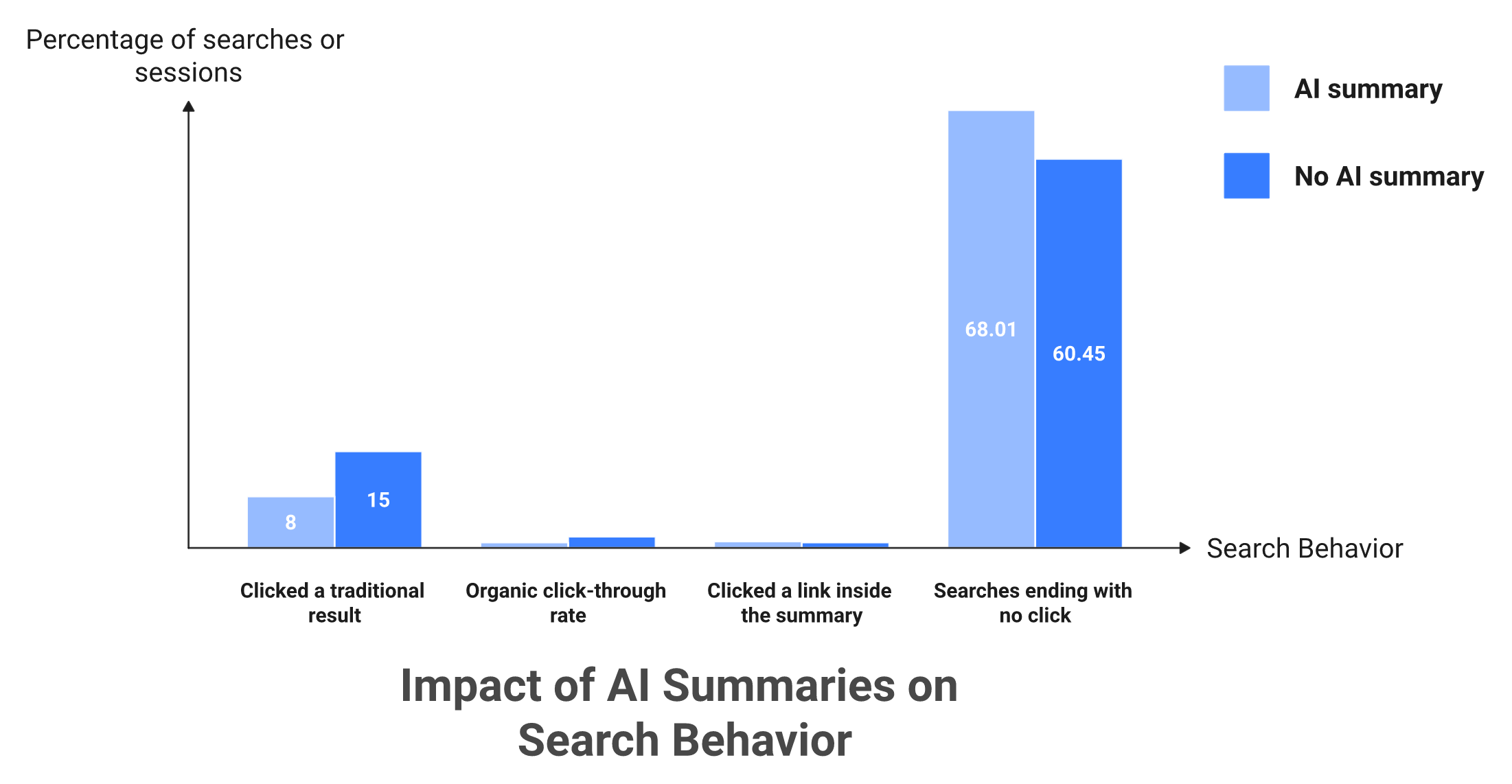
- Pew found clicks fall from 15% to 8% when an AI summary appears, and links inside the summary get clicked only 1% of the time.
- Mentions and citations are separate scoreboards; Semrush found overlap between mentioned brands and cited domains as low as 30% on Gemini.
- Score every page on extractability, differentiation, and decision-stage fit, then multiply the three and mark it retire, rebuild, or double down.
- AI-influenced visits arrive as direct or branded search, so instrument self-reported attribution and report assisted pipeline instead of sessions.
- AI crawlers do not execute JavaScript, so server-rendered pricing, specs, and reviews decide whether agents can choose you at all.
Q1. What is a click worthiness strategy, and why does it replace rank chasing?
A click worthiness strategy decides which pages deserve a visit after an AI has already answered the question. It has two halves: extractable structure that earns the citation, and proprietary depth a summary cannot reproduce. Rank became an input, not an outcome. Pew found clicks fall from 15% to 8% when an AI summary appears, so the surviving click must be earned on merit.
The metric that stopped working
📉 Flat impressions, falling clicks
Most organic dashboards still treat position as a proxy for traffic. That assumption held for twenty years. It stopped holding the moment AI Overviews took the top of the page.
Pew Research Center tracked 68,879 real Google searches from 900 US adults in March 2025. When an AI summary appeared, users clicked a traditional result 8% of the time. Without one, they clicked 15% of the time.
🔗 The citation link nobody opens
The same study found users clicked a link inside the AI summary itself just 1% of the time. Being cited is not the same as being visited.
MaximusLabs AI measures this split directly, tracking citation presence separately from referral traffic across ChatGPT, Perplexity, and Google AI Overviews. The two numbers move independently more often than teams expect.
The two halves of click worthiness
🧩 Extractability plus a withheld payoff
Click worthiness is not one property. It is two, and they pull in different directions.
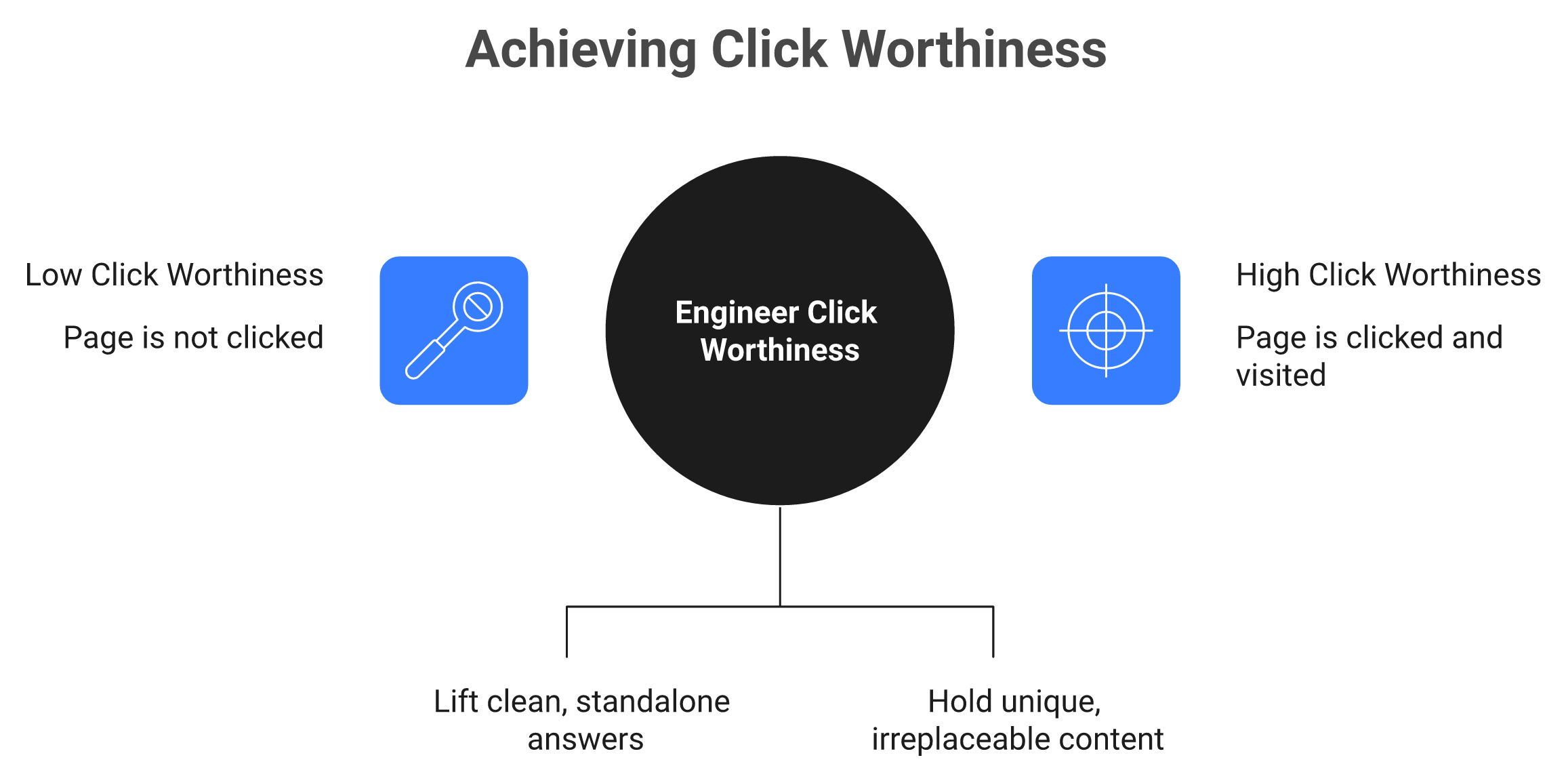
Extractability means an engine can lift a clean, self-contained answer from your page. Differentiation means the page still holds something the summary could not carry: your data, your comparison, or your decision support.
A page with only the first half gets cited and ignored. A page with only the second half is invisible. You need both, deliberately.
⚖️ What that looks like on a real page
Take a pricing comparison page. The extractable half is a forty word definition of the pricing models. The withheld half is your own cost-per-outcome data, which no summary can invent.
MaximusLabs AI scores citation-worthiness as one of ten publication dimensions, with a minimum of 70 out of 100 before anything ships. A page that cannot be extracted never gets the chance to be clicked.
Why this reframes the whole job
🎯 Become the answer, then deserve the visit
My honest read is that the industry split these into two camps too early. One camp chases citations. The other mourns lost traffic. Both are describing halves of the same page.
Krishna's framing at MaximusLabs AI is that the goal is to become the answer, not merely to appear in it. Click worthiness is the human-facing half of that same trust problem.
I might be reading the sequencing too strongly here. But every audit I have run starts the same way: the pages that lost clicks were the ones with nothing left to withhold.
MaximusLabs AI builds every article with a mandatory extractable answer block and a proprietary payoff the summary cannot reproduce, because visibility without a reason to visit is a cost line, not a channel.
Q2. Why does ranking #1 no longer guarantee the click, and which queries lose most?
Ranking #1 inside an AI Overview delivers roughly the clicks of a position-6 organic result. Seer measured organic CTR falling from 1.76% to 0.61% on affected queries, and SparkToro clickstream data put US zero-click searches at 68.01% in early 2026, up from 60.45% in 2024. The loss is not uniform. Answer-based queries collapse. Decision-stage queries retain click intent.
The model everyone still budgets against
🧾 Position as a traffic forecast
Every organic forecast I have seen in the last decade multiplies estimated volume by a CTR curve tied to position. That curve was built in a world where the top of the page was a blue link.
The curve is now wrong in a specific way. It is not uniformly wrong, which is what makes it dangerous.
🔢 Three numbers that broke the curve
Seer Interactive's 2025 analysis put organic CTR at 1.76% without an AI Overview and 0.61% with one. SparkToro's clickstream work with Similarweb put zero-click at 68.01% of US Google searches in early 2026.
MaximusLabs AI re-baselines client CTR targets per query segment rather than site-wide, because a single blended number hides which half of the site is actually bleeding.
Not all queries lose equally
📊 Answer-based versus decision-based
| Query class | Example | What the AI does | Click outcome |
| Answer-based | "what is zero-click search" | Fully resolves it | Collapse, near-total |
| Comparison | "tool A vs tool B pricing" | Summarises, misses nuance | Partial loss |
| Decision-based | "best GEO agency for B2B SaaS" | Names a shortlist | Click intent survives |
| Verification | "does X integrate with Y" | Answers, user verifies | Click often retained |
The pattern is consistent. The closer a query sits to a purchase decision, the more the reader still wants to see the source with their own eyes.
⚠️ The reporting trap
Blended site CTR averages these four classes together. A team can lose 80% of clicks on definitional content while decision pages hold steady, and the dashboard shows a moderate decline.
That average tells you nothing actionable. Segment first, then decide what to cut.
The twist nobody budgeted for
🆕 Domain authority matters less than it did
Low-authority and newer domains still surface inside AI Overviews with some regularity. Keyword difficulty, the metric most content calendars are built on, is a weaker predictor than it was.
MaximusLabs AI tracks share of voice across thousands of question variants instead of a single rank, because one position number no longer forecasts a single visit.
🎲 A more binary game
Krishna's line on this is blunt. There is no page 2 in an AI answer. You are in the response or you are not in the consideration set at all.
That cuts both ways. It is harsher for incumbents coasting on domain authority, and genuinely better for a small brand with a sharp, well-structured answer.
MaximusLabs AI reports position alongside citation presence and assisted pipeline, so a client can see the difference between a page that is visible and a page that is working.
Q3. Is being mentioned in the answer worth more than being cited beneath it?
Being named inside the AI's answer usually beats being a numbered citation underneath it. A mention shapes brand preference and drives high-intent direct visits. A citation sits behind a source tray most users never expand. Semrush's 2026 index of 126 million prompts found overlap between mentioned brands and cited domains as low as 30% on Gemini. Measure both, separately.
The citation obsession, and what it misses
🏃 A running shoe explains it faster than a chart
Picture a shoe brand optimising for "tips for runners with flat feet." The citation strategy tries to win a slot in the collapsed source list.
Ask yourself the honest question. What are the odds a reader expands that tray, scrolls the sources, finds your domain, and clicks?
🛒 The mention does the commercial work
Now picture the same answer naming your shoe inside the recommendation itself. The reader never clicks a source. They search your brand name later and buy.
MaximusLabs AI treats brand mention frequency as a first-class metric alongside citation rate, because the mention is what enters the buyer's consideration set.
Two scoreboards, not one
📋 What each one actually measures
| Dimension | Mention | Citation |
| What it is | Your brand named in the answer text | Your page used as the evidence |
| What it drives | Preference, branded search, direct visits | Referral clicks, source credibility |
| Who controls it | Third parties, reviews, communities, and reputation | Your page structure and extractability |
| Failure mode | Nobody talks about you anywhere | Nobody can lift a clean answer from you |
| Fix | Off-site trust and presence work | On-page structure and answer blocks |
🔍 Using the gap as a diagnostic
This table is a diagnostic, not trivia. High mentions with low citations means an extractability problem on your pages.
Low mentions with decent citations means an authority problem off your pages. Semrush found only 36 of more than 1,200 tracked brands stayed visible across ChatGPT, Gemini, and Google AI every single month. Consistency is rarer than presence.
Why the trust transfer sits on the mention
🤝 The engine stakes its own credibility
Krishna's model here is the one I keep coming back to. When ChatGPT names your brand, it lends you its own credibility, and that is a transfer the reader feels.
A footnote carries no such endorsement. It is evidence, not recommendation.
📈 What the proof looks like
MaximusLabs AI took Oliv AI to a 64% citation rate across AI platforms within six months, against billion-dollar incumbents sitting near 30%. That is a MaximusLabs first-party figure, not an audited third-party benchmark, and I want to label it as such.
My read is that the category has this backwards. Everyone is instrumenting citations because they are easy to count, while mentions are what actually enter the buying conversation.
MaximusLabs AI audits mention share and citation share as two separate numbers before recommending any content work, because the fix for one will not move the other.
Q4. How do AI engines decide who gets quoted, and which levers move it?
Citation and click respond to different levers. Princeton's GEO study across roughly 10,000 queries found quotations lifted visibility 41%, statistics 33%, and citing sources 28%, while keyword stuffing lost 8%. Those are citation levers. Click levers are different: original data, decision support, and a reason the summary cannot satisfy. Optimising only the first set buys visibility with no traffic.
How retrieval actually works
🔄 Search first, then summarise
Modern AI chat does not answer from memory. It runs a search, retrieves a candidate set, reads it, and synthesises. Retrieval-augmented generation (RAG) means the retrieval step is where optimisation happens.
That is why AEO shares foundations with SEO without being SEO. You are competing to enter a candidate pool, not to hold a position.
📎 Grounding happens on a fragment
ChatGPT's standard web search grounds heavily on structured metadata, often a short excerpt rather than the full page. Your meta description is doing more work than your third H2.
MaximusLabs AI writes meta descriptions as dense, front-loaded answers rather than teaser copy, because that string is now a control surface for what the engine says about you.
The click-quality filter underneath
🖱️ NavBoost and the 13-month window
Google's NavBoost system, surfaced in antitrust testimony, uses goodClicks, badClicks, and lastLongestClicks (post-click dwell time) over a rolling 13-month window. Recent engagement is weighted more heavily. Sustained engagement compounds.
Plainly: the system remembers whether people who visited you stayed.
🚫 The link tier nobody talks about
The same disclosures describe three link-index tiers, low, medium, and high, with click data determining which tier a document's links fall into. Pages with no Chrome click data land in the low-quality index, and their links are ignored entirely.
That means a low-engagement page cannot pass authority to anything. Publishing volume without engagement builds nothing.
Picking levers by objective
🎚️ The lever table
| Lever | Effect | Serves |
| Add expert quotations | Plus 41% visibility | Citation |
| Add verifiable statistics | Plus 33% visibility | Citation |
| Cite credible sources | Plus 28% visibility | Citation |
| Keyword stuffing | Minus 8% visibility | Neither |
| First-party data | Cannot be summarised away | Click |
| Interactive tools and calculators | Requires the visit | Click |
| Head-to-head comparisons | Reader verifies the detail | Click |
🧪 What I would test first
MaximusLabs AI works from the papers, patents, and platform docs behind these systems rather than the blogs summarising them, which is why the recommendations tend to survive model updates.
The Princeton deltas come from a controlled benchmark, not from your site. Treat them as direction, not as a guarantee, and run your own before-and-after on twenty pages.
MaximusLabs AI sequences citation levers before click levers on new domains, because a page nobody retrieves cannot demonstrate anything about engagement.
Q5. How do you score a page's click worthiness before you publish it?
Score every page on three axes: extractability (can an engine lift a standalone answer), differentiation (does it contain something a summary cannot reproduce), and decision-stage fit (does the query sit near a buying decision). Multiply, do not average. A page scoring zero on differentiation earns citations and no clicks. MaximusLabs AI applies this scoring before publication, not after traffic drops.
Why nobody scores this today
📝 Tactics lists are not diagnostics
Every guide on AI search hands you a checklist. Add schema. Write an FAQ. Structure your headings. Useful, but a checklist cannot tell you which of your 400 existing pages is worth saving.
Scoring can. MaximusLabs AI runs every article through an ICP perspective audit across six criteria, rewriting any section that scores below seven out of ten before it ships.
🔢 Three axes, one to five each
| Axis | Score 1 | Score 5 |
| Extractability | No standalone answer anywhere on the page | Clean 40 to 80 word answer under every heading |
| Differentiation | Everything here exists in five other articles | Original data, tool, or comparison only you hold |
| Decision-stage fit | Definitional query, no product context | Buyer is shortlisting vendors right now |
Multiply the three. The ceiling is 125. Anything under 20 is not a content problem, it is a portfolio problem.
Why multiply instead of average
✖️ A zero on any axis is fatal
Averaging hides the failure mode. A page scoring 5, 1, and 5 averages to a respectable 3.7 and still earns almost nothing.
Pew measured in-summary citation link clicks at 1%. That is what a high-extractability, low-differentiation page actually gets. Perfect structure, nothing withheld, and no visit.
🧮 A page scored end to end
Take a "what is generative engine optimization" post. Extractability 5, because the definition is clean. Differentiation 1, because thirty other pages say the same thing.
Decision-stage fit 2, since the reader is still learning. Total: 10 out of 125. MaximusLabs AI would mark that page for merge, not rewrite, because no amount of editing adds proprietary depth that was never collected.
Turning scores into decisions
🗂️ Retire, rebuild, or double down
- Under 20: retire or merge into a stronger page.
- 20 to 60: rebuild, usually by adding first-party data or a comparison.
- Over 60: double down with distribution, internal links, and off-site citation work.
MaximusLabs AI sequences client roadmaps this way, clearing the bottom tier first, because dead pages dilute crawl attention and pass no authority.
🤔 Where I am still unsure
MaximusLabs AI's scoring points strongly toward multiplication over averaging, though I might be over-weighting differentiation for very technical B2B categories. In narrow verticals, sometimes clean structure alone is enough to win, simply because nobody else bothered.
My honest position is that the rubric is a forcing function, not a physics equation. Its real value is that it makes a team say out loud what a page offers that a summary cannot.
MaximusLabs AI scores click worthiness before publication rather than diagnosing it after a traffic drop, because the cheapest time to fix a page is before it exists.
Q6. Which content formats still earn clicks when AI summarises everything?
Five formats still earn clicks: first-party data, case studies, interactive tools and calculators, head-to-head comparisons, and decision-support content. What they share is that summarising them destroys their value. MaximusLabs AI builds client roadmaps around these five and skips definitional content entirely, because an engine reproduces a definition completely and leaves the reader no reason to visit.
What the calendar looks like now
📅 Half your plan is already free
Most content calendars I audit still carry a heavy load of "what is" and "how does X work" pieces. Those were reasonable bets in 2021. They are donations now.
The engine answers them fully, in place, with no click. You paid for the research and someone else delivered it.
⚖️ Survives versus absorbed
| Format | Fate in AI search | Why |
| First-party data or benchmarks | ✅ Survives | The engine must cite you to use the number |
| Case studies with named outcomes | ✅ Survives | Specificity resists compression |
| Calculators and interactive tools | ✅ Survives | Cannot be executed inside an answer |
| Head-to-head comparisons | ✅ Survives | Buyers verify detail themselves |
| Decision frameworks | ✅ Survives | Reader wants the full logic |
| Definitions and glossaries | ❌ Absorbed | Fully reproducible |
| "Ultimate guide" roundups | ❌ Absorbed | Summary of summaries |
| Generic listicles | ❌ Absorbed | No verification needed |
The cost of average
💸 Automating a B-minus workflow
The sharpest thing I have heard on this came from a practitioner describing AI agencies: they take a B-minus workflow, automate it, turn it into a C-plus, and charge eighty percent less. Cheaper mediocrity is still mediocrity.
The penalty for average has never been so severe. Average is exactly what the engine already produces for free.
🎯 Why TOFU is a deliberate skip
MaximusLabs AI starts every engagement at bottom-of-funnel content and skips top-of-funnel entirely, because pipeline comes from decision-stage queries rather than definitions. That is a position, not an oversight.
Traditional agencies still sell TOFU volume because impressions look good in a monthly report. Impressions were always a weak proxy. They are now a misleading one.
Making the call for next quarter
🔁 A three-column exercise
List every planned piece. Put it in one of three columns: has original data, has decision support, or has neither. Kill the third column.
MaximusLabs AI reallocates that budget into fewer, deeper assets rather than more pieces, since concentration beats coverage when average content cannot clear the bar.
🧾 The honest caveat
Format is necessary and not sufficient. A calculator nobody can find is still invisible, and a case study without a real number is just a testimonial.
I would rather ship six assets with genuine proprietary substance than twenty that summarise the same five sources everyone else read.
MaximusLabs AI produces GEO content at roughly $60 per piece against a $260 traditional agency benchmark, which is what makes concentrating depth on fewer, better assets financially realistic for a growth-stage team. See the full tier and cost breakdown.
Q7. How do you engineer a page that gets extracted and still earns the visit?
The snippet is the new rank. ChatGPT's web search grounds answers heavily in structured metadata, so a 120 to 158 character meta description is a real control surface. MaximusLabs AI pairs that with a mandatory 40 to 80 word self-contained answer under every heading, exposes hidden attribute metadata as visible text, and reserves the proprietary payoff for the page itself.
The interface you forgot you controlled
🔤 A description is not teaser copy
Most meta descriptions are written as advertising. In an answer engine, that string often becomes the raw material for what the model says about you.
Write it as a dense, front-loaded answer that also gives a human a reason to click. MaximusLabs AI rewrites meta descriptions as compressed answers rather than hooks, because vague copy produces vague synthesis.
🧱 The standalone test
Every heading gets a 40 to 80 word block directly underneath. Then apply one test: strip the title, byline, and surrounding text.
Does the block still make complete sense alone? If not, rewrite it. That is the only version an engine will ever quote, which is why answer structure carries more weight than word count.
Structural hygiene, honestly framed
⚠️ Schema is a gate, not a lever
Google states plainly that no special structured data is required for AI Overviews or AI Mode, and no schema type triggers a citation. Schema still earns rich-result eligibility and helps machines categorise your content, so keep it accurate and matched to visible text.
MaximusLabs AI implements Article, Organization, and Author markup as baseline hygiene rather than as a citation tactic, which is a smaller claim than most vendors make.
🚫 The llms.txt question, settled
Google's June 2026 guidance says you do not need new machine-readable files, AI text files, or Markdown to appear in its generative features. Mueller's argument is simple: every llms.txt makes the same promotional claim, so it cannot help a system choose between sites.
Skip it. Spend that engineering hour on rendering content in HTML instead.
The two deliverables inside one page
👁️ Expose what the crawler cannot click
Bots do not open JavaScript dropdowns or facet filters. Attribute detail buried in tabs, accordions, or filters is functionally invisible.
Pull material, dimensions, integrations, pricing tiers, and compatibility into visible body text. MaximusLabs AI surfaces this hidden metadata as plain HTML sections, because follow-up questions in chat are almost always attribute questions.
🎁 The withheld payoff
Here is the part the category avoids saying. You should decide, on purpose, what the extractor does not get.
Give the definition, the framework name, and the summary. Keep the benchmark table, the calculator, and the full methodology on the page. My read is that most GEO advice optimises only for extraction, which quietly trains your best asset to work for someone else's interface.
MaximusLabs AI engineers the citation block and the reason to visit as two separate deliverables inside one page, because a page optimised only for extraction becomes free inventory for the engine.
Q8. Why do third-party sites decide your click worthiness more than your own?
For broad, high-value queries, engines cite third parties before they cite you. In Semrush's 2026 B2B software findings, G2 ranked fifth and Capterra eighth in Shopify's ChatGPT citation mix. MaximusLabs AI builds review-platform presence and community citation footprints alongside content, because the mention that drives the visit often lives on a domain you do not own.
The assumption teams still make
🏠 Optimising only what you control
Every content team I have worked with starts inside their own CMS. It is the surface they can change on a Tuesday afternoon.
That instinct is correct for long-tail questions. It is close to useless for head terms.
🔍 Where head-term answers actually come from
Ask an engine for the best tool in any B2B category. The answer is assembled from review sites, community threads, and roundups, not from vendor pages.
Semrush's index of 126 million prompts shows this pattern holding across platforms. MaximusLabs AI maps the specific URLs cited for a client's target questions before recommending a single new article.
Where to spend the earned-media hour
📊 Source priority for B2B categories
| Surface | Why engines lean on it | First move |
| G2, Capterra, and Gartner Peer Insights | Structured, comparative, and frequently cited | Complete profile, ten fresh reviews |
| Reddit and Quora threads | Perceived as unincentivised opinion | Find cited threads, contribute substance |
| Category roundups and listicles | Pre-summarised comparison sets | Pitch inclusion with real data |
| YouTube walkthroughs | Demonstrated use, transcript-indexed | One honest product demo |
| Your own site | Long-tail and follow-up questions | Comprehensive attribute coverage |
⏰ The four-item sprint
Claim and complete your review profiles. Request ten reviews from recent customers. Identify the three Reddit threads engines cite for your category. Publish one comparison your competitors will not write about themselves.
MaximusLabs AI runs this as an off-page workstream in parallel with content production, since review velocity takes weeks to register and cannot be accelerated at the end.
The uncomfortable part
🤝 You cannot fully control your own answer
A single negative, heavily cited thread can shape how an engine describes you for months. That is reputation management, not SEO, and most content budgets do not have a line for it.
MaximusLabs AI treats this as Search Everywhere Optimization, tracking brand presence across third-party and community surfaces rather than domain metrics alone.
🧭 What I would tell a founder with limited cash
Spend the first thousand dollars on review platform presence, not on more articles. Ten genuine G2 reviews will move more AI answers than three additional blog posts.
I hold that view loosely for very new categories, where no review taxonomy exists yet and owned content is genuinely the only source available.
MaximusLabs AI builds the off-site citation footprint and the on-site answer layer as one budget rather than two, because engines assemble a brand view from everywhere it appears.
Q9. How do you measure clicks and revenue you cannot see in analytics?
AI-influenced visits arrive as direct or branded search, not as referrals. The buyer reads the answer, opens a new tab, and types your brand name. MaximusLabs AI instruments this with self-reported attribution at conversion, branded-query trend monitoring, and AI channel groups in GA4, then reports citation share and assisted pipeline instead of sessions.
The mechanic nobody logs
🕳️ How the referral string disappears
A buyer asks ChatGPT for the best tool in your category. Your brand gets named. They do not click the citation.
They open a new tab and type your domain, or they search your brand on Google. Your analytics records direct traffic or branded search. The AI answer that created the demand leaves no trace.
📉 Why last-touch punishes AEO
Last-touch attribution credits the final referrer. In this pattern, the final referrer is the buyer's own memory.
MaximusLabs AI treats branded search volume as a downstream AI-visibility signal rather than as a separate channel, because the two move together once citations start landing.
Building the instrumentation
🔧 Three fixes, all cheap
- Add a self-reported attribution field at conversion. One open question: "How did you first hear about us?" Nothing else works as well.
- Create an AI channel group in GA4. Google now surfaces an AI Assistants channel, and a custom regex group catches the rest.
- Track branded query volume in Search Console weekly, not monthly.
MaximusLabs AI runs all three from week one on client engagements, since retroactive attribution is not possible once the sessions are already logged.
🧵 The regex that actually catches them
Group chatgpt.com, chat.openai.com, perplexity.ai, claude.ai, gemini.google.com, and copilot.microsoft.com into one channel, placed above the default referral rule. That captures the clicked citations.
It will not capture the dark majority. That is what the self-reported field is for, and it is why referral decline overstates the real loss.
What to report instead
💰 Conversion quality is the counterweight
The volume of AI-sourced traffic looks small. The quality does not. Buyers arrive having already done their evaluation inside the model, which compresses the sales cycle.
MaximusLabs AI's own client observation is that AI-sourced sessions convert at roughly four to five times the rate of general organic sessions, and I want to label that as a company figure rather than an audited benchmark.
📋 The board slide that survives questions
Replace sessions with four numbers: citation share, brand mention share, self-reported AI attribution rate, and assisted pipeline from those accounts.
My honest hedge is that self-reported attribution is noisy, and the sample skews toward people who bother to answer. It is still more truthful than a direct-traffic bucket that quietly absorbs your best channel.
MaximusLabs AI reports pipeline influence rather than session counts, because clicks and impressions are vanity metrics if they never move revenue.
Q10. Where should you concentrate budget when most pages will never be clicked?
Roughly one in twenty landing pages drives about 85% of site traffic, so concentration beats coverage in a zero-click market. The volume picture is genuinely contested: Gartner projects traditional search volume falling 25% by 2026, while SparkToro clickstream data shows Google search grew around 21.6% in 2024. MaximusLabs AI budgets for fragmentation of intent, not collapse of volume.
The concentration law
📊 Five percent of pages, most of the traffic
Every large content library I have audited shows the same shape. A small handful of pages carry almost everything. The rest are maintenance cost.
That was tolerable when thin pages at least earned impressions. It is not tolerable now, because thin pages also fail the click worthiness test.
💸 Cheaper average is still average
The current agency pitch is automation: take an existing workflow, run it through a model, and cut the price by eighty percent. What you get is faster mediocrity.
MaximusLabs AI produces GEO content at roughly $60 per piece against a $260 traditional agency and $800 in-house benchmark, and the point of that gap is depth per page, not volume per month.
Reading the contested data honestly
⚖️ Two datasets, both credible
Gartner's projection describes intent moving to AI-native interfaces. SparkToro's clickstream describes raw Google query volume still rising. Both can be true.
Total search is expanding. High-consideration research is fragmenting into conversational tools. That combination hurts definitional content and barely touches decision content.
🔮 Where I might be wrong
This is my current thinking, subject to revision. If ads arrive inside AI chat at scale, the economics shift again and the fragmentation argument gets weaker.
MaximusLabs AI's read is that the brand you build survives that shift better than any tactic does, since an engine has to recommend the brand buyers already ask for by name.
The allocation
🗺️ Three tiers, three budgets
| Tier | What it is | Budget share | Investment type |
| Revenue core | Pages tied to closed deals | 60% | Original data, tools, comparisons, and refresh cadence |
| Contenders | Decision-stage pages not yet converting | 30% | Rebuild with proprietary depth, off-site citations |
| Long tail | Definitional and legacy pages | 10% | Consolidate, merge, or retire |
MaximusLabs AI sequences client work bottom-of-funnel first for exactly this reason, because the revenue core is where a limited budget can still change an outcome this quarter.
✂️ What to cut on Monday
Rank every URL by assisted revenue, not by sessions. Cut the bottom half of the long tail entirely.
Your money is finite and probably already committed. Moving spend from twenty shallow pages to five deep ones costs nothing extra and changes what the engine has to work with.
Q11. What happens to click worthiness when agents do the buying?
Agentic platforms remove the click altogether. When an agent books the flight and the hotel, the buyer visits neither site. Machine-legibility then decides the outcome. A Vercel and MERJ analysis of more than 500 million GPTBot fetches found zero JavaScript execution, so MaximusLabs AI renders critical content and metadata in server-side HTML rather than client-side scripts.
The scenario already shipping
🧳 "Plan my vacation" ends the visit
A user tells an agentic browser to plan a trip. It books the flight, reserves the hotel, and confirms the car.
The user never opened either brand's website. The merchant became a fulfilment endpoint with no touchpoint, no upsell, and no relationship. That is the practical shape of agentic commerce.
🍳 The ghost kitchen frame
Your website UI is the dining room, built for humans who walk in. Agentic commerce is the ghost kitchen, where the delivery driver only needs a machine-legible data feed to fulfil the order.
MaximusLabs AI audits both surfaces separately, because a beautiful dining room does nothing if the kitchen has no readable menu.
The binary that decides it
🚫 The crawlers do not run your JavaScript
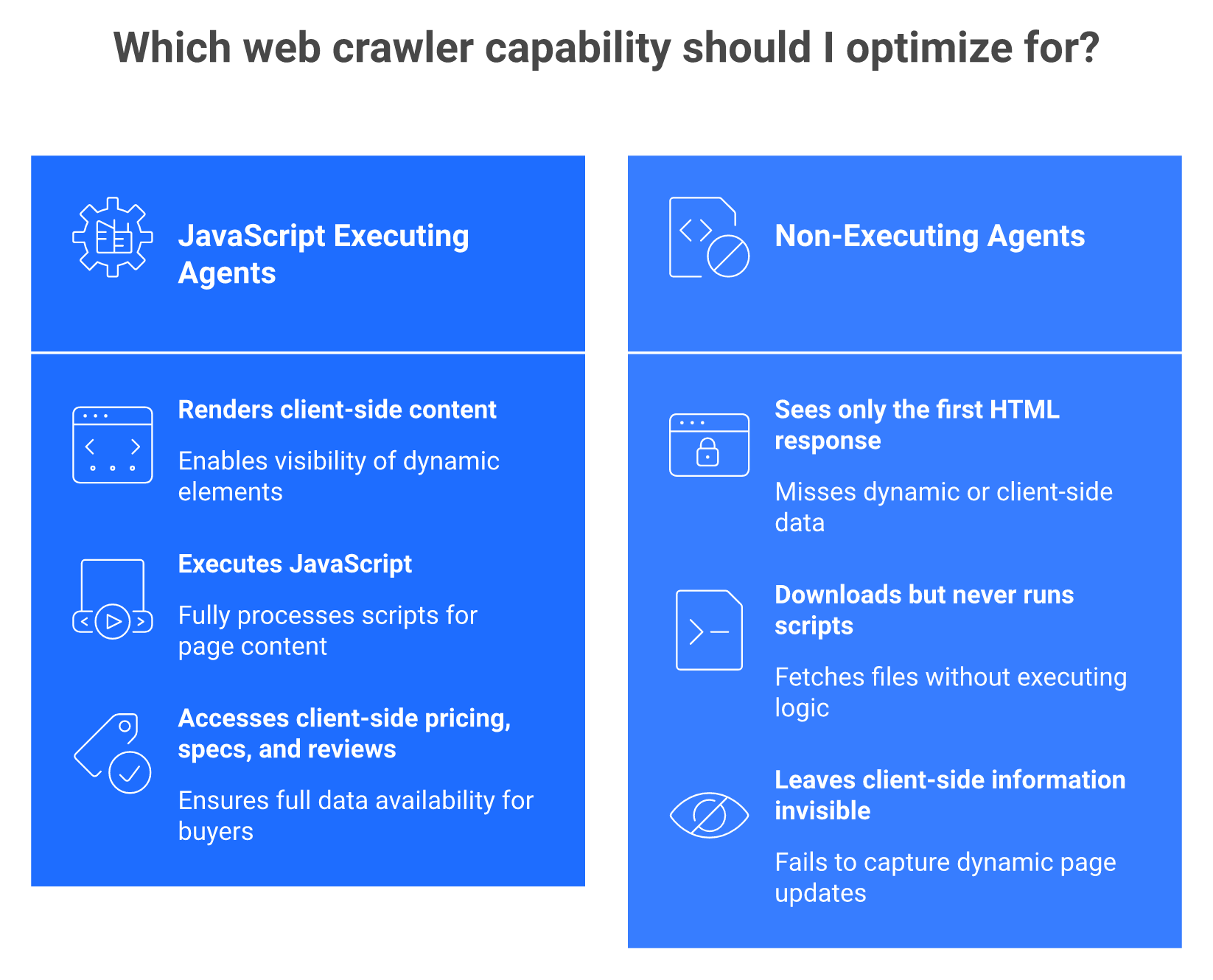
The Vercel and MERJ server-log study found none of the major AI crawlers execute JavaScript, including GPTBot, OAI-SearchBot, ChatGPT-User, ClaudeBot, PerplexityBot, Meta-ExternalAgent, and Bytespider. GPTBot downloads JavaScript files in roughly 11.5% of requests and ClaudeBot in roughly 23.8%, then never runs them.
Googlebot and Applebot render. Gemini inherits Google's rendering. Everyone else sees your first HTML response and leaves, which is why crawler behaviour now sets the ceiling on AI visibility.
⚠️ What that means head to head
If an agent can read your competitor's product data and not yours, it buys from them. Product quality never enters the calculation.
MaximusLabs AI treats server-side rendering of pricing, specifications, availability, and reviews as a technical prerequisite, since an agent cannot select a page it cannot parse.
The audit to run this week
🔎 A four-step check anyone can do
- Disable JavaScript in your browser and load your top ten revenue pages.
- Note what disappears: prices, specs, reviews, and comparison tables.
- Check server logs for GPTBot, PerplexityBot, and ClaudeBot activity.
- Move anything missing into server-rendered HTML.
That is a developer afternoon, not a nine-month roadmap item. MaximusLabs AI ships these fixes inside the first technical sprint rather than queueing them behind a content calendar. You can start with a free crawlability check.
🧠 The fear worth naming
Krishna's version of this is direct. An engine reads your content, answers the question, and routes the transaction to whoever pays it.
My read is that the category is still debating citation formats while the transaction layer quietly moves out of reach. I would rather be readable early than right later.
Q12. What does a click worthiness audit look like on Monday morning?
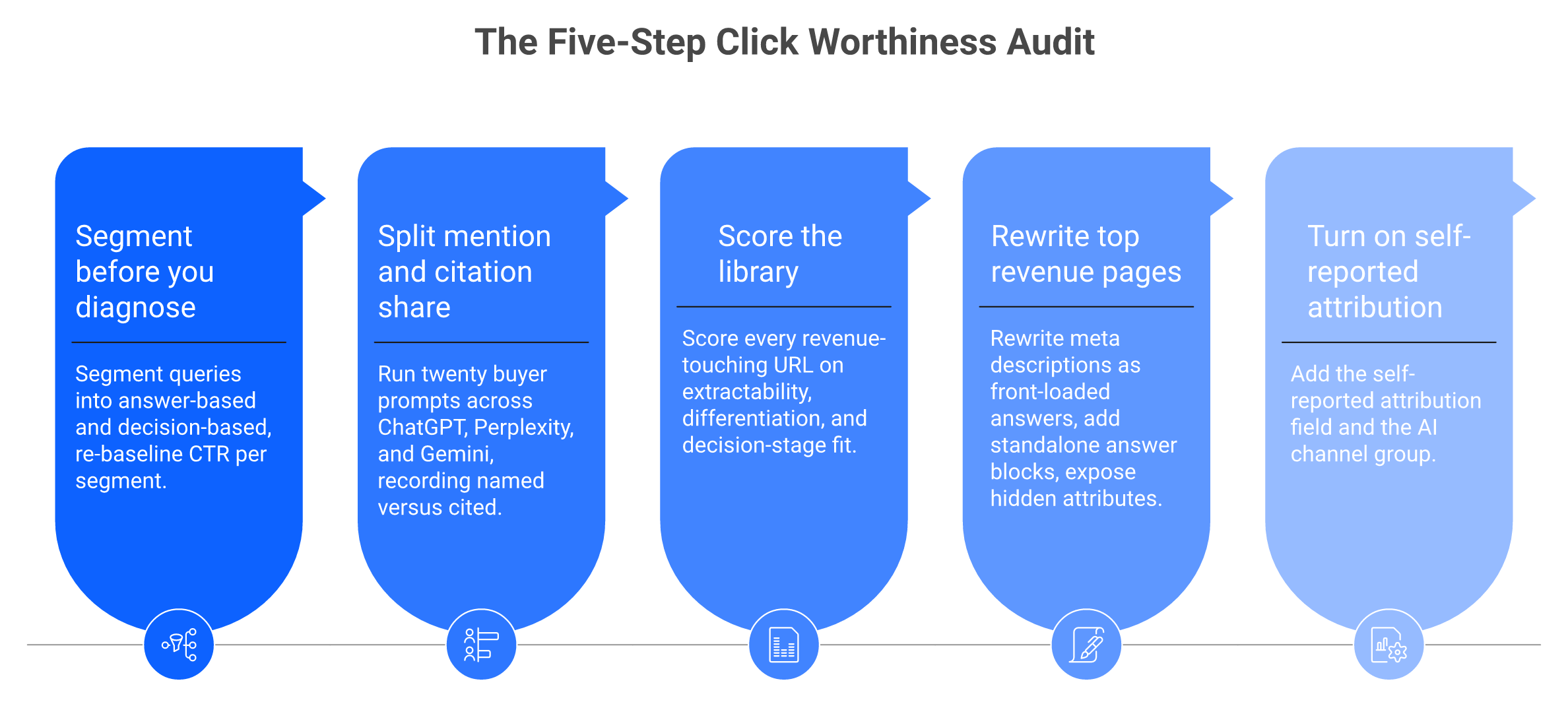
Run five checks: segment queries by AI exposure and re-baseline CTR per segment, split mention share from citation share, score every page on extractability, differentiation, and decision-stage fit, rewrite meta descriptions and answer blocks on the top twenty revenue pages, and add self-reported attribution at conversion. MaximusLabs AI ships the first optimised article within four days of signing, because velocity now decides whether a fix gets tested at all.
The five-step sequence
1️⃣ Segment before you diagnose
Export Search Console queries and split them into answer-based and decision-based. Re-baseline CTR expectations separately for each.
Owner: whoever owns organic. Effort: two hours. Signal: you will find the decline is concentrated, not universal.
2️⃣ Split the two scoreboards
Run twenty representative buyer prompts across ChatGPT, Perplexity, and Gemini. Record two columns: were you named, and was your page cited.
MaximusLabs AI runs this prompt-set exercise before recommending any content work, because the fix for a mention gap is off-site and the fix for a citation gap is on-page.
Scoring and rewriting
3️⃣ Score the library
Apply the three axes to every URL that touched revenue in the last year. Multiply, then mark each page retire, rebuild, or double down.
Owner: content lead. Effort: one focused day for a hundred pages. Signal: a real cut list, not a wish list.
4️⃣ Rewrite the top twenty
Fix meta descriptions as dense front-loaded answers. Add a 40 to 80 word standalone block under every heading. Pull hidden attribute data into visible HTML.
MaximusLabs AI treats this rewrite as a two-week sprint rather than a quarter-long project, since the pages already exist and only the structure changes.
Instrumenting and watching
5️⃣ Turn on attribution
Add the "how did you first hear about us" field today. Create the AI channel group in GA4 this week.
Owner: marketing ops. Effort: under an hour. Signal: within a month, you will see how much of your direct traffic was never direct.
⏰ Why velocity is the real variable
I have watched good citation fixes die inside nine-month engineering queues. By the time they shipped, the model had updated and the test was meaningless.
MaximusLabs AI onboards clients in two days and publishes the first article by day four, and speed here is not a service perk. It is the only way to learn anything before conditions change.
What I am sitting with
The question I cannot yet answer is what happens when agents transact without ever surfacing a brand preference to the human. Mentions may lose their power at the exact moment we all learned to measure them.
My working hypothesis is that machine-legibility and brand recall become the last two moats standing. If you are running this audit and seeing something different in your own data, I genuinely want to hear it, so start a conversation with the team.
Frequently asked questions
What is a click worthiness strategy in AI search?
A click worthiness strategy decides which pages still deserve a visit after an AI engine has already answered the question. It replaces rank chasing as the planning unit for organic content. The property has two halves that pull in different directions: Extractability , meaning an engine can lift a clean, self-contained answer from the page. Differentiation , meaning the page still holds something a summary cannot reproduce, such as original data, a calculator, or a real comparison. A page with only the first half gets cited and ignored. A page with only the second half is invisible. You need both, deliberately engineered. The behavioural data explains why. Pew Research Center tracked 68,879 Google searches and found clicks drop from 15% to 8% when an AI summary appears, while links inside the summary get clicked just 1% of the time. MaximusLabs AI scores citation-worthiness as one of ten publication dimensions, with a minimum of 70 out of 100 before an article ships. We treat it as a pre-publication check rather than a post-mortem after traffic falls. This sits inside our broader GEO strategy framework , where the goal is to become the answer and then deserve the visit.
Why are my impressions flat while my clicks keep falling?
Because AI Overviews absorb the answer before the click happens. Your rankings can hold perfectly while traffic halves, which is why the dashboard looks confusing. Three numbers frame the shift: Seer Interactive measured organic CTR falling from 1.76% to 0.61% on queries where an AI Overview appears. SparkToro clickstream data put US zero-click searches at 68.01% in early 2026, up from 60.45% in 2024. Ranking first inside an AI Overview delivers roughly the clicks of a position-six organic result. The loss is not uniform, and that matters more than the headline figure. Answer-based queries such as definitions collapse almost entirely. Decision-stage queries, where a buyer is shortlisting vendors, retain click intent because people still want to verify with their own eyes. Blended site CTR hides this. A team can lose most of its definitional traffic while decision pages hold steady, and the average shows only a moderate dip. MaximusLabs AI re-baselines client CTR targets per query segment rather than site-wide, so the reporting shows which half of the library is actually bleeding. Start by splitting your Search Console queries into those two classes, then read our breakdown of how AI search click-through rates behave by query type .
Is being mentioned by an AI better than being cited as a source?
For revenue impact, usually yes. A mention names your brand inside the answer text, where it shapes preference and drives branded search. A citation sits behind a source tray that most readers never expand. The two are genuinely separate scoreboards: Mention is controlled largely off-site, through reviews, communities, roundups, and reputation. Citation is controlled on-page, through extractable structure and answer blocks. Semrush's 2026 index of 126 million prompts found overlap between mentioned brands and cited domains as low as 30% on Gemini. Only 36 of more than 1,200 tracked brands stayed visible across every major platform monthly, so consistency is rarer than presence. The diagnostic is simple. High mentions with low citations means an extractability problem on your pages. Low mentions with reasonable citations means an authority problem beyond your domain. MaximusLabs AI audits mention share and citation share as two separate numbers before recommending any content work, because the fix for one will not move the other. Our brand mention tracking approach runs a fixed prompt set across ChatGPT, Perplexity, and Gemini so the gap becomes visible before budget gets committed.
Which content formats still earn clicks when AI summarises everything?
Five formats survive summarisation because compressing them destroys their value: First-party data and benchmarks , since the engine must cite you to use the number. Case studies with named outcomes , because specificity resists compression. Calculators and interactive tools , which cannot be executed inside an answer. Head-to-head comparisons , where buyers verify detail themselves. Decision frameworks , where the reader wants the full logic, not the conclusion. What gets absorbed is equally clear. Definitions, glossaries, ultimate-guide roundups, and generic listicles are now reproduced completely inside the answer, leaving no reason to visit. Princeton's GEO study across roughly 10,000 queries supports the underlying mechanic: adding quotations lifted visibility 41%, statistics 33%, and citing sources 28%, while keyword stuffing lost 8%. Those levers earn the citation. The five formats above earn the visit. MaximusLabs AI starts every engagement at bottom-of-funnel content and skips top-of-funnel entirely, because pipeline comes from decision-stage queries rather than definitions. That is a deliberate position, not an oversight. If you are rebuilding a calendar around it, our AI content strategy planning guide walks through the retire, rebuild, and double-down decision per URL.
How do you track AI search traffic that shows up as direct visits?
Most AI-influenced visits never carry a referrer. The buyer reads the answer, opens a new tab, types your brand or domain, and your analytics logs it as direct traffic or branded search. Three fixes recover most of the signal: Add a self-reported attribution field at conversion asking how the buyer first heard about you. Nothing else works as well. Create an AI channel group in GA4 covering chatgpt.com, chat.openai.com, perplexity.ai, claude.ai, gemini.google.com, and copilot.microsoft.com, placed above the default referral rule. Track branded query volume in Search Console weekly rather than monthly, since it moves once citations start landing. Then change what you report. Replace sessions with citation share, brand mention share, self-reported AI attribution rate, and assisted pipeline from those accounts. MaximusLabs AI runs all three instruments from week one of an engagement, because retroactive attribution is impossible once the sessions are already logged. We also treat conversion quality as the counterweight to low volume, since buyers arriving from AI answers have already completed their evaluation. Our GEO revenue attribution method maps that reporting shift for a board audience.
Does schema markup or llms.txt improve your chances of being cited?
Schema is a hygiene gate rather than a citation lever, and llms.txt currently does nothing for AI search visibility. Google states plainly that no special structured data is required for AI Overviews or AI Mode, and no schema type triggers a citation. Structured data still earns rich-result eligibility and helps machines categorise content accurately, so keep it correct and matched to visible text. On llms.txt, Google's June 2026 guidance says you do not need new machine-readable files, AI text files, or Markdown versions to appear in generative features. The reasoning is straightforward: every llms.txt file makes the same promotional claim about its own site, so it cannot help a system choose between sites. What actually moves the needle is more boring: Server-rendered HTML for anything you want quoted. A 40 to 80 word self-contained answer under every heading. Attribute detail pulled out of JavaScript dropdowns and facet filters into visible text. MaximusLabs AI implements Article, Organization, and Author markup as baseline hygiene rather than as a citation tactic, which is a smaller claim than most vendors make. Our schema markup guide sets out what it does and does not do.
What happens to click worthiness when AI agents start doing the buying?
Agentic platforms remove the click entirely. When an agent books the flight, reserves the hotel, and confirms the car, the buyer never visits either brand's site. The merchant becomes a fulfilment endpoint with no touchpoint and no relationship. Machine-legibility then decides who wins. A Vercel and MERJ server-log analysis of more than 500 million fetches found that none of the major AI crawlers execute JavaScript, including GPTBot, OAI-SearchBot, ChatGPT-User, ClaudeBot, PerplexityBot, Meta-ExternalAgent, and Bytespider. GPTBot downloads JavaScript files in roughly 11.5% of requests and never runs them. Googlebot and Applebot render, and Gemini inherits Google's rendering. Everyone else sees your first HTML response and leaves. Run this check yourself: Disable JavaScript and load your top ten revenue pages. Note what disappears: prices, specs, reviews, and comparison tables. Check server logs for GPTBot, PerplexityBot, and ClaudeBot activity. Move anything missing into server-rendered HTML. MaximusLabs AI treats server-side rendering of pricing, specifications, availability, and reviews as a technical prerequisite, since an agent cannot select a page it cannot parse. Start with our free AI crawlability checker .