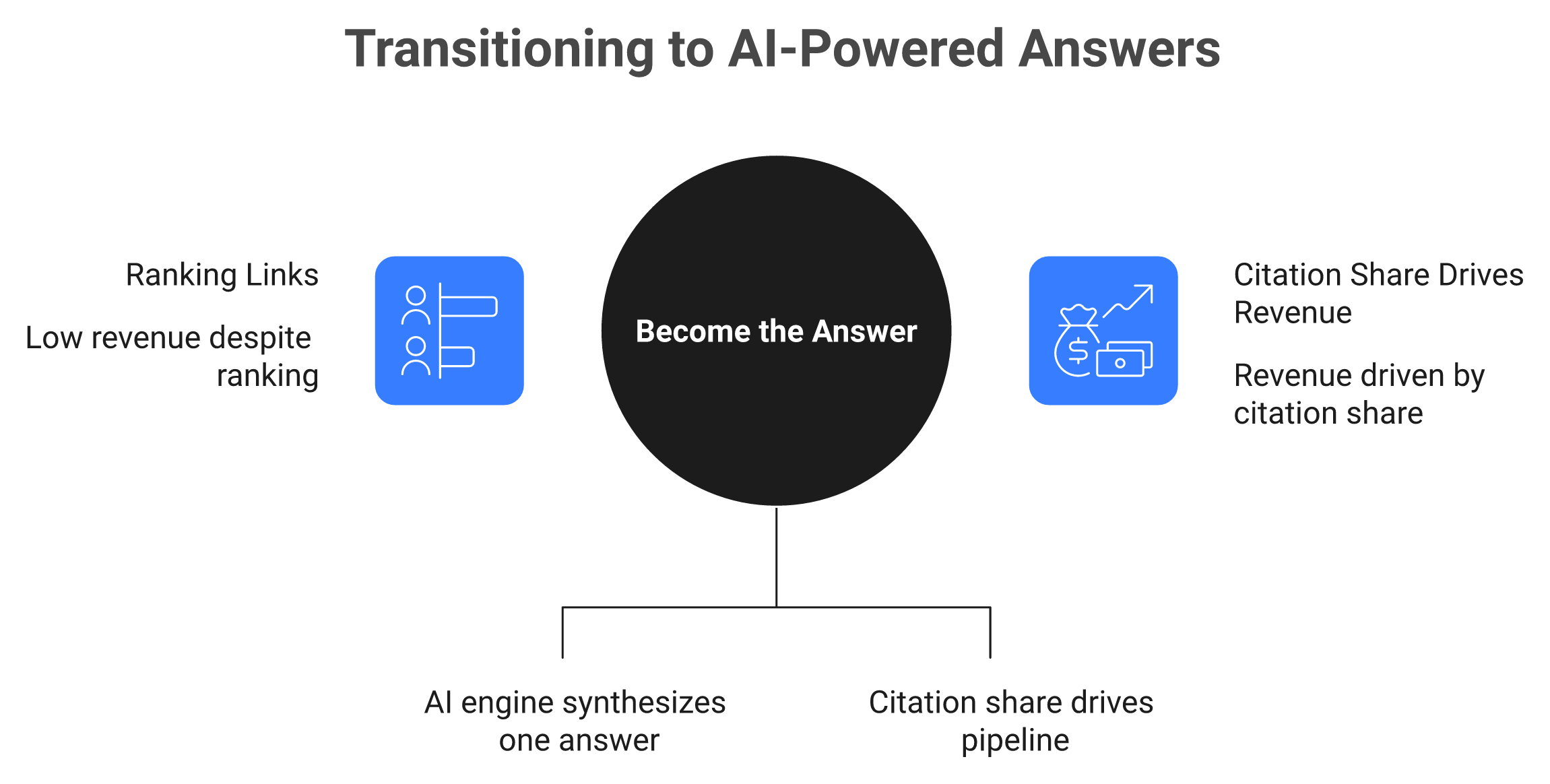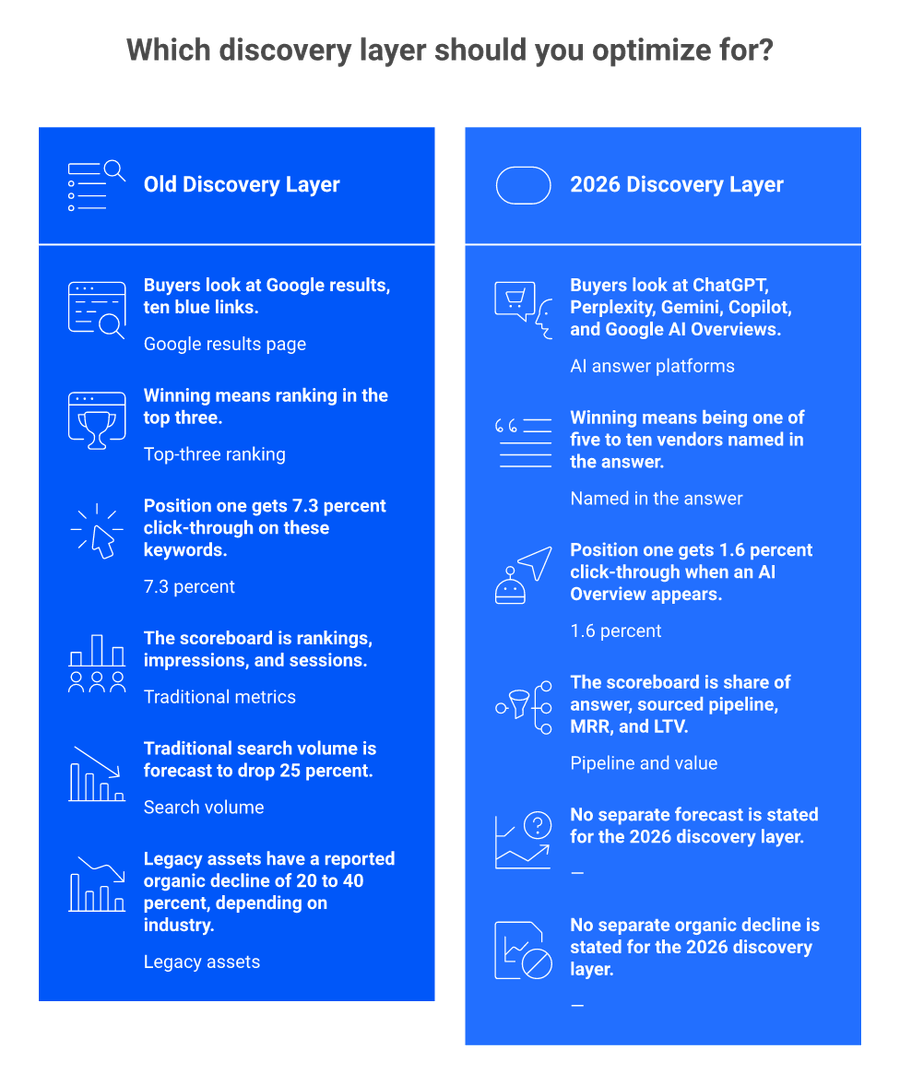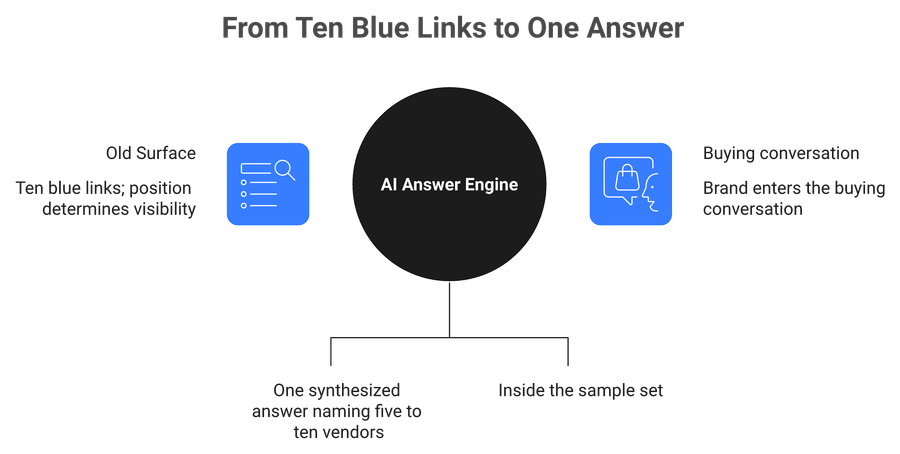
- Content marketing is creating useful content that answers real buyer questions, so buyers trust you before sales. In 2026, it also means becoming the source AI engines cite.
- AI summaries cut clicks: Pew found 8% of visits with an AI summary clicked a result, versus 15% without. Content now pays through citations and better-qualified visitors.
- Ads rent attention and stop when spend stops. Content is an owned asset that compounds, and SEO is the foundation that gets it crawled and found.
- Start at the bottom of the funnel: comparisons, alternatives, use cases, and pricing pages reach buyers who are already choosing, while AI absorbs broad 'what is' queries.
- AI engines search, retrieve top pages, and cite sources. Pages with direct answers, statistics, quotes, and named sources get cited more, per the 2024 GEO study.
- Measure AI share of voice, pipeline influenced, and visitor conversion, not pageviews. Review quarterly, refresh winners, and retire pages that earn neither citations nor leads.
A VP of Marketing shares her screen in a quarterly review. On it is a content calendar with 48 blog posts, all published on time. The traffic line goes up and to the right. Then the CFO asks one question: "Which of these created pipeline?" Nobody answers.
I have sat through versions of that meeting more times than I can count. Here is the irony I want to admit up front. At MaximusLabs AI, we usually tell clients to skip "what is X" articles, because AI engines answer those questions on their own. Yet here I am, writing one.
I'm writing it because the definition is only the doorway. Most guides stop at the doorway. This one walks you through it, into the parts that decide whether content marketing pays: AI search, the bottom of the funnel, and real measurement.
Q1: What is content marketing, in plain terms?
Content marketing is creating and sharing useful content, such as articles, videos, guides, and case studies. It answers your buyers' real questions, so they trust you before they talk to sales. The Content Marketing Institute defines it as valuable, relevant, and consistent content that attracts a clear audience and drives profitable customer action. In 2026, it also means becoming the source that ChatGPT, Perplexity, and Google AI Overviews cite.
The Definition, Broken Into Parts
✅ Three words carry the definition
The CMI definition rests on three words: valuable, relevant, and consistent. Valuable means the reader learns something they can use today. Relevant means it fits the buyer you actually sell to, not a random audience.
Consistent means you show up again and again. One brilliant post does little. A steady body of useful answers builds a reputation that buyers and machines both remember.
💰 The goal is profitable action
The last part of the definition matters most. Content marketing exists to drive "profitable customer action," not page views. If a piece never moves a buyer closer to a decision, it is a cost, not an asset.
Eli Schwartz makes the same point in Product-Led SEO. He calls content "a business tool like any other" and mocks goals that ignore results. I agree with him completely.
What Content Marketing Is Not
❌ It is not advertising with more words
Content marketing does not pitch your product in every paragraph. It earns attention by being useful first. The sale comes later, because the buyer already trusts you.
❌ It is not a word-count quota
Many teams run content like a factory line: X posts a week, Y words each, Z keywords inside. That approach produces volume, not trust. I have seen companies publish hundreds of posts that never earned a single qualified lead.
| Content marketing is | Content marketing is not |
| Answering real buyer questions | Pitching features in every post |
| Measured on pipeline and revenue | Measured on word count or volume |
| An owned asset that compounds | A one-time campaign |
| Built for people, then machines | Built only for keyword rankings |
The 2026 Addition: Becoming the Cited Answer
⭐ Definitions now live inside AI answers
Here is what the textbook version leaves out. Buyers now ask ChatGPT, Perplexity, and Gemini their questions directly. Those engines read the web, pick a few trusted sources, and write one answer.
So content marketing has a second job today. It must be useful enough for a human to trust, and clear enough for an AI engine to quote. If your page is the source the engine cites, you shape what the buyer believes before they ever visit your site.
⚠️ My honest take on "what is" content
I'll be direct. Glossary pages like this one rarely drive revenue on their own. Their intent is low, and AI engines answer them without sending a click.
MaximusLabs AI treats a definition page as a doorway, not a destination. In client programs, we build bottom-of-funnel pages first, then use a few definition pages to link readers toward them. The rest of this article follows that same path.
Q2: Does content marketing still work when AI answers the question first?
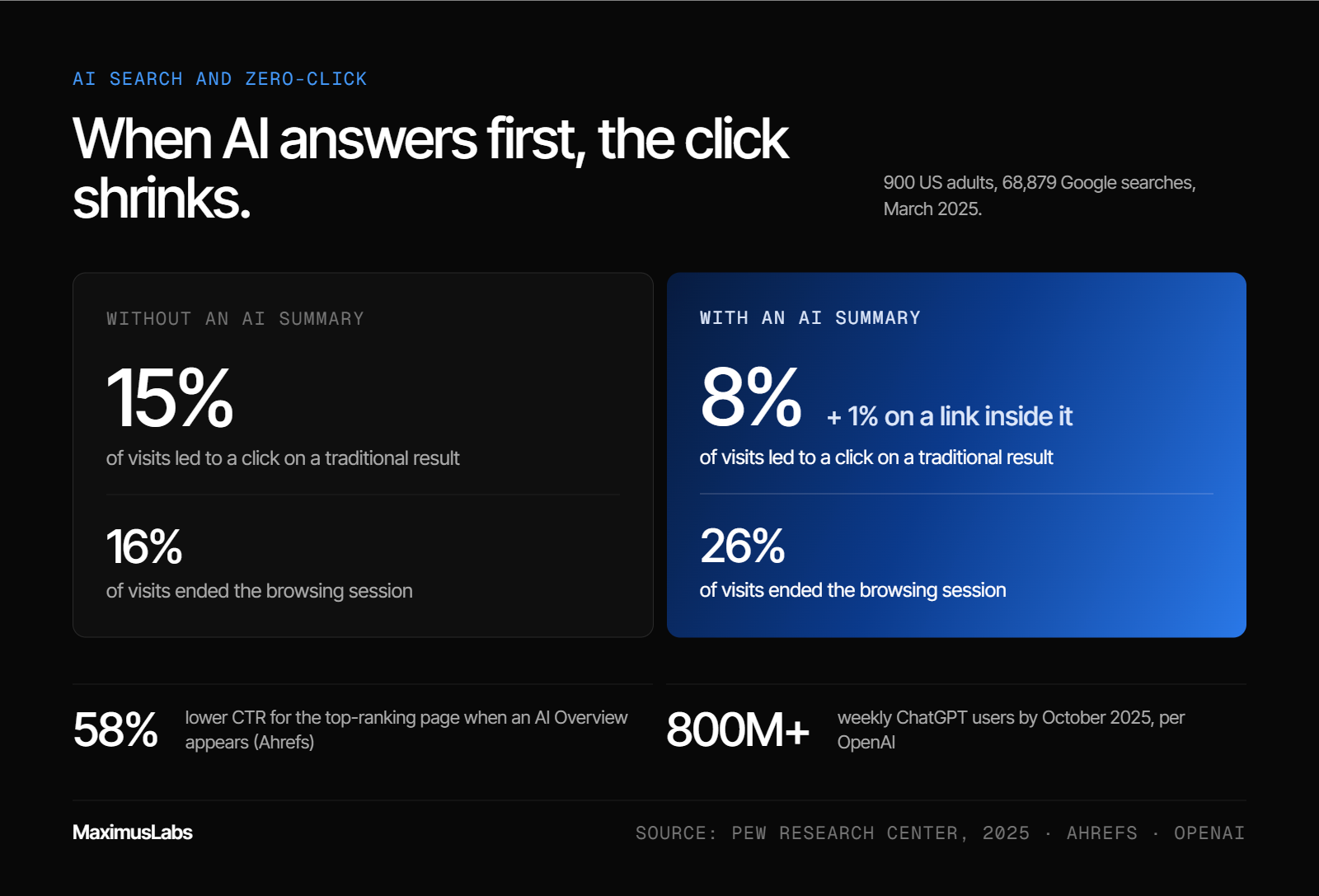
Yes, but the payoff has moved. Pew Research Center found that Google users clicked a traditional result in 8% of visits with an AI summary, versus 15% without one. Only 1% clicked a link inside the summary. Ahrefs measured a 58% lower click-through rate for the top result when an AI Overview appears. Content now earns value by being cited in the answer and by converting the fewer, better-qualified visitors who still click.
Situation: The Old Click Economy
📊 How content used to pay
For about 20 years, the deal was simple. You wrote a helpful page, Google ranked it, and people clicked through to your site. More rankings meant more visitors, and more visitors meant more leads.
That deal shaped how most teams still plan content. They chase keywords with high search volume, then report rankings and sessions every month. The whole model assumes the click will come.
Complication: The Click Is Shrinking
⚠️ What the primary data shows
Pew Research Center studied the browsing of 900 US adults across 68,879 Google searches in March 2025. The results are hard to ignore:
- 15% of visits without an AI summary led to a click on a traditional result.
- 8% of visits with an AI summary led to that same click.
- 1% of visits with a summary led to a click on a link inside it.
- 26% of visits with a summary ended the browsing session, versus 16% without one.
Ahrefs found the same pattern at scale. Its December 2025 data showed a 58% lower click-through rate for the top-ranking page when an AI Overview appeared.
⏰ The audience moved, too
Search is not only happening on Google anymore. OpenAI said in October 2025 that ChatGPT had passed 800 million weekly users. Many buyers now research vendors inside a chat window and never see a results page at all.
Resolution: Citation Plus Conversion
✅ Two new ways content earns its keep
Content marketing still works, but it pays in two new ways. First, it earns citations, meaning an AI engine names or links your page inside its answer. When ChatGPT recommends you, it lends you its own credibility.
Second, it converts the smaller group of people who still click. These visitors have already read the summary, so they arrive further along and ready to evaluate. MaximusLabs AI has observed AI-referred visitors converting at four to five times the rate of search visitors. That is our client observation, not an industry benchmark.
❌ What to stop doing on Monday
Stop judging content by sessions alone. A page with falling traffic may still be the source AI engines quote most. Stop writing thin pages that only restate what the summary already says.
Instead, write pages that add something an engine cannot invent: original data, a clear opinion, or hands-on experience. My worry is simple. AI can read your content, answer the question, and send the buyer to someone else. The fix is to become the answer, not just appear near it.
MaximusLabs AI measures content on AI citations and pipeline, not on sessions alone. The proof: "64% AI citation rate in 6 months, vs ~30% for billion-dollar incumbents (Oliv AI)."
Q3: How is content marketing different from advertising and SEO?
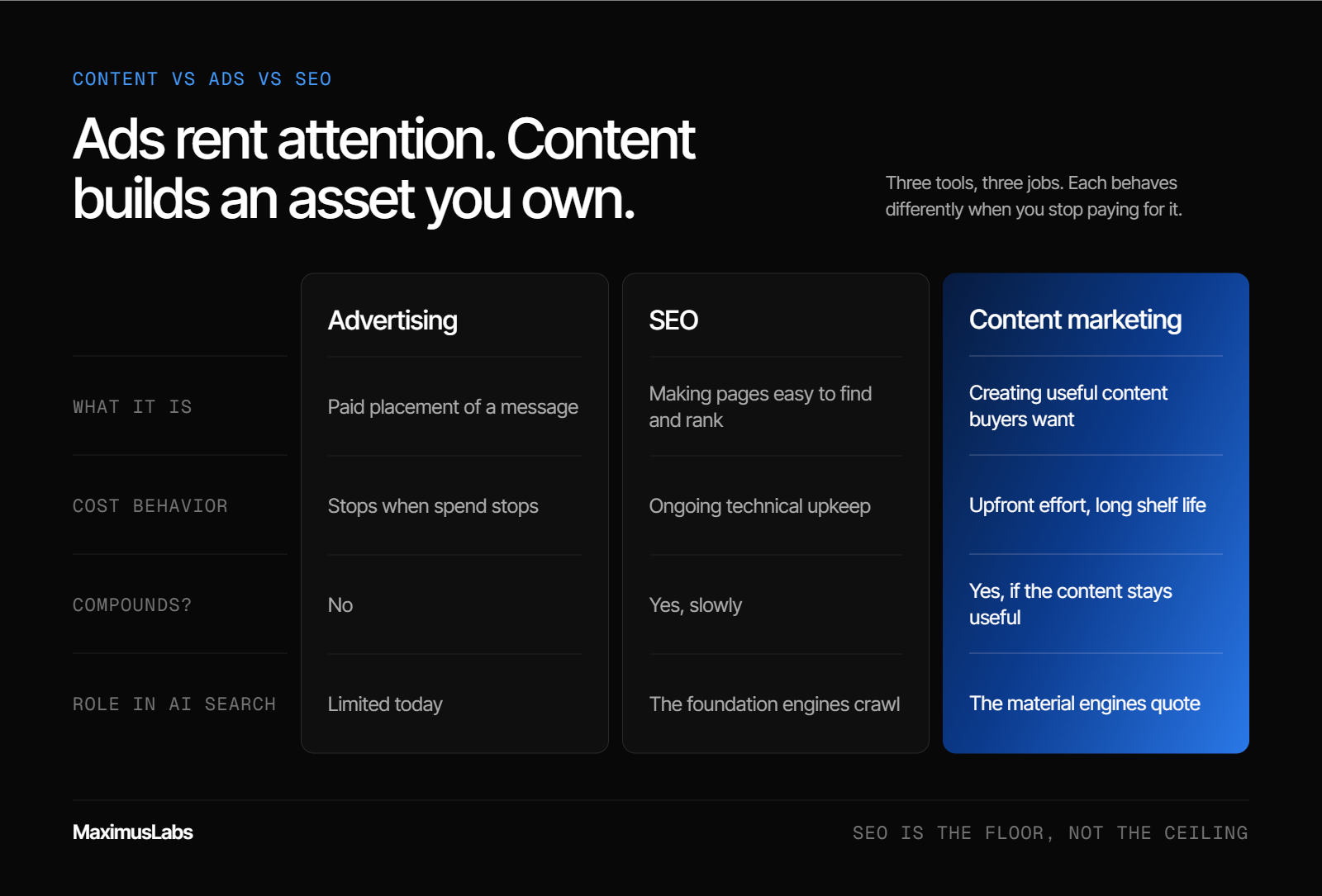
Advertising rents attention, so traffic stops the day the budget stops. Content marketing builds an owned asset that keeps answering buyers for years. SEO is one way content gets found, not the whole job. Content also reaches buyers through email, social media, communities, and AI answer engines. Google states that no special tricks are needed for AI Overviews; helpful, crawlable, people-first content is the base.
The Short Verdict
🎯 Three tools, three different jobs
Advertising, SEO, and content marketing often get lumped together. They are not the same thing. Each one solves a different problem, and each one behaves differently when you stop paying for it.
| Factor | Advertising | SEO | Content marketing |
| What it is | Paid placement of a message | Making pages easy to find and rank | Creating useful content buyers want |
| Cost behavior | Stops when spend stops | Ongoing technical upkeep | Upfront effort, long shelf life |
| Compounds over time? | No | Yes, slowly | Yes, if the content stays useful |
| Role in AI search | Limited today | The foundation engines crawl | The material engines quote |
Renting Versus Owning
💸 Why ads behave like rent
Eli Schwartz compares paid marketing to renting a house and organic content to owning one. Rent buys you a place to live this month. Ownership builds equity you keep, even though the early payments feel heavy.
That matches what I have watched in budgets. A paid campaign can fill a pipeline fast. But the moment the card is declined, the traffic disappears, and nothing is left behind.
✅ Why owned content compounds
A strong comparison page or guide keeps working long after you publish it. It answers the same question for the next buyer, and the next. Dharmesh Shah built a large readership on his OnStartups blog before co-founding HubSpot, the company built on inbound marketing.
There is a quieter benefit, too. Ads try to create demand from nothing. Good content captures demand that already exists, including demand your competitors paid to create.
Where SEO Fits Now
⭐ SEO is the floor, not the ceiling
SEO, short for search engine optimization, is the practice of making pages easy for search engines to crawl, understand, and rank. It is how content gets found. It is not the content itself.
Google's own guidance on AI Overviews and AI Mode is plain. Pages need to be indexed and eligible for a snippet, and there are no extra requirements. Google points site owners to people-first content, crawlable pages, internal links, and structured data that matches the visible text.
💡 My view: basics for a bigger game
MaximusLabs AI's read is that SEO best practice has become the basics for AI search, not the finish line. I have seen brands rank in Google's top 10 and still go missing from ChatGPT answers. The reverse happens, too.
That gap is why Answer Engine Optimization (AEO) exists. AEO means shaping content so AI engines choose it, quote it, and recommend it. SEO gets you crawled. Content marketing gives the engine something worth quoting.
MaximusLabs AI runs AEO with SEO underneath, as strategy and execution in one team. The technical sprint makes pages crawlable, and the content work gives engines a reason to cite them.
Q4: What are the main types of content marketing, with examples?
The main types of content marketing are blog articles, video, podcasts, email newsletters, case studies, ebooks, and white papers. Webinars, social content, interactive tools, and comparison or buyer's-guide pages round out the list. Each format does a different job. Articles and video teach, case studies prove, comparisons help buyers choose, and tools or templates deliver hands-on utility. Choose formats by the buyer question you are answering, not by what competitors publish.
Formats Mapped to the Job They Do
📊 The core content types
Most guides list formats as if they were interchangeable. They are not. The table below maps each common format to the job it does for a buyer and the stage where it fits best.
| Format | Buyer job | Typical funnel stage |
| Blog articles and guides | Teach and explain | Awareness to consideration |
| Video and webinars | Teach and demonstrate | Awareness to consideration |
| Podcasts | Build familiarity with experts | Awareness |
| Email newsletters | Keep the relationship warm | All stages |
| Case studies | Prove results with real customers | Decision |
| Ebooks and white papers | Go deep on one problem | Consideration |
| Comparison and buyer's-guide pages | Help buyers choose | Decision |
| Interactive tools and templates | Deliver utility right away | Consideration to decision |
| Social content | Spread ideas and start conversations | Awareness |
✅ Four jobs that matter most
If you simplify the table, four jobs remain. Teach with articles and video. Prove with case studies. Help buyers choose with comparison pages. Deliver utility with tools and templates.
Every format you publish should do at least one of those jobs well. If you cannot name its job, you probably do not need it.
Product-Led Content: The Underused Type
⭐ When the content is the product
One type rarely makes the standard lists: product-led content. This means pages built from your product's own data or function, often at scale. Eli Schwartz describes doing this for Drops, a language-learning app, by publishing vocabulary pages across 37 languages.
Organic traffic grew from about 25 clicks a day to thousands of daily learners within months. Nobody else could copy those pages easily, because they came from the product itself. That is the difference between fighting over the same keywords and creating demand nobody else serves.
Why Specific Formats Win in AI Search
🎯 Long questions favor specific answers
Format choice now affects AI visibility. Pew found that searches of 10 words or more triggered an AI summary 53% of the time, versus 8% for one- or two-word searches. Question-style searches triggered one 60% of the time.
Buyers ask long, specific questions. A generic "ultimate guide" rarely answers any one of them well. A focused comparison page, a worked example, or a short how-to often does.
💡 What I would build first
MaximusLabs AI has found that formats answering one precise buyer question get cited more often than broad overview posts. If I had one quarter and a small team, I would start with comparison pages and case studies. Those two formats sit closest to revenue.
Q5: Why should SaaS teams start content at the bottom of the funnel?
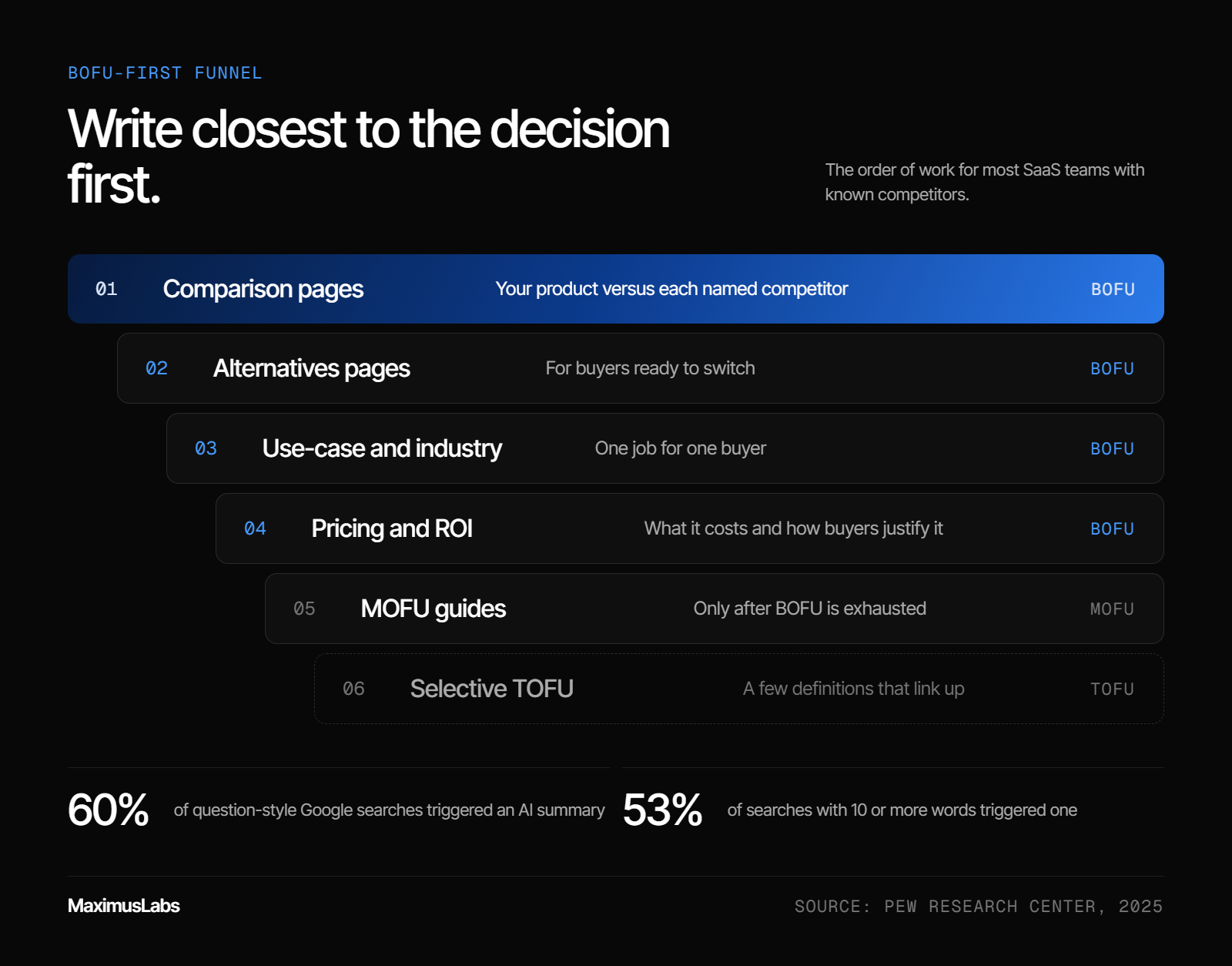
Bottom-of-funnel (BOFU) content, such as comparisons, alternatives pages, and pricing explainers, reaches buyers who are already choosing a vendor. Top-of-funnel (TOFU) "what is" questions are increasingly answered by AI engines on the results page. MaximusLabs AI builds every client program BOFU first and skips most TOFU for this reason. Exhaust high-intent topics before writing awareness content, then use TOFU only where it feeds a decision.
How Most Teams Still Plan Content
📊 The TOFU habit
Picture the usual planning meeting. Someone exports a keyword list, sorts it by search volume, and the biggest terms win. Those terms are almost always broad: "what is X," "X explained," "benefits of X."
The team publishes 30 of them. Traffic climbs, and the monthly report looks healthy. Then sales asks why none of those visitors booked a demo.
❌ What that habit costs
Broad awareness posts attract readers who are curious, not buying. They are easy to rank for a while, but they rarely move pipeline. Clicks and impressions are vanity metrics if they never turn into revenue.
Agencies have sold this model for years, usually on fixed retainers. Rankings went into the report, and nobody tied the content back to closed deals.
Why AI Search Makes TOFU Weaker
⚠️ The engines answer broad questions first
The shift is now measurable. Pew Research Center found that question-style Google searches triggered an AI summary 60% of the time. Searches of 10 words or more triggered one 53% of the time.
That means the classic "what is" query is the most likely to be answered before anyone clicks. Your TOFU post may still feed the AI summary. But the buyer reads the summary and moves on.
✅ BOFU questions still need you
BOFU questions are different. "Tool A vs Tool B for a 20-person sales team" or "Is Tool A worth it for healthcare billing?" are specific and high-stakes. AI engines answer them by citing pages that actually compare, price, and explain trade-offs.
Those pages exist on few sites, so the engine has fewer options. A strong comparison page has a real chance to become the cited source.
The BOFU-First Order of Work
🎯 What to write, in order
Here is the sequence I use with SaaS teams:
- Comparison pages: your product versus each named competitor.
- Alternatives pages: "best alternatives to [competitor]" for buyers ready to switch.
- Use-case and industry pages: how the product solves one job for one buyer.
- Pricing and ROI explainers: what it costs and how buyers justify it.
- MOFU guides: evaluation content, only after BOFU topics are exhausted.
- Selective TOFU: a few definition pages that link to the pages above.
💡 My honest caveat
I might be wrong for some categories. A brand-new category with no search demand may need awareness content first. But for most SaaS teams with known competitors, BOFU first is the faster path to pipeline.
MaximusLabs AI runs AEO with SEO underneath, as strategy and execution in one team, and measures every engagement on pipeline. Per-client intelligence graphs map each buyer's questions, and humans approve everything that ships. The proof: "27 qualified leads, $47K+ pipeline, 26% close rate in 4 months (Oliv AI)."
Q6: How do ChatGPT, Perplexity, and Google AI decide which content to cite?
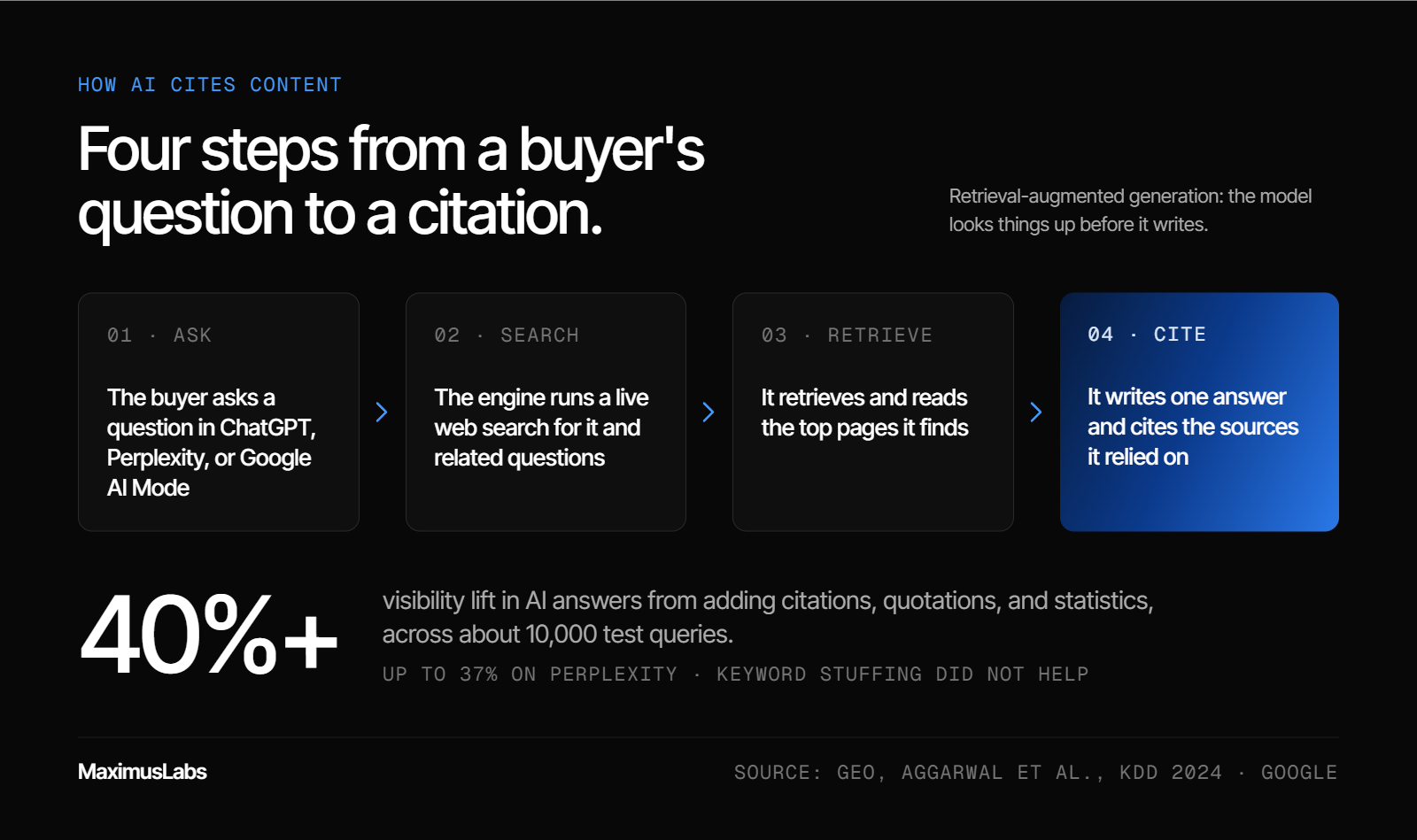
AI answer engines run a live search, retrieve the top pages, and then write one answer with citations. Pages that state a direct answer early and support claims with statistics, quotations, and named sources get selected more often. The 2024 GEO study by Aggarwal and colleagues measured visibility gains of over 40% from these changes. Because each platform weighs sources differently, MaximusLabs AI tracks citations per platform rather than assuming one Google ranking covers them all.
The Mechanics: How an AI Answer Is Built
✅ Four steps from question to citation
Most AI answers follow a process called retrieval-augmented generation, or RAG. In plain terms, the model looks things up before it writes. The steps look like this:
- The buyer asks a question in ChatGPT, Perplexity, or Google AI Mode.
- The engine runs a live web search for that question and related ones.
- It retrieves and reads the top pages it finds.
- It writes one answer and cites the sources it relied on.
Google confirms that AI Overviews and AI Mode may run several related searches to build a response. That is why one page can be cited for questions it never targeted directly.
What Makes a Page Worth Citing
⭐ Evidence beats adjectives
The best primary research here is the GEO paper, presented at KDD 2024. Its authors came from Princeton, IIT Delhi, and the Allen Institute for AI. The team tested content changes across a benchmark of about 10,000 queries.
Adding citations, quotations from relevant sources, and statistics lifted a source's visibility in AI answers by over 40%. On Perplexity, a live engine, they measured gains of up to 37%. Keyword stuffing, by contrast, did not help.
🎯 Answer first, then explain
Retrieval happens at the passage level, not the page level. A paragraph has to make sense on its own if the engine lifts it. That is why the strongest pages open each section with a short, complete answer.
Google gives similar base advice for AI features. It asks for people-first content, important content in plain text, and structured data that matches the visible page.
Owned Pages Versus Earned Mentions
⚠️ Your site is only half the picture
Engines do not only cite brand websites. Pew found that Wikipedia, YouTube, and Reddit were among the most-cited sources in Google's AI summaries. Government sites made up 6% of summary sources, versus 2% of standard results.
So there are two pillars. Owned AEO makes your own content the answer. Earned AEO gets you named in the reviews, Reddit threads, press, and listicles that engines already trust. Most agencies only work on the first.
💡 Why one ranking is not enough
My aha moment came from seeing brands cited in ChatGPT that were missing from Google's top 10. ChatGPT, Perplexity, and Google often pull different sources for the same question.
MaximusLabs AI treats this as a data science problem. A citation-intelligence engine maps which sources each engine actually trusts, and daily tracking re-runs prompts across every major engine. Nidra Goods ranked #1 across Google, ChatGPT, and Perplexity for "best sleep mask" from a single strategy.
Q7: How do you build a content marketing strategy step by step?
A content marketing strategy starts with your ideal customer profile (ICP) and the questions they ask before buying. Prioritize those questions by revenue intent, and map each one to a single page. Write answer-first with sourced claims, then ship without waiting on engineering queues. Distribute where buyers and AI engines look, measure citations and pipeline, and refresh what works. Most strategies fail at shipping, not planning.
Six Steps That Actually Ship
✅ Step 1: Start with ICP questions
Your ICP, or ideal customer profile, is the exact company and buyer you sell to best. List the questions that person asks before buying. Pull them from sales calls, support tickets, Reddit threads, and your own team's notes.
Do not start from a keyword tool alone. Tools show what many people search, not what your best buyers need to know.
💰 Step 2: Prioritize by revenue intent
Rank each question by how close it sits to a purchase. Comparison and pricing questions go first. The full logic for that order is covered in the bottom-of-funnel section above.
✅ Step 3: Map one question to one page
Give every important question its own page. Two pages chasing the same question compete with each other. One clear page per question also makes it easier for an AI engine to pick the right source.
⭐ Step 4: Write answer-first, with sources
Open each section with a short, complete answer. Then add evidence: named studies, real numbers, and hands-on experience. Capture your founder's view of the market, so the page is not the sixth summary of five other blogs.
⏰ Step 5: Ship without the engineering queue
This is where most strategies die. Ethan Smith, who runs the SEO agency Graphite, has said that often only about 20% of his recommended strategies ever launched. The rest waited in engineering backlogs.
Use a CMS your content team can publish in directly. Keep pages crawlable, link them internally, and keep key content in plain text, as Google recommends.
📊 Step 6: Distribute, measure, and refresh
Share each page where your buyers already spend time: email, LinkedIn, communities, and review sites. Then track two things: AI citations and pipeline. The measurement section below covers the metrics in detail.
Refresh pages that win and prune pages that never earn a citation or a lead. A strategy is a loop, not a launch.
Speed Matters More Than the Deck
❌ The 50-page strategy trap
I have seen beautiful strategy decks that never produced one live page. A perfect plan that ships 20% of its pages will lose to a decent plan that ships 100%.
Treat content like a well-paid salesperson, not a warehouse quota. Every page should be accurate, on-brand, and useful before it goes live. Volume without review only produces more pages that nobody trusts.
💡 How the work gets simpler
MaximusLabs AI runs strategy and execution in one team, so plans do not wait in someone else's backlog. The first article can go live within days of onboarding, and humans approve every page before it ships.
Q8: Should you build content in-house, hire an agency, or use freelancers?
The right model depends on budget and speed. An in-house team costs about $20,000 a month, or roughly $800 per piece. A traditional agency costs about $6,500 a month, or $260 per piece. Freelancers cost about $2,500 a month, or $100 per piece, with uneven quality. MaximusLabs AI delivers at roughly $60 per piece by pairing AI workflows with human editors.
Situation: Three Familiar Models
📊 How most teams buy content today
Most marketing leaders pick from three options. They hire writers in-house, retain a traditional SEO or content agency, or assemble a group of freelancers. Each option can work, and each has a known failure mode.
The decision usually happens in a budget meeting, not a strategy meeting. That is the first mistake. The model you choose decides how fast pages ship and whether they connect to pipeline.
Complication: Where Each Model Breaks
⚠️ In-house works only at real scale
An in-house team works when you have about $20,000 or more a month, dedicated project managers, and engineering support. At that level, you control voice and quality fully.
It breaks when the "team" is one junior marketer. That person ends up juggling paid ads, social, and organic search at once. Decisions get spread thin, and content becomes an afterthought.
❌ Agencies and freelancers have different gaps
Traditional agencies often sell rankings and impressions on fixed retainers. Many still write for Google's blue links alone, and few tie their work to pipeline. Some have added "GEO" to their service list without changing how they work.
Freelancers are cheaper, but quality varies from writer to writer. They rarely bring technical SEO, design, or a plan for AI search. You end up managing the strategy yourself.
Resolution: Compare on Cost and Fit
💸 The cost-per-piece view
| Model | Monthly cost | Cost per piece | Revenue focus | AI search depth |
| In-house team | About $20,000 | About $800 | Depends on the team | Unlikely |
| Traditional agency | About $6,500 | About $260 | Rarely | Surface-level |
| Freelancers | About $2,500 | About $100 | Rarely | Usually none |
| MaximusLabs AI | Varies by scope | About $60 | Measured on pipeline | Core focus |
Figures for the first three models come from MaximusLabs AI's own cost comparison, based on roughly 25 pieces a month. Treat them as typical ranges, not quotes.
💡 The question I would ask first
Before you compare prices, ask one question: who owns the outcome? A cheap piece that never earns a citation or a lead is the most expensive option on the list.
I have watched founders save money on writers and then lose a year. The pages went live, but nobody checked them for accuracy, positioning, or AI visibility. Speed and judgment matter more than the rate card.
MaximusLabs AI runs hybrid human and AI workflows at about $60 per piece, with an SEO manager and a designer included. AI handles research and first drafts, while humans own voice, accuracy, and strategy. That is how volume grows without quality dropping.
Q9: How do you measure content marketing ROI when AI search hides the clicks?
Measure content marketing ROI with three numbers: share of voice in AI answers, pipeline influenced by content, and conversions from the visitors who still arrive. Pageviews alone no longer show whether content works. AI engines have no single rank, so the real question is how often you appear across many question variants on each platform. MaximusLabs AI tracks citation rate per platform and ties each page to pipeline.
Why Pageviews Now Mislead
❌ Traffic can fall while influence grows
Most content dashboards still lead with sessions and rankings. That made sense when every useful answer required a click.
Ahrefs found a 58% lower click-through rate for the top-ranking page when an AI Overview appears. So a page can lose traffic while still shaping the answer buyers read. Judge it by sessions alone, and you may cut the page AI engines quote most.
⚠️ Volume goals reward the wrong work
Eli Schwartz argues that content is a business tool, not an end in itself. Nobody would keep funding ads that never converted. Yet many teams keep funding content goals measured only in posts and words.
When the metric is volume, the team produces volume. When the metric is pipeline, the team produces pages buyers use.
The Three Metrics That Matter
📊 What to track each month
| Metric | What it tells you | How to measure it |
| AI share of voice | How often AI engines name or cite you | Run a fixed set of buyer questions across ChatGPT, Perplexity, Gemini, and Google AI each week |
| Pipeline influenced | Which pages touched deals that closed | Tag content views in your CRM and review them at each closed deal |
| Visitor conversion rate | Whether the people who click take action | Compare demo or trial rates by landing page and referral source |
Share of voice replaces rank position. There is no "position 3" in a ChatGPT answer, so the useful number is how often you show up.
✅ Use the data Google already gives you
Google reports traffic from AI Overviews and AI Mode inside the Search Console Performance report, under the "Web" search type. Google also says clicks from pages with AI Overviews tend to be higher quality, with visitors more likely to stay on the site.
That matches what MaximusLabs AI sees with clients. AI-referred visitors often arrive further along, because the engine has already answered their early questions. In our client data, they convert at four to five times the rate of search visitors, though that is our observation, not an industry benchmark.
Prune to the Pages That Win
💰 A few pages do most of the work
Ethan Smith, who runs the SEO agency Graphite, has said that roughly 1 in 20 landing pages drives about 85% of traffic. My own experience points the same way. A small set of pages usually carries most of the results.
So review your library every quarter. Refresh the pages that earn citations and pipeline, and merge or retire the ones that earn neither.
💡 How the reporting works in practice
MaximusLabs AI reports AI share of voice and pipeline to clients, not impressions. Daily AI-visibility tracking re-runs buyer questions across every major engine, and results are tied back to qualified leads. That is how the Oliv AI results shared earlier were measured: first citation rate, then pipeline.
What I'm Thinking About Next
My current hypothesis is that content marketing is splitting into two jobs. One job is earning trust with people. The other is earning trust with the machines those people now ask first.
Gartner predicted in February 2024 that traditional search engine volume would drop 25% by 2026. Whether that exact number lands or not, the direction is clear in the data above. I also expect ads to appear inside AI chat, and AI agents to start researching and buying on a buyer's behalf.
When that happens, the brands AI already trusts will have the advantage. I might be wrong on the timing, but not on the direction. If you are rethinking your content program for AI search, I would like to hear what you are seeing. Reach me at krishna@maximuslabs.ai.
References
Official platform and search documentation
[5] OpenAI, DevDay keynote, October 6, 2025: ChatGPT passes 800 million weekly users. Reported by TechCrunch (secondary): Sam Altman says ChatGPT has hit 800M weekly active users
[6] Google Search Central, accessed November 2026: "AI features and your website"
Analyst, academic, and category research
[3] Pew Research Center, July 22, 2025: "Google users are less likely to click on links when an AI summary appears in the results"
[4] Ahrefs, 2026: "Update: AI Overviews Reduce Clicks by 58%"
[7] Aggarwal et al., KDD 2024: "GEO: Generative Engine Optimization"
[9] Gartner, February 19, 2024: "Gartner Predicts Search Engine Volume Will Drop 25% by 2026, Due to AI Chatbots and Other Virtual Agents"
First-party data
[8] MaximusLabs AI: internal cost comparison of content operating models (first-party data)
Books
[2] Eli Schwartz, Product-Led SEO: The Why Behind Building Your Organic Growth Strategy, 2021
Industry associations
[1] Content Marketing Institute: "What Is Content Marketing?"
Questions, answered
7 questionsWhat is the difference between content marketing and content strategy?
Content strategy is the plan. Content marketing is the work of creating and distributing the content that plan calls for. We find it helps to think of strategy as the map and content marketing as the journey. A content strategy answers a few core questions: • Who is the ideal customer, and what do they ask before buying? • Which questions matter most for revenue? • Which page will answer each question? • How will success be measured? Content marketing then turns that plan into real pages, videos, case studies, and newsletters. It also covers distribution, so the right buyers and AI engines actually find the work. The two fail in different ways. A strategy with no execution becomes a deck that never ships. Execution with no strategy becomes a pile of posts that never earn a lead. In our experience, the second problem is more common, because publishing feels like progress. MaximusLabs AI runs strategy and execution in one team for this reason. When the same people plan and ship, the plan stays tied to buyer questions and pipeline. If you want to see how we structure the planning side, our guide to AI-era content strategy planning walks through it step by step.
How long does content marketing take to show results?
Content marketing usually takes months, not days, to show results. The timeline depends on what you publish first and how you measure success. Here is the pattern we see most often: • Weeks 1 to 4: technical fixes and the first bottom-of-funnel pages go live. • Months 2 to 4: early citations in AI answers and first qualified leads from high-intent pages. • Months 4 to 12: compounding results as more pages earn trust and links. Bottom-of-funnel pages, such as comparisons and alternatives pages, tend to produce results faster. They reach buyers who are already choosing a vendor. Broad awareness posts take longer and often convert less. MaximusLabs AI can put a first article live within days of onboarding. Even so, we tell clients that trust with AI engines builds over months. Oliv AI's citation gains, for example, came over 6 months of steady work. Be wary of anyone promising results in a week. Content compounds, much like owning a house builds equity over time. You can see real examples of that compounding in our GEO case studies and success stories.
How much does content marketing cost?
Content marketing costs vary widely by operating model. Based on MaximusLabs AI's own cost comparison at roughly 25 pieces a month, typical ranges look like this: • In-house team: about $20,000 a month, or about $800 per piece. • Traditional agency: about $6,500 a month, or about $260 per piece. • Freelancers: about $2,500 a month, or about $100 per piece, with uneven quality. • MaximusLabs AI: about $60 per piece, using hybrid human and AI workflows. Price per piece is only half the picture. A cheap article that never earns a citation or a lead is the most expensive option. We always ask a different question first: who owns the outcome? In-house teams make sense at real scale, with dedicated project managers and engineering support. Agencies and freelancers can work, but many still focus on rankings and impressions rather than pipeline. Budget also depends on your goals. Competing for AI citations in a crowded category takes more pages and more off-site work than a niche category does. For a wider view of how teams are allocating spend in 2026, see our GEO budget benchmark report.
Is content marketing the same as inbound marketing?
Content marketing and inbound marketing overlap, but they are not identical. Inbound marketing is the broader approach of attracting buyers to come to you, instead of interrupting them with ads or cold outreach. Content marketing is the main engine that makes inbound work. Inbound usually includes several parts: • Content that answers buyer questions. • Search visibility, so people find that content. • Lead capture, such as forms, demos, and trials. • Nurturing through email and follow-up content. Content marketing sits at the center of that system. Without useful content, there is nothing to attract buyers in the first place. The idea grew popular as founders saw helpful blogs outperform expensive ad campaigns. HubSpot, co-founded by Dharmesh Shah, built its company around this approach. In 2026, the inbound path has a new first step. Many buyers now ask ChatGPT, Perplexity, or Google AI before they visit any website. So the content has to earn a mention inside the AI answer, not only a click. That shift is why we focus on answer engines alongside search. If the term is new to you, our explainer on what answer engine optimization is covers the basics.
Can AI write content marketing that ranks and gets cited?
AI can help write content marketing, but AI alone rarely produces content that earns trust. The problem is not the tool. It is that pure AI drafts tend to summarize what already exists, and AI engines have little reason to cite a sixth summary of five articles. Content that gets cited usually adds something an engine cannot invent: • Original data or first-hand results. • A clear, defensible opinion. • Hands-on experience and specific examples. • Named, checkable sources for every claim. Google's own guidance for AI features points to helpful, people-first content, not to how the text was produced. The bar is usefulness and accuracy. MaximusLabs AI uses a hybrid workflow. AI handles research gathering, formatting, and first drafts. Humans own voice, accuracy, and strategy, and they approve every page before it ships. We also capture the founder's view of the market, so each page sounds like a real operator wrote it. Our honest view is that volume without review backfires. Publishing hundreds of unchecked AI pages can hurt trust faster than it builds traffic. For the principles we follow, see our trust-first content playbook.
What skills does a content marketer need in 2026?
A content marketer in 2026 needs the classic skills plus a working understanding of AI search. Writing well is still the base, but it is no longer enough on its own. The core skills we look for are: • Buyer research: finding the real questions your ideal customers ask before buying. • Answer-first writing: opening each section with a short, complete answer an engine can quote. • Sourcing: backing claims with named studies and real numbers. • Basic technical SEO: making sure pages are crawlable, linked, and readable as text. • AI visibility tracking: checking how often ChatGPT, Perplexity, and Google AI mention the brand. • Revenue thinking: tying content to pipeline, not just traffic. The biggest shift is measurement. Rankings and sessions used to be the scorecard. Now a good content marketer also tracks citations and pipeline influenced. Judgment matters more than speed. AI tools can produce drafts quickly, so the human value moves to choosing the right questions and checking accuracy. For a practical checklist of current habits, see our GEO best practices for 2026.
How do you get your content cited by ChatGPT and other AI engines?
To get content cited by ChatGPT, Perplexity, and Google AI, make each page the clearest, best-sourced answer to one specific buyer question. AI engines search the web, read the top pages, and cite the sources they rely on. The steps we follow: • Answer one question per page, and state the answer in the first few lines. • Add statistics, quotes, and named sources. The 2024 GEO study found these lifted AI visibility by over 40%. • Keep pages crawlable, internally linked, and readable as plain text. • Earn mentions on sites engines already trust, such as review platforms, Reddit, and industry press. • Track citations on each platform, because each engine often cites different sources. Owned content is only half the job. Earned mentions on third-party sites often decide whether a brand appears in broad questions like "best tools for X." MaximusLabs AI tracks citations daily across every major engine and maps which sources each one trusts. Nidra Goods ranked #1 across Google, ChatGPT, and Perplexity for "best sleep mask" with this approach. For platform-specific tactics, our ChatGPT SEO guide goes deeper.