 Krishna Kaanth M
- AEO optimises for retrieval and citation inside AI answers, not for blue-link rank. Roughly 70% of searches are now zero-click, so visibility happens inside the answer itself.
- Princeton GEO-bench research proved citing credible sources, adding statistics, and quoting authorities lift visibility up to 40%. Keyword stuffing produced little to no improvement.
- Extractability beats length. 44.2% of AI citations come from the first 30% of a page, so front-load a self-contained 40 to 80 word answer after every heading.
- Platforms diverge sharply: Wikipedia is 47.9% of ChatGPT's top-10 share while Reddit is 46.7% of Perplexity's. One asset produces different outcomes per engine.
- Prioritise crawler access, server-rendered answers, and product feeds. Schema is contested hygiene, not strategy, and llms.txt has no confirmed engine consumption yet.
- Measure share of voice and AI-sourced pipeline, not rank. Off-site corroboration and a closed sameAs entity loop outweigh anything your homepage claims about itself.
Q1. What Exactly Is Answer Engine Optimization, and Why Is Ranking No Longer the Goal?
Answer Engine Optimization (AEO) is the practice of structuring your content, data, and off-site presence so AI answer engines (ChatGPT, Perplexity, Gemini, Microsoft Copilot, and Google AI Overviews) cite you inside the answer they generate. Traditional SEO competes for a ranked link a human clicks. AEO competes for inclusion in the synthesized answer, where absence from the answer means absence from the buyer's consideration set.
A Head of Organic Growth pulls up a Looker board on a Tuesday standup. Rankings are flat and green. Then someone asks ChatGPT the exact query the company owns position two for, and the brand is nowhere in the answer. As one practitioner put it, buyers now say "just tell me the answer instead of me having to go through and read the articles, so just do it for me".
🧩 Three Acronyms, One Briefing Problem
Most marketing leads hear AEO, GEO, and LLMO used interchangeably in the same vendor call. Then they try to brief a team and cannot say what changes on Monday. The confusion is not academic. It decides where next quarter's content budget goes.
📄 What The Documentation Actually Says
Google's own guidance describes AI Overviews as previews assembled from multiple automatically selected sources, with links chosen by its systems rather than submitted by publishers. Read that carefully. Inclusion in a synthesis is the unit of visibility, not a position on a list. There is no field in Search Console where you claim your slot.
🔀 Five Engines, Five Different Judgments
ChatGPT, Perplexity, Gemini, Copilot, and Google AI Overviews each run different retrieval and trust logic. One study cited in practitioner research found only around 35% citation overlap between ChatGPT and Google, while Perplexity overlapped roughly 70% with Google. So "optimize for AI" is not one job. It is four or five jobs with different scorecards, which is why citation patterns differ across ChatGPT, Perplexity, and Gemini.
MaximusLabs AI was built on one observation Krishna made while running GTM as the second employee at WiseMonk, where SEO drove 98% of company revenue: companies were appearing inside ChatGPT while sitting outside Google's top 10, proof the two systems were never running the same algorithm.
🎯 The Reframe: Sample Set, Not Rank
Stop asking where you rank. Start asking whether you are in the sample set the engine draws from. When a Head of Sales asks Perplexity for the best AI sales tools, the model returns 10 to 15 names, and that list becomes the entire evaluation universe. Page two does not exist. There is no scroll.
Here is the hierarchy I use when a founder asks me to draw it on a whiteboard. SEO is the foundation floor. GEO is the building on top. AEO is the floor of that building dedicated specifically to answer engines. RAEO and R-GEO, the revenue-focused versions, are terms MaximusLabs AI coined because citation counts alone do not pay salaries.
⚠️ Where I Hold This Loosely
MaximusLabs AI's tracking data points toward platform divergence being durable, though I might be reading it too strongly. Engines could converge as they standardize on similar grounding indexes. My working position is that what ChatGPT thinks matters is not what Google thinks matters, and neither matches Perplexity.
MaximusLabs AI treats AEO as a subset of AI visibility rather than a rebrand of SEO, which is why its engagements start with a citation audit across engines instead of a keyword export. That sequencing came from watching brands with clean rankings stay invisible inside answers.
Q2. How Do Answer Engines Actually Decide Which Sources to Cite?
Answer engines run retrieval-augmented generation (RAG), which means your question triggers a live search, the model retrieves and reads candidate documents, then synthesizes an answer with citations. Optimization happens almost entirely at retrieval, clearing semantic similarity thresholds so your passage enters the context window. Google confirms its systems select supporting links automatically, with no special publisher action required beyond standard Search Essentials.
🔍 Advice Without Mechanism Is Unusable
Most AEO checklists tell you what to do and never explain what the machine does. That leaves a VP Marketing unable to evaluate the next tactic a vendor pitches. GEO is not SEO. It is closer to a data science problem, and you need to know how these retrieval systems work to be present in the answers.
🪜 The Four-Step Sequence
- A user asks a question. Average AI chat queries run around 25 words versus roughly six in search.
- The engine fires a live web search against its grounding index.
- It retrieves and reads candidate documents under a strict budget.
- It synthesizes an answer and attaches citations to the sources it leaned on.
Step three is where the money is. Everything before it is table stakes, and everything after it is out of your hands.
🚪 What Gates Each Step
- Crawlability gates candidacy. If GPTBot or OAI-SearchBot is blocked in robots.txt, you are not in the pool.
- Extractability and semantic match gate selection. A self-contained 40 to 80 word block that survives being pulled out of context beats a beautiful 2,000 word narrative.
- Entity clarity and third-party corroboration gate attribution. The engine cross-checks what the rest of the web says about you.
MaximusLabs AI measures this by building prompt sets across ChatGPT, Claude, Perplexity, and Gemini, then mapping which exact URLs get cited most often for a client's target questions, because the domain matters far less than the specific page.
⏱️ Retrieval Runs On A Budget
Microsoft's published grounding-layer benchmark reports 164ms p95 for its full Web IQ pipeline, roughly 2.5x faster than the nearest alternative. That number explains more about citations than any 40-item checklist. Systems operating at that tail latency favour content that is cheap to parse: clean HTML, semantic markup, and minimal JavaScript dependency for critical text.
MaximusLabs AI reads the patents and grounding-layer documentation behind these retrieval systems rather than the blogs summarizing them, and treats secondary sources as a last resort when no primary one exists.
🚫 There Is No Secret Switch
Google has stated plainly that no special AI tag, code, or trick exists for AI Overviews, and that inclusion relies on established structured data and normal ranking systems. Any vendor implying they have a backdoor is selling a story. What they can honestly sell is better extractability, stronger corroboration, and cleaner entity signals.
💡 What This Changes In Practice
You are not writing for a ranking function anymore. You are writing for a retriever working under a context budget, deciding in milliseconds whether your passage answers the question cleanly enough to quote. That reframe kills a lot of busywork. Meta description tinkering does not survive it. Answer-first block structure does.
MaximusLabs AI builds every section to be extraction-ready first and human-readable second, with schema, clean HTML, and unblocked AI crawlers handled in a week-one technical sprint before any content ships.
Q3. AEO vs SEO vs GEO: What's Genuinely Different, and Do You Need All Three?
SEO targets ranked links, measured by position and organic clicks. AEO targets citation inside answer engines, measured by citation share. GEO is the broader optimization paradigm formalized in the Princeton and IIT Delhi SIGKDD research, measured by visibility within generative responses. MaximusLabs AI operates RAEO and R-GEO, the revenue-focused versions of both, reporting pipeline rather than impressions.
🗂️ Situation: Three Acronyms, Four Definitions
A budget owner gets four vendor decks with four definitions. One says GEO and AEO are identical. Another says AEO is a subset. A third says it is all just SEO. Nobody can tell them which line item to fund.
⚠️ Complication: "It's All Just SEO" Is Wrong Expensively
The lazy answer has real support. A widely quoted view holds that whether you call it GEO, LLMO, or AEO, it comes down to doing good SEO. That is half right, and the half it gets wrong costs money. Rank and citation are different objective functions. Crawlable, authoritative pages are the entry ticket. They do not decide who gets quoted, which is the practical heart of the AEO versus SEO distinction.
"AEO and GEO are just SEO, IF you've been doing SEO right all along."
Most-upvoted comment, r/SEO Reddit Thread
"SEO is changing rather than fading away. In fact, there are now more avenues connecting search and AI than before."
u/halfstrudel, r/DigitalMarketing Reddit Thread
📊 The Three Disciplines Side By Side
| Discipline | Goal | Unit of visibility | Primary metric | Where it breaks |
| SEO | Rank a page | A blue link on a SERP | Position, organic clicks | Zero-click answers strip the click from the rank |
| AEO | Be cited in an answer | A citation inside a generated response | Citation share across question variants | No single rank exists to report |
| GEO | Be visible across generative systems | Presence in the generated text itself | Visibility within responses | Varies by engine, so one strategy leaves gaps |
| RAEO / R-GEO | Influence pipeline | Cited answers on buying-stage questions | Revenue attribution, pipeline | Requires ICP discipline, not volume |
📐 The Measurement Shift Is The Real Divide
SEO gives you one number: position. AEO gives you share of voice across thousands of question variants, tracked separately on ChatGPT, Perplexity, Gemini, Claude, and Google AI. Ask the same question three times and the cited sources shift. If an agency reports keyword rankings for AI search, they are measuring the wrong object.
MaximusLabs AI tracks brand frequency across thousands of question variants rather than a keyword list, because a single rank does not exist to report.
✅ Resolution: All Three, In Order
SEO best practices have become the basics of GEO. Necessary, no longer sufficient. Run SEO as hygiene, AEO as the commercial layer where the buying decision happens, and GEO as the umbrella that keeps you honest across engines. Traditional agencies bolt GEO on as a line item without understanding how retrieval works, and you cannot sell as a service what you do not understand completely.
MaximusLabs AI pioneered the revenue-focused versions of both disciplines, RAEO and R-GEO, because an agency reporting citation counts without reporting pipeline is selling a prettier dashboard, not growth.
Q4. Why Is AEO a Revenue Play Rather Than a Traffic Play?
AEO trades click volume for intent density. Semrush's first-party analysis found AI search visitors convert at roughly 4.4x the rate of traditional organic visitors, and projects AI search visitors could overtake traditional search visitors by 2028. The buyer arrives pre-sold because the engine already did the research. That is why AEO should start at BOFU and MOFU queries, not definitional TOFU content.
😬 Situation: Every Pitch Opens With A Scary Number
A CFO asks for the source behind "50% of search moves to AI." Then she asks why another slide says Google grew. Both slides are in the same deck. This is where most AEO business cases fall apart.
⚖️ Complication: The Datasets Contradict Each Other
Gartner forecasts search volume dropping 25% by 2026 as users shift to AI assistants. SparkToro's clickstream data cuts the other way, showing Google search grew roughly 21.6% in 2024 and handling on the order of 373x more queries than ChatGPT. Practitioners running large client portfolios have said openly they have not seen an aggregate decline in Google traffic from AI Overviews. Both datasets deserve to be on the slide.
MaximusLabs AI argues from measured datasets rather than forecasts, which is why we publish the SparkToro numbers next to the Gartner ones instead of quoting only the scarier of the two.
🧮 The Reconcilable Middle
- AI chat is additive. The pie of search is getting larger, and Google's slice stays roughly the same size.
- Zero-click compresses click-through without removing impressions. Over 70% of searches already end without a click.
- Fast AI-referral growth is real growth from a small base, which is why percentage gains look dramatic and absolute volumes stay modest.
"The decline in traffic is evident, yet the quality paradox you mention is very accurate. AI summaries and LLM optimization tend to attract users with higher intent."
u/upword_BeTheAnswer, r/DigitalMarketing Reddit Thread
"AI search traffic is lower volume but way more ready to decide. The sessions look calmer. Fewer bounces, longer sessions."
r/Agent_SEO Reddit Thread
💰 Why The Conversion Gap Exists
Webflow reported roughly 6x higher conversion from LLM traffic than Google search traffic, and around 8% of signups coming from LLMs. The mechanism is unglamorous. The buyer spent 25 words describing their situation, got a shortlist, and clicked one name. Objection handling already happened inside the chat. You are meeting a shortlisted vendor, not a browser.
🎯 Payoff: A Prioritization Model
Rank your question set by deal influence, not volume. Start with comparison, alternatives, pricing, and integration questions your sales calls already surface. MaximusLabs AI skips TOFU deliberately because engines already answer "what is X" competently, and every article maps to a defined ICP instead, which is the core of the revenue-focused R-GEO framework. Clicks and impressions are vanity metrics if they do not move the revenue needle.
⏰ What I Am Genuinely Unsure About
My fear is structural, not tactical. If buyers never reach the site, engines read the content, answer the question, and route attention wherever they choose. Attribution stays messy, since an AI recommendation often surfaces later as branded or direct traffic.
MaximusLabs AI reports pipeline influence alongside citation share, and pairs last-touch data with a "how did you hear about us" field because AI-sourced demand routinely misattributes itself as direct. If you want that mapped against your own question set, talk it through with our team.
Q5. What Does the Princeton GEO Research Prove, and What Did It Show Doesn't Work?
The Princeton, IIT Delhi, and Georgia Tech SIGKDD study built GEO-bench, testing nine optimization strategies across roughly 10,000 queries, and found targeted optimization lifts visibility by up to 40%. Two findings get quietly dropped by vendors: efficacy varies significantly by domain, so tactics are conditional and not universal, and keyword stuffing, SEO's oldest lever, showed little to no improvement in generative responses.
📝 What GEO-bench actually measured
GEO-bench is a benchmark dataset of about 10,000 real queries drawn from multiple search sources, run through generative engines with nine content variations applied to the same source pages. The headline number most agencies repeat is "up to 40%." The paper's own reported range across strategies and domains is closer to 22% to 41%, which is a meaningful difference when you are budgeting a quarter of work.
The lift was measured on visibility inside the generated answer, not clicks. That distinction matters because a page can gain citation share while its traffic line stays flat, which is why GEO measurement needs its own metric set.
⭐ The three levers that actually moved citations
The strategies that produced consistent gains were unglamorous and content-side, not technical.
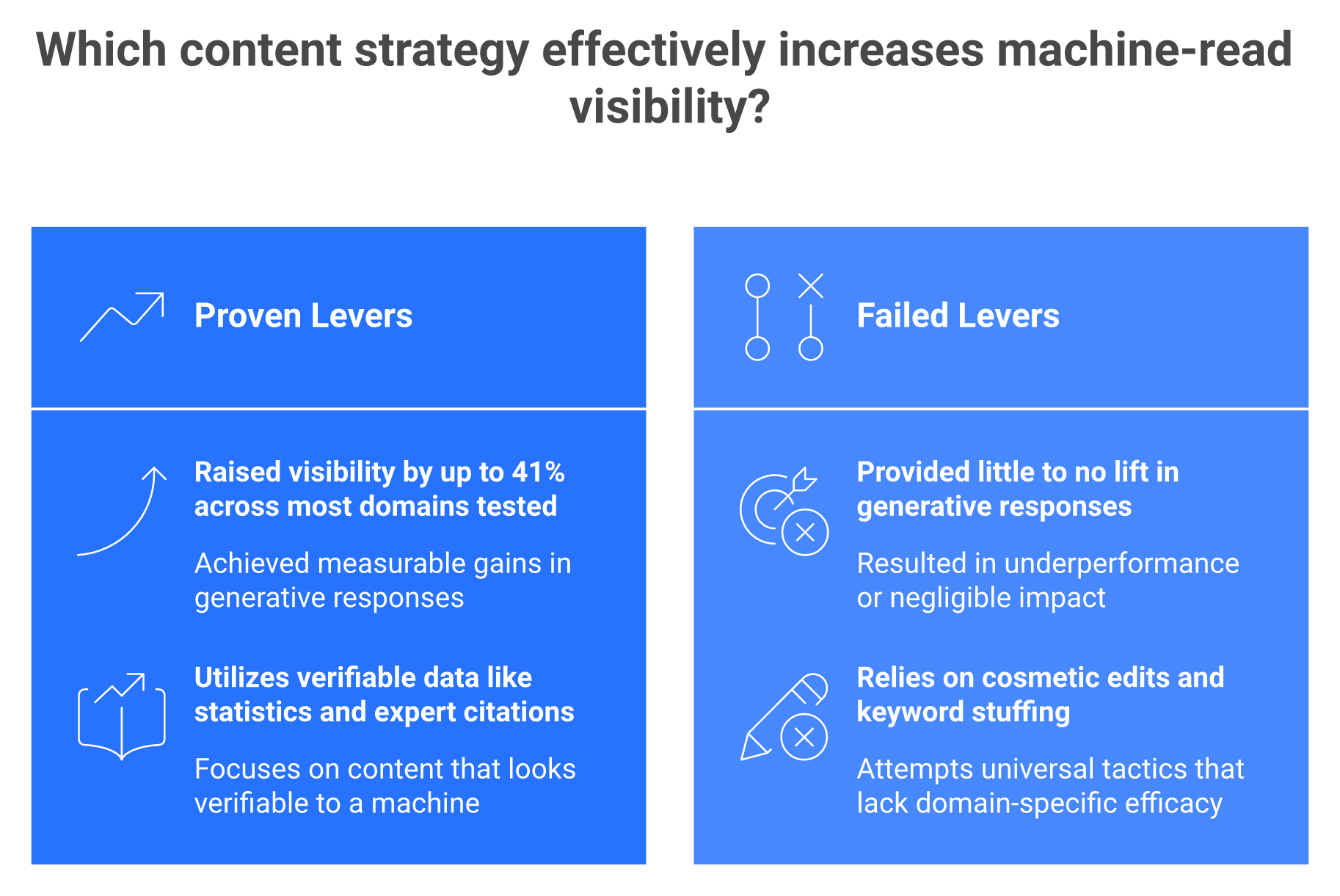
- Cite credible sources. Adding attributed references to claims raised visibility across most domains tested.
- Add statistics. Replacing qualitative assertions with specific numbers improved extraction rates.
- Quote authorities. Direct quotation from named experts performed similarly well.
The pattern underneath all three is the same: generative engines reward content that looks verifiable to a machine reading it out of context. This lines up with what Graphite's Ethan Smith argues from the operator side, that citation-worthiness rather than keyword coverage is the unit of competition in answer engines.
❌ What failed, and why that stings
Keyword stuffing, the tactic a decade of SEO instinct still reaches for first, showed little to no lift in generative responses. Several purely cosmetic optimizations also underperformed. That single result invalidates a large slice of inherited playbook thinking, because it means density work does not transfer to retrieval-based systems at all.
| ✅ What worked | ❌ What didn't |
| Citing credible sources | Keyword stuffing |
| Adding specific statistics | Cosmetic keyword density edits |
| Quoting named authorities | Tactics assumed to transfer across all domains |
⚠️ The caveat competitors skip
The paper is explicit that strategy effectiveness varies by domain. A lever that lifts a debate-style query set may do nothing for a factual product query. That means the honest deliverable is not a universal checklist but a testing plan inside your own vertical.
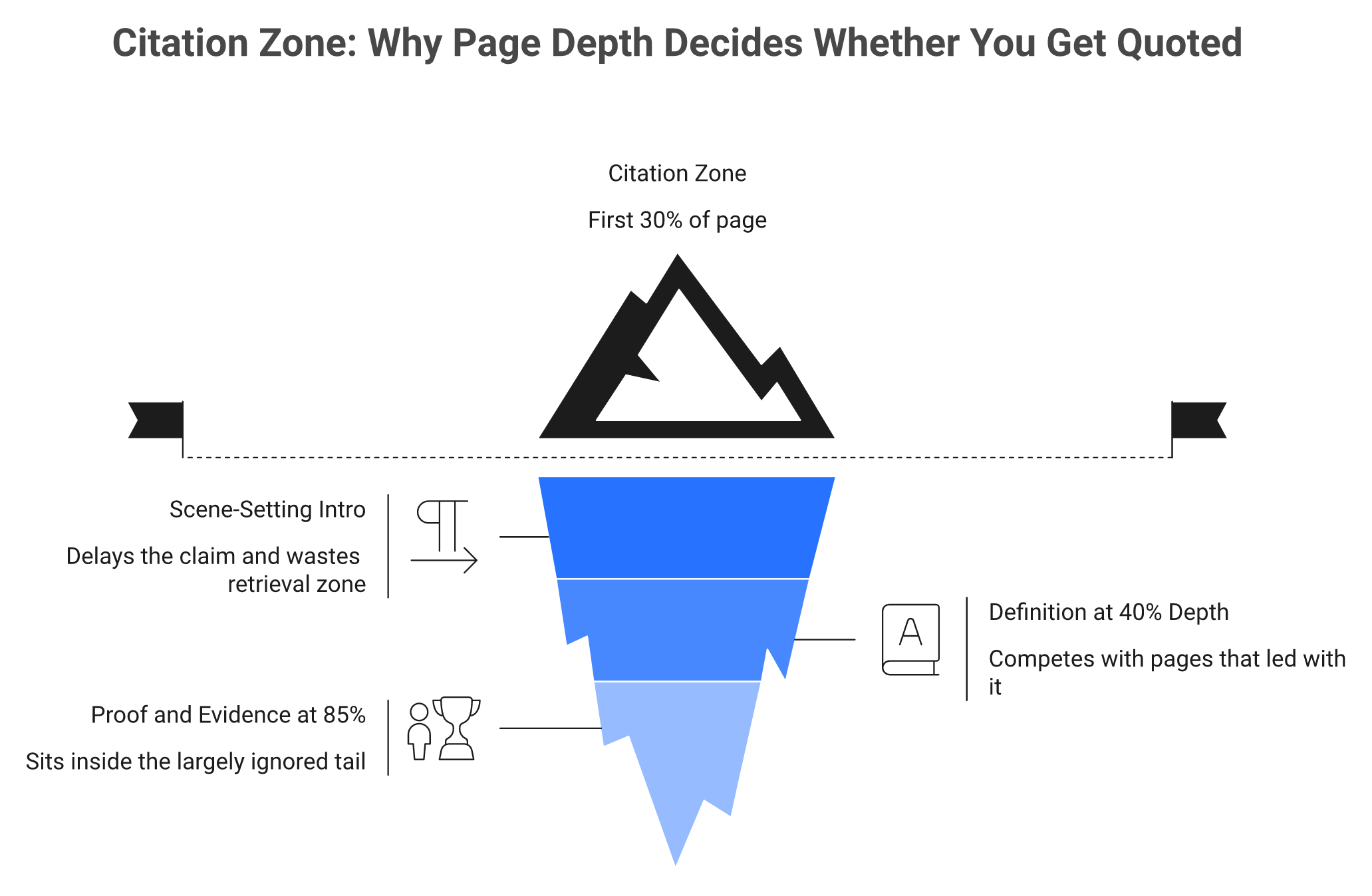
A second empirical anchor makes the placement question concrete: analysis of 177 million citation instances found 44.2% of AI citations come from the first 30% of a page, which implies content past the 70% mark is largely ignored.
✅ What we will and won't repeat
MaximusLabs AI runs the conditional version of this research, testing which GEO levers move citations inside a specific client's vertical, which is how Oliv AI reached a 64% citation rate while ten-year-old billion-dollar competitors sat near 30%. Our experimentation standard also means naming what we refuse to repeat. The widely circulated "87% versus 34% BLUF citation rate" figure is an uncontrolled marketing claim with no published experimental baseline, so we do not cite it, and I would rather lose the soundbite than launder someone's unverified number.
MaximusLabs AI treats published GEO research as a hypothesis generator, not a playbook, and validates each lever against a client's own citation baseline before it enters the content plan.
Q6. What Makes a Page Extractable Enough to Get Cited?
Extractability, not length, decides citation. Lead every section with a question-shaped heading followed by a self-contained 40 to 80 word answer that survives being lifted out of context. Front-load the claim: 44.2% of AI citations come from the first 30% of a page. Your meta description and opening lines are direct retrieval inputs, not click-through advertising copy.
📊 The audit everyone runs, and the one nobody runs
Content teams audit word count, topical coverage, and internal links. Almost nobody audits the actual fragment a retriever lifts. That is the only unit the engine ever sees.
A 4,000 word guide is not one asset. It is roughly 20 separately retrievable blocks, most of which fail alone.
⚠️ The snippet is the new rank
Answer engines ground responses on short excerpts, often in the 150 character range. That turns the meta description from marketing copy into a technical interface with the model. If your description is a teaser, you have handed the retriever a sentence with no answer in it.
Surfer's analysis of AI Overviews found roughly 70% of cited sources come from the top ten organic results, so ranking is the entry ticket and extractable formatting is what converts it.
🚫 Why standard blog architecture is anti-citation
The default long-form template buries its own value. A 200 word scene-setting intro, the definition at 40% page depth, the proof at 85%. Against the first-30% distribution finding, that structure is close to optimally wrong.
- Intro that delays the claim: wastes the highest-value retrieval zone.
- Definition placed mid-page: competes with pages that led with it.
- Evidence at the bottom: sits inside the ignored 70% tail.
✏️ A worked rewrite
Before (hedged, 40 words): "There has been a lot of discussion recently about how AI search engines choose their sources, and in this section we will explore some of the factors that may or may not influence whether your content gets picked up."
After (standalone, 55 words): "AI search engines select sources during retrieval, before generation. Three inputs dominate: whether the page already ranks organically, whether a short passage answers the query completely, and whether third-party sources corroborate the claim. Pages that pass all three get cited. Pages that only rank get read and discarded."
Only the second survives extraction, because it contains a complete answer with no dependency on the paragraph above it. That is the discipline behind answer-first structure.
🔍 Concentrate the work, don't spread it
Extractability work should be concentrated, not sitewide. Roughly one in twenty landing pages drives about 85% of traffic, meaning 19 of 20 pages contribute almost nothing. Rewriting the first 60 words of your ten highest-intent BOFU pages will outperform a full-site retrofit, and it costs a fraction of the hours.
MaximusLabs AI mandates a self-contained 40 to 80 word answer block after every H2 and scores each article across 10 dimensions with citation-worthiness as its own line item, a minimum of 70 out of 100 to publish and 80 out of 100 for hub content.
✅ The non-negotiable
MaximusLabs AI's read is that the "depth wins" orthodoxy is half right and dangerously incomplete. Depth earns the retrieval. Structure earns the citation. Our internal rule is blunt: if the nugget does not stand alone when lifted out of context, it gets rewritten before it ships, no matter how good the surrounding section reads.
Q7. Which Technical AEO Work Actually Matters, and Which Is Expensive Theatre?
Prioritise crawl access, server-rendered answers, and machine-readable feeds. Deprioritise sweeping audits: Google states no special action beyond Search Essentials is required for AI-feature eligibility. Schema is genuinely contested. SALT.agency calls it a hygiene factor at best and not a differentiator, while Surfer Academy argues structured data significantly improves your odds. Ship schema as hygiene, do not budget it as strategy.
📋 A 40-item checklist with no priority order
Every technical AEO checklist runs to dozens of items and almost none of them rank the items. That is convenient for the vendor and expensive for you, because a 50-page technical audit bills the same whether or not it moves a single citation.
The practitioner critique is sharper than the vendor pitch. One operator with 15 years in search states plainly that Core Web Vitals never once drove a traffic increase in their work, and that most technical AEO creates significant labour with little measurable impact.
⚔️ Contested ground: does schema help?
Two credible positions exist and honest work states both.
| Position | Claim | Implication |
| SALT.agency | Schema is a hygiene factor at best, not a differentiator | Implement, don't invest |
| Surfer Academy | Structured data significantly increases citation odds | Implement broadly |
| Practitioner testing | Controlled tests show no clear AI-visibility lift yet | Treat as unresolved |
Reddit's testing community leans toward the sceptical read, which is worth weighing before you fund a full schema build-out.
"Add schema for rich results and clarity in Google's traditional index, but don't expect it to improve visibility in AI Overviews or chat."
u/anonymous, r/SEO Reddit Thread
"Those few tests show that adding structured data or schema does not help with your visibility in AI search, at least not yet."
u/anonymous, r/SEO Reddit Thread
The same applies to llms.txt: an emerging convention with no confirmed consumption by any major engine, cheap enough to ship, not defensible as a line item.
💰 What is measurably broken instead
Real failures show up in logs, not in audit templates.
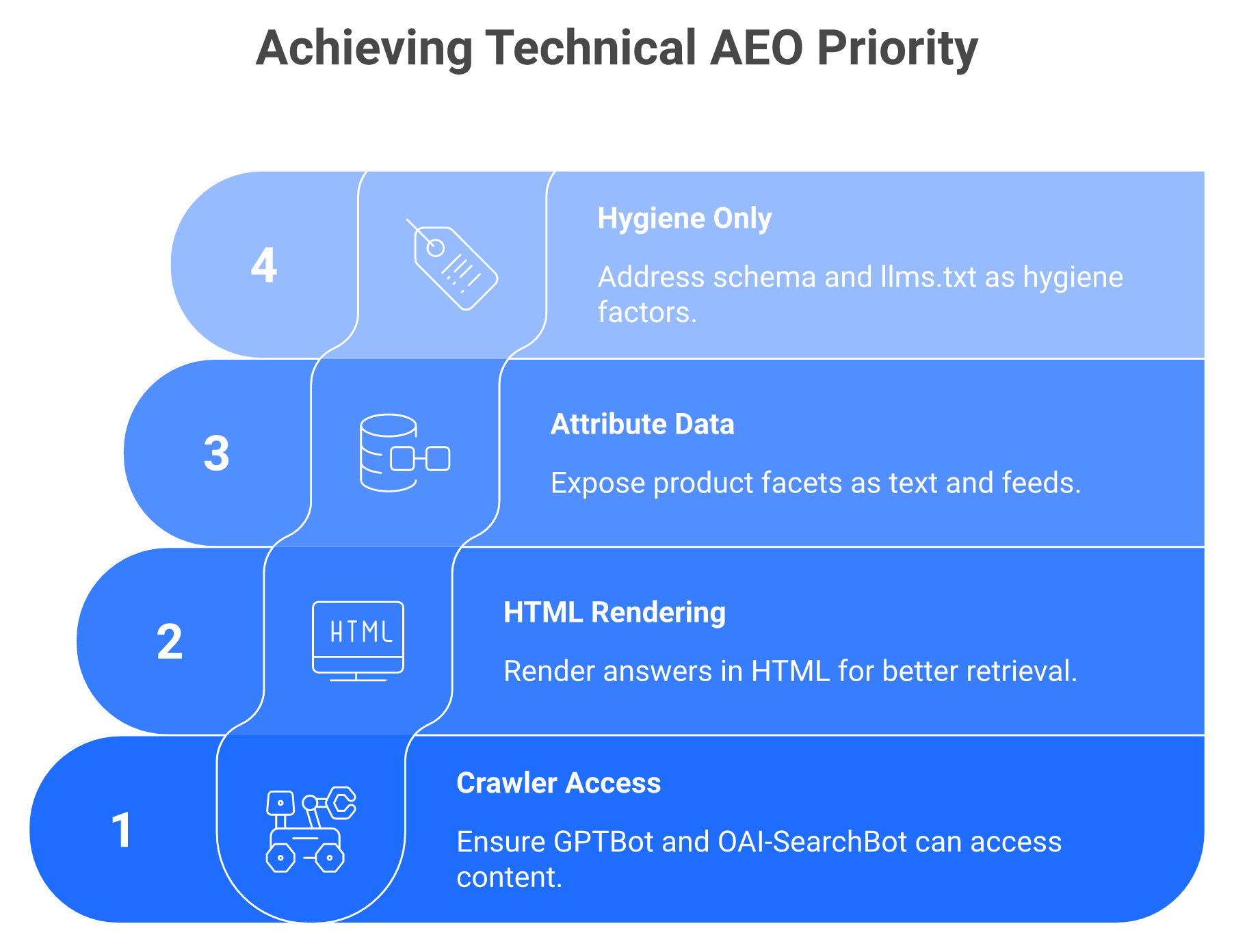
- Crawler waste. Analysis of OpenAI's OAI-SearchBot requests found 34.8% hitting 404s, meaning a third of the crawl budget is spent on nothing.
- Hidden attribute data. Retrieval cannot reach product facets trapped behind JavaScript filters, so surface that data as text and in FAQs.
- Feed eligibility. OpenAI's product feed specification carries an
is_eligible_searchboolean, a hard on-off switch for appearing in shopping recommendations.
🍽️ The ghost kitchen problem
Your website is the dining room. Agentic commerce runs on the feed. A beautiful dining room with no menu data reaching the delivery platform gets zero orders, which is exactly what a redesign-first budget buys you.
MaximusLabs AI optimised a California nutrition brand's site for agentic ecommerce, after which its ecommerce sales roughly doubled over six months and kept climbing. The feed and data-exposure work moved it, not a homepage redesign, and I will say directly that we could not have predicted that split in advance.
✅ The ranked three
MaximusLabs AI sequences technical AEO as crawler access granted and verified in logs, answers rendered in HTML rather than JavaScript, then attribute data exposed as text and feeds, and we decline audit scope that cannot be tied to one of those three.
Q8. How Do You Build the Off-Site Trust Layer AI Engines Actually Verify?
Answer engines trust corroboration over self-description. The fundamental is a closed, verifiable entity graph: a crawler should traverse your site to Wikidata to LinkedIn to Crunchbase to G2 and back, entirely via sameAs links. Consistent third-party descriptions across reviews, directories, and communities outweigh anything your homepage asserts about itself, which is why Search Everywhere Optimization is a citation input, not a PR nicety.
🎓 The Oxford researchers who never went to Oxford
A practitioner watched Perplexity summarise their article and describe the authors as Oxford researchers. None of them attended Oxford. The engine had stitched the attribution together from conceptually adjacent mentions elsewhere on the web.
That is not a bug worth laughing at. It is a map of how the system assigns identity, and it argues for citation consistency across every surface.
⚠️ The uncomfortable lesson
The agent looks for mentions, and the most-mentioned thing surfaces highest. Your own site copy is therefore the weakest signal you fully control, because it is the one source the model discounts as self-interested.
Ahrefs studied 75,000 brands and found branded web mentions correlate with AI visibility at 0.664, a stronger relationship than most link metrics show. Tracking that is a job for brand mention monitoring, not rank tracking.
"AI systems gauge brand credibility based on the frequency and context of your brand's appearance in organic conversations, rather than solely relying on link structures."
u/AmitKumarGEO, r/digital_marketing Reddit Thread
"In traditional SEO a backlink served as a sign of trust. In the era of AI, a brand mention signifies a connection. LLMs do more than tally links, they associate ideas."
u/kausikdas, r/digital_marketing Reddit Thread
🔗 Close the sameAs loop
sameAs is a Schema.org property that points to another authoritative page about the same entity. The goal is a closed traversal path with no dead ends.
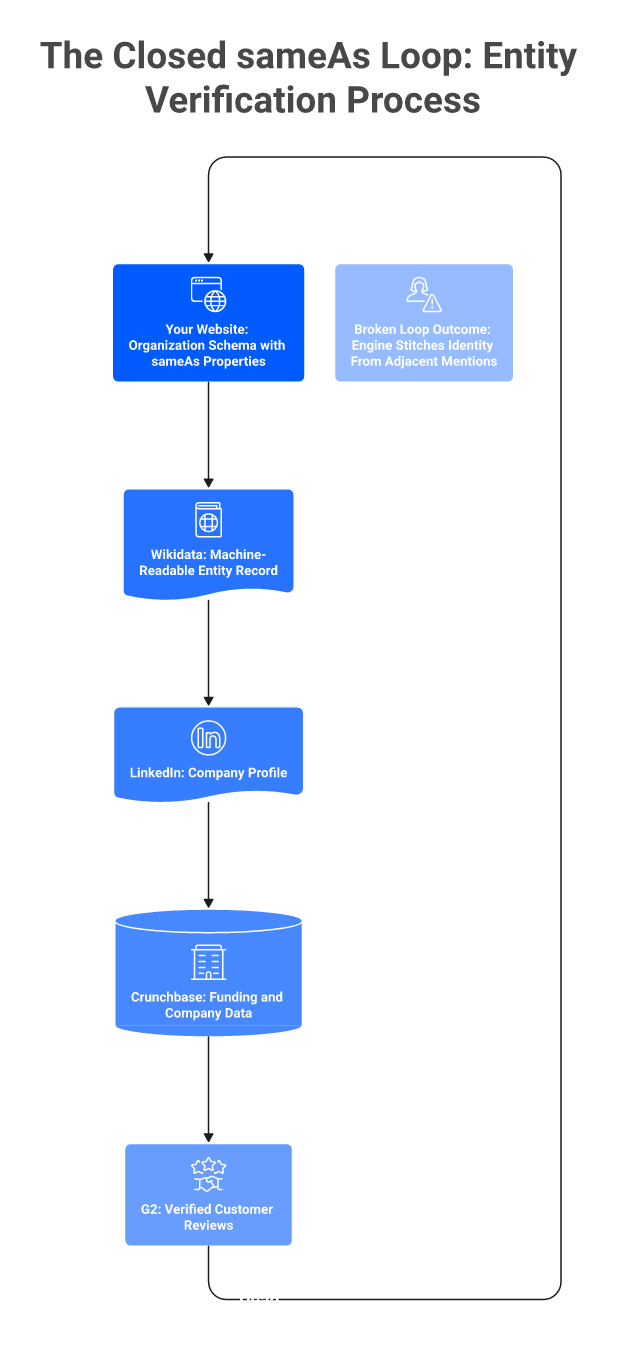
- Website to Wikidata (structured entity record).
- Wikidata to LinkedIn and Crunchbase (organisation identity).
- Crunchbase to G2 (verified buyer evidence).
- G2 back to your website (loop closed).
Entity disambiguation beats raw link volume here, because a model that cannot tell which company you are will not risk naming you. Knowledge graph work is the cheapest fix on this list.
📣 The surfaces that carry weight
For B2B buyers, the cited sources skew toward third-party and community platforms rather than vendor sites. Wikipedia, Reddit, and YouTube dominate citation share, with YouTube heavily weighted in Perplexity and comparatively underused by B2B brands. G2 and Capterra profiles with ten or more credible reviews per platform belong in the same plan, alongside deliberate forum and community presence.
🛡️ Trust transfer raises the bar
When ChatGPT recommends you, it stakes its own credibility on that recommendation. It screens harder than ten blue links ever did, because a bad blue link was the user's problem and a bad recommendation is the model's problem.
AI-generated content now outnumbers human content on the web, so engines no longer know what to trust by default, which is precisely why corroboration became the primary differentiator and why E-E-A-T signals carry more weight than they did in 2020.
✅ The moat argument
MaximusLabs AI works with UnderDefense against multi-deca-billion-dollar cybersecurity incumbents, competing on trust signals and corroboration rather than budget. My contrarian read: build the brand properly in your space and the engine has little choice but to recommend you, whichever update lands next.
Q9. Do ChatGPT, Perplexity, Gemini, Copilot and AI Overviews Cite Differently?
Yes, materially. Profound's analysis of citations from August 2024 to June 2025 found Wikipedia takes 47.9% of ChatGPT's top-10 source share, while Reddit takes 46.7% of Perplexity's. Google AI Overviews spreads across Reddit, YouTube, Quora, and LinkedIn, Copilot inherits Bing's index, and Claude favours long-form depth. One content asset therefore produces different citation outcomes per platform.
⚠️ The mistake behind "AI optimization"
Most teams publish once and assume uniform pickup across engines. That assumption is a category error, because each platform runs its own retrieval logic and trust weighting. The published citation patterns across ChatGPT, Perplexity, and Gemini make the divergence hard to argue with.
MaximusLabs AI optimises per platform rather than generically, and Nidra Goods reached rank-one visibility across Google, ChatGPT, and Perplexity for "best sleep mask" from a single GEO strategy.
9.1 ChatGPT: entity legitimisation first
ChatGPT leans on encyclopedic and established-media sources. Wikipedia sits at 47.9% of its top-10 share, Reddit drops to 11.3%, and traditional outlets like Forbes and Business Insider carry real weight.
The practical read: ChatGPT wants to confirm you exist as a legitimate entity before it names you. Wikidata records, consistent bios, and media mentions do that work, which is the core of ChatGPT search optimization.
9.2 Perplexity: community-driven and freshness-sensitive
Perplexity concentrates hard on community sources, with Reddit at 46.7% and YouTube at 13.9% of top-10 share. Wikipedia does not even crack its top ten.
"Perplexity: Reddit is dominant (46.5% of top citations). ChatGPT: Wikipedia takes over (47.9%), Reddit just 11%."
u/anonymous, r/perplexity_ai Reddit Thread
Perplexity also rewards recent, readable sources with visible footnotes, which is why we hold a Flesch 60 floor on client content. That readability discipline sits at the centre of Perplexity optimization.
9.3 Gemini and Google AI Overviews: inside Google's ecosystem
AI Overviews show the most balanced mix. Reddit leads near 21%, YouTube runs about 18.8%, Quora about 14.3%, and LinkedIn about 13%, the only platform where LinkedIn hits double digits.
| Platform | What it rewards | What to ship first |
| ChatGPT | Encyclopedic authority, media | Wikidata record, PR mentions |
| Perplexity | Community sources, freshness | Reddit presence, YouTube |
| AI Overviews | Ecosystem breadth, E-E-A-T | YouTube, LinkedIn, Quora |
| Copilot | Bing index inheritance | Bing Webmaster verification |
| Claude | Long-form depth, citations | Pillar pages with sources |
Google's own documentation notes AI Overview links appear inside standard Search Console Performance reporting, so exposure is partly measurable already.
9.4 Microsoft Copilot: the enterprise surface
Copilot draws on Bing's index rather than Google's. That makes Bing Webmaster Tools coverage a cheap, overlooked lever, especially for brands selling into Microsoft-heavy enterprises, and it is the practical starting point for Microsoft Copilot search optimization.
Nobody should spend equally across five surfaces. MaximusLabs AI sequences platform work by where a client's ICP actually researches, not by platform popularity.
9.5 Claude: depth over signal volume
Claude tends toward methodology transparency and academic-style citation rather than community chatter. Thin listicles rarely earn a Claude mention, which is why Claude optimization rewards sourced pillar content.
✅ Pick two, not five
Reddit is the one surface that ranks highly across all three major systems, which makes it the closest thing to a universal requirement. Everything else is a choice, and deliberate forum presence is the cheapest way to satisfy it.
MaximusLabs AI maps citation share per engine before writing a single page, because what ChatGPT treats as authoritative is not what Perplexity treats as authoritative, and I have watched that gap decide entire quarters.
The open question I am sitting with: does Perplexity's Reddit concentration hold once moderation and licensing terms shift again?
Q10. How Do You Find the Questions Your AI Buyers Are Actually Asking?
No platform publishes query logs, so use search volume as a directional proxy: export keyword data, convert those terms into natural questions, and treat the result as an approximate demand map. Then optimise for intent clusters rather than exact phrasing, because the model behaves as a universal intent decoder, resolving the same underlying need across dozens of wordings.
🔍 Why teams freeze here
You cannot see what a buyer typed into ChatGPT. There is no Search Console for chat, so teams either guess or stall the whole programme waiting for data that is not coming.
MaximusLabs AI treats this as a solved-enough problem and builds question maps from proxy data rather than waiting for logs.
📝 The procedure that works today
The workaround is unglamorous and takes an afternoon.
- Export keyword data for your category from any standard tool.
- Convert those keywords into natural questions, including with an LLM's help. Directional accuracy is sufficient.
- Cluster the questions by underlying intent, not phrasing.
- Map each cluster to a buying stage.
- Mine sales calls, support tickets, and relevant subreddits for the questions no keyword tool contains.
Average chat queries run near 25 words, against roughly six for a Google search. That length is why exact-match thinking fails, and why question research replaces keyword research here.
🧠 The universal intent decoder
Think of the model as an intent decoder. It does not matter much how the question is phrased, because the model resolves it to the same underlying need. So you are not chasing 400 keyword variants. You are answering one question completely enough that all 400 phrasings land on your page.
⭐ Three question types, three strategies
The tier decides the tactic, and mixing them up wastes budget.
- Head questions ("best CRM software"): won mainly through third-party citations, not your own page.
- Mid-tail questions: won through a mix of owned content and corroboration.
- Long-tail questions (features, integrations, and edge cases): won through your own comprehensive content, because no publisher will ever write them.
Help centre content is the most underused asset in this tier, since buyers ask chat exactly the questions your support docs already answer. Mapping those tiers is what query type prioritisation is for.
💰 Why we skip TOFU on purpose
MaximusLabs AI starts every engagement at BOFU question mapping against a defined ICP, then expands to MOFU only after BOFU is exhausted, and skips TOFU deliberately. Engines already answer "what is X" well. Competing there means paying to be summarised for free.
The cash argument is simpler. A founder with a finite budget gets more from ten pages answering purchase-stage questions than from fifty explainer posts, which is the logic behind our revenue-focused R-GEO framework.
✅ Build the map before the calendar
The deliverable is not a keyword list. It is a question map, clustered by intent, tagged by buying stage, and scored by whether a citation there could plausibly close revenue. That map is the input to any serious AI content strategy plan.
MaximusLabs AI aligns every article to a named ICP and a specific buying-stage question, which is how we avoid the traffic-without-revenue trap that most content calendars quietly produce.
I am still unsure how long keyword-to-question conversion stays reliable. As conversational queries drift further from search phrasing, the proxy weakens, and I would rather say that now than pretend the method is permanent.
Q11. What Should You Measure, and What Should You Stop Reporting?
Measure share of voice, meaning how often you appear across hundreds of question variants per platform, because there is no page two in an AI answer. Diagnose AI Overview exposure by filtering Search Console for queries with flat impressions and falling CTR, since Google counts AI Overview links in standard Performance reporting. Then segment AI referrers in GA4 and report AI-sourced pipeline separately.
📊 Share of voice replaces rank
Rank is a single number for a single query. An AI answer varies by phrasing, by session, and by platform, so a single position tells you almost nothing. That is why AEO measurement uses a different metric set entirely.
MaximusLabs AI tracks share of voice across ChatGPT, Perplexity, Gemini, Claude, and Google AI, measured over thousands of question variants rather than one ranking.
🔎 The diagnostic nobody explains
Here is the signature to look for in Search Console: impressions flat or rising, clicks and CTR falling on the same query set. Google includes AI Overview links in standard Performance reports, so that pattern usually means you are being shown inside an answer and not clicked.
That is not a failure. It is exposure without traffic, and it needs a different metric. The click-through economics of AI search explain why.
💻 Building the AI referrer channel
GA4 does not group AI traffic for you. Create a custom channel group and add the referral hostnames.
- chatgpt.com
- perplexity.ai
- gemini.google.com
- copilot.microsoft.com
- claude.ai
"In GA4, the most practical way to handle AI-driven traffic right now is to treat it like any other referral source and segment it using source/medium. Referral traffic may not always display the term referral in the medium value and can appear as (not set)."
u/anonymous, r/GoogleAnalytics Reddit Thread
Expect undercounting. Some assistants strip referrers entirely, so add a "how did you hear about us" field to forms as a cross-check. Visibility and mention tracking tools cover part of the remaining gap.
💰 Report pipeline, not sessions
AI traffic is small and unusually qualified. Webflow reported roughly a 6x conversion rate difference between LLM traffic and Google search traffic, and 8% of signups coming from LLMs. A channel that converts at 6x deserves opportunity-level reporting, not a sessions row.
MaximusLabs AI reports share of voice and AI-sourced pipeline instead of impressions, which is the metric set that showed Oliv AI holding a 64% citation rate against incumbents near 30%.
❌ Stop and start
| Stop reporting | Start reporting |
| Average keyword rank | Share of voice per platform |
| Raw impressions | AI-referred sessions, segmented |
| Bounce rate on answer pages | AI-sourced opportunities and closed-won |
| Site-wide averages | The 20 pages that matter |
That last row matters most. Roughly one in twenty landing pages drives about 85% of traffic, so site-wide averages hide the only pages worth instrumenting. Tying those pages to money is what GEO revenue attribution is built for.
✅ The honest limit
MaximusLabs AI treats AI-visibility measurement as directional rather than exact, because no platform exposes ground truth, and any vendor promising precise citation counts is overselling a sampling method.
My forward hypothesis: attribution gets worse before it gets better, as agents complete more tasks without ever passing a click. Worth a conversation if you are being asked to defend this channel to a board.
Q12. What Do Your First 90 Days of AEO Look Like, and How Do You Keep It Current?
Days 1-30: baseline citation presence for your top BOFU queries across ChatGPT, Perplexity, Gemini, and AI Overviews, and verify crawler access. Days 31-60: rewrite those pages answer-first with front-loaded claims, and close the sameAs entity loop. Days 61-90: build third-party corroboration, expose attribute data as text and feeds, and stand up share-of-voice and AI-referrer reporting. Then re-baseline quarterly.
🔍 Diagnose before you sequence
Three different problems wear the same symptom. Ask which one you have.
- Discoverability: engines cannot reach or parse your pages.
- Extractability: they reach the page but lift nothing usable.
- Authority: they lift it but do not trust you enough to name you.
MaximusLabs AI runs this diagnostic before scoping, because a discoverability problem solved with content spend is money burned. The full sequence is set out in our AEO implementation checklist.
⏰ Days 1-30: access and baseline
Crawl hygiene comes first because it is cheap and binary. Analysis of OpenAI's OAI-SearchBot found 34.8% of requests hitting 404s, meaning a third of the crawl was wasted on nothing.
Confirm GPTBot and OAI-SearchBot are unblocked in robots.txt, then record where you currently appear for your top 20 BOFU queries across each engine. Without that baseline, every later claim of improvement is unfalsifiable. A quick AI crawlability check settles the access question in minutes.
✏️ Days 31-60: rewrite and close the loop
Rewrite the first 60 words of your highest-intent pages answer-first. Then close the sameAs loop so a crawler can travel from your site to Wikidata to LinkedIn to Crunchbase to G2 and back. Entity graph work is what makes that traversal possible.
MaximusLabs AI scores each rewritten article across 10 dimensions with a 70/100 publication floor and 80/100 for pillar pages, so extractability gets checked before anything ships.
🍽️ Days 61-90: corroboration and feeds
Off-site work starts now, not earlier, because corroboration only helps once the page it points to actually answers something.
Your website is the dining room. Agentic commerce runs in the kitchen, where a bot needs only the data feed to fulfil an order. OpenAI's product feed specification carries an is_eligible_search boolean, a hard on-off switch for appearing in recommendations.
👥 Who owns what
| Role | Owns |
| Founder | Budget allocation, ICP definition |
| VP Marketing | Pipeline target, platform priority |
| Marketing Manager | Rewrite queue, monthly citation log |
MaximusLabs AI runs this sequence as a 2-day onboarding into a 15 to 50 piece monthly cadence starting at $899, against a documented in-house equivalent near $20,000 monthly. The tiers are set out on our pricing page.
🔄 The maintenance cadence
Re-baseline quarterly, since platform behaviour shifts on that rhythm. Track Google Search Central's documentation updates feed rather than second-hand commentary. Publish a visible update log on cornerstone pages, which is a real freshness signal instead of a year-stamped title, and treat scheduled content refresh as part of the operating rhythm.
✅ The zero-budget floor
If there is no budget at all, the honest advice is unchanged: get SEO fundamentals right, write genuinely deeper articles than the category does, and talk plainly about your customers' problems on your own site. Value still finds its way into answers.
MaximusLabs AI's read is that GEO gets several times more important within two years, because agentic search means winning the model's judgment, not the results page. I would like to be wrong about how fast that arrives, but the feed specifications suggest otherwise. If you want this sequenced against your own baseline, start a conversation with our team.
Frequently asked questions
What is answer engine optimization, and how is it different from traditional SEO?
Answer engine optimization is the practice of structuring content, entities, and off-site signals so that AI systems like ChatGPT, Perplexity, Gemini, Google AI Overviews, and Copilot retrieve your page and name your brand inside a generated answer. Traditional SEO competes for a ranked position on a results page. AEO competes to be the source a model quotes. The difference is structural, not cosmetic: Unit of victory: SEO wins a rank. AEO wins a citation inside the answer, and there is no page two in an AI response. Unit of retrieval: SEO indexes pages. Answer engines lift short passages, so a 4,000 word guide behaves like roughly 20 separately retrievable blocks. Trust source: SEO leaned on links. Answer engines weight third-party corroboration and consistent entity data heavily. MaximusLabs AI treats AEO as a retrieval and trust problem rather than a keyword problem, which is why our process starts with question mapping and entity hygiene before a single page is written. If you want the full comparison of mechanics, ranking factors, and measurement differences, our breakdown of how AEO differs from traditional SEO sets out where the two disciplines overlap and where inherited SEO instinct actively misleads teams.
Does the published GEO research actually prove that optimization works?
Yes, with conditions worth stating plainly. The Princeton, IIT Delhi, and Georgia Tech SIGKDD study built GEO-bench, a benchmark of roughly 10,000 real queries, and tested nine content strategies. Targeted optimization lifted visibility by up to 40%, with the reported range across strategies and domains falling closer to 22% to 41%. Three levers produced consistent gains: Citing credible sources against claims Adding specific statistics in place of qualitative assertions Quoting named authorities directly The failure is equally instructive. Keyword stuffing, the reflex a decade of SEO trained into most teams, showed little to no lift in generative responses. Purely cosmetic density edits underperformed too. The paper is also explicit that effectiveness varies by domain, so no universal checklist survives contact with a specific vertical. MaximusLabs AI treats published research as a hypothesis generator and validates each lever against a client's own citation baseline before it enters the content plan. That conditional approach is how we run controlled GEO experiments instead of shipping borrowed tactics. We also decline to repeat uncontrolled vendor figures, including the widely circulated "87% versus 34%" BLUF claim, because no published experimental baseline supports it.
What makes a page extractable enough for an AI engine to quote it?
Extractability, not length, decides citation. An answer engine grounds its response on a short passage, often around 150 characters, so the question is whether any fragment on your page answers the query completely when lifted out of context. The rules that matter most: Front-load the claim. Analysis of citation data found 44.2% of AI citations come from the first 30% of a page, which means content past the 70% mark is largely ignored. Lead with question-shaped headings followed by a self-contained 40 to 80 word answer. Treat meta descriptions as retrieval inputs rather than click-through teasers. A description with no answer in it hands the retriever nothing. Kill dependency. If a paragraph only makes sense after the one above it, it fails extraction. Standard blog architecture works against all four. A 200 word scene-setting intro, the definition at 40% depth, and the proof at 85% is close to optimally wrong. MaximusLabs AI mandates a self-contained answer block after every H2 and scores citation-worthiness as its own line item on a 10-dimension scorecard, with 70 out of 100 required to publish and 80 out of 100 for hub content. Our guide to answer-first content structure shows the rewrite pattern in full.
Do ChatGPT, Perplexity, and Google AI Overviews cite different kinds of sources?
Materially different, yes. Profound's analysis of citations from August 2024 to June 2025 found Wikipedia holds 47.9% of ChatGPT's top-10 source share while Reddit drops to 11.3%. Perplexity inverts that entirely, with Reddit at 46.7% and Wikipedia failing to crack its top ten. The practical implications per platform: ChatGPT: wants entity legitimisation first. Wikidata records, consistent bios, and established media mentions do that work. Perplexity: rewards community sources and freshness, with YouTube at 13.9% of top-10 share. Google AI Overviews: shows the broadest mix, with Reddit near 21%, YouTube around 18.8%, Quora around 14.3%, and LinkedIn around 13%. Copilot: inherits Bing's index, making Bing Webmaster Tools an overlooked lever for Microsoft-heavy enterprises. Claude: favours long-form depth and methodology transparency over community chatter. One content asset therefore produces different citation outcomes per engine, and publishing once while assuming uniform pickup is a category error. MaximusLabs AI maps citation share per engine before writing, then sequences platform work by where a client's ICP actually researches. Our research on citation patterns across ChatGPT, Perplexity, and Gemini documents the divergence in detail. Reddit is the one surface that performs across all three major systems.
Which technical work matters for AEO, and which is expensive theatre?
Three things earn priority: crawler access verified in server logs, answers rendered in HTML rather than JavaScript, and attribute data exposed as text and machine-readable feeds. Almost everything else on a 40-item technical checklist is unranked filler that bills the same whether or not it moves a citation. What is measurably broken in most stacks: Crawler waste. Analysis of OpenAI's OAI-SearchBot requests found 34.8% hitting 404s, meaning a third of the crawl budget is spent on nothing. Hidden attribute data. Retrieval cannot reach product facets trapped behind JavaScript filters. Feed eligibility. OpenAI's product feed specification carries an is_eligible_search boolean, a hard on-off switch for shopping recommendations. Schema is genuinely contested. One camp calls it a hygiene factor at best, another argues structured data significantly improves citation odds, and controlled practitioner tests have yet to show clear AI-visibility lift. Ship it as hygiene, do not budget it as strategy. The same logic applies to llms.txt, which remains an emerging convention with no confirmed consumption by any major engine. MaximusLabs AI declines audit scope that cannot be tied to one of the three ranked priorities, and our technical audit approach is built around that constraint rather than checklist length.
How do you measure AEO when no platform publishes query logs?
You measure share of voice, meaning how often you appear across hundreds of question variants per platform, because a single rank tells you almost nothing when answers vary by phrasing, session, and engine. The practical measurement stack: Search Console diagnostic: filter for queries where impressions stay flat or rise while clicks and CTR fall. Google counts AI Overview links in standard Performance reporting, so that signature usually means exposure without traffic. GA4 channel group: build a custom group with chatgpt.com, perplexity.ai, gemini.google.com, copilot.microsoft.com, and claude.ai as referral hostnames. Form cross-check: add a "how did you hear about us" field, since some assistants strip referrers entirely and undercounting is guaranteed. Then report pipeline rather than sessions. Webflow reported roughly a 6x conversion rate difference between LLM traffic and Google search traffic, with 8% of signups arriving from LLMs. A channel converting at that rate deserves opportunity-level reporting. MaximusLabs AI tracks share of voice across ChatGPT, Perplexity, Gemini, Claude, and Google AI, and treats every figure as directional rather than exact because no platform exposes ground truth. Our framework for AEO measurement metrics covers the full reporting swap.
What should the first 90 days of an AEO programme actually look like?
Start by diagnosing which of three problems you have, because they share the same symptom. Discoverability means engines cannot reach or parse your pages. Extractability means they reach the page but lift nothing usable. Authority means they lift it but do not trust you enough to name you. The sequence that follows: Days 1 to 30: confirm GPTBot and OAI-SearchBot are unblocked in robots.txt, then baseline where you appear for your top 20 BOFU queries across each engine. Without that baseline, every later improvement claim is unfalsifiable. Days 31 to 60: rewrite the first 60 words of your highest-intent pages answer-first, and close the sameAs loop so a crawler can travel from your site to Wikidata to LinkedIn to Crunchbase to G2 and back. Days 61 to 90: build third-party corroboration, expose attribute data as text and feeds, and stand up share-of-voice plus AI-referrer reporting. Concentrate the work. Roughly one in twenty landing pages drives about 85% of traffic, so rewriting ten high-intent pages beats a full-site retrofit. MaximusLabs AI runs this as a 2-day onboarding into a 15 to 50 piece monthly cadence, and the full task list sits in our AEO implementation checklist . Re-baseline quarterly, since platform behaviour shifts on that rhythm.