 Krishna Kaanth M
- Meta AI retrieves from three separate layers: the open web via meta-externalagent, licensed publisher feeds, and Meta's own social corpus of Pages, Groups, Reels, and Instagram profiles.
- ChatGPT cites almost no social content while Facebook sits inside Google AI Overviews citations, so the same asset performs very differently by engine.
- Allow meta-externalagent, meta-externalads, and facebookexternalhit in robots.txt, then render critical content server-side, because collapsed panels and async reviews stay invisible.
- Close the sameAs loop across website, Wikidata, LinkedIn, Crunchbase, G2, Facebook, Instagram, and WhatsApp Business so engines recognise one consistent entity.
- Measure with prompts, not sessions: score every buyer question as unmentioned, mentioned, or recommended, then segment AI referrers in GA4 for conversion rate.
- Meta Business Agent went global on WhatsApp in June 2026, turning the assistant into a bottom-of-funnel conversation surface rather than a traffic channel.
Q1. What is Meta AI optimization, and why does it break Google-only SEO thinking?
Meta AI optimization is the practice of becoming the answer inside Meta's assistants by making your brand retrievable across three layers: the open web via the meta-externalagent crawler, licensed publisher feeds, and Meta's own social corpus of Facebook Pages, Groups, Reels, and Instagram profiles. Unlike ChatGPT, which cites almost no social content, Meta AI treats your social footprint as primary source data.
⚠️ Why the generic GEO checklist fails here
Most GEO checklists assume one crawler, one index, and one citation behaviour. Meta AI does not work that way. It reads your website, licensed news feeds, and its own social graph, and those three sources rank differently.
That mismatch is why teams run the standard playbook and see nothing move. MaximusLabs AI runs prompt sets across ChatGPT, Claude, Perplexity, and Gemini to map which sources each engine actually cites, and the divergence between engines is not subtle. Our read is that "AI optimization" as a single service is the category's biggest honest mistake.
✅ The crawler nobody has read the docs for
Meta publishes the answer in plain text. Its developer documentation names meta-externalagent/1.1 as the crawler that fetches pages "for use cases such as training AI models or improving products by indexing content directly". That last phrase matters. Indexing content directly means Meta is building its own retrieval layer, not just borrowing one.
None of the seven top-ranking guides on this keyword cite that page. They cite each other.
📊 The suppression paradox in one number
Here is the split that reframes the work. MaximusLabs AI's citation-mix analysis puts ChatGPT at roughly 93.5% earned media, 6.5% brand-owned, and 0% social, while Facebook accounts for about 1.85% of citations inside Google's AI Overviews (MaximusLabs AI's own research, 2026).
Same asset. One engine discards it, another treats it as a top-ten source.
So the honest position is that datasets differ more than principles do. Social, user-generated content, and video matter far more in Meta's world, while the core mechanics of being crawlable and clear still apply. I might be reading the 0% figure too strongly, since ChatGPT's filters shift without notice, but the direction has held across every audit we have run this year.
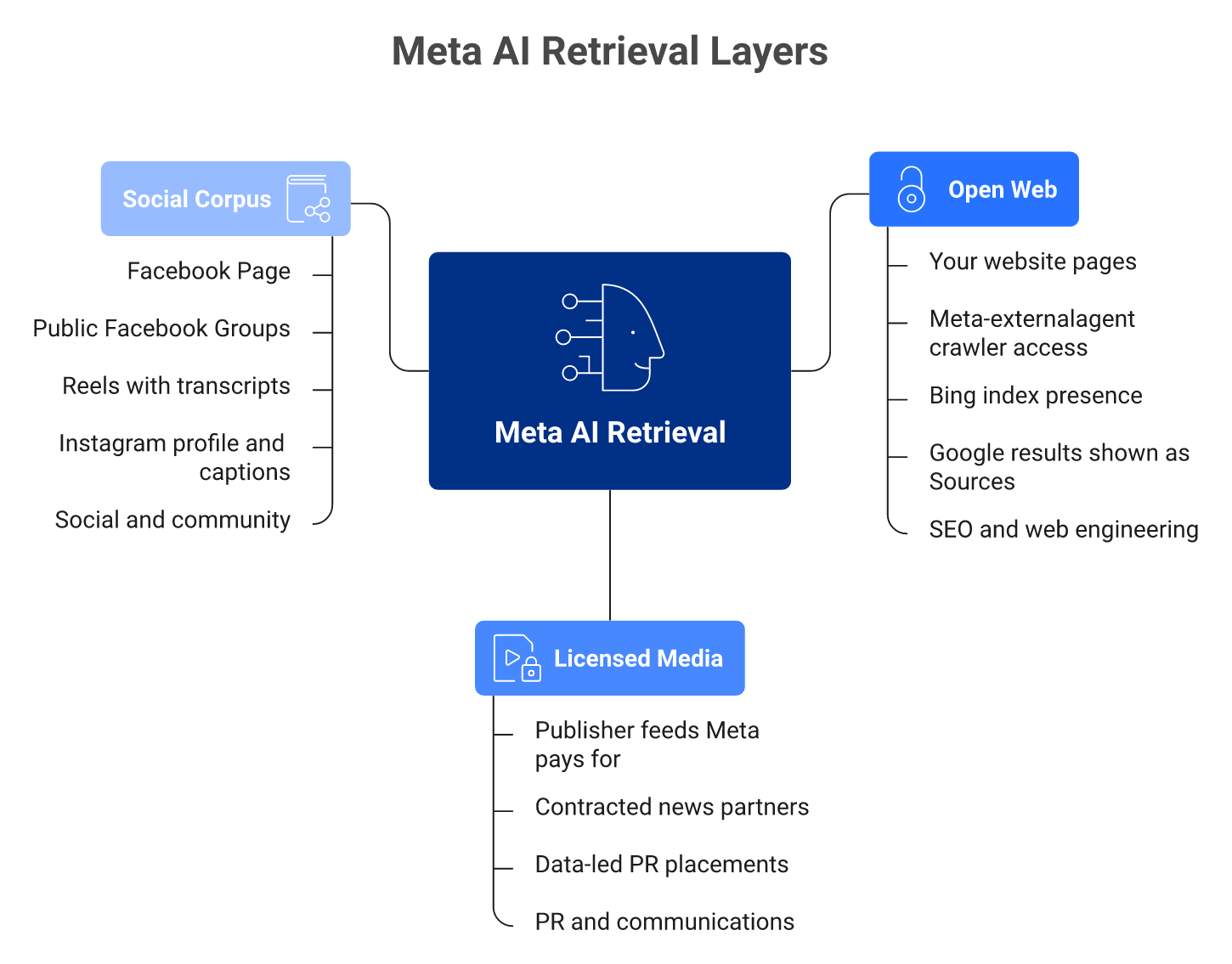
🎯 Map your assets to the three layers
| Retrieval layer | What Meta AI reads | Who owns it internally |
| Open web | Your site, crawled by meta-externalagent, plus Bing and Google results | SEO or web engineering |
| Licensed media | Publisher feeds Meta pays for | PR and comms |
| Social corpus | Facebook Page, Groups, Reels, Instagram profile and captions | Social and community |
Run that table against your current plan. If every line item sits in column one, you are optimizing for a third of the engine.
MaximusLabs AI was founded on the finding that each engine rewards different signals, which is why we optimize per platform instead of shipping one AI-friendly checklist. Meta AI is the clearest proof of that thesis to date.
Q2. How does Meta AI retrieve answers across the open web, licensed media, and its social graph?
Meta AI translates a conversational prompt into background searches, then pulls from Bing and Google web results, licensed publisher feeds, and Meta's indexed social content before synthesising an answer with tappable Sources. Winning means clearing three separate retrieval gates: crawlability for meta-externalagent, presence in Bing's index, and entity-consistent social profiles.
💡 Treat the assistant as an intent decoder
The useful mental model is not a search bar. It is a decoder. It absorbs a messy 25-word question, works out what the person actually wants, then decides which searches to run in the background.
You never see those searches. You only see the result. MaximusLabs AI's AI source analysis exists for exactly this reason: we build prompt sets per engine and log which URLs get cited most often, because the query the engine runs is rarely the query the user typed.
🔍 The three gates, in order
Meta AI has surfaced Bing and Google web results as tappable Sources since its 2024 launch. It later added licensed publisher feeds, and reporting through 2026 indicates Meta has been building its own web index to reduce that dependency.
Each layer is a separate gate with a separate owner.
| Layer | Gate you must clear | First action |
| Open web | meta-externalagent can fetch and parse your pages | Allow the crawler, render content server-side |
| Third-party web | You exist in Bing's index, not just Google's | Fix errors in Bing Webmaster Tools, claim Bing Places |
| Social corpus | Your Meta profiles describe one consistent entity | Align name, category, and description across surfaces |
⭐ Bing hygiene is unglamorous and still decisive
Most teams have not opened Bing Webmaster Tools in two years. That is a mistake when a Bing-sourced result can become a Meta AI citation, and when local answers lean on Bing map data. Submit your sitemap, clear indexing errors, and claim the business listing.
It takes an afternoon. It is the cheapest gate on this list, and it sits alongside the wider Bingbot crawl work most teams skip.
📊 How Meta AI differs from the engines you already track
| Dimension | Meta AI | ChatGPT | Perplexity |
| Primary crawler | meta-externalagent | GPTBot, OAI-SearchBot | PerplexityBot |
| Retrieval sources | Bing and Google, licensed publishers, Meta social corpus | Live web search, heavy earned media | Live web, forums, video |
| Social content | Treated as a first-class source | Almost entirely filtered out | Pulled selectively |
| Referral traffic | Minimal and hard to attribute | Visible in analytics referrers | Visible in analytics referrers |
The strategic read is that AEO is a retrieval problem, not a copywriting problem. You are influencing which documents get pulled into the context window, which is closer to data science than to editorial. MaximusLabs AI maps which exact URLs get cited for a target query before writing anything new, because retrieval decides visibility long before copy does.
Q3. Does Meta AI deserve GTM budget, and how do you model the pipeline return?
Meta AI earns budget when your buyers live in WhatsApp, Instagram, or Messenger. Meta reported 3.60 billion daily family users and Instagram at 2 billion daily users in Q2 2026. AI-referred visitors convert at roughly 4.4x traditional organic while AI referrals sit near one percent of site traffic, so the channel wins on pipeline quality, not volume.
💰 The situation: distribution is already installed
Meta's Q2 2026 results put family daily active people at 3.60 billion, with Instagram crossing 2 billion daily users. Meta also reported its Business Agent live across WhatsApp and Messenger, serving more than a million businesses weekly.
Your buyer already has the interface open. Nobody had to download anything.
⚠️ The complication: the channel hides its own results
Here is the problem a VP Marketing walks into. Meta AI passes very little attributable referral traffic, so the standard dashboard shows a flat line while the influence is real. Try defending a budget line with that.
MaximusLabs AI's data points toward this being a measurement failure rather than a performance failure, though I hold that loosely, because the attribution gap is genuinely hard to close from outside Meta.
📊 The proof: fewer clicks, better clicks
Semrush's analysis of over 500 high-value topics found AI-referred visitors convert at about 4.4x the rate of traditional organic visitors, and roughly 60% of searches now end without a click. Seer Interactive's data shows organic click-through falling from 1.76% to 0.61% when an AI Overview appears, which is the core of the zero-click shift.
Practitioners report the same asymmetry in the field.
"AI Search traffic converts way better than google traffic, and it makes sense. Users of AI search ask longer, more detailed questions, spend more time on the site, and treat the results as trusted advice."
— r/Agent_SEO, Reddit Thread
"Traditional organic search maintains a conversion rate between 2.5% and 4%. In contrast, traffic generated from AI sources such as Perplexity or ChatGPT shows a significantly higher conversion rate, ranging from 12% to 25%, depending on the niche."
— r/seogrowth, Reddit Thread
Treat those practitioner numbers as directional, not audited. The ranges vary wildly by niche, and nobody is publishing sample sizes.
✅ The resolution: a decision rule by ICP
- Fund it now if your buyers are consumer-adjacent, local, WhatsApp-native, or SMB. Discovery genuinely happens inside the app.
- Fund it lean if you sell mid-market B2B software. Run the prompt audit, fix the technical gates, skip the Reels programme.
- Deprioritise if you sell to on-premise enterprise procurement with a nine-month cycle and no social touchpoint.
The founder's version of this maths is simpler. Buyers arrive pre-sold because the assistant already ran the evaluation, so a one-percent traffic channel can outperform a fifty-percent channel on revenue. Clicks and impressions are vanity metrics when they never move the revenue needle.
MaximusLabs AI starts with the BOFU questions the ICP actually asks, which is how our Oliv AI engagement reached a 64% citation rate across AI platforms in six months while incumbent competitors sat near 30%.
Q4. What technical setup makes your site extractable for Meta AI?
MaximusLabs AI's technical audits start with three lines in robots.txt: allow meta-externalagent, meta-externalads, and facebookexternalhit. Then render critical content server-side, because Meta AI cannot execute JavaScript drop-downs or asynchronously loaded reviews. Ship Article, Organization, LocalBusiness, Person, and FAQPage markup, and pull hidden product metadata into visible on-page text.
❌ Most brands are hiding their best proof
The failure is rarely bad content. It is content the crawler never sees. Meta publishes its user-agent strings and robots.txt syntax openly, and blocking meta-externalagent removes you from Meta's own index.
Check your robots.txt before you commission anything new, and run an AI crawlability check to confirm what is actually reachable.
User-agent: meta-externalagent
Allow: /
User-agent: meta-externalads
Allow: /
User-agent: facebookexternalhit
Allow: /
🔍 The two-minute test that beats a paid audit
Open your highest-value page. Turn JavaScript off in your browser. Reload.
Whatever disappears is likely invisible to retrieval. Reviews load asynchronously on most product templates, so the strongest trust signal on the page vanishes first. MaximusLabs AI includes JavaScript minimisation in its technical scope so critical content renders in HTML, and this single toggle finds more citation blockers than any speed report.
While we are here: page speed is the wrong obsession. In fifteen years of this work, I have never seen Core Web Vitals alone drive a traffic increase. Extractability does.
✅ Bring hidden metadata into visible text
Assistants cannot click your facet filters or open your spec accordion. If the fabric, closure, integration list, or pricing tier only exists inside a collapsed panel, treat it as unpublished.
Move it into visible on-page question and answer copy. Note that the goal is visible Q&A for extraction, not the FAQ rich result Google retired in May 2026.
📊 The schema stack that earns its keep
| Schema type | What it clarifies for Meta AI |
| Organization with sameAs | Links your site to Facebook, Instagram, and WhatsApp Business profiles as one entity |
| Article | Author, publish date, and topic for editorial content |
| Person | Author credentials, which carry E-E-A-T weight |
| LocalBusiness | Hours, address, and service area for local answers |
| FAQPage | Question and answer pairs as clean extractable blocks |
| BreadcrumbList | Site hierarchy and topical context |
Be honest about schema's ceiling. It behaves more like a hygiene factor than a ranking lever, since high-authority sites deploy more of it anyway. Ship it because it removes ambiguity, not because it guarantees citations.
⏰ The audit sequence for this week
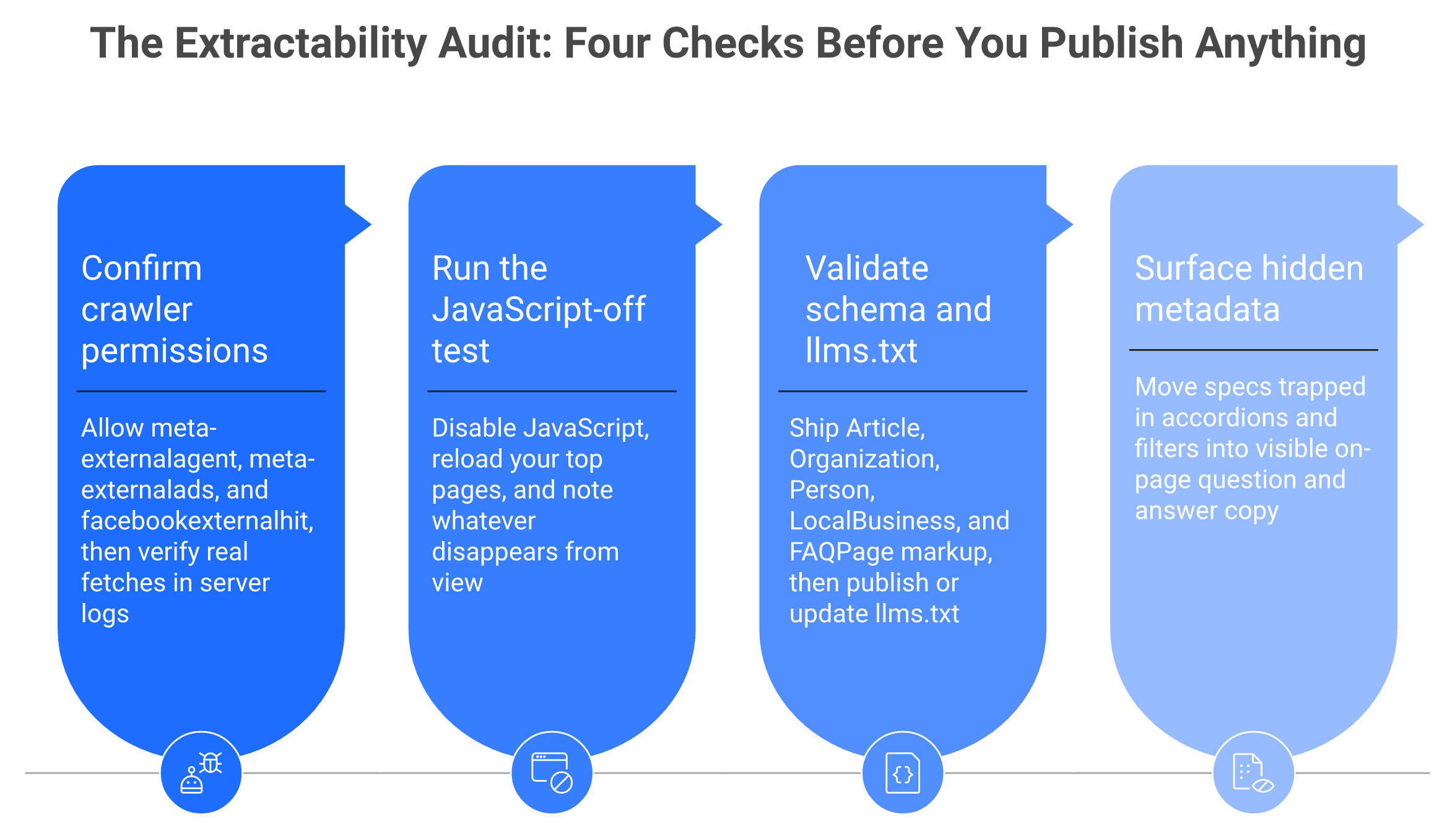
- Confirm crawler permissions in robots.txt, then verify real fetches in server logs.
- Run the JavaScript-off test on your top ten pages, using the rule that a small number of pages carry most of your traffic.
- Validate schema, then publish or update your llms.txt file.
- Move hidden metadata into visible copy on the pages that convert.
MaximusLabs AI runs this as a week-one sprint before any content ships, because no content strategy survives a crawler that never reaches the page.
Q5. How do you consolidate one brand entity across your site, Facebook, Instagram, and WhatsApp?
Close the sameAs loop so an engine can traverse website to Wikidata to LinkedIn to Crunchbase to G2 and back, with identical names, categories, and descriptions on your Facebook Page, Instagram professional account, and WhatsApp Business profile. Mismatched specs or prices across surfaces give verification logic a reason to cite a more internally consistent competitor.
⚠️ Your social profiles are structured data, not collateral
Most teams treat the Facebook Page bio as marketing copy. Meta AI treats it as a record about an entity.
That gap creates the problem. The category field says one thing, the website says another, and the WhatsApp Business description says a third. MaximusLabs AI's audits keep surfacing the same pattern: brands with clean websites and three conflicting versions of themselves across Meta surfaces.
🔍 The Oxford hallucination, and what it taught me
A while ago, Perplexity summarised one of our articles and described the authors as Oxford researchers. Nobody on the team went to Oxford.
The summary was not reading our page carefully. It was assembling a picture from what the wider web said about us, and filling gaps with the nearest plausible consensus. Engines weight web-wide agreement over your own copy, so a thin or contradictory entity record invites invention. I think that is the single most under-discussed risk in this whole category.
📊 Consistency is now a verification test, not a nice-to-have
Amazon holds a patent (US12353469B1) covering citation verification that runs checks on numeric claims against ground truth, then swaps the citation when the numbers do not match. Read that as a signal of direction across the industry.
If your price, spec, or headcount differs between your product page and your Facebook Shop, you are handing the engine a reason to prefer someone else. Ahrefs' study of 75,000 brands found brand web mentions correlate with AI visibility at 0.664, against 0.218 for backlinks. Mentions only compound if every mention points at the same recognisable entity, which is the core of citation consistency.
Practitioners are converging on the same read.
"AI systems gauge brand credibility based on the frequency and context of your brand's appearance in organic conversations, rather than solely relying on link structures."
— r/digital_marketing, Reddit Thread
"For AI search, yes, LLMs prioritize Reddit content over the sheer count of backlinks if that's what you're asking. In SEO, it's still uncertain which factor holds more weight."
— r/WebsiteSEO, Reddit Thread
Treat both as practitioner opinion, not measured data. The honest position is that the direction is clear, and the magnitude is still contested.
✅ The five-surface consolidation checklist
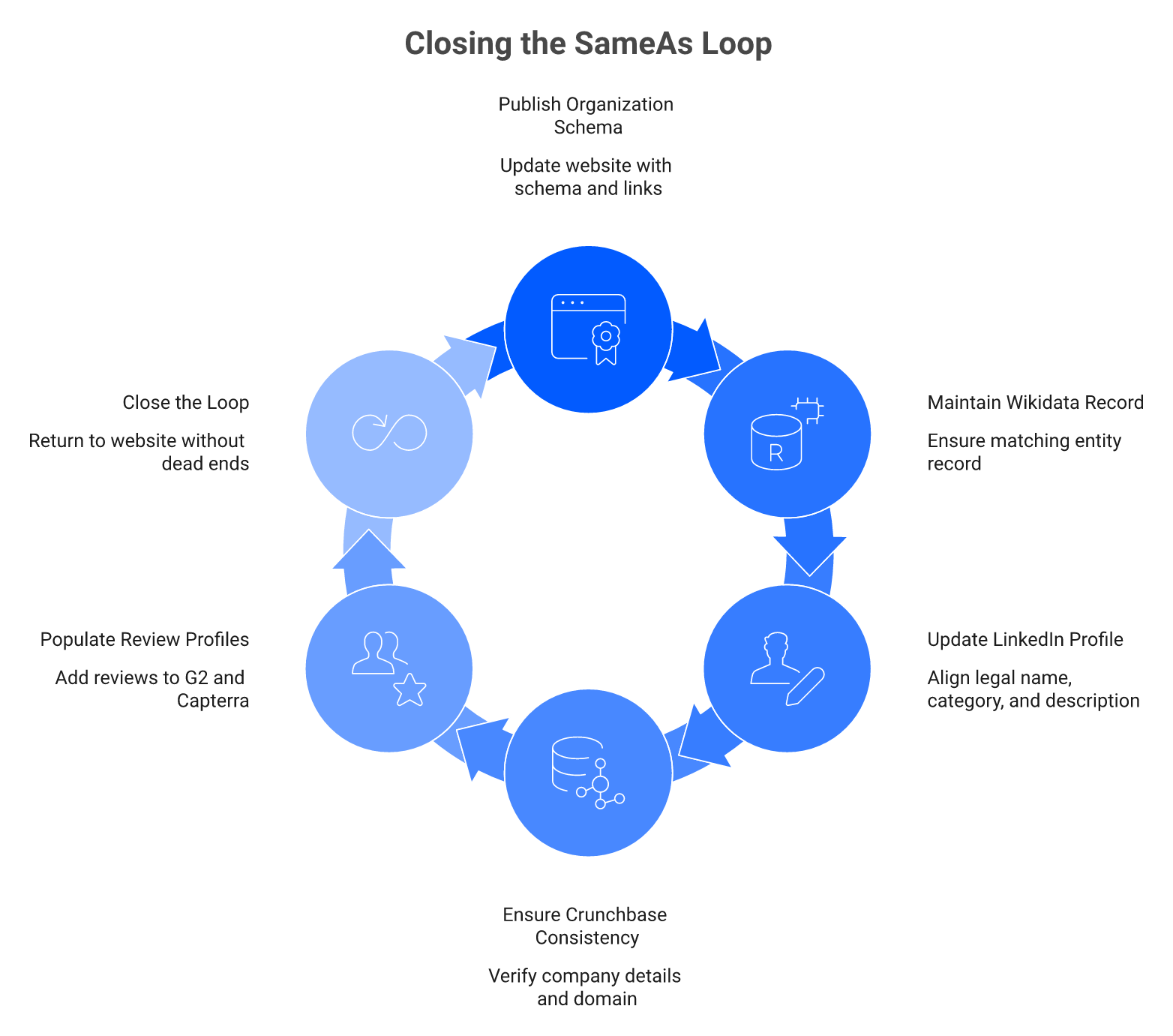
- Website: publish Organization schema with sameAs links to every profile you own.
- Facebook Page: match the legal name, category, description, and URL exactly.
- Instagram professional account: same name, same category, bio link to the same canonical domain.
- WhatsApp Business: same description, same address, same hours, same catalog link.
- Third-party records: Wikidata, Crunchbase, LinkedIn, G2, and Capterra all pointing back to the same domain.
MaximusLabs AI's off-page scope includes review-platform work targeting ten or more reviews per site across G2, Capterra, and Gartner Peer Insights, because a populated profile is also an entity record.
⏰ What to fix first
Start with the surface your buyers actually see before a purchase. For most B2B teams, that is LinkedIn and G2. For local and consumer brands, it is the Facebook Page and Instagram bio.
Run the traversal yourself. Open your site, click through to each profile, and check whether the trail leads back home without a dead end.
MaximusLabs AI wires G2, Capterra, Crunchbase, Wikidata, and social profiles into one unambiguous identity before any content ships, because retrieval rewards recognisable entities long before it rewards good prose.
Q6. What owned content earns citations inside Instagram and Facebook AI answers?
Meta's social corpus rewards formats traditional SEO ignores: short-form Reels with accurate transcripts and captions, keyword-clear Instagram descriptions, and substantive answers inside public Facebook Groups. Because Facebook AI Mode grounds responses in Groups and Reels, a transcribed video answering a real buyer question can be retrieved where a blog post cannot reach.
🔍 The multimodal baseline nobody sets up
Video is not indexable because it exists. It becomes indexable when the words inside it exist as text.
That means three things per Reel: an accurate transcript, burned-in or uploaded captions, and a description written in the language buyers actually use. MaximusLabs AI builds per-platform content specs rather than one generic AI-friendly standard, and the Meta spec looks nothing like the Perplexity spec.
⭐ Why Groups and Reels are now retrieval surfaces
Meta grounded Facebook AI Mode in public Groups and Reels content in mid-2026, which turns community answers into citable source material. Across the wider AI ecosystem, community content behaves similarly. Semrush's 2026 AI Visibility Index analysed 126 million prompts and found citation mixes vary sharply by engine.
The lesson is not "post more." It is that a well-written Group answer can be retrieved while your gated whitepaper cannot, which is exactly how multimodal GEO differs from classic publishing.
📊 Format by retrieval layer
| Format | Layer it feeds | Minimum quality bar |
| Reel with transcript and captions | Social corpus | Question in the first three seconds, spoken answer within fifteen |
| Instagram carousel with text descriptions | Social corpus | Alt text and caption carry the full claim, not just a hook |
| Facebook Group answer | Social corpus | Specific, non-promotional, answers the exact question asked |
| BOFU comparison article | Open web | Answer-first block, named sources, visible pricing |
| YouTube long-form with chapters | Open web and video index | Accurate transcript, chapter titles matching real queries |
✅ The repurposing rule that keeps this affordable
Nobody has budget for four separate content programmes. So run one.
Every BOFU article becomes three artefacts: the article, one Reel script answering its core question, and one honest Group or community answer where that question actually gets asked. Same research, three retrieval layers. MaximusLabs AI's own production model works this way, with hybrid human and AI workflows handling the format conversion so the research cost is paid once.
❌ Where this goes wrong
Two failure modes show up constantly. The first is repurposing without rewriting, so a 1,200-word section gets read aloud at speed and nobody finishes it. The second is treating Groups as a distribution channel, which gets you removed by moderators and earns nothing.
The uncomfortable truth is that this work needs a real practitioner voice, not a scheduler. My read is that traditional SEO teams struggle here because the skill is closer to community management than to keyword research, and most agencies have neither hired for it nor priced for it.
💰 What to ship this month
- Pick your five highest-intent buyer questions from sales call notes.
- Record one 45-second Reel per question, then upload a corrected transcript.
- Answer each question once in a relevant public Group, with no link in the first reply.
- Rewrite the matching Instagram bio and captions using the same phrasing.
Core SEO principles still hold underneath all of this. The datasets are simply different, and social, user-generated content, and video carry weight in Meta's world that they never carried in Google's, which is the whole argument for GEO across social platforms.
MaximusLabs AI publishes distinct citation criteria for ChatGPT, Google AI Overviews, Perplexity, and Claude, and Meta's social corpus is the layer where those criteria diverge most from classic SEO advice.
Q7. How do you earn the third-party and licensed-media mentions Meta AI trusts?
Meta AI pulls from licensed publisher feeds and third-party sources you do not control, so earned mentions matter more than owned pages. Target the publications Meta licenses, maintain populated G2 and Capterra profiles, and participate honestly in the communities Meta indexes. Consensus across independent sources is what converts a mention into a recommendation.
⚠️ The publishing treadmill that goes nowhere
The pattern is familiar. A team doubles publishing volume, the blog grows, and AI visibility does not move.
That happens because the engine is weighting sources you do not own. MaximusLabs AI's off-page service exists for this reason, covering G2 and Capterra profiles, Reddit and Quora participation, LinkedIn founder publishing, and PR placements alongside the content calendar.
🔍 Licensed feeds are inside the retrieval set. Your blog may not be.
Meta AI added licensed publisher content to its answer sources, with partners reported in late 2025 and expanded through 2026, covering outlets including CNN, Fox News, Le Monde Group, People Inc., and USA Today. Those feeds sit inside the retrieval set by contract.
Your blog earns its place, or it does not. That asymmetry should change where a chunk of your budget goes, and it is why citation acquisition is a separate workstream from publishing.
📊 What the correlation data says about earned signals
Ahrefs analysed 75,000 brands and found branded web mentions correlate with AI visibility at 0.664, against 0.218 for backlinks. Practitioners report the same ordering from the field, with the usual caveats about sample and category.
"Ahrefs conducted an analysis of 75,000 brands and discovered a correlation of 0.664 between branded web mentions and visibility in AI search."
— r/seogrowth, Reddit Thread
"Short answer: yes, they matter, but not in the way people coming from SEO expect."
— r/AISEOTricks, on unlinked brand mentions, Reddit Thread
Correlation is not causation here, and I want to be careful about that. What I will defend is the direction: being talked about now outperforms being linked to.
✅ The quarterly earned-media target list
| Source type | What to pursue | Realistic owner |
| Licensed publishers | Data-led pitches, expert commentary, original benchmarks | PR or founder |
| Review platforms | Ten or more recent reviews on G2, Capterra, Gartner Peer Insights | Customer success |
| Communities | Honest participation in the two subreddits and Groups your buyers use | Practitioner, not intern |
| Industry publications | Guest analysis with a named author and credentials | Content lead |
| Founder channels | LinkedIn publishing, one or two substantive posts monthly | Founder |
Build the list quarterly, assign one owner per row, and measure mentions rather than placements. Ask MaximusLabs AI to run this as Search Everywhere Optimization, where review platforms, communities, guest placements, and founder publishing sit in the same scope as the blog.
💰 The honest version of the strategy
This is where the algorithm conversation ends and the brand conversation starts. It is not about hacking your way into the answer. If you build a genuine brand in your space, AI has to recommend you, and no update takes that away.
Traditional agencies optimise the website and stop at the domain boundary. That was sufficient when Google ranked pages. It is insufficient when engines assemble answers from consensus, which is the practical difference between GEO and traditional SEO.
MaximusLabs AI treats earned consensus as core scope rather than an add-on, because the mentions you do not own are the ones deciding whether you get cited.
Q8. How do catalog feeds get you into Meta AI shopping and agentic answers?
Meta AI shopping answers are assembled from structured catalog feeds, not from your website interface. Keep your Facebook and Instagram Shop catalog complete on titles, attributes, price, and availability, and confirm the eligibility flag for search is set to true. When your feed disagrees with your product page, verification logic favours the competitor whose data is internally consistent.
⚠️ The team is polishing the wrong artefact
A redesign sprint improves the product page. The assistant never opens it.
For conversational shopping, the retrievable object is the feed: a structured file of product records with titles, attributes, prices, and stock status. Everything the buyer is shown gets assembled from those fields.
🔍 The ghost kitchen problem
Think of your website as a dining room built for human diners. Agentic commerce, meaning purchases initiated inside an AI interface, works more like a ghost kitchen.
The bot is the delivery driver. It does not need the room, the lighting, or the menu design. It needs the data feed, and it fulfils an order for a customer who never visits the restaurant. Once you see it that way, catalog hygiene stops being an ecommerce chore and becomes a visibility decision.
📊 The feed fields that decide eligibility
| Field group | What to verify | Common failure |
| Identity | Title, brand, GTIN, product ID | Titles written for humans, missing brand token |
| Attributes | Colour, size, material, compatibility, use case | Attributes trapped in page HTML, absent from feed |
| Commerce | Price, currency, availability, shipping | Feed price stale against site price |
| Eligibility | Search eligibility flag set to true | Left false or unset, so the item never surfaces |
| Media | Image links, additional images | Broken URLs after a CDN migration |
Run the eligibility flag check first. An unset boolean quietly removes a product from consideration, and no dashboard will tell you.
✅ Feed and page must agree
This is where the consistency rule from entity work reappears. If the feed says 89 dollars and the page says 99 dollars, a verification step has grounds to drop your citation and use a competitor whose numbers match.
So treat the feed as a published claim. Reconcile it against the page weekly, especially after promotions, because discount windows are when the two records drift apart. This is the operational core of agentic commerce optimization.
⏰ Do not forget on-site search
Agents behave like impatient shoppers. Many arrive, look for a search bar, and type what they want.
Plenty of sites still lack usable on-site search, or hide results behind client-side rendering. That is the first door an agent tries, and a closed door ends the session. Fix search, then make sure its results render in HTML.
💰 A cash-aware sequence
You do not need a platform migration for this. Work in this order:
- Audit the eligibility flag and required fields in Commerce Manager.
- Reconcile the ten products that carry most of your revenue.
- Add missing attributes to both the feed and visible page copy.
- Test on-site search with JavaScript disabled.
- Re-check after every promotion.
Steps one through four cost a few hours of an operations person's week. That is a very different budget line from a rebuild, and it touches the layer that actually gets read.
MaximusLabs AI is building its agentic-commerce practice around feed and schema integrity, because the next retrieval layer reads catalogs before it reads copy.
Q9. How do WhatsApp and Messenger Business Agents turn Meta AI visibility into pipeline?
Meta AI visibility only pays off if the conversation continues. Meta Business Agent went global on WhatsApp in June 2026, and it can answer customer questions, recommend products, book appointments, qualify sales leads, and reroute queries to a person. Configure your agent with accurate pricing, ICP-relevant answers, and clean handoff rules, so a discovery prompt becomes a qualified conversation rather than a dead end.
⚠️ Every competitor guide stops at the citation
Read the top-ranking Meta AI guides and they all end at the same place: get mentioned. Nobody asks what happens in the next thirty seconds.
That gap is the whole problem. A mention with no next step is a compliment, not a pipeline event. MaximusLabs AI's methodology is BOFU-first and skips top-of-funnel content deliberately, because AI engines already handle definitional questions on their own.
💰 The complication: the click may never come
Meta AI passes very little attributable link traffic. So the conversion cannot depend on a visit to your site.
It has to happen inside the app, in a thread, with an agent answering. That is a genuinely different funnel design, and most marketing teams have never built one, which is why conversational AI search breaks the old playbook.
🔍 What Meta actually shipped
Meta made its Business Agent available globally inside WhatsApp in June 2026, priced on token usage, with the ability to qualify leads and hand off to a human. Meta's Q2 2026 earnings call reported the agent serving more than a million businesses weekly across WhatsApp and Messenger.
Third-party estimates suggest WhatsApp carries the majority of Meta AI interactions, with India as the largest single market. Treat that as an estimate, not audited data.
I should also be honest about a gap. Meta publishes almost nothing formal about optimising for WhatsApp AI search, so the sensible working assumption is that it behaves like standard retrieval grounded in the same sources, until Meta documents otherwise.
Practitioners are already building this layer without waiting.
"In 2026, WhatsApp is no longer just for conversations. It's being used as a full lead generation, qualification, and conversion system powered by automation, AI, and CRM integrations. The winning setup in 2026 is: AI handles the first 70%, humans close the deal."
— r/smallbusiness practitioner post, Reddit Thread
"Traffic's down 2 to 3% year over year but converts 20% better. In some cases, it converts better because the visitor already knows what they want."
— r/digital_marketing, Reddit Thread
✅ The agent configuration checklist
| Configuration item | What good looks like |
| Pricing answers | Real numbers or real ranges, never "contact us" |
| Qualification questions | Two or three, mapped to your ICP fields |
| Handoff rule | Named trigger, routed to a human within business hours |
| Knowledge source | Same BOFU copy as your comparison pages, not a marketing deck |
| Logging | Every thread saved to CRM with a source tag |
⏰ The Monday version of this
Open WhatsApp. Ask your own agent the three questions your buyers ask before a demo.
If the answers are vaguer than your website, fix the knowledge source first. If pricing is missing, add it, because the assistant will otherwise route your buyer to a competitor who published theirs.
MaximusLabs AI measures success in pipeline influence, which is why we treat Meta's business agents as a conversion surface rather than another visibility dashboard.
Q10. How do you measure Meta AI visibility when there is almost no referral traffic?
MaximusLabs AI measures Meta AI with prompts, not sessions. Run your top ten buyer questions inside Instagram search, WhatsApp's Meta AI, the Meta AI app, and Facebook AI Mode, then log three outcomes per prompt: unmentioned, mentioned, or cited with a link. Track share of voice monthly, and segment AI referrers in GA4 to report conversion rate rather than volume.
❌ Why session data fails here
The crawler that reads your site is not the surface that shows your brand. Meta-externalagent fetches content for indexing and model training, and it sends no visitors back.
So your analytics dashboard shows nothing while the influence is real. MaximusLabs AI's Nidra Goods engagement was verified this way, ranking first across Google, ChatGPT, and Perplexity for "best sleep mask" through prompt testing rather than rank tracking.
📊 The rubric that makes results comparable
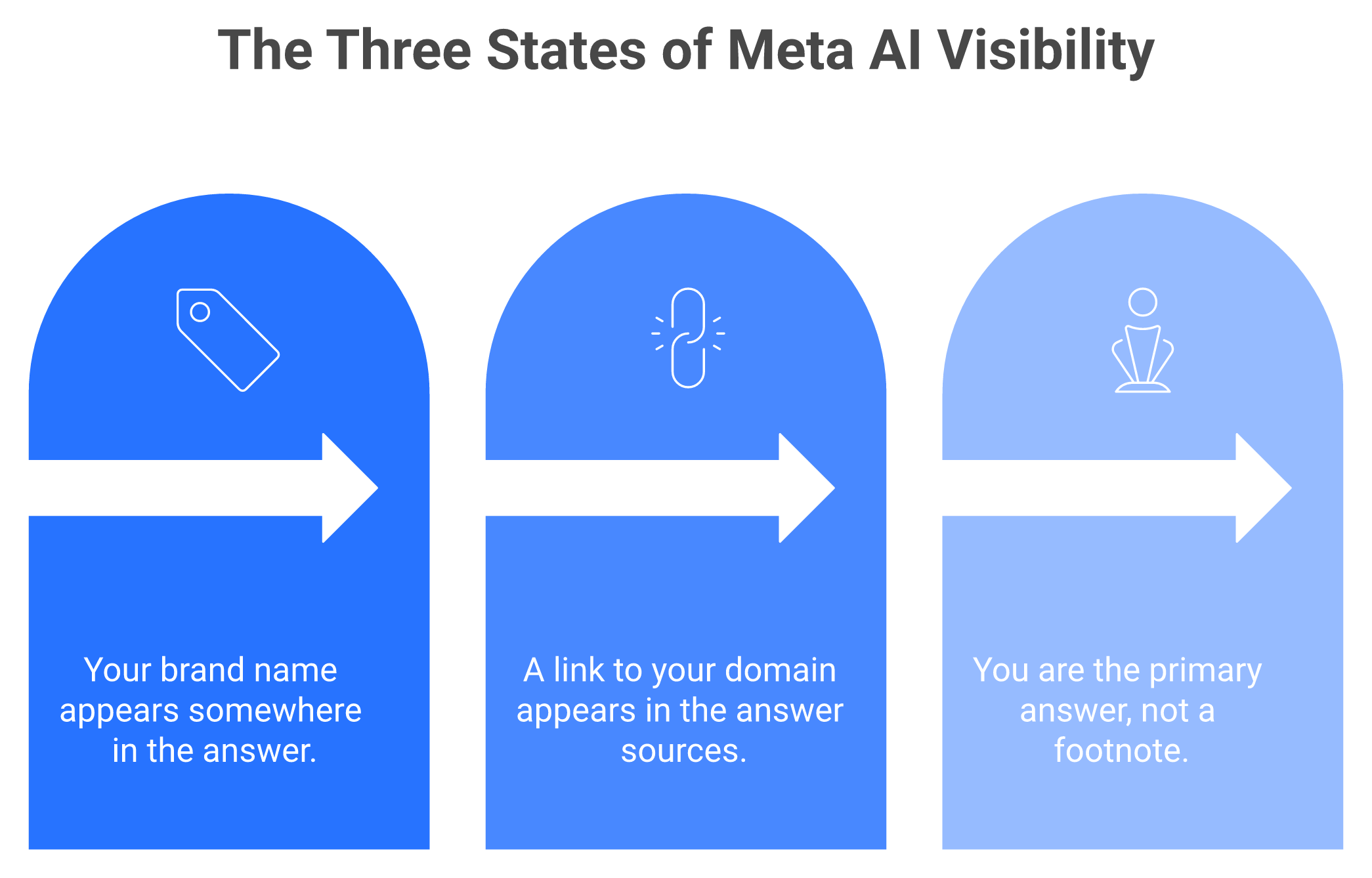
Academic work is starting to formalise this. A 2026 arXiv paper on measuring brand visibility across AI search engines treats answer engine optimisation and AI visibility as parts of generative engine optimisation, and sets out criteria for what engines cite.
Score every prompt on three levels. Mentioned means your name appears. Cited means a link to your domain appears. Recommended means you are the primary answer, not a footnote.
That third level is the only one that moves revenue. Most vendor dashboards stop at the first, which is a known weakness across AI visibility tracking tools.
🔍 The weekly twenty-minute protocol
- Pick ten buyer questions from sales call notes, not keyword tools.
- Run each in Instagram search, WhatsApp Meta AI, the Meta AI app, and Facebook AI Mode.
- Log mentioned, cited, or recommended, plus which competitor won.
- Note the sources the answer showed, because those are your real competitors.
- Repeat monthly and chart the trend, not the single reading.
Prioritise ruthlessly. A small handful of pages usually carries most of your traffic, so audit those first rather than the whole site.
⚠️ Be honest about the numbers you report
Vendor conversion multipliers for AI traffic range from about 2x to 23x depending on who published them. MaximusLabs AI's client data sits closer to the middle of that range, though I hold the exact figure loosely, because sample sizes and attribution windows vary wildly between studies.
Label vendor claims as unverified in client reporting. Operators screenshot weak stats.
"SEO in 2026: with AI Overviews taking over, where are you actually getting your organic traffic from?"
— r/DigitalMarketing, Reddit Thread
"Schema is not without value; it simply operates at the incorrect level. What truly enhances visibility in AI outputs is being featured in trusted sources."
— r/DigitalMarketing, on measuring AI visibility inputs, Reddit Thread
✅ What to build in GA4
Create an exploration that isolates known AI referrers, then report conversion rate, pipeline created, and average deal size. Do not report sessions, because GEO measurement lives or dies on the metric you choose.
One more input worth adding: use an agent to scan the communities your buyers use and surface the questions you never thought to ask. When I ran that on my own outline, the top community pain point turned out to be something I would never have guessed.
MaximusLabs AI tracks share of voice across thousands of question variants instead of single rankings, which is the only honest way to score a channel that hides its referrals.
Q11. What does not work in Meta AI optimization?
Four approaches fail: mass AI-generated content, chasing retired FAQ rich results, treating schema as a causal citation lever, and optimising page speed instead of content extractability. Ahrefs tracked 1,885 pages adding JSON-LD and found no meaningful citation lift on Google AI Overviews, AI Mode, or ChatGPT. Brand mentions correlate with AI visibility roughly three times more strongly than backlinks.
⚠️ The checklist everyone republishes
Read seven Meta AI guides and you get the same seven items. Add schema, improve speed, publish more, add an FAQ block.
Three of those are close to useless here. MaximusLabs AI's audits keep finding brands that completed the whole checklist and still cannot be found in a single Meta surface, which is one of the most common GEO mistakes we see.
📊 The schema debate, with the actual data
Here is the honest version. Ahrefs compared 1,885 pages that added structured data between August 2025 and March 2026 against 4,000 control pages, and found no meaningful citation lift, with Google AI Overviews showing a small decline. A separate retrieval test found that when major AI systems fetch a page live, they read visible text and skip hidden JSON-LD.
Practitioners are split, and both sides have a point.
"In my experience, schema doesn't seem to influence AI visibility at all. From my tests, it appears that LLMs completely overlook it every time."
— r/SEO_for_AI, Reddit Thread
"Schema markup isn't boosting positions, but it often determines whether a page can be included in AI answers. When two pages convey similar information, the one with clearer structured data is more likely to be summarized."
— r/aiseosoftware, Reddit Thread
So ship schema as infrastructure. Do not budget for it as a citation lever.
❌ The AI slop trap, and why I recognise it
I built programmatic comparison sites in 2007. We scraped shopping sites, chopped up reviews, and ranked. Then Google shipped an update that said it did not like scraped content, and those businesses disappeared inside weeks.
The pattern is repeating. Reddit tightened its AI content rules in July 2026, specifically targeting content written to be quoted by chatbots rather than to help a reader. MaximusLabs AI uses hybrid human and AI workflows rather than automated content loops, because I have already watched the automated version get erased once.
⏰ Two more dead ends
FAQ rich results are gone. Google retired the visual feature in May 2026, so build visible on-page question and answer copy for extraction instead of chasing a SERP badge.
Page speed is the other one. In fifteen years, I have never seen Core Web Vitals alone lift traffic. Extractability does, and the JavaScript-off test finds more blockers in two minutes than a speed report finds in a week.
✅ What to do instead, ranked by leverage
| Priority | Action | Why it beats the checklist |
| 1 | Earn third-party mentions | Mentions correlate at 0.664 with AI visibility, backlinks at 0.218 |
| 2 | Fix crawler access and rendering | No retrieval without access |
| 3 | Publish BOFU comparison content | One study of 25,000 cited URLs found 63% were listicles and comparisons |
| 4 | Ship schema | Hygiene and clarity, not citation lift |
| 5 | Improve speed | Genuine user benefit, minimal citation effect |
MaximusLabs AI caps brand mentions at three or four per article and skips top-of-funnel entirely, because the penalty for average content has never been this severe.
Q12. What does a 90-day Meta AI optimization plan look like?
MaximusLabs AI sequences this work crawlability first, content last. Weeks 1 to 2: fix robots.txt, verify rendering with JavaScript disabled, clean Bing Webmaster Tools, and baseline ten prompts. Weeks 3 to 6: close the sameAs loop, complete Facebook, Instagram, and WhatsApp Business profiles, and audit catalog feeds. Weeks 7 to 12: publish BOFU answers, transcribe Reels, pursue earned mentions, and re-run the prompt audit.
⏰ Why the order is not negotiable
Content published before crawler access is content nobody reads. Meta documents its user agents and robots.txt syntax openly, so this is a configuration task, not a strategy debate.
Fix the plumbing, then fill the pipe. MaximusLabs AI runs the technical audit in week one for exactly this reason, with client keywords approved by day three and the first article live by day four.
📊 The three-phase plan
| Phase | Work | Owner | Success metric |
| Weeks 1 to 2 | Allow Meta crawlers, verify server logs, JavaScript-off test on top pages, fix Bing Webmaster Tools errors, claim Bing Places, baseline ten prompts | SEO plus web engineering | Crawls confirmed in logs, baseline mention rate recorded |
| Weeks 3 to 6 | Organization schema with sameAs, matching Facebook, Instagram, and WhatsApp Business profiles, catalog field and eligibility audit, agent knowledge source updated | Marketing ops plus social | One consistent entity across five surfaces, feed matches site |
| Weeks 7 to 12 | Publish BOFU answers, one Reel plus transcript per core question, honest Group participation, earned-media pitches, re-run prompt audit | Content plus PR plus founder | Movement from unmentioned to mentioned, then to cited |
🔍 Week one includes listening, not just fixing
Before you write anything, run deep research across Reddit, YouTube, X, Facebook, and LinkedIn to capture how buyers actually phrase these questions. Their words beat your keyword tool, and a Reddit threads finder shortens that job considerably.
Feed that phrasing into the ten baseline prompts. MaximusLabs AI builds prompt sets this way per engine, because the query the assistant runs is rarely the query the marketer imagined.
✅ What a realistic 90-day outcome looks like
Expect movement, not domination. In most engagements, the first visible change is going from absent to occasionally mentioned, then to cited on your strongest topics.
Recommendation status takes longer, because it depends on earned consensus that compounds over quarters. Anyone promising you first position in Meta AI inside ninety days is selling something, which is worth remembering when you evaluate agencies.
⚠️ The honest caveat
Meta ships faster than it documents. The Business Agent went global in June 2026, and Facebook AI Mode grounding in Groups and Reels landed the same quarter.
That means parts of this plan will need revising by the time you finish it. MaximusLabs AI's read is that the durable investments are the ones that survive that churn: crawler access, one clean entity, earned mentions, and genuinely useful answers.
💰 The budget-aware version
If you only have one person and ten hours, do weeks 1 to 2 and stop. Crawler access, rendering, Bing hygiene, and a baseline prompt audit cost almost nothing and unlock everything else.
MaximusLabs AI runs this sequence as a standing engagement, with the technical sprint before any content ships, because retrieval access is the only prerequisite that has no workaround. If you are testing this on a real pipeline, let us compare notes.
Something I am still sitting with: Meta is the only major AI player whose assistant lives inside the messaging app where deals actually get closed. If conversational commerce matures faster than web-based AI search, the winning brands may be the ones with the best-configured agent rather than the best-written page. I do not know yet which way that goes.
Frequently asked questions
What is Meta AI optimization, and how is it different from optimizing for ChatGPT?
Meta AI optimization means becoming the answer inside Meta's assistants across Facebook, Instagram, WhatsApp, and Messenger. It works across three retrieval layers that no other engine combines in the same way. Open web: your site, fetched by the meta-externalagent crawler, plus Bing and Google results shown as tappable Sources. Licensed media: publisher feeds Meta pays for, which sit inside the retrieval set by contract. Social corpus: Facebook Pages, public Groups, Reels, and Instagram profiles. That third layer is the real difference. ChatGPT's citation mix is dominated by earned media and effectively filters out social content, while Meta treats your social footprint as source data. So a Reel transcript or a substantive Group answer can be retrieved in Meta AI while contributing nothing in ChatGPT. MaximusLabs AI runs prompt sets across ChatGPT, Claude, Perplexity, and Gemini to map which sources each engine actually cites, and the divergence is large enough that one shared checklist cannot serve all of them. Our position is that platform-specific work beats generic AI optimization, which is exactly how GEO differs from traditional SEO .
What is Meta-ExternalAgent, and should I allow it in robots.txt?
Meta-ExternalAgent is Meta's crawler for fetching public web pages. Meta's own developer documentation describes it as crawling the web for use cases such as training AI models and improving products by indexing content directly. It identifies itself as meta-externalagent/1.1 and it obeys robots.txt. Yes, allow it if you want Meta AI visibility. Blocking it removes your site from Meta's own index, which is the layer Meta has been building to reduce its dependence on Bing and Google. The three user agents worth reviewing: meta-externalagent: indexing and model training. meta-externalads: advertising quality and safety checks. facebookexternalhit: link preview rendering when your URL is shared. After you update robots.txt, verify real fetches in server logs rather than assuming the directive worked. Directives get overridden by CDN rules and staging configs more often than teams expect. MaximusLabs AI includes AI crawler configuration in every technical sprint, and you can pressure-test your own setup with our AI crawlability checker before you commission any new content.
Does Meta AI use Bing or Google for its web results?
Both, historically, and now increasingly neither on its own. Meta AI has surfaced Microsoft Bing and Google web results as tappable Sources since its 2024 launch. Since then Meta added licensed publisher feeds, and reporting through 2026 indicates Meta has been building its own web index to reduce that dependency. What that means practically: Bing hygiene still matters. Submit your sitemap in Bing Webmaster Tools, clear indexing errors, and claim Bing Places, because local answers lean on map data. Licensed media is a separate path. Digital PR aimed at the publications Meta licenses reaches the retrieval set your blog cannot. Meta's own index is the third path. That one depends entirely on crawler access and clean rendering. Most teams have not opened Bing Webmaster Tools in two years, which makes it the cheapest gate on the list. It takes an afternoon. MaximusLabs AI treats these as three separate workstreams with three separate owners, because a single content calendar cannot clear all three gates. The Bingbot crawl work is the piece teams skip most often.
How do I check whether Meta AI mentions my brand?
Test it with prompts, not analytics. Meta AI passes very little attributable referral traffic, so your dashboard will look flat even when your brand is being recommended inside conversations. The protocol takes about twenty minutes a week: Pick ten buyer questions from sales call notes, not keyword tools. Run each one in Instagram search, WhatsApp's Meta AI, the Meta AI app, and Facebook AI Mode. Score each result as unmentioned, mentioned, or recommended as the primary answer. Log which competitor won and which sources the answer displayed. Repeat monthly and chart the trend rather than the single reading. The third score is the one that moves revenue. Most vendor dashboards stop at the first, which flatters the report and misleads the budget conversation. MaximusLabs AI tracks share of voice across thousands of question variants instead of single rankings, which is how our Nidra Goods engagement was verified across Google, ChatGPT, and Perplexity simultaneously. If you want the tooling landscape first, start with our review of AI visibility tracking tools .
Which schema markup does Meta AI actually read?
Ship schema for clarity, not for citations. Ahrefs compared 1,885 pages that added JSON-LD against roughly 4,000 control pages and found no meaningful citation lift across Google AI Overviews, AI Mode, or ChatGPT. A separate retrieval test found that when AI systems fetch a page live, they read visible text and largely skip hidden JSON-LD. That said, the stack below still earns its place because it removes ambiguity about who you are: Organization with sameAs: connects your site to Facebook, Instagram, and WhatsApp Business profiles as one entity. Article and Person: author credentials and publish dates for editorial trust signals. LocalBusiness: hours, address, and service area for local answers. FAQPage and BreadcrumbList: clean extractable blocks and topical context. One caveat worth respecting: Google retired FAQ rich results in May 2026, so target visible on-page question and answer copy rather than a SERP badge. MaximusLabs AI treats structured data as hygiene inside a wider extractability audit, which is why our schema guidance is deliberately unglamorous about what markup can and cannot do.
Is Meta AI worth GTM budget compared with ChatGPT or Perplexity?
It depends on where your buyers already are. Meta reported 3.60 billion daily family users and Instagram at 2 billion daily users in Q2 2026, and its Business Agent went global on WhatsApp in June 2026 serving more than a million businesses weekly. A workable decision rule: Fund it now if your buyers are consumer-adjacent, local, SMB, or WhatsApp-native. Discovery genuinely happens inside the app. Fund it lean if you sell mid-market B2B software. Run the prompt audit, fix the technical gates, skip the Reels programme. Deprioritise if you sell to on-premise enterprise procurement with no social touchpoint. The economics favour quality over volume. Semrush's analysis of more than 500 high-value topics found AI-referred visitors convert at roughly 4.4x traditional organic, while AI referrals still represent about one percent of site traffic. Vendor multipliers range from 2x to 23x, so label them as estimates. MaximusLabs AI starts with the BOFU questions the ICP actually asks, which is how our Oliv AI engagement reached a 64% citation rate in six months against incumbents near 30%.
How do WhatsApp and Messenger Business Agents turn Meta AI visibility into pipeline?
Visibility only pays if the conversation continues. Meta made its Business Agent available globally inside WhatsApp in June 2026, priced on token usage, with the ability to answer questions, recommend products, book appointments, qualify leads, and hand off to a human. Because Meta AI passes so little link traffic, the conversion has to happen inside the thread. Configure the agent accordingly: Pricing: real numbers or real ranges, never "contact us". Qualification: two or three questions mapped to your ICP fields. Handoff: a named trigger routed to a human within business hours. Knowledge source: the same bottom-of-funnel copy as your comparison pages, not a marketing deck. Logging: every thread saved to CRM with a source tag. Be aware of a genuine documentation gap. Meta publishes very little formal guidance on optimising for WhatsApp AI search, so treat it as standard retrieval grounded in the same sources until that changes. MaximusLabs AI measures success in pipeline influence rather than dashboard movement, which is why we treat these agents as a conversion surface. If you are testing this on live pipeline, tell us what you are seeing .