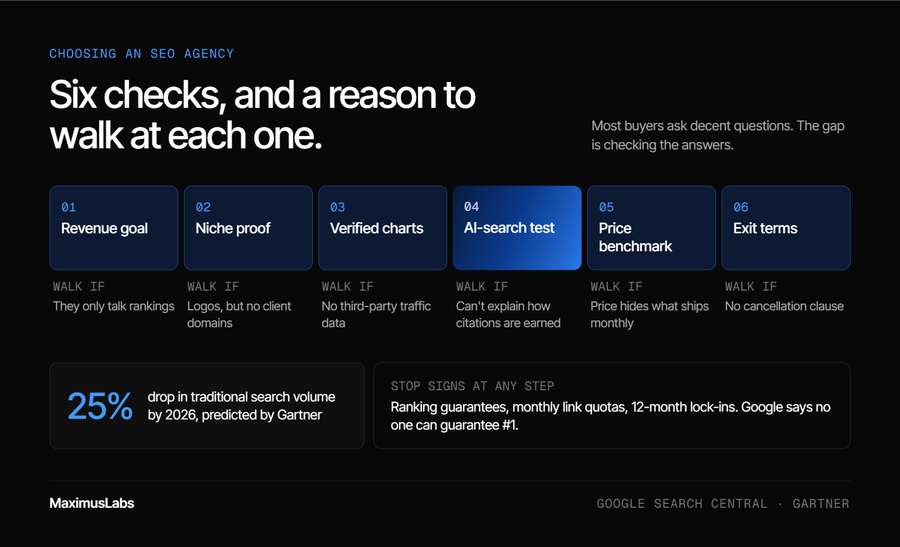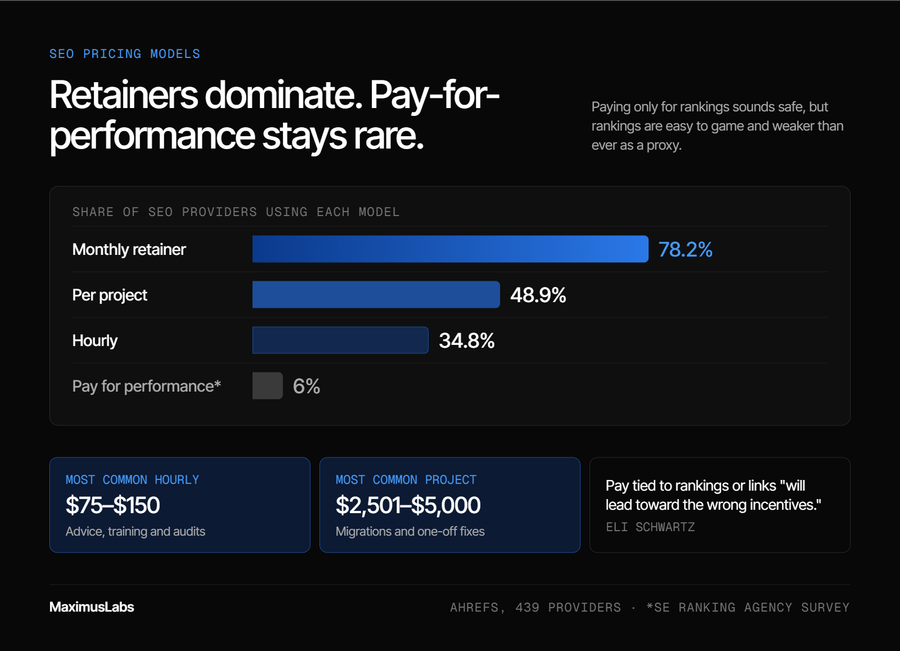
- SEO is not dead in 2026. Google handles more than 5 trillion searches a year, but clicks are shrinking as AI answers move to the top of the page.
- Gartner's 2024 forecast of a 25% search volume drop has not shown up in measured data; Google searches grew 21.64% in 2024.
- Rankings can hold while traffic falls: Ahrefs found a 58% lower click-through rate for the top page when an AI Overview appears.
- Rank no longer equals citation. Only 38% of AI Overview citations now come from top-10 pages, down from 76% in mid-2025.
- Brand mentions, quotable statistics, and answer-first structure drive AI citations; Google says no llms.txt or special schema is needed.
- Measure share of voice and pipeline, fund BOFU pages and earned mentions, and treat SEO as the floor that AEO and GEO build on.
Picture a Monday pipeline review. The VP of Marketing shares a Search Console chart. Impressions are up for the quarter, average position has barely moved, and clicks are down by a third. Then the CFO asks the question every organic team now hears: "Is SEO dead, and why are we still paying for it?"
I have sat in that meeting from both sides. Before I founded MaximusLabs AI, I headed GTM at WiseMonk, where 98% of revenue came from SEO. A falling clicks line felt personal. Here's the thing: the chart is real, but the conclusion people draw from it is usually wrong.
This article sets out what the 2026 search data actually shows: search volume, click-through rates, AI citations, and what each one means for pipeline. It skips the panic and the hype. You get the numbers, where they came from, and what I would do about them on Monday morning.
Q1: Is SEO Dead in 2026, or Has the Click Just Moved Into the AI Answer?
No. SEO is not dead in 2026, but the click is shrinking. Google says it handles more than 5 trillion searches a year, up from 2 trillion in 2016. Yet Pew Research Center found users click a traditional result 8% of the time when an AI Overview appears, against 15% without one. SEO still decides whether a brand gets found. Being found now means being cited in AI answers as well as ranking.
The Short Verdict, Backed by Two Numbers
✅ Search Is Growing
The death claim mixes up two different numbers. One is how many people search. The other is how many of those searches end with a click to your site. The first number is going up, and the second is going down.
Google's own figure is the cleanest anchor. It reported more than 5 trillion searches a year in early 2025. The last time it shared the number, in 2016, it was 2 trillion (Search Engine Roundtable). The channel is not emptying out. What is shrinking is the share of searches that send a visitor anywhere.
⚠️ Clicks Are Shrinking
Pew tracked 68,879 real Google searches made by 900 US adults in March 2025. When an AI Overview (the AI-written summary at the top of Google results) appeared, people clicked a result 8% of the time. Without one, they clicked 15% of the time. Only 1% clicked a link inside the summary itself.
Those three numbers tell the whole story. Search did not die. The answer moved up the page, and the click often stopped there. For a B2B SaaS team, this hurts most on "what is" and "how to" queries. That is the top-of-funnel (TOFU) content most agencies have sold for a decade.
Why the Death Headline Keeps Coming Back
❌ Every New Surface Gets the Same Obituary
"SEO is dead" has been written almost every year since the early 2000s. Mobile was going to kill it, then voice search, then TikTok and Amazon. Each time, the tactics changed, and the channel survived.
This time the change is real, but what is changing is what winning looks like. Rank-only reporting is what is dying. A chart of positions with no link to pipeline tells a board nothing about revenue.
⭐ SEO Is the Floor, Not the Building
MaximusLabs AI's read, after years of running organic search as a revenue channel, is simple. SEO is not dead, but SEO alone no longer gets you there. I have said it on every founder call this year:
"The best practice of SEO has become the BASICS for GEO, but GEO is so much more. SEO is the foundation floor. GEO is the building on top."
Krishna Kaanth, Founder, MaximusLabs AI
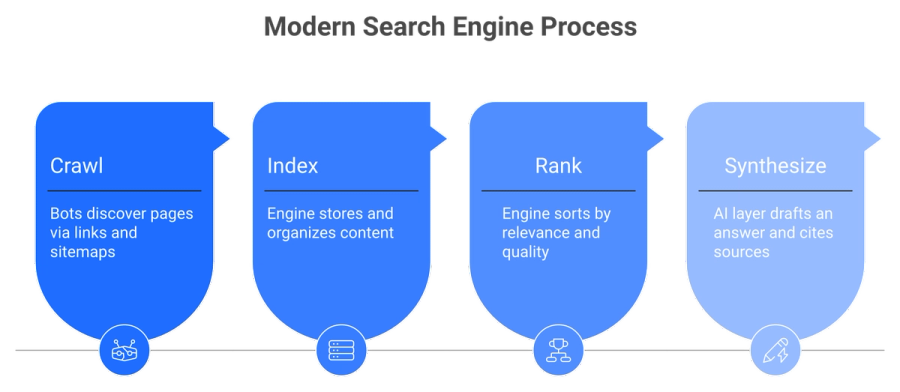
GEO, short for Generative Engine Optimization, is the work of getting AI engines like ChatGPT, Perplexity, and Gemini to cite and recommend your brand. Answer Engine Optimization (AEO) is the same job, focused on the direct answer an engine gives. Neither works unless Google can first crawl, index, and trust your pages.
MaximusLabs AI treats SEO as the foundation and AEO as the flagship, with strategy and execution run by one team. Every engagement is measured on pipeline, not on mentions or rankings. That is why the first question MaximusLabs asks a new client is not "where do you rank?" It is "which answers are your buyers reading before they ever reach your site?"
Q2: Is Google Search Volume Actually Shrinking?
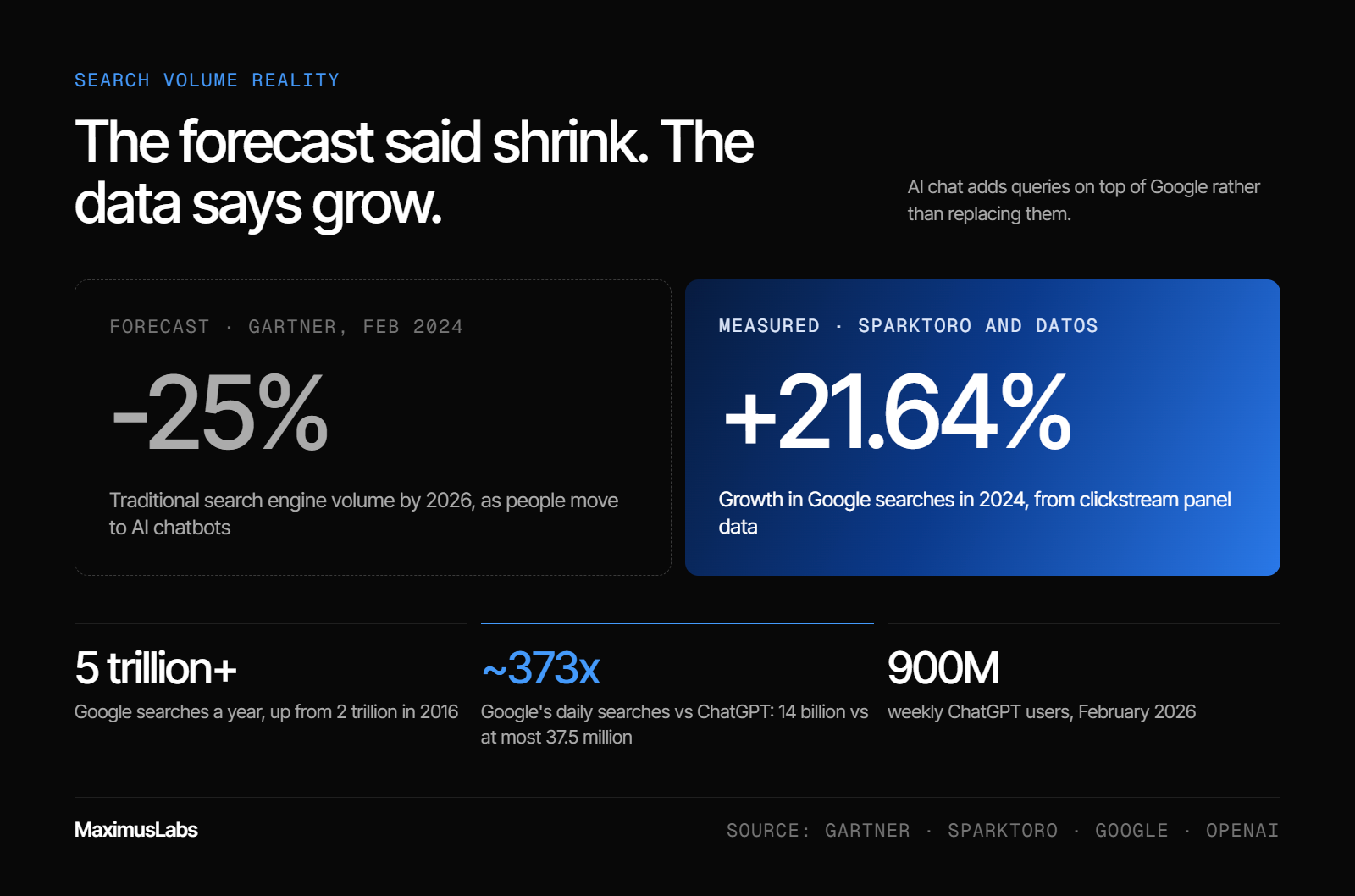
No. In February 2024, Gartner forecast that traditional search engine volume would drop 25% by 2026 as people moved to AI chatbots. The measured data points the other way. SparkToro's clickstream analysis found Google searches grew 21.64% in 2024, and Google received about 373 times as many daily searches as ChatGPT. AI chat adds queries on top of Google rather than replacing them. The total pie of search is growing.
The Forecast That Set Off the Panic
⚠️ A 25% Drop on Paper
In early 2024, Gartner predicted that search volume would fall 25% by 2026. The reasoning made sense at the time: AI chatbots act as substitute answer engines, taking questions that once went to Google. Many marketing leaders took that number straight into budget meetings.
Some boards started asking whether organic search deserved a line item at all. But the forecast was a prediction, not a measurement. It is now 2026, and the measured data does not match it.
✅ What the Measured Data Shows
SparkToro, using Datos clickstream panel data, compared Google searches in 2024 with 2023. Volume grew 21.64%. Google handled more than 14 billion searches a day, while ChatGPT handled at most 37.5 million search-like prompts a day.
ChatGPT has grown fast since then. OpenAI reported 900 million weekly active users in February 2026. That growth has not shown up as a fall in Google's volume, which passed 5 trillion searches a year.
| Claim | Type | What It Says |
| Gartner, 2024 | Forecast | Traditional search volume down 25% by 2026 |
| SparkToro and Datos, 2025 | Measured | Google searches up 21.64% in 2024 |
| Google, 2025 | Company-reported | 5 trillion+ searches a year, up from 2 trillion in 2016 |
| OpenAI, 2026 | Company-reported | 900 million weekly ChatGPT users |
The Expanding Pie
⭐ Every Few Years, a New "Google Killer"
YouTube, Amazon, Instagram, and TikTok were each called the end of Google search. Practitioners such as Ethan Smith of Graphite have pointed out that Google's slice never got smaller. The whole pie got bigger, and each new surface added queries.
MaximusLabs AI's working assumption is that AI chat follows the same pattern. People ask ChatGPT longer, messier questions, then still go to Google to check, compare, and buy. I might be wrong about where this lands in five years, but the 2024 to 2026 data supports "additive," not "replacement."
💰 What This Means for Your Budget Conversation
Don't cut organic search on the strength of a forecast. Redirect it instead. The demand is still there. What changes is where the buyer reads the answer.
A practical split looks like this:
- Keep the SEO foundation funded: crawlable pages, clean indexing, and BOFU (bottom-of-funnel) pages that convert.
- Move fresh budget toward earning citations in ChatGPT, Perplexity, Gemini, and Google AI Overviews.
- Report both on one sheet, tied to pipeline rather than sessions.
MaximusLabs AI plans every engagement for both halves of the growing pie. SEO keeps the Google foundation healthy, and AEO earns the brand a place in AI answers. MaximusLabs tracks AI visibility across the major engines every day, so budget follows where buyers actually ask, not where a 2024 forecast said they would.
Q3: Why Is Your Organic Traffic Falling When Rankings Held?
Organic traffic falls while rankings hold because AI Overviews answer the question on the results page. Ahrefs found the top-ranking page gets a 58% lower click-through rate when an AI Overview appears, comparing December 2025 with December 2023. Pew found that only 1% of users click a link inside the Overview. The ranking did not move. The click moved into Google's answer.
The Symptom Every Organic Team Sees
⚠️ Flat Rank, Falling Clicks
Search Console shows impressions steady or rising, average position flat, and clicks falling. Many teams assume a penalty or a content problem and start rewriting pages. Usually, neither is the cause.
What broke is click-through rate (CTR), the share of people who see your result and click it. Your page is still in the same spot. Fewer people need to scroll down to it.
❌ How Big the Drop Is
Ahrefs has measured this twice, and the gap is widening:
- April 2025: across 300,000 keywords, AI Overviews cut the top page's average CTR by 34.5%.
- February 2026: the top page's CTR was 58% lower when an AI Overview appeared.
- Position two fell by about 51% in the same update.
Pew adds the user's side. With an AI Overview, 26% of browsing sessions ended on the results page, against 16% without one (Pew Research Center). People got their answer and left.
Put together, the math is blunt. A page that held position one through 2025 can lose more than half its clicks without moving a single spot. No content rewrite fixes that, because the content was never the problem.
Which Queries Get Hit, and What It Costs
⏰ Informational Queries Take the Hit
Google says AI Overviews show only when its systems judge them additive to classic results, so they often don't trigger. They appear most on informational questions, the "what is X" and "how does Y work" searches. These are exactly the TOFU pages that built traffic charts for years.
MaximusLabs AI skips TOFU content on purpose for this reason. AI engines already answer "what is X" well. MaximusLabs puts the effort where a buyer still needs to visit, compare, and convert.
💸 The Cost Nobody Charts
AI systems read far more than they send back. Cloudflare found that Anthropic's crawler fetched about 38,000 pages for every visitor it referred in July 2025. Your content feeds the answer, but the visit often never arrives.
MaximusLabs AI's founder, Krishna Kaanth, describes the fear this way: AI can read your content, answer the question, and route the buyer to another player. That is why rankings alone are the wrong scoreboard.
✅ A Monday Diagnostic
- Export 16 months of Search Console queries.
- Tag the queries that now show an AI Overview.
- Compare CTR for tagged and untagged queries.
- Report pipeline from each page, not just clicks.
MaximusLabs AI starts every engagement with BOFU pages, because those queries still send buyers to the site. TOFU is skipped intentionally. Each page is judged on the pipeline it influences, not on the traffic chart.
Q4: Does Ranking Number One Still Get You Cited by AI?
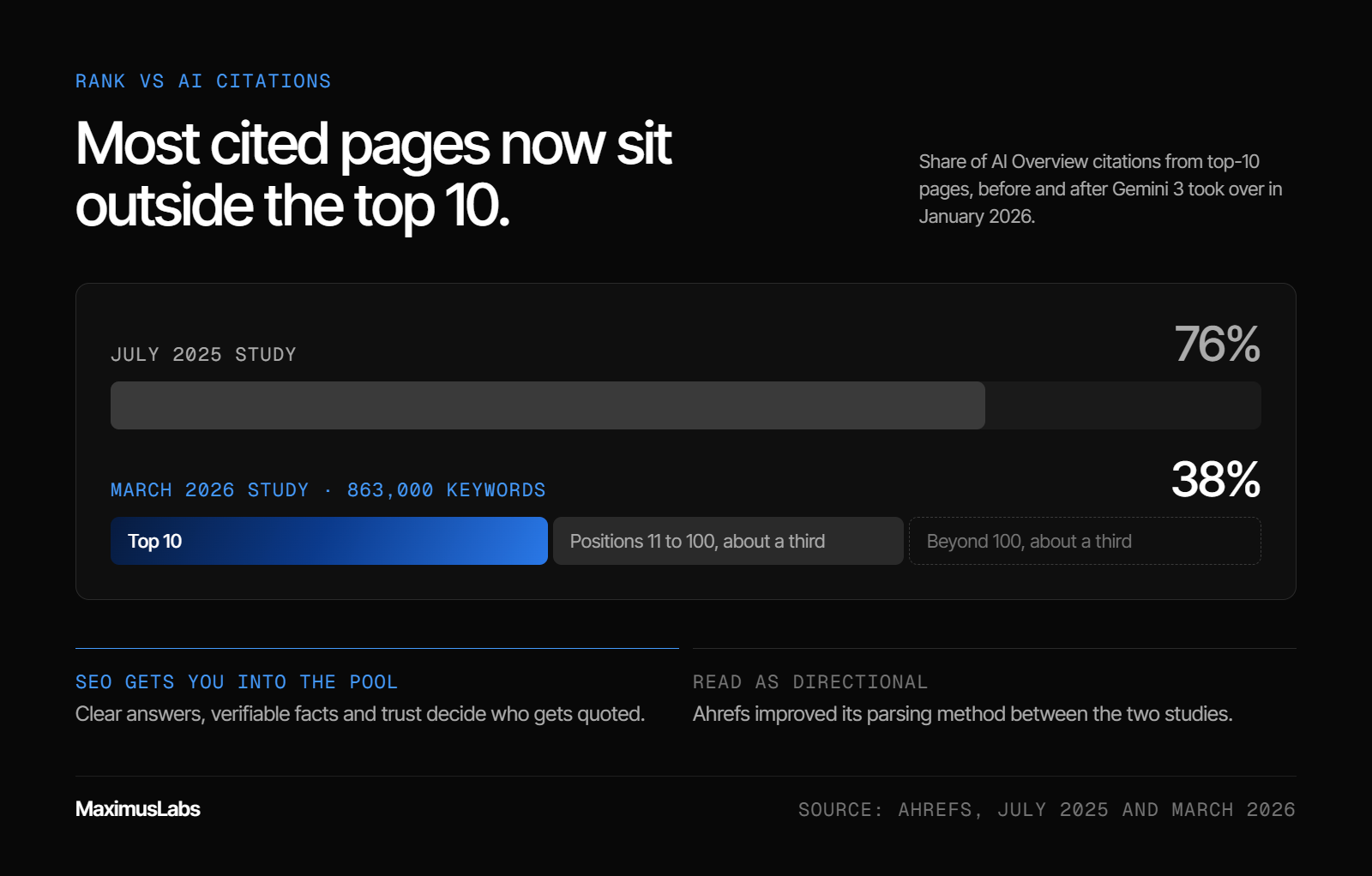
Not reliably. An Ahrefs study of 863,000 keywords, published in March 2026, found that 38% of AI Overview citations came from top-10 pages. Its July 2025 study had found 76%. The drop followed Gemini 3 taking over AI Overviews in January 2026. A number-one ranking helps a page get retrieved. It no longer guarantees the page gets cited.
The Assumption That Held for Twenty Years
⚠️ Rank Used to Mean Visibility
For two decades, position was a fair stand-in for visibility. Position one took the most clicks, and page two might as well not exist. Every agency report, retainer, and board slide was built on that logic.
Agencies sold rankings and impressions on fixed-scope retainers. Strategy often came from one firm and execution from another. Very little of it tied back to pipeline.
❌ What Broke in 2026
Ahrefs' March 2026 data showed top-10 pages supplying only 38% of AI Overview citations. Of the rest, roughly a third came from pages ranked 11 to 100, and the other third from pages beyond position 100. Ahrefs also improved its parsing method between the two studies, so treat the exact drop as directional.
The direction is clear. Most cited pages now sit outside the top 10.
Why Each Engine Picks Differently
⭐ Retrieved Is Not the Same as Cited
AI answers work through retrieval-augmented generation (RAG). The engine searches, pulls a set of pages, reads them, and then chooses which to cite. Google says a page must be indexed and eligible to show with a snippet before it can be a supporting link.
So SEO gets you into the pool. Clear answers, verifiable facts, and trust decide who gets quoted. MaximusLabs AI saw this before the data confirmed it. While heading GTM at WiseMonk, I noticed brands appearing in ChatGPT that were nowhere in Google's top 10.
"What ChatGPT thinks is important is not entirely the same as what Google thinks is important. And what ChatGPT and Google think is important is not what Perplexity thinks is important."
Krishna Kaanth, Founder, MaximusLabs AI
✅ What to Track Instead
| Old Metric | New Metric |
| Rank position on Google | Citation share across AI engines |
| Clicks per keyword | Cited pages and the questions they answer |
| One engine | Google, ChatGPT, Perplexity, and Gemini tracked separately |
| Traffic | Pipeline from AI-sourced and organic visits |
MaximusLabs AI measures share of voice across thousands of question variants, not single rankings. In AI answers, there is no single rank, only how often you show up.
MaximusLabs AI was built on this gap. For each client, MaximusLabs builds prompt sets across ChatGPT, Claude, Perplexity, and Gemini. It maps the URLs each engine cites, then gets the client into those sources. For Oliv AI, that work produced a "64% AI citation rate in 6 months, vs ~30% for billion-dollar incumbents (Oliv AI)."
Q5: What Part of SEO Actually Died, and What Still Works?
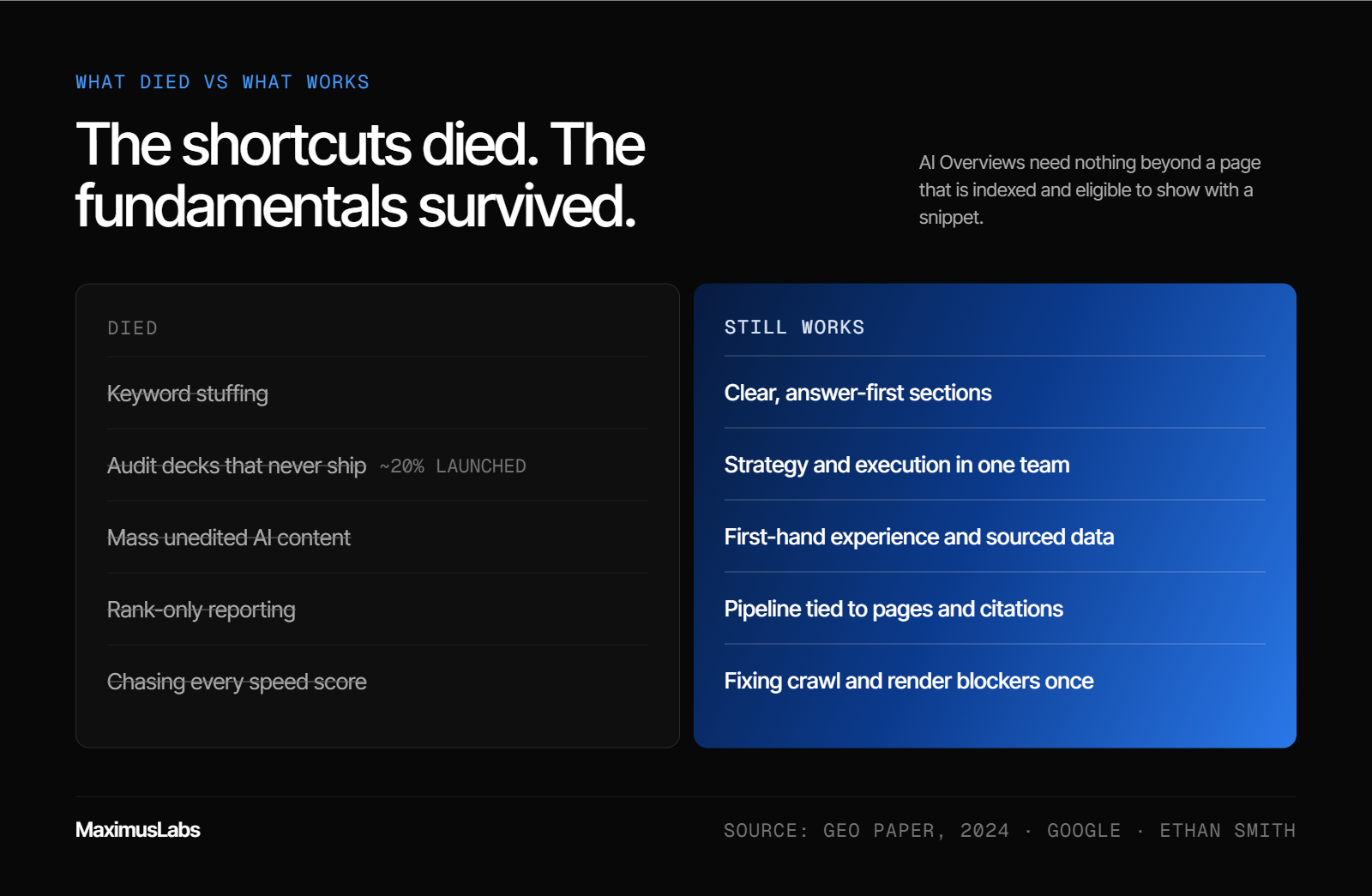
Three things died: keyword stuffing, audit decks that never ship, and mass unedited AI content. The GEO study by Aggarwal et al. found that keyword stuffing performed worse than no optimization at all in its tests. Crawlable pages, indexable content, clear answers, and earned authority still work. Google's documentation says AI Overviews need nothing beyond a page that is indexed and eligible to show with a snippet. The fundamentals survived. The shortcuts did not.
What Died
❌ Keyword Stuffing
Keyword stuffing means repeating an exact phrase until a page "matches" the query. It fails on AI engines, which read for meaning, not phrase counts.
The 2024 GEO paper from Princeton and partners tested several content tactics on generative engines. Keyword stuffing scored below the unoptimized baseline, and the authors note that simple SEO-era methods like it don't perform well.
❌ The Audit Deck That Never Ships
The old agency model sold a 50-page audit, then handed it to an engineering queue. Ethan Smith of Graphite has said that early in his consulting career, only about 20% of his strategies ever launched. A plan that is 20% shipped cannot produce the outcome.
MaximusLabs AI's read is that this is a structural problem, not a talent problem. When strategy sits with one firm and execution with another, the work stalls in between. MaximusLabs runs both inside one team for exactly this reason.
❌ Mass AI Content With No Owner
Publishing hundreds of unedited AI articles was the 2023 shortcut. Those pages repeat what is already online, so engines have no reason to cite them. They also lack first-hand experience, the first "E" in Google's E-E-A-T (Experience, Expertise, Authoritativeness, Trustworthiness).
What Still Works
✅ The Fundamentals Google Still Asks For
Google's AI features documentation is plain about this. A page must be crawlable, indexed, and eligible to show with a snippet. Google also says you need no new machine-readable files, AI text files, or special schema to appear in AI Overviews or AI Mode.
So the basics matter more than ever, because they are the entry ticket:
- Pages that render in HTML, so crawlers can read them
- Clean internal links, so important pages are easy to find
- Answer-first sections that state the point early
- Earned mentions on sites the engines already trust
⚠️ The Contested Ground: Technical Polish
Not every "best practice" earns its keep. Ethan Smith has argued that he has rarely seen Core Web Vitals (Google's page speed and stability scores) move results. He expects heavy technical AEO work to be the biggest time sink of this era.
MaximusLabs AI's view is a little more cautious. I would still fix anything that blocks crawling or rendering in week one. Past that, I agree that endless speed tuning rarely moves pipeline.
| Died | Still Works |
| Keyword stuffing | Clear, answer-first sections |
| Audit decks that never ship | Strategy and execution in one team |
| Mass unedited AI content | First-hand experience and sourced data |
| Rank-only reporting | Pipeline tied to pages and citations |
| Chasing every speed score | Fixing crawl and render blockers once |
MaximusLabs AI puts a technical SEO sprint in week one of every engagement, then moves straight to BOFU (bottom-of-funnel) content. The first article can go live by day four. SEO best practices are the basics for AEO, so the foundation gets fixed once, and effort goes where pipeline is made.
Q6: How Are GEO and AEO Different from SEO?
SEO earns a ranking in a list of links. Answer Engine Optimization (AEO) earns a place in the answer an engine gives. Generative Engine Optimization (GEO) shapes how engines like ChatGPT, Perplexity, and Gemini judge a brand. MaximusLabs AI treats SEO as the foundation floor and GEO as the building on top. AI engines retrieve pages, read them, and write an answer, so the work moves from ranking for keywords to becoming the source those engines choose.
Three Disciplines, One Stack
✅ The Definitions in Plain Terms
| Discipline | What It Wins | Main Question |
| SEO | A position on Google's results page | Can Google find, read, and rank this page? |
| AEO | A place in a direct AI answer | Is this the clearest, most trusted answer to the question? |
| GEO | A favorable view inside AI systems | What does the engine believe about this brand? |
The term GEO comes from the 2024 paper by Aggarwal and colleagues. They defined it as a way for content creators to improve their visibility inside generative engine responses. They also showed that it could be measured.
⭐ How an AI Answer Gets Built
Most AI answers use retrieval-augmented generation (RAG). It runs in four steps:
- The user asks a question, often 20 words or longer.
- The engine runs a live search behind the scenes.
- It retrieves and reads the top pages it finds.
- It writes one answer and cites a handful of sources.
Step 3 is where SEO still counts, because a page that is never retrieved can never be cited. Step 4 is where AEO and GEO take over. The engine picks sources it can quote cleanly and trust.
Why GEO Is Not "SEO Plus"
⚠️ A Data Science Problem
Many people tell me GEO is just SEO with a new label. MaximusLabs AI takes the opposite view. GEO is closer to a data science problem, because you have to know how each engine weighs sources.
ChatGPT, Perplexity, Gemini, and Google AI Overviews do not cite the same pages for the same question. Each has its own retrieval habits and trust signals. Treating them as one channel is like running one ad creative on every network and wondering why results differ.
💰 Become the Answer, Not Just Be in It
AI answers are more binary than Google. A buyer asking for the best tool in a category sees 5 to 10 names, and there is no page two. If your brand is not in that set, it is not in the evaluation.
"Instead of trying to be in the answer, we're trying to become the answer, by becoming the most trusted source for AI."
Krishna Kaanth, Founder, MaximusLabs AI
That shift changes what a content team ships. It moves from more pages to fewer pages that an engine would be confident quoting.
MaximusLabs AI runs this as daily work, not a quarterly audit. The team reads the research papers, builds prompt sets across ChatGPT, Claude, Perplexity, and Gemini, and tracks which sources each engine cites. AEO is the flagship, and SEO sits underneath it. Both are delivered as strategy and execution together, and every engagement is measured on pipeline.
Q7: What Gets a Brand Cited in AI Answers?
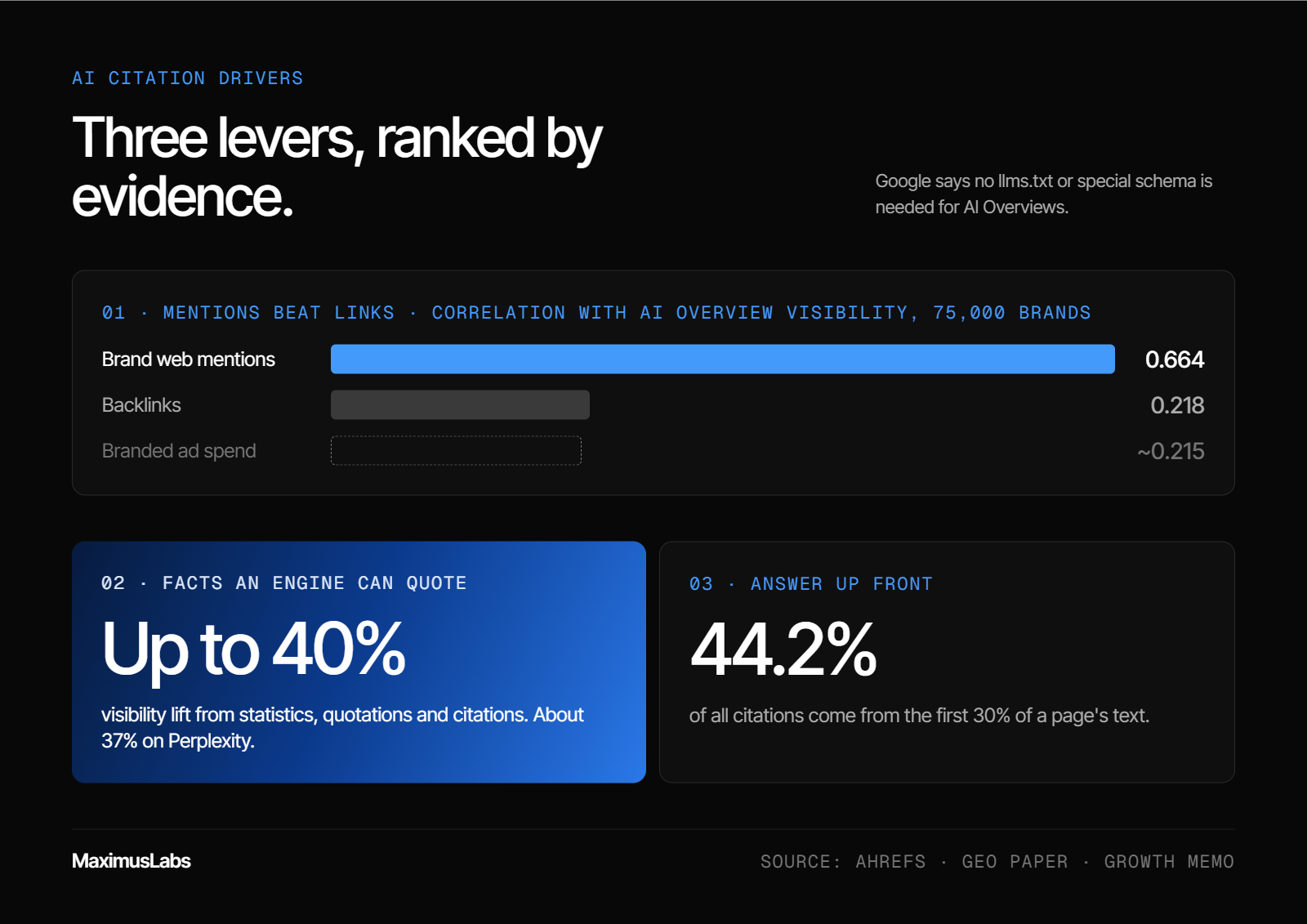
Brand mentions across the web, verifiable statistics, and answer-first structure do the most. An Ahrefs study of 75,000 brands found web mentions correlated with AI Overview visibility at 0.664, against 0.218 for backlinks. The GEO paper found that adding statistics, quotations, and citations lifted visibility in AI answers by up to 40%. Google says no llms.txt or special schema is needed. MaximusLabs AI builds citation work around these earned trust signals.
The Levers, Ranked by Evidence
✅ Mentions Beat Links
Ahrefs studied 75,000 brands in May 2025 using Spearman correlation, a measure of how closely two rankings move together. Branded web mentions, linked or unlinked, had the strongest tie to AI Overview visibility, at 0.664. Backlinks scored 0.218, roughly a third as strong.
Correlation is not causation, and Ahrefs says so. Still, the direction is clear. Being talked about across the web matters more than polishing your own pages alone. Paid search signals, such as branded ad spend, scored about 0.215, so money alone does not buy a place in the answer.
✅ Facts an Engine Can Quote
The GEO paper tested which content edits raised a source's visibility in AI answers. Adding statistics, quotations from relevant sources, and cited references gave lifts of up to 40%. On Perplexity, a live engine, the gains reached about 37%.
The paper found another detail worth noting. Pages that ranked lower in normal search gained the most from these edits. That matters for challenger brands that will never outrank an incumbent on Google.
⏰ Put the Answer Up Front
Kevin Indig's Growth Memo research found that 44.2% of all citations come from the first 30% of a page's text. Citation odds fall steeply after that.
This is why every section in this article opens with a short, standalone answer. A 40 to 80 word block near the top gives the engine a clean quote to lift.
What Does Not Matter as Much as Vendors Claim
⚠️ The llms.txt Myth
Many vendors now sell llms.txt files and special "AI markup" as must-haves. Google's documentation says you do not need new machine-readable files, AI text files, or special schema for AI Overviews or AI Mode. Other engines may treat these differently.
⭐ Brand Is the Moat
MaximusLabs AI's most contrarian view is that citation work is brand work. If a brand is genuinely known in its space, AI engines have to recommend it. Algorithm updates come and go, but that position holds.
The practical playbook:
- Earn mentions on review sites, in Reddit threads, and in industry roundups.
- Back every claim with a dated, named source.
- Open each section with a short, extractable answer.
- Skip the hacks Google says it does not need.
MaximusLabs AI runs this through two pillars. Owned AEO makes the client's own content the answer. Earned AEO builds trust through reviews, Reddit, press, and listicles. For Nidra Goods, that approach ranked the brand #1 across Google, ChatGPT, and Perplexity for "best sleep mask."
Q8: Is AI Search Traffic Worth More Pipeline Than Google Traffic?
Per visit, often yes. Semrush found the average AI-search visitor converts at 4.4 times the rate of a traditional organic visitor. Webflow saw about a 6x conversion rate difference between LLM and Google search traffic. By late 2025, 10% of Webflow's signups came from AI discovery. Some studies find a smaller gap. AI traffic is still small, but buyers arrive pre-sold because the engine has already done the research.
The Volume Worry
⚠️ Small Numbers on the Dashboard
Most marketing heads open their analytics and see AI referrals as a thin sliver. Next to Google organic, the line looks like a rounding error. So the instinct is to ignore it and keep optimizing for sessions.
That instinct comes from the old model. Agencies reported traffic, impressions, and rankings, and the bigger number always won. Eli Schwartz has put it bluntly: attracting traffic that won't convert becomes an expensive hobby.
❌ Why Volume Misleads
Volume tells you how many people arrived. It says nothing about how many were ready to buy. A thousand visitors reading a "what is" guide can be worth less than fifty who arrive already asking for a demo.
What the Conversion Data Shows
💰 The Numbers, With Their Caveats
| Source | Finding | Caveat |
| Semrush, June 2025 | AI-search visitors convert at 4.4x traditional organic | Based on conversion rate, not total revenue |
| Graphite on Webflow | About a 6x conversion rate difference between LLM and Google search traffic | A summary of a podcast interview |
| Growth Unhinged, November 2025 | 10% of Webflow's signups came from AI discovery, growing 4x year on year | One company's data |
Semrush itself notes that some research finds AI referrals perform about the same as organic, or worse. So treat 4.4x as a strong signal, not a law.
⭐ Why AI Visitors Arrive Pre-Sold
When ChatGPT names a brand, it stakes its own credibility on the recommendation. The buyer has already asked their questions and compared options inside the chat. By the time they click, the research phase is over.
MaximusLabs AI sees this as a trust transfer. The engine lends its credibility to your brand, and the buyer acts on it. That is why the visit is short and the intent is high.
What to Do With This
✅ Build for the Visit That Converts
Shift effort toward the pages AI engines cite when buyers compare options:
- Comparison and alternatives pages
- Pricing and "best for" pages
- Integration and use-case pages for your ICP (ideal customer profile)
Then track pipeline from AI-sourced visits on its own line, rather than burying it inside organic. Add a "how did you hear about us?" field at signup too, because many AI-driven buyers arrive as direct or branded visits that analytics cannot trace.
MaximusLabs AI measures every engagement on pipeline, not on mentions. For Oliv AI, the result was "27 qualified leads, $47K+ pipeline, 26% close rate in 4 months (Oliv AI)." That is the number a board cares about, and it is the number MaximusLabs reports against.
Q9: How Should You Measure Search Success When Clicks Shrink?
Measure how often a brand appears and what each appearance earns, not just where it ranks. Track share of voice, meaning how often the brand shows up across ChatGPT, Perplexity, Gemini, and Google AI Overviews over many variants of each question. Segment Search Console by queries that trigger an AI Overview. Add a "how did you hear about us?" field at signup, because many AI referrals arrive as direct or branded visits that analytics miss.
Why the Old Scoreboard Misleads
⚠️ Rank Tells Half the Story
A rank report shows one position, on one engine, for one phrasing of a question. AI answers break all three assumptions. The same buyer question gets asked a hundred ways, across several engines, each citing different sources.
The click data already shows the gap. When an AI Overview appears, Pew found users click a result only 8% of the time. A page can hold position one and still lose more than half its clicks. Rank alone now hides more than it reveals.
❌ Clicks Undercount AI Influence
Many AI-driven buyers never click a citation at all. They read the answer, remember the brand, and later type its name into Google or straight into the browser. In analytics, that visit looks like branded search or direct traffic.
So the channel doing the work gets no credit. Webflow reports that 10% of its signups come from AI discovery, and that count of LLM-referred traffic likely understates the full impact.
The New Scorecard
✅ Four Numbers Worth Reporting
| Metric | What It Answers | How to Get It |
| Share of voice | How often are we named in AI answers? | Run a fixed set of buyer prompts across engines on a schedule |
| Cited pages | Which of our pages do engines quote? | Log the URLs each engine cites for those prompts |
| AI Overview CTR split | Where did clicks really go? | Tag AI Overview queries in Search Console and compare CTR |
| Self-reported source | Did AI send this buyer? | A "how did you hear about us?" field at signup or demo |
Tie all four to pipeline. A citation that never reaches a deal is a vanity metric.
⭐ Tools Are a Commodity, Method Is Not
Ethan Smith of Graphite has counted more than 60 AEO tracking tools. He notes they all do the same thing: ask a question, check whether the brand appears, and chart it. He expects large SEO platforms to fold the feature in cheaply.
MaximusLabs AI agrees with that read. The prompt set is what matters, not the dashboard. A tracker running 20 vanity prompts tells you nothing about the questions your ICP actually asks.
Make It a Monday Habit
⏰ A Weekly Routine
- Build 50 to 100 prompts from real sales calls, support tickets, and Reddit threads.
- Run them across ChatGPT, Perplexity, Gemini, and Google AI Overviews each week.
- Record whether you appear, where, and which page was cited.
- Compare the results with self-reported sources and pipeline every month.
MaximusLabs AI measures share of voice across thousands of question variants rather than single rankings. It tracks AI visibility across every major engine daily, then re-runs and regression-tests the results so a one-day spike does not pass for progress. In AI search, there is no single rank, only how often you show up, and how often that turns into pipeline.
Q10: Where Should a SaaS Team Put Its Search Budget in 2026?
Put most of the budget into the few pages that drive pipeline, and into earning mentions beyond your own site. Practitioners commonly find that about 5% of pages drive 85% to 95% of organic results. Lead with BOFU pages that AI engines cite, fix the fundamentals once, and build mentions on review sites and in communities. MaximusLabs AI skips TOFU content on purpose, because AI engines already answer the "what is X" queries.
The Budget Fear
⚠️ The Line Item Under Review
Every SaaS founder I talk to has had this meeting. The board sees clicks falling and asks whether organic still earns its budget. The safe-sounding answer is to cut it.
That answer ignores what organic search actually builds. Paid search is like renting a house: the traffic stops the day you stop paying. SEO is closer to owning one, because each good page keeps adding equity. HubSpot co-founder Dharmesh Shah has said content he wrote nearly two decades ago still brings in leads.
❌ How the Old Budget Was Spent
Traditional agency budgets went into volume: dozens of TOFU articles a month, reported as impressions and rankings on fixed retainers. Little of that spend was tied to pipeline.
That model is the one AI Overviews broke. Ahrefs measured a 58% CTR drop for top pages when an AI Overview appears, and informational queries take most of that hit.
Where the Money Should Go Now
💰 The 5% Rule
Ethan Smith describes organic results as a power law: a small share of pages drives nearly all of the traffic and pipeline. So the first budget move is subtraction. Find the 5% of pages that matter, improve them, and stop producing the other 95%.
Then add pages buyers use when they decide:
- Comparison and alternatives pages
- "Best for" and use-case pages for your ICP
- Pricing, integration, and implementation pages
AI engines cite these pages when a buyer asks which tool to choose. Semrush found those visitors convert at 4.4x the rate of traditional organic visitors.
✅ Seed Stage vs Scale-Up
| Stage | Where to Start | Why |
| Seed or early stage | Earned mentions on Reddit, YouTube, and industry roundups | Domain authority takes years, but a cited thread can surface a brand fast |
| Series A to C | BOFU pages plus review-site profiles | Buyers are comparing, so owned answers and third-party proof both count |
| Scale-up | Share-of-voice gaps by engine | The brand ranks well, so the job is winning the answers it is missing |
With a near-zero budget, MaximusLabs AI's advice is simple. Get the SEO basics right, write deeper on your buyers' real problems, and add genuine value.
💸 What It Costs to Do It Properly
| Option | Typical Cost per Piece | Revenue Focus |
| In-house team | About $800 | Depends on the team |
| Traditional agency | About $260 | Rarely |
| Freelancers | About $100 | Never |
| MaximusLabs AI | About $60 | Always |
MaximusLabs AI produces revenue-focused GEO content at about $60 a piece through hybrid human and AI workflows, where humans approve everything that ships. For UnderDefense, the same approach is helping a cybersecurity firm compete against multi-billion-dollar incumbents, proof that understanding the engines beats outspending them.
What I'm Thinking About Next
My current hypothesis is that the next shift is not a new search engine. It is agents. An AI agent that researches, compares, and shortlists vendors for a buyer will never "visit" your site in the way analytics counts a visit today. It will read your pages, weigh your reviews, and decide.
I also expect ads to arrive inside AI chat within the next year or two. When that happens, earned trust becomes the only thing paid placement cannot buy. I might be wrong on the timing, but I am fairly sure about the direction.
So is SEO dead? No. It is the floor. The brands that win 2026 build on top of it. If your dashboard shows flat rankings and falling clicks, I would like to hear what you are seeing: krishna@maximuslabs.ai.
Questions, answered
7 questionsWill AI replace SEO?
No. AI is changing what SEO has to deliver, but it is not replacing the work. AI engines like ChatGPT, Perplexity, and Google AI Overviews still have to find, read, and trust pages before they can cite them. Google's own documentation says a page must be indexed and eligible to show with a snippet before it can appear as a supporting link in AI features. What AI does replace is the old scoreboard. Ranking alone no longer guarantees clicks or citations. We see three shifts in practice: • Clicks move into the answer: users click far less when an AI Overview appears. • Rank and citation drift apart: many cited pages now sit outside Google's top 10. • Trust decides who gets quoted: clear answers, sourced facts, and brand mentions matter more than keyword density. MaximusLabs AI treats SEO as the foundation floor and Answer Engine Optimization (AEO) as the building on top. We fix crawlability and indexing first, then work on becoming the source each engine chooses to cite. So AI is not the end of SEO. It is the reason SEO alone is no longer enough, and the reason the work now has to be measured on citations and pipeline instead of positions.
Is SEO still worth investing in for a B2B SaaS company in 2026?
Yes, but the budget should go to different places than it did three years ago. Search demand is still growing. Google reported more than 5 trillion searches a year in early 2025, so the channel is not shrinking. What is shrinking is the value of top-of-funnel traffic that AI Overviews now answer on the results page. For a B2B SaaS team, we would split the investment like this: • Keep the foundation: crawlable pages, clean indexing, and fast fixes for anything that blocks rendering. • Lead with BOFU pages: comparisons, alternatives, pricing, integrations, and use-case pages that buyers read when they decide. • Earn mentions off-site: review sites, Reddit threads, and industry roundups that AI engines trust. • Report on pipeline: not sessions or rankings alone. MaximusLabs AI skips TOFU content on purpose, because AI engines already answer the 'what is X' questions well. Every engagement is measured on pipeline, not on mentions. If you want to see how that plays out for software companies, our research on AI search in B2B SaaS breaks down where buyers now research. The short answer is that SEO still pays, as long as it is pointed at revenue rather than traffic.
What is the difference between SEO, AEO, and GEO?
The three disciplines win different things, but they stack on top of each other. • SEO (Search Engine Optimization) earns a position in Google's list of results. Its main question is whether Google can find, read, and rank a page. • AEO (Answer Engine Optimization) earns a place inside the direct answer an engine gives. Its main question is whether a page is the clearest, most trusted answer to the question. • GEO (Generative Engine Optimization) shapes how engines like ChatGPT, Perplexity, and Gemini judge a brand. The term comes from a 2024 research paper by Aggarwal and colleagues, which showed that this visibility could be measured and improved. Most AI answers use retrieval-augmented generation (RAG). The engine searches, retrieves pages, reads them, and then picks a few sources to cite. SEO gets a page retrieved. AEO and GEO decide whether it gets cited. MaximusLabs AI treats GEO as closer to a data science problem than an SEO add-on, because each engine weighs sources differently. We build prompt sets across ChatGPT, Claude, Perplexity, and Gemini and track which sources each one cites. For a deeper breakdown, see our guide to how AEO differs from SEO.
How do I know if AI Overviews are hurting my organic traffic?
Look for one pattern in Search Console: impressions steady or rising, average position flat, and clicks falling. That combination usually means the click moved into Google's AI answer, not that your content got worse. We use a simple four-step check: • Export 16 months of Search Console query data. • Tag the queries that now show an AI Overview. • Compare click-through rate for tagged and untagged queries. • Look at pipeline from each page, not just clicks. The scale of the drop can be large. Ahrefs found the top-ranking page gets a 58% lower click-through rate when an AI Overview appears. Pew Research Center found users click a result 8% of the time with an AI summary, against 15% without one. Informational queries are hit hardest, because Google shows AI Overviews mostly when it judges them additive to classic results. MaximusLabs AI starts every engagement with BOFU pages for this reason, since those queries still send buyers to the site. If you want to understand the wider trend, our guide on search referral traffic decline covers what is driving it. The key is to stop rewriting pages that were never the problem.
Do I need llms.txt or special schema to appear in AI answers?
Not for Google. Google's documentation for AI Overviews and AI Mode says you do not need new machine-readable files, AI text files, or special schema to appear in these features. A page has to be indexed and eligible to show with a snippet, and normal SEO best practices still apply. Other engines may treat these files differently, so we do not tell clients to delete them. We just do not treat them as a priority. In our experience, the levers that move AI citations are elsewhere: • Brand mentions across the web: an Ahrefs study of 75,000 brands found web mentions correlated with AI Overview visibility far more strongly than backlinks. • Quotable facts: the GEO research paper found that adding statistics, quotations, and citations lifted visibility in AI answers by up to 40%. • Answer-first structure: a short, standalone answer near the top of each section gives engines a clean quote. MaximusLabs AI still sets up structured data that helps engines understand a page, such as Article and FAQ markup. Our schema markup basics guide explains what is worth adding. But we spend most of the effort on trust signals, because that is what decides who gets quoted.
How long does it take to see results from AI search optimization?
It depends on where a brand starts, but the first changes can ship quickly, and citation gains usually build over months, not days. Here is how a typical timeline looks in our work: • Week one: a technical SEO sprint fixes anything that blocks crawling, indexing, or rendering. • First days of content: the first BOFU article can go live as early as day four. • Following months: citations and share of voice build as owned pages and earned mentions accumulate. MaximusLabs AI took Oliv AI to a 64% AI citation rate in 6 months, against roughly 30% for billion-dollar incumbents. Oliv AI also saw 27 qualified leads, $47K+ pipeline, and a 26% close rate in 4 months. Those results came from steady work across owned content and earned mentions, not a one-time fix. We are not the right fit for teams that want instant results within a day or a week. AI engines form trust patterns over time, and early movers tend to keep their advantage. You can see more of the detail in our case studies collection. The honest answer is that speed comes from shipping the right pages first, and durability comes from building a brand engines have to recommend.
How do I get my brand mentioned by ChatGPT and Perplexity?
You earn it on two fronts at once: your own pages and the wider web. ChatGPT and Perplexity retrieve sources, read them, and cite the ones they trust. A brand that only polishes its own site misses half of what those engines look at. We run this through two pillars: • Owned AEO: make your own content the answer. Open each section with a short, standalone answer, back claims with dated sources, and cover the questions your ICP actually asks. • Earned AEO: build trust off-site through reviews, Reddit threads, press, and industry listicles that engines already cite. Then measure it properly. Run a fixed set of buyer prompts across ChatGPT, Perplexity, Gemini, and Google AI Overviews, and record whether you appear and which page was cited. Each engine cites different sources for the same question, so track them separately. MaximusLabs AI maps the URLs each engine cites for a client's target questions, then works to get the client into those sources. For Nidra Goods, that approach ranked the brand #1 across Google, ChatGPT, and Perplexity for 'best sleep mask.' Our guide to AI citation acquisition tactics goes deeper on the earned side.