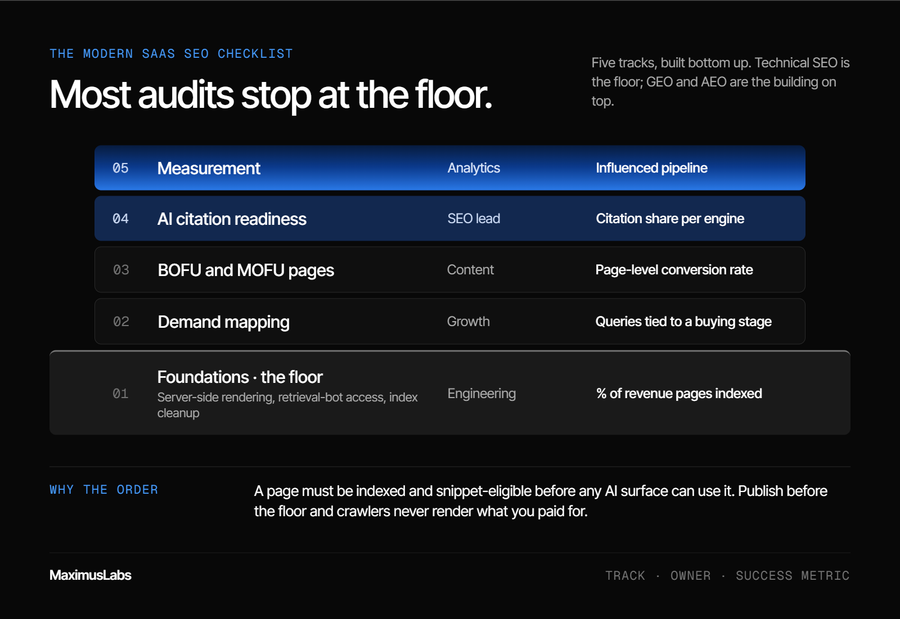
- An SEO strategy ties business goals to buyer topics, the content and technical work to win them, and pipeline-based measurement.
- In 2026 it has two scoreboards: Google rankings, where AI Overviews cut position-one clicks about 58%, and AI citations.
- Most strategies fail in execution, so rank recommendations by pipeline impact, ship a short list, and give SEO a seat with engineering.
- Research buyer questions and topics, not keyword lists, and start with bottom-of-funnel pages because a few pages drive most results.
- Fix only technical issues that block crawling or reading, build owned and earned authority, and structure pages so AI can quote them.
- Measure pipeline first, track AI referrals and citations per engine, re-forecast clicks, and run the plan in 90-day cycles.
Picture a VP Marketing walking into the quarterly board meeting with a 60-slide SEO strategy deck. It has keyword lists, a technical audit, a content calendar, and a rankings chart that points up and to the right.
Then the CEO asks one question: "How much pipeline did organic bring in?" The room goes quiet. Half the audit never shipped. The rankings went up, but clicks went down. And when the CEO typed the company's category into ChatGPT that morning, three competitors showed up. Their brand did not.
That gap is what an SEO strategy has to close in 2026. Ranking is still part of the job. But a #1 position buys far fewer clicks than it used to, and AI engines (ChatGPT, Perplexity, Gemini, and Google AI Overviews) now decide which brands a buyer even hears about.
This guide shows how to build a plan that does both: ranks on Google, gets cited by AI, and ties every step back to revenue.
Q1. What is an SEO strategy in 2026, and what changed?
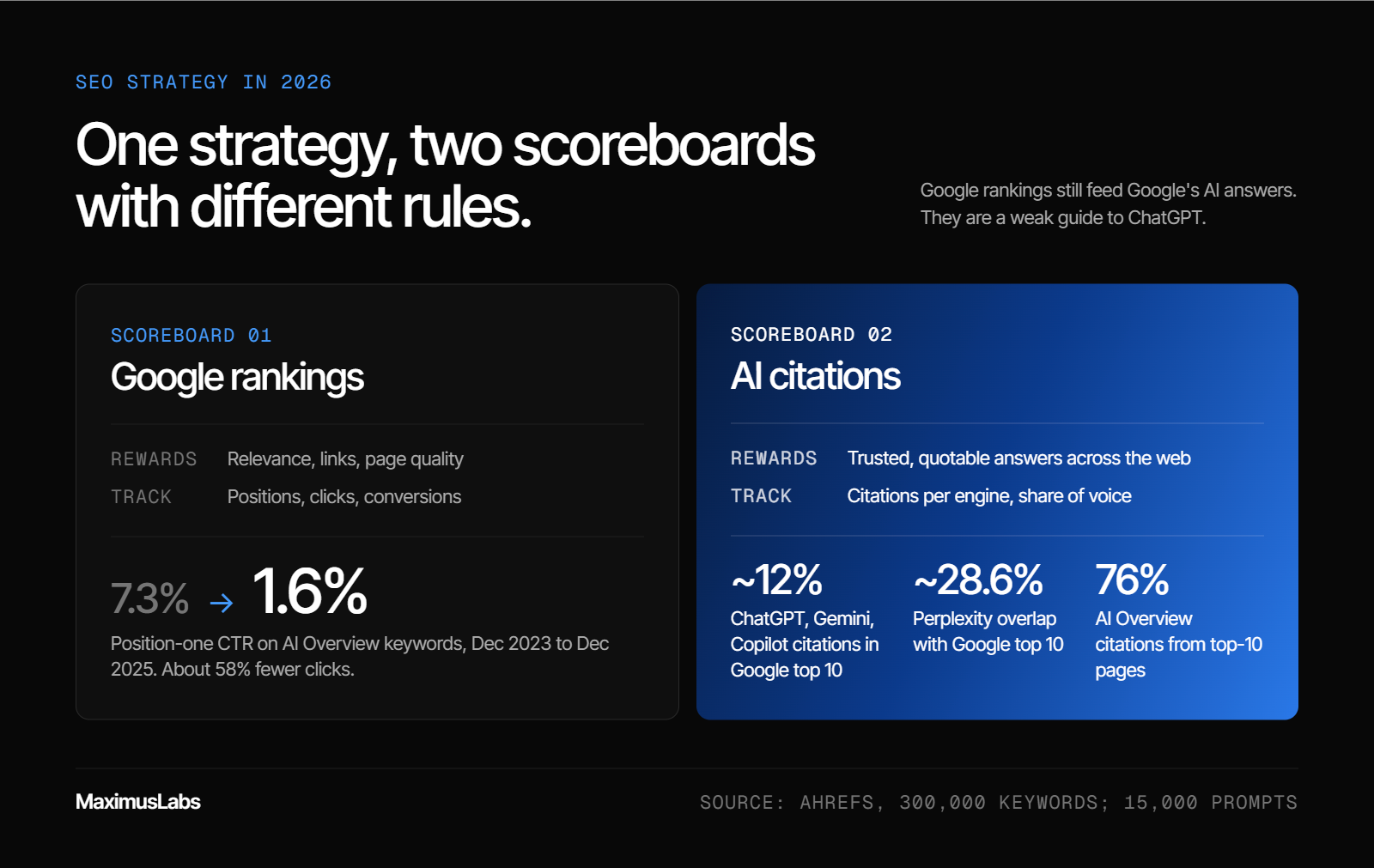
An SEO strategy is a plan that ties business goals to the topics buyers search, the content and technical work needed to win those topics, and how results are measured. In 2026 the plan has two scoreboards. Ahrefs found AI Overviews correlate with 58% lower clicks for the top-ranking page. It also found only about 12% of links cited by ChatGPT, Gemini, and Copilot rank in Google's top 10.
The definition, without the jargon
✅ What a strategy actually contains
A strategy is not a keyword list or an audit. It is a set of choices about where to compete and why. A working SEO strategy answers four questions:
- Which buyers and problems matter? The topics closest to a purchase decision.
- What will we publish or fix? The pages, content, and technical work that win those topics.
- How will we earn trust? Authority on your site and mentions across the web.
- How will we know it worked? Metrics tied to pipeline, not only traffic.
Everything else (tools, checklists, calendars) is execution. Those matter, but they come after the choices.
What changed: the first scoreboard got smaller
⚠️ Rankings buy fewer clicks
Ahrefs compared 300,000 keywords, half with an AI Overview and half without [1]. When an AI Overview appeared, the top-ranking page saw about 58% lower average click-through rate. The same study found 34.5% just ten months earlier, so the gap is widening.
Position one on AI Overview keywords fell from a 7.3% click-through rate to 1.6% between December 2023 and December 2025 [1]. A ranking that once filled the funnel now fills a fraction of it.
What changed: a second scoreboard appeared
📊 AI citations follow different rules
Ahrefs ran 15,000 long-tail prompts through Google, Bing, and four AI assistants [2]. On average, only about 12% of the links ChatGPT, Gemini, and Copilot cited ranked in Google's top 10 for the same prompt. Perplexity overlapped more, at about 28.6%.
Google's own AI Overviews are different. The same Ahrefs article notes that 76% of AI Overview citations come from top-10 pages [2]. So Google rankings still feed Google's AI answers. They are a weak guide to ChatGPT.
| Scoreboard | What it rewards | What to track |
| Google rankings | Relevance, links, page quality | Positions, clicks, conversions |
| AI citations | Trusted, quotable answers across the web | Citations per engine, share of voice |
Is SEO dead, then?
💡 The pie is getting bigger
No. SEO practitioner Ethan Smith has made a point I agree with: every few years a new surface appears, people predict the end of Google search, and the pie simply grows. New search surfaces add to the total rather than replace it.
My view is that SEO best practice has become the floor, not the ceiling. You still need pages Google can rank. Now those pages also have to become the answer that AI engines choose to quote.
MaximusLabs AI builds strategies around both scoreboards from day one. Answer Engine Optimization (AEO), the work of getting a brand cited inside AI answers, is the flagship, and SEO is the foundation underneath it. Every MaximusLabs engagement is measured on pipeline, not on rankings alone.
Q2. Why do most SEO strategies fail before they ever launch?
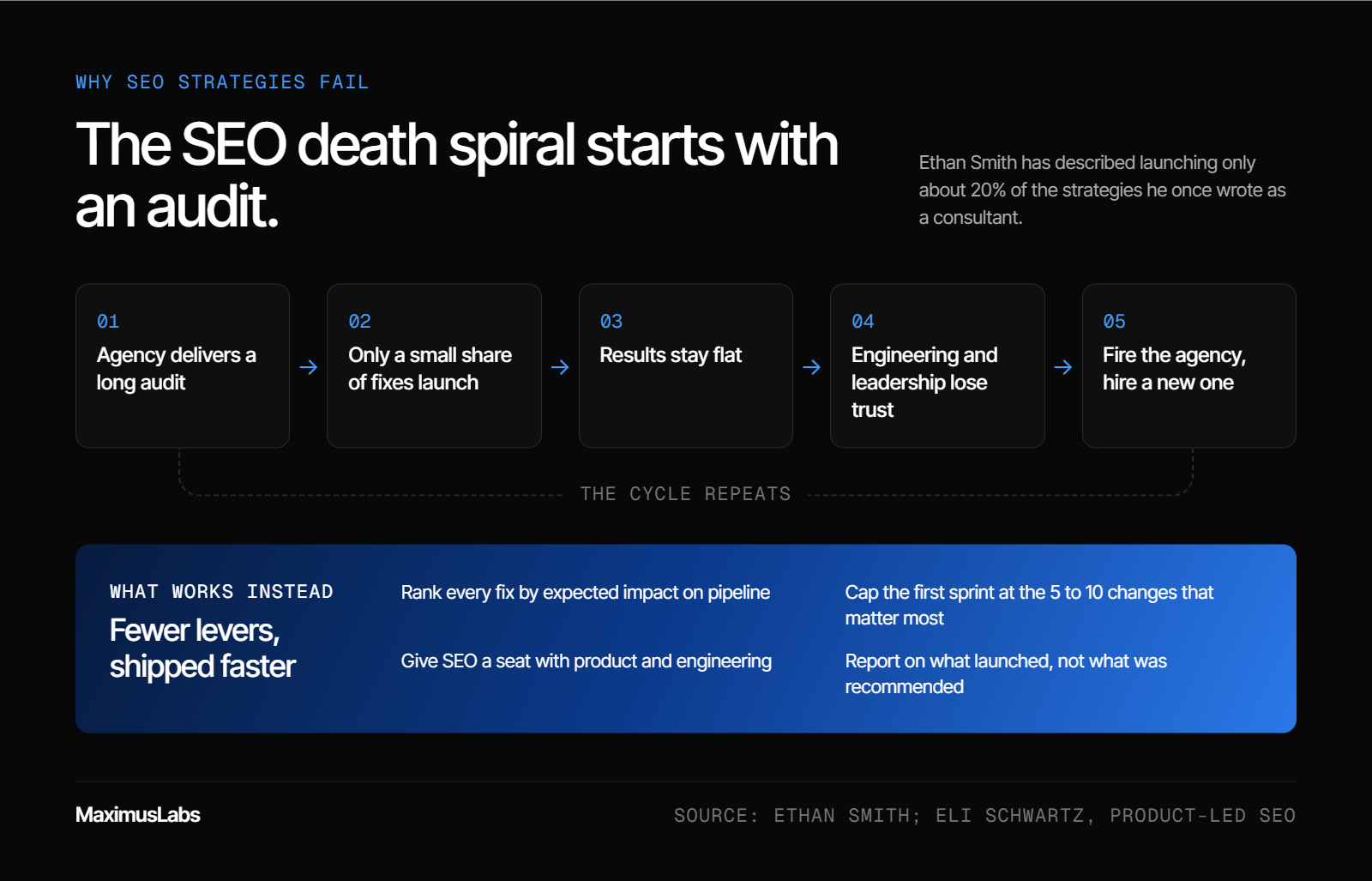
Most SEO strategies fail in execution, not in research. A team receives a long audit, launches a fraction of the recommendations, sees flat traffic, and loses leadership's trust. SEO practitioner Ethan Smith has described launching only about 20% of the strategies he once wrote as a consultant. MaximusLabs AI runs strategy and execution in one team, so recommendations ship as pages and fixes instead of waiting on a backlog.
The situation: the audit deck
⚠️ A familiar scene
An agency delivers a 50-page audit. It lists hundreds of issues, each one technically true. Missing alt text. Long title tags. Duplicate meta descriptions. The document goes to engineering, where it joins a queue that is already months long.
Six months later, a handful of items have shipped. Traffic is flat. The board starts asking whether SEO works at all.
The complication: the death spiral
❌ How trust erodes
Ethan Smith has a name for this pattern: the SEO death spiral. It runs in five stages:
- A team hires an agency that delivers a long audit.
- Only a small share of the recommendations launch.
- Results stay flat, because the launched items were low impact.
- Engineering and leadership lose trust in SEO.
- The company fires the agency and repeats the cycle with a new one.
The research was never the problem. The plan had no priority order, and nothing tied the work to results.
💸 Marketing vs engineering
Eli Schwartz describes this friction in his book Product-Led SEO [5]. On his first day running SEO at SurveyMonkey, an engineering director told him that marketing does not get to direct engineering. His point is that SEO fails when it lives only in marketing. It works when product and engineering treat search as part of the product.
The resolution: fewer levers, shipped faster
✅ What works instead
Strong strategies pick a short list of high-impact changes and ship them. In practice, that means:
- Rank every recommendation by expected impact on pipeline, not by how many issues it fixes.
- Cap the first sprint at the five to ten changes that matter most.
- Give SEO a seat with product and engineering, so fixes ship as normal work.
- Report on what launched, not on what was recommended.
Google's own guidance points the same way. It asks whether content adds original value rather than "mainly summarizing what others have to say" [4]. A long list of generic fixes rarely changes that.
💡 My take
A strategy that does not ship is a document, not a strategy. When I look at a stalled SEO program, I start with one question: what launched in the last 90 days? The answer usually explains the results better than any audit.
The second question is who owns each fix. If the answer is "the agency" for every row, nothing will move. Every item needs an internal owner, a ship date, and a reason tied to revenue.
MaximusLabs AI does strategy and execution together, so the plan is measured by what ships and the pipeline it drives. That removes the handoff where most strategies die.
Q3. How do you set SEO goals that tie to pipeline, not traffic?
Set SEO goals in pipeline terms: qualified leads, demos, and revenue from organic and AI search, with traffic as a supporting metric. A small share of pages usually drives most results, so prioritize the bottom-of-funnel pages buyers use to decide. Semrush found the average visitor from AI search is 4.4 times as valuable as an average organic visitor, which makes conversion quality the goal.
Why traffic is the wrong headline metric
❌ The vanity trap
Traffic is easy to report and easy to grow. It is also easy to grow in ways that never reach revenue. Eli Schwartz makes this point well in Product-Led SEO: traffic that does not convert is an expensive hobby [5].
The shift to AI search makes this sharper. Fewer people click, but the ones who do arrive further along. Semrush's study of 500+ digital marketing topics found the average AI search visitor is 4.4 times as valuable as an organic visitor, judged by conversion rate [3]. A strategy aimed at raw sessions will under-invest in exactly those visitors.
Goals that hold up in a board meeting
✅ A simple goal stack
| Level | Example goal | Why it matters |
| Revenue | Pipeline sourced or influenced by organic and AI search | The number leadership funds |
| Conversion | Demo requests and signups from organic pages | Shows which pages earn money |
| Visibility | Rankings and AI citations for priority topics | Leading signal for pipeline |
| Activity | Pages shipped and fixes launched | Proves the plan is executing |
Set one target per level for the quarter. Review the top two monthly and the bottom two weekly.
The 5% rule
📊 A few pages carry the results
Ethan Smith has observed that roughly 5% of a site's landing pages drive most of its organic traffic and pipeline. The other 95% produce little. That matches what I see in most audits.
The implication is practical. Do not spread effort evenly across hundreds of pages. Find the pages that already convert, protect them, and build more pages like them. Then review the pages that earn nothing. Many can be merged, refreshed, or retired, which frees time for the pages that matter.
💰 Start at the bottom of the funnel
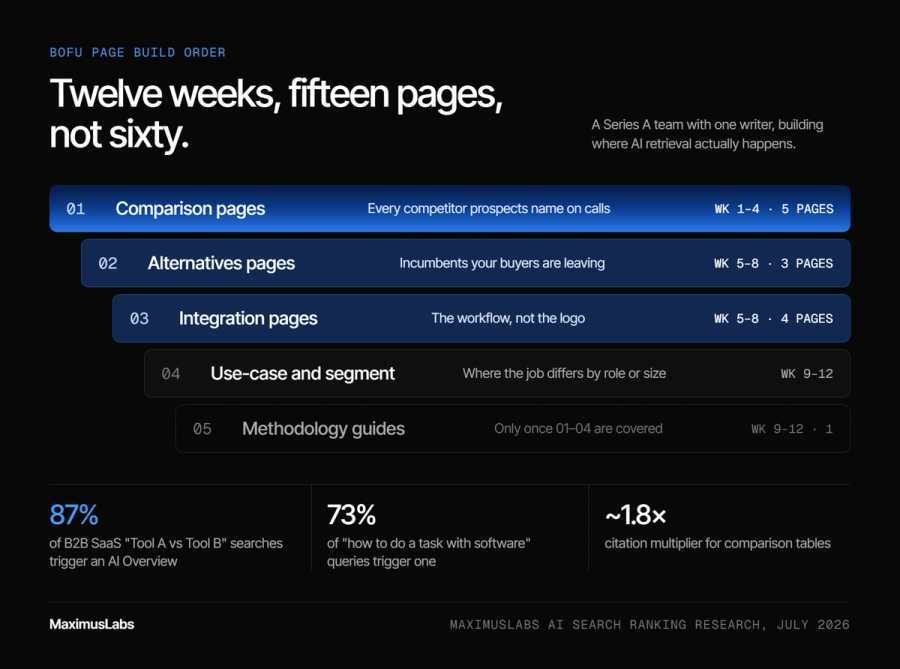
Bottom-of-funnel (BOFU) pages answer questions buyers ask right before choosing: comparisons, alternatives, pricing logic, and use cases. Middle-of-funnel (MOFU) pages help buyers evaluate options. Top-of-funnel (TOFU) "what is X" content is the first thing AI engines answer on their own, so it rarely reaches a buyer's shortlist.
Renting vs owning
💡 Why the goal is equity
Schwartz compares paid marketing to renting a house and SEO to owning one [5]. Paid traffic stops the day the budget stops. SEO builds equity each month, even with a large upfront cost. A pipeline goal keeps that equity pointed at revenue, not at pageviews.
MaximusLabs AI starts every engagement with BOFU pages aligned to the ideal customer profile and measures each one on pipeline, not mentions. Traffic still gets reported, but it never becomes the goal.
Q4. How do you research topics and buyer questions instead of keyword lists?
Research topics, not single keywords. One strong page can rank for thousands of related queries, and many valuable buyer questions show zero volume in keyword tools. Start from sales calls, support tickets, Search Console queries, and the prompts buyers type into ChatGPT. Group them into topics by intent, then pick the ones closest to a buying decision.
The situation: the keyword spreadsheet
⚠️ Where most plans start
Most SEO plans begin with a spreadsheet exported from a keyword tool. It lists search volume, difficulty, and a target page for each term. Then content gets written to match the list, month after month, whether or not it converts.
Eli Schwartz calls this red ocean SEO [5]. Everyone uses the same public tools, sees the same keywords, and fights over the same terms.
The complication: keywords are the wrong unit
📊 Pages rank for topics
Ethan Smith has shown that a single strong page often ranks for thousands of keywords at once. His example is a "best website builder" page ranking for about 2,400 related queries. You are not targeting one phrase. You are targeting a cluster of phrases that share an intent.
❌ Zero volume does not mean zero demand
Keyword tools also miss real demand. Schwartz describes the language app Drops in Product-Led SEO [5]. Keyword tools showed little or no volume for niche vocabulary terms. The team built pages for them anyway and grew non-branded traffic from a trickle to millions of monthly impressions.
AI search widens this gap. Buyers type long, specific prompts into ChatGPT that no keyword tool records. Ahrefs found AI assistants mostly cite pages that do not rank in Google's top 10 for those prompts [2]. The questions are new, and so are the winning pages.
The resolution: research from the buyer outward
✅ Where to find real questions
- Sales calls and demos: the objections buyers raise before signing.
- Support tickets: the problems customers try to solve after buying.
- Search Console: the queries your pages already appear for.
- AI prompts: what buyers ask ChatGPT and Perplexity about your category.
- Communities: Reddit and industry forums where buyers compare options.
💡 How to group them
Sort questions into three types. Head questions are broad, like "best CRM software," and are won mostly through third-party citations. Mid-tail questions narrow the audience, like "best CRM for small SaaS teams." Long-tail questions are specific, like whether one tool integrates with another for lead routing. Owned content wins those, so answer them in full.
Then rank each topic by how close it sits to a buying decision. Build the plan from the top of that list down. This is blue ocean SEO: you serve demand the spreadsheet never showed you.
Keyword tools still have a job. Use them to size a topic and spot the words buyers use, not to decide what matters. The decision comes from the buyer's questions and the revenue each answer can support.
MaximusLabs AI builds its research this way, starting from how the ideal customer actually asks AI engines for a solution. That question set, not a keyword export, becomes the content plan, and every topic is ranked by its likely path to pipeline.
Q5. How should you structure content: topic clusters, editorial or programmatic?
Organize content as topic clusters: a hub page that covers the strategic overview, and spoke pages that answer specific questions, all linked to each other. Use editorial content for high-consideration B2B buying, where expertise and original insight decide trust. Use programmatic pages when a database can answer many precise queries, as marketplaces and directories do. Give every page one distinct job.
Hub and spoke, in plain terms
✅ How a cluster works
A hub page explains a topic broadly: the what and the why. Spoke pages go deep on one question each: the exactly how. The hub links to every spoke, and each spoke links back to the hub and to related spokes.
This structure helps in three ways:
- Readers can move from overview to detail without hunting.
- Search engines see a clear map of what the site covers.
- AI engines find one focused answer per question instead of three half-answers.
⚠️ One page, one job
The most common failure is cannibalization, where two pages compete for the same question. Neither wins, because neither is clearly the best answer. Before writing a new page, check whether an existing page already owns that question. If it does, improve that page instead.
Editorial or programmatic?
📊 Pick the model by the buying decision
| Content model | Works when | Example |
| Editorial | Buyers need expertise, judgment, and original insight | B2B software comparisons, strategy guides |
| Programmatic | A database can answer many exact queries | Directories, templates, location or integration pages |
| Product-led | The product itself answers the search | Free tools, template libraries, calculators |
Eli Schwartz describes the product-led model in Product-Led SEO [5]. At SurveyMonkey, survey templates and resource pages were built into the product itself. Search became a product feature, not just a marketing channel.
❌ Where programmatic goes wrong
Programmatic pages fail when they are thin. Google warns against content that mainly summarizes others "without adding much value" [4]. It also treats automation used to manipulate rankings as spam. A page per city or per keyword, with no unique data behind it, fits that warning.
Original perspective is the real moat
💡 My take
Here is the thing. After AI arrived, most of the internet started summarizing five articles and writing the sixth. That content is easy to produce and easy for AI engines to ignore, because they already have the first five.
The pages that win carry something new: first-hand experience, original data, or a clear point of view. Google's guidance asks the same question directly: does the content provide original information, reporting, research, or analysis [4]? If the answer is no, the page is filler, however well it is formatted.
Keep clusters fresh
⏰ A refresh rhythm
Clusters decay. Facts change, competitors publish, and AI engines favor current sources. Review your priority hubs every quarter, and update the spokes that feed pipeline first. Google also warns against changing dates on pages that have not substantially changed [4], so refresh the substance, not just the timestamp.
MaximusLabs AI builds hub-and-spoke content ecosystems in the founder's voice, so each page has one job and a perspective AI engines cannot find elsewhere. That combination keeps clusters from cannibalizing each other and gives AI a reason to cite the brand instead of a summary of it.
Q6. Which technical SEO work actually moves the needle?
Most technical SEO checklists are true but low impact. The work that moves results is making sure search engines and AI crawlers can read your pages and reach them through internal links. Prioritize content that loads in the page HTML, shallow click depth, contextual internal links to priority pages, and a crawlable site structure. Fix those before chasing minor audit warnings.
The situation: the 300-row audit
⚠️ True, but not important
A technical audit can list hundreds of issues. Images without alt text. Title tags a few characters too long. Redirects that could be cleaner. Every item is real. Very few of them change rankings or citations.
SEO practitioner Ethan Smith has argued that this is where teams waste the most time. In his view, two technical factors matter far more than the rest: internal links, and whether search engines can read the page at all. I agree with the spirit of that, even if the exact split varies by site.
The complication: important pages are hard to reach
❌ Buried pages do not get crawled
Search engines find pages by following links. A page linked only from a deep archive gets visited rarely and trusted less. Kevin Indig has described an audit where key pages sat around 13 clicks deep, and fixing that internal path drove a large traffic gain.
The lesson is simple. If your best pages are hard to reach from the homepage, crawlers treat them as unimportant.
⚠️ Pages AI cannot read
The second failure is content that only appears after scripts run in the browser. If the main text of a page loads late through JavaScript, some crawlers may see an almost empty page. That risk matters more now that AI engines retrieve pages to build answers.
The resolution: four fixes that matter
✅ The short list
- Make key content readable in the HTML. View the page source. If the main text is missing, fix the rendering for priority pages first.
- Shorten click depth. Keep priority pages within about three clicks of the homepage.
- Add contextual internal links. Aim for roughly 5 to 10 relevant internal links pointing to each priority page, using descriptive anchor text.
- Keep the structure crawlable. Clean sitemaps, working links, and no accidental blocks on important sections.
💡 How to tell impact from noise
Ask one question of every audit item: does it stop a search engine or AI crawler from finding, reading, or trusting a priority page? If yes, fix it this sprint. If no, put it in a maintenance backlog and move on.
💰 Where it connects to revenue
Technical work earns its budget when it unblocks pages that sell. A fix to a comparison page that converts is worth more than a sitewide cleanup of pages nobody visits. Start with the 5% of pages that drive pipeline, covered in Q3, and work outward.
MaximusLabs AI runs a technical SEO sprint in the first week of an engagement. It checks that critical content renders in HTML for AI crawlers, that AI crawlers are not blocked, and that priority pages sit close to the homepage. Everything else waits until those pages can be found and read.
Q7. How do you build authority that Google and AI engines trust?
Authority comes from trust signals on and off your site. Google says trust is the most important part of E-E-A-T (experience, expertise, authoritativeness, and trustworthiness) and warns against content that mainly summarizes others. Off-site, AI engines lean on third-party sources: Semrush found Quora and Reddit are the most-cited sites in Google AI Overviews. MaximusLabs AI builds owned answers and earned mentions together.
Trust starts on your own pages
✅ What Google asks for
Google's helpful content guidance lists the parts of E-E-A-T and states that trust is the most important [4]. It also notes that E-E-A-T is not itself a single ranking factor. Instead, it describes signals that help systems identify helpful, reliable content.
In practice, that means:
- Show who wrote it. Named authors with real experience in the topic.
- Show how it was made. Disclose methods, including any use of AI or automation [4].
- Show why it exists. Content written to help a reader, not to fill a keyword slot.
Off-site mentions matter more in AI search
📊 AI engines read the whole web
AI answers rarely rely on your site alone. Semrush's AI search study found Quora is the most commonly cited website in Google AI Overviews, with Reddit second [3]. Buyers also meet brands through review sites, industry lists, and community threads long before they visit a vendor's page.
My current view is that brand mentions across the web now carry more weight for AI visibility than backlinks alone. I might be wrong about the exact size of that effect. But every audit points the same way: brands that get discussed get recommended.
Owned or earned? It depends on the question
💡 Two kinds of visibility
| Question type | Example | What wins |
| Broad head term | "Best CRM software" | Earned mentions: reviews, lists, community threads |
| Mid-tail | "Best CRM for small SaaS teams" | A mix of mentions and strong owned pages |
| Long-tail | "Does Tool A sync with Tool B for lead routing?" | Owned content that answers in full |
Broad questions get answered from third-party summaries, so you need to be in those sources. Specific questions get answered from detailed vendor pages, so you need the best page on the topic.
Building earned authority
⏰ Where to start
- Review platforms: keep G2 and Capterra profiles complete, with a steady flow of real reviews.
- Communities: find the Reddit and Quora threads AI engines already cite for your category, and contribute genuinely.
- Founder content: publish expert points of view on LinkedIn and in industry publications.
- Digital PR: earn coverage with original data, not press releases.
💸 What not to do
Do not buy links or post fake reviews. When ChatGPT recommends a brand, it puts its own credibility behind that answer. Engines that stake their trust on you will watch for signs you do not deserve it.
MaximusLabs AI runs Owned AEO and Earned AEO together: content that becomes the answer, plus reviews, Reddit, and third-party mentions that make AI trust the brand. Most agencies only do the first half, and AI engines notice the gap.
Q8. How do you get your content cited by ChatGPT, Perplexity and AI Overviews?
Structure each page so an AI engine can lift a complete answer: a question heading, a 40 to 80 word direct answer near the top, then evidence and specifics. Track citations per engine, because each engine behaves differently. Ahrefs found Perplexity cites Google top-10 pages about 28.6% of the time, while ChatGPT, Gemini, and Copilot average about 8%. Run your buyer prompts in each engine every month.
Write answers AI can lift
✅ The answer-first block
AI engines quote passages, not whole pages. A passage gets quoted when it answers a question completely on its own. Build each key section like this:
- A question as the heading, phrased the way a buyer asks it.
- A direct answer of 40 to 80 words right under the heading.
- Evidence next: a number, a source, or a worked example.
- Detail last: steps, tables, and edge cases for readers who want more.
Put the most important answers in the top third of the page. Long introductions push the answer below the point where retrieval systems tend to look.
⚠️ Name things plainly
Use the full names of products, platforms, and concepts. A passage that says "it" or "this tool" loses meaning out of context.
Each engine plays by its own rules
📊 Citations differ by platform
Ahrefs tested 15,000 long-tail prompts across Google, Bing, and four AI assistants [2]. Perplexity cited Google top-10 pages about 28.6% of the time. ChatGPT, Gemini, and Copilot averaged about 8%, and most of their citations did not rank for the query at all.
So a page can win on one engine and be invisible on another. That is why I treat each platform as its own channel, with its own trust signals and its own winners.
| Engine | What tends to help | What to check |
| Google AI Overviews | Strong Google rankings and clear answers | Whether top-10 pages are cited |
| Perplexity | Recent, well-sourced pages | Freshness and visible sources |
| ChatGPT | Pages that match narrow sub-questions | Which pages appear for long prompts |
Cover the sub-questions
💡 Fan-out queries
AI assistants often split one prompt into several smaller searches, called fan-out queries. A buyer asks one big question, and the engine looks up five narrow ones. Pages that answer those narrow questions directly get pulled into the final answer.
This is why topic clusters from Q5 matter so much. Each spoke answers one sub-question cleanly, which gives the engine exactly what it is looking for.
Track it like a channel
⏰ A monthly prompt routine
- List 20 to 50 buyer prompts, from broad category questions to specific comparisons.
- Run each prompt in ChatGPT, Perplexity, Gemini, and Google every month.
- Record whether your brand is mentioned, which page is cited, and which competitors appear.
- Act on the gaps: improve the owned page, or earn a mention on the source the engine prefers.
💰 Why it pays
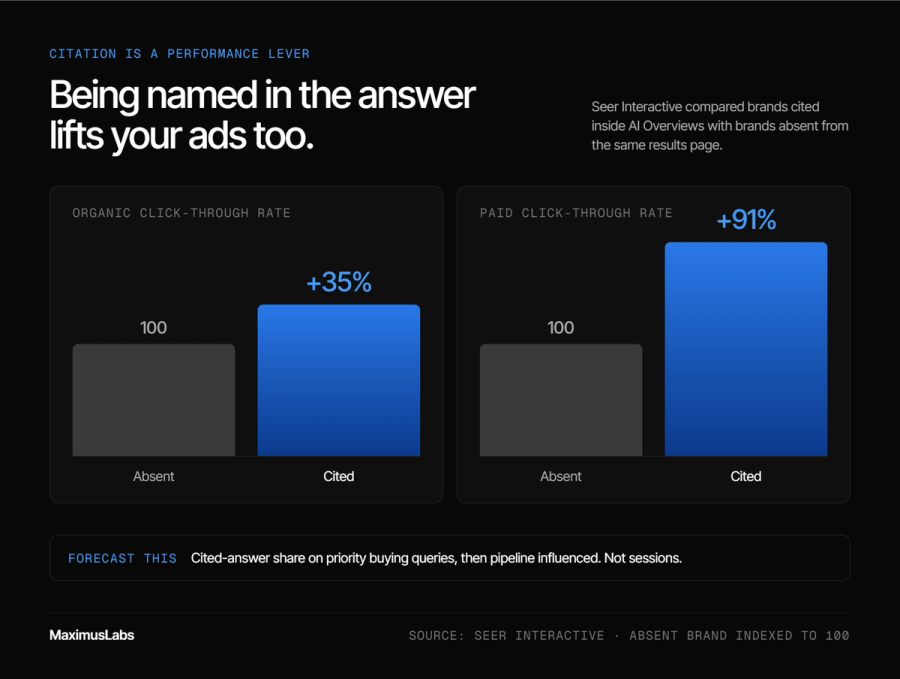
A citation in an AI answer reaches a buyer who is already deciding. When an engine names your brand, it lends you its credibility.
MaximusLabs AI builds prompt sets across ChatGPT, Claude, Perplexity, and Gemini for each client, then maps which URLs those engines cite most. Content and outreach then target the exact sources each engine trusts.
Q9. How do you measure an SEO strategy when clicks are shrinking?
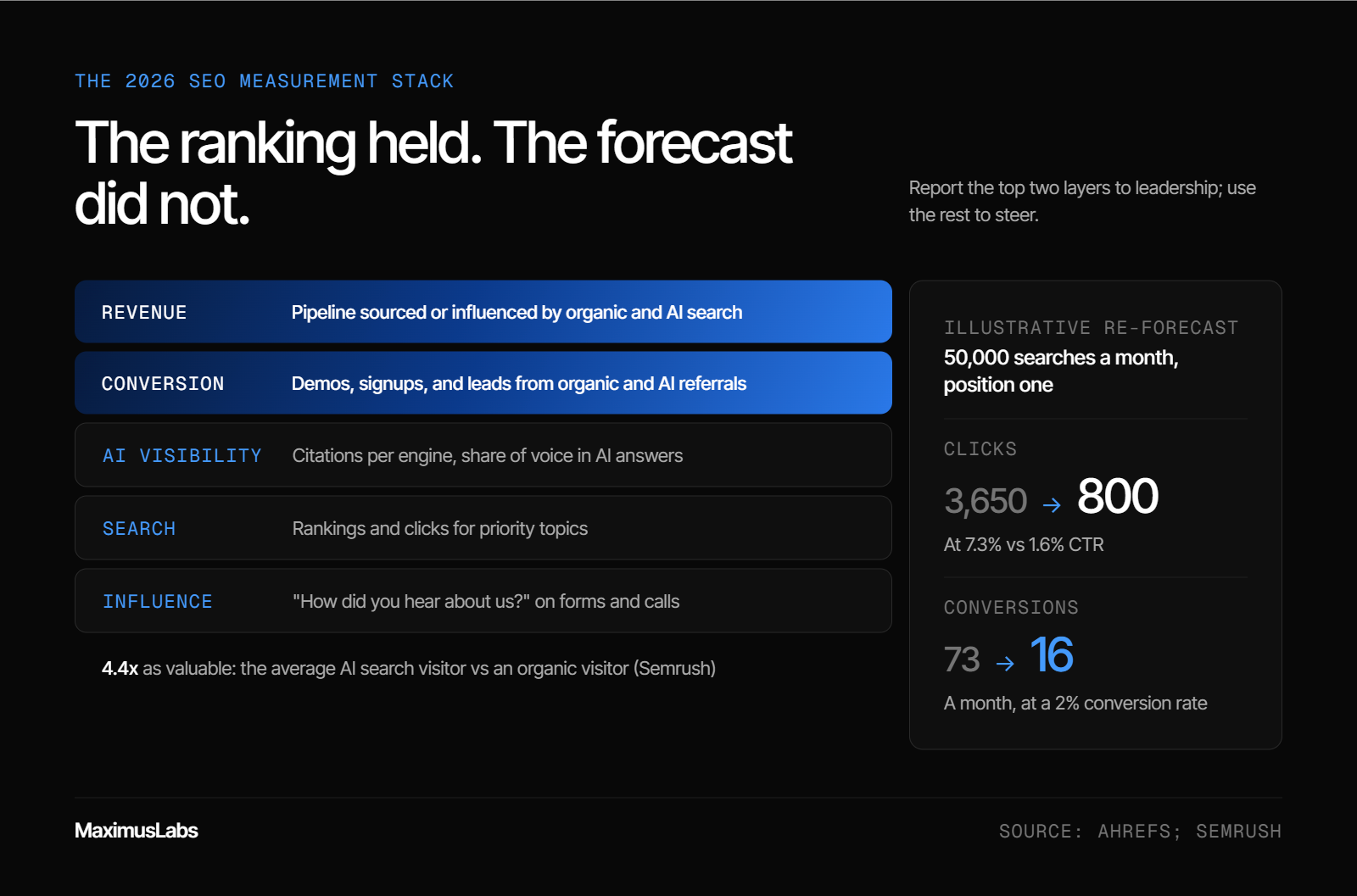
Measure SEO on pipeline first: leads, demos, and revenue from organic and AI referrals. Track AI referral traffic separately, since Semrush found the average AI search visitor is 4.4 times as valuable as an average organic visitor. Add share of voice in AI answers, citations per engine, and a "how did you hear about us" field to catch AI influence that analytics misses. MaximusLabs AI tracks AI visibility daily and measures every engagement on pipeline.
Why traffic now misleads
⚠️ Fewer clicks, not less demand
Traffic used to be a fair stand-in for SEO success. That chain has broken.
Ahrefs found that an AI Overview correlates with 58% lower click-through rate for the top-ranking page [1]. A team can hold every ranking and see traffic fall, because the buyer read the answer in the AI summary first. A team can also grow traffic on pages that never convert. Neither number tells you what search earned.
The 2026 measurement stack
✅ Five layers, top to bottom
| Layer | Metric | Where to find it |
| Revenue | Pipeline sourced or influenced by organic and AI search | CRM, linked to landing pages |
| Conversion | Demos, signups, and leads from organic and AI referrals | GA4 and CRM |
| AI visibility | Citations per engine, share of voice in AI answers | Monthly prompt tracking |
| Search visibility | Rankings and clicks for priority topics | Search Console |
| Influence | Self-reported source on forms and calls | "How did you hear about us?" field |
Report the top two layers to leadership; use the rest to steer.
Track AI referrals on their own
📊 The visitors are worth more
Semrush found the average AI search visitor is 4.4 times as valuable as an average organic visitor, judged by conversion rate [3]. Mixing those visitors into general referral traffic hides them. Set up a separate channel for ChatGPT, Perplexity, Gemini, and other AI sources in your analytics, then compare their conversion rates with organic search.
💡 Catch what analytics misses
Much AI influence never shows up as a referral. A buyer reads a ChatGPT answer, then searches your brand on Google later, and analytics credits branded search. Add a free-text "How did you hear about us?" field to demo and signup forms. It is low-tech, and it often reveals AI as a source your dashboards never showed.
There is no single rank in AI. What you measure is how often you show up, where, and what those appearances earn.
Re-forecast before you panic
💰 A worked example
Here is an illustrative example using the Ahrefs click-through rates. Ahrefs found position one on AI Overview keywords fell from 7.3% to 1.6% click-through rate between December 2023 and December 2025 [1].
- A topic cluster gets 50,000 searches a month.
- At 7.3%, position one earned 3,650 clicks.
- At 1.6%, it earns 800 clicks.
- At a 2% conversion rate, conversions drop from 73 to 16 a month.
The ranking did not change; the forecast did. Re-forecast every priority topic with an AI Overview.
MaximusLabs AI tracks AI visibility daily across the major engines and measures every engagement on pipeline, not mentions. For Oliv AI, that meant a "64% AI citation rate in 6 months, vs ~30% for billion-dollar incumbents (Oliv AI)" and "27 qualified leads, $47K+ pipeline, 26% close rate in 4 months (Oliv AI)".
Q10. What does a 90-day SEO strategy plan look like?
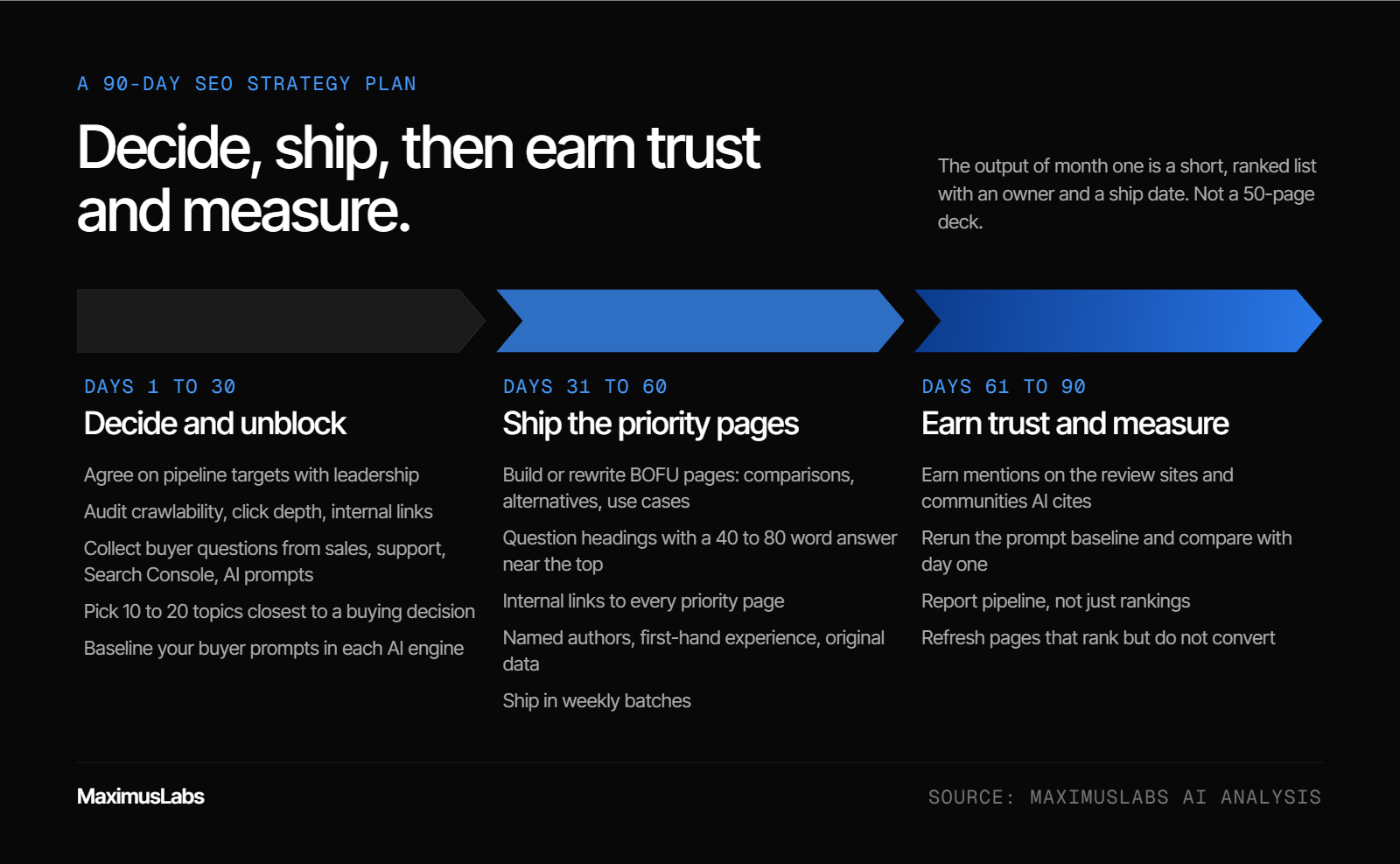
A 90-day SEO plan runs in three phases. Days 1 to 30: set pipeline goals, audit crawlability and internal links, and pick the bottom-of-funnel topics that matter most. Days 31 to 60: publish and fix the priority pages with answer-first structure. Days 61 to 90: earn mentions, track rankings and AI citations, and refresh based on pipeline data. MaximusLabs AI can put a first article live as early as day four.
Days 1 to 30: decide and unblock
✅ Set the foundation
- Goals: agree on pipeline targets with leadership, using the goal stack from Q3.
- Audit: check that priority pages can be crawled, read, and reached within a few clicks (Q6).
- Research: collect buyer questions from sales calls, support tickets, Search Console, and AI prompts (Q4).
- Prioritize: pick 10 to 20 topics closest to a buying decision.
- Baseline: run your buyer prompts in ChatGPT, Perplexity, Gemini, and Google, and record who gets cited.
The output of this phase is a short, ranked list with an owner and a ship date for each item. Not a 50-page deck.
Days 31 to 60: ship the priority pages
⏰ Publish and fix
- Build or rewrite the priority BOFU pages: comparisons, alternatives, and use cases.
- Structure each page with question headings and a 40 to 80 word answer near the top (Q8).
- Add internal links from related pages to every priority page.
- Show expertise: named authors, first-hand experience, and original data where you have it. Google's guidance asks whether content offers original information or analysis [4].
Ship in weekly batches. A page live this week beats a perfect page next quarter. Track each launch against its target topic, so you can tell in phase three which pages moved and which did not.
Days 61 to 90: earn trust and measure
📊 Expand beyond your own site
- Earn mentions on the review sites, communities, and lists that AI engines cite for your category (Q7).
- Rerun the prompt baseline and compare citations with day one.
- Report pipeline, not just rankings, using the measurement stack from Q9.
- Refresh the pages that rank but do not convert, and double down on the ones that do.
💡 If you have no budget
My advice for a team with zero budget is the same every time. Get your SEO basics right. Write deeper than anyone else on the questions your buyers actually ask. Talk about your customers' real problems on your own site. If you add genuine value, you will find your way into AI answers, even without a big team.
How MaximusLabs runs the first week
🚀 Day one to day seven
MaximusLabs AI starts every engagement with an in-depth technical audit, then prepares a plan from the client's goals and shares it for approval. Once the client approves the keywords, articles start going live, and the first one can be out as early as day four. Strategy and execution stay in one team, so the 90-day plan is measured on what ships and the pipeline it drives.
What I'm Thinking About Next
Here is my current hypothesis, and I might be wrong. The best SEO strategies of the next two years will look less like keyword plans and more like brand plans. AI engines recommend brands they trust, and trust gets built across the whole web, not just on your own pages.
That raises the bar. A ranking used to be enough to earn attention. Now a brand has to be the answer that ChatGPT, Perplexity, Gemini, and Google all feel safe repeating. The teams that win will be the ones that ship fewer, better pages, earn real mentions, and measure everything in pipeline.
I am watching how fast AI answers take share from classic results, and which signals engines lean on as they mature. If you are rebuilding your SEO strategy this quarter, I would love to compare notes: krishna@maximuslabs.ai.
About the Author
Hey, I'm KK. I help brands turn organic search into predictable revenue growth engines.
Over the years, I've experimented, broken things, and rebuilt systems that actually drive growth through AI-first SEO and GEO. Along the way, I realized most brands don't need more noise. They need visibility that converts.
At MaximusLabs, we don't chase vanity metrics. We build visibility that moves the revenue needle, helping brands show up where real buyers make decisions: AI search (ChatGPT, Gemini, Perplexity) and Google.
If you're trying to make your product impossible to ignore, or you're simply tired of "traffic without revenue," let's talk. You'll leave with clarity, not jargon.
If you're building a brand that deserves to be seen, let's make sure it gets found: krishna@maximuslabs.ai
Questions, answered
7 questionsHow long does an SEO strategy take to show results?
It depends on what you measure. Some wins show up in weeks, while compounding results take months. • Weeks: technical fixes that unblock priority pages, and new bottom-of-funnel pages that answer questions buyers already ask. • One to three months: early rankings, first AI citations, and the first leads from new pages. • Three months and beyond: topic authority, earned mentions, and pipeline that compounds as clusters fill out. We plan in 90-day cycles for that reason. The first cycle sets pipeline goals, fixes what blocks crawling, and ships the pages closest to a buying decision. Later cycles build authority and refresh what works. MaximusLabs AI runs a technical audit and a plan in the first week, and the first article can go live as early as day four. We still tell clients plainly that durable results compound over months, not days. If you want a sense of how fast AI visibility can move, our case studies show the timelines we have published. The best early signal is not traffic. It is whether the right pages shipped and started earning citations and conversions.
Can I build an SEO strategy myself, or do I need an agency?
You can build one yourself. Many strong strategies start with a founder or marketing manager and a clear list of priorities. What you need is not a big team. It is the right order of work. A do-it-yourself plan works when you: • Know your buyers' real questions from sales and support. • Can ship pages and technical fixes without long engineering queues. • Measure results in leads and pipeline, not just traffic. Outside help makes sense when execution stalls, when you need to compete in AI answers across several engines, or when content volume outgrows your team. If you do hire help, ask one question first: who ships the work? We have seen many strategies fail because one firm writes the plan and another team is supposed to build it. MaximusLabs AI does strategy and execution in one team, measured on pipeline. Before you choose any partner, our guide to evaluating AEO agencies lists the questions we would ask in your position.
What is the difference between SEO, GEO, and AEO?
The three overlap, but each has a different goal. • SEO (search engine optimization) helps your pages rank in search results like Google. It is the foundation: crawlable pages, useful content, and authority. • AEO (Answer Engine Optimization) helps your content become the answer that AI tools like ChatGPT, Perplexity, and Google AI Overviews quote directly. • GEO (Generative Engine Optimization) is the wider practice of shaping how generative AI systems find, judge, and recommend your brand across sources. Here is the practical difference. SEO is measured by rankings and clicks. AEO and GEO are measured by citations, mentions, and share of voice inside AI answers. A page can rank well and still be missing from ChatGPT, because AI engines often cite pages that do not rank in Google's top 10. We treat SEO best practice as the floor and AEO as the building on top. MaximusLabs AI leads with AEO, with SEO underneath, because a modern strategy has to win both scoreboards.
How often should I update my SEO strategy?
Review the strategy every quarter and the tactics every month. • Monthly: check rankings, AI citations for your buyer prompts, and conversions from priority pages. Adjust what you publish next. • Quarterly: revisit goals, re-forecast traffic for topics where AI Overviews appear, and refresh the hubs and spokes that feed pipeline. • After big changes: a product launch, a site migration, a new market, or a major search update calls for a fresh look. Updating does not mean rewriting everything. Most of the value comes from refreshing the few pages that already drive revenue, and from fixing pages that rank but do not convert. Be careful with cosmetic updates. Google's guidance warns against changing a page's date when the content has not substantially changed. Refresh the substance, then the date. MaximusLabs AI builds content refresh cycles into every engagement, guided by pipeline data rather than a fixed calendar. We would rather improve three pages that sell than publish ten that do not.
Is SEO still worth investing in with AI Overviews taking clicks?
Yes, but the return looks different. Clicks per ranking have fallen. Ahrefs found AI Overviews correlate with about 58% lower click-through rate for the top-ranking page. At the same time, the visitors who do arrive from AI search tend to be worth more, and Semrush found the average AI search visitor is 4.4 times as valuable as an organic visitor. That changes where the investment goes: • Less effort on broad top-of-funnel traffic that AI now answers on its own. • More effort on bottom-of-funnel pages buyers use to decide. • New effort on being cited in ChatGPT, Perplexity, Gemini, and Google AI Overviews. • Measurement in pipeline, not sessions. SEO is still the foundation those AI answers draw on, especially Google's own AI Overviews, which mostly cite top-ranking pages. MaximusLabs AI measures every engagement on pipeline. For a view of how referral traffic is shifting, see our zero-click research. Our view is simple: SEO is not dead, but SEO alone is no longer enough.
What should a B2B SaaS SEO strategy prioritize first?
Start with the pages closest to revenue. For most B2B SaaS companies, that order looks like this: • Bottom-of-funnel pages: comparisons, alternatives, use cases, and integration pages that buyers read right before choosing. • Technical blockers: make sure those pages are crawlable, readable in the page HTML, and well linked internally. • Buyer questions: answers to the specific questions from sales calls and AI prompts. • Authority: reviews on platforms like G2, mentions in community threads, and founder-led thought leadership. Top-of-funnel "what is" content comes last. AI engines already answer those questions well, so they rarely reach a buyer's shortlist. Keep the first list short. Ten to twenty priority topics are enough for a first quarter. Ship those, measure the leads they bring in, and expand from the topics that convert. A long backlog of unwritten pages is a plan, not progress. MaximusLabs AI follows this BOFU-first order for B2B SaaS and AI companies, and it is how Oliv AI reached a 64% AI citation rate in six months against billion-dollar incumbents.
Should I use AI to write SEO content?
Use AI to speed up the work, not to replace the expertise. Google's guidance is clear on two points. Using automation mainly to manipulate search rankings violates its spam policies. And content that mostly summarizes what others have said, without adding value, is a warning sign. Where AI helps: • Research aggregation and first drafts. • Formatting, outlines, and structure. • Finding gaps in existing content. Where humans still matter: • First-hand experience and original data. • A clear point of view the reader cannot find elsewhere. • Accuracy checks and final judgment. Google also suggests being open about how content was created, including any use of AI. MaximusLabs AI uses hybrid human and AI workflows: AI handles research aggregation and drafts, while humans drive voice, originality, and strategy. Our trust-first content playbook explains how we keep that balance. The test we apply to every page is simple: would a buyer learn something here they could not get from the first five search results?