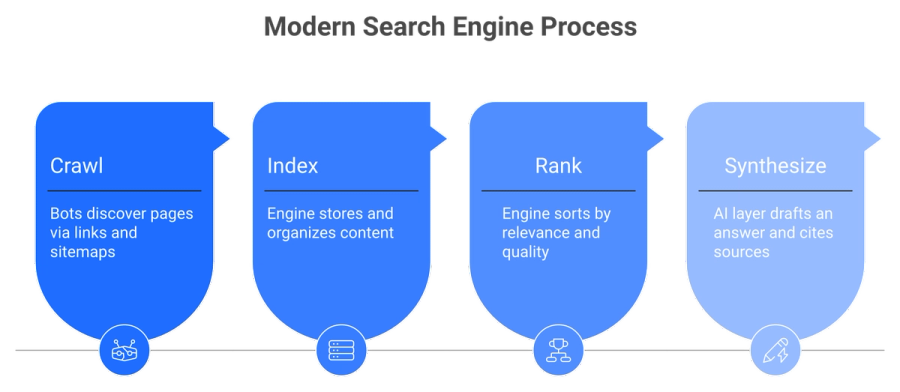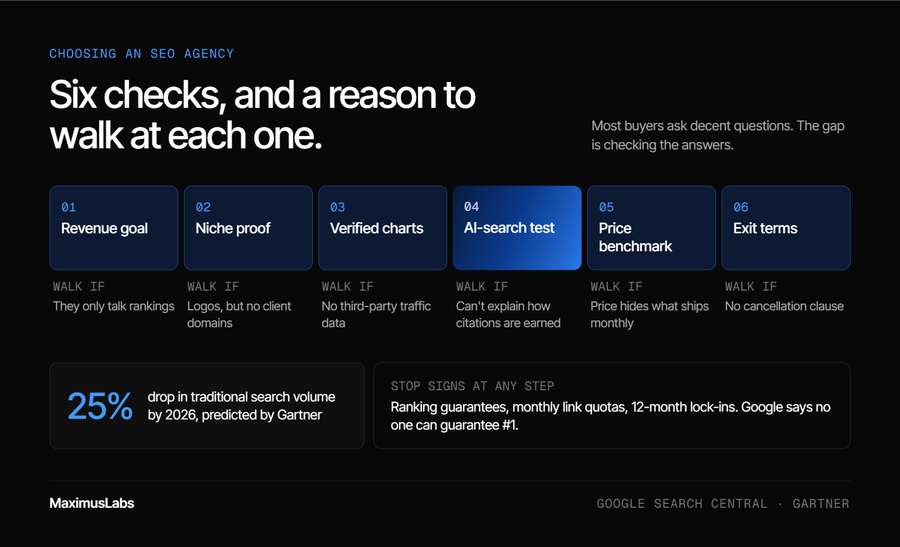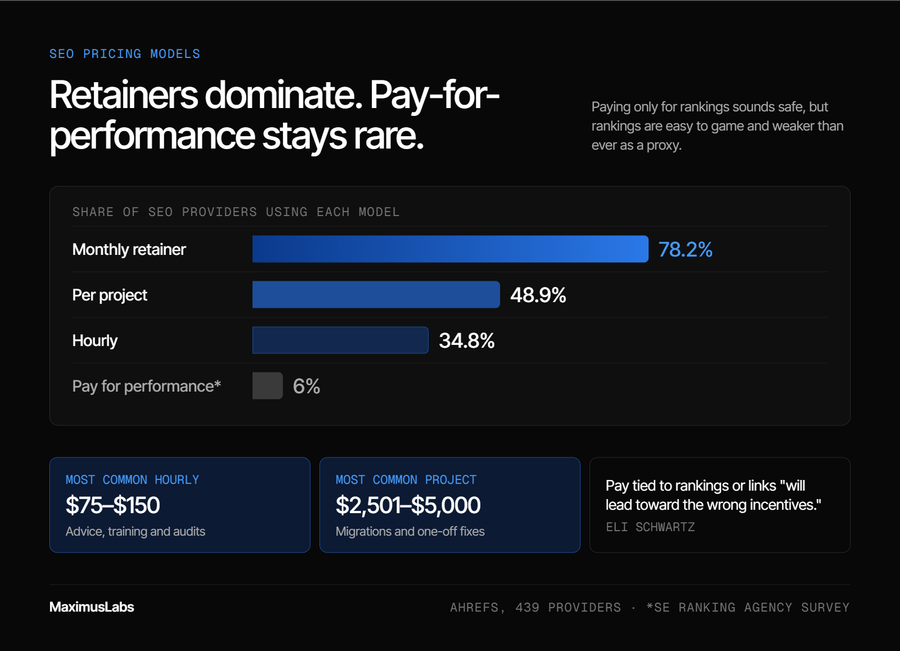
- Google publishes no full list of ranking factors, but its ranking systems guide names the live systems, and helpful content now sits inside core ranking.
- AI Overviews cut position 1 CTR by 58% on affected keywords (Ahrefs), so ranking is now the entry ticket and being cited is the prize.
- The 2024 API leak and DOJ testimony show Google stores site authority, NavBoost click signals, Chrome views, and host age, but not how each is weighted.
- Originality, trust, and brand mentions matter more than raw links; Ahrefs found mentions track AI Overview visibility about three times more strongly than backlinks.
- Fix crawl access, rendering, and internal links to money pages first, structure pages around question-led answer blocks, and treat Core Web Vitals as hygiene.
- Prioritize BOFU pages and measure pipeline and AI citation share, not rank alone; Oliv AI reached a 64% AI citation rate in six months.
A VP of Marketing at a B2B SaaS company opens the monthly SEO report. The rankings chart is climbing. Twelve money keywords sit in the top three. Then the board asks one question: where is the pipeline? Organic clicks are flat, demo requests from search are down, and the agency's answer is a 40-page audit titled "200 Ranking Factors."
I have sat in that meeting. The audit is not wrong, exactly. It just answers a 2019 question. In 2026, Google ranks pages with a set of named systems. AI Overviews answer the query before anyone clicks. Buyers ask ChatGPT and Perplexity for a shortlist.
This guide separates what Google has confirmed from what leaked and what is folklore. Then it shows which factors still earn a ranking, which ones earn a citation, and which ones earn revenue.
Q1. What are Google ranking factors in 2026, really?
Google ranking factors are the signals Google's ranking systems use to order results. They include helpful, original content, relevance to search intent, links (PageRank), user interaction, freshness, page experience, and spam checks. Google publishes no full list. Its ranking systems guide names the live systems, including RankBrain, BERT, passage ranking, and SpamBrain. The helpful content system joined core ranking in March 2024.
Why the 200-factor lists mislead
🔍 Factors are outputs, not inputs
Most ranking factor articles list 200 or more items in one flat column. Domain age sits next to title tags, which sits next to "content quality." That format hides the real structure. Google does not run one algorithm with 200 dials. It runs many systems, and each one looks at a narrow set of signals for a specific job.
One practitioner I respect makes the same point. Squeezing Google into a single simple algorithm ignores how layered real rankings are. When a team treats every item as equal, it spends a month on meta tags. It never touches the one system holding it back.
📘 The real map is Google's own guide
Google's "A guide to Google Search ranking systems" is the closest thing to an official list. It describes each live system in plain language. Here is how I group them for a planning meeting:
| Job the system does | Named systems (Google's guide) |
|---|---|
| Understand the query and the page | RankBrain, BERT, neural matching, MUM, passage ranking |
| Judge quality and trust | Reliable information, reviews, original content systems |
| Judge authority | Link analysis and PageRank |
| Keep results fresh and varied | Freshness, deduplication, site diversity |
| Remove abuse | SpamBrain, removal-based demotions, exact match domain system |
Google also lists retired systems. Panda, Penguin, and the helpful content system now live inside core ranking. So "helpful content" did not go away. It became part of everything.
From ranking blue links to becoming the answer
⚠️ Ranking is now half the job
Here is the shift most audits miss. A page can rank first and still lose the buyer. AI Overviews, AI Mode, ChatGPT, and Perplexity now read your page and answer for you. The goal is no longer only to rank a blue link. It is to become the answer those engines cite.
SEO best practices have become the floor for this work, not the ceiling. Google-only SEO still matters, but it is no longer enough on its own. My hypothesis is that the teams who win in 2026 will treat ranking as the entry ticket and citation as the prize.
✅ How this article grades the evidence
Every factor in this guide carries a label. "Confirmed" means Google's own documentation says it. "Leaked" means the 2024 API documentation or trial testimony shows it. "Correlated" means a study found a pattern, not a cause. I will tell you which is which, because a factor's evidence level should decide how much budget it gets.
MaximusLabs AI builds every client roadmap from this same evidence ladder, starting with Google's named systems instead of a generic checklist. That keeps the work tied to what actually moves rankings and AI citations, and away from tasks that only fill an audit.
Q2. How do AI Overviews and AI Mode change what each ranking factor is worth?
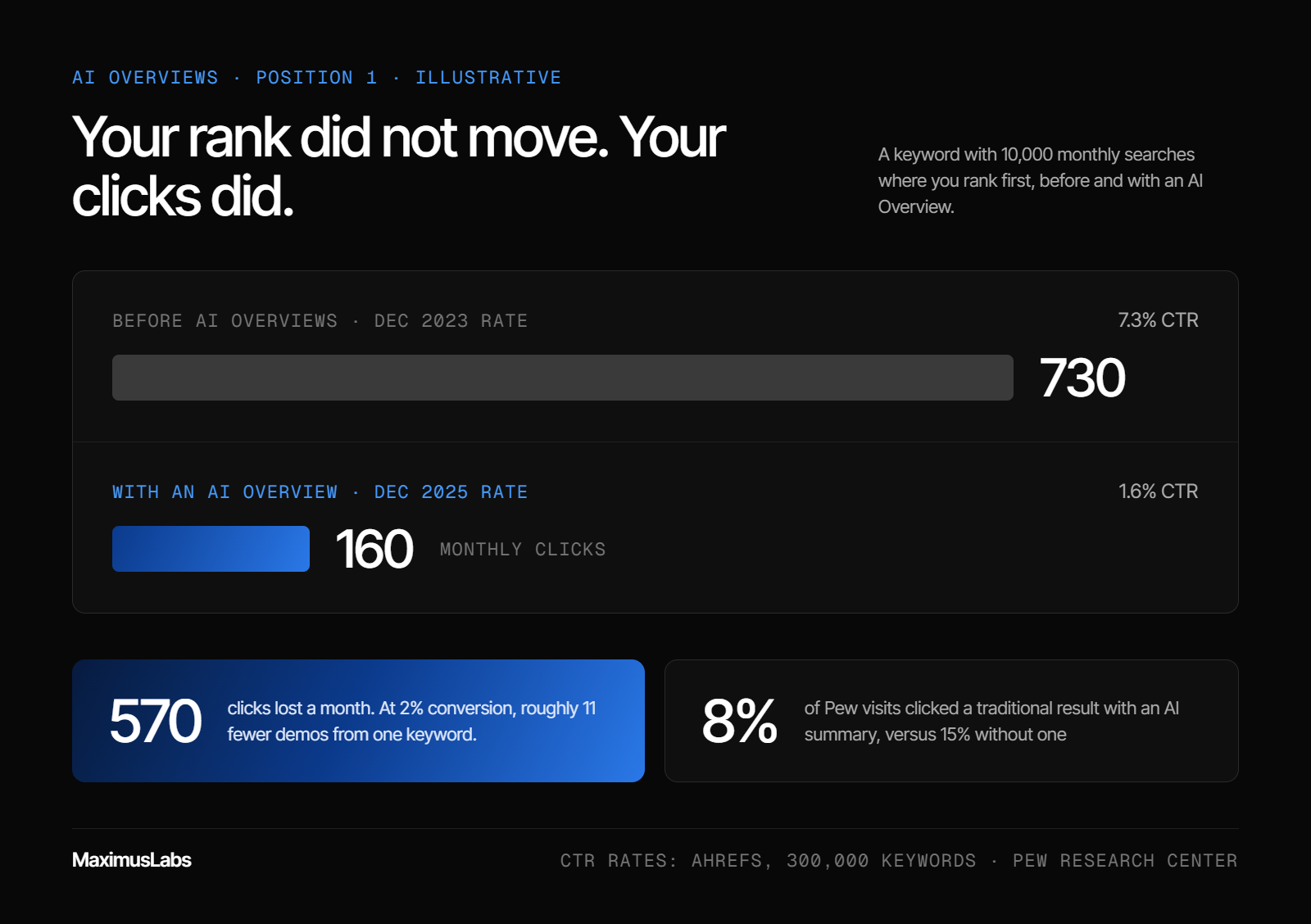
AI Overviews shrink the value of a top ranking. Ahrefs found that AI Overviews cut position 1 click-through rate by 58% on affected keywords, measured from December 2023 to December 2025. Pew Research Center found users clicked a traditional result on 8% of visits with an AI summary, versus 15% without one. Google says AI features need no extra requirements, but query fan-out rewards pages that answer many subquestions.
How it used to work
📈 Rank was the whole game
For a decade, the playbook was simple. Rank in the top three, collect the clicks, and convert some of them. Click-through rate (CTR, the share of searchers who click a result) followed a predictable curve. Agencies reported rank, and rank stood in for revenue.
That model still shapes most retainers. Teams buy rankings, track positions weekly, and assume clicks will follow. On queries with an AI Overview, that assumption no longer holds.
What changed
💸 The click math broke
Ahrefs studied 300,000 keywords. On keywords with an AI Overview, position 1 CTR moved from 0.073 in December 2023 to 0.016 in December 2025. The effect shrinks further down the page, with a 19.4% drop at position 10. Pew's panel of 900 US adults showed only 1% of visits included a click on a link inside the AI summary itself.
Here is an illustrative example. Take a keyword with 10,000 monthly searches where you rank first.
| Scenario | CTR at position 1 | Monthly clicks |
|---|---|---|
| Before AI Overviews (Dec 2023 rate) | 7.3% | 730 |
| With an AI Overview (Dec 2025 rate) | 1.6% | 160 |
Your rank did not move. You lost 570 clicks a month anyway. If 2% of those clicks became demo requests, that is roughly 11 fewer demos every month from one keyword.
🔀 Query fan-out changes what "relevant" means
Google explains that AI Overviews and AI Mode may use query fan-out. That means issuing multiple related searches across subtopics and data sources to build one answer. So the engine is not only asking "who ranks for this keyword?" It is asking "who answers each piece of this question best?"
Google also says no special schema or AI text file is needed to appear. The same ranking systems still choose the sources. What changes is the reward: depth across subtopics beats one keyword-matched page.
Google adds one more point worth noting. It says clicks from results with AI Overviews tend to be higher quality, with visitors staying longer. Fewer clicks, but better ones, which is why conversions now matter more than raw traffic.
What to do about it
🎯 Track citation next to rank
When ChatGPT or an AI Overview names your brand, it lends you its own credibility. That is a trust transfer, and it is worth more than a blue link the buyer never clicks. So the scorecard needs a second column: how often you are cited, not just where you rank.
MaximusLabs AI tracks AI visibility daily across Google AI Overviews, ChatGPT, Perplexity, and Gemini, next to classic rank. For Oliv AI, that work produced a "64% AI citation rate in 6 months, vs ~30% for billion-dollar incumbents (Oliv AI)." The ranking report alone would never have shown that gap.
Q3. Which ranking factors has Google confirmed, and which did the 2024 leak reveal?
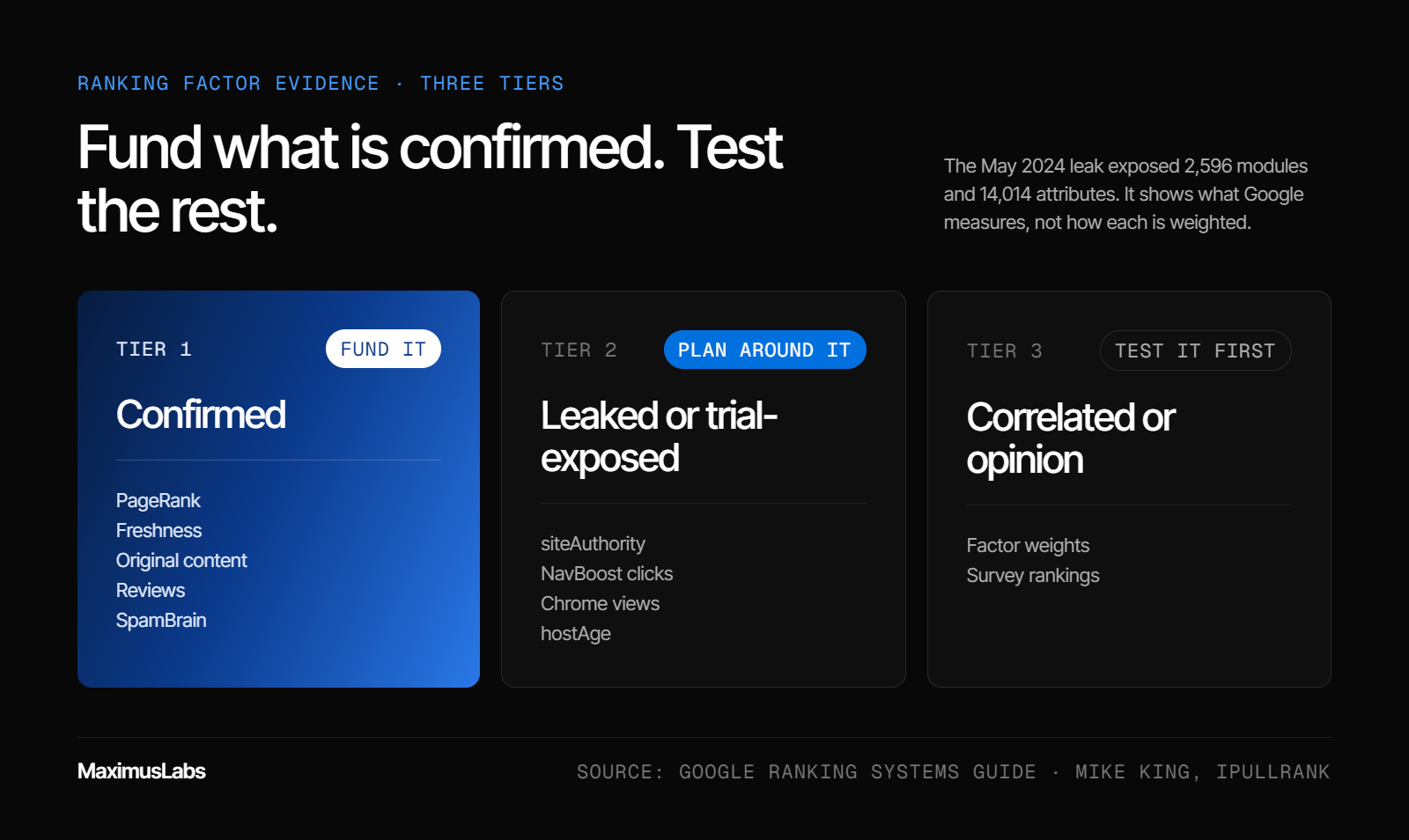
Google's documentation confirms systems such as PageRank, freshness, original content, reviews, and spam detection. The May 2024 Content Warehouse API leak exposed 2,596 modules and 14,014 attributes. They include a site-level authority attribute, NavBoost click signals, Chrome view counts, and host age. The leak shows what Google measures, not how each signal is weighted, so treat it as direction, not formula.
Tier 1: what Google confirms
✅ Written in Google's own docs
The confirmed tier is short but solid. Google's ranking systems guide names link analysis and PageRank, freshness systems, original content systems, the reviews system, reliable information systems, and SpamBrain. Google also says helpful content is part of core ranking, and that page experience matters for visitors from both classic and AI results.
These are the factors you can defend in a board meeting. If budget is tight, this tier gets funded first.
Notice what is missing from the confirmed list. Google does not publish weights, thresholds, or a ranked order. It tells you which systems exist and what each one rewards, then leaves the trade-offs to you.
Tier 2: what the leak and the trial exposed
🔓 The 2024 API documentation
In May 2024, Mike King published an analysis of leaked Google API documentation. Here is what it showed, in plain terms:
- siteAuthority: a site-level quality attribute stored with compressed quality signals. Google had long said it had no website authority score.
- NavBoost: a module that tracks clicks, including goodClicks, badClicks, and lastLongestClicks (the last result a user stayed on).
- chromeInTotal: site-level Chrome view counts.
- hostAge: used, in the document's words, "to sandbox fresh spam in serving time."
King also points to DOJ antitrust trial testimony from Google's Pandu Nayak, which described NavBoost and its rolling window of click data.
⚠️ What the leak does not tell you
King states plainly that nobody knows how these features are weighted in downstream scoring. Some attributes may be old or unused. One field, unicornClicks, is often misread as "super-user" engagement. The leaked description ties it to a specific user group, so I would not build strategy on it.
My read is simple. The leak confirms that Google stores site-level authority and click behavior. It does not hand you a formula. Use it to decide where to look, then test before you spend.
Tier 3: correlation and opinion
📊 Patterns, not proof
Everything else lives here: industry correlation studies, expert surveys, and agency "weights." A correlation can guide a test. It cannot tell you that one factor causes a ranking.
| Evidence tier | Examples | How much to trust it |
|---|---|---|
| Confirmed | PageRank, freshness, original content, reviews, SpamBrain | Fund it |
| Leaked or trial-exposed | siteAuthority, NavBoost clicks, Chrome views, hostAge | Plan around it |
| Correlated or opinion | Factor weights, survey rankings | Test it first |
MaximusLabs AI reads the primary documents, the guide, the leak analysis, and the trial record, before advising on any factor. Every recommendation we ship carries its evidence tier, so clients know what is proven and what is still a bet.
Q4. How do helpful content, E-E-A-T and originality decide whether a page ranks?
Google's core ranking includes the helpful content system, and its original content and reviews systems reward first-hand analysis over rewrites. E-E-A-T (Experience, Expertise, Authoritativeness, and Trustworthiness) is not one ranking factor. Google says a mix of factors identifies good E-E-A-T, and trust matters most. Pages that add new data, tested experience, or a clear point of view outrank pages that only summarize the current top ten.
The old content playbook
📝 Summarize the top ten, add 20%
The standard agency brief goes like this. Pull the top ten results, list their headings, and write a longer version. Add the keyword in the right places. Ship it.
It worked for years because Google rewarded coverage. But it produced millions of near-identical pages. After AI writing tools arrived, that volume exploded. Everyone now summarizes five articles and writes the sixth.
The cost shows up quietly. A team publishes 40 posts a quarter, and traffic stays flat. Nobody can say which post moved pipeline, because none of them said anything new.
What Google rewards now
🔍 Originality is a named system
Google's guide lists original content systems that favor original reporting over pages that merely cite it. Its helpful content guidance asks a pointed question: does the content provide original information, reporting, research, or analysis? It also warns against summarizing others without adding much value.
Google adds three checks that map well to E-E-A-T. Readers should see who made the content, how it was made, and why it exists. Google calls "why" perhaps the most important of the three.
⭐ Trust is the filter, not a bonus
E-E-A-T is not a score you can raise with an author bio. It is a pattern Google's systems look for across a page and a site. Of the four parts, Google says trust is the most important.
This matters even more for AI citation. An AI engine that recommends you puts its own credibility on the line. So it leans toward sources that look first-hand and verifiable.
I think of it like a referral between friends. You only recommend a plumber you have watched work. AI engines behave the same way with sources.
How to add information others cannot copy
✅ Monday actions
- Add one data point per page that only your team has, such as a test result, a benchmark, or a customer pattern.
- Name the author and show real experience with the topic.
- Cite primary sources, such as Google's docs, papers, and patents, instead of blogs that summarized them.
- State a clear position where the category hedges.
- Cut any section that repeats what the top ten already say.
💡 Where the founder's voice fits
MaximusLabs AI sits with each client's leadership team to capture the founder's own view of the market. Then it traces every claim in the article to a primary source. The result carries information a competitor cannot copy by summarizing the same ten pages, which is exactly what Google's originality systems are built to find.
Q5. Do backlinks still matter, or have brand mentions overtaken them?
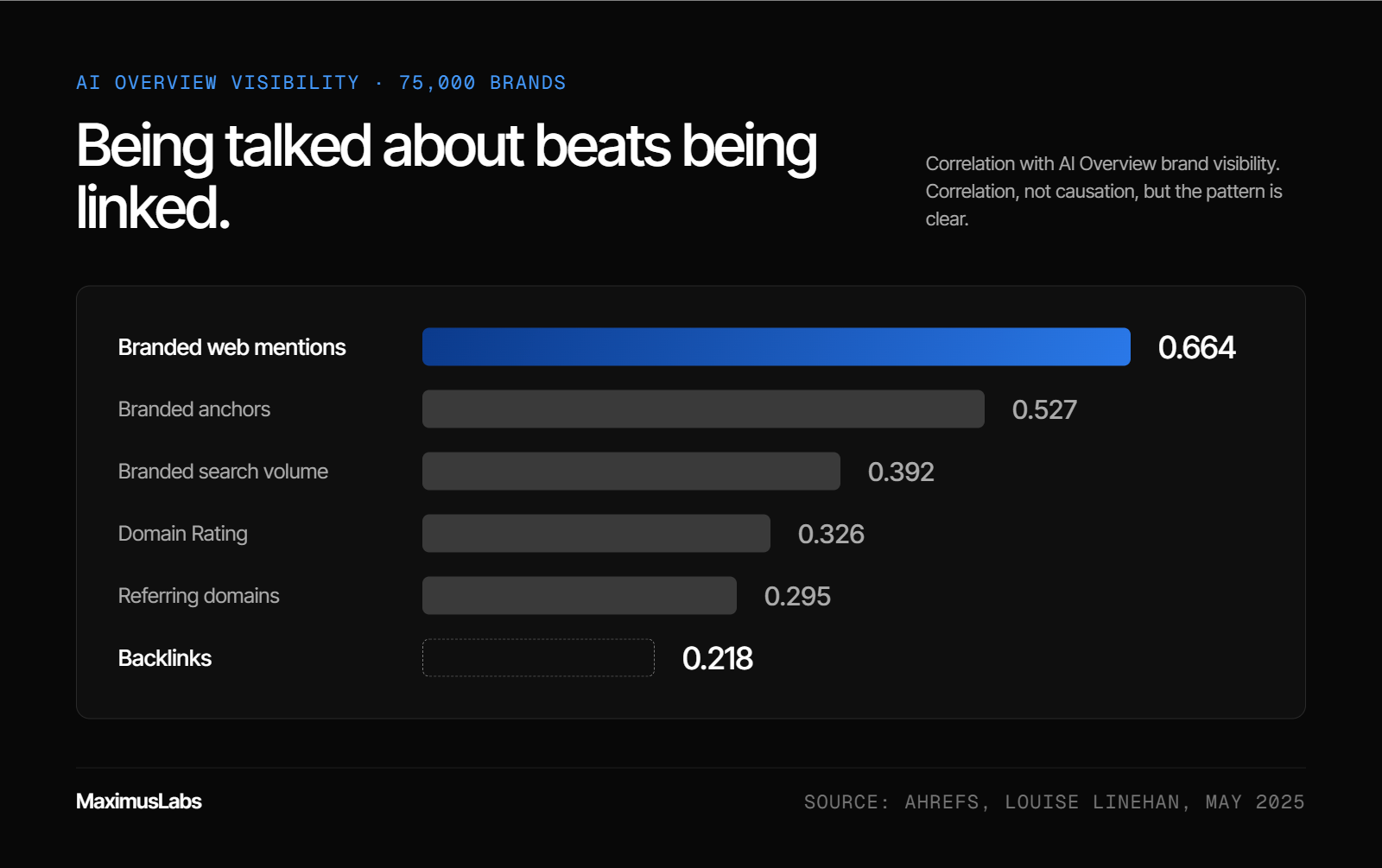
Backlinks still matter. Google confirms link analysis and PageRank are part of its ranking systems. The 2024 leak also describes homepage trust signals that pass to new pages. For AI visibility, off-site brand mentions appear to matter more. Ahrefs' study of 75,000 brands found branded web mentions correlated with AI Overview visibility at 0.664, versus 0.218 for backlinks. MaximusLabs AI's Search Everywhere work ranked Nidra Goods first for "best sleep mask" on Google, ChatGPT, and Perplexity.
What links still do
🔗 PageRank is alive
Google's ranking systems guide still lists link analysis and PageRank as part of core ranking. Links help Google discover pages and judge which ones others vouch for. So a strong, relevant link profile is still a confirmed advantage, not folklore.
Quality beats count. One link from a respected site in your category tells Google more than fifty links from unrelated directories. Diversity matters too, because many different sites vouching for you is harder to fake than one site linking many times.
🏠 Your homepage passes trust forward
The leaked documentation describes homepage-level PageRank and trust values that new pages can inherit. In plain terms, a new page on a trusted site starts life with some credit. A new page on an unknown site starts from zero.
This is why the same article ranks fast on one domain and stalls on another. The page is identical. The trust behind it is not.
Why mentions now carry more weight
📊 What the 75,000-brand study found
Ahrefs measured which brand factors tracked mentions inside AI Overviews. Here is what it reported:
| Factor | Correlation with AI Overview brand visibility |
|---|---|
| Branded web mentions | 0.664 |
| Branded anchors | 0.527 |
| Branded search volume | 0.392 |
| Domain Rating | 0.326 |
| Referring domains | 0.295 |
| Backlinks | 0.218 |
The author stresses that correlation is not causation. Still, the pattern is clear. Being talked about across the web tracks AI visibility far more than raw link counts.
⭐ Local rankings run on the same idea
Google says local results depend mainly on relevance, distance, and prominence. Prominence means how well-known a business is. Google ties it partly to links and to the number of reviews, and says more positive reviews can help. So for local, reviews and mentions are not extras. They are the ranking input.
Build the brand, and AI has to cite it
💡 Brand over algorithm
My contrarian view is that link building alone is the old game. If you build a real brand in your category, AI engines have to recommend you, because everyone else already talks about you. Links follow brands far more often than brands follow links.
So the Monday list looks like this:
- Earn links from category sites your buyers already read.
- Get listed and reviewed on the platforms AI engines cite for your category.
- Show up in community threads where buyers compare options.
- Track unlinked brand mentions, not only backlinks.
MaximusLabs AI runs Search Everywhere Optimization across reviews, communities, and third-party lists, alongside owned content. For Nidra Goods, one strategy produced the #1 spot for "best sleep mask" across Google, ChatGPT, and Perplexity. The work measured success by where buyers decide, not by link counts.
Q6. How does Google use clicks and user behavior to rerank results?
Google uses click data. DOJ antitrust trial testimony and the 2024 API documentation describe NavBoost. It reranks results using click signals such as goodClicks, badClicks, and lastLongestClicks. Testimony described a rolling window of about 13 months of click data. Pages that end the search gain ground. Pages that send users back to the results lose it. Intent match is measured by behavior, not keywords.
What NavBoost is
🧭 The system Google described under oath
For years, Google said little about clicks in ranking. Then the DOJ antitrust trial put a Google search executive, Pandu Nayak, on the stand. His testimony described NavBoost, a system that uses past click behavior to adjust rankings.
The 2024 leak filled in detail. Mike King's analysis lists a NavBoost module that tracks clicks and impressions. King reports the click window was once 18 months and was later cut to 13 months.
🖱️ The click signals, in plain terms
| Signal (leaked name) | What it likely captures |
|---|---|
| goodClicks | A searcher clicked and seemed satisfied |
| badClicks | A searcher clicked, then bounced back fast |
| lastLongestClicks | The last result a searcher stayed on before stopping |
| chromeInTotal | Site-level Chrome views |
Nobody outside Google knows the weights. But the direction is clear. Google watches which result ends the search, and it remembers that across many months.
Why intent mismatch shows up in clicks
⚠️ Pogo-sticking is the real penalty
Pogo-sticking means a searcher clicks your result, returns to Google, and clicks someone else. That is the behavior a badClicks signal would capture. It usually happens because the page answered a different question than the one asked.
Here is a common example. Someone searches "Google ranking factors 2026" and lands on a 2019 list of 200 items. The format is right, but the content is stale. They hit back and pick a fresher result. Repeat that thousands of times, and the stale page slides.
🎯 Design for the last click
My rule is simple: be the last click. If your page is where the search ends, every click signal works in your favor. That means matching the format the searcher expects, putting the answer near the top, and leaving no reason to go back.
What to do on Monday
✅ A short checklist
- Search your top ten money keywords and note the format of the top results (list, guide, tool, comparison).
- Match that format, then beat it on freshness and depth.
- Put a direct answer in the first screen of the page.
- Add the next question the reader will have, so they stay.
- Watch for pages with high impressions but falling clicks in Search Console, since those often signal a mismatch.
MaximusLabs AI starts every content brief from how buyers actually phrase the question in Google and in AI chats. Then it shapes the page to end that search. That keeps click behavior working for the page instead of against it.
Q7. Which technical factors actually move rankings, and which are a distraction?
Two technical factors carry most of the weight: whether Google can crawl and read the page, and how internal links pass authority to it. Google says links help it find pages, and every page you care about should have an internal link. Page experience still counts, but Google says it shows relevant content even when page experience is sub-par. Fix indexability, rendering, and link depth first; treat Core Web Vitals as hygiene.
The audit that never ships
📋 Sixty findings, zero launches
Every SEO has seen this. An agency delivers a technical audit with sixty findings, color coded by severity. Engineering gets the PDF, adds it to a backlog, and ships maybe a fifth of it over six months. Rankings do not move, and everyone blames the algorithm.
The problem is not the findings. It is that they are all weighted the same. A missing alt tag sits next to a JavaScript bug that hides half the site from Google.
The gates that decide everything
🚪 Can Google crawl and read it?
Google's guidance for AI features repeats the basics: allow crawling, use internal links, and keep important content in text form. If Googlebot cannot fetch the page, or the main content only appears after heavy JavaScript runs, nothing else on the checklist matters.
Links must be crawlable too. Google says it generally only follows links that use a standard a element with an href attribute. Buttons with click events and no href may never be found.
🔗 How deep are your money pages?
Internal links are the technical lever I see teams underuse most. Google says every page you care about should have at least one contextual internal link, with descriptive anchor text. Pages buried many clicks from the homepage get crawled less and earn less authority.
Kevin Indig has described finding app pages buried deep in Atlassian's site structure, then seeing large traffic gains after fixing the internal linking. I have watched the same pattern on smaller sites. Flatten the path to revenue pages, and they start to rank.
Core Web Vitals, in proportion
⏱️ Hygiene, not a growth lever
Core Web Vitals (Google's speed and stability metrics: LCP, INP, and CLS) are real ranking signals. But Google is clear that good scores do not guarantee top rankings, and relevance comes first. Going from 2.0 to 1.8 seconds will not beat a competitor with better content.
So fix pages that are truly slow or broken. Then stop.
The technical priority list
✅ In this order
| Priority | Fix | Why |
|---|---|---|
| 1 | Crawl access and indexability | Nothing ranks if Google cannot fetch it |
| 2 | Main content in server-rendered HTML | Google and AI crawlers read text reliably |
| 3 | Internal links to money pages | Passes authority and speeds discovery |
| 4 | Clean, crawlable link markup | Links Google cannot follow do not count |
| 5 | Core Web Vitals on failing pages | Hygiene once 1 to 4 are done |
MaximusLabs AI runs a technical sprint in the first week of an engagement, focused on rendering, crawl access, and internal links. Speed tuning comes after those gates are fixed, not before.
Q8. How do you structure a page so Google ranks it and AI engines cite it?
Structure pages around questions. Put a 40 to 80 word direct answer under each question heading. Google's passage ranking system scores sections of a page on their own, and AI engines lift standalone blocks. Add sourced statistics and named expert quotes. The GEO study by Aggarwal and colleagues found such methods lift generative engine visibility by up to 40%. MaximusLabs AI writes a standalone answer nugget under every H2 it publishes.
Why page structure became a ranking factor
🧩 Google ranks passages, not just pages
Google's passage ranking system evaluates individual sections of a page to judge relevance. So one strong section can rank for a question, even inside a long article. AI Overviews and AI Mode go further, using query fan-out to pull answers for many subquestions.
That changes how you write. Each section has to work as its own answer, because it may be read alone.
Think of each H2 as a small landing page. A reader, or an AI engine, may arrive at that block with no context. If the block assumes they read the intro, it fails.
The anatomy of a citable page
🏗️ Five parts, top to bottom
- Question-style heading. Phrase the H2 the way a buyer asks it.
- Standalone answer. 40 to 80 words directly under the heading. It must make sense with nothing around it.
- Sourced statistic. A specific number, named source, and date.
- Expert quote or first-hand insight. A named person or a tested result.
- Accurate schema. Structured data that matches what is visible on the page.
📊 What the GEO research adds
The GEO paper, accepted at KDD 2024, tested ways to make content more visible inside generative engine answers. Adding citations, quotations, and statistics was among the strongest methods, with gains of up to 40%. In practice, a claim with a named source is easier for an AI engine to trust and reuse.
Keep it fresh, and make it machine-readable
⏰ Real updates, not new dates
Google runs freshness systems for queries where newer content is expected. But changing the date without changing the content does nothing useful. Update the data, the examples, and the claims that aged.
🏷️ Schema that matches the page
Google says there is no special schema needed for AI features. Its advice is that structured data should match the visible content and be validated. Organization schema with consistent sameAs links helps engines connect your site to the same entity elsewhere.
How to apply this on Monday
✅ Rework one page this week
Pick your highest-value page. Rewrite each H2 as a question and add an answer block under each. Attach one sourced number per section, and check that the schema matches the page.
Then test it. Ask ChatGPT, Perplexity, and Google the same question your page answers, and note which sources they cite. Repeat in a month to see whether your page joins them.
MaximusLabs AI builds every H2 this way for ChatGPT, Perplexity, and Google AI Overviews at once. Each article is then scored on a 10-dimension quality scorecard, including citation-worthiness and factual density, before it ships.
Q9. How should you prioritize ranking factors when budget and dev time are limited?
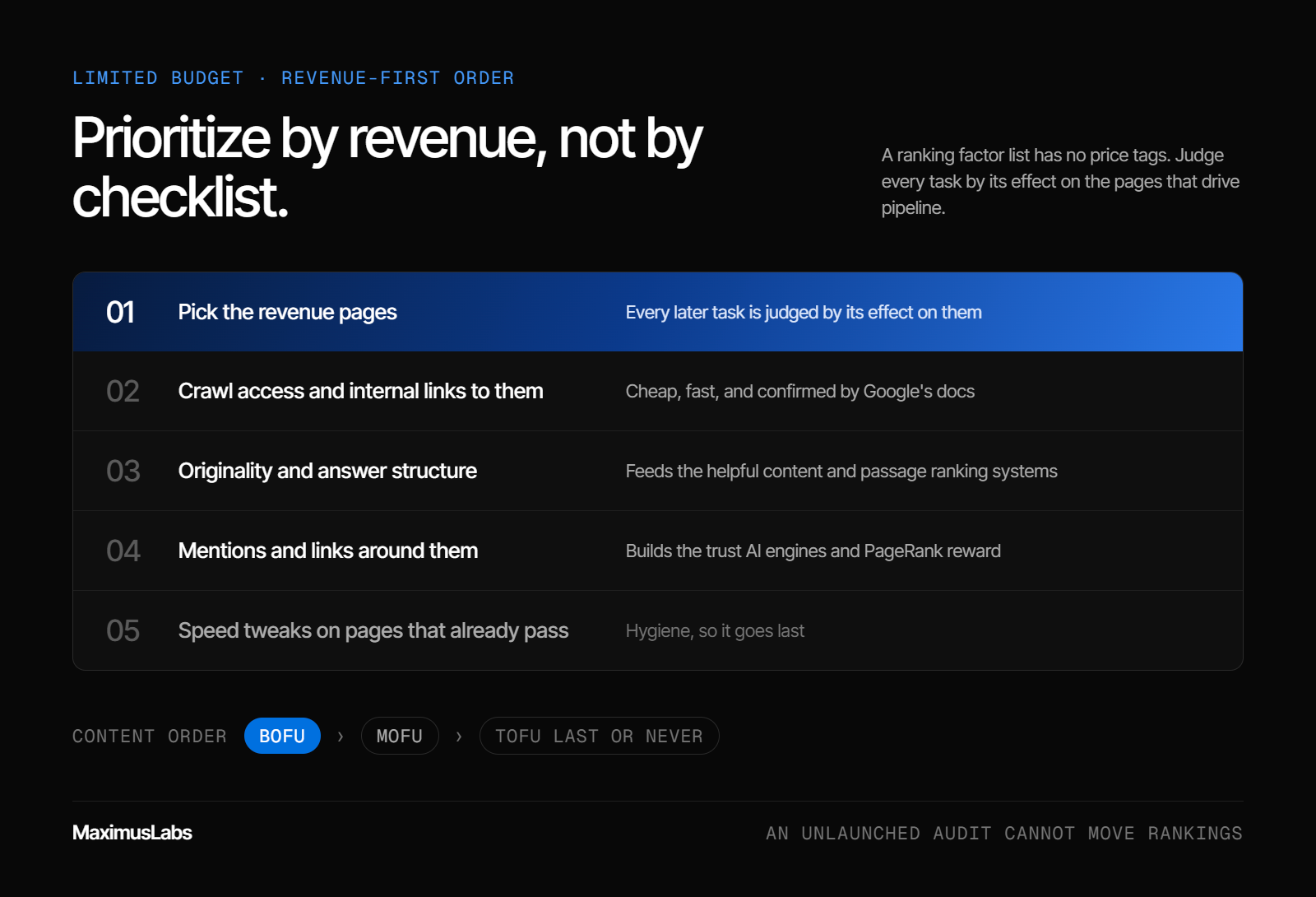
Prioritize by revenue, not by checklist. A small share of pages drives most organic pipeline. Fix crawlability and internal links to those pages first. Then upgrade their content for originality and answer structure. Then earn mentions and links around them. Google advises site owners to measure the overall value of visits, such as sales and signups, not just clicks. Skip work nobody will ship, because an unlaunched audit cannot move rankings.
The problem with a flat checklist
📋 Every factor looks equally urgent
A ranking factor list has no price tags. Title tags, schema, Core Web Vitals, and link building all look the same size. So teams spread budget thin and finish nothing.
I have made this mistake myself. I once treated a 200-item audit as a to-do list. Six months later, almost nothing that mattered to revenue had moved.
Start where the money is
💰 A few pages carry the pipeline
Open your analytics and sort organic landing pages by conversions, not sessions. In most sites I have audited, a short list of pages drives most demo requests and signups. Those are your money pages, and every ranking factor should be judged by its effect on them.
🎯 BOFU before TOFU
BOFU (bottom-of-funnel) pages answer buying questions: comparisons, alternatives, pricing logic, and "best X for Y." TOFU (top-of-funnel) pages answer "what is X?" AI engines already answer most TOFU questions well, so those pages earn fewer clicks and less pipeline.
So the order is BOFU first, then MOFU (middle-of-funnel) evaluation content, and TOFU last or never.
The revenue-first order of work
✅ What to fix first, second, and third
| Order | Work | Why it comes here |
|---|---|---|
| 1 | Pick the revenue pages | Every later task is judged by its effect on them |
| 2 | Crawl access and internal links to those pages | Cheap, fast, and confirmed by Google's docs |
| 3 | Originality and answer structure on those pages | Feeds the helpful content and passage ranking systems |
| 4 | Mentions and links around those pages | Builds the trust AI engines and PageRank reward |
| 5 | Speed tweaks on pages that already pass | Hygiene, so it goes last |
🧭 Match the work to the question type
Not every query needs the same lever. I group buyer questions into three types:
- Head questions like "best CRM software" are won mostly by third-party citations, so mentions matter most.
- Mid-tail questions like "best CRM for small SaaS teams" need both mentions and strong owned pages.
- Long-tail questions like "does this CRM route Slack leads automatically?" are won by the most complete owned answer.
Ship less, launch more
⚠️ A plan is worth what launches
Ethan Smith has described a pattern most consultants will recognize. Only a small part of a full SEO strategy usually gets launched, and an unlaunched plan cannot change outcomes. I agree. If only a fifth of the audit ships, the fifth is what counts.
Eli Schwartz and Dharmesh Shah compare paid marketing to renting and SEO to owning a home. I like that framing, with one addition. You only build equity on the rooms you actually finish.
MaximusLabs AI starts every engagement with BOFU pages tied to the client's ideal customer profile. Technical fixes, content, and off-site work are then sequenced around those pages, so each step has a clear line to pipeline.
Q10. How do you measure whether ranking factor work is paying off?
Measure outcomes, not positions. Track organic conversions and pipeline first. Then track citation rate and share of voice across Google AI Overviews, ChatGPT, Perplexity, and Gemini, with rank as a leading signal only. Google reports AI feature traffic inside the Search Console Performance report under the Web search type. MaximusLabs AI measured "64% AI citation rate in 6 months, vs ~30% for billion-dollar incumbents (Oliv AI)," a gap rank tracking would never show.
Why rank is a weak KPI now
📉 The chart goes up, the pipeline does not
Rank was a good proxy when a top position meant a predictable share of clicks. Q2 showed why that link broke. On AI Overview queries, a page can hold position 1 and lose most of its clicks.
There is a second problem. AI answers have no fixed position. ChatGPT may name you in one answer and skip you in the next, depending on how the question is phrased. So there is no single rank in AI. What matters is how often you show up.
The metric stack that replaces it
📊 Four layers, from leading to lagging
| Layer | Metric | Where it comes from |
|---|---|---|
| Visibility | Rank on money keywords | Search Console, rank tracking |
| Citation | Share of voice and citation rate across AI engines | Prompt sets run across ChatGPT, Perplexity, Gemini, and AI Overviews |
| Engagement | Conversions per organic session | Analytics goals and events |
| Revenue | Qualified leads and pipeline from organic and AI referrals | CRM attribution |
Read it bottom up. If pipeline grows, the layers above are working. If rank grows and pipeline does not, something in the middle is broken.
🔍 How to measure AI citation in practice
- List 50 to 100 questions your buyers actually ask, taken from sales calls and support tickets.
- Run them across ChatGPT, Perplexity, Gemini, and Google AI Overviews.
- Record whether your brand is named or your page is cited.
- Repeat on a fixed schedule, and compare against your top three competitors.
Google adds one caution. Search Console does not separate AI Overview clicks from classic results; both sit inside the Web search type. So pair Search Console with your own prompt tracking.
What it looks like when it works
⭐ The Oliv AI numbers
MaximusLabs AI reports every engagement on pipeline and citation share, not impressions. For Oliv AI, the measured results were "27 qualified leads, $47K+ pipeline, 26% close rate in 4 months (Oliv AI)." Over a longer window, the same client reached a "64% AI citation rate in 6 months, vs ~30% for billion-dollar incumbents (Oliv AI)."
Neither number shows up in a rank report. Both show up in a board meeting.
💡 What I would track first
If you can only add one metric this quarter, add pipeline from organic and AI referrals. It forces every other conversation to connect back to revenue. Rank and citations then become what they should be, leading signals for the number that matters.
MaximusLabs AI runs daily AI-visibility tracking across the major engines next to classic rank. Each client sees citation share and pipeline in the same report, so ranking work is judged by what it earns.
What I'm Thinking About Next
My current hypothesis is that "ranking factors" and "citation factors" will keep drifting apart. Google will keep its named systems, and they will keep mattering. But more buying decisions will start inside an AI answer that names five brands and links to two.
I might be wrong about the pace. I am fairly sure about the direction. The brands that win will treat SEO as the floor and trust as the building on top. That means original evidence, real mentions, and pages built to be the answer.
Next, I want to go deeper on two questions this guide only touched. How exactly does query fan-out pick its sources? And how should a small team split time between owned pages and earned mentions? If you are testing either, I would love to compare notes.
Questions, answered
7 questionsDoes Google officially publish a list of its ranking factors?
No. Google has never published a complete, weighted list of ranking factors. What it does publish is a guide to its ranking systems, which names the live systems and explains what each one rewards. We treat that guide as the real map. It names systems such as: • Understanding: RankBrain, BERT, neural matching, and passage ranking. • Quality and trust: reliable information, reviews, and original content systems. • Authority: link analysis and PageRank. • Abuse: SpamBrain and removal-based demotions. Google also lists retired systems. Panda, Penguin, and the helpful content system now live inside core ranking, so their ideas still apply. The popular lists of 200 factors mix confirmed systems with leaked attributes, correlation studies, and opinion. That is why we grade every factor by its evidence before it gets budget. Confirmed factors get funded first, leaked ones get planned around, and correlated ones get tested. If you are newer to the basics behind all of this, our guide on what SEO is and how search engines rank pages is a good starting point. MaximusLabs AI builds client roadmaps from Google's named systems rather than a generic checklist.
Are backlinks still a Google ranking factor in 2026?
Yes. Google's ranking systems guide still lists link analysis and PageRank as part of core ranking. Links help Google discover pages and judge which ones other sites vouch for. What has changed is how much weight links carry for AI visibility. Ahrefs studied 75,000 brands and found branded web mentions correlated with AI Overview brand visibility at 0.664, while backlinks correlated at 0.218. The author is clear that correlation is not causation, but the pattern is hard to ignore. Here is how we approach links now: • Earn links from category sites your buyers already read, not from unrelated directories. • Favor many different referring sites over many links from one site. • Track unlinked brand mentions alongside backlinks. • Get listed and reviewed where AI engines look for your category. Links follow brands far more often than brands follow links. MaximusLabs AI pairs link earning with mention building across reviews, communities, and third-party lists. Our playbook on earning AI citations covers the off-site side in more depth.
Is E-E-A-T a direct Google ranking factor?
Not as a single score. Google's own helpful content guidance says E-E-A-T itself is not a specific ranking factor. Instead, Google uses a mix of factors that can identify content with good Experience, Expertise, Authoritativeness, and Trustworthiness. Of the four, Google says trust is the most important. In practice, that means you cannot add an author bio and expect a lift. Google's systems look for a pattern across the page and the site. Its guidance points to three questions every page should answer for readers: • Who created the content. • How it was produced. • Why it exists, which Google calls perhaps the most important of the three. We see E-E-A-T matter even more for AI citation. An AI engine that recommends a source puts its own credibility on the line, so it leans toward sources that look first-hand and verifiable. MaximusLabs AI builds trust signals into every page by capturing the founder's real view and tracing each claim to a primary source. For a deeper look, see our guide to E-E-A-T for answer engines.
Do Core Web Vitals affect Google rankings?
Yes, but less than most audits suggest. Core Web Vitals are Google's speed and stability metrics: LCP, INP, and CLS. They feed into page experience, which is a real ranking signal. Google is clear about their limits. Its page experience documentation says Search always seeks to show the most relevant content, even if the page experience is sub-par. Good scores do not guarantee top rankings. Page experience helps most when many equally helpful pages compete for the same query. So we put Core Web Vitals in proportion: • First, make sure Google can crawl and index the page. • Second, render main content in HTML, not only after heavy JavaScript. • Third, fix internal links to your money pages. • Then fix Core Web Vitals on pages that truly fail. Going from 2.0 to 1.8 seconds will not beat a competitor with better content. Treat speed as hygiene, not a growth lever. MaximusLabs AI runs crawl, rendering, and internal link fixes before speed tuning. Our technical SEO guide walks through that order step by step.
How do I get my content cited in Google AI Overviews?
Google says there are no additional requirements to appear in AI Overviews or AI Mode. A page must be indexed and eligible to show with a snippet, and no special schema or AI text file is needed. The same ranking systems still choose the sources. What changes is what gets rewarded. AI Overviews may use query fan-out, which runs related searches across subtopics to build one answer. Pages that answer many subquestions well have more chances to be pulled in. The page structure we use: • A question-style heading that matches how buyers ask. • A 40 to 80 word direct answer under each heading. • A sourced statistic with a named source and date. • A named expert quote or first-hand result. • Structured data that matches the visible page. The GEO study by Aggarwal and colleagues found that adding citations, quotations, and statistics can lift visibility in generative engine answers by up to 40%. MaximusLabs AI writes a standalone answer block under every H2 it publishes. Our guide to citation-worthy content for AI engines covers more examples.
Does domain age matter for Google rankings?
Domain age on its own is not a factor Google confirms in its ranking systems guide. But the 2024 leak of Google's API documentation, analyzed by Mike King, showed an attribute called hostAge. The document describes it as used to sandbox fresh spam in serving time. So the honest answer is nuanced. Age does not make a site rank. Newness, combined with spam-like signals, may hold a site back for a while. What matters more is the trust a domain builds over time: • The leak describes homepage trust values that new pages can inherit. • A new page on a trusted site starts with some credit. • A new page on an unknown site starts from zero. That is why the same article can rank quickly on one domain and stall on another. The page is identical, but the trust behind it is not. For newer sites, we focus on earning real mentions and links, publishing original BOFU pages, and keeping the site clean of spam patterns. MaximusLabs AI sequences that work for younger brands through a GEO strategy framework that puts trust-building ahead of volume.
Does Google use click data and dwell time to rank pages?
Google uses click data. Testimony from Google's Pandu Nayak in the DOJ antitrust trial described NavBoost, a system that uses past click behavior to adjust rankings. The 2024 leak, as analyzed by Mike King, lists NavBoost click signals such as goodClicks, badClicks, and lastLongestClicks. King reports the click window was once 18 months and was later cut to 13 months. Nobody outside Google knows how these signals are weighted. Dwell time is not named as a standalone factor. But the direction is clear: Google watches which result ends the search. Pogo-sticking, where a searcher clicks, returns to Google, and picks someone else, is the behavior a bad click would capture. What we do about it: • Match the format the top results use for the query. • Put the answer in the first screen of the page. • Add the next question the reader will have. • Watch pages with high impressions but falling clicks. MaximusLabs AI shapes every brief around how buyers phrase the question, so the page becomes the last click. Our click-worthiness strategy explains how to earn the click when AI answers come first.