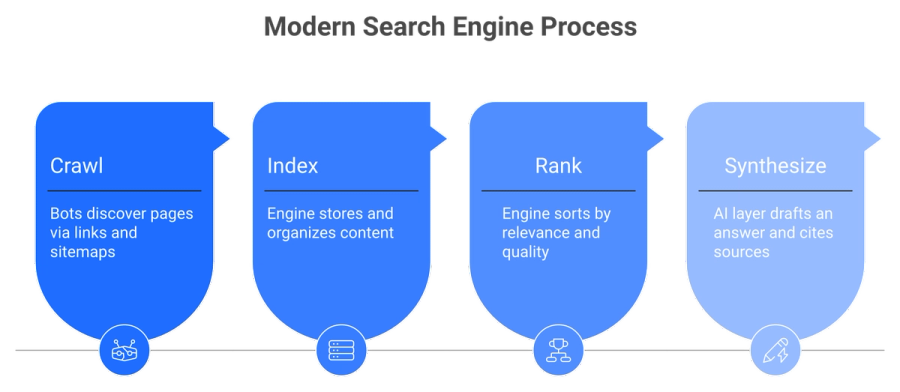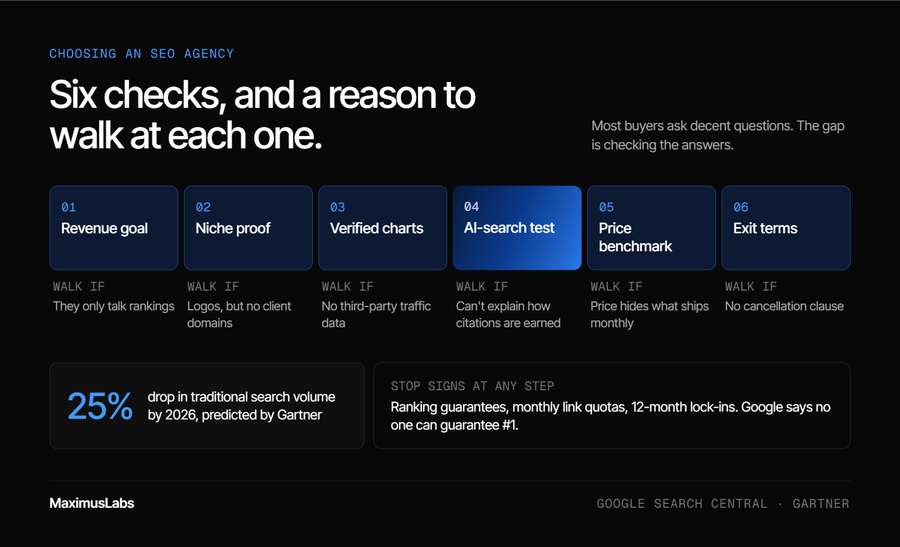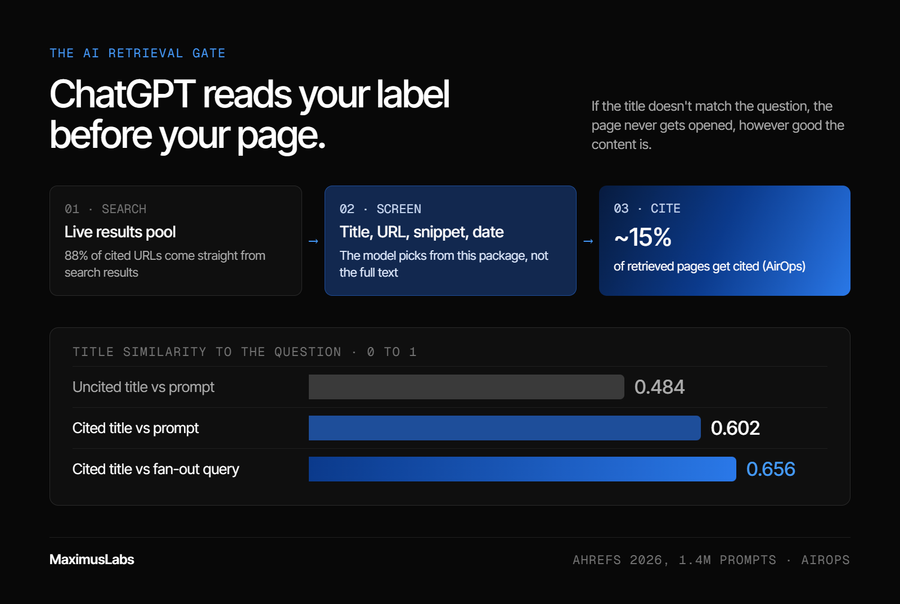
- Keyword research finds the words, questions, and prompts buyers use in Google and AI engines, then judges each by intent, difficulty, and business value.
- AI Overviews and AI Mode fan one question out into many searches, so research now maps every sub-question a page must answer to get cited.
- Read volume, difficulty, CPC, and traffic potential together, and discount keywords with AI Overviews, which Seer Interactive and Ahrefs tie to sharply lower clicks.
- The best keywords come from Search Console, sales calls, support tickets, forums, and competitors' paid terms, not just the public tool exports everyone shares.
- Score keywords by business fit, funnel stage, and AI Overview presence; in our example, a 900-search buying query beats a 12,000-search definition.
- Group keywords into topic clusters with one page each, then measure impressions, AI citations, and pipeline every quarter.
It's Monday, 9:40 a.m. A marketing manager at a B2B SaaS company opens the keyword sheet her agency sent last quarter. It has 412 rows, sorted by search volume, with the biggest numbers at the top. Her VP has one question in the Slack thread: which of these rows produced a demo?
She can't answer. The top keyword now shows an AI Overview, so Google answers it before anyone clicks. When she types the same question into ChatGPT, three competitors come back. Her brand isn't one of them.
That gap is why I wrote this guide. Keyword research still matters. But the version most beginners learn, a volume spreadsheet and a difficulty filter, was built for ten blue links. This guide covers the basics properly. Then it shows how to research the questions buyers ask Google and AI engines, so your pages rank, get cited, and drive pipeline.
Q1. What is keyword research, and why does it matter when AI engines answer first?
Keyword research is the process of finding the words, questions, and prompts your buyers use in Google and AI engines. You then judge each one by intent, difficulty, and business value. It matters more now, not less. AI Overviews and AI Mode run many related searches behind one question. Research now maps every sub-question a page must answer to rank, get cited, and become the answer.
What keyword research actually produces
🎯 A map of demand, not a list of words
Good keyword research answers three questions. What does my buyer type or ask? What do they want when they ask it? Which of those questions can my business answer better than anyone else? The output is a ranked plan of topics and pages, not a spreadsheet you file away.
A keyword, in this guide, is any search term. A prompt is the longer, conversational version someone types into ChatGPT, Perplexity, or Gemini. Beginners should collect both, because buyers now switch between them in the same week. A founder might Google "expense software" on Monday, then ask ChatGPT to compare three options on Wednesday.
⚠️ Why a tool export alone fails
Every public keyword tool shows the same data to anyone with a login. So a list pulled straight from a tool is a list your competitors also have. MaximusLabs AI treats tool data as the starting point. Then it adds language from sales calls, support tickets, and forums that no database shows competitors.
There's a second limit. SEO is an optimization channel, not a demand-creation channel. It works best where demand already exists. If your product creates a new category, few people search for it yet, and no tool will show volume. Research then shifts to the problems buyers describe, not the product name.
Why it still matters in AI search
✅ AI engines search before they answer
Google states that AI Overviews and AI Mode may use a "query fan-out" technique. That means the system issues multiple related searches across subtopics before it writes one answer. Each of those hidden searches is a keyword. A page that covers the full cluster has more chances to be retrieved and cited.
Google also says there are no extra technical requirements to appear in these features. A page just needs to be indexed and eligible to show a snippet. So the basics of keyword research and on-page SEO are now the entry ticket to AI visibility, not a separate discipline.
💡 How I think about it
Here's the thing. I see SEO as the foundation floor and AI visibility as the building on top. The best practices of keyword research became the basics. They are necessary, but they are no longer enough on their own.
MaximusLabs AI uses keyword research to build question maps for each client's ideal customer profile (ICP). Every mapped topic is then tied to a page and a pipeline goal. That keeps research pointed at revenue rather than raw traffic, which is the standard the rest of this guide uses.
Q2. How do search intent and keyword types decide which keywords are worth targeting?
Search intent is the job a searcher wants done: learn, navigate, compare, or buy. Keyword type describes length and specificity, from broad head terms to long-tail questions. A keyword is worth targeting only when your page can satisfy its intent and the person behind it could become a customer. Google can reclassify intent at any time, so check the live results before you commit.
The four intent types
🔍 Read the job behind the words
Ahrefs groups intent into informational, navigational, commercial, and transactional searches. The labels sound academic, but the test is simple. Ask what the searcher wants to have when they leave the page.
| Intent | What the searcher wants | Example query | Page that fits |
|---|---|---|---|
| Informational | To learn or understand | what is expense tracking | Guide or explainer |
| Navigational | To reach a known site | Brex login | Brand or product page |
| Commercial | To compare options | best expense tracking software for startups | Comparison or listicle |
| Transactional | To act or buy | expense tracking software free trial | Pricing or sign-up page |
Commercial and transactional searches sit closest to revenue. These are bottom-of-funnel (BOFU) and middle-of-funnel (MOFU) queries, the stages where buyers compare and decide. MaximusLabs AI starts client plans with these BOFU queries, because they convert, and adds informational topics only when they support a buying decision.
Head, mid-tail, and long-tail keywords
📏 Length changes who wins
MaximusLabs AI sorts questions into three types. Head terms are broad, like "best CRM software." Mid-tail terms add context, like "best CRM for small SaaS teams." Long-tail terms are specific, like "does HubSpot integrate with Slack for lead routing."
Each type is won differently in AI answers. Head terms are dominated by third-party sources, such as reviews, listicles, and forums. Long-tail questions are where owned content wins, because a detailed page can be the most complete answer available.
💸 Volume is not the same as value
Beginners often chase head terms because the volume looks exciting. But a new site rarely ranks for them, and the searchers are mixed. A long-tail query with small volume can carry a buyer who already knows exactly what they need.
Check intent on the live results
⚠️ Google can change its mind
Intent is not fixed. SEO consultant Eli Schwartz has described how SurveyMonkey's rankings for "create survey" dropped. The team first suspected a technical error. A manual look at the results showed Google had shifted the query toward sites where people take surveys, not software for creating them.
The fix was to stop fighting the shift and retarget. That lesson applies to every keyword on your list. Before you write, search the term yourself and look at what ranks. If the top results are all comparison pages, a product page won't win.
✅ A quick intent check
- Search the keyword in Google and note the page types in the top five.
- Ask the same question in ChatGPT or Perplexity and note which sources get cited.
- Match your page format to what both surfaces reward.
MaximusLabs AI runs this check across Google and AI engines before any brief is written. The page format then matches intent on every surface a buyer uses.
Q3. Which keyword metrics should beginners trust, and where do they mislead?
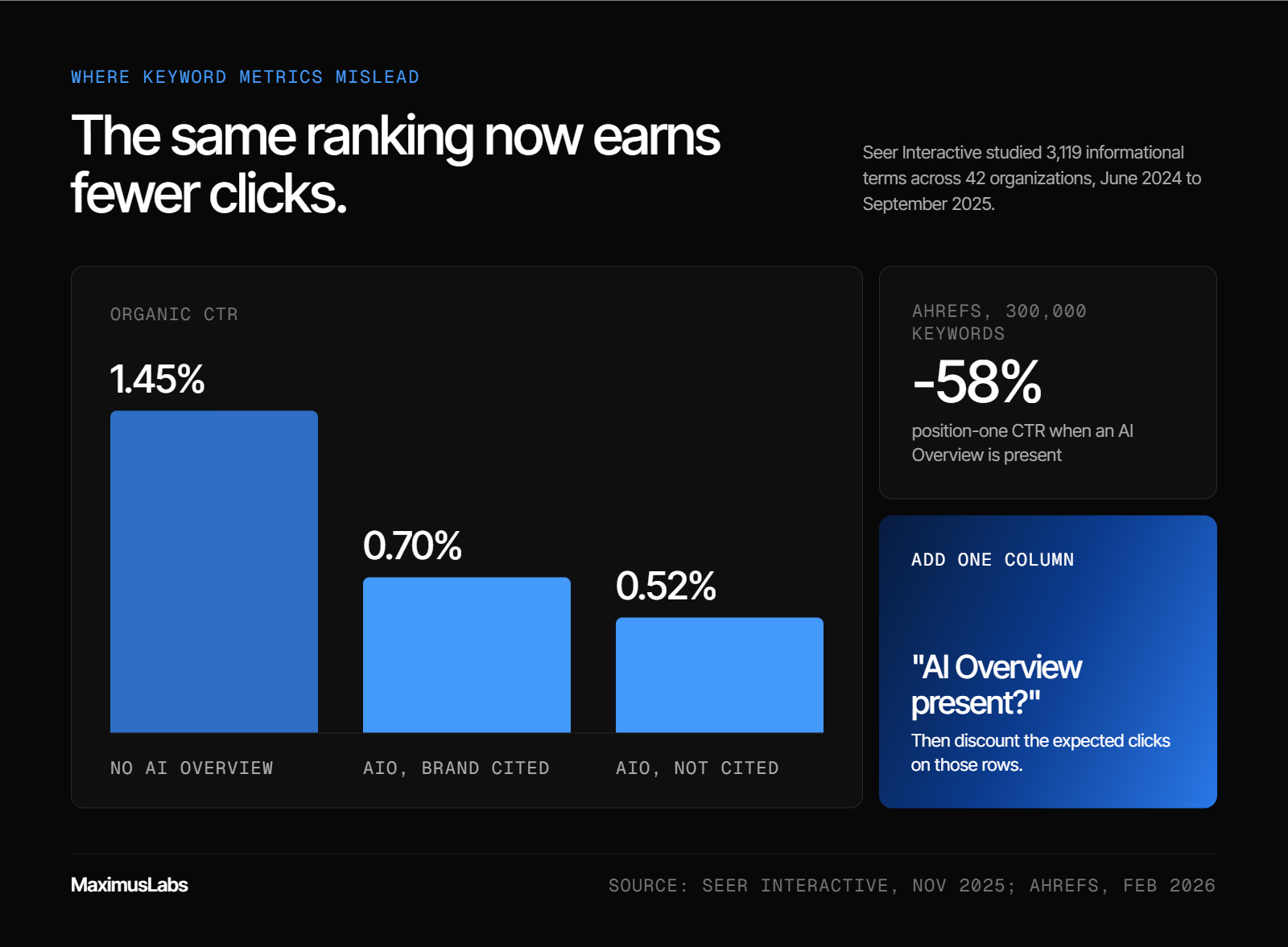
Beginners should read five metrics together: search volume, keyword difficulty, cost per click (CPC), traffic potential, and click potential. Each one misleads on its own. Volume is a tool estimate, difficulty ignores your authority, and clicks shrink when an AI Overview appears. Seer Interactive measured organic click-through rate (CTR) at 0.52% when an AI Overview appeared without citing the brand. With no AI Overview, it was 1.45%.
The five metrics and their blind spots
📊 What each number really tells you
| Metric | What it measures | Blind spot |
|---|---|---|
| Search volume | Estimated monthly searches for one phrase | Misses rephrased versions of the same question |
| Keyword difficulty (KD) | How hard it is to reach page one, usually 0 to 100 | Ignores your own site's authority and topic depth |
| Cost per click (CPC) | What advertisers pay for one click | Varies by industry; high CPC can mean high competition |
| Traffic potential | Traffic the top page gets from all its keywords | Assumes clicks still happen at the old rate |
| Click potential | How many searches end in a click | Falls sharply when AI Overviews appear |
Ahrefs adds a sixth idea that beginners should borrow: business potential. It scores how naturally your product fits the topic, on a scale of 0 to 3. That single column often does more for prioritization than volume.
💰 CPC is an honest signal
CPC is underrated by beginners. Advertisers pay for clicks that make money, so a high CPC usually means buyers are behind the query. MaximusLabs AI reads CPC as a commercial-value signal, then checks intent before trusting it.
Where AI Overviews break the math
⚠️ Fewer clicks for the same ranking
Seer Interactive studied 3,119 informational search terms across 42 organizations from June 2024 to September 2025. Organic CTR fell to 0.52% when an AI Overview appeared and the brand wasn't cited. It was 0.70% when the brand was cited, and 1.45% with no AI Overview.
Ahrefs found a similar pattern in 300,000 keywords. When an AI Overview was present, position-one CTR was about 58% lower than expected. A keyword that looks like 1,000 visits a month may deliver far less.
✅ What to do with that
Add one column to your sheet: "AI Overview present?" Then discount the expected clicks on those rows. Seer's data also links citation to more clicks, though the authors note the link may reflect brand strength rather than cause. Either way, being cited beats being ignored.
Difficulty thresholds for new sites
⏰ Pick fights you can win
A practical rule I've found useful: sites with low authority should start with keywords under KD 40, and often under 20 to 30. Early wins build the topical authority that makes harder terms reachable later. Chasing KD 70 terms in month one burns budget and morale.
MaximusLabs AI reads these metrics together, with business fit and AI Overview presence weighted before raw volume. That is how a short list of winnable, high-intent topics replaces a 400-row sheet.
Q4. How do you do keyword research step by step?
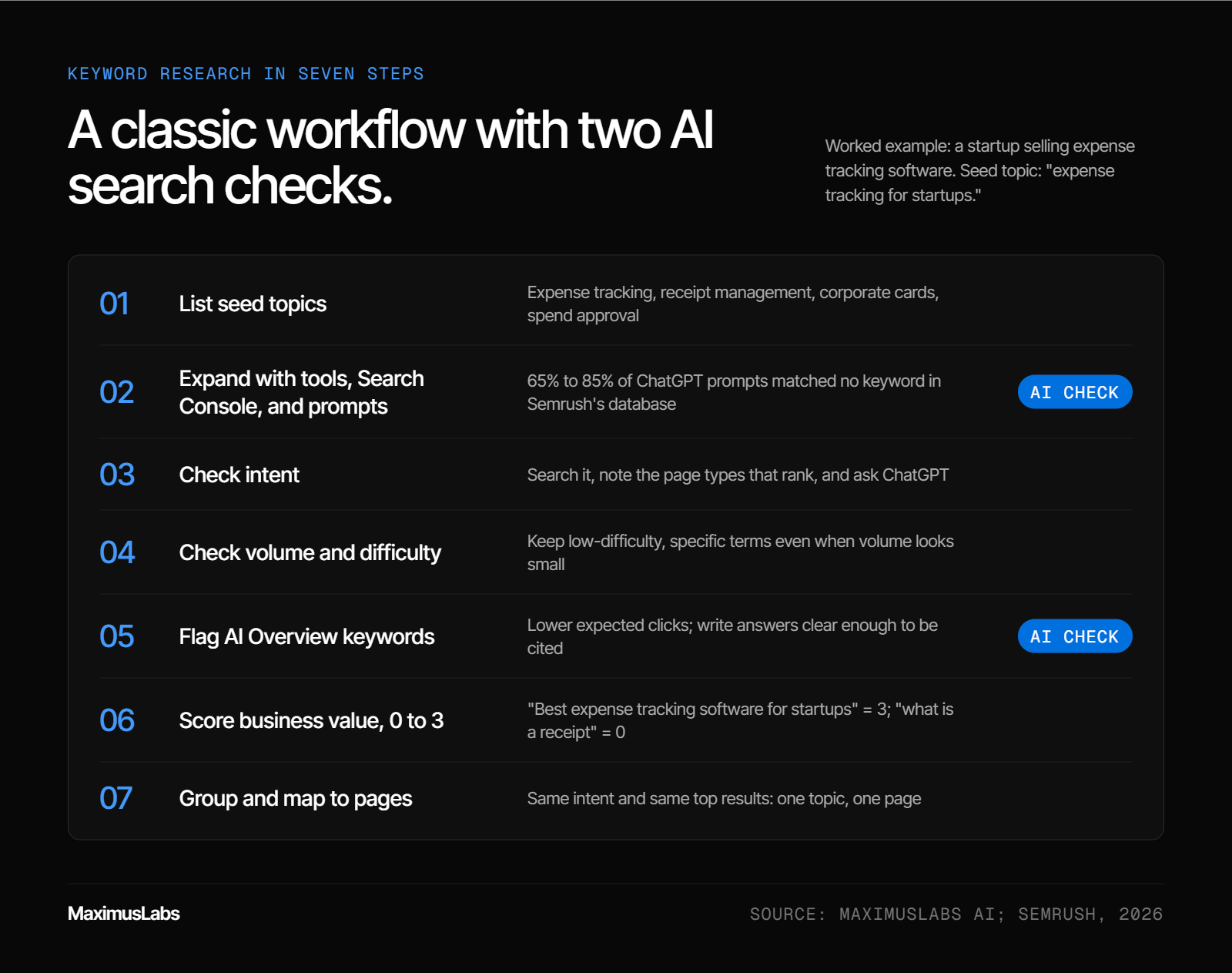
Do keyword research in seven steps. 1. List seed topics from your product and customers. 2. Expand them with tools, Search Console, and real prompts. 3. Check intent on the live results. 4. Check volume and difficulty. 5. Flag keywords that trigger AI Overviews. 6. Score each by business value. 7. Group the winners into topics and map each topic to one page.
To keep it concrete, I'll carry one example through every step. Imagine a startup that sells expense tracking software to other startups. Its seed topic is "expense tracking for startups."
Step 1: List seed topics
🌱 Start from the product and the buyer
Seed topics are the broad themes your product solves. Pull them from your homepage, sales deck, and the problems customers name on calls. For the example, seeds include expense tracking, receipt management, corporate cards, and spend approval.
Step 2: Expand with tools, Search Console, and prompts
🔍 Widen the list from three sides
Run each seed through a keyword tool for matching and related terms. Then check Google Search Console for queries your site already shows up for. Semrush's 2026 guide also recommends mining first-party data, such as sales calls and support tickets.
Add prompts too. Semrush found that 65% to 85% of ChatGPT prompts matched no keyword in its 27-billion-keyword database for most of its study. So write down how buyers phrase questions in AI tools, such as "what's the simplest way for a 10-person startup to track expenses?"
Step 3: Check intent
✅ Search it before you plan it
Search each promising term and note the page types that rank. Then ask the same question in ChatGPT and note the cited sources. "Expense tracking software for startups" shows comparison pages, so it needs a comparison page.
Step 4: Check volume and difficulty
📊 Filter for reach and winnability
Note volume and KD for each term. Keep low-difficulty, specific terms even when volume looks small. Rephrased long-tail questions often add up to more demand than any single row shows.
Step 5: Flag AI Overview keywords
⚠️ Adjust for answers that steal clicks
Mark any keyword where Google shows an AI Overview. Lower its expected clicks, and plan to write answers clear enough to be cited inside that overview.
Step 6: Score business value
💰 Rank by revenue, not volume
Give each keyword a 0 to 3 business-fit score. "Best expense tracking software for startups" scores 3, because the product is the answer. "What is a receipt" scores 0. Sort by this score first, then by volume.
Step 7: Group and map to pages
🗺️ One topic, one page
Group keywords that share the same intent and the same top results. Each group gets one page. "Expense tracking for startups," "startup expense software," and "best expense app for small teams" likely belong on a single comparison page.
💡 Why the last step decides everything
Ethan Smith, CEO of Graphite, has said that early in his consulting work only about a fifth of a full strategy ever launched. A plan that never ships produces nothing. The mapping step turns research into briefs someone can execute this week.
MaximusLabs AI runs this same seven-step sequence inside a 3-stage content pipeline of research, writing, and QA. Keyword research feeds directly into briefs, so it ships as pages instead of sitting in a forgotten spreadsheet.
Q5. Why do zero-volume and long-tail keywords often beat high-volume terms?
Zero-volume and long-tail keywords often win because tools undercount them, competitors ignore them, and the people searching them are closer to buying. One eight-word question can be phrased dozens of ways. Each phrasing shows zero volume, but together they add up to real demand. Head terms suit established brands with strong authority. New sites should start specific and earn the right to go broad.
How keyword lists usually get built
📋 The volume column runs the meeting
Picture a quarterly planning call. Someone sorts a keyword export by monthly searches and deletes every row below 100. The team argues about which big terms to chase. Nobody asks who is behind each search, or whether that person could ever buy.
That habit made sense when ten blue links were the whole game. Bigger volume meant more potential clicks. But it quietly trained teams to treat a tool's estimate as the truth about demand.
Why the volume habit breaks
❌ Tools miss rephrased demand
Long-tail keywords are specific searches, usually three words or more, with low individual volume. Tools struggle with them because buyers phrase the same need in many ways. "Expense app for a 10-person startup" and "simplest way for small teams to track spend" are one need. In a tool, they are two rows that each show zero.
Eli Schwartz has written about the language app Drops, which had about 1,000,000 users but only 25 to 50 non-branded search clicks a day. The team stopped chasing tool volume. It built pages around what learners actually needed, across 37 languages. Clicks grew into the thousands per day, much of it from queries tools said had no volume.
⚠️ Head terms are a fight for the strong
Head terms are not useless. They work for brands with deep authority and years of trust signals. For a small site, a head term like "expense software" means months of fighting incumbents. The prize is traffic with mixed intent.
What changed with AI search
🤖 The long tail became the main road
In MaximusLabs AI's framework, the average AI chat query runs about 25 words. That's a long-tail question by any definition. When a buyer asks ChatGPT or Perplexity for help, they describe their exact situation. The engine then cites whichever page answers that situation best.
This flips the old math. Head questions like "best CRM software" in AI answers are dominated by reviews, listicles, and forums. Specific questions are where your own content can become the answer. The fit rule is simple: low-authority sites start with long-tail, while strong brands can also compete for head terms.
How MaximusLabs AI works the long tail
✅ Systems, not spreadsheets
MaximusLabs AI runs Answer Engine Optimization (AEO), with SEO underneath, as strategy and execution in one team. Per-client intelligence graphs, built from AI agents, research each client's market and context. They surface the specific questions buyers ask, including those that tools score at zero. A citation-intelligence engine then maps which sources each engine trusts for those questions.
Daily AI-visibility tracking re-runs the questions across every major engine, so the team sees which long-tail pages get cited. Humans approve everything that ships, and every engagement is measured on pipeline, not mentions.
💰 Where it lands
For one B2B AI SaaS client, that long-tail, intent-first approach produced "27 qualified leads, $47K+ pipeline, 26% close rate in 4 months (Oliv AI)". Those numbers came from specific buying questions, not head terms with the biggest volume.
Q6. Where do you find the keywords your buyers actually use?
The best keywords come from sources your competitors cannot see in a public tool. Start with Search Console impressions, which show real demand for your own pages. Then mine sales calls, support tickets, and community threads for the exact words buyers use. Finally, study the terms competitors pay for in search ads, because ad spend reveals which queries make money.
Search Console: your own ground truth
🔍 Read the impressions, not just the clicks
Google Search Console is a free Google tool that shows the queries your pages appear for. Treat its impression data as your most reliable demand signal. Tool volumes are estimates, but impressions are real searches that already found you.
Google also reports AI feature traffic inside the Search Console Performance report, under the "Web" search type, according to Google. So the same report shows demand from both classic results and AI Overviews. Filter for queries with high impressions and low clicks. Those are pages that rank but don't earn the click, and they're often the fastest wins.
Sales calls and support tickets
🎧 Buyers say the keyword out loud
Semrush's 2026 keyword research guide recommends mining sales calls and support tickets as first-party sources. This is where buyers describe problems in their own words, before marketing rewrites them. A line like "we keep losing receipts after team offsites" is a long-tail query waiting for a page.
MaximusLabs AI's question research pulls long-tail questions from search data, sales calls, support tickets, and Reddit. Ask your sales team for their ten most common objections. Each one is a question a buyer will also ask ChatGPT.
Forums, Reddit, and communities
💬 Where people ask before they buy
Reddit threads, Quora answers, and niche Slack groups show unfiltered questions. Read the titles and the top comments. The phrases people repeat there are often the same prompts they type into AI search tools.
Semrush also describes analyzing competitor prompts and community discussions with an AI assistant to pull out keyword ideas. Paste a long thread into ChatGPT or Claude. Then ask it to list every distinct question and pain point raised. Always check the output against the original thread.
Competitor paid terms
💸 Follow the ad money
Competitors' search ad keywords show which queries they've proven make money. Most keyword tools list the paid terms a domain bids on. Pull the top ones, then turn each into a question cluster your content can answer organically.
Product competitors vs audience competitors
⚖️ Mine both, for different jobs
| Competitor type | Who they are | What to mine |
|---|---|---|
| Product competitors | Companies selling a similar product | Feature, integration, pricing, and "vs" keywords |
| Audience competitors | Media sites and publishers serving the same reader | Topic ideas and content structure for informational terms |
Product competitors show you the commercial terms. Audience competitors, such as finance publishers for an expense tool, show the questions your buyers ask before they're ready to buy. Use both, but give product-competitor terms first priority.
MaximusLabs AI makes this simpler by running these sources together for each client's ICP. Search data, call notes, and community threads merge into one question list before any brief is written.
Q7. How has AI search changed keyword research from ranking to becoming the answer?
AI search turned keyword research into question research. Google confirms AI Overviews and AI Mode split one query into many related searches, called query fan-out. Semrush found most ChatGPT prompts match no keyword in its 27-billion-keyword database. MaximusLabs AI treats each keyword as a cluster of sub-questions and tracks citation share across ChatGPT, Perplexity, Gemini, and Google, not just a single rank.
The old model: one keyword, one page, one rank
📈 The report everyone used to trust
For years, the monthly SEO report looked the same. A list of target keywords, a rank for each, and a traffic chart going up. Agencies sold rankings, impressions, and clicks on fixed retainers. If position one held, everyone relaxed.
Nobody tied those rows back to pipeline. Strategy often came from one firm and execution from another. The page was written for Google's blue links, and the keyword was the whole unit of strategy.
What changed
🤖 One question, many hidden searches
Google now says AI Overviews and AI Mode may issue multiple related searches across subtopics before writing a response. Your buyer types one question. The engine quietly runs several more. A page that answers only the head keyword misses most of those chances.
Prompts are also getting longer. Semrush's clickstream study found search-enabled ChatGPT prompts grew from 4.7 words to 8.7 words between early 2025 and early 2026. Buyers now describe their situation, not just a topic.
🔎 Grounding queries make it visible
Microsoft launched an AI Performance report in Bing Webmaster Tools in early 2026. It shows "grounding queries," the shorter searches Copilot runs to fetch sources, and which pages get cited. For the first time, a free tool shows the keywords behind AI answers.
⭐ The answer has 5 to 10 names
Buyers asking ChatGPT, Perplexity, Gemini, or Claude get one answer with 5 to 10 brands in it. A brand is either in that answer or invisible. AI engines recommend sources they trust, because their own credibility rides on the answer.
The Princeton-led GEO study found that generative engine optimization methods can boost visibility in AI responses by up to 40%. Adding citations, quotations, and statistics was among the methods tested. Structure and evidence now matter as much as the keyword itself.
How MaximusLabs AI researches for answers
✅ Owned and Earned AEO
MaximusLabs AI built its method on one observation. ChatGPT, Google, and Perplexity often cite different sources for the same question. So the team maps each keyword into its fan-out sub-questions, then works the Two Pillars. Owned AEO makes the client's content the answer. Earned AEO puts the client in the reviews, Reddit threads, press, and listicles AI trusts.
A citation-intelligence engine maps which sources each engine cites. Daily AI-visibility tracking re-runs every question cluster and flags regressions. Humans approve everything that ships, and the engagement is measured on pipeline.
💰 What it produced
For Oliv AI, the result was a "64% AI citation rate in 6 months, vs ~30% for billion-dollar incumbents (Oliv AI)". That citation share became qualified pipeline, not a dashboard number.
Q8. How do you prioritize keywords by revenue instead of volume?
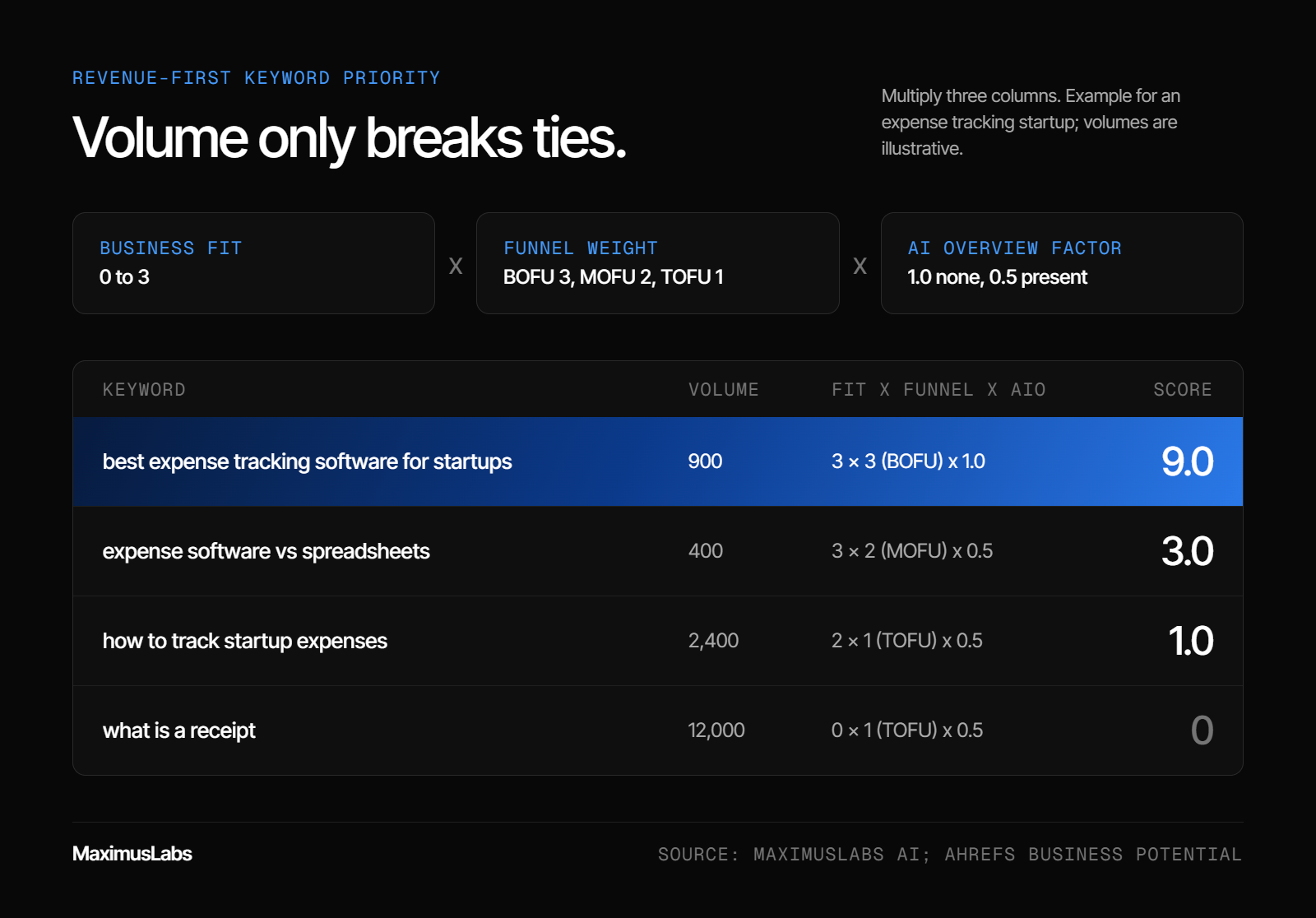
Prioritize keywords by how directly they lead to revenue. Score each one 0 to 3 for business value, and weight bottom- and middle-of-funnel intent highest. Discount keywords that trigger AI Overviews, then compare volume and difficulty. MaximusLabs AI starts with BOFU content aligned to the ideal customer profile, because a small set of high-intent pages usually drives most of the pipeline.
The three-factor score
🧮 A simple formula you can run in a sheet
Use three columns and multiply them.
- Business fit (0 to 3). Ahrefs' business potential scale: 3 means your product is the answer, 0 means no real fit.
- Funnel weight. BOFU (ready to buy) = 3, MOFU (comparing) = 2, top-of-funnel (TOFU, learning) = 1.
- AI Overview factor. 1.0 if there's no AI Overview, 0.5 if there is one.
The 0.5 factor is my working assumption, not a standard. It sits close to the drops Seer Interactive measured. Ahrefs also found position-one CTR about 58% lower when an AI Overview appears. Adjust it as your own Search Console data comes in.
A worked example
📊 Four keywords for an expense tracking startup
The volumes below are illustrative, for the example only.
| Keyword (example) | Volume | Fit | Funnel | AIO factor | Priority score |
|---|---|---|---|---|---|
| best expense tracking software for startups | 900 | 3 | 3 (BOFU) | 1.0 | 3 x 3 x 1.0 = 9.0 |
| expense software vs spreadsheets | 400 | 3 | 2 (MOFU) | 0.5 | 3 x 2 x 0.5 = 3.0 |
| how to track startup expenses | 2,400 | 2 | 1 (TOFU) | 0.5 | 2 x 1 x 0.5 = 1.0 |
| what is a receipt | 12,000 | 0 | 1 (TOFU) | 0.5 | 0 x 1 x 0.5 = 0 |
✅ What the table tells you
The 900-search comparison keyword ranks first, with a score of 9.0. The 12,000-search definition keyword scores zero, because nobody searching it needs the product. Volume only breaks ties between keywords with similar scores, and difficulty decides the order you tackle them in.
Why a few pages carry the pipeline
⚠️ Most pages do very little
Ethan Smith of Graphite has argued that most SEO pages drive little or no traffic. A small share, often around 1 in 20, drives most results. If that pattern holds for you, choosing the right twenty topics matters more than publishing two hundred.
Eli Schwartz frames the same risk differently. Traffic that never converts is an expensive hobby. A revenue score protects you from building that hobby.
💡 Where I'd start on Monday
Score your current list with the three columns above. Publish the top five scores first and measure them for a quarter. Track demos and sign-ups, not just sessions. Only then expand into MOFU.
MaximusLabs AI scores every topic against the client's ICP and funnel stage before a single brief is written. That's why its content plans lead with comparison, alternative, and use-case pages.
Q9. How do you turn a keyword list into topic clusters and pages?
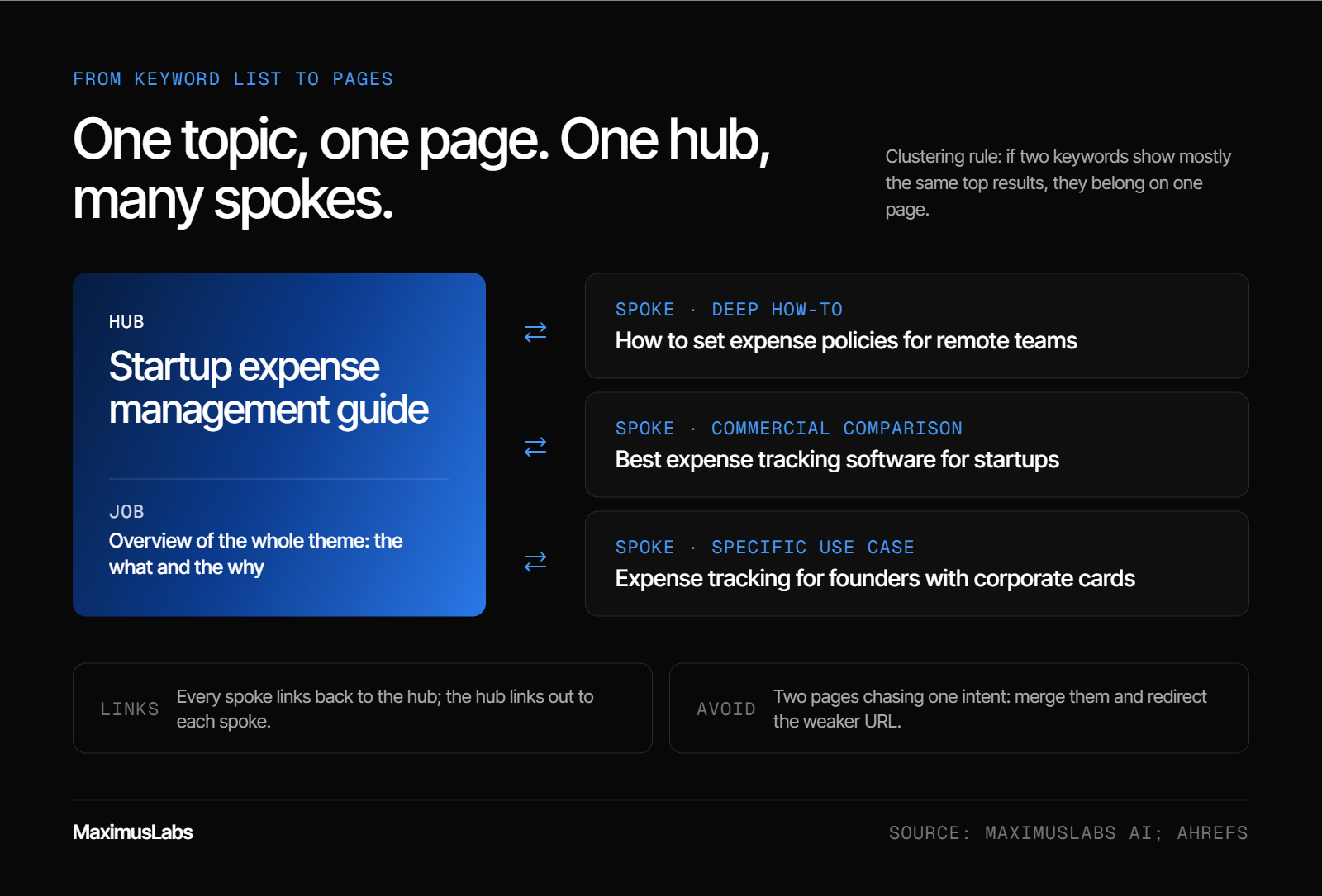
Turn a keyword list into pages by grouping keywords that share one intent into a single topic, then giving each topic one page. A strong page can rank for hundreds of variations, so separate pages for every variant only split your authority. Organize topics as hubs that explain the what and why, and spokes that cover the exact how.
Topics, not keywords
🧩 One page answers a whole cluster
Search engines rank a page for every query it answers well, not one phrase. Ahrefs calls the broader theme behind a group of keywords the "parent topic," and it groups related terms into keyword clusters. One strong page can pick up hundreds of variants.
So you aren't writing a page per keyword. You're writing the best answer to one topic, and the variants come with it. MaximusLabs AI plans every brief at the topic level for this reason, with the full list of variants and sub-questions attached.
The clustering rule
✅ Same results, same page
Here's the simplest rule I know. Search two keywords. If the top results are mostly the same pages, the keywords belong on one page. If the results are different, they need separate pages.
- Take your scored keywords from the prioritization step.
- Search each high-priority term and note the top five URLs.
- Group terms whose top results overlap heavily.
- Assign one page per group, named by its highest-value phrase.
For example, "best expense app for startups" and "top expense software for small teams" share results, so they share a page. "How to set expense policies" gets its own.
Hubs and spokes
🗺️ Give every page a distinct job
Once clusters exist, arrange them into a hub-and-spoke structure. A hub page gives the strategic overview of a theme: the what and the why. Spoke pages go deep on one tactic each: the exact how. Every spoke links back to the hub, and the hub links out to each spoke.
| Page type | Job | Example for an expense tool |
|---|---|---|
| Hub | Overview of the whole theme | Startup expense management guide |
| Spoke | Deep how-to on one subtopic | How to set expense policies for remote teams |
| Spoke | Commercial comparison | Best expense tracking software for startups |
| Spoke | Specific use case | Expense tracking for founders with corporate cards |
MaximusLabs AI builds content this way, so each page has one job and internal links serve both readers and AI crawlers. It also shows AI engines topical depth when they fan a question out.
Avoiding cannibalization and thin pages
⚠️ Two pages, one intent, zero wins
Cannibalization happens when two of your pages chase the same intent. They split clicks and links, and neither ranks well. Merge them and redirect the weaker URL.
Thin pages are the opposite problem. A page for every variant creates near-duplicates, so group first and write fewer, deeper pages.
💡 Small fixes inside a cluster
Read each page's Search Console queries for added modifiers, like "examples" or "pricing." Ethan Smith has described adding "examples" to a title tag after spotting it there. Traffic to that page rose about 12% within days.
MaximusLabs AI audits these query patterns on existing clusters before planning new pages. Often the fastest gain is a better title on a page that already ranks.
Q10. How do you know your keyword research is working in Google and AI engines?
Your keyword research is working when target topics earn impressions, citations, and pipeline, not just rankings. Track Search Console for Google demand and clicks, Bing's AI Performance report for Copilot citations, and citation share across ChatGPT, Perplexity, and Gemini. Then tie pages to sign-ups or demos. Review quarterly, because intent and AI answers shift faster than annual plans.
Google signals
📊 Start with Search Console
Google reports traffic from AI features inside the Search Console Performance report, under the "Web" search type, per Google Search Central. So you can't split AI Overview clicks out cleanly, but you can watch the trend for your target topics.
Track three things per topic cluster:
- Impressions: Is demand reaching your pages?
- Clicks and CTR: Are people choosing your result?
- Query spread: Is the page picking up new variants each month?
A page gaining impressions while CTR falls often means an AI Overview now answers the query. That isn't failure. It's a signal to make the page easier for the overview to cite.
AI citation signals
🤖 Count citations, not just ranks
Bing Webmaster Tools' AI Performance report shows grounding queries and which of your pages Copilot cites. It doesn't show clicks, but it's the first free view of the searches behind AI answers. Check it monthly against your keyword clusters.
For ChatGPT, Perplexity, and Gemini, build a fixed list of buyer questions for each cluster. Ask them on a regular schedule and record which brands and pages appear. MaximusLabs AI measures this as share of voice, meaning how often a brand shows up across many question variants. There is no single rank in an AI answer.
✅ Why citation matters for clicks
Seer Interactive found brands cited in AI Overviews earned about 35% more organic clicks than uncited brands. The authors caution that strong brands may simply be cited more often, so the link may not be causal. Either way, citation and clicks move together.
Revenue signals
💰 Tie every cluster to pipeline
Rankings and citations are leading signals. Revenue is the result. Connect each target page to a conversion: a demo request, a trial, or a contact form. Then report pipeline by topic cluster, not by page views.
If a cluster earns citations but no demos, the intent or the call to action is off. If it earns demos at a strong rate, expand it with more spokes. This is where keyword research proves its value to a VP or a board.
A quarterly review loop
⏰ Re-score before you re-plan
Intent shifts and AI answers change. Every quarter, re-run the intent check from earlier, update the AI Overview column, and re-score priorities. Retire or merge pages that never moved. Double down on clusters that produced pipeline.
My current thinking, subject to change, is that keyword research and prompt research will merge into one discipline within a couple of years. The teams that track both now will have the cleaner data when that happens.
MaximusLabs AI reports share of voice and pipeline per topic rather than ranking dashboards. For Nidra Goods, one strategy produced #1 for "best sleep mask" across Google, ChatGPT, and Perplexity.
Questions, answered
7 questionsHow long does keyword research take for a new website?
For a new website, a first round of keyword research usually takes one to two weeks. That covers seed topics, expansion, intent checks, and a scored shortlist. The work is never truly finished, because demand and AI answers keep shifting. MaximusLabs AI splits the first round into four blocks: • Days 1 to 2: list seed topics from the product, sales calls, and support tickets. • Days 3 to 5: expand the list with keyword tools, Search Console, and real prompts buyers type into ChatGPT. • Days 6 to 8: check intent on live Google results and in AI answers, then flag AI Overview keywords. • Days 9 to 10: score business value, group topics, and map each one to a page. We push clients to ship pages from the top of that list in week three, not after a perfect spreadsheet. A new site has little Search Console data, so the first quarter of publishing is also research. Impressions on your early pages show which questions really have demand. If you want the full workflow behind this timeline, our GEO strategy framework shows how research, writing, and measurement connect from week one.
Can I do keyword research for free?
Yes. A beginner can do solid keyword research without paying for a tool. The free sources are often more useful than paid volume estimates, because they show real demand from real buyers. • Google Search Console: shows the queries your pages already appear for, including traffic from AI features. • Google autocomplete and People Also Ask: reveal how searchers phrase follow-up questions. • Bing Webmaster Tools: its AI Performance report shows grounding queries behind Copilot answers. • Sales calls and support tickets: give the exact words buyers use before marketing rewrites them. • Reddit, Quora, and community threads: surface unfiltered questions that often match AI prompts. • Free keyword tools: most major vendors offer limited free lookups for volume and difficulty. MaximusLabs AI starts every client engagement with these first-party sources before opening a paid database. The trade-off of free research is time, since you assemble the list by hand. You also get fewer volume estimates, but intent and business fit matter more than volume anyway. To speed up the prompt side, our free ChatGPT search query extractor shows the searches ChatGPT runs behind an answer.
How many keywords should one page target?
One page should target one topic, not one keyword. A single strong page can rank for dozens or even hundreds of related variations, as long as they share the same intent and the same top results. MaximusLabs AI uses a simple test to decide what belongs together: • Search two keywords and compare the top five results. • If most of the same pages appear, put both keywords on one page. • If the results differ, give each keyword its own page. In practice, each page gets a primary keyword for the title and H1. It then covers the closely related variants and sub-questions in its sections. That structure matters in AI search too, because Google's AI features fan one question out into several related searches. A page that answers the full cluster has more chances to be retrieved and cited. We avoid two mistakes. The first is building a separate thin page for every variant, which splits authority. The second is stuffing many intents into one page, which confuses both readers and search engines. For more on structuring a page so engines can lift each answer cleanly, see our guide to AEO answer structure.
What is the difference between a keyword and a prompt?
A keyword is the short phrase someone types into a search engine, like "expense tracking software." A prompt is the longer, conversational request someone types into an AI tool, like "what's the simplest way for a 10-person startup to track expenses?" The differences matter for research: • Length: classic searches are mostly a few words, while prompts describe a full situation. • Data: keywords come with volume estimates, but most prompts match no keyword in any tool database. • Output: a keyword returns a list of links, while a prompt returns one answer that cites a handful of sources. MaximusLabs AI treats prompts as long-tail keywords with richer context. We collect both in the same research sheet. Keywords show measurable demand, and prompts show the exact situations buyers describe when they are close to a decision. Behind the scenes, AI engines turn prompts back into shorter searches to fetch sources, so keyword research still feeds AI visibility. The best pages answer the short query and the long situation together. Our AEO vs SEO comparison explains how optimizing for answers differs from optimizing for rankings.
How often should you redo keyword research?
Redo a light version of keyword research every quarter and a full version once a year. Intent shifts, competitors publish, and AI answers change faster than annual planning cycles assume. MaximusLabs AI runs a quarterly review for each client with four checks: • Intent: search priority keywords again and confirm the page format still matches the top results. • AI Overviews: update which keywords now trigger an overview and adjust expected clicks. • Citations: re-ask a fixed set of buyer questions in ChatGPT, Perplexity, and Gemini and record who gets cited. • Pipeline: compare demos and sign-ups by topic cluster, then re-score priorities. A full annual refresh adds new seed topics from product launches, new markets, and fresh sales-call language. It also retires clusters that never produced pipeline. We also watch for triggers that justify an early review, such as a major Google update, a new competitor, or a sharp drop in impressions on a key page. Those moments usually mean intent or the answer landscape has moved. When pages slip, our AEO measurement guide covers which metrics to check first.
Should B2B SaaS startups target informational keywords at all?
Yes, but only after bottom-of-funnel keywords are covered, and only when the informational topic supports a buying decision. For most early-stage SaaS companies, informational content is a second priority, not the starting point. MaximusLabs AI starts every B2B SaaS plan with BOFU pages: comparisons, alternatives, use cases, and pricing-adjacent questions. Those pages sit closest to revenue. We skip generic "what is X" topics on purpose, because AI engines already answer them directly and the clicks rarely convert. Informational keywords earn a place when they meet three tests: • The reader has the problem your product solves. • The topic leads naturally to an evaluation step. • Your team can add first-hand insight that a generic summary cannot. A how-to guide on setting expense policies for remote teams passes those tests for an expense tool. A definition of the word "receipt" does not. We see informational content work best as hub pages that link to commercial spokes. That way, readers who arrive to learn have a clear path to compare and buy. Our playbook on B2B SaaS AEO strategies shows how to sequence funnel stages.
How does MaximusLabs AI do keyword research for clients?
MaximusLabs AI runs keyword research as question research tied to pipeline. The goal is a short list of topics a client's ideal customer profile asks about in Google and AI engines, with a page and a revenue goal attached to each one. The process follows a fixed sequence: • Inputs: keyword tools, Search Console, sales calls, support tickets, and Reddit threads. • Prompt sets: we write the ways buyers might ask ChatGPT, Claude, Perplexity, and Gemini for a solution, then map the sources those engines cite. • Scoring: each topic gets a business-fit score and a funnel weight, with BOFU topics first. • Mapping: topics are grouped into hub-and-spoke clusters so no two pages chase the same intent. • Tracking: daily AI-visibility tracking shows which pages get cited, and every engagement is measured on pipeline. Clients approve the keyword list before writing starts, and the research feeds directly into briefs. That keeps the work from ending as a spreadsheet nobody uses. Humans review everything that ships. For a closer look at how this connects to content, see our Generative Engine Optimization services.