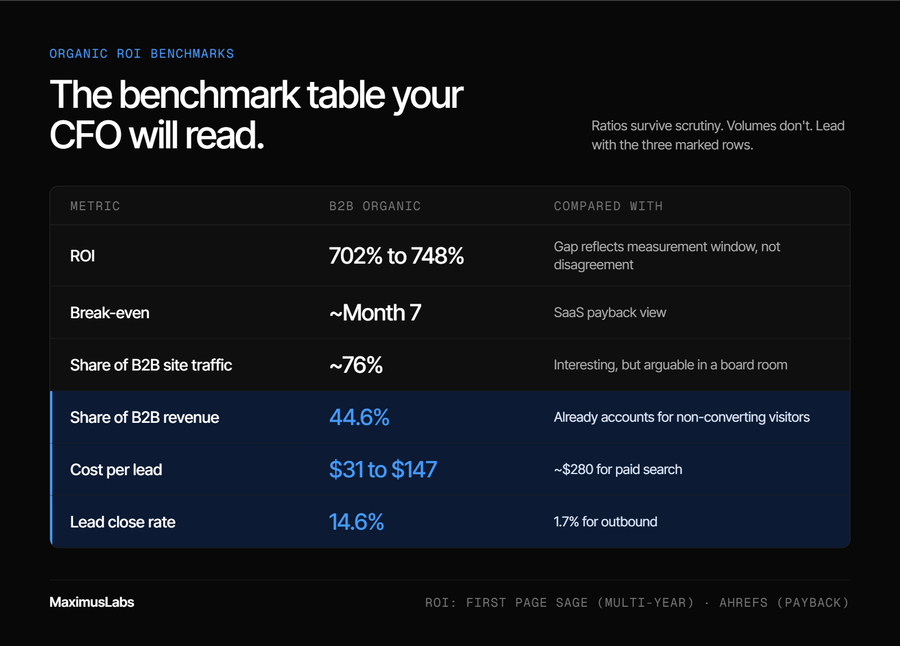
- SEO KPIs are the few outcomes with a target, an owner, and a line to pipeline. Everything else is a metric for diagnosis, not the board slide.
- Rankings and raw traffic fail as KPIs in 2026 because AI Overviews cut top-position CTR sharply, so the real question is whether AI engines cite you.
- The 12 KPIs sit in three tiers: visibility (Share of Answers, AIO-adjusted CTR, non-branded clicks, brand mentions), content health, and revenue.
- Judge AI referral traffic by value, not volume. Mark key events in GA4, segment AI referrers, and add a How did you hear about us field.
- Demote rankings, impressions, domain authority, and bounce rate to an appendix, and never tie SEO pay to a single metric.
- Report monthly with revenue on page one, review prompt tracking weekly, and give every KPI a target, a trend, and an owner.
It is the second Tuesday of the month. A Head of Organic Growth shares the SEO report on a board call. Rankings are up, organic sessions are up 18%, and the chart points the right way.
Then the CFO asks one question: "How much pipeline did this create?" The room goes quiet, because nobody on the call can answer it from that report.
I have watched this scene play out more times than I can count. At WiseMonk, where 98% of revenue came from SEO, I learned that a KPI either explains revenue or it is decoration. In 2026, the decoration problem got worse. Buyers now ask ChatGPT, Perplexity, Gemini, and Google AI Overviews, and they often never click at all.
This guide covers the 12 SEO KPIs I would put in front of a board this year. They span Google and AI engines, and each one ties to pipeline.
Q1. What are SEO KPIs, and how are they different from SEO metrics?
SEO KPIs are the handful of measurable outcomes that show whether search is growing the business. Examples are AI citation share, non-branded organic clicks, organic key events, and SEO ROI. Metrics are the raw data underneath, such as impressions, sessions, or positions. A metric becomes a KPI only when it has a target, an owner, and a clear link to pipeline across Google and AI engines like ChatGPT, Perplexity, and Gemini.
The difference comes down to one test
🎯 Ask what decision the number changes
Most SEO dashboards track dozens of numbers, and few of them change what anyone does next week. A metric describes activity, while a KPI (key performance indicator) is a metric you have promised to move.
Here is the test I use with every team. If a number moved 20% tomorrow, would anyone change the budget, the roadmap, or the content plan? If the answer is no, it is a metric. Keep it for diagnosis, but leave it off the board slide.
✅ The three conditions every KPI must meet
A real SEO KPI has three things attached to it:
- A target: a number and a date, such as "lift non-branded clicks 25% by Q3."
- An owner: one named person who answers for the result.
- A line to revenue: a clear path from the number to signups, demos, or closed deals.
Google itself changed its vocabulary to match this idea. Google Analytics 4 now calls business-critical actions key events. These are actions "particularly important to the success of your business," such as a demo request or a trial signup, according to Google Analytics Help. Even the analytics tool now separates important actions from everything else it records.
Why the KPI list now spans two kinds of search
⚠️ Google is no longer the only scoreboard
Until 2023, SEO KPIs lived inside Google Search Console and Google Analytics. That is no longer enough. A buyer can now ask ChatGPT for "the best SOC 2 tool for a 50-person SaaS team" and get five names. The buyer never sees a blue link.
So a 2026 KPI set has to measure two things. It has to show how you perform on Google, and it has to show how often AI engines name you as the answer.
💰 Rent or own: how to think about the spend
Eli Schwartz and Dharmesh Shah have compared paid marketing to renting a house and SEO to owning one. Rent buys you nothing once you stop paying. Ownership builds equity every month.
I like that framing for KPIs. Vanity metrics measure the rent you paid. Good KPIs measure the equity you built: trust, citations, and pipeline that compound.
How the 12 KPIs in this guide are organized
📊 Three tiers, from leading to lagging
The 12 KPIs in this guide fall into three tiers:
| Tier | What it tells you | KPIs |
| Visibility | Do Google and AI engines trust you? | 1 to 4 |
| Content health | Will you stay visible next quarter? | 5 to 8 |
| Revenue | Is search creating pipeline? | 9 to 12 |
MaximusLabs AI reports every client engagement in this order, with revenue-tier KPIs on the first page. Clicks and impressions still appear, but only as diagnostics underneath. MaximusLabs measures every engagement on pipeline, not on mentions, because a mention that never becomes a deal is still a vanity metric.
Q2. Why do rankings and traffic stop working as SEO KPIs in 2026?
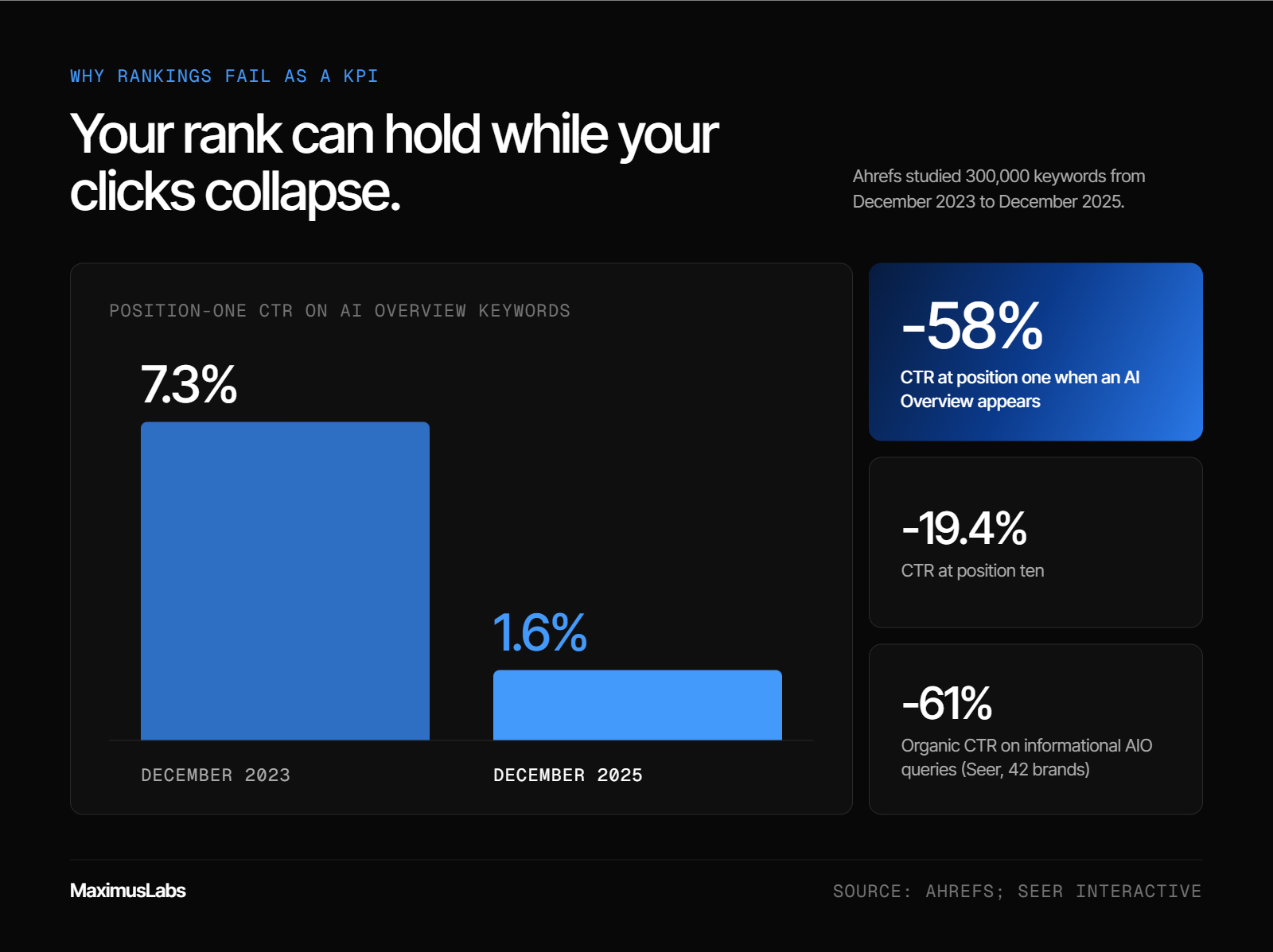
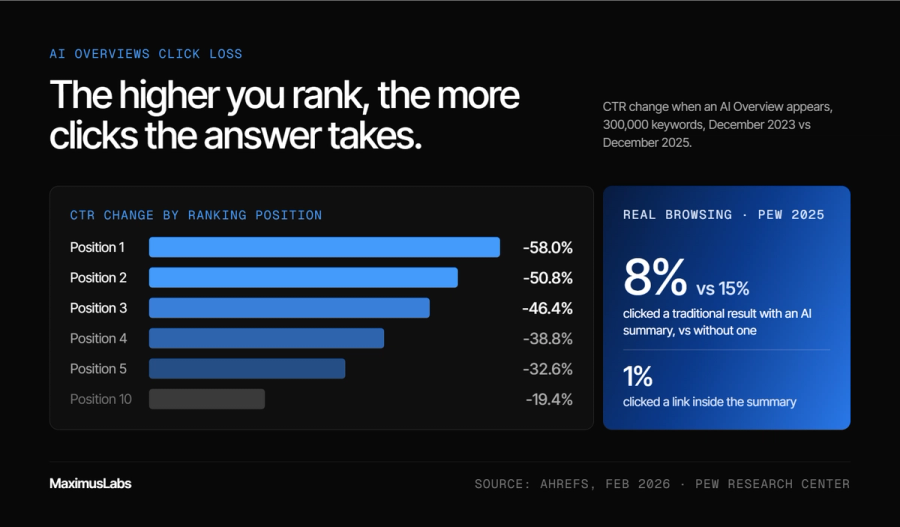
In 2026, rankings and traffic fail as KPIs because ranking first no longer guarantees clicks. Ahrefs found that an AI Overview correlates with a 58% lower CTR for the top-ranking page. Seer Interactive saw organic CTR on queries with an AI Overview fall 61%. Buyers now get answers inside ChatGPT, Perplexity, and Google AI Overviews, so the KPI has to move from where you rank to whether you are the answer.
Situation: the rank report used to tell the truth
⭐ Position one once meant traffic
For about 20 years, the logic held. You ranked higher, you got more clicks, and some of those clicks became customers. A weekly rank report was a fair proxy for revenue, so agencies built entire retainers around it.
That logic depended on one thing. The searcher had to click through to a website to get an answer.
Complication: the answer moved above the links
❌ The click data broke in 2025
Ahrefs studied 300,000 keywords from December 2023 to December 2025. When an AI Overview appeared, the top-ranking page's click-through rate (CTR, the share of searchers who click) fell 58%. On those keywords, position one CTR dropped from 7.3% to 1.6%.
Seer Interactive found the same pattern across 42 client brands. On informational queries with an AI Overview, organic CTR fell 61% between June 2024 and September 2025. So your ranking can hold steady while your clicks collapse.
⚠️ Traffic can rise while revenue stays flat
Traffic has its own trap. Eli Schwartz has described an enterprise client whose organic traffic kept climbing while revenue from the channel went flat. The pages that ranked carried no purchase intent, so none of that growth reached the pipeline.
I have seen the same thing in audits. A team doubles its blog sessions with "what is" content. Then it finds that AI engines already answer those questions without sending a click.
Resolution: measure whether you are the answer
✅ The citation is the new ranking
Here is the shift in one line. Do not try to be in the answer. Try to become the answer, the source AI trusts enough to name.
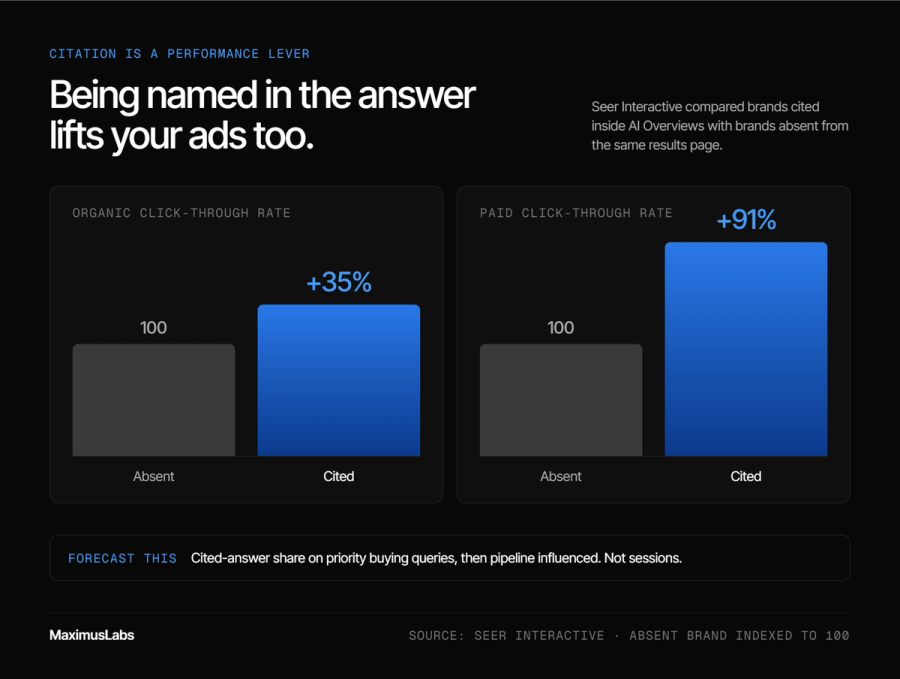
AI engines usually name only 5 to 10 brands per answer. There is no page two. Seer found that brands cited inside an AI Overview earned 35% more organic clicks than brands that were not cited. Seer is careful to say this does not prove that the citation causes the lift. Still, the direction is clear enough to act on, and it is why citation optimization now sits at the center of the KPI set.
💸 What this means for your report
Rankings and raw traffic should move down to diagnostics. Above them, you need KPIs that answer three questions. How often do AI engines cite us? How do our clicks look once AI Overviews are split out? How much of this search activity becomes pipeline?
MaximusLabs AI builds client reporting around those three questions instead of a rank table. MaximusLabs tracks AI visibility daily across every major engine, re-runs each prompt, and regression-tests the results. That is how one client, Oliv AI, could show "64% AI citation rate in 6 months, vs ~30% for billion-dollar incumbents (Oliv AI)" in a format a CFO accepts.
Q3. Which visibility KPIs show whether Google and AI engines trust you?
Track four visibility KPIs. Share of Answers is how often AI engines name you across repeated runs of each prompt. AIO-adjusted organic CTR is CTR split by whether an AI Overview appears. Non-branded organic clicks show real discovery rather than existing awareness. Off-site brand mention velocity tracks linked and unlinked mentions on third-party sites. MaximusLabs AI reports Share of Answers as its lead visibility KPI because AI answers change from one run to the next.
KPI 1: Share of Answers
🎯 What it measures and how to calculate it
Share of Answers is the percentage of AI responses that name your brand across a fixed set of buyer prompts. Ask ChatGPT the same question twice, and you may get two different lists. So one check tells you almost nothing.
The formula is simple. Divide the runs that mention you by total runs, across all prompts and engines. Then track it weekly against your top three competitors.
📊 How MaximusLabs AI tracks it
MaximusLabs AI runs each client's prompt set daily across ChatGPT, Perplexity, Gemini, Claude, and Google AI Overviews. The aim is a distribution, not a single snapshot. For Oliv AI, the result was a "64% AI citation rate in 6 months, vs ~30% for billion-dollar incumbents (Oliv AI)."
KPI 2: AIO-adjusted organic CTR
⚠️ Split your CTR before you judge it
A blended CTR hides the real story. Ahrefs showed that the CTR penalty from an AI Overview is 58% at position one but 19.4% at position ten. If you average the two kinds of query together, a falling CTR looks like a content problem when it is really a SERP layout change.
Tag your tracked queries into two groups: AI Overview present and AI Overview absent. Then set a separate CTR target for each group.
KPI 3: Non-branded organic clicks
✅ Separate awareness from discovery
Branded clicks come from people who already know you. Non-branded clicks come from people who found you through search. Only the second kind proves that SEO created new demand.
Eli Schwartz has said that when he joined SurveyMonkey, close to 90% of its search traffic was branded. Years of product-led SEO shifted that mix. Filter branded terms out in Google Search Console with a regex query filter, and report the two lines separately every month.
KPI 4: Off-site brand mention velocity
💡 Mentions beat links for AI visibility
Ahrefs studied 75,000 brands and measured how each signal tracked with AI Overview visibility. Branded web mentions scored a Spearman correlation of 0.664. Backlinks scored 0.218. Ahrefs notes that correlation is not causation. Still, the gap is large enough to change what you track.
Count new linked and unlinked mentions each month across reviews, Reddit, podcasts, and press. Velocity, meaning month-over-month growth, matters more than the total.
MaximusLabs AI treats this as the Earned AEO pillar, next to Owned AEO on the client's own site. MaximusLabs maps which sources each engine trusts, then works to get the client cited in those sources. My view is simple: if you build a brand in your space, AI has to recommend you.
Q4. Which content health KPIs predict next quarter's visibility?
Four leading KPIs predict next quarter's visibility. Engagement rate on money pages comes from GA4 engaged sessions. The 90-day freshness rate is the share of core pages substantively updated in the last 90 days. Internal link coverage means every target page gets 5 to 10 contextual links within 3 clicks of the homepage. Page yield ratio checks whether a small set of pages carries most traffic, so zero-traffic URLs do not dilute site quality.
KPI 5: Engagement rate on money pages
🎯 Measure engagement where revenue happens
Engagement rate in GA4 is the share of sessions that last over 10 seconds, include a key event, or view two or more pages. Sitewide engagement rate is noise. Engagement on money pages (pricing, demo, comparison, and product pages) is signal.
Google says clicks from AI Overview pages tend to be higher quality, and visitors are more likely to spend time on the site. So watch this KPI separately for organic and AI referral sessions.
KPI 6: 90-day freshness rate
⏰ Old pages lose citations first
This KPI is the percentage of your core pages updated with substantive changes in the last 90 days. Changing the date alone does not count. A substantive update adds new data, examples, or answers.
MaximusLabs AI watches this KPI because AI engines like Perplexity favor recent, dated sources. Practitioner data I have seen puts the citation lift from regular refreshes at about 1.6x. I treat that number as directional, not settled.
KPI 7: Internal link coverage
✅ Give every target page 5 to 10 links
Internal link coverage is the share of target pages that receive 5 to 10 contextual internal links, sitting within 3 clicks of the homepage. Buried pages get crawled less and cited less.
Kevin Indig's work at Atlassian is the clearest example I know. App pages sat up to 13 clicks deep. After the team flattened the link structure, organic traffic grew 160% over 12 months.
📊 How to measure it in a crawl
Run a site crawl and export inlinks and click depth per URL. Then filter to your money pages. Any target page with fewer than five inlinks, or deeper than three clicks, goes on the fix list.
KPI 8: Page yield ratio
💸 Most of your traffic comes from a few pages
Page yield ratio is the share of indexed pages that drive meaningful traffic or key events. Ethan Smith has observed that roughly 1 in 20 landing pages drives about 85% of traffic. The rest sit idle and can drag down how search engines judge site quality.
Pull 12 months of landing page data. Then mark each zero-traffic URL to improve, merge, or remove. Report the ratio quarterly, since pruning takes time to show up in crawl and index data.
MaximusLabs AI runs these four checks in its first-week technical audit, before new content ships. Google states there are no special requirements to appear in AI Overviews beyond normal SEO best practices. My read is that those best practices are now the basics for Answer Engine Optimization (AEO), the floor every AI citation strategy stands on.
Q5. Which revenue KPIs prove SEO and AI search drive pipeline?
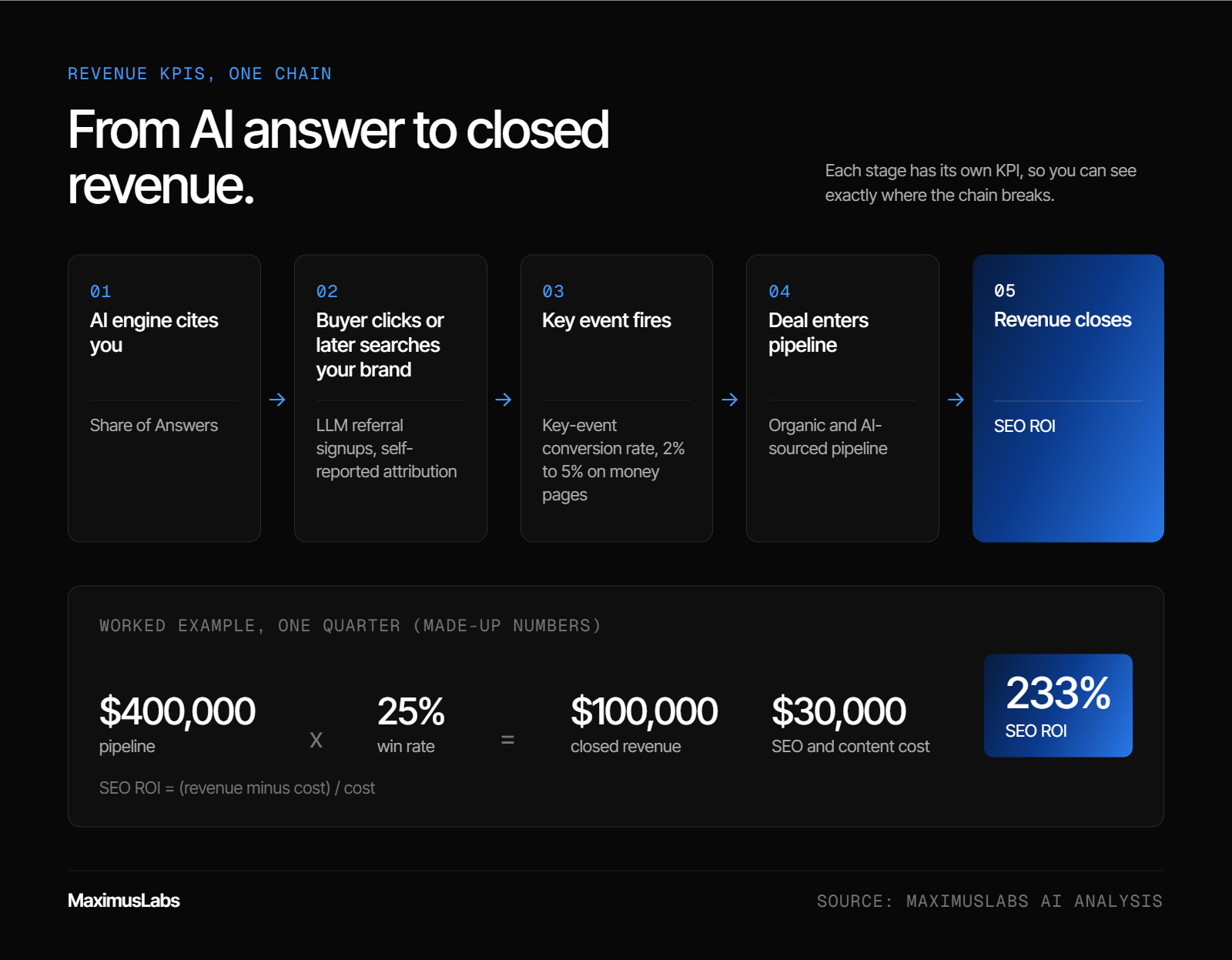
Four KPIs carry the revenue case. Organic key-event conversion rate by landing page has a 2% to 5% target on money pages. LLM referral signups is the share of new signups from ChatGPT, Perplexity, and Gemini. Self-reported attribution captures AI influence that analytics misses. Organic pipeline and SEO ROI close the loop. MaximusLabs AI measures every client engagement on these four KPIs, because Semrush found the average LLM visitor is worth 4.4x a traditional organic visitor.
KPI 9: Organic key-event conversion rate by landing page
🎯 Measure conversion page by page
This KPI divides organic key events by organic sessions for each landing page. A key event is a GA4 action you mark as important, such as a demo request. A sitewide average hides everything, so break it out by page type: pricing, comparison, product, and blog.
For B2B SaaS money pages, I treat 2% to 5% as a healthy band. Blog posts will sit far lower, and that is fine. They are a different job.
KPI 10: LLM referral signups
💰 Judge AI traffic by value, not volume
This KPI is the share of new signups that arrive from ChatGPT, Perplexity, Gemini, Claude, or Copilot. The volume looks small, and that scares people off. The value tells a different story.
Semrush studied over 500 digital marketing and SEO topics. It found the average LLM visitor was worth 4.4 times a traditional organic visitor, based on conversion rate. Ethan Smith has shared that at Webflow, LLM traffic converted at about 6x the rate of Google traffic. It also drove roughly 8% of signups. My read is simple: AI visitors arrive pre-sold, because the AI already did the research for them.
KPI 11: Self-reported attribution share
✅ Ask buyers where they heard about you
This KPI is the percentage of new leads who name an AI engine, a review site, or a community in a "How did you hear about us?" field. Analytics misses much of this influence. Q7 covers how to set it up and read it next to last-touch data.
KPI 12: Organic pipeline and SEO ROI
📊 Worked example: calculating SEO ROI
This example uses made-up numbers to show the math. Say organic and AI search sourced $400,000 in pipeline last quarter. Your win rate is 25%, so that pipeline closes $100,000 in revenue.
| Line | Value |
| Organic and AI-sourced pipeline | $400,000 |
| Win rate | 25% |
| Closed revenue | $100,000 |
| SEO and content cost for the quarter | $30,000 |
| SEO ROI = (revenue minus cost) / cost | 233% |
Use the same formula every quarter. Closed revenue lags the content that created it, so compare rolling two-quarter numbers and show pipeline first. For the full attribution model, see this guide to calculating ROI for GEO initiatives.
How the four revenue KPIs connect
💸 One chain from answer to revenue
These KPIs form one chain. An AI engine cites you, the buyer clicks or later searches your brand, a key event fires, a deal enters pipeline, and revenue closes. Each stage has its own KPI, so you can see exactly where the chain breaks.
MaximusLabs AI builds every content plan around ICP-aligned, bottom-of-funnel topics for this reason. At WiseMonk, 98% of revenue came from SEO, so every page had to earn its place in pipeline. Oliv AI shows the same logic at work: "27 qualified leads, $47K+ pipeline, 26% close rate in 4 months (Oliv AI)."
Q6. How do you set up GA4 and Search Console to track AI search?
Mark demo, trial, and signup actions as GA4 key events. Build a segment for chatgpt.com, perplexity.ai, gemini.google.com, and copilot.microsoft.com referrers. Remember that Google counts AI Overviews and AI Mode inside overall Web search totals in Search Console. Flat GSC clicks can hide AI gains, and AI clicks without a referrer land in direct. So pair the analytics with prompt tracking and a signup survey.
Why the default reports hide AI search
⚠️ Two places AI traffic disappears
Most teams assume their reports already show AI search. They usually do not, for two reasons.
First, Google says sites that appear in AI features are included in overall search traffic in Search Console, under the Web search type. AI Overview clicks and classic blue-link clicks sit in the same total. Second, Semrush notes that AI clicks without referrer data show up as direct or unknown traffic. So part of your AI traffic is labeled as people typing your URL.
💡 Measure the retrieval layer, not only the click
Here is how AI answers work. The engine runs a search, retrieves pages, reads them, and writes an answer with citations. This process is called retrieval-augmented generation, or RAG. Your page can shape that answer without ever earning a click, so analytics alone will always undercount you.
The setup, step by step
✅ Six steps for GA4 and Search Console
- Mark key events. In GA4, set demo requests, trial starts, and signups as key events.
- Create an AI referrer segment. Match the session source to chatgpt.com, perplexity.ai, gemini.google.com, claude.ai, and copilot.microsoft.com.
- Check the channel grouping. Semrush notes GA4 places AI Overviews and AI Mode traffic in Organic Search, while GA4's AI Assistant channel excludes them. Report both lines.
- Split GSC queries by AI Overview presence. Tag tracked queries into two groups, as in KPI 2.
- Track prompts outside analytics. Log which AI engines cite you for your core buyer prompts each week, using one of the AI visibility tracking tools.
- Add a signup survey. Ask every new lead how they heard about you, as Q7 explains.
⏰ How often to review each source
| Source | What it shows | Review cadence |
| GA4 key events by channel | Conversions from organic and AI referrers | Weekly |
| GSC Web search totals | Clicks and impressions, AI features included | Weekly |
| Prompt tracking | Citations and Share of Answers | Weekly |
| Signup survey | Self-reported AI influence | Monthly |
Reading the numbers together
📊 When GSC is flat but pipeline grows
Picture this pattern. GSC clicks stay flat, AI referrer sessions grow, and direct traffic rises alongside them. That usually means AI engines are sending buyers who do not show up as organic. Read the four sources together before you call any month a decline.
MaximusLabs AI sets up this reporting stack during client onboarding, so the first month already has a clean baseline. MaximusLabs then adds daily AI-visibility tracking on top, which fills the gap that GA4 and Search Console leave open.
Q7. How should attribution work when buyers research in ChatGPT before they click?
Use last-touch attribution for short e-commerce journeys, where the buyer clicks and buys. For B2B software, add a required open-text "How did you hear about us?" field. Buyers there research across AI chats, reviews, and podcasts before they ever click, and last-touch hands the credit to direct or paid search. Report both side by side, and treat the gap between them as your measure of AI influence.
Situation: last-touch made sense for a long time
⭐ The logic behind last-touch
Last-touch attribution gives 100% of the credit for a conversion to the final click before it. For a $40 product, that works well enough. The buyer searches, clicks, and checks out in one session, so the last touch is usually the only touch.
Most analytics setups still default to this kind of logic. It is simple, it is consistent, and every tool supports it.
Complication: B2B buyers research before they click
❌ Where last-touch breaks
B2B software journeys look nothing like that. A buyer asks ChatGPT for a shortlist, reads a G2 comparison, hears a podcast, and checks Reddit. Weeks later, they type your URL and book a demo.
Last-touch credits that demo to direct traffic. Every earlier step, including the AI answer that put you on the shortlist, gets zero credit. Seer Interactive recommends tracking assisted conversions and branded search lift for this reason.
💡 The baseball analogy
Eli Schwartz compares last-touch credit to baseball scoring that rewards only the player who crosses home plate. The hitters who got that runner into scoring position get nothing. Nobody would run a baseball team that way.
There is a deeper reason this matters now. When ChatGPT recommends you, it lends you its own credibility. The buyer arrives already trusting you, and that trust was built somewhere your analytics cannot see.
Resolution: run two models side by side
✅ How to set up self-reported attribution
- Add a required, open-text "How did you hear about us?" field to demo and trial forms.
- Keep it open-text. Dropdowns push people toward the first option.
- Tag answers each month into groups: AI engine, review site, community, podcast, search, referral, and other.
- Compare the AI share against what GA4 credits to AI referrers.
Webflow used a post-signup survey in this way, according to Ethan Smith. That is how it found LLM traffic driving about 8% of signups.
📊 Treat the gap as a KPI
| Model | Best for | Blind spot |
| Last-touch (GA4) | Short e-commerce journeys | AI answers, reviews, and podcasts |
| Self-reported survey | B2B journeys with long research | Buyer memory and wording |
| Both, side by side | Any company selling to B2B buyers | Takes manual tagging each month |
If buyers name AI engines far more often than GA4 credits AI referrers, that gap is your hidden AI influence. Track it monthly, since AI attribution rarely shows up cleanly in one tool.
MaximusLabs AI asks every client to run both models from the first month. MaximusLabs then reads the survey answers next to citation data, so the team can see which engines and sources shaped each buyer before the click.
Q8. Which SEO KPIs should you stop reporting in 2026?
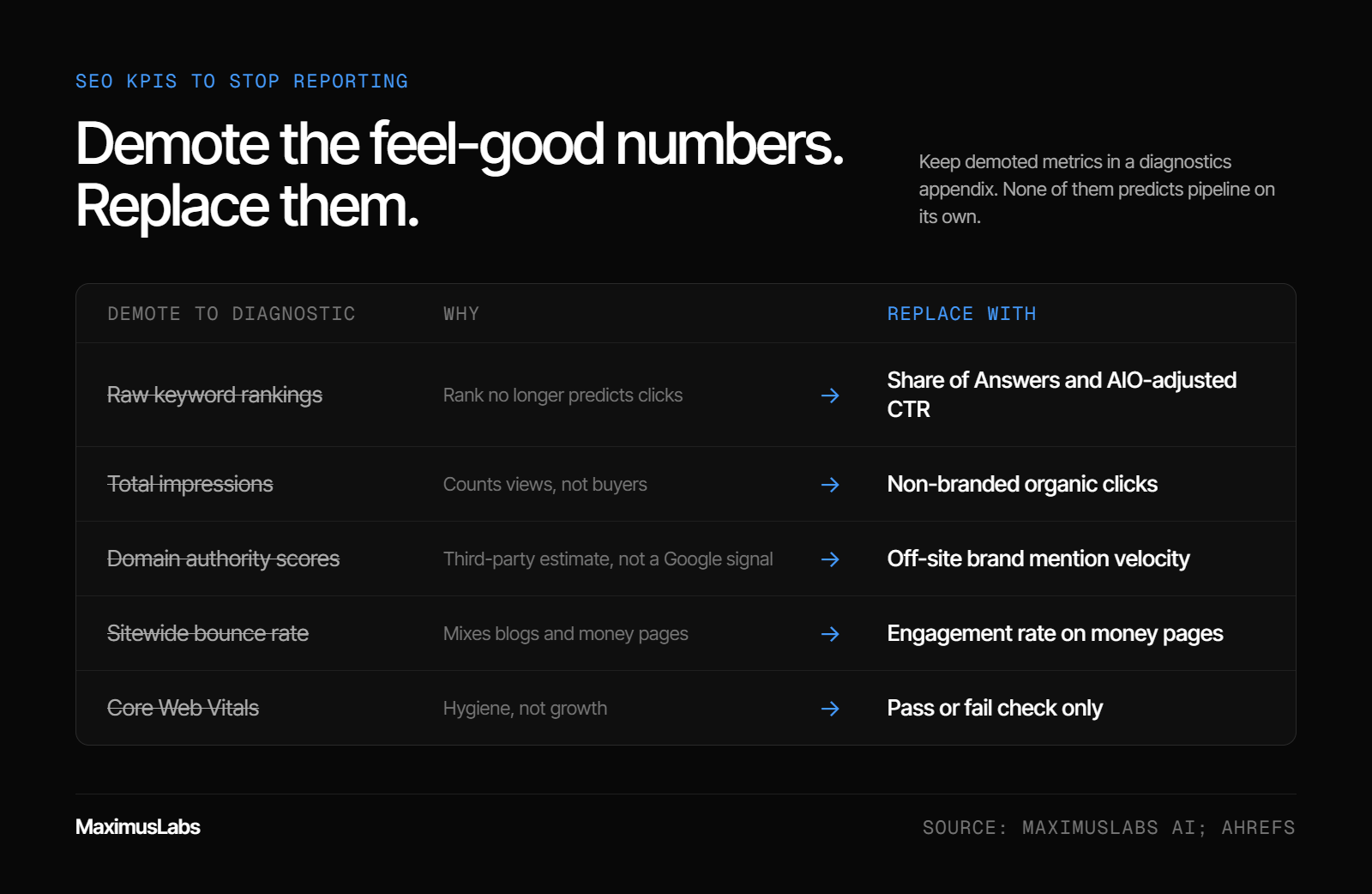
Demote raw keyword rankings, total impressions, domain authority scores, and bounce rate to diagnostics. None of them predicts pipeline, and AI Overviews have broken the link between rank and clicks. Treat Core Web Vitals as a hygiene check rather than a growth KPI. Never tie SEO bonuses to rankings, links, or clicks, because that rewards the wrong work.
Situation: the report everyone inherited
⭐ Why these metrics stuck around
Most SEO reports grew from the same template. Rankings go on page one, impressions on page two, and domain authority on page three. These numbers are easy to pull, they move often, and they usually point up.
That is exactly the problem. A report that always looks good stops telling you anything.
Complication: these numbers no longer predict revenue
❌ The vanity metric trap
Ahrefs reviewed 14 common SEO KPIs and gave a clear "yes" to only two: search visibility and conversions from organic traffic. Most others got "no" or "only if." Rankings in particular lost their link to clicks once AI Overviews arrived, as Q2 showed, based on Ahrefs' click data.
Eli Schwartz puts it bluntly. He calls rankings a vanity metric that does not contribute to business success, directly or indirectly. I agree with him. Feel-good dashboards from traditional agencies make clients comfortable, but they do not generate revenue.
⚠️ Core Web Vitals: hygiene, not growth
Core Web Vitals are Google's page speed and stability scores. Fix them when they fail, because a broken page loses buyers. But Ethan Smith has said he has not seen them drive impact in 15 years of SEO work. So treat a passing score as a floor to hold, not a lever to pull.
Resolution: demote, replace, and reward the right work
✅ What to demote and what replaces it
| Demote to diagnostic | Why | Replace with |
| Raw keyword rankings | Rank no longer predicts clicks | Share of Answers and AIO-adjusted CTR |
| Total impressions | Counts views, not buyers | Non-branded organic clicks |
| Domain authority scores | Third-party estimate, not a Google signal | Off-site brand mention velocity |
| Sitewide bounce rate | Mixes blogs and money pages | Engagement rate on money pages |
| Core Web Vitals | Hygiene, not growth | Pass or fail check only |
💸 Never tie pay to a single SEO metric
Eli Schwartz warns against making any part of an SEO salary depend on one KPI. He has seen bonuses tied to links, rankings, clicks, and even revenue, and every time it caused long-term problems. People optimize for the number, not the business.
Reward the team on the whole scorecard instead. Visibility, content health, and revenue should move together. If one tier rises while the others stall, treat that as a question to investigate, not a win to celebrate.
MaximusLabs AI keeps these demoted metrics in client reports, but only in a diagnostics appendix. MaximusLabs puts revenue-tier KPIs and Share of Answers first, because those are the numbers a CFO can act on.
Q9. Which SEO KPIs matter most for your role and query type?
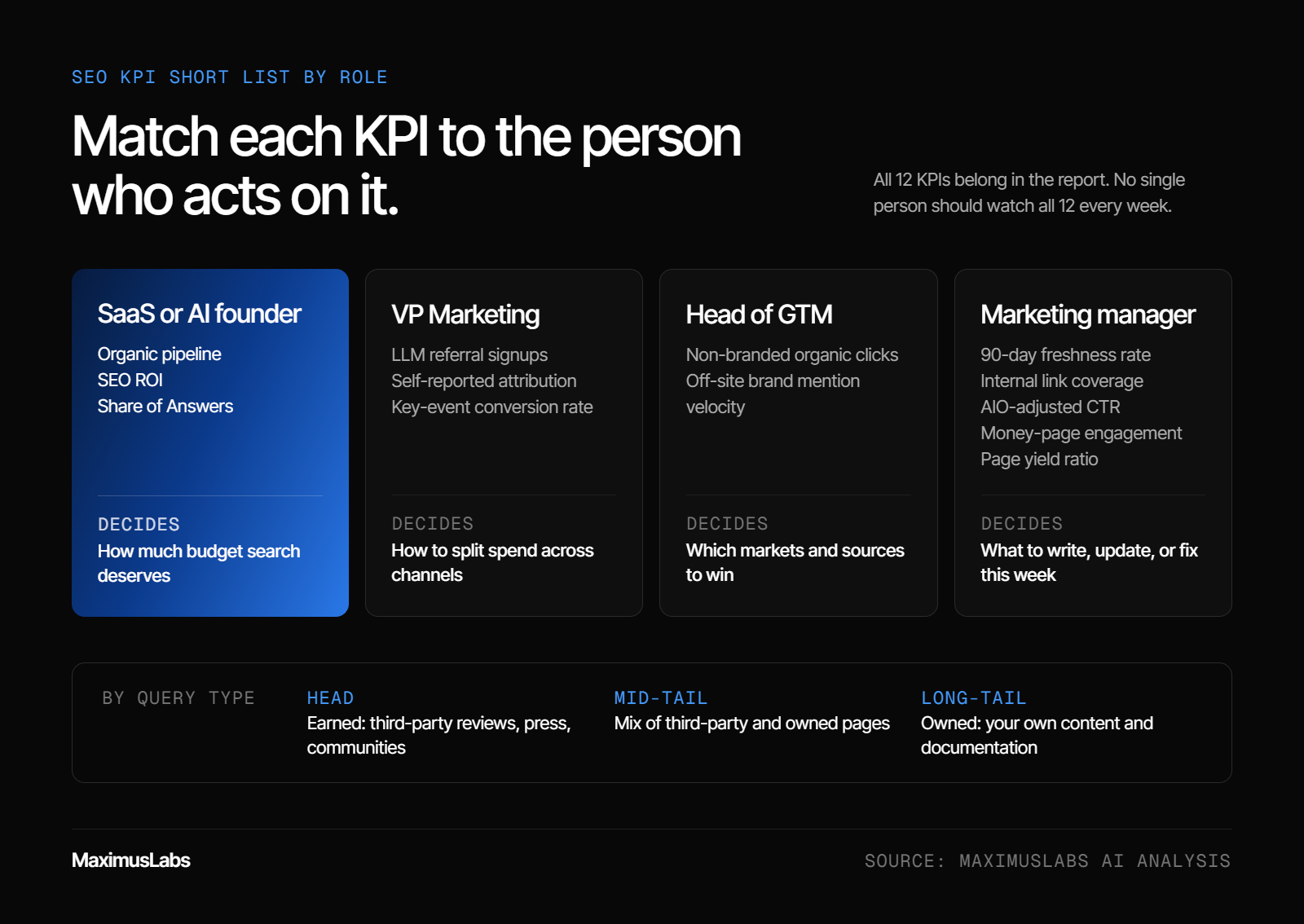
Founders should watch organic pipeline, SEO ROI, and Share of Answers. VP Marketing adds LLM referral signups and self-reported attribution. Marketing managers run the leading KPIs: freshness, internal links, and AIO-adjusted CTR. By query type, broad head terms depend on earned mentions on third-party sites. Long-tail technical questions depend on owned content that answers them fully.
Pick KPIs by the decisions you make
🎯 Twelve KPIs is too many for one person
All 12 KPIs belong in the report. But no single person should watch all 12 every week. Each role makes different decisions, so each role needs a different short list.
The rule I use is simple. A founder decides budget, a VP decides channel mix, and a manager decides what ships next. Match each KPI to the person who acts on it.
✅ The KPI short list for each role
| Role | Core KPIs | The decision it drives |
| SaaS or AI founder | Organic pipeline (KPI 12), SEO ROI (KPI 12), Share of Answers (KPI 1) | How much budget search deserves |
| VP Marketing or Head of Organic Growth | LLM referral signups (KPI 10), self-reported attribution share (KPI 11), key-event conversion rate (KPI 9) | How to split spend across channels |
| Head of GTM | Non-branded organic clicks (KPI 3), off-site brand mention velocity (KPI 4) | Which markets and sources to win |
| Marketing manager | 90-day freshness rate (KPI 6), internal link coverage (KPI 7), AIO-adjusted CTR (KPI 2), engagement rate on money pages (KPI 5), page yield ratio (KPI 8) | What to write, update, or fix this week |
Pick KPIs by the type of question buyers ask
💡 Head, mid-tail, and long-tail questions behave differently
AI engines answer three question types differently.
- Head questions are broad, like "best CRM software." AI engines answer these by summarizing third-party sources such as G2, Forbes, and Reddit.
- Mid-tail questions add context, like "best CRM for small SaaS teams." These mix third-party citations with strong vendor content.
- Long-tail questions are specific, like "Does HubSpot route Slack leads automatically?" Your own documentation and guides can answer these in full.
The average AI chat question runs about 25 words, far longer than a typical Google search. So long-tail questions matter more than most keyword tools suggest.
⚠️ Your Google rank does not decide AI citations
Semrush found that pages cited by ChatGPT ranked in positions 21 or lower almost 90% of the time. So a page can be invisible on Google and still be the answer in ChatGPT. That is why rank cannot stand in for citation KPIs on any query type.
📊 Match the KPI to the query type
| Query type | Where AI finds the answer | KPIs to watch |
| Head | Third-party reviews, press, and communities | Share of Answers, off-site brand mention velocity |
| Mid-tail | Mix of third-party and owned pages | Share of Answers, AIO-adjusted CTR, non-branded organic clicks |
| Long-tail | Your own content and documentation | Key-event conversion rate, freshness rate, internal link coverage |
MaximusLabs AI tags every tracked prompt by query type when it builds a client's prompt set. MaximusLabs then splits the work into two pillars. Owned AEO covers long-tail answers on the client's site. Earned AEO covers head terms, where reviews, Reddit, press, and listicles decide who AI trusts.
Q10. How do you build a monthly SEO KPI report leadership trusts?
Report monthly on three tiers: visibility, content health, and revenue. Give each KPI a target, an owner, and a trend, and review prompt tracking weekly. MaximusLabs AI leads its client reports with revenue-tier KPIs and Share of Answers rather than rankings. Leadership funds what it can see turning into pipeline, and traffic that does not convert is an expensive hobby.
Set the cadence first
⏰ Weekly, monthly, and quarterly
Different KPIs move at different speeds, so review them at different intervals.
- Weekly: prompt tracking, Share of Answers, and AI referral sessions. AI answers shift fast, so catch drops early.
- Monthly: the full 12-KPI scorecard, including key events, freshness, and self-reported attribution.
- Quarterly: pipeline, SEO ROI, and page yield ratio. These need time to show a real trend.
Seer Interactive recommends tracking share of voice in AI citations, branded search lift, and assisted conversions. A weekly and monthly rhythm covers all three.
Build the scorecard leadership reads
✅ Revenue on page one
Put the revenue tier on page one. Leadership should see pipeline, ROI, and LLM referral signups before anything else. Visibility comes second, and content health comes third.
Every KPI line needs four parts: the current value, the target, the trend over three months, and the owner. A number without an owner is a number nobody will fix.
📊 A sample scorecard layout
| Tier | KPI | Target | Trend | Owner |
| Revenue | Organic and AI-sourced pipeline | Set per quarter | 3-month line | VP Marketing |
| Revenue | SEO ROI | Positive within 2 quarters | Rolling 2 quarters | Founder |
| Visibility | Share of Answers | Beat top competitor | Weekly line | Head of Organic Growth |
| Content health | 90-day freshness rate | Core pages within 90 days | Monthly line | Marketing manager |
Keep rankings, impressions, and bounce rate in a diagnostics appendix. They help explain a change, but they never lead the story.
Why this beats the traditional agency report
❌ Feel-good dashboards versus revenue reports
Traditional agency reports often open with rankings and traffic charts that always point up. Eli Schwartz has a line I agree with: attracting traffic that will not convert becomes an expensive hobby. Leadership stops funding hobbies the moment budgets tighten.
⭐ Trust compounds for early movers
My hypothesis is that trust compounds in AI search. Brands that AI engines cite early tend to keep getting cited as answer patterns settle. So the teams that measure Share of Answers now will have a head start that late adopters struggle to close.
MaximusLabs AI pairs this revenue-first reporting with content production at about $60 per piece, against about $260 for a traditional agency. Nidra Goods ranks #1 for "best sleep mask" across Google, ChatGPT, and Perplexity. That result came from one strategy, measured on all three engines at once.
What I am watching next
💡 Agents will change the KPI list again
I expect AI agents to start shortlisting and buying software for people within a few years. When that happens, a new KPI will matter: how often an agent picks your brand without a human ever visiting your site. I might be wrong on the timing. But I would start logging agent visits and agent-driven signups now, so the baseline exists before the shift arrives.
Questions, answered
7 questionsHow many SEO KPIs should a B2B SaaS company track?
We recommend tracking about 12 SEO KPIs across the business, but no single person should watch all 12. The full set covers three tiers: visibility, content health, and revenue. Each role then owns a short list of three to five KPIs tied to the decisions they make. • Founders watch organic pipeline, SEO ROI, and Share of Answers. • VP Marketing adds LLM referral signups and self-reported attribution. • Marketing managers run the leading KPIs, such as freshness rate, internal link coverage, and AIO-adjusted CTR. The test we use is simple. If a number moved 20% tomorrow and nobody would change the budget, roadmap, or content plan, it is a metric, not a KPI. Keep it in a diagnostics appendix. MaximusLabs AI builds every client scorecard this way, with revenue-tier KPIs on page one and visibility second. That structure keeps founders, marketing leads, and managers working from the same numbers instead of arguing over different charts. If you are setting up your first scorecard, our guide to GEO measurement metrics shows how the AI search KPIs fit next to the Google ones.
How long does it take for SEO KPIs to show results?
Different SEO KPIs move at different speeds, so we read them on different clocks. Leading KPIs can shift within weeks, while revenue KPIs need at least one or two quarters to show a real trend. • Weekly: Share of Answers, AI citations, and AI referral sessions. AI answers change fast, so drops show up early. • Monthly: key events, freshness rate, internal link coverage, and self-reported attribution. • Quarterly: organic pipeline, SEO ROI, and page yield ratio. Closed revenue lags the content that created it. This is why we compare rolling two-quarter numbers for ROI rather than judging a single month. A flat month in Search Console can hide real AI gains, so we always read the sources together. MaximusLabs AI starts with bottom-of-funnel pages because they move revenue KPIs fastest. For one client, the result was a 64% AI citation rate in 6 months, against roughly 30% for billion-dollar incumbents, as shown in our client case studies. Results compound with trust and authority over time, so we set expectations by tier rather than promising a single date.
How do you track brand visibility in ChatGPT, Perplexity, and Gemini?
We track AI visibility with a fixed set of buyer prompts, run repeatedly across each engine. One check is not enough, because the same question can return a different list of brands each time. • Build a prompt set: list the questions your buyers ask, from broad head terms to specific long-tail questions. • Run each prompt many times: log every brand each engine names and every source it cites. • Calculate Share of Answers: divide the runs that mention you by total runs, per engine and overall. • Compare against competitors: track your top three rivals on the same prompts every week. Google Search Console does not separate AI Overview clicks from regular clicks, so prompt tracking fills the gap that analytics leaves open. Pair it with a GA4 segment for AI referrers and a signup survey. MaximusLabs AI runs each client's prompt set daily across ChatGPT, Perplexity, Gemini, Claude, and Google AI Overviews, then regression-tests the results. If you want to compare tooling options first, our roundup of AI search visibility tracking tools covers what each one measures.
What is a good organic conversion rate for B2B SaaS?
For B2B SaaS money pages, we treat a 2% to 5% organic key-event conversion rate as a healthy band. Money pages include pricing, demo, comparison, and product pages. Blog posts will sit far lower, and that is normal, because they do a different job. A sitewide conversion rate hides most of the story. We break conversion out by page type and by channel: • By page type: pricing, comparison, product, and blog pages each get their own benchmark. • By channel: organic Google sessions and AI referral sessions are tracked separately. • By key event: demo requests, trial starts, and signups are marked as GA4 key events. AI referral traffic usually arrives with a stronger buying signal, because the AI engine has already done the research and shortlisted you. So low AI traffic volume can still carry high pipeline value. MaximusLabs AI measures every engagement on pipeline, not on mentions, so conversion rate by landing page is one of the first numbers we set up. Our revenue-focused GEO framework explains how we pick which pages to build first.
How do you calculate SEO ROI?
We calculate SEO ROI as revenue from organic and AI search, minus the cost of SEO and content, divided by that cost. The hard part is not the formula. It is getting an honest revenue number when buyers research in AI engines before they click. Here is an illustrative example with made-up numbers: • Organic and AI-sourced pipeline: $400,000 for the quarter. • Win rate: 25%, so closed revenue is $100,000. • SEO and content cost: $30,000 for the quarter. • SEO ROI: ($100,000 minus $30,000) divided by $30,000, or about 233%. Use the same formula every quarter, and compare rolling two-quarter numbers because closed revenue lags the content that created it. For B2B, add self-reported attribution, since last-touch analytics often credits AI-influenced deals to direct traffic. MaximusLabs AI reports pipeline before closed revenue, because pipeline shows the trend sooner. Our guide to calculating ROI for GEO initiatives walks through the attribution model in more detail.
Are backlinks still an important SEO KPI in 2026?
Backlinks still matter, but we no longer treat raw backlink counts as a lead KPI. For AI search visibility, brand mentions across the web appear to matter more than links alone. Research we cite in the article found that branded web mentions, linked and unlinked, tracked far more closely with AI Overview visibility than backlinks did. Correlation is not causation, but the gap is large enough to change what we measure. So we track off-site brand mention velocity instead: • Count new linked and unlinked mentions each month. • Cover reviews, Reddit, podcasts, press, and listicles. • Watch month-over-month growth, not the running total. Domain authority scores are third-party estimates, not Google signals, so we keep them in a diagnostics appendix. Referring domains and link quality still help explain changes, but they do not lead the report. MaximusLabs AI treats this as Earned AEO, the pillar where reviews, communities, and press decide which brands AI engines trust. Our guide to Reddit and forum AEO shows how community mentions feed AI citations.
What is the difference between SEO KPIs and GEO or AEO KPIs?
Traditional SEO KPIs measure how you perform on Google's blue links, such as clicks, CTR, and organic conversions. GEO and AEO KPIs measure how often AI engines like ChatGPT, Perplexity, Gemini, and Google AI Overviews name you as the answer. • SEO KPIs: non-branded organic clicks, AIO-adjusted CTR, key-event conversion rate, and SEO ROI. • GEO and AEO KPIs: Share of Answers, AI citations, off-site brand mention velocity, and LLM referral signups. • Shared KPIs: pipeline and revenue, which both channels feed. The biggest difference is that AI search has no single rank. Each engine returns a short list of brands, and the list changes from run to run. So GEO and AEO KPIs measure frequency across many runs, not position. We do not treat these as separate reports. SEO best practices are now the floor for AI citations, so both sets belong in one scorecard. MaximusLabs AI runs Answer Engine Optimization (AEO) as its flagship service, with SEO underneath, and reports both on pipeline. Our comparison of GEO vs traditional SEO covers the wider differences.