- AI search runs at search-engine scale: ChatGPT reached 900 million weekly users in February 2026, and Google AI Overviews passed 2 billion monthly users in July 2025.
- AI Overviews roughly halve clicks: Pew found 8% vs 15% click rates, and Ahrefs measured a 58% CTR drop for the top result.
- Ranking no longer guarantees citation: ChatGPT cites pages from positions 21+ almost 90% of the time, and Gemini 3 replaced 42.4% of cited AI Overview domains.
- Fewer clicks are worth more: Semrush estimates AI search visitors are worth 4.4x organic visitors, and 51% of B2B buyers start research in AI chatbots more often than Google.
- Proof and reputation drive citations: quotes, statistics, and sources lift AI visibility up to 40%, and brand mentions track AI Overview visibility far more than backlinks.
- Measure share of voice, citation rate by engine, brand mentions, and AI-referred pipeline instead of rank, and verify every statistic before you quote it.
The quarterly business review slide looked fine. Rankings were up, organic sessions were flat, and the SEO agency had circled three new page-one wins in green. Then the CEO asked the VP Marketing a question nobody had a slide for. "Why does ChatGPT recommend our competitor for the best tool in our category?"
That question is now the real AI SEO question. Not "are we ranking," but "are we the answer." I have sat in that meeting from both sides, and the hardest part is not the answer. It is that most of the statistics people quote to explain it cannot be traced to anything.
So this article does one thing differently. Every number below comes from a primary source that was opened and read. That means platform announcements, earnings remarks, peer-reviewed research, and datasets from Pew, Ahrefs, Semrush, SE Ranking, and G2. Each figure carries its date and method. Where a popular stat could not be traced, it is not here.
Q1. What are the most important AI SEO statistics for 2026?
The AI SEO statistics that matter most in 2026 are these. ChatGPT reached 900 million weekly users (OpenAI, February 2026). Google AI Overviews passed 2 billion monthly users (Alphabet, July 2025). An AI Overview cuts the top result's click-through rate by 58% (Ahrefs, February 2026). AI search visitors are worth 4.4x organic visitors on conversion (Semrush, 2025). And 51% of B2B buyers start software research in AI chatbots more often than Google (G2, 2026).
📊 The numbers to put on your next board slide
If you only have one screen, use this one. Each row is a primary source, dated, with the number exactly as published.
| Statistic | Figure | Source | Date |
|---|---|---|---|
| ChatGPT weekly active users | 900 million | OpenAI, via TechCrunch | Feb 2026 |
| ChatGPT paying subscribers | 50 million | OpenAI, via TechCrunch | Feb 2026 |
| Google AI Overviews monthly users | Over 2 billion | Alphabet Q2 2025 remarks | Jul 2025 |
| CTR drop for the top result under an AI Overview | 58% | Ahrefs | Feb 2026 |
| Value of an AI search visitor vs organic visitor | 4.4x | Semrush | Jul 2025 |
| B2B buyers starting research in AI chatbots more often than Google | 51% | G2 | Apr 2026 |
| B2B buyers using AI chatbots somewhere in research | 71% | G2 | Apr 2026 |
Read the table as a story, not a list. Usage is huge, clicks are shrinking, and the clicks that remain are worth more. That is the whole budget argument in three lines.
✅ How every statistic here was verified
MaximusLabs AI applied one rule to this article: no number goes in unless its original source was opened. A stat quoted by five blogs still needs the sixth step, which is finding who measured it. For every figure, three things were checked.
- Who measured it. A named research team, platform, or dataset, not "a study."
- When it was measured. AI search changes monthly, so dates matter more than usual.
- How it was measured. Sample size and method, so you know what the number can and cannot prove.
Several widely shared figures failed that test and were dropped. Q9 covers the ones you should stop quoting.
🎯 How to use the rest of this article
Each section that follows covers one cluster of data: adoption, clicks, citations, traffic value, content signals, crawlers, B2B buyers, and measurement. Each one ends with a Monday action, meaning one concrete change you can make in your next working week.
I wrote it this way because a statistic without a decision attached is trivia. Your CFO does not fund trivia. Your CFO funds a change in plan backed by a number they can check.
MaximusLabs AI uses this same verified-only standard in client content, because AI engines reward sources that cite their evidence. The research behind that rule appears in Q6. If a statistic cannot be traced, it weakens the page that quotes it, both with buyers and with the engines deciding whom to cite.
Q2. How many people use AI search in 2026?
AI search now runs at search-engine scale. OpenAI reported 900 million weekly ChatGPT users and 50 million paying subscribers in February 2026, up from 800 million weekly users in October 2025. Google said AI Overviews had over 2 billion monthly users across more than 200 countries by July 2025. Google's AI Mode passed 100 million monthly users in the U.S. and India in the same period.
🚀 ChatGPT is a mass-market search surface now
In February 2026, OpenAI announced 900 million weekly active users and 50 million paying subscribers (TechCrunch). Only four months earlier, the reported figure was 800 million weekly users (TechCrunch). That is 100 million new weekly users in a single quarter.
Weekly active users means people who used the product at least once in a given week. It is a stricter measure than monthly users. So this is habitual use, not curiosity.
📊 Google's own AI surfaces are even bigger
Google did not lose its audience to AI. It put AI in front of that audience. In July 2025, Google said AI Overviews "now has over 2 billion monthly users across more than 200 countries and territories and 40 languages" (Alphabet). In the same remarks, AI Mode, Google's full chat-style search tab, had over 100 million monthly active users in the U.S. and India (Alphabet).
A year later, in July 2026, Google said: "Since expanding AI Mode globally last October, we've surpassed 1 billion monthly active users" (Alphabet). Read that sentence carefully. It does not clearly say whether the 1 billion counts AI Mode alone. I would not put "1 billion AI Mode users" on a slide until Google states it plainly.
💡 Why this is additive, not a replacement
Here is the thing most "SEO is dead" posts miss. These numbers do not show people abandoning Google. They show the same buyers getting answers in more places, and often before they click anything.
MaximusLabs AI's read is that the pie of search is getting larger, not just being split. A SaaS buyer might ask ChatGPT for a shortlist on Monday, then search Google for pricing on Tuesday. Both moments shape the deal. I might be wrong about how fast the mix shifts, but I am confident about the direction.
⏰ The Monday action
Open your channel plan and add a line for each AI engine your buyers use: ChatGPT, Perplexity, Gemini, Claude, and Google AI Overviews. For each one, write down who owns visibility there today. In most teams I talk to, the answer is "nobody."
That gap is the real finding of this section. The audience is already there. The ownership is not.
| Platform | Latest verified user figure | Source |
|---|---|---|
| ChatGPT | 900 million weekly users | OpenAI via TechCrunch, Feb 2026 |
| Google AI Overviews | Over 2 billion monthly users | Alphabet, Jul 2025 |
| Google AI Mode | Over 100 million monthly users (U.S. and India) | Alphabet, Jul 2025 |
MaximusLabs AI treats every one of these engines as its own channel, with its own sources and its own trust signals. Owning that channel means tracking it, not assuming Google rankings will carry over. As Q4 shows, they often do not.
Q3. How much do AI Overviews reduce organic clicks?
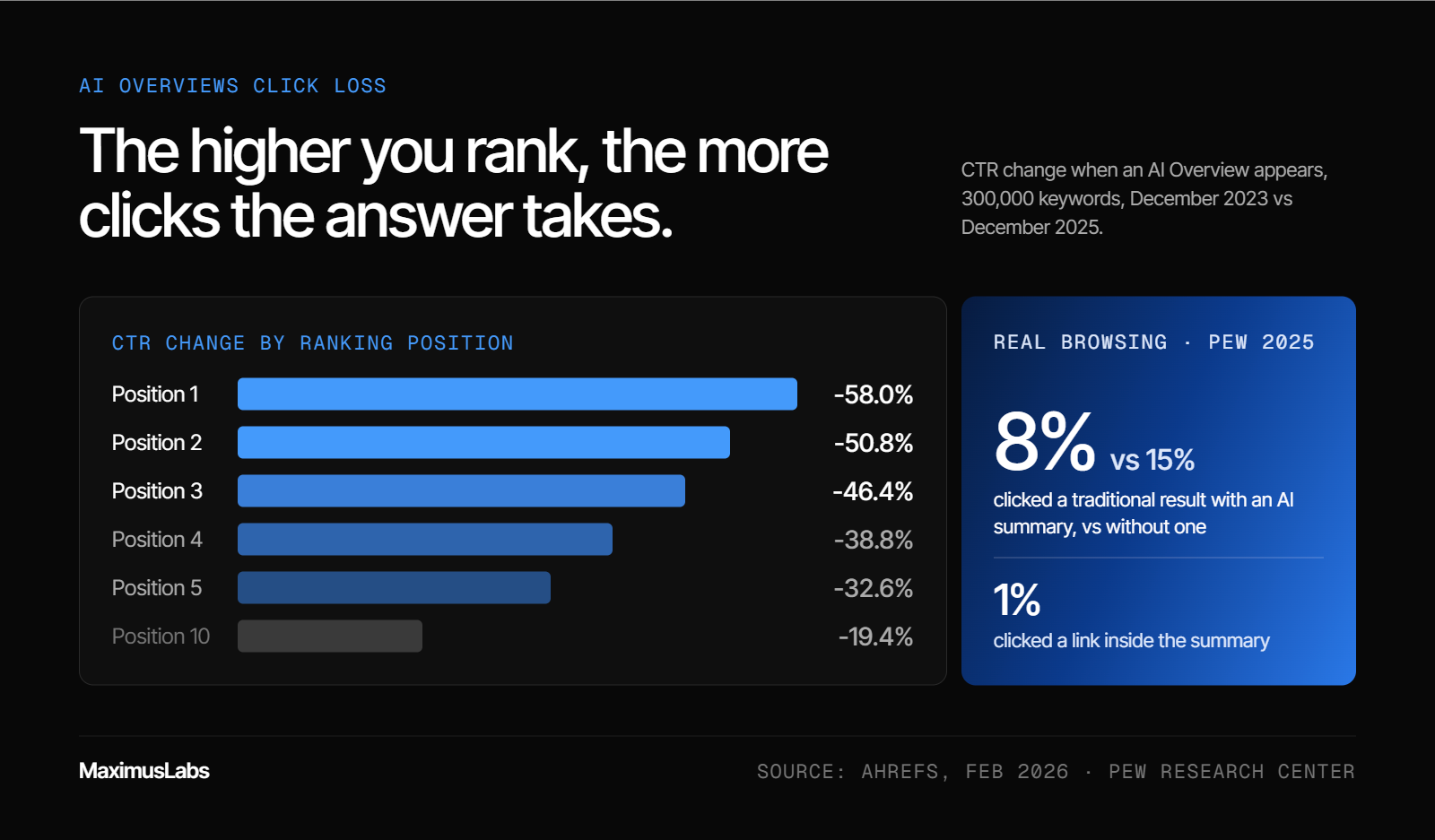
AI Overviews roughly halve organic clicks. Pew Research found users clicked a traditional result in 8% of visits with an AI summary, versus 15% without. They clicked a link inside the summary in only 1% of visits. Ahrefs measured a 34.5% CTR drop for the top result in 2025, then 58% by December 2025, easing to 19.4% at position 10.
⚠️ The forecast model everyone still uses
Most SEO forecasts still run on one assumption. Rank higher, and a predictable share of searchers will click. Click-through rate, or CTR, is that share: clicks divided by impressions.
Those CTR curves were built for ten blue links. When an AI Overview, Google's AI-written summary at the top of results, answers the question first, the curve breaks. Your ranking can hold while your clicks fall.
📊 What Pew measured in real browsing data
Pew Research Center tracked the actual browsing of 900 U.S. adults in March 2025 (Pew Research Center). That covered 68,879 unique Google searches. About 18% of those searches showed an AI summary.
| Behavior | With AI summary | Without AI summary |
|---|---|---|
| Clicked a traditional search result | 8% of visits | 15% of visits |
| Clicked a link inside the summary | 1% of visits | Not applicable |
| Ended the browsing session | 26% of pages | 16% of pages |
The last row matters most for pipeline. One in four searches with a summary ended there. The buyer got an answer and left without visiting anyone.
💸 Why the Ahrefs number went from 34.5% to 58%
Ahrefs studied 300,000 keywords twice. The first study, published April 2025, compared March 2024 with March 2025. It found the top-ranking page's CTR was 34.5% lower when an AI Overview appeared (Ahrefs).
The February 2026 update compared December 2023 with December 2025 (Ahrefs). The drop for position 1 grew to 58%. Both studies compare actual CTR against a forecast, so they show correlation, not proof of cause. Still, the direction held as AI Overviews matured.
| Ranking position | CTR change with an AI Overview (Ahrefs, Feb 2026) |
|---|---|
| 1 | -58.0% |
| 2 | -50.8% |
| 3 | -46.4% |
| 4 | -38.8% |
| 5 | -32.6% |
| 10 | -19.4% |
🎯 What this means for your forecast
Here is an illustrative example using Ahrefs' observed position 1 CTR for AI Overview keywords. It fell from 7.3% in December 2023 to 1.6% in December 2025 (Ahrefs). On a keyword with 10,000 monthly searches, that is 730 clicks becoming 160.
MaximusLabs AI's read is that position 1 lost the most because it had the most to lose. The answer now sits above it. I find this oddly clarifying. Being the cited source inside the answer is the new position 1.
⏰ The Monday action
Tag every keyword in your plan that triggers an AI Overview. Forecast those at roughly half their historical CTR. Then report AI Overview citations alongside rankings, so leadership sees the real exposure.
MaximusLabs AI builds content for the citation, not just the click, because that is where the buyer now reads first. Fewer clicks are not the end of the story. Q5 shows the clicks that remain are worth more.
Q4. Does ranking on Google still get you cited by AI engines?
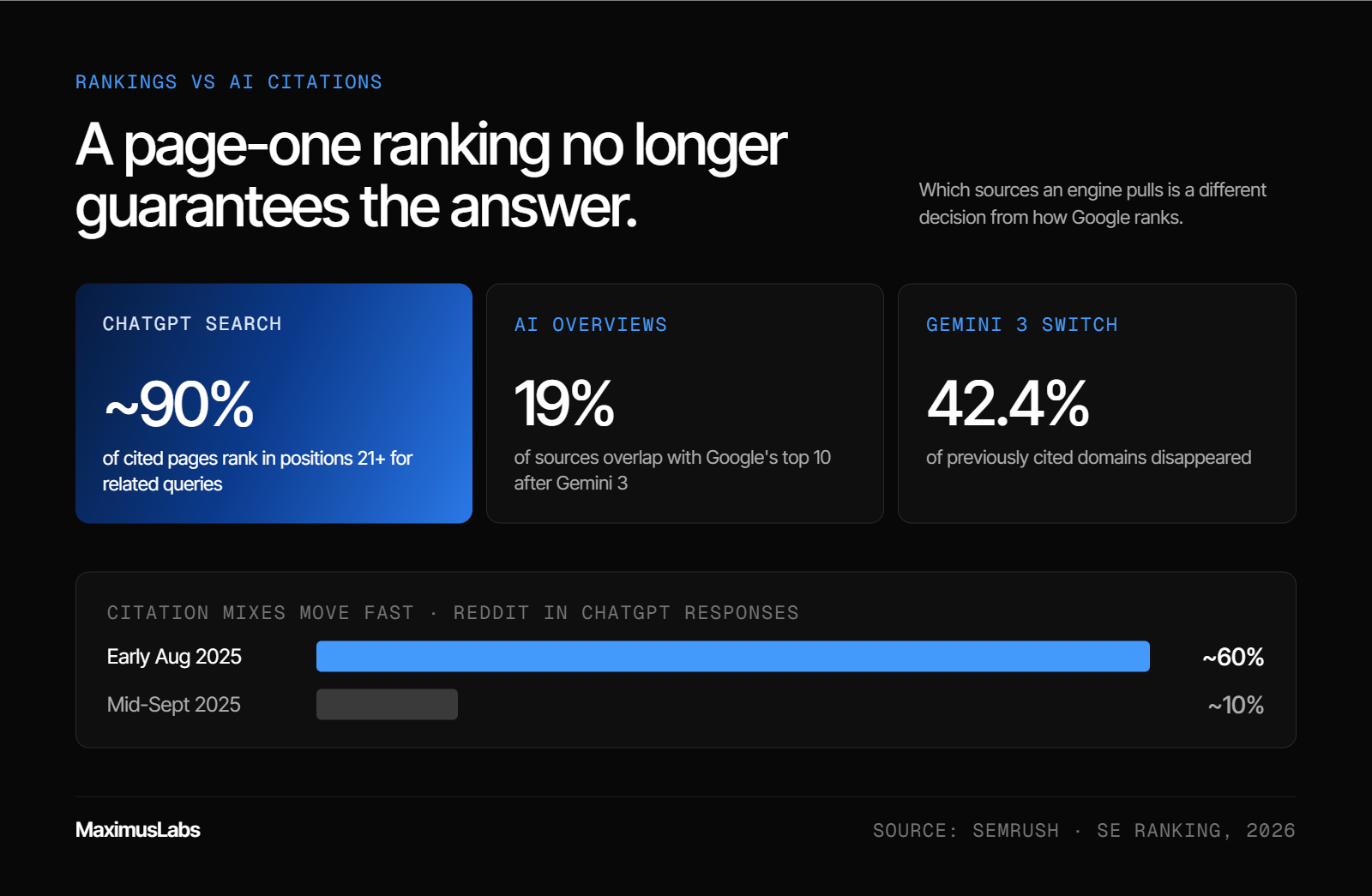
Less than it used to. Semrush found ChatGPT search cites pages ranking in organic positions 21+ almost 90% of the time. SE Ranking found only 19% of AI Overview sources overlap with Google's top 10. After the Gemini 3 switch, 42.4% of previously cited domains disappeared. MaximusLabs AI optimizes for each engine separately, because a page-one ranking no longer guarantees you are part of the answer.
⚠️ The old rule: rank, and you will be seen
For twenty years, the deal was simple. Earn a top-three ranking, and buyers would find you. Every SEO report, retainer, and forecast was built on that deal.
AI engines broke it quietly. They use retrieval-augmented generation, or RAG: they search, pull a set of sources, and write one answer. Which sources they pull is a different decision from how Google ranks.
📊 What the citation data shows
Semrush studied AI citations across more than 500 digital marketing and SEO topics (Semrush). For ChatGPT search, cited pages ranked in positions 21+ for related queries almost 90% of the time. Semrush also found Quora is the most cited site in Google AI Overviews, with Reddit second.
SE Ranking tracked 100,000 keywords across 20 niches before and after Google moved AI Overviews to Gemini 3 in January 2026 (SE Ranking). Afterward, only 19% of AI Overview sources overlapped with the top 10 results. About 42.4% of previously cited domains disappeared. The average number of sources per answer rose 31.8%, from 11.55 to 15.22.
❌ Citation mixes can change in two weeks
Here is the part that should worry anyone reporting "AI visibility" once a quarter. Semrush tracked 230,000 prompts across ChatGPT search, Google AI Mode, and Perplexity (Semrush). ChatGPT cited Reddit in close to 60% of responses in early August 2025. By mid-September, that was around 10%.
No ranking change explains that. The engine changed what it trusted. If your visibility depends on one source type, a single retrieval change can erase it.
💡 Where I first saw this gap
MaximusLabs AI started from exactly this observation. While heading growth at WiseMonk, I kept seeing companies named by ChatGPT that were nowhere in Google's top 10. What ChatGPT thinks is important is not what Google thinks is important. And Perplexity disagrees with both.
That was the moment GEO, Generative Engine Optimization, stopped looking like SEO with a new label to me. It looked like a data science problem: learn what each engine trusts, then become that source.
⏰ The Monday action
Write down the 20 questions your buyers actually ask before they buy. Run each one in ChatGPT, Perplexity, Gemini, and Google AI Overviews. Log which brands and which sources get named. Repeat monthly, because the Reddit drop shows the mix will move.
| Signal | Old SEO view | AI search reality |
|---|---|---|
| Google top 10 ranking | Guarantees visibility | 19% overlap with AI Overview sources |
| Stable citations | Assumed | 42.4% of cited domains replaced after Gemini 3 |
| Source mix | Your own pages | Reddit, Quora, and third-party sites weigh heavily (Semrush) |
MaximusLabs AI was built on this gap, optimizing per platform instead of for "AI" in general. For Oliv AI, that meant a "64% AI citation rate in 6 months, vs ~30% for billion-dollar incumbents (Oliv AI)." Rankings were never the finish line. Being the source each engine trusts is.
Q5. Does AI search traffic convert better than Google organic?
Yes, on the best available data. Semrush estimates the average AI search visitor is 4.4 times as valuable as a traditional organic visitor, based on conversion rate. Semrush also projects AI search visitors will pass traditional search visitors by early 2028. The buyer often arrives pre-sold, because the AI already answered the comparison questions. MaximusLabs AI reports this traffic on pipeline, not sessions.
💰 What the 4.4x number actually says
Semrush studied more than 500 high-value digital marketing and SEO topics (Semrush). It found the average visitor from an AI search source, such as ChatGPT, is worth 4.4 times the average traditional organic visitor. "Worth" here means conversion rate, the share of visitors who take a valuable action like a signup or a demo request.
The same study projects AI search visitors will overtake traditional search visitors by early 2028 (Semrush). Semrush labels this an extrapolation from historical data and adoption rates. Treat it as a direction, not a date to plan a budget around.
💡 Why AI visitors arrive pre-sold
MaximusLabs AI sees the same pattern in client work, and our internal read is closer to 4 to 5 times. The reason is simple. By the time a buyer clicks through from ChatGPT, they have already asked their questions. Which tool fits a 20-person team? Does it integrate with HubSpot? What do users complain about?
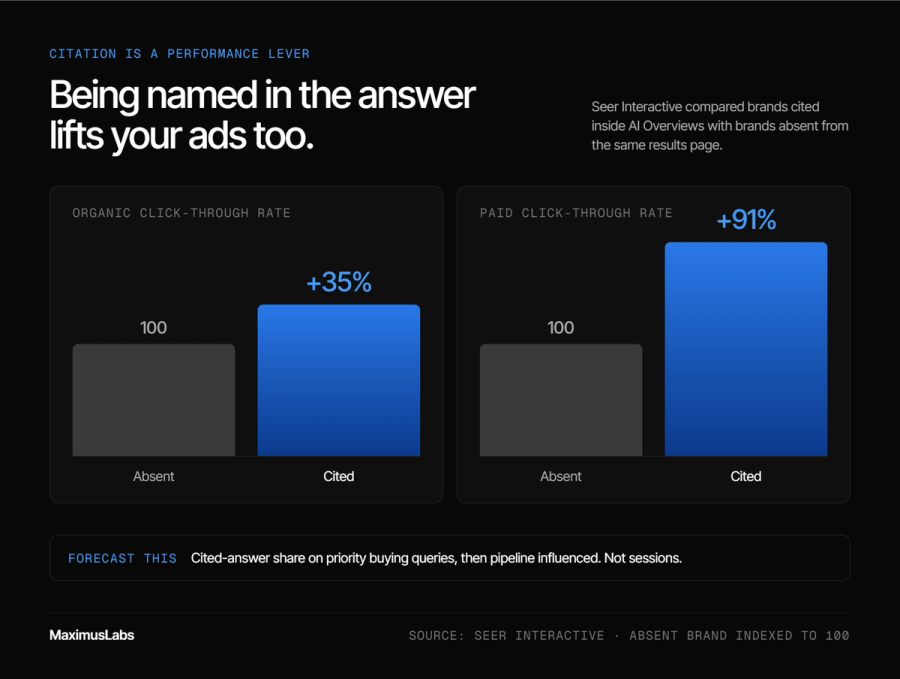
The AI did that research for them, and then it named you. Think about what that means. When ChatGPT recommends a brand, it lends that brand its own credibility. The buyer is not discovering you. They are confirming a recommendation from a source they already trust.
⚖️ Fewer clicks, better clicks
Put Q3 and this section side by side. AI Overviews cut clicks to the top result by 58% (Ahrefs). AI search visitors convert at 4.4 times the organic rate (Semrush). Both are true at once, and the budget conversation has to hold both.
Here is an illustrative example of the math. Imagine 100 visitors arrive from AI engines in a month. At 4.4 times the conversion value, they are worth roughly what 440 average organic visitors would be. A dashboard that only counts sessions would show 100 and call the channel small.
| Metric | Traditional organic | AI search referral |
|---|---|---|
| Visitor volume | Higher, but shrinking on AI Overview queries | Lower today, projected to pass organic by early 2028 |
| Value per visitor | Baseline (1x) | 4.4x, based on conversion rate |
| Buyer stage on arrival | Often still researching | Often already shortlisting |
⏰ The Monday action
Separate AI referral traffic in your analytics so it stops hiding inside "referral" or "direct." In GA4, Google's analytics tool, create a custom channel group for AI sources. Then report three numbers for it every month.
- Sessions from chatgpt.com, perplexity.ai, gemini.google.com, copilot.microsoft.com, and claude.ai.
- Conversion rate for those sessions, compared with organic search.
- Pipeline influenced, meaning opportunities in your CRM that first touched an AI source.
The third number is the one your board cares about. The first number is the one most teams stop at.
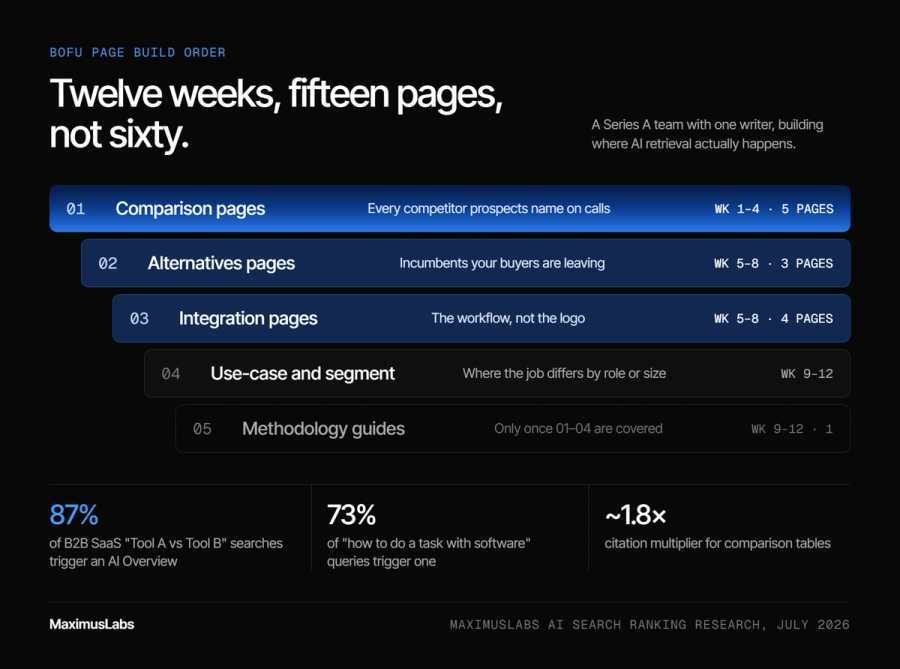
MaximusLabs AI measures every engagement on pipeline, not on mentions, and builds content ICP-aligned and BOFU-first, meaning written for buyers close to a decision. AI engines already answer the "what is X" questions well. For Oliv AI, that approach produced "27 qualified leads, $47K+ pipeline, 26% close rate in 4 months (Oliv AI)."
Q6. What makes content get cited by AI engines?
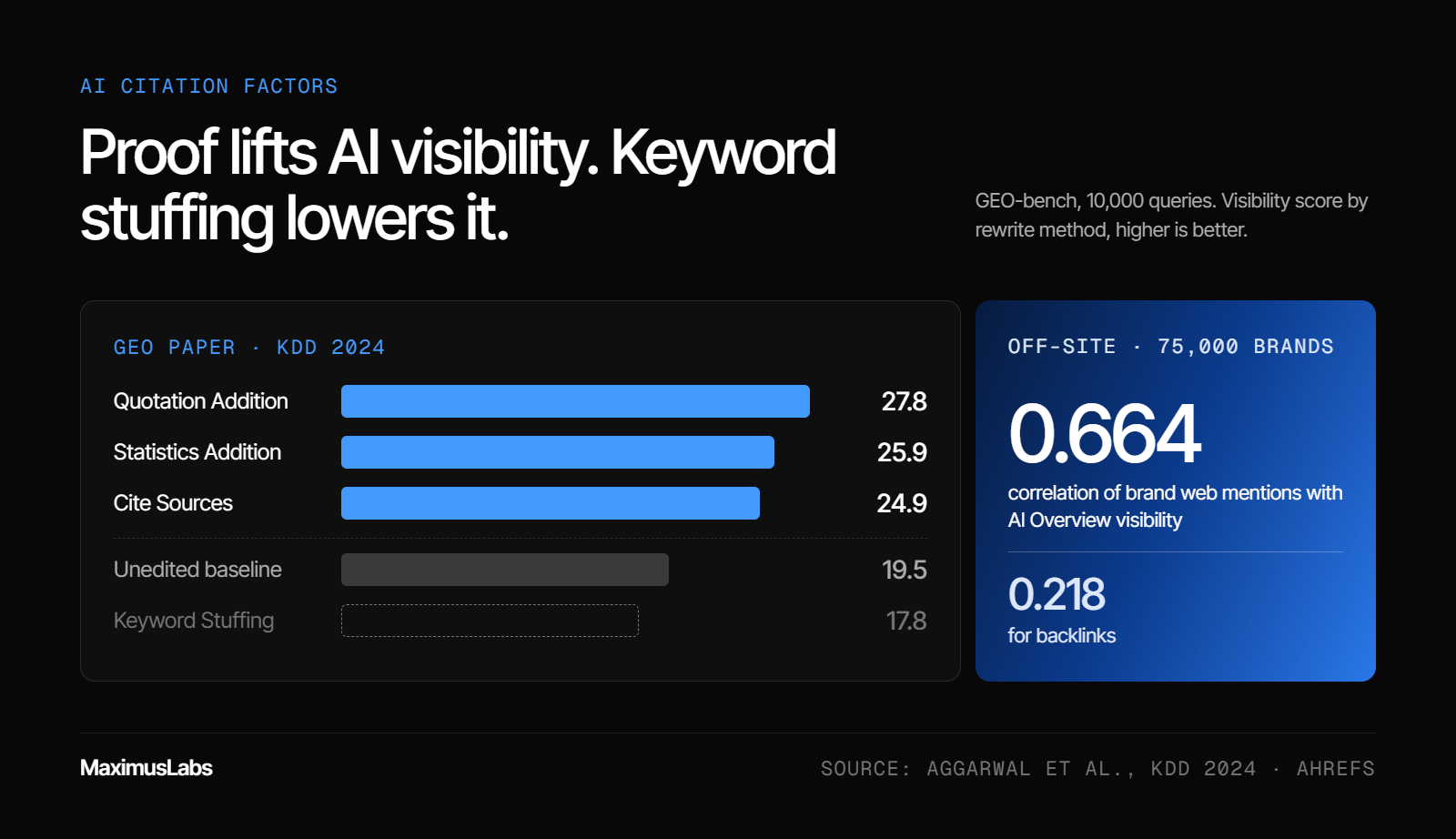
Evidence and reputation. The GEO paper (Aggarwal et al., KDD 2024) tested rewrites of source pages. Adding quotations, statistics, and source citations lifted visibility in AI answers by up to 40%. Keyword stuffing scored below the unedited baseline. Off-site, Ahrefs found brand web mentions correlate with AI Overview visibility at 0.664, versus 0.218 for backlinks, across 75,000 brands.
📊 What the GEO paper actually tested
The GEO paper is the closest thing this field has to a controlled experiment (Aggarwal et al., KDD 2024). Researchers from Princeton and partner institutions built GEO-bench, a set of 10,000 queries. They rewrote source pages in different ways and measured how visible each version became in AI-generated answers.
Their main metric, Position-Adjusted Word Count, measures how much of the answer draws on a source, weighted by where it appears. The unedited baseline scored 19.5.
| Rewrite method | Visibility score (higher is better) |
|---|---|
| Quotation Addition | 27.8 |
| Statistics Addition | 25.9 |
| Cite Sources | 24.9 |
| Unedited baseline | 19.5 |
| Keyword Stuffing | 17.8 |
Notice the last row. The classic SEO move, repeating the keyword, made pages less visible than doing nothing. On Perplexity specifically, the paper reported visibility gains of up to 37% (Aggarwal et al., KDD 2024).
🔗 Off-site mentions beat backlinks
Ahrefs studied 75,000 brands to see what tracks with AI Overview visibility (Ahrefs). Brand web mentions, meaning any page that names your brand with or without a link, showed the strongest correlation at 0.664. Backlinks came in at 0.218.
A correlation of 1.0 would mean perfect agreement, and 0 means none. So mentions track visibility roughly three times more closely than links. A later Ahrefs study of 10,000 brands found webpage mentions at 0.70 and YouTube mentions at 0.64 (Ahrefs). Different samples, same direction: being talked about matters more than being linked to.
💡 Why proof beats keywords
MaximusLabs AI's read is that both findings point to one idea: trust. AI-generated content now floods the web, and an AI engine cannot easily tell which source is reliable. So it leans on signals that are hard to fake. Named sources, real numbers, quotes from real people, and other sites talking about you.
I might be overstating how deliberate this is inside the models. But the practical lesson holds either way. Write pages an editor would trust, then get the rest of the web to vouch for you.
⏰ The Monday action
Pick your five highest-intent pages, the ones closest to a buying decision. For each one, make three changes.
- ✅ Add at least three statistics, each linked to its primary source and dated.
- ✅ Add one quote from a named expert, customer, or your founder.
- ✅ Put the direct answer to the page's main question in its first 100 words.
Then list ten third-party sites in your category that AI engines already cite. Work out how to earn a mention on each.
MaximusLabs AI runs this as two pillars of AEO (Answer Engine Optimization). Owned AEO makes your pages the answer. Earned AEO uses reviews, Reddit, press, and listicles to make AI trust you. Most agencies only work on the first pillar.
Q7. Which AI crawlers decide whether you can be cited?
OpenAI, Perplexity, and Anthropic each document a dedicated search crawler. OAI-SearchBot surfaces websites in ChatGPT's search features. PerplexityBot surfaces and links websites in Perplexity's results. Claude-SearchBot improves search result quality for Claude users. Each vendor lists these separately from its other bots, so blocking a search crawler in robots.txt can remove you from that engine's answers.
🤖 What the official docs say
Start with the source, not a blog summary. Each vendor publishes its own crawler page, and each one names a bot built for search.
| Vendor | Search crawler | What the vendor says it does | Other bots listed |
|---|---|---|---|
| OpenAI | OAI-SearchBot | Surfaces websites in search results in ChatGPT's search features | Other OpenAI agents on the same page |
| Perplexity | PerplexityBot | Surfaces and links websites in Perplexity search results | Perplexity-User |
| Anthropic | Claude-SearchBot | Navigates the web to improve search result quality for users | ClaudeBot, Claude-User |
A crawler is the automated program that fetches your pages. Robots.txt is the plain text file at your site's root that tells each crawler what it may fetch. Because these bots have separate names, you can allow search access while making a different choice for other bots.
⚠️ The quiet way brands block themselves
Here is a scene I have seen more than once. A security or engineering team blocks "AI bots" across the board to stop scraping. Months later, marketing asks why ChatGPT never cites the company. Nobody connected the two decisions.
MaximusLabs AI checks robots.txt in the first week of every engagement for exactly this reason. It is the cheapest fix in AI search, and one of the most commonly missed.
🧱 Can the crawler actually read the page?
Allowing a crawler is step one. Step two is making sure it finds your text when it arrives. None of the three vendor pages says whether its search crawler runs JavaScript, the code many modern sites use to load content in the browser.
MaximusLabs AI's practice is to assume nothing. We serve core content, statistics, and links in the server-rendered HTML, meaning the text is in the page before any script runs. If a crawler skips scripts, it still gets the full answer.
⏰ The Monday action
Open yoursite.com/robots.txt and look for the three search crawler names. If you want to be cited, make sure none of them is disallowed. A minimal allow block looks like this:
User-agent: OAI-SearchBot
Allow: /

User-agent: PerplexityBot
Allow: /

User-agent: Claude-SearchBot
Allow: /
Then load your top five pages with JavaScript turned off in your browser. If the main answer disappears, an AI crawler may not see it either.
✅ A quick crawler checklist
- Search crawlers named in robots.txt are allowed, not caught by a blanket block.
- Firewall or bot-protection rules do not challenge these user agents.
- Core answers, tables, and statistics appear in the raw HTML.
- Pages you want cited return a normal 200 status, not a redirect chain.
MaximusLabs AI treats crawler access as the foundation layer of AEO, with technical SEO underneath it. Great content that a search crawler cannot fetch or read never gets the chance to become the answer.
Q8. How are B2B buyers using AI to research software?
AI is now the first stop for many B2B software buyers. G2's 2026 AI Search Insight Report found 51% of B2B decision makers start software research with an AI chatbot more often than Google. Also, 71% use AI chatbots somewhere in the research process. AI answers name only a handful of vendors, so missing from that answer means missing from the evaluation set.
🔍 How the buying journey used to work
A few years ago, a VP of Sales shopping for a new tool followed a familiar path. Google the category, open ten tabs, read a few review sites, and book demos with three vendors. Your job was to rank on page one and look credible when they landed.
That path still exists. It is just no longer where the shortlist gets made.
📊 What G2 found in 2026
G2 surveyed 1,076 B2B decision makers across North America, EMEA, and APAC in March 2026 (G2). Some 51% now start their research with an AI chatbot more often than Google. And 71% rely on AI chatbots somewhere in the software research process.
Read the 51% carefully. It does not mean half of buyers never use Google. It means AI has become their default starting point. The first impression of your category, and of you, is now often written by ChatGPT, Perplexity, Gemini, or Claude.
❌ There is no page two in an AI answer
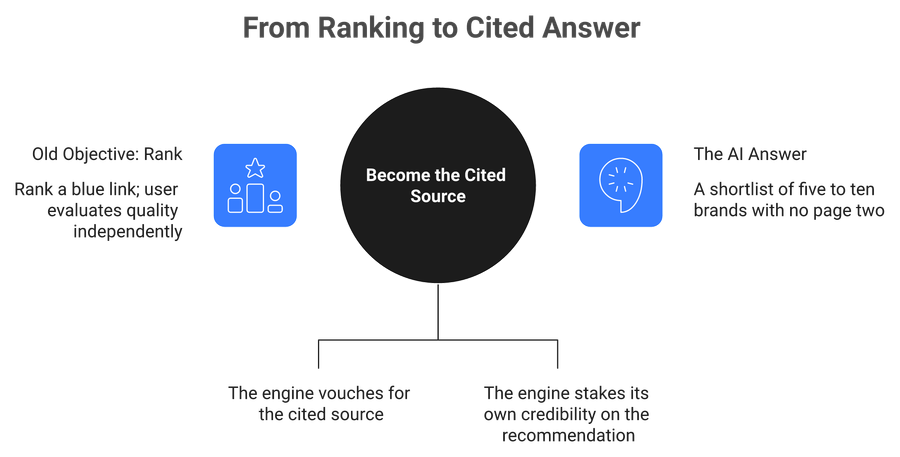
MaximusLabs AI calls this the sample set problem. A buyer asks AI for the best CRM for a small SaaS team. There are hundreds of CRMs, but the answer names five to ten. If you are not in that set, you are not on page two. You are simply not in the evaluation.
That makes AI search more binary than Google ever was. And the stakes are higher, because the buyer trusts the AI's shortlist. When it names your competitor, it lends them its credibility.
🌐 Your own site is only part of the answer
Semrush found that 50% of links in ChatGPT 4o responses point to business or service websites (Semrush). That is good news, because your pages can be cited. The rest of the answer draws on other sources, including the third-party sites Q4 and Q6 showed carry heavy weight.
So the B2B playbook has two halves. Your site has to answer buyer questions clearly enough to be cited. And the wider web, from review profiles to community threads, has to describe you the way you want to be described.
⏰ The Monday action
Write ten prompts a real buyer in your category would type. Examples include "best [category] for [company size]" and "[your brand] vs [top competitor]." Run each in ChatGPT and record three things.
- Are you named at all?
- Which competitors are named instead?
- Which sources does the answer cite or rely on?
The third column becomes your Earned AEO target list for the quarter.
MaximusLabs AI runs this audit across every major engine for B2B SaaS clients first, then turns the gaps into owned and earned work. The goal is not just to be mentioned in the shortlist. It is to turn that mention into qualified pipeline.
Q9. Which AI SEO statistics should you stop quoting?
Stop quoting numbers you cannot trace. Popular figures were checked against their originals for this article. The 34.5% AI Overview CTR drop was superseded by Ahrefs' own 58% update. A "2.5 billion" AI Overview users figure does not appear in Google's remarks, which say over 2 billion. And SE Ranking's Gemini 3 study reports 42.4% domain turnover and 19% top-10 overlap, not the before-and-after shares that circulate.
⚠️ Why bad statistics spread so fast
Here is how a bad stat is born. One study publishes a careful number with a date and a method. A blog rounds it. A second blog cites the first blog. Then an AI tool summarizes all three, and the number gains a new decimal and loses its source.
MaximusLabs AI hit this constantly while researching this article. Several figures appeared on many ranking pages, yet the original said something different or could not be found.
❌ Claims vs what the source actually says
| What gets quoted | What the source says |
|---|---|
| "AI Overviews cut clicks by 34.5%" | True for March 2024 vs March 2025 (Ahrefs). Ahrefs' February 2026 update found 58% for the top result (Ahrefs). Quote the newer one, with its date. |
| "AI Overviews have 2.5 billion users" | Google's July 2025 remarks say "over 2 billion monthly users" (Alphabet). A higher figure did not appear in the remarks checked. |
| Before-and-after shares of AI Overview citations from the top 10, credited to SE Ranking's Gemini 3 study | The study reports 42.4% of cited domains disappeared and 19% overlap with the top 10 (SE Ranking). It gives no pre-switch top-10 share. |
| "Reddit citations in ChatGPT collapsed in September 2025" | The drop ran from close to 60% in early August to around 10% by mid-September (Semrush). |
| "51% of B2B buyers use AI instead of Google" | G2 says 51% start research with an AI chatbot more often than Google (G2). That is a habit, not a full switch. |
| "AI search will pass Google by 2028" | Semrush projects AI search visitors pass traditional search visitors by early 2028, and calls it an extrapolation (Semrush). |
🔍 The analyst forecast nobody can check
You have probably seen a 2024 analyst forecast that search engine volume would fall sharply by 2026 because of AI chatbots. It is quoted everywhere. The original release could not be opened for this article, so its exact figure is left out here.
What can be checked points another way. As Q2 showed, Google's AI surfaces reached over 2 billion monthly users (Alphabet). A forecast is a prediction, not a measurement. Present it as one, or leave it out.
⏰ The Monday action
Before any statistic goes into a deck, an article, or a sales email, run three checks.
- Who measured it? Name the team, platform, or dataset. "A study" is not an answer.
- When was it measured? If it predates the latest platform change, look for a newer figure.
- How was it measured? Know the sample size and whether it shows correlation or cause.
If a number fails any check, find the original or drop it.
MaximusLabs AI applies this three-check rule to every client article before it ships. In a category full of recycled numbers, a page that cites its sources stands out to readers and to the engines choosing what to cite.
Q10. What should you measure instead of rankings in 2026?
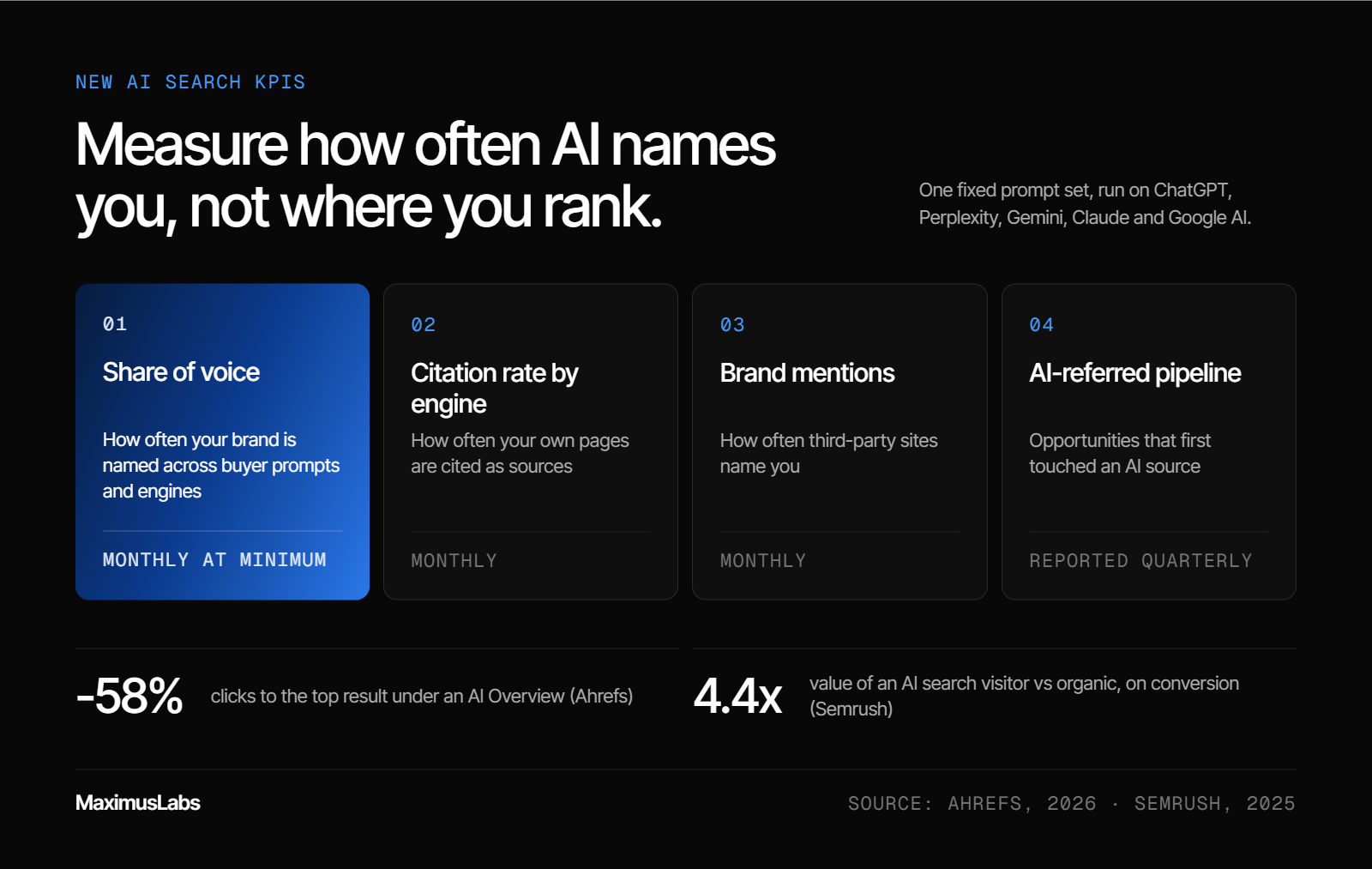
Measure how often AI names you, not where you rank. AI search has no single position. Visibility is the share of answers your brand appears in, across many prompt variants and engines. MaximusLabs AI pairs that share of voice with citation rate per engine, brand mentions, and AI-referred conversions. Leadership then sees pipeline influence, not impressions.
📉 Why a rank report stopped telling the truth
A rank report answers one question: where does my page sit on Google for this keyword? That was the right question when ten blue links were the whole game. It is the wrong question when the buyer reads an AI answer first and may never scroll.
Look at what the earlier sections showed. Clicks to the top result fell 58% under AI Overviews (Ahrefs). ChatGPT cites pages from positions 21+ almost 90% of the time (Semrush). A rising rank chart can sit right next to a shrinking pipeline, and both can be accurate.
🎯 Share of answers replaces position
In AI search, the unit of visibility is the answer, not the position. Ask the same buyer question 50 ways across five engines. Count how often your brand appears. That percentage is your share of voice, sometimes called share of answers.
It behaves differently from rank. It moves when a competitor earns a new review, when a Reddit thread gets cited, or when an engine changes what it trusts. The Reddit drop from close to 60% to around 10% in about six weeks shows how fast that can happen (Semrush).
📊 The four metrics for your AI search scorecard
| Metric | What it measures | How to track it | Cadence |
|---|---|---|---|
| Share of voice | How often your brand is named across buyer prompts and engines | Fixed prompt set run on ChatGPT, Perplexity, Gemini, Claude, and Google AI | Monthly at minimum |
| Citation rate by engine | How often your own pages are cited as sources | Same prompt set, logging cited URLs | Monthly |
| Brand mentions | How often third-party sites name you | Mention monitoring across reviews, communities, and press | Monthly |
| AI-referred pipeline | Opportunities that first touched an AI source | GA4 AI channel group plus CRM attribution | Monthly, reported quarterly |
Brand mentions tracked AI Overview visibility at 0.664 in Ahrefs' study of 75,000 brands (Ahrefs). AI visitors are worth 4.4 times organic visitors on conversion (Semrush). The scorecard follows the money.
💡 Brand beats the algorithm
Here is my most contrarian view, and MaximusLabs AI is built on it. Do not chase the algorithm. Build the brand AI has to recommend.
Algorithms will keep changing. Gemini 3 replaced 42.4% of cited domains in one update (SE Ranking). But a brand that buyers, reviewers, and communities talk about keeps showing up, update after update. I might be wrong about how long this holds as agents take over more buying. For now, every dataset in this article points the same way.
⏰ The Monday action
Build your first scorecard this week. Run 25 buyer prompts on five engines and log mentions and cited URLs. Add your GA4 AI channel numbers beside them. Next month, run the same prompts again and compare.
MaximusLabs AI tracks share of voice across ChatGPT, Perplexity, Gemini, Claude, and Google AI for every client. Rank on one engine says little about who makes the shortlist. Pipeline from that shortlist is the number we answer for.
What I'm Thinking About Next
Two questions keep me up at night. First, ads are coming to AI chat, and I expect them within a year or two. When they arrive, earned trust becomes the only visibility you cannot simply buy. Second, AI agents will soon research and shortlist vendors with no human reading the answer at all.
My hypothesis is that the brands cited most today will compound that lead, because AI systems learn patterns early. I might be wrong on timing. I am not worried about direction.
If your data tells a different story, I want to hear it. Write to me at krishna@maximuslabs.ai and tell me what you are seeing in your own AI search numbers.
Questions, answered
7 questionsWhat percentage of Google searches show an AI Overview?
In Pew Research Center's study of real browsing data, about 18% of Google searches showed an AI summary. Pew tracked 900 U.S. adults in March 2025, covering 68,879 unique searches. That share is not the same for every query. Pew found some types of searches were much more likely to show a summary than others. So your own exposure depends on your keyword mix, and you have to measure it yourself. • Pull your top 100 keywords from Google Search Console. • Search each one and note whether an AI Overview appears. • Tag those keywords and forecast them at roughly half their historical CTR. MaximusLabs AI runs this tagging step at the start of every engagement, because it changes which pages deserve investment. A keyword that triggers an AI Overview is no longer a click opportunity first. It is a citation opportunity first. We also re-check the list monthly. AI Overview coverage shifts as Google updates its models, so a one-time audit goes stale fast. Our guide to optimizing for Google AI Overviews covers how to win the citation once you know which queries matter.
Is SEO dead because of AI search?
No. SEO is not dead, but SEO alone no longer covers how buyers find you. The data shows both things at once. • Google's AI Overviews passed 2 billion monthly users in July 2025, so Google search is still enormous. • Ahrefs found the top result's CTR is 58% lower when an AI Overview appears. • Semrush found ChatGPT search cites pages ranking in positions 21+ almost 90% of the time. So ranking still matters, but it no longer guarantees clicks or AI citations. The best practices of SEO, like clean technical foundations, clear answers, and strong authority, have become the basics. Generative Engine Optimization (GEO) builds on top of them. MaximusLabs AI treats SEO as the foundation floor and Answer Engine Optimization (AEO) as the building on top. We still fix crawlability, structure, and authority first. Then we work on what each AI engine trusts, which is often third-party mentions and reviews rather than your own pages. If you want the full comparison, our breakdown of AEO vs SEO explains where the two overlap and where they split.
How fast is ChatGPT growing as a search channel?
Fast. OpenAI reported 800 million weekly ChatGPT users in October 2025 and 900 million in February 2026, along with 50 million paying subscribers. That is about 100 million new weekly users in roughly four months. Weekly active users is a strict measure. It counts people who use the product at least once a week, so this reflects habit, not curiosity. For B2B teams, G2's 2026 research adds context: 51% of B2B buyers now start software research with an AI chatbot more often than Google. Growth alone does not mean Google is shrinking. MaximusLabs AI's read is that AI chat is additive. The same buyer may ask ChatGPT for a shortlist, then search Google for pricing later. • Treat ChatGPT as its own channel with its own owner. • Track which competitors it names for your category prompts. • Segment ChatGPT referral traffic in analytics and report its conversions. Our ChatGPT SEO guide walks through how ChatGPT search picks sources and how to become one of them.
Does adding statistics to content help it get cited by AI engines?
Yes, according to the strongest controlled study available. The GEO paper by Aggarwal et al., presented at KDD 2024, tested rewrites of source pages across 10,000 queries. • Adding quotations scored 27.8 on its visibility metric. • Adding statistics scored 25.9. • Citing sources scored 24.9. • The unedited baseline scored 19.5, and keyword stuffing scored 17.8. Overall, the paper found these methods can lift visibility in AI answers by up to 40%. Keyword stuffing, the classic SEO habit, made pages less visible than doing nothing. There is a catch. A statistic only helps if it is real and traceable. MaximusLabs AI applies a simple rule before any number goes into client content: who measured it, when, and how. Unsourced numbers weaken a page with readers and with the engines deciding whom to trust. We add at least three sourced statistics and one named quote to high-intent pages, and place the direct answer early. Our guide to citation-worthy content for AI engines covers the full checklist.
How do you measure your brand's visibility in AI search?
You measure share of voice, not rank. AI answers have no fixed position, so the useful question is how often your brand appears across many prompts and engines. • Share of voice: the percentage of buyer prompts where AI names your brand. • Citation rate by engine: how often your own pages are cited as sources in ChatGPT, Perplexity, Gemini, Claude, and Google AI. • Brand mentions: how often third-party sites name you. Ahrefs found mentions correlate with AI Overview visibility at 0.664, versus 0.218 for backlinks. • AI-referred pipeline: opportunities that first touched an AI source. Run the same fixed prompt set every month. Citation mixes move quickly. Semrush saw Reddit fall from close to 60% of ChatGPT responses to around 10% in about six weeks in 2025. MaximusLabs AI tracks share of voice across every major engine for each client and ties it back to pipeline in the CRM. Visibility on its own is a vanity metric until it shows up as qualified opportunities. Our GEO measurement metrics guide explains how to set up each of these.
Should you block AI crawlers on your website?
It depends on which crawler. OpenAI, Perplexity, and Anthropic each document a dedicated search crawler, separate from their other bots. • OAI-SearchBot surfaces websites in ChatGPT's search features. • PerplexityBot surfaces and links websites in Perplexity's results. • Claude-SearchBot improves search result quality for Claude users. If you block these search crawlers in robots.txt, you can remove yourself from that engine's answers. Because the bots have separate names, you can allow search access while making a different decision for other bots. A common mistake is a blanket block. A security team blocks every AI bot to stop scraping, and months later marketing wonders why ChatGPT never cites the company. MaximusLabs AI checks robots.txt and firewall rules in the first week of every engagement for exactly this reason. Allowing the crawler is only step one. We also serve core content in server-rendered HTML, so a crawler that skips JavaScript still sees the answer. You can run a quick check with our AI crawlability checker.
How should a B2B SaaS company budget for AI search in 2026?
Budget on pipeline, not traffic. The data points one way: fewer clicks, but more valuable ones. • Ahrefs found AI Overviews cut the top result's CTR by 58%. • Semrush estimates an AI search visitor is worth 4.4 times a traditional organic visitor, based on conversion rate. • G2 found 51% of B2B buyers start software research with an AI chatbot more often than Google. That means a budget built on session targets will undervalue AI search. A better split funds three things: bottom-of-funnel content that answers buyer questions, earned visibility on the third-party sites AI engines trust, and measurement that ties AI referrals to opportunities. MaximusLabs AI starts every B2B SaaS engagement with BOFU content and a share-of-voice baseline, then reports results on pipeline. For Oliv AI, that approach produced 27 qualified leads, $47K+ pipeline, and a 26% close rate in 4 months. We skip top-of-funnel definition content on purpose, because AI engines already answer those questions well. Our GEO budget benchmark for 2026 shows how teams are splitting spend across owned and earned work.