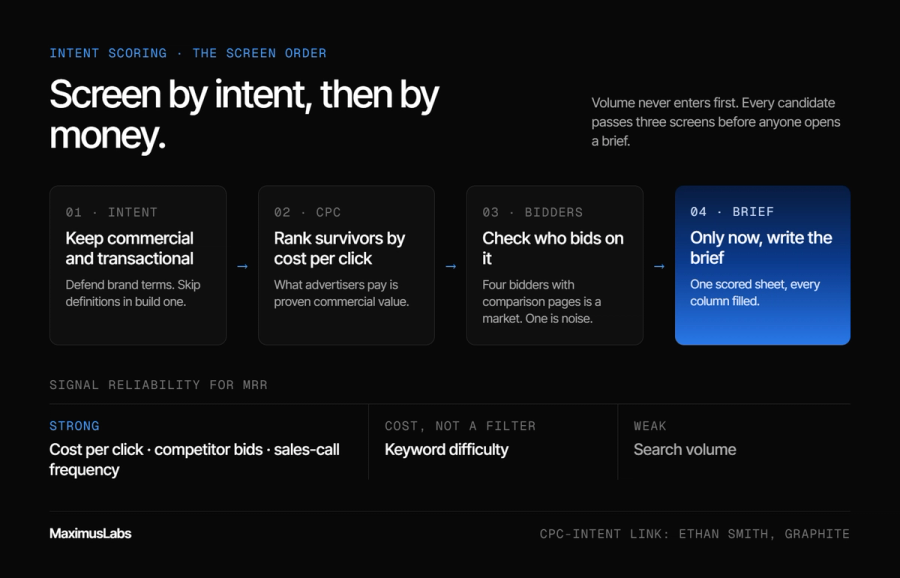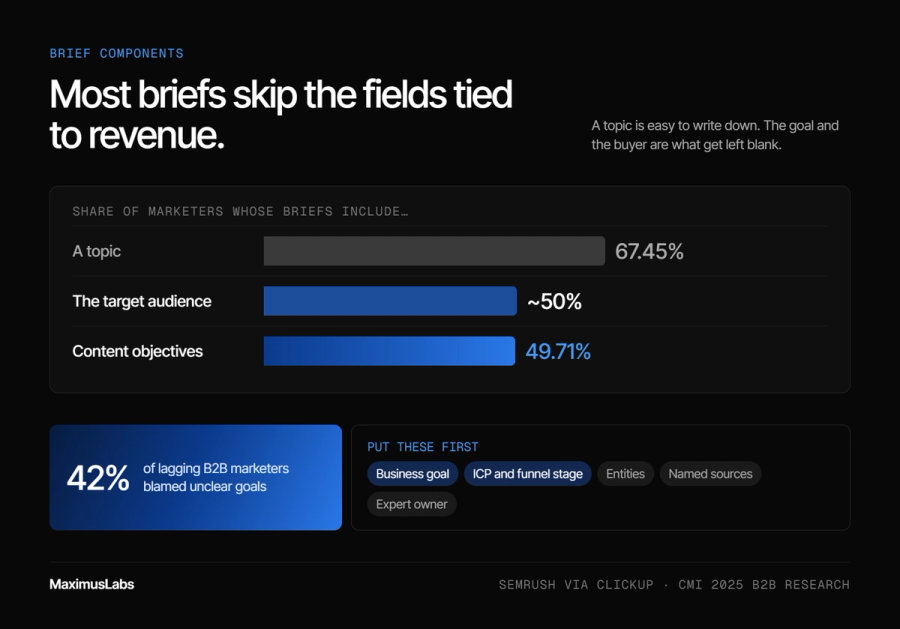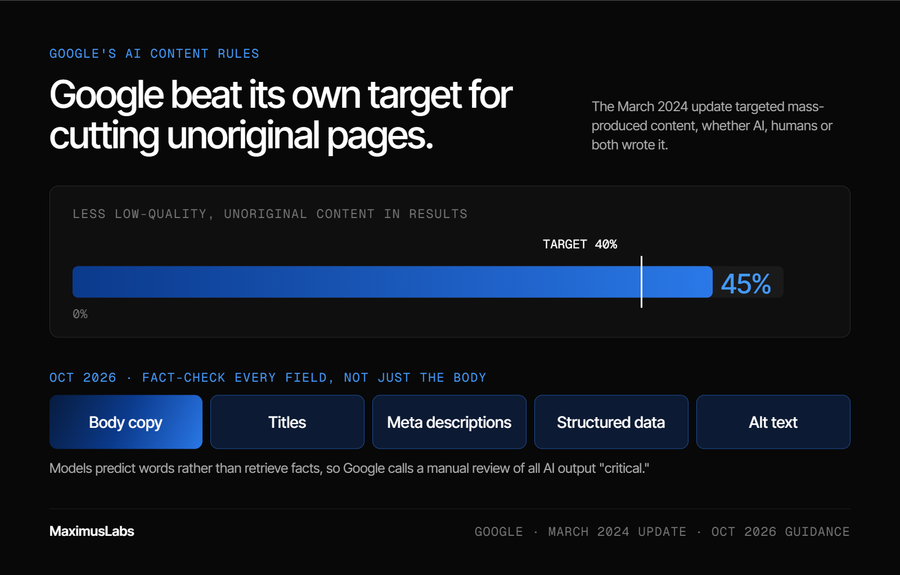
- Most content A/B tests produce false winners because before and after comparisons have no control group, so seasonality, algorithm updates, and AI platform growth get credited to the edit.
- Match the test design to the audience: user-level tests for reader behavior, page-level buckets for search engines, and controlled sequential tests only for small sites.
- Set the goal, hypothesis, one variable, sample size, and end date before launch, then run in full weeks without peeking and log every result.
- Follow Google's rules: no cloaking, rel=canonical on variant URLs, 302 redirects, a fixed end date, and cleanup of test URLs and scripts afterward.
- Test AI citations with a fixed buyer prompt set and matched page groups; the KDD 2024 GEO study found sourced statistics and quotes lifted visibility over 40%.
- Decide winners on one revenue metric such as demo requests or pipeline, treat CTR and citations as guardrails, and reproduce wins before sitewide rollout.
A Head of Growth at a B2B SaaS company drops a screenshot into Slack on Monday morning. Demo requests from the pricing page are up since the new headline went live. The CEO replies within a minute: "Roll it out everywhere."
Nobody in the thread checks the other line on the dashboard. ChatGPT referrals grew in the same weeks, and a Google core update landed in the middle of the test. So was it the headline, the platform, or the algorithm?
I see this moment again and again. Most content "wins" are guesses with a chart attached. This guide shows you how to run content split tests that hold up. You will learn to protect rankings while you test. You will also measure what matters now: whether AI engines pick your page, and whether that turns into pipeline.
Q1. What does A/B testing content mean when AI engines pick the answer?
A/B testing content compares two versions of the same content that differ in one element. You test against a control and keep the version that moves a metric chosen in advance. Multivariate testing changes several elements at once and needs far more traffic. Content has three test units: users (conversion), pages (organic search response), and AI answers (citations in ChatGPT, Perplexity, or Google AI Overviews).
The Core Idea in Plain Terms
🎯 One change, one control, one metric
A split test is a fair fight between two versions. Version A is the control, the page as it is today. Version B carries one change, such as a new title, a tighter intro, or a new call to action. A call to action (CTA) is the button or link that asks the reader to act.
Contentsquare notes that "split testing" and "A/B testing" are used as the same term in practice. Semrush frames the process the same way: find an opportunity, form a hypothesis, change one variable, and measure the result. The hypothesis is the part most teams skip, and it is the part that makes a result useful.
💡 Why "content" is different from landing page testing
Landing page tests usually measure one thing: did the visitor convert? Content has more jobs. A blog post must earn the click, hold the reader, and move them toward a demo. Now it also has to get cited by AI engines. Each of those jobs is a separate test with a separate audience.
A/B Testing vs Multivariate Testing
⚠️ When more variables means less truth
Multivariate testing changes several elements at once, such as headline, image, and CTA together. It tells you which combination works best, but every extra variable splits your traffic further. Most B2B content pages lack the traffic for it.
| Method | What changes | Traffic needed | Best for |
|---|---|---|---|
| A/B test | One element | Moderate | Most content pages |
| Multivariate test | Several elements at once | Very high | High-traffic templates |
The Three Things You Can Test Against
📊 Users, pages, and AI answers
This is where content testing in 2026 gets more interesting than the old guides suggest:
- Users: Show different versions to different visitors and measure behavior, such as clicks, scroll depth, or sign-ups.
- Pages: Change a group of pages and compare them with an untouched group to see how search engines respond.
- AI answers: Track whether a change makes ChatGPT, Perplexity, Gemini, or Google AI Overviews cite your page more often.
The third unit is the new one. Ahrefs found that AI Overviews cut clicks to the top organic result by 58% in its December 2025 data. When fewer people click, being the cited answer becomes a result you need to measure on its own.
🚀 Why one winner may not win everywhere
Here's what I learned early: Google, ChatGPT, and Perplexity reward different signals. A title that wins clicks on Google may do nothing for a Perplexity citation. So every test needs a clear answer to one question first: which audience are you testing against?
MaximusLabs AI treats content testing as a way to become the answer, not only to rank. That means every hypothesis names its test unit before launch: users, pages, or AI answers. The rest of this guide covers test design, the step-by-step process, and the false winners that fool most teams.
Q2. Why do most content A/B tests produce false winners?
Most content tests produce false winners because they compare a page before and after an edit with no control group. Seasonality, algorithm updates, competitor moves, and AI platform growth all shift traffic at once. The edit then gets credit it did not earn. Small samples add noise that looks like a lift. A control group and a preset sample size fix both problems.
The Situation: The Before and After Habit
📊 How most teams "test" content today
The common routine looks like this. A marketer rewrites a post, waits four weeks, and compares traffic with the four weeks before. Traffic went up, so the rewrite worked. The result goes into the monthly report, and the team repeats the change on twenty more posts.
This feels like testing, but it is not. There is no control group, so nothing separates the edit from everything else that happened in those weeks.
The Complication: Noise Dressed Up as a Win
⚠️ Four forces that move traffic without your help
Eric Enge, a long-time search practitioner, makes this point bluntly. Before and after comparisons cannot isolate your edit. Seasonality, unrelated site changes, Google updates, competitor actions, or ad-driven demand can all explain the change. Any of those can be larger than the effect of a new headline.
The fifth force is new, and it is big. Ethan Smith, CEO of Graphite, warns that AI traffic will rise simply because more people use tools like ChatGPT. If ChatGPT referrals climb 50% from usage growth alone, a team can wrongly credit its AEO work. Answer Engine Optimization (AEO) is the practice of getting content cited by AI answer engines.
💸 The macro misattribution trap
Search behavior is also shifting under everyone at once. Ahrefs reports that AI Overviews cut clicks to the top organic result by 58% in December 2025. Its April 2025 figure was a 34.5% drop. A page whose clicks fell during a test may have lost to Google's interface, not to your edit.
The Small Sample Problem
❌ Why a lucky week looks like a lift
Small samples make random swings look meaningful. If a post gets 300 visits a week, a few extra sign-ups can look like a big conversion jump. Run it again next month, and the "winner" often disappears.
Ethan Smith also notes that many tactics work the first time and fail the second. That is why reproducing a result before you trust it matters as much as the first test.
The Resolution: Controls Before Conclusions
✅ Three rules that stop false winners
- Always keep a control. Leave a matched set of users or pages unchanged during the test.
- Set the sample size first. Decide how much data you need before launch, not after you see a number you like.
- Reproduce before rollout. Confirm a win on a second group before applying it site-wide.
My view is simple. Generative Engine Optimization (GEO, optimizing content to appear in AI-generated answers) is a data science problem, not an SEO add-on. Every content claim is a hypothesis until a control group backs it.
MaximusLabs AI treats AI-search traffic gains as unproven until they beat an untouched control set. Platform usage growth alone can inflate referral numbers. So the team measures share of voice across thousands of question variants, not one page's traffic curve. That is how a reported win stays a real win when the CEO asks about pipeline.
Q3. Which split test design fits your site: user-level, page-level or sequential?
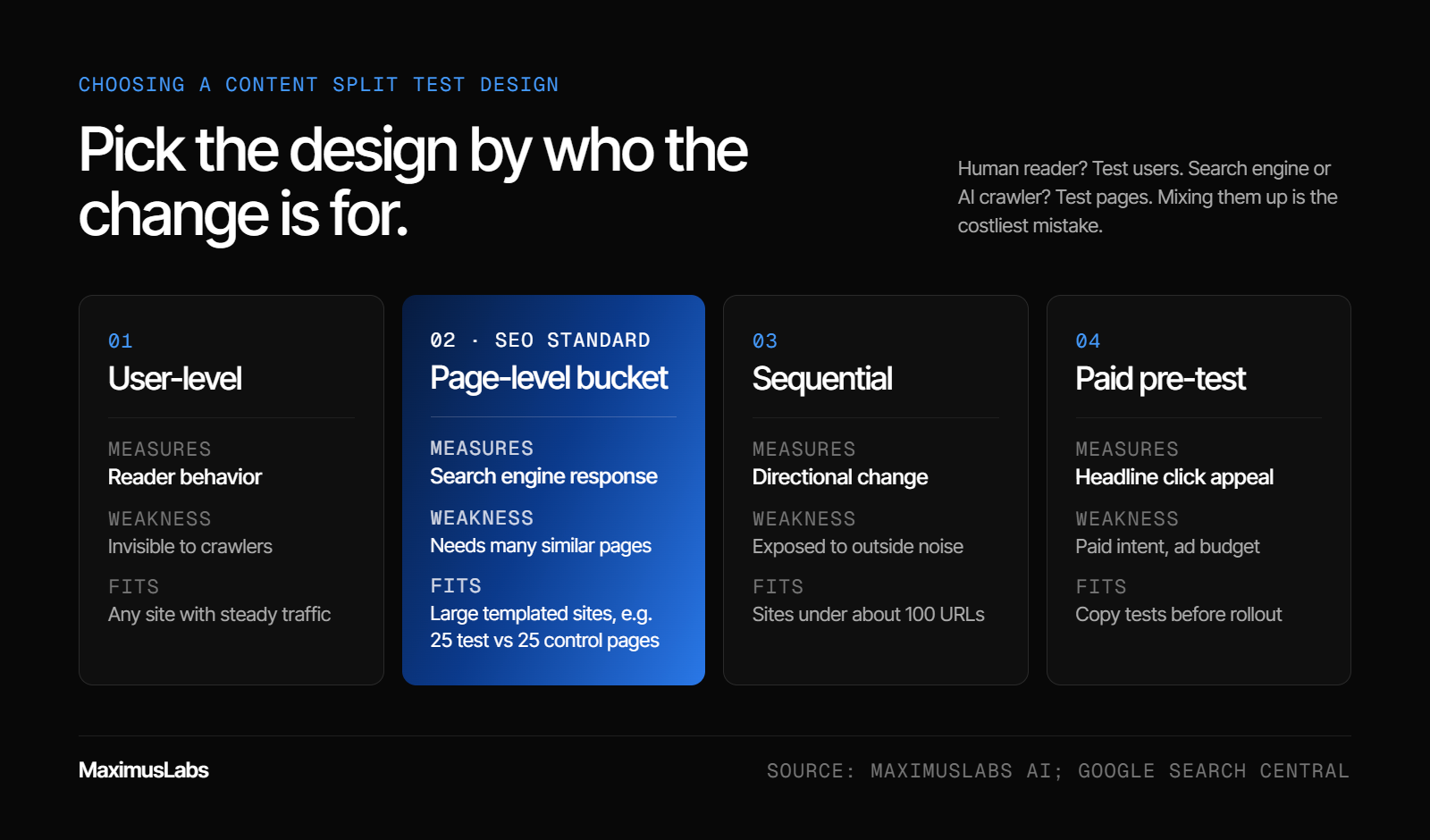
Use user-level split testing to measure on-page behavior such as clicks and sign-ups. Use page-level bucket testing, with matched control and test URL groups, to measure search engine response. Crawlers see only one version of each URL. Use controlled sequential testing only when you have too few pages to bucket, and track macro trend lines alongside it. Paid ads can pre-test headline copy quickly.
Match the Design to the Question
🎯 Start with what you want to learn
The right design depends on one question: who is the audience for the change? If it is the human reader, test users. If it is a search engine or an AI crawler, test pages. Mixing them up is the costliest testing mistake.
User-Level Split Testing
✅ Best for conversion behavior
User-level tests show version A to some visitors and version B to others, usually through JavaScript or cookies. They work well for CTAs, intros, forms, and layout. The visitor is the unit, so the result tells you how people behave on the page.
❌ Why it says nothing about rankings
Here's my contrarian take: user-level splitters cannot tell you anything about rankings. Googlebot sees one version of a URL, so it cannot respond to a split it never sees. Google's own guidance also warns that showing crawlers different content than users is cloaking, which breaks its spam policies.
Page-Level Bucket Testing
📊 The standard for measuring search impact
Page-level testing changes a group of similar pages and leaves a matched group untouched. Picture a company with 50 near-identical state service pages. You put 25 in a test bucket and 25 in a control bucket, then apply the change only to the test bucket.
Both buckets live through the same updates and seasons, so the gap between them isolates your change. SearchPilot, which publishes its SEO test results, runs its experiments on this page-group model. The catch is scale: you need many templated pages with similar traffic.
Sequential Testing and Paid Pre-Tests
⚠️ When you have too few pages
Small sites, often under about 100 URLs, cannot build fair buckets. In that case, a controlled sequential test is the fallback. You change the page, then compare it against macro trend lines such as sitewide traffic, competitor visibility, and known update dates. Treat the result as directional, not proven.
💰 Using paid search as a copy lab
Phil Singleton, a search agency founder, describes using Google Ads to test headline and description copy before changing organic pages. Paid ads give you a randomized audience in a week or two. The trade-off is that paid searchers can behave differently from organic readers.
| Design | What it measures | Main weakness | Fits |
|---|---|---|---|
| User-level | Reader behavior | Invisible to crawlers | Any site with steady traffic |
| Page-level bucket | Search engine response | Needs many similar pages | Large templated sites |
| Sequential | Directional change | Exposed to outside noise | Sites under about 100 URLs |
| Paid pre-test | Headline click appeal | Paid intent, ad budget | Copy tests before rollout |
MaximusLabs AI picks the test design from the audience first: readers, search crawlers, or AI answer engines. For AI answers, the team tracks citation share across ChatGPT, Perplexity, Gemini, Claude, and Google AI. No single design above captures that unit. The goal is a result that ties to pipeline, not a chart that only looks clean.
Q4. How do you run a content split test step by step?
Run a content split test in seven steps. Pick one business goal, and write a hypothesis that names the change and its expected effect. Change one variable, and set sample size and duration before launch. Split users or pages randomly into control and test. Run to the preset end without peeking, then ship the winner and log the result. Skipping the preset end is the most common error.
The Seven-Step Process
✅ A routine you can run on Monday
HubSpot's A/B testing guide sets the base rules. Choose one variable, and pick your primary metric before you build the variation. Then split your audience equally and randomly. The steps below apply those rules to content, with search and AI answers in mind.
Step 1: Pick One Business Goal
Choose the outcome that matters, such as demo requests, trial sign-ups, or qualified leads. Pageviews are rarely the right goal. If the test cannot touch revenue, ask why you are running it.
Step 2: Write the Hypothesis
Write it as a sentence: "If we change X, then Y will improve, because Z." Base the "because" on how buyers ask their question. A hypothesis built around the buyer's real question beats one copied from a CRO (conversion rate optimization) checklist.
Step 3: Change One Variable
Change only the title, only the intro, or only the CTA. Change two things, and you will not know which one worked. If you use AI to draft variants at scale, review them in small batches of about 10 pages before anything ships.
Step 4: Set Sample Size and Duration First
Decide how many visitors or pages you need, and how long the test runs, before launch. Run full weekly cycles, so weekday and weekend behavior both count. Google also warns against running experiments longer than needed.
Step 5: Split Randomly Into Control and Test
⚠️ Randomness is what makes it fair
For user tests, let the tool split visitors at random. For page tests, assign pages to buckets so both groups have similar traffic and intent. Never hand-pick your strongest pages for the test group.
Step 6: Run to the Preset End Without Peeking
❌ The step most teams break
This is where tests fail. Someone checks the dashboard on day four, sees a lift, and calls it. Early results swing widely, so stopping early locks in noise. Write the end date in the test log, and hold to it.
Step 7: Ship the Winner and Log the Result
⭐ The test log is the real asset
Roll out the winner, remove the losing variant, and clean up test URLs and scripts, as Google recommends. Then log the hypothesis, the result, and what surprised you. Before rolling out site-wide, confirm the win on a second group of pages.
A test log turns one result into team memory. After a year, it tells you which kinds of changes work for your audience and which ones only looked good once.
MaximusLabs AI names the test unit in Step 2. Each experiment states whether it targets readers, crawlers, or AI answers. The team reviews AI-drafted variants in small batches before they ship, and logs every result against pipeline signals, not traffic alone.
Q5. How much traffic do you need, and how long should a test run?
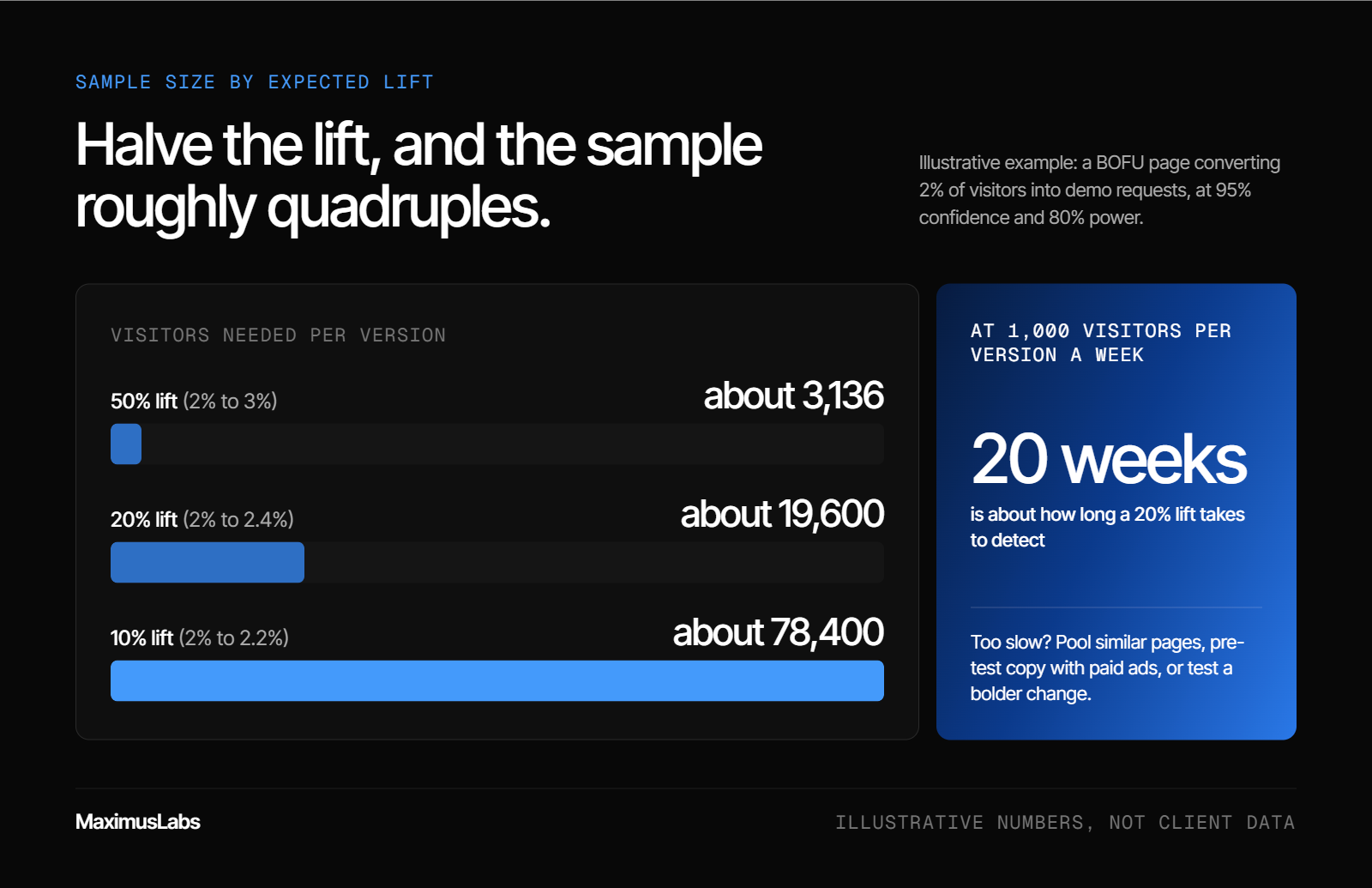
You need enough visitors or pages in each group to detect the lift you care about at your chosen confidence level. Smaller expected lifts need far larger samples. Fix the sample size and duration before launch, and run full weekly cycles. If a page cannot reach that sample in a few weeks, pool similar pages or pre-test copy with paid ads. Otherwise, accept a directional sequential test.
The Situation: Every Test Needs Enough Data
📊 What "statistical power" means
Statistical power is a test's ability to spot a real effect when one exists. Low power means you will often miss real wins, or crown random noise as a winner. HubSpot's guide says to let tests build a real sample and to check significance before declaring a winner.
Eli Schwartz, author of Product-Led SEO, puts it plainly. Most sites cannot run statistically significant SEO A/B tests, because they lack a large and representative population to test on. I agree, and I think saying so out loud builds more trust than pretending otherwise.
The Complication: Small Lifts Need Huge Samples
⚠️ A worked example (illustrative numbers)
The numbers below are an illustrative example, not client data. Say a BOFU page converts 2% of visitors into demo requests. A common rule of thumb for 95% confidence and 80% power is: visitors per version ≈ 16 × p × (1 − p) ÷ (difference)².
| Lift you want to detect | New rate | Visitors needed per version |
|---|---|---|
| 50% (2% to 3%) | 3.0% | about 3,136 |
| 20% (2% to 2.4%) | 2.4% | about 19,600 |
| 10% (2% to 2.2%) | 2.2% | about 78,400 |
Now picture that page getting 2,000 visits a week, so 1,000 per version. Detecting a 20% lift would take about 20 weeks. Halve the lift you want to detect, and the sample roughly quadruples.
⏰ How long a test should run
Run in full weeks, so weekday and weekend behavior both count. Set the end date before launch, and stop there. Google also warns that running an experiment longer than needed can look like an attempt to mislead search engines. If a test needs months to reach significance, change the design instead of waiting.
The Resolution: Options for Low-Traffic Sites
✅ What to do when one page is not enough
- Pool similar pages. Apply one change across a group of pages with the same template and intent, and compare against a matched group.
- Pre-test copy with paid ads. Paid search gives you a randomized audience in one to two weeks for headline and CTA wording.
- Test bigger changes. A bold rewrite of the opening answer block is easier to detect than a one-word tweak.
- Accept directional results. On small sites, a controlled sequential test with trend lines is honest guidance, not proof.
💡 The honest limit for B2B blogs
Most B2B blogs cannot reach significance on a single post. That is fine. The goal is a decision you can defend, not a p-value you cannot reach.
MaximusLabs AI sets sample size and duration before any content experiment starts. The team says so when a single page cannot support a valid test. In that case, the team pools matched pages or treats the result as directional. Every result is then judged against pipeline signals, so a small site still gets decisions tied to revenue.
Q6. Which content elements are worth testing first?
Test the elements closest to the click and the conversion first. That means title tags, meta descriptions, intent modifiers such as "templates" or "examples," the opening answer block, and the primary CTA. These are small edits with measurable effects. Practitioner tests report a 12% organic click-through rate gain from rewritten titles and descriptions across 1,500 pages. Results vary by site, so test before rolling out.
Start Where the Click Happens
🎯 Why titles come first
The title tag is the first thing a searcher reads in Google, and it shapes the AI snippet too. It is also cheap to change and easy to roll back. That makes it the best first test for most content teams.
Click-through rate (CTR) is the share of searchers who see your result and click it. A small CTR change on a high-traffic page can be worth more than a full rewrite of a low-traffic one.
What Real Title Tests Show
📊 The 1,500-page test
Eric Enge describes a controlled test at RankHammer on a lead generation site with stalled CTR. The team used GPT-4 to rewrite titles and meta descriptions, then shipped them in batches of 10 pages for human review. The test group earned a 12% organic CTR increase over the unedited control group.
The batch size matters as much as the result. Small batches let a person catch a bad AI rewrite before it spreads across hundreds of URLs.
⭐ Intent modifiers
Ethan Smith describes a simpler lever. His team audited search queries and found that buyers added words like "templates" and "examples." Adding those modifiers to existing titles and H1s produced traffic lifts of 12% to 25% or more on plateaued pages.
Why You Must Test, Not Copy
⚠️ The same change can win or lose
SearchPilot, which publishes its SEO split test results, shows how context-dependent this is. Shortening title tags and removing keywords produced an 11% organic traffic uplift on one site. Removing numbers from article titles had a negative impact on organic traffic in another test.
So a "best practice" from someone else's site is a hypothesis for yours. It is not a rule. The GEO study from KDD 2024 also found that keyword stuffing performed worse than unedited content in AI answers.
Then Move Down the Page
💰 Intros, answer blocks, and CTAs
After titles, test the parts that move readers toward revenue:
- The opening answer block: a direct 40 to 80 word answer under the heading.
- The primary CTA: wording, placement, and offer, such as a demo versus a template.
- Proof placement: whether a data point near the CTA lifts conversions.
My bias is clear here. Test BOFU pages first. A lift on a TOFU post rarely moves pipeline, while a small gain on a pricing or comparison page often does.
MaximusLabs AI starts content tests on BOFU and MOFU pages, where buyers decide. Title, answer block, and CTA tests run in small, human-reviewed batches. Each result is checked against qualified conversions before rollout, because a click lift that brings the wrong buyer is not a win.
Q7. How do you split test content without hurting SEO?
Google says content tests are fine if you follow four rules. Never show Googlebot different content than users. Add rel=canonical from variant URLs to the original, and use 302 rather than 301 redirects for temporary variants. End tests once you have an answer, then remove test URLs and scripts. Overly long experiments can be read as deceptive, so serve crawlers one stable canonical version.
The Rules Come From Google Itself
✅ Google's own guidance
Google Search Central publishes a page called "Minimize A/B testing impact in Google Search." It is short and clear, and it is the only source on this topic that matters for rankings. Everything below follows it.
Rule 1: No Cloaking
❌ What cloaking means
Cloaking is showing search engines one version of a page and users another. Google says this breaks its spam policies, whether you are running a test or not. The penalty can be a demotion or removal from search results.
In practice, this means your testing tool must treat Googlebot like any other visitor. Never write a rule that sends crawlers to the "safe" version by default.
Rule 2: Use Canonical Tags and 302 Redirects
⚠️ Handling alternate URLs
If your test uses separate URLs for each variant, add a rel=canonical tag on each variant pointing to the original page. A canonical tag tells Google which URL is the main version. Google recommends this over a noindex tag, which can have unwanted side effects.
If you redirect users from the original URL to a variant, use a 302 redirect, which signals a temporary move. A 301 redirect signals a permanent move and can transfer the original's ranking signals to the test page.
💡 The static canonical safeguard
When you run JavaScript or cookie-based variants, make sure crawlers always receive one stable, canonical version of the page. This keeps Google from indexing several versions of the same content.
Rule 3: End the Test and Clean Up
⏰ Duration and cleanup
Google warns that experiments running longer than needed can be read as an attempt to deceive. Once you have your answer, update the site with the winning version. Then remove alternate URLs, test scripts, and test markup as soon as you can.
The SEO-Safe Testing Checklist
| Check | What to do |
|---|---|
| Same content for crawlers and users | Never special-case Googlebot |
| Variant URLs | rel=canonical to the original |
| Redirects | 302, never 301, during the test |
| End date | Set before launch, then stop |
| Cleanup | Remove test URLs, scripts, and markup |
Here's how I think about it. SEO best practices are now the basics for GEO. A broken test setup does not just risk Google rankings. It can confuse every AI engine that reads your pages through search results.
MaximusLabs AI checks every content test against Google's testing guidance before launch. That means one version for crawlers, canonical tags on variants, 302 redirects, and a fixed end date. After the test, the team removes test URLs and scripts. This protects the search foundation that Answer Engine Optimization (AEO) builds on.
Q8. How do you A/B test content for AI search citations?
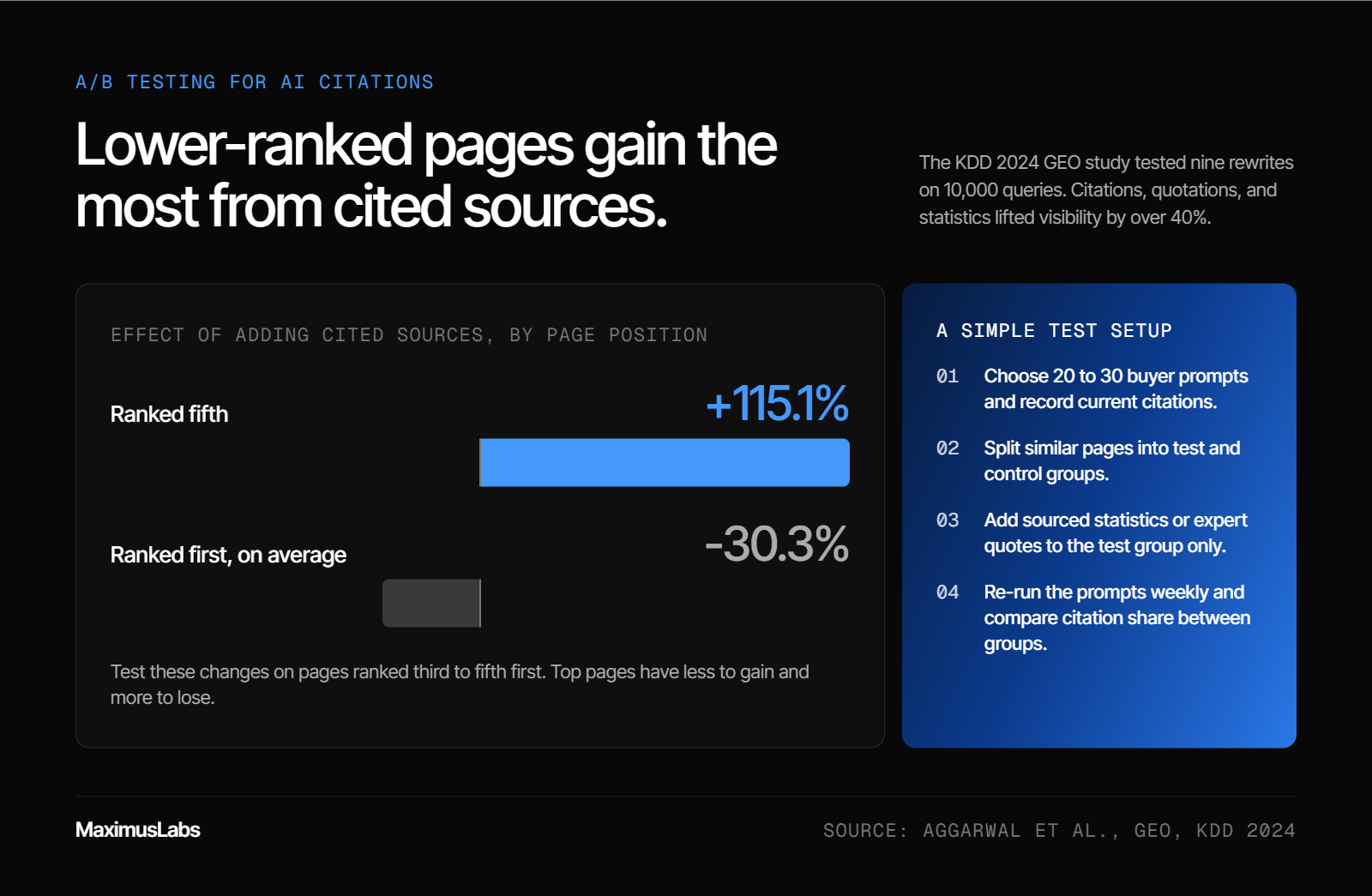
To test content for AI citations, track a fixed set of buyer prompts across ChatGPT, Perplexity, Gemini, and Google AI Overviews. Apply one change, such as adding sourced statistics or quotes, to a test group of pages. Keep a matched control group untouched. The KDD 2024 GEO study found such changes lifted visibility by over 40%, with larger gains for lower-ranked pages. MaximusLabs AI measures share of voice, not single ranks.
The Situation: Clicks Are Shrinking
📊 What the CTR data shows
Seer Interactive studied over 3,100 queries and found a 61% drop in organic CTR on queries with AI Overviews. Ahrefs found a 58% drop in clicks to the top organic result in its December 2025 data. A test that only measures clicks now measures a shrinking slice of attention.
There is a second finding in Seer's work. Brands cited inside AI Overviews earned 35% higher organic CTR than those not cited. Seer's authors caution that this is a correlation, since stronger brands may simply get cited more.
The Complication: Citations Are a Different Metric
🎯 Become the answer
In AI search, there is no page 2. A buyer gets one answer with a handful of brands, and you are either in it or invisible. So the question for a content test becomes: did this change make AI engines cite us more often?
That needs a fixed prompt set. Pick the questions your buyers actually ask, run them on each engine on a set schedule, and record which pages get cited.
The Resolution: Test Like the GEO Researchers Did
✅ How the KDD 2024 study worked
Pranjal Aggarwal and colleagues built a benchmark of 10,000 queries and tested nine content rewrites against unmodified text. Adding citations, quotations, and statistics boosted source visibility by over 40%. That design, with a control and one change per test, is the model to copy.
⭐ The underdog effect
The most useful finding is who benefits. Adding cited sources raised visibility by 115.1% for pages ranked fifth in the search results. On average, visibility for the top-ranked page fell by 30.3%.
| Page position | Effect of adding cited sources |
|---|---|
| Ranked fifth | Visibility up 115.1% |
| Ranked first | Visibility down 30.3% on average |
So test these changes on pages that rank third to fifth first. Your top-ranked pages have less to gain and more to lose.
💡 A simple test setup
- Choose 20 to 30 buyer prompts and record current citations.
- Split similar pages into test and control groups.
- Add sourced statistics or expert quotes to the test group only.
- Re-run the prompts weekly, and compare citation share between groups.
MaximusLabs AI tracks citation share across ChatGPT, Perplexity, Gemini, Claude, and Google AI, rather than a single rank. For Oliv AI, that approach produced a "64% AI citation rate in 6 months, vs ~30% for billion-dollar incumbents (Oliv AI)." The team then ties those citations to pipeline, because being cited is the means and revenue is the outcome.
Q9. Which metrics should decide the winning variant?
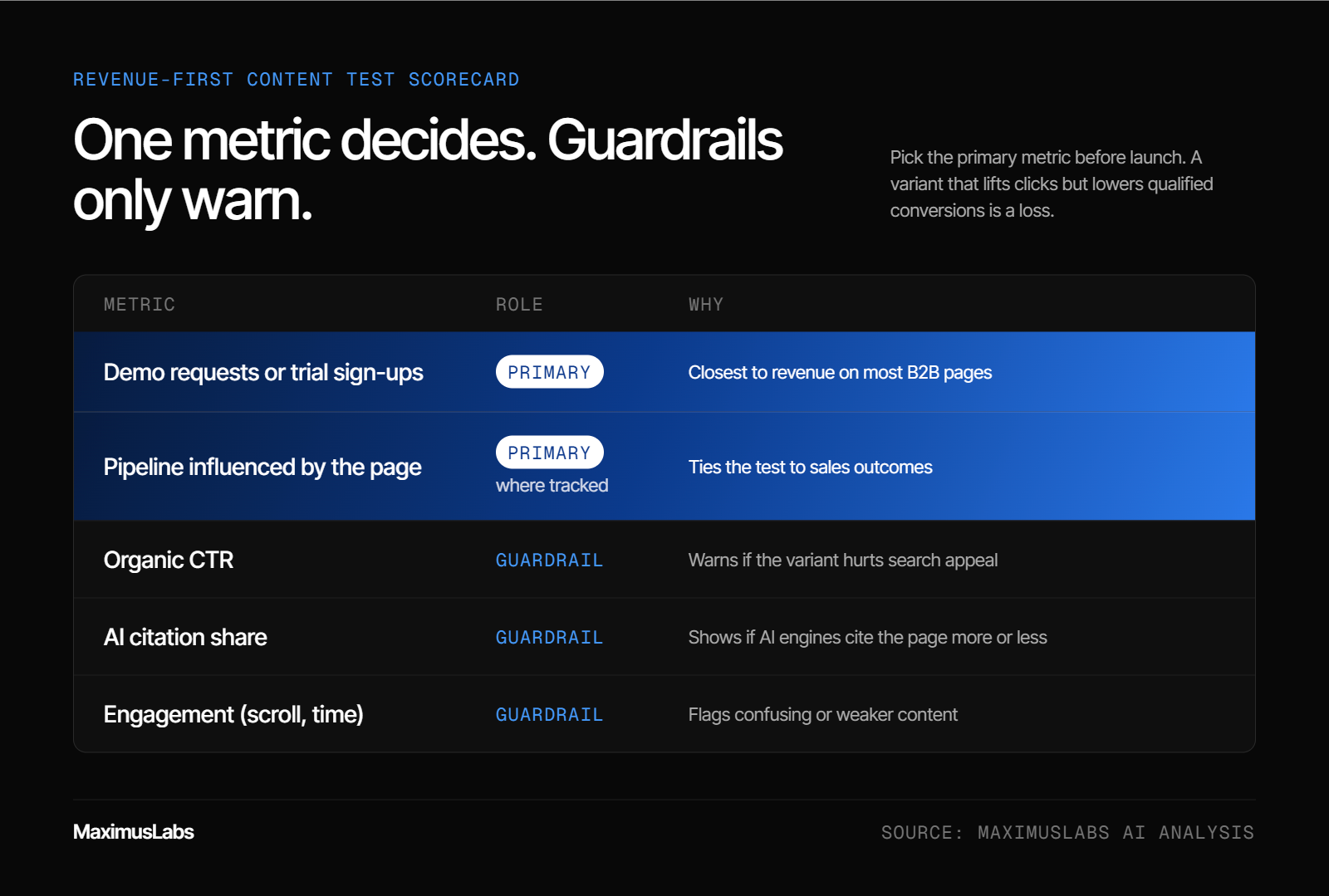
Pick one primary metric tied to revenue before launch, such as demo requests, sign-ups, or pipeline influenced by the page. Use click-through rate, AI citations, and engagement as secondary guardrails, not as the decision. A variant that lifts clicks but lowers qualified conversions is a loss. MaximusLabs AI scores content tests on pipeline, because clicks and impressions are vanity metrics when they do not move revenue.
The Situation: Dashboards Full of Green Arrows
📊 How content tests usually get judged
Most content teams judge a test by the number that moved most. Traffic went up, so the variant won. Time on page went up, so the new intro worked. These numbers are easy to pull and look good in a monthly report.
The trouble starts in the board meeting. Someone asks how many qualified buyers the "winning" page produced. Nobody has the answer, because nobody chose that metric before the test began.
The Complication: Clicks Are Not the Business
⚠️ The vanity metric trap
A vanity metric looks like progress but does not change revenue. Clicks, impressions, and pageviews are the usual suspects. A curiosity headline can lift clicks while pulling in readers who will never buy.
AI search makes this worse. Ahrefs found that AI Overviews cut clicks to the top organic result by 58% in December 2025. If clicks are falling for reasons outside your control, a click-based test can call a good page a loser.
💡 Why AI traffic changes the math
In my view, AI search traffic arrives more pre-sold than classic search traffic. The buyer has already asked ChatGPT or Perplexity their questions, and the AI has already named a short list. So the quality of each visit matters more than the volume.
The Resolution: A Revenue-First Scorecard
✅ One primary metric, a few guardrails
Choose one primary metric that decides the test. Then pick two or three guardrail metrics that warn you if something else breaks. Google Analytics 4 calls the actions you care most about "key events," which replaced the old "conversions" label in 2024. Set your primary metric up as a key event before the test starts.
| Metric | Role | Why |
|---|---|---|
| Demo requests or trial sign-ups | Primary | Closest to revenue on most B2B pages |
| Pipeline influenced by the page | Primary (where tracked) | Ties the test to sales outcomes |
| Organic CTR | Guardrail | Warns if the variant hurts search appeal |
| AI citation share | Guardrail | Shows if AI engines cite the page more or less |
| Engagement (scroll, time) | Guardrail | Flags confusing or weaker content |
💰 How to break a tie
If the primary metric is flat, do not let a guardrail crown a winner by itself. Keep the control, log the result, and move on to a bolder test. Seer Interactive found that brands cited in AI Overviews had 35% higher organic CTR, but it called this a correlation. Treat citation lifts as a promising signal, then confirm them with conversions.
MaximusLabs AI aligns every article with the ideal customer profile (ICP) and BOFU intent first, then judges content tests on pipeline signals. This is the Revenue-focused Answer Engine Optimization (RAEO) approach. For Oliv AI, it produced "27 qualified leads, $47K+ pipeline, 26% close rate in 4 months (Oliv AI)." A traffic lift that adds no qualified buyers changes nothing.
Q10. How do you turn one winning test into a repeatable testing program?
Turn wins into a program by reproducing each result on a second, independent page group before sitewide rollout. Keep a log of every hypothesis and outcome. Focus tests on the small share of pages that drive most traffic and revenue. Many tactics work once and fail the second time, so reproduction separates real levers from luck.
Focus Where the Value Is
⭐ The 5% rule
Ethan Smith, CEO of Graphite, describes a power law in content results. Most strategies do not work, and most landing pages drive little traffic. A small share of pages, often around 5%, drives most of the traffic and business impact.
That should shape your test calendar. Run your tests on the pages that already earn buyers' attention, such as pricing, comparison, alternatives, and high-intent guides. A 10% lift on a top page is worth more than a 50% lift on a page nobody reads.
Reproduce Before You Roll Out
⚠️ Why one win is not enough
Ethan Smith also warns that a tactic often works the first time and fails the second. A single win can come from timing, a lucky sample, or a quiet competitor. Before you trust a result, run the same change on a second, separate group of pages.
SearchPilot's public tests show why this matters. One site gained 11% organic traffic from shorter titles with fewer keywords. Another test, removing numbers from article titles, hurt organic traffic. Title changes are not universal rules, so each new site or template needs its own proof.
✅ A simple reproduction rule
- Win on group A against its control.
- Repeat the same change on group B, with a fresh control.
- Roll out site-wide only if both groups show the same direction.
- If group B disagrees, log both results and treat the tactic as unproven.
Build the Test Log
📊 What to record for every test
The test log is the memory of your program. Record these fields every time:
- Hypothesis: "If we change X, Y improves, because Z."
- Test unit: users, pages, or AI answers.
- Primary metric and guardrails: chosen before launch.
- Dates and sample size: planned and actual.
- Result: win, loss, or inconclusive, with the numbers.
- Reproduced: yes, no, or pending.
⏰ Set a steady cadence
Run one or two tests at a time on separate page groups, so they do not overlap. Review the log once a month, and kill ideas that fail twice. Over a year, the log becomes a playbook built on your own buyers, not someone else's blog post.
Here's what I believe. Brand is the real moat, and testing is how you make brand work measurable. Each logged test tells you what your buyers and the AI engines that serve them actually reward.
MaximusLabs AI runs content through a research, writing, and QA pipeline with a 10-dimension quality scorecard. Each test result feeds that documented standard rather than ending as a one-off win. The team experiments daily, tracking citations and trust signals across AI engines, and keeps only the changes that hold up twice.
What I'm Thinking About Next
My hypothesis is that content testing will split into two tracks over the next two years. One track will keep testing for human readers: clicks, sign-ups, and demos. The other will test for AI engines: which version of a page ChatGPT, Perplexity, and Gemini choose to cite.
I might be wrong about the timing. But I am fairly sure the teams that win will run both tracks against the same revenue scorecard. A page that gets cited but never converts is just free research for your competitors.
If you are running content tests now, I would love to hear what surprised you. Which change moved pipeline, and which "best practice" failed on your site? Send it to krishna@maximuslabs.ai.
Questions, answered
7 questionsDoes A/B testing content hurt SEO?
A/B testing content does not hurt SEO when you follow Google's published testing guidance. The risk comes from setup mistakes, not from testing itself. We follow four rules on every test: • No cloaking. Googlebot must see the same content a user sees. Showing crawlers a different version breaks Google's spam policies. • Canonical tags on variants. If a variant lives on its own URL, point a rel=canonical tag back to the original page. • 302 redirects, not 301. A 302 signals a temporary move. A 301 signals a permanent one and can shift ranking signals to the test page. • A fixed end date. Google warns that experiments running longer than needed can look deceptive. Once a test ends, ship the winner and remove test URLs, scripts, and markup. We treat this cleanup as part of the test, not an afterthought. If you are unsure whether your current setup is safe, a technical SEO audit will show stray variant URLs, redirect chains, and duplicate pages before they cause damage. A safe test setup protects the search foundation that AI answer engines also read from.
How long should a content A/B test run?
A content A/B test should run until it reaches the sample size you set before launch, in full weekly cycles. There is no fixed number of days that works for every page. We set three things before any test starts: • The lift we want to detect. Smaller lifts need far larger samples. • The sample size. For an illustrative page converting 2% of visitors, detecting a 20% lift needs about 19,600 visitors per version. • The end date. We write it in the test log and hold to it. Full weeks matter because weekday and weekend readers behave differently. Stopping early is the most common mistake. Early results swing widely, so a lift on day four is usually noise. Duration also has an upper limit. Google warns that experiments running longer than needed can be read as deceptive. If a test would need months to reach significance, change the design instead, for example by pooling similar pages. To decide what you measure across that window, see our guide to GEO metrics and KPIs.
What is the difference between A/B testing and SEO split testing?
A/B testing and SEO split testing answer different questions, because they test different audiences. • A/B testing (user-level) shows version A to some visitors and version B to others, usually with JavaScript or cookies. It measures reader behavior, such as clicks, sign-ups, and demo requests. • SEO split testing (page-level) changes a group of similar pages and leaves a matched group untouched. It measures how search engines respond, such as rankings and organic traffic. The key point is that a user-level test says nothing about rankings. Googlebot sees one version of each URL, so it cannot respond to a split it never sees. Page-level tests solve this by comparing whole page groups that live through the same algorithm updates and seasons. We pick the design from the audience first. If the change is for readers, we test users. If it is for search engines or AI crawlers, we test pages. Small sites without enough similar pages can use a controlled sequential test, but the result is directional only. For the basics of how rankings work, start with what SEO is and how it works.
Can you A/B test content on a low-traffic B2B site?
Yes, but usually not one page at a time. Most B2B blog posts cannot reach statistical significance on their own traffic, and we think saying so honestly matters more than faking a result. MaximusLabs AI uses four options when a single page cannot support a valid test: • Pool similar pages. Apply one change across pages with the same template and intent, then compare against a matched control group. • Pre-test copy with paid ads. Paid search gives a randomized audience in one to two weeks for headline and CTA wording. • Test bigger changes. A bold rewrite of an opening answer block is easier to detect than a one-word tweak. • Accept directional results. A controlled sequential test, read against sitewide trend lines, still guides decisions. We also start on BOFU pages, such as pricing, comparison, and alternatives pages, where a small lift moves pipeline. A low-traffic site does not need more experiments. It needs fewer, better-chosen ones tied to revenue. Our content marketing work follows the same rule: BOFU first, then MOFU.
How do you test whether content gets cited by AI search engines?
You test AI citations the same way you test anything else: a control group, one change, and a fixed measurement. MaximusLabs AI runs citation tests in four steps: • Pick 20 to 30 buyer prompts and record which pages ChatGPT, Perplexity, Gemini, and Google AI Overviews cite today. • Split similar pages into a test group and a matched control group. • Add one change to the test group only, such as sourced statistics or expert quotes. • Re-run the prompts weekly and compare citation share between the groups. The design mirrors the KDD 2024 GEO study, which tested content rewrites against unmodified text across 10,000 queries. It found that adding citations, quotations, and statistics lifted visibility by over 40%. The gains were largest for lower-ranked pages, so we test pages ranked third to fifth first. We track share of voice across many prompts, not one rank, because AI answers vary from run to run. Tools can help with the tracking, and our comparison of ChatGPT tracking tools covers the options.
What should you A/B test first on a blog post?
Start with the elements closest to the click and the conversion. They are cheap to change, easy to roll back, and have measurable effects. We test in this order: • Title tag. It shapes clicks in Google and how AI engines frame the page. • Meta description. It supports the title in search results. • Intent modifiers. Words buyers add, such as "templates" or "examples," can lift traffic on plateaued pages. • Opening answer block. A direct 40 to 80 word answer under the heading. • Primary CTA. Its wording, placement, and offer. Results vary by site. SearchPilot's public tests show that shortening titles helped one site, while removing numbers from article titles hurt another. So treat any best practice as a hypothesis for your own pages. Avoid keyword stuffing. The KDD 2024 GEO study found it performed worse than unedited content in AI answers. If you need help drafting variants, our free AI content optimizer is a useful starting point. Review AI drafts in small batches before they ship.
Which metric should decide the winner of a content A/B test?
One primary metric tied to revenue should decide the winner, and you should choose it before launch. For most B2B pages, that means demo requests, trial sign-ups, or pipeline influenced by the page. MaximusLabs AI uses a simple split: • Primary metric: the revenue outcome that decides the test. • Guardrails: organic CTR, AI citation share, and engagement. These warn you if a variant breaks something, but they never crown a winner alone. A variant that lifts clicks but lowers qualified conversions is a loss. Clicks are also falling for reasons outside your control. Ahrefs measured a 58% drop in clicks to the top organic result when AI Overviews appear, so a click-only test can call a good page a loser. In Google Analytics 4, set your primary metric up as a key event before the test starts. If the primary metric is flat, keep the control and log the result. We judge every content test on pipeline signals, because a traffic lift that adds no qualified buyers changes nothing. Our guide to measurement and metrics in GEO goes deeper on revenue-first tracking.