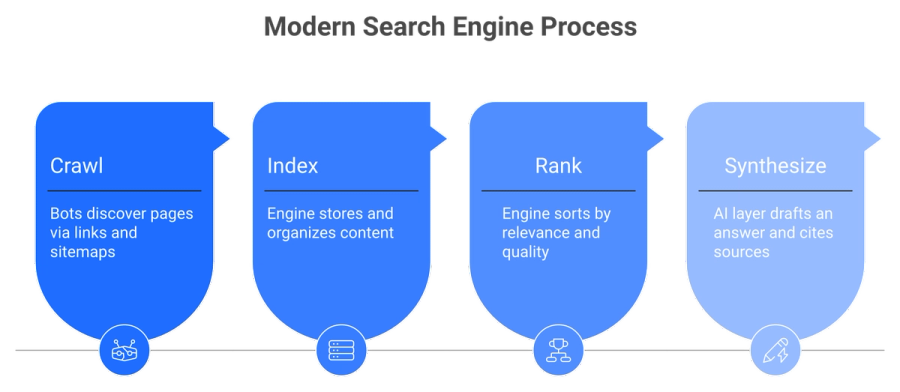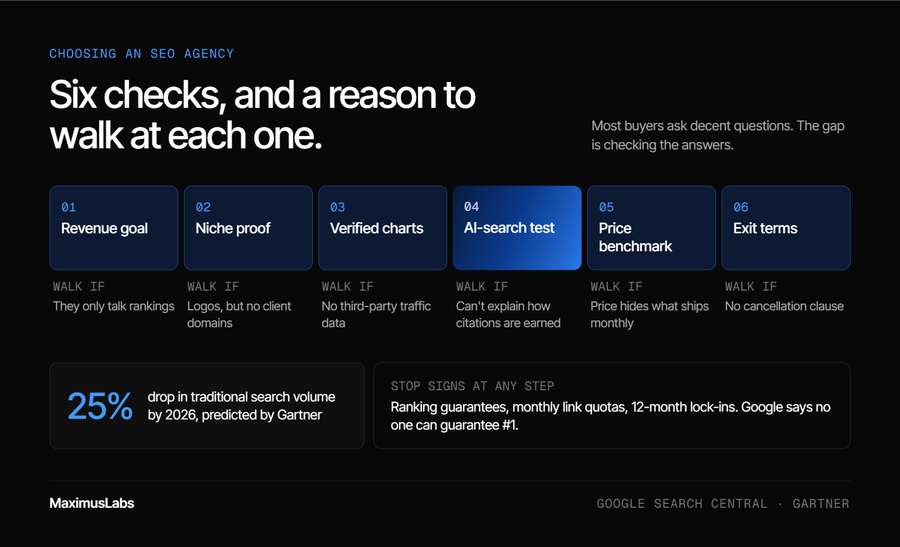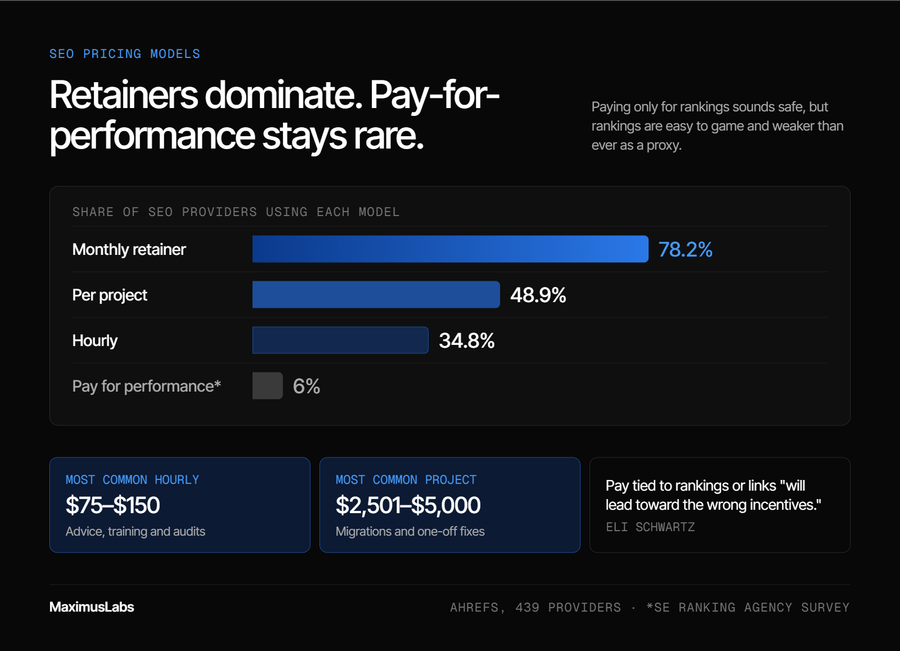
- Search intent is the goal behind a query, and Google rewrites queries into that intent, so a page must match what the searcher wants or it will not rank.
- The four classic types plus local and generative intent are useful vocabulary, but a single label hides mixed intent and how intent drifts within a session.
- Google's query fan-out and Bing's GPT-4 query expansion mean engines answer many sub-questions, so pages should cover the follow-ups buyers ask next.
- A 30-second audit of modifiers, top results, SERP features, and AI answer sources reveals the format to match, and no optimization fixes a content type mismatch.
- AI Overviews cut top-result clicks by more than half, so informational content works as a citation play while BOFU commercial pages drive B2B pipeline.
- Measure intent fit by share of voice in AI answers, next-step rate, and assisted conversions; Oliv AI reached a 64% AI citation rate in 6 months.
A Head of Content opens the quarterly report. Their best guide is 2,800 words long, took six weeks to make, and is sitting on page four. They search the keyword themselves and see the problem in ten seconds. Google is showing calculators and product pages, and ChatGPT answers the question without citing anyone. The guide was never going to rank, however well it was written.
I have watched this happen to smart teams more often than I would like to admit. The guide was fine. It was simply the wrong page for what the searcher wanted.
This article explains search intent the way it works now. Google rewrites queries, AI engines split them into sub-questions, and the real goal is to become the answer, not just to rank for it.
Q1. What is search intent, and why does it decide whether you rank or become the AI answer?
Search intent is the goal behind a query: what the person wants to know, do, compare, or buy. Google and AI engines rank and cite the content that meets that goal fastest. Google rewrites queries into their underlying intent, so you cannot force a keyword to rank. A page either matches what the searcher actually wants, or no amount of optimization saves it.
🎯 The plain definition
Take the query "CRM for startups." The words are about software, but the goal is a shortlist. The searcher wants options, rough prices, and a quick sense of fit. A product homepage fails that goal. So does a 3,000-word history of CRM.
Google's Search Quality Rater Guidelines turn this into a formal test called Needs Met. Human raters score how well a result satisfies the user's intent, on a scale from "Fails to Meet" to "Fully Meets." Google uses those ratings to evaluate its ranking systems. Intent is not an SEO theory. It is how the grader thinks.
📚 Where the idea came from
The first formal intent model came from Andrei Broder at AltaVista in 2002. He sorted web searches into navigational, informational, and transactional queries. His key finding was that informational queries made up less than half of all searches. Many people were trying to reach a site or get something done.
That model is more than twenty years old, and it still shapes most SEO advice. The definition holds up. The way engines act on it has changed completely.
⚠️ Why intent now beats keywords
Here's the thing most keyword checklists miss. Google does not search your exact words. Eli Schwartz led SEO at SurveyMonkey. In Product-Led SEO, he explains that Google translates a query into a different query that reflects what the user meant. Once that happens, keyword density stops being a lever. Either the content matches the intent or it does not.
This is why a page can be well optimized and still lose to a thinner page. The thinner page just answers the right question in the right format.
💸 The stakes when AI picks the sources
The cost of a mismatch has gone up. An Ahrefs study from December 2025 found that when an AI Overview appears, the top-ranking page gets about 58% fewer clicks. In ChatGPT or Perplexity, there is no page two. The engine cites a handful of sources, and everyone else is invisible.
MaximusLabs AI treats SEO best practice as the floor for Generative Engine Optimization (GEO), not the ceiling. In my view, intent fit is the first test both Google and large language models run. A page that fails it never reaches the trust or citation stage.
✅ What this means for your content plan
Start every brief with one question: what does this searcher want to walk away with? Then decide the page type before anyone writes a word. Keywords come after that, as vocabulary, not as strategy.
MaximusLabs AI starts every article with a search intent breakdown covering primary intent, secondary intent, and the reader's role before writing begins. The goal is not just a ranking. The goal is to become the answer an AI engine cites when a buyer asks a real question. That answer needs to lead somewhere near pipeline.
Q2. What are the types of search intent, and where does the four-type model break?
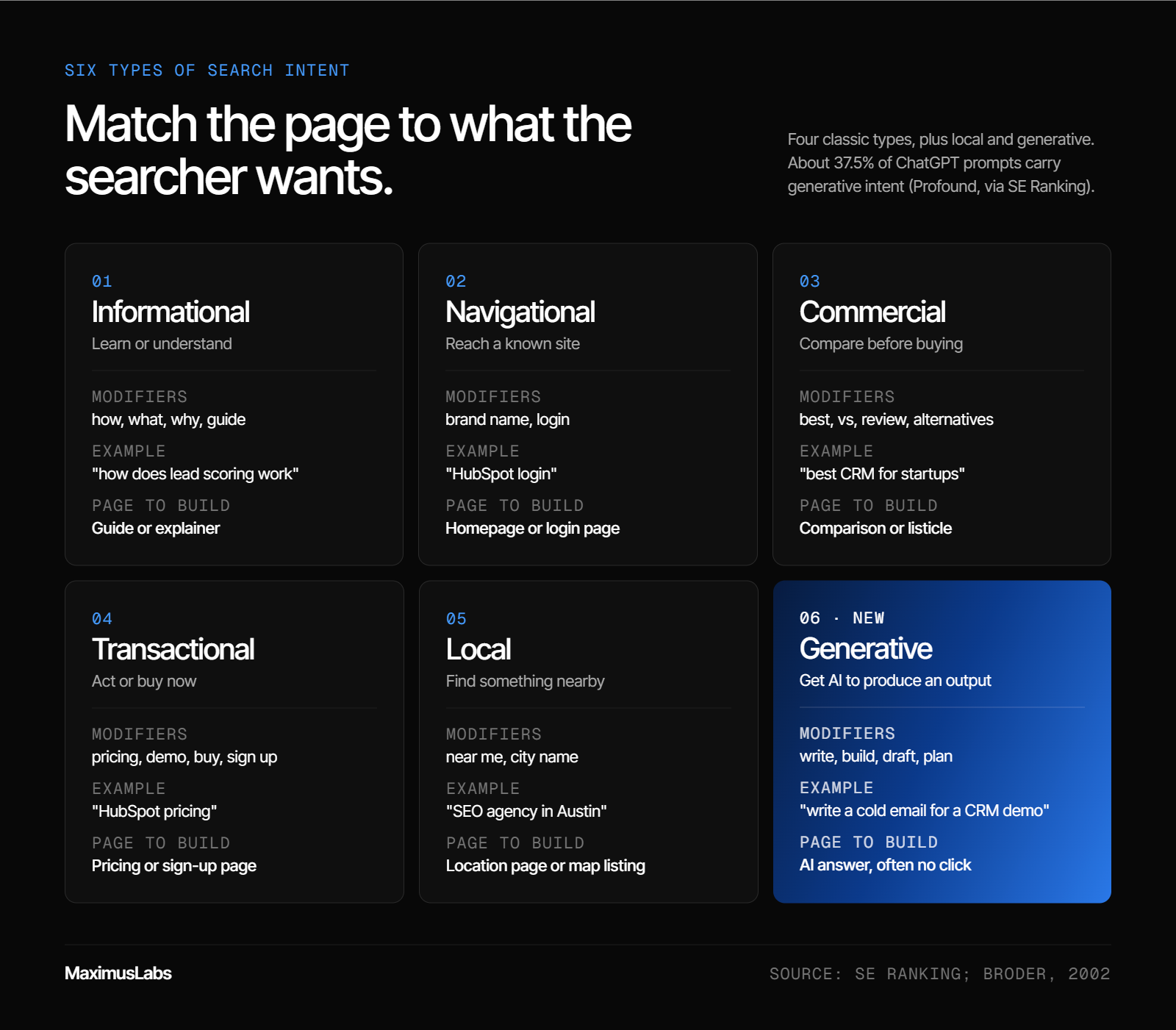
The four classic types are informational (learn), navigational (reach a site), commercial (compare before buying), and transactional (act or buy). Local intent and generative intent, where users ask AI to produce something, extend the list. The model breaks because most queries are a few words long, many carry mixed intent, and intent shifts within a single session.
📊 The six types at a glance
Most guides stop at four types. Two more are now worth tracking: local and generative. SE Ranking added generative intent to its framework in 2025 and defines it as prompts that ask AI to create, solve, or calculate something.
| Intent type | What the searcher wants | Typical modifiers | Example query | Page that satisfies it |
| Informational | Learn or understand | how, what, why, guide | how does lead scoring work | Guide or explainer |
| Navigational | Reach a known site | brand name, login | HubSpot login | Homepage or login page |
| Commercial | Compare before buying | best, vs, review, alternatives | best CRM for startups | Comparison or listicle |
| Transactional | Act or buy now | pricing, demo, buy, sign up | HubSpot pricing | Pricing or sign-up page |
| Local | Find something nearby | near me, city name | SEO agency in Austin | Location page or map listing |
| Generative | Get AI to produce an output | write, build, draft, plan | write a cold email for a CRM demo | AI answer, often no click |
🔍 How generative intent changes the picture
Generative intent is the newest type, and it is growing. SE Ranking, citing a study by Profound, reports that about 37.5% of ChatGPT prompts carry generative intent. That figure is secondary, so treat it as directional.
These prompts rarely send a click. The user wants an output, not a website. Your job here is to be the source the AI draws from, not the page it links to.
❌ Where the four buckets fall apart
The first problem is length. Most queries are only a few words long, so the engine has to guess what the searcher means. "CRM" alone could be a definition, a shortlist, or a login.
The second problem is mixed intent. "Best CRM pricing" is commercial and transactional at once. Google's raters are told to consider multiple intents for exactly this reason.
⏰ Intent moves during a session
The third problem is drift. A traveler might start with a navigational search for a booking site. Then they move to all-inclusive packages, then to specific resorts, then to local theme parks. One session, four intents.
B2B buyers do the same thing over weeks. They begin with a problem, move to solution categories, and end on vendor comparisons. A single label per keyword hides that whole journey.
💡 Use the types as vocabulary, not strategy
My contrarian take is simple. The four buckets are a 2002 framework built for ten blue links. They are useful words for a team to share. They are a poor way to plan revenue.
MaximusLabs AI maps every target query to an intent type, a buyer stage, and an answer surface. Surfaces include Google, AI Overviews, ChatGPT, and Perplexity. The type tells us what to build. The stage and surface tell us whether it can ever reach pipeline.
Q3. How do Google and AI engines actually decode intent today?
Google rewrites a query into what it thinks the user meant, then ranks pages against that intent. AI Overviews and AI Mode go further with query fan-out, which runs several related searches across subtopics. Large language models act as intent decoders. They turn vague prompts into precise retrieval queries, then score passages on one question: does this answer the intent?
🧩 Situation: search used to match strings
For years, search worked like a lookup table. You typed words, and the engine found pages containing those words. SEO followed that logic. Put the keyword in the title, the H1, and the first paragraph, and you had a fair shot.
That world rewarded repetition. It also produced a lot of pages that said the same thing in slightly different words.
🔄 Complication: the query you type is not the query they run
Modern engines rewrite before they retrieve. Microsoft launched Bing Deep Search in December 2023. It uses GPT-4 to expand a query into a fuller description of what ideal results should include. For ambiguous queries, it identifies the possible intents and writes a description for each one.
Google's AI features work in a similar spirit. Google's documentation says AI Overviews and AI Mode may use "query fan-out," issuing multiple related searches across subtopics and data sources. One question becomes many.
🤖 How passage scoring decides the winner
After rewriting comes retrieval, and then scoring. The engine pulls candidate passages and ranks them by how well each one answers the decoded intent. Bing says the biggest ranking factor in Deep Search is how well a page matches that expanded description.
Practitioner Mark Williams-Cook describes large language models as universal intent decoders. However a user phrases the prompt, the model works out what to search for. The passage is the unit that wins or loses, not the page.
⚙️ Why I call this a data science problem
MaximusLabs AI's view is that GEO is closer to a data science problem than an extension of SEO. The retrieval step is where optimization actually happens. If your passage never gets retrieved for the decoded intent, nothing downstream matters.
I might be wrong about how much weight each engine gives to each signal. Nobody outside these companies knows the exact numbers. But the direction is clear across both Google's and Microsoft's own documentation.
✅ Resolution: write for the sub-questions
If engines fan one query out into many, your page has to answer the many. Start by listing the sub-questions a buyer would ask next. For "CRM for startups," that means pricing, integrations, setup time, and migration.
Then give each sub-question its own clearly labeled block with a direct answer near the top. That gives the scorer a passage it can lift cleanly.
MaximusLabs AI builds prompt sets across ChatGPT, Claude, Perplexity, and Gemini for each target topic. It then maps which sources each engine cites. That shows which sub-intents the engines actually retrieve, so the content covers what gets cited, not what we guess.
Q4. How do you identify the search intent of a keyword in 30 seconds?
Read the modifiers first: how, best, vs, price, near me. Then search the keyword and note what ranks: guides, listicles, tools, or product pages. Check SERP features such as AI Overviews and People Also Ask. Then ask ChatGPT or Perplexity the same question and see which sources they cite. The dominant format across both is the intent you need to match.
⏰ The four checks, in order
This audit takes about 30 seconds per keyword once you have done it a few times. Run it before any brief gets written.
- Read the modifiers. "How" and "why" point to informational intent. "Best," "vs," and "alternatives" point to commercial. "Pricing," "demo," and "buy" point to transactional. "Near me" points to local.
- Scan the top results. Note the page type that dominates: guides, listicles, tools, category pages, or product pages. If seven of ten are listicles, the intent is a shortlist.
- Read the SERP features. An AI Overview, People Also Ask box, shopping row, or map pack each tells you something about the intent.
- Ask the AI engines. Put the same question to ChatGPT and Perplexity. Note which sources they cite and what format those sources use.
🔍 What SERP features tell you
SERP features are Google's own hints about intent. People Also Ask (PAA), the box of related questions, signals that searchers have follow-up questions to answer. A map pack signals local intent. Shopping results signal a transactional query.
An AI Overview usually means Google sees the query as informational and answerable in place. That matters for your click expectations, as covered later in this article.
⚠️ Why tools miss intent
Keyword tools label intent automatically, and those labels are a useful start. But they read patterns in the words, not the live results. They also cannot see how Google has recently reclassified a query.
Google's raters are trained to judge intent by context, including whether a query is a Know, Do, Website, or Visit-in-Person query. That kind of reading still needs a human looking at the page.
📉 The SurveyMonkey lesson
Eli Schwartz tells a story from his time at SurveyMonkey. Rankings slipped for head terms like "take survey." The tools suggested a technical problem. A manual look at the results showed something else. Google had decided searchers wanted sites that pay them to take surveys, not tools to build surveys.
No technical fix could change that. His conclusion was that tools are helpful, but human judgment catches what they miss.
✅ Make the AI check a habit
The fourth check is the one most teams skip. Google, ChatGPT, and Perplexity often cite different sources for the same question. Each engine has its own sense of what is trustworthy and useful.
MaximusLabs AI runs this check across ChatGPT, Claude, Perplexity, and Gemini as part of its AI source analysis for every target topic. The cited URLs show the format and depth each engine rewards. That tells our team what to build before the first draft starts, which is where intent mistakes are cheapest to fix.
Q5. What happens when your content type does not match the intent?
A content type mismatch means you built the wrong kind of page for the query. If the results show tools or category pages and you publish a 2,000-word blog post, it will not rank, however well it is optimized. Match three things: content type (blog, product, category, or tool), format (guide, list, or comparison), and angle (fast, beginner, or current year). Keep key content in visible text, not hidden behind tabs.
🧩 Situation: the brief looked perfect
Most mismatches start with a good brief for the wrong page. The keyword has volume, and the writer is strong. Everyone assumes a long, thorough guide is the safe choice.
Then the page stalls on page three. The team tweaks titles and builds links. Nothing moves, because the problem was never quality.
❌ Complication: you cannot optimize your way out
A blunt rule I share with every content team: no amount of optimization fixes a content type mismatch. If Google shows calculators for a query, it has decided searchers want to calculate something. Your essay about the formula does not answer that need.
The same logic applies in AI search. When ChatGPT answers "best CRM for startups," it builds a shortlist from comparison pages and third-party reviews. A vendor's feature page rarely makes that list, because it is the wrong type of source.
📐 The three things to match
Ahrefs breaks intent fit into what it calls the three Cs. MaximusLabs AI uses a version of the same check in every brief.
| What to match | What it means | Example for "best CRM for startups" |
| Content type | The kind of page | Comparison listicle, not a product page |
| Content format | How the page is built | Ranked list with a table, not an essay |
| Content angle | The hook that wins the click | "For teams under 20," "2026 pricing" |
Get the type wrong and nothing else matters. Get the angle wrong, and you lose the click to a sharper competitor.
⚠️ Hidden content is invisible content
There is a quieter mismatch that many teams miss. Content behind tabs, accordions, or client-side filters often goes unseen. Google's Gary Illyes has explained, in a conversation with Eric Enge, that on a single URL Google typically sees only the default content. Anything a user has to click to reveal may not count toward intent.
Google's own guidance for AI features says to keep important content in text form. If your pricing table loads only after a click, an AI engine may never read it.
✅ Resolution: a fix checklist before you write
MaximusLabs AI matches the dominant format before a single word gets written. Here is the checklist:
- Confirm the page type. Do the top results show guides, listicles, tools, or product pages?
- Match the format. If most results use a ranked list with a table, build one.
- Pick an angle. Find the gap in the top titles, such as a role, a team size, or a year.
- Expose key facts. Put prices, specs, and comparisons in plain HTML text, not behind clicks.
- Check AI answers. Note which source types ChatGPT and Perplexity cite for the query.
💡 Sometimes the fix is a different asset
MaximusLabs AI treats a mismatch as a strategy call, not a writing problem. When the intent calls for a calculator or a comparison page, that is what gets built.
Q6. How does search intent change inside ChatGPT, Perplexity, and AI Overviews?
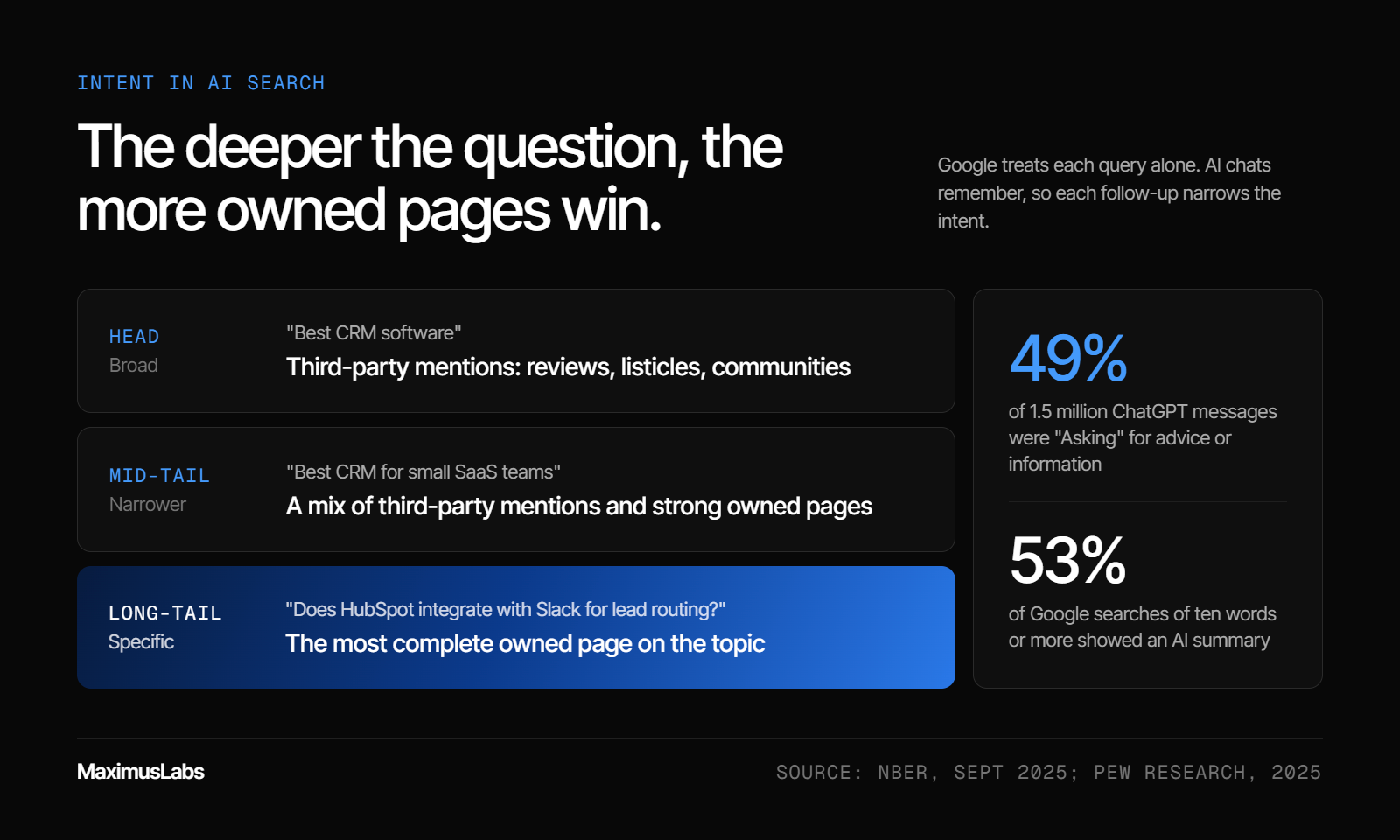
Google treats each query as a separate event. ChatGPT and Perplexity keep the conversation going, so intent builds across follow-ups about integrations, compliance, and fit. Prompts are longer and more advisory: about half of ChatGPT messages ask for advice or information. Broad head questions get answered mostly from third-party sources. Long-tail questions reward the most complete owned page.
🔄 Situation: search was stateless
Classic search is stateless, which means each query stands alone. Google does not carry your last search into the next one the way a conversation does. A buyer who searches "CRM for startups" and then "HubSpot vs Pipedrive" starts fresh each time.
That shaped how we wrote content. One keyword, one page, one intent. The searcher did the joining up in their own head.
🧠 Complication: AI conversations remember
ChatGPT, Perplexity, and Gemini are stateful. They keep the context of the conversation. A buyer can ask for a CRM shortlist, then ask which ones integrate with Slack, then ask about SOC 2 compliance.
Each follow-up narrows the intent. By the third or fourth turn, the question is specific enough that only a few pages in the world answer it well.
📊 What advisory intent looks like
The best data on this comes from OpenAI and NBER researchers. Their September 2025 working paper analyzed 1.5 million ChatGPT conversations. They found that 49% of messages were "Asking," where people use ChatGPT as an advisor to get information or guidance.
That is a different intent from a Google keyword. The user is not looking for a page. They want a recommendation they can act on.
⏰ Longer questions, more AI answers
Prompts also run longer. MaximusLabs AI's working estimate is that the average AI chat query runs about 25 words. Compare that with the few words most people type into Google.
Length changes what Google does too. Pew Research found that AI summaries appeared on about one in five Google searches in March 2025. For searches of ten words or more, that share rose to 53%.
🎯 Resolution: match content to question depth
Krishna Kaanth's framework sorts AI questions into three types. Each type calls for a different content play.
| Question type | Example | What wins the citation |
| Head (broad) | "Best CRM software" | Third-party mentions: reviews, listicles, communities |
| Mid-tail | "Best CRM for small SaaS teams" | A mix of third-party mentions and strong owned pages |
| Long-tail | "Does HubSpot integrate with Slack for lead routing?" | The most complete owned page on the topic |
⚖️ Owned content vs earned mentions
This is where teams argue, and both sides are partly right. For broad head terms, AI engines lean on third-party publishers, so earned mentions matter most. For specific long-tail questions, your own documentation and guides often become the answer.
MaximusLabs AI runs two tracks for this reason. Owned work makes your pages the answer to long-tail questions. Earned work places the brand in the reviews, Reddit threads, and listicles AI trusts for head terms. Most teams only do the first, so they never appear in the broad answers that shape the shortlist.
Q7. Which search intents actually drive pipeline for B2B SaaS?
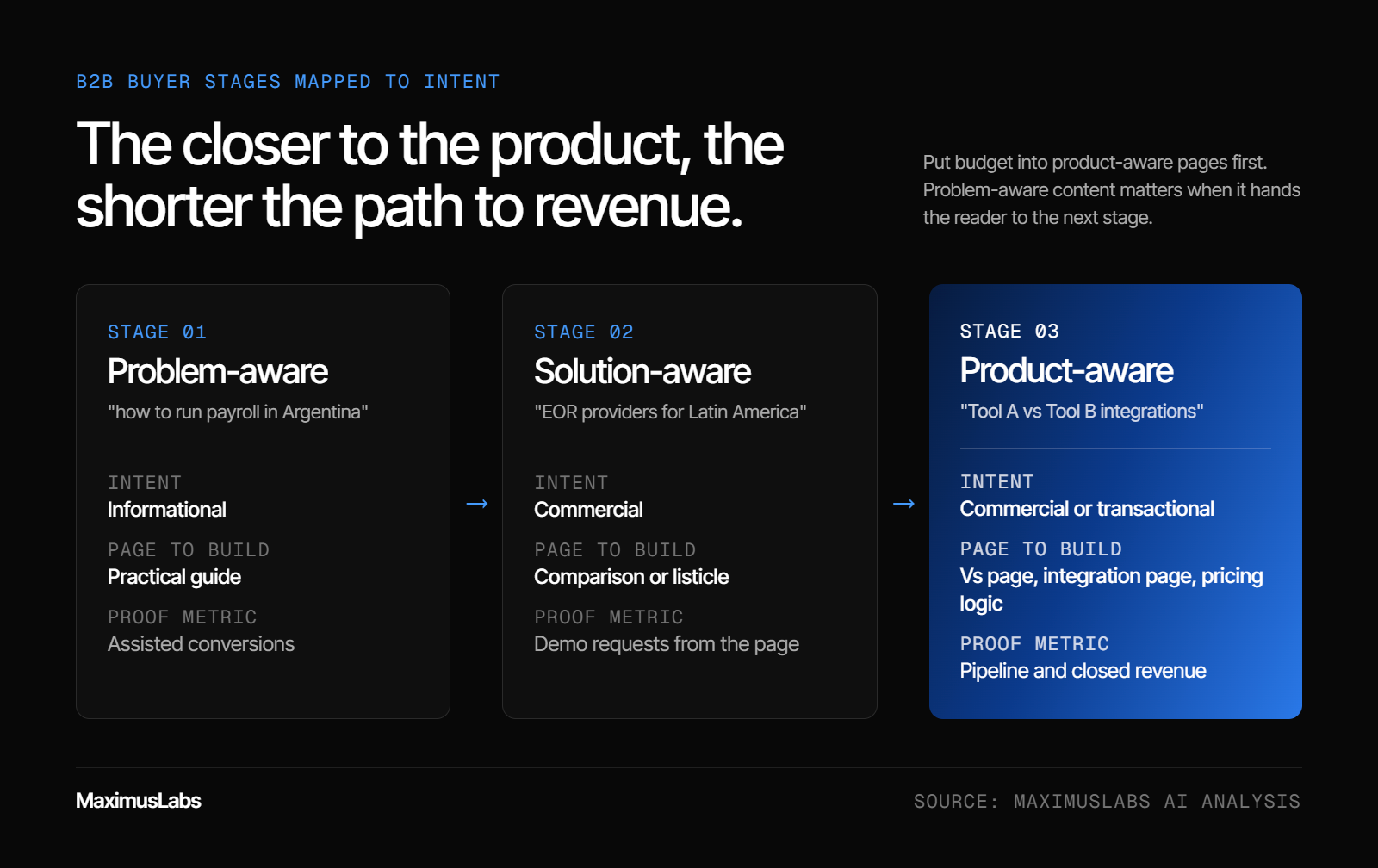
Commercial and transactional intent drive pipeline because the buyer is already comparing options or ready to act. MaximusLabs AI builds content BOFU (bottom of funnel) first: comparisons, integrations, pricing logic, and use cases tied to the ICP (ideal customer profile). AI engines already answer most "what is" questions without a click. Informational content earns its place only when it answers the follow-up questions buyers ask before shortlisting.
🎯 The awareness stages that matter
B2B buyers move through three stages. Each stage carries a different intent and needs a different page.
| Stage | Example query | Intent | Page to build | Metric that proves it |
| Problem-aware | how to run payroll in Argentina | Informational | Practical guide | Assisted conversions |
| Solution-aware | EOR providers for Latin America | Commercial | Comparison or listicle | Demo requests from the page |
| Product-aware | Tool A vs Tool B integrations | Commercial or transactional | Vs page, integration page, pricing logic | Pipeline and closed revenue |
The closer a query sits to the product-aware stage, the shorter the path to revenue. That is where budget should go first. Problem-aware content still matters, but only when it hands the reader to the next stage.
💸 Why glossaries rarely pay
Ethan Smith, CEO of Graphite, makes a point I agree with. He says he would spend almost no time on glossary definitions and low-intent content. His focus is the end and middle of the buyer journey.
The logic is simple. AI engines answer "what is X" in place, so there is little to click. The searcher also has no buying intent yet. That is two strikes against one page.
⏰ B2B intent takes time
B2B buying is slow and involves many people. HR, Legal, Finance, and the end user may all weigh in. A single visit rarely turns into a purchase.
This is why last-click attribution misleads B2B teams. The comparison page that started the journey gets no credit when the deal closes through a direct visit weeks later.
✅ Use transitional CTAs
Forcing a "Buy now" button on an enterprise buyer in research mode usually backfires. B2B pages need transitional calls to action (CTAs) that match the stage. These include a template, a calculator, a webinar, or a short demo.
Each one moves the buyer a step forward without asking for a decision they are not ready to make.
💰 What this looks like in practice
MaximusLabs AI calls this approach Revenue-focused Answer Engine Optimization (RAEO). Clicks and impressions are vanity metrics if revenue does not move. So the work starts with BOFU pages tied to the ICP, and moves to MOFU (middle of funnel) only after BOFU is covered.
TOFU (top of funnel) glossaries are skipped by design. That choice frees budget for pages that sit closest to a buying decision.
📈 The proof
MaximusLabs AI judges every article by pipeline, not pageviews. For Oliv AI, the BOFU-first approach produced "27 qualified leads, $47K+ pipeline, 26% close rate in 4 months (Oliv AI)." That is the outcome intent mapping should be held to.
Q8. Does informational intent still pay off when AI Overviews take the click?
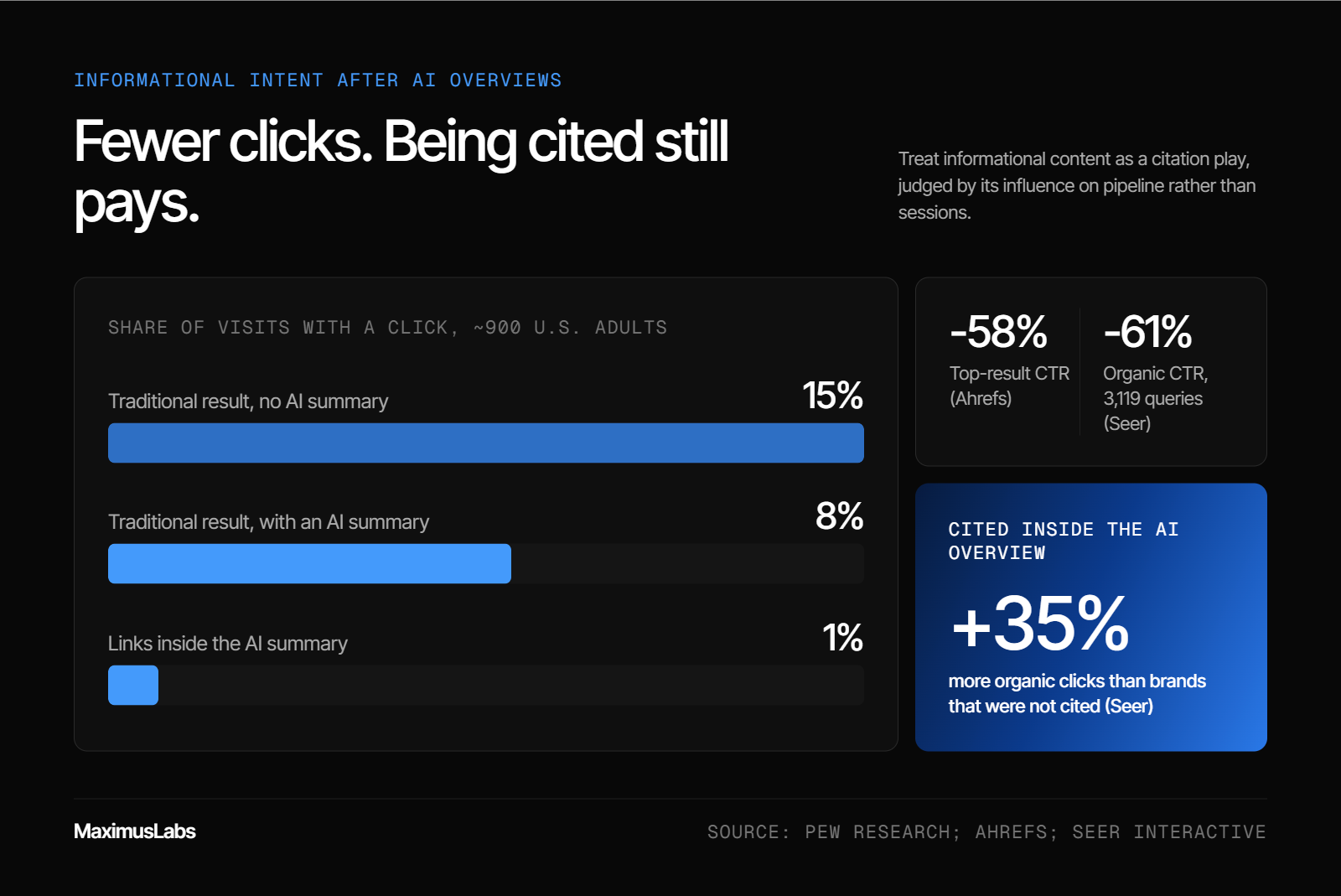
It pays off less as traffic and more as influence. When an AI Overview appears, the top result's click-through rate drops by more than half, and people rarely click links inside the summary. Being the cited source still shapes the shortlist, and visitors who arrive from AI answers come pre-informed. Treat informational intent as a citation play, judged by its influence on pipeline rather than by sessions.
📉 Situation: the click data is grim
Three independent studies point the same way. Ahrefs found that an AI Overview correlates with a 58% lower click-through rate (CTR) for the top-ranking page. CTR is the share of searchers who click a result.
Seer Interactive tracked 3,119 informational queries across 42 organizations from June 2024 to September 2025. Organic CTR on queries with AI Overviews fell 61%.
🔍 What real users do
Pew Research looked at actual browsing records from about 900 U.S. adults. Users who saw an AI summary clicked a traditional result on 8% of visits. Users without a summary clicked on 15%.
Links inside the AI summary itself were clicked only 1% of the time. Pew also found that users were more likely to end their session after seeing a summary.
⚠️ Complication: clicks are the wrong lens
If you judge informational content by sessions, these numbers say stop writing it. But that misses what the AI Overview is doing. It still has to pull its answer from somewhere.
Seer's data shows that being the source matters. Brands cited inside an AI Overview earned 35% more organic clicks than brands that were not cited. Seer notes this may reflect brand authority rather than direct cause, which is a fair caution.
🤝 Citation as a trust transfer
Here is how I think about it. When ChatGPT or Google names your brand, it is lending you its credibility. The buyer did not have to judge ten blue links. The engine did that for them.
That is why AI-referred visitors tend to arrive pre-sold. MaximusLabs AI's working view is that AI search traffic converts at four to five times the rate of traditional search traffic. I hold that as our own observation, not an industry benchmark.
✅ Resolution: when informational content is still worth it
Informational content earns its place in three cases:
- It answers follow-up questions buyers ask mid-journey. These are the integration, compliance, and setup questions that come before a shortlist.
- It feeds AI answers your buyers read. Being the cited source on a key how-to puts your name in front of buyers.
- It links clearly to a commercial page. The guide should lead to a comparison, use case, or demo.
💡 The longer-term case
Eric Enge has cited Conductor data showing that users who find helpful informational content are 131% more likely to buy from that brand later. That figure comes secondhand, so treat it as directional.
MaximusLabs AI tracks informational pages by citation share and assisted pipeline, not by sessions. A how-to guide with fewer clicks can still be the page that put your brand on the shortlist.
Q9. How do you optimize a page for search intent, step by step?
Confirm intent with a SERP and AI answer check, then match the dominant format. Open each section with a direct 40 to 80 word answer under a question heading. Cover the sub-questions a fan-out search would generate. Add named sources and statistics, which the Princeton GEO study found can lift visibility in AI answers by up to 40%. MaximusLabs AI builds each of these steps into its research, writing, and QA pipeline.
✅ Step 1: Confirm the intent before the brief
Run the four-check audit from earlier in this article: modifiers, top results, SERP features, and AI answers. Write the verdict at the top of the brief in one line. For example: "Commercial intent, ranked listicle with a comparison table, angle is teams under 20."
That single line prevents most of the expensive mistakes. Every later step depends on getting it right.
🎯 Step 2: Lead every section with the answer
Use question-style H2s that mirror how buyers actually ask. Then put a direct, standalone answer of 40 to 80 words right under each heading. Think of it as an answer nugget, a block that still makes sense if an AI engine lifts it out of context.
This structure helps three ways. Google can pull it into a featured snippet, AI engines can quote it, and busy readers get the point fast.
🧩 Step 3: Cover the fan-out sub-questions
Google says AI Overviews and AI Mode may run several related searches across subtopics to build one answer. Your page should answer those related searches too. List the next five questions a buyer would ask, then give each one its own labeled block.
For a page on "CRM for startups," that list might include pricing, setup time, integrations, data migration, and contract terms. Skip any question that belongs on a different page.
📊 Step 4: Add evidence, not keywords
The strongest research on this comes from Princeton and IIT Delhi. Their GEO paper, presented at KDD 2024, tested nine ways to optimize content for generative engines. Methods like adding statistics, quotations, and cited sources lifted visibility by up to 40% on their benchmark of 10,000 queries.
Keyword stuffing, the old SEO habit of repeating a term, did not help in their tests. The authors also found that results varied by domain, so test what works in your category.
⚙️ Step 5: Make commercial pages machine-readable
For commercial intent, bring the facts buyers filter by onto the page itself. Integrations, regions, languages, compliance badges, and plan limits should sit in plain HTML text. Hidden filters and tabs leave AI crawlers guessing.
Then check that any structured data matches the visible text. Google says it should, and that no special schema is required for AI features.
💡 How MaximusLabs AI runs this at scale
MaximusLabs AI runs every article through a three-stage pipeline. Stage one is deep research, covering intent, the SERP, primary sources, and content gaps. Stage two is writing in the founder's voice, with answer nuggets and question-led H2s.
Stage three is QA: an ICP review, formatting, and footnotes that trace every claim to a primary source. Our team treats that last stage as trust work, not polish. AI engines cite sources they can verify.
Q10. How do you measure whether your content matches search intent?
Measure intent fit by outcome, not rank. Track how often AI engines cite you across question variants (share of voice). Then track whether visitors take the next intended step, and count assisted conversions across multi-day journeys. Last-click attribution hides intent work, because many conversions happen days after the first search. MaximusLabs AI tracks citation rate across AI platforms. For Oliv AI, that reached a 64% AI citation rate in six months.
⚠️ Why rank alone misleads
A page can rank first and still fail the intent. If visitors land, scan, and leave without the next step, the page answered the wrong question. Rank tells you Google liked the page. It does not tell you the buyer did.
In AI search, there is no single rank at all. ChatGPT may cite you for one wording of a question and skip you for the next. That is why MaximusLabs AI measures frequency across many variants, not one position.
📏 The metric set that tracks intent
These five metrics, read together, show whether a page matches intent:
| Metric | What it tells you | Where to find it |
| Share of voice in AI answers | How often engines cite or name you across question variants | AI visibility tracking across ChatGPT, Perplexity, Gemini, and Google AI |
| Next-step rate | Whether visitors take the action the intent implies | Analytics events, such as demo clicks or pricing views |
| Assisted conversions | Whether the page appears earlier in journeys that convert | Multi-touch attribution reports |
| Search Console clicks and impressions | Visibility on Google, including AI features | Performance report, "Web" search type |
| Pipeline influenced | Revenue tied to journeys that touched the page | CRM reporting |
Google says traffic from AI Overviews and AI Mode is counted in the Search Console Performance report under the "Web" search type. You cannot split it out there, so pair it with AI visibility tracking.
⏰ Fixing the last-click blind spot
Search journeys are rarely one step. Eric Enge has described a Microsoft search session that began with "Merrell shoes." Over 55 minutes, the user ran five refinements and finally settled on a different brand.
Last-click attribution gives all the credit to that final search. Every earlier page that shaped the decision gets nothing. B2B journeys stretch over weeks, so the distortion is even bigger.
✅ What to change on Monday
Switch your content reports to show assisted conversions next to last-click conversions. Add a monthly AI visibility check for your top 20 commercial questions. Then review each page against one question: did it move the buyer to the next stage?
None of this needs a big budget. It needs a team that agrees clicks and impressions alone are vanity metrics.
📈 What the proof looks like
MaximusLabs AI tracks citation rate and share of voice across ChatGPT, Perplexity, Gemini, and Google AI for every client. For Oliv AI, that work produced a "64% AI citation rate in 6 months, vs ~30% for billion-dollar incumbents (Oliv AI)."
That number matters because it shows Oliv AI inside the shortlist buyers actually see. The same engagement also produced "27 qualified leads, $47K+ pipeline, 26% close rate in 4 months (Oliv AI)." Citation was the means. Pipeline was the outcome.
What I'm Thinking About Next
My hypothesis is that "search intent" will soon mean "conversation intent." The unit of optimization is shifting from a keyword to a full buyer conversation with an AI engine. That conversation runs across prompts, follow-ups, and sessions.
I might be wrong about how fast this happens. But the direction is clear in Google's fan-out documentation, Bing's query expansion, and how people already use ChatGPT. The teams that win will map the whole conversation, not just the first question.
I am also watching agentic search closely, where AI agents shortlist and even buy on a user's behalf. When that arrives, intent will be read by machines first and people second. If you are already testing how your brand shows up in those conversations, I would love to compare notes.
Questions, answered
7 questionsWhat are some examples of search intent for B2B SaaS keywords?
Search intent examples are easiest to see when you line up real B2B queries by what the buyer wants next. We sort them like this: • Informational: "how does lead scoring work" or "how to run payroll in Argentina." The buyer wants to learn. • Navigational: "HubSpot login." The buyer wants a specific site. • Commercial: "best CRM for startups" or "EOR providers for Latin America." The buyer is comparing options. • Transactional: "HubSpot pricing" or "book a demo." The buyer is ready to act. • Generative: "write a cold email for a CRM demo." The buyer wants AI to produce something. MaximusLabs AI maps each target query to one of these types, plus a buyer stage and the answer surface where it appears, such as Google, AI Overviews, ChatGPT, or Perplexity. The type tells us what page to build. The stage tells us how close that page sits to pipeline. For most B2B SaaS teams, the commercial and transactional examples deserve budget first, because the buyer is already shortlisting. If you want to see how these queries play out in AI answers, our research on the B2B SaaS buyer journey in AI search walks through each stage in detail.
Can a single keyword have more than one search intent?
Yes. Many keywords carry mixed intent, and Google's own rater guidelines tell evaluators to consider multiple intents for the same query. "Best CRM pricing" is a good example. The searcher wants to compare options and check cost at the same time. Short queries are the most mixed. A two-word query like "CRM software" could mean a definition, a shortlist, or a vendor's homepage. The engine has to guess, so the results page often shows a blend of guides, listicles, and product pages. Here is how we handle mixed intent at MaximusLabs AI: • We look at which page type dominates the top results and build for that first. • We cover the secondary intent inside the same page with a clearly labeled section, such as a pricing table inside a comparison. • We check how ChatGPT and Perplexity answer the query, because AI engines often split a mixed query into several sub-questions. When two intents are far apart, we build two pages instead of one confused page. A buyer guide and a pricing page can link to each other without competing. Our guide to the query types answer engines prioritize explains how AI engines treat these splits.
What is the difference between search intent, user intent, and keyword intent?
In practice, the three terms mean almost the same thing, and most SEO teams use them interchangeably. There are small differences in emphasis. • Search intent is the goal behind a query typed into a search engine or AI assistant. • User intent is the broader term. It covers what a person wants across any interface, including apps, chat, and voice. • Keyword intent is the label an SEO tool attaches to a specific keyword, such as "commercial" or "informational." The difference that matters is between the intent a tool labels and the intent an engine acts on. Tools read patterns in the words. Google and AI engines read the words and the context, then rewrite the query into what they think the person meant. That is why MaximusLabs AI treats tool labels as a starting point, not a verdict. We confirm intent by looking at the live results page and at the sources ChatGPT, Claude, Perplexity, and Gemini cite for the same question. If you are building a question list for this work, our AEO keyword and question research guide shows how we gather the questions buyers actually ask.
How often does the search intent of a keyword change?
Search intent can shift at any time, and there is no fixed schedule. Google reclassifies queries as user behavior changes, as new page types appear, and as AI features roll out. A keyword that showed guides last year may show tools or AI Overviews today. A well-known example comes from SurveyMonkey. Rankings slipped for "take survey," and the cause turned out to be intent, not technical SEO. Google had decided searchers wanted sites that pay people to take surveys, not tools to build surveys. We watch for these signals at MaximusLabs AI: • The dominant page type in the top results changes. • A new SERP feature appears, such as an AI Overview or a shopping row. • AI engines start citing different source types for the same question. • A page holds its rank, but its next-step rate drops. For revenue pages, we recheck intent every quarter. For pages that suddenly drop, we recheck intent before touching anything technical. Refreshing a page to match new intent is often the fastest recovery, and our guide to content refresh for GEO covers how we approach it.
Do SEO tools identify search intent accurately?
SEO tools are useful for a first pass, but they are not accurate enough to make the final call. Most tools label intent from patterns in the keyword, such as "best" meaning commercial or "how" meaning informational. That works for clear queries and fails for ambiguous ones. Tools have three blind spots: • They do not always reflect how Google has recently reclassified a query. • They cannot tell you which format wins, such as a calculator versus a guide. • Most do not show how AI engines answer the same question or which sources they cite. MaximusLabs AI uses tool labels to sort large keyword lists, then confirms intent manually for every page we plan to build. The manual check takes about 30 seconds: read the modifiers, scan the top results, note the SERP features, and ask ChatGPT and Perplexity the same question. That last step is the one tools miss most. Google, ChatGPT, and Perplexity often cite different sources for the same query, so intent in AI search needs its own check. Our free ChatGPT search query extractor helps you see the searches ChatGPT runs behind a prompt.
How does matching search intent affect conversions and pipeline?
Matching search intent improves conversions because the page gives buyers what they came for and makes the next step obvious. A mismatched page may still get traffic, but visitors leave without acting. The effect is strongest on commercial and transactional queries. A buyer searching "Tool A vs Tool B integrations" is close to a decision. If the page answers that exact question and offers a fitting next step, such as a demo or a migration guide, the path to pipeline is short. Here is how MaximusLabs AI ties intent to revenue: • We build BOFU pages first, because they sit closest to a buying decision. • We match each page's call to action to the buyer's stage, using templates, calculators, or demos rather than a hard sell. • We measure assisted conversions, not just last-click, because B2B journeys run for weeks. For Oliv AI, this approach produced 27 qualified leads, $47K+ pipeline, and a 26% close rate in 4 months. You can read how that engagement worked in our case studies. The lesson is simple: intent fit is a revenue lever, not only a ranking factor.
How do you fix existing content that targets the wrong search intent?
Start by confirming the mismatch. Search the target keyword and compare your page type with what ranks. If the results show listicles and you have an essay, or tools and you have a guide, the page has the wrong intent. Then choose one of three fixes: • Reformat the page. Keep the URL and rebuild it in the winning format, such as a ranked list with a comparison table. • Retarget the page. Point the existing content at a different keyword whose intent it already matches. • Build a new asset. If the intent calls for a calculator or template, build that and link it from the old page. MaximusLabs AI also checks that key facts sit in plain HTML text, not behind tabs or filters, because hidden content often goes unseen by Google and AI crawlers. We add direct answers under question-style headings so AI engines can quote the page. After the fix, give the page a few weeks and track next-step rate and AI citations, not only rank. If you want a structured place to start, our AEO implementation checklist covers the on-page changes we make most often.