 Krishna Kaanth M
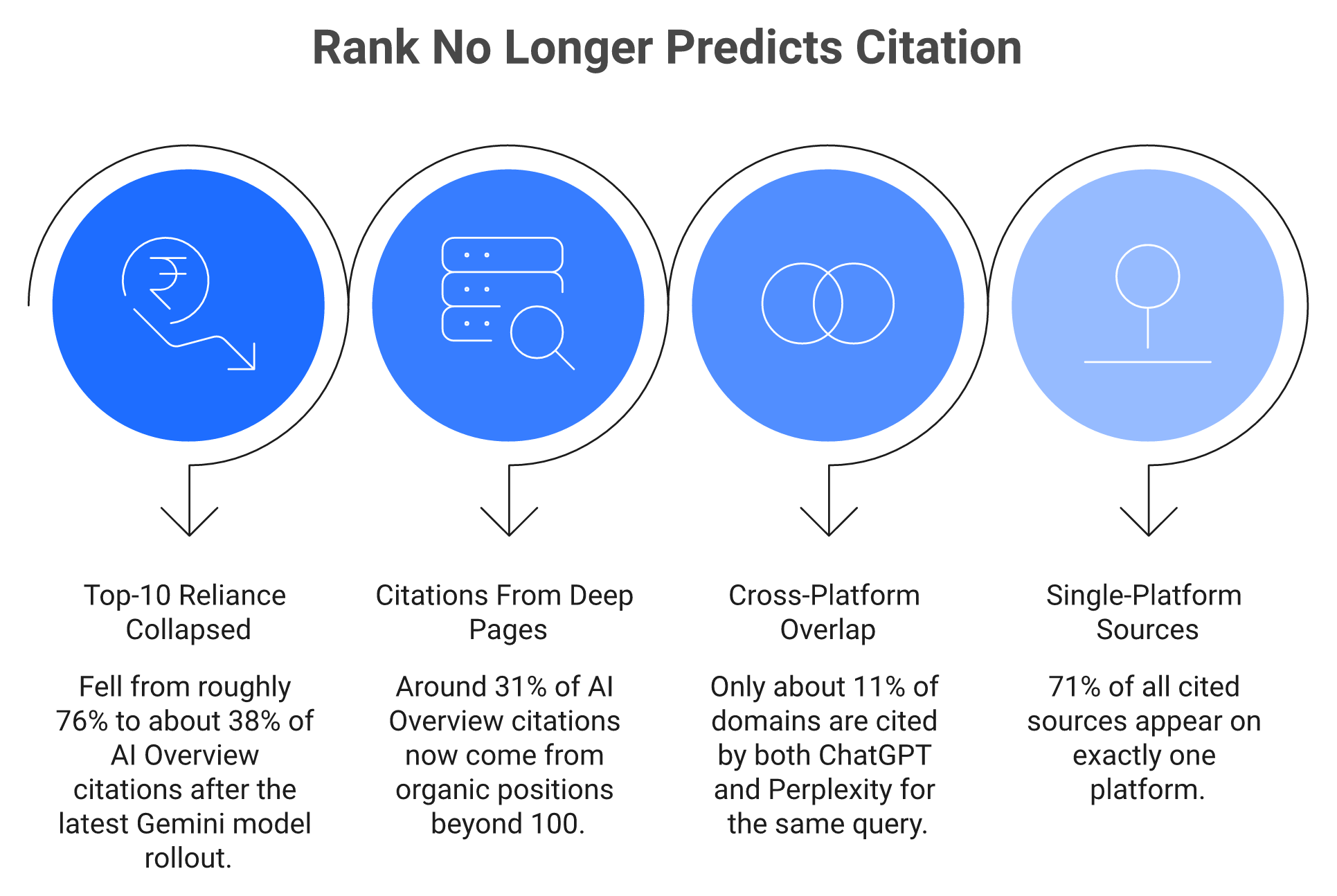
- Ranking in AI search means being cited inside a generated answer. Post Gemini 3, top-10 reliance for AI Overview citations fell from roughly 76% to about 38%.
- Four tactics no longer earn citations: keyword stuffing, Core Web Vitals tuning, schema as a visibility play, and llms.txt. Clean indexation remains the floor.
- Retrieval decides everything. Microsoft's RAG patent specifies cosine similarity above 0.7 to 0.8, and Perplexity runs a comparable gate on a 100ms budget.
- Front-load answers. Around 44.2% of citations come from the first 30% of page text, and statistics plus named expert quotations produced the largest measured lifts.
- Brand mentions beat backlinks at r=0.664 versus r=0.218, and the G2 family accounts for roughly 84% of B2B review-site citations in AI Overviews.
- Measure share of voice, then pipeline. AI visitors convert at about 4.4x organic, and Webflow reported a 6x difference between LLM and Google traffic.
Q1. What does it actually mean to "rank" in AI search in 2026?
Ranking in AI search means being retrieved, re-ranked, and cited inside a generated answer, not holding a position on a results page. Before the Gemini 3 rollout in January 2026, roughly 76% of AI Overview citations came from Google's top 10. Afterwards that reliance fell to about 38%, with around 31% of citations drawn from organic positions beyond 100. There is no page two in an AI answer.
📉 The dashboard that stopped describing reality
That VP was not being lied to. The rank tracker was accurate. It was simply pointed at a surface that no longer decides the outcome.
When a buyer asks ChatGPT for the best vendor in a category, they get one answer naming five to ten brands. Your position among the blue links underneath is not part of that answer. You are either named or you are absent.
🔗 Rank and citation have come apart
The 76% to 38% collapse is the clearest number in this whole shift. It means a brand can hold position three and still be invisible, while a competitor sitting at position 140 gets quoted.
Cross-platform data makes it stranger. Only about 11% of domains are cited by both ChatGPT and Perplexity for the same query, and 71% of cited sources appear on exactly one platform. Winning one engine tells you almost nothing about the others. The full breakdown sits in our ChatGPT, Perplexity, and Gemini citation-pattern research.
📊 What to put on the report instead
Replace rank with share of voice: how often your brand appears across a defined set of buyer questions, per engine, tracked over time.
The practical version takes an afternoon. Build 30 to 50 questions your ideal customer would actually type. Run them monthly across ChatGPT, Perplexity, Gemini, and Google AI Overviews. Record whether you were named, who else was, and which URL got cited.
That last column is the one that changes behaviour. It tells you whether your own page earned the mention or a third-party listicle did it for you.
⚠️ The honest counterweight
Here is where I break with most GEO commentary. Gartner forecast in February 2024 that traditional search engine volume would drop 25% by 2026, according to its own published prediction. That prediction did not land. Measured organic search traffic in the US fell roughly 2.5% year over year by January 2026, and SparkToro's clickstream analysis found Google still receiving around 373 times more searches than ChatGPT.
So the ground is shifting, not collapsing. Anyone telling you to abandon Google is selling you something.
What is genuinely true is narrower and more useful. The queries where buyers compare vendors, the ones closest to a purchase, are moving fastest. Those are the queries that pay for your content program.
I will admit the uncertainty I still carry. I do not know whether the 38% figure holds through the next model generation, and I would not bet a full-year plan on it staying put. Track it yourself, quarterly, and let your own numbers overrule mine.
Q2. Which SEO tactics no longer move AI citations?
Four widely sold tactics fail to earn AI citations. Keyword stuffing performs about 10% worse than baseline on Perplexity.ai in the Princeton and IIT Delhi GEO paper's controlled rewrites. Core Web Vitals has no demonstrated citation lift. Schema is structural hygiene rather than a citation lever, and Google retired FAQ rich results on May 7, 2026. And llms.txt is unsupported: Gary Illyes confirmed in July 2025 that Google does not read it and has no plans to.
❌ The verdict table
| Tactic | Evidence | Verdict |
| Keyword density optimization | About 10% worse than baseline on Perplexity in controlled A/B rewrites | Actively harmful |
| Core Web Vitals tuning | No published citation-lift study | Hygiene, not a lever |
| Schema as a citation multiplier | FAQ rich results retired May 7, 2026 | Parsing aid only |
| llms.txt | Google confirmed non-support, July 2025 | Optional, unproven |
🔍 Why keyword work backfires now
The GEO paper tested this properly. Researchers rewrote the same pages nine different ways and measured visibility inside generated answers across a controlled set of competing sources.
Keyword stuffing was the only edit that scored below the untouched original. Retrieval systems match meaning through vector embeddings, which are numerical representations of text. Repetition distorts that representation instead of sharpening it.
One housekeeping note, because this number circulates wrongly. The paper reports roughly 10% worse than baseline. The widely quoted "minus 9.7%" figure does not appear in it. We keep a running list of these misquotes in our GEO common mistakes reference.
⚡ Core Web Vitals and the impact illusion
Ethan Smith, CEO of Graphite, put it bluntly in his AEO talk: much of SEO best practice is true but not impactful, and Core Web Vitals is his example. He said he has never seen it drive impact in 15 years, and that reported 20% traffic lifts are usually bad analysis.
I would soften that slightly. Speed still matters for retrieval, because engines fetch under tight latency budgets. It just does not earn you a citation on its own, which is why our technical SEO audit treats it as a floor rather than a lever.
🏷️ Schema is parsing help, not persuasion
Structured data helps a machine read your page correctly. It does not convince a model to quote you.
The May 2026 retirement of FAQ rich results settled the argument for most teams, per Google Search Central's deprecation notice. Keep Article, Organization, and Person markup for entity clarity, as covered in our schema markup basics guide. Stop building schema as a visibility play.
📄 The llms.txt question, answered plainly
Illyes said in July 2025 that Google does not support llms.txt and is not planning to, and John Mueller has compared it publicly to the old keywords meta tag. Neither OpenAI nor Anthropic has confirmed reading it for retrieval.
Publishing one costs an hour and harms nothing, and our llms.txt generator makes it a five-minute job. Treating it as a ranking lever costs a quarter.
✅ What stays on the floor
None of this means SEO is dead, and I would not say that to a Head of Organic Growth who has spent five years building a clean site.
SEO best practice has become the basics for GEO. Crawlable, server-rendered, properly indexed pages are the precondition for everything in the next section. You cannot be retrieved from a page an engine cannot fetch.
Defund the four tactics above. Keep the foundation. Spend the recovered hours on the retrieval layer.
Q3. How do AI engines actually choose which sources to cite?
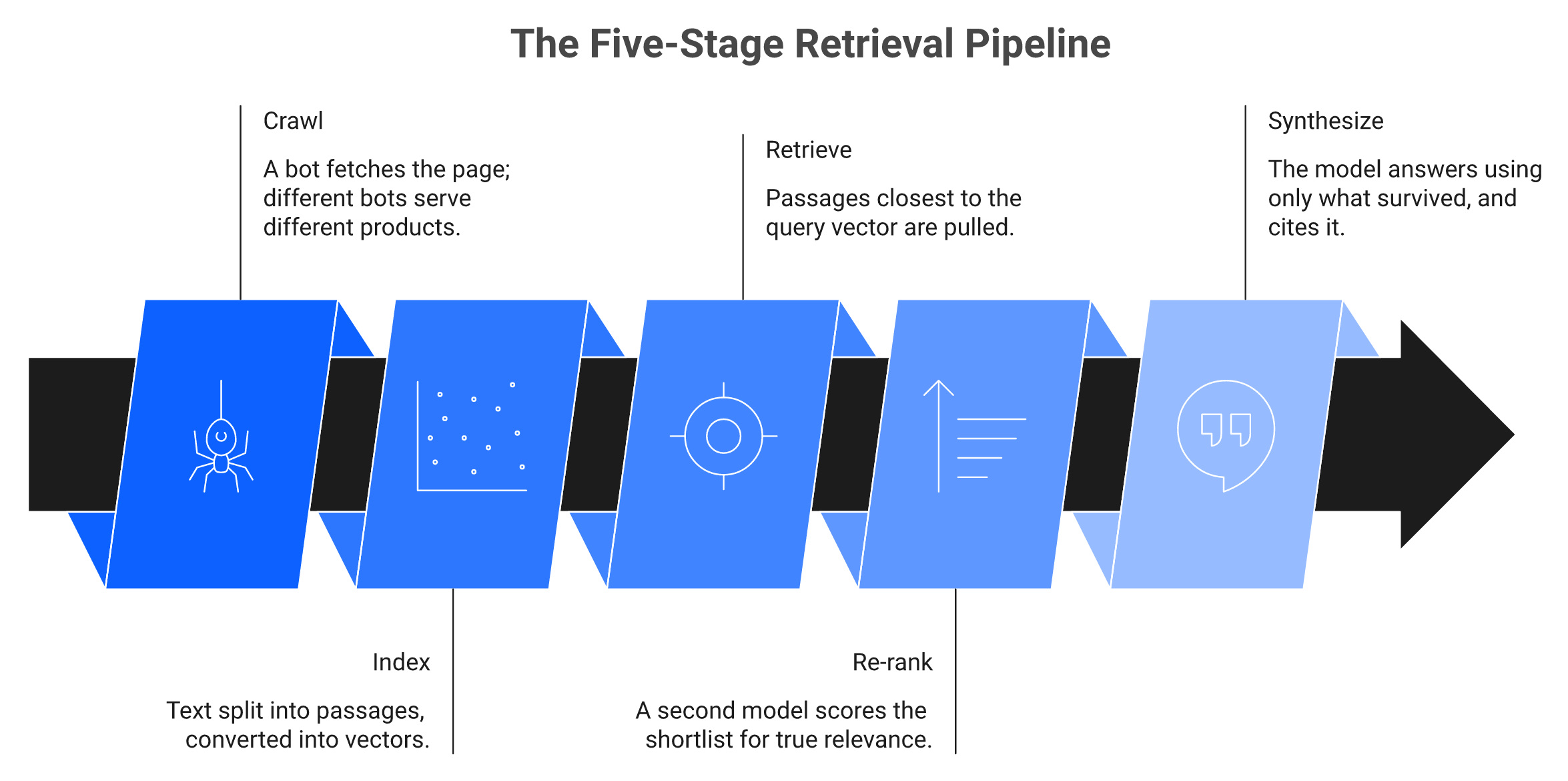
AI answers run five stages: crawl, index, retrieve, re-rank, then synthesize with citations. Retrieval is where optimization happens. Microsoft's RAG patent US20240346256A1 specifies a cosine similarity threshold above 0.7 to 0.8 for passage inclusion, and Perplexity applies a comparable gate under a roughly 100ms Vespa latency budget. Content that is unchunked, slow, or unrendered never reaches the model.
🔄 The five stages in plain language
- Crawl. A bot fetches your page. Different bots serve different products, as mapped in our complete AI crawler guide.
- Index. Your text is split into passages and converted into vectors, which are lists of numbers representing meaning.
- Retrieve. Your question becomes a vector too. The system pulls passages whose vectors sit closest to it.
- Re-rank. A second model scores the shortlist for genuine relevance to the question.
- Synthesize. The model writes an answer using only what survived, and cites those sources.
Every optimization decision you make lands on stage three or stage four. Nothing else is reachable.
📐 The thresholds nobody tells you about
Microsoft's RAG patent sets an explicit cosine similarity cutoff, above 0.7 or 0.8 depending on configuration, below which a passage is simply dropped. The filing is public as US20240346256A1. Perplexity's retrieval layer applies a comparable quality gate and runs on roughly a 100ms budget, with Microsoft's Web IQ operating at sub-165ms P95 latency.
Read that as a hard constraint. The system has milliseconds to decide. A passage that needs three paragraphs of context to make sense loses to one that answers the question on its own.
MaximusLabs AI reads the patents and papers behind these systems rather than the blogs summarizing them, because the thresholds only appear in the primary documents. We maintain a source order that puts academic papers and patents above secondary coverage for exactly this reason, and the resulting method sits inside our generative engine optimization work.
🎯 Grounding is the whole ballgame
Aravind Srinivas, CEO of Perplexity, described the design constraint directly: the principle is that you are not supposed to say anything you do not retrieve. That single sentence reframes the job. You are not persuading a model. You are competing to be inside the small set of passages it is allowed to speak from, which is the core premise of citation-worthy content.
🧪 The Bing experiment that changed our audit order
Ivan Hristov ran an experiment worth more than most agency decks. A site received a manual Bing penalty and vanished completely from ChatGPT Search results, while holding its Google positions untouched.
That finding rearranged how MaximusLabs AI sequences technical work. We now verify Bing indexation health before touching content, because a penalty there silently removes a site from ChatGPT Search while every Google-based dashboard still reads green.
I might be weighting that single experiment too heavily, and I would like to see it replicated. But the downside of checking is twenty minutes.
🛠️ What to do with this on Monday
- Chunk every key page into self-contained passages that survive extraction alone.
- Server-render critical content as static HTML so retrieval does not wait on JavaScript.
- Confirm your pages are indexed in Bing, not just Google.
- Check that every retrieval bot you want is allowed in robots.txt, and verify it with our AI crawlability checker.
MaximusLabs AI runs this as a week-one technical sprint before any content ships, because clean retrieval is the precondition for every tactic that follows. Pipeline, not impressions, is what the sprint is eventually measured against.
Q4. Is GEO just SEO with a new name?
No. MaximusLabs AI's position is that Generative Engine Optimization (GEO) is a data science problem rather than an SEO upgrade. SEO optimizes a document for a ranking function you observe through position changes. GEO optimizes a passage for vector retrieval, cosine thresholds, and cross-encoder re-ranking, which are systems you have to model rather than watch. SEO best practice is the floor. GEO is the architecture built on top.
🧭 The consensus, stated fairly
Most of the industry calls GEO "SEO plus." It is a reasonable position, and it carries real truth. Crawlability, indexation, and content quality still matter.
Traditional agencies adopted that framing quickly, and many added GEO as a service line within a quarter. The problem is not dishonesty. It is that the framing makes the new work look like a checklist extension, a pattern we unpack in our GEO versus traditional SEO comparison.
⚠️ What "SEO plus" cannot explain
Three observations break it.
- A page at Google position three is absent from the AI Overview, while one beyond position 100 gets cited.
- Only about 11% of domains are cited by both ChatGPT and Perplexity for the same query.
- Adding statistics and named expert quotations produced the largest measured visibility gains in controlled rewrites, while keyword work went backwards, per the Princeton and IIT Delhi GEO study.
If GEO were SEO plus a few tasks, those three things would not happen. They happen because a different mechanism is running underneath.
| Dimension | Traditional SEO | GEO |
| Win condition | Position on a results page | Named inside a generated answer |
| Unit optimized | The document | The retrievable passage |
| Core mechanism | Ranking function, observed | Vector retrieval and re-ranking, modeled |
| Primary metric | Rank, impressions, clicks | Share of voice, then pipeline |
| Main lever | Keywords and backlinks | Entity clarity, sourced claims, third-party mentions |
💡 Where this view came from
My own version of this started at WiseMonk, where I headed go-to-market and 98% of revenue came from SEO. Optimizing for AI engines, I kept hitting the same wall: what ChatGPT treated as important was not what Google treated as important, and neither matched Perplexity.
That is the whole origin of the position. Many people tell me GEO is SEO plus. My contrary view is that GEO is more of a data science problem, because you need to know how these algorithms actually work to be present in the answers.
The uncomfortable follow-on question for buyers is simple. How do you add something as a service if you do not understand it completely?
🔍 Three questions to ask any vendor
- Which primary sources, papers, patents, or platform docs shape your retrieval approach? Ask for two by name.
- How do you measure visibility across engines, and what did your last regression test show?
- Do you work earned surfaces, like review platforms and Reddit, or only our own site?
A vendor who answers all three with specifics is doing the work. One who answers with tool logos is reselling tracking, and our AEO agency evaluation framework walks through the rest of the diligence.
MaximusLabs AI pioneered revenue-focused GEO and Answer Engine Optimization (AEO) because the "SEO plus" framing kept producing dashboards instead of pipeline. The method is concrete: primary-source research precedes writing in a three-stage pipeline, and every article is scored across ten quality dimensions, with nothing shipping below 70 out of 100, or 80 for pillar content.
Q5. Which questions should you target, and does your own page or a third party win them?
Split the work by question tier. Head questions like "best CRM software" are decided by third-party cited URLs, so review platforms and citation work win them. Mid-tail questions blend citations with strong owned content. Long-tail conversational questions, where the average AI chat query runs around 25 words, are won by your own comprehensive pages. MaximusLabs AI starts every engagement with bottom-of-funnel and comparison questions, then expands to middle-of-funnel only once that set is exhausted.
🎯 The three tiers, and who wins each
| Tier | Example query | Who wins it | Your move |
| Head | "Best CRM software" | Third-party listicles and review sites | Earn mentions on the URLs already cited |
| Mid-tail | "Best CRM for small SaaS teams" | Mixed | Own page plus targeted citations |
| Long-tail | "Does HubSpot route Slack leads automatically?" | Your own site | Deep, self-contained answers |
Ethan Smith, CEO of Graphite, frames the head-tier problem well in his AEO talk. For a query like "best credit card," a brand appears because NerdWallet mentioned it, not because its own page ranked.
🔍 Where the questions actually come from
Keyword tools give you phrases. AI engines receive questions. Those are different inputs, and the gap is where most content plans go wrong, which is why we treat question research as a separate discipline.
MaximusLabs AI pulls question sets from four places: search data, sales-call transcripts, support tickets, and the Reddit threads engines already cite for the category. Our Reddit threads finder handles that last input. The transcripts matter most. Buyers ask salespeople the exact objection-shaped questions they later type into ChatGPT.
❌ The filter that saves you a quarter
Here is the cut most teams skip. Some questions never produce a product mention, no matter who gets cited.
"How do I reduce churn" returns advice. "Best churn prediction tool for Series B SaaS" returns vendors. Being cited in the first one earns you nothing you can measure in pipeline, a pattern mapped in our B2B SaaS buyer journey research.
So filter the list. Keep questions where a product or vendor can plausibly be named in the answer. Drop the rest, however high the volume looks.
⚠️ Why I skip "what is" content on purpose
This is the part that gets argued with most, and I will state it plainly. AI engines already answer definitional queries well, so funding top-of-funnel definitions buys pageviews rather than pipeline.
MaximusLabs AI treats clicks, impressions, and mentions on their own as vanity metrics, which is why we sequence bottom-of-funnel first inside our revenue-focused R-GEO framework. I hold this one with some uncertainty. If your category is genuinely new and buyers do not yet have language for the problem, definitional content may be the only door open.
✅ Your 30-question starter set
Build it this week. It takes an afternoon.
- Pull your ten highest-intent commercial keywords and rewrite each as a question a buyer would type.
- Add the five objections your sales team hears most, phrased as questions.
- Add five competitor comparison questions, including "X vs Y" and "alternatives to X."
- Add five integration or feature questions from support tickets.
- Add five category questions where vendors get named, like "best tool for" plus your ICP.
- Tag each as head, mid, or long-tail, then mark whether a third party or your own page should win it.
That last column becomes your budget split. Head-tier rows go to earned work. Long-tail rows go to your content calendar.
MaximusLabs AI runs this mapping before any article is commissioned, because the tier decides whether the budget belongs in content or in earned placements. Question research draws on sales transcripts and already-cited Reddit threads, not a keyword tool alone, and the engagement is measured on pipeline rather than on mentions.
Q6. How should you structure a page so AI engines extract and cite it?
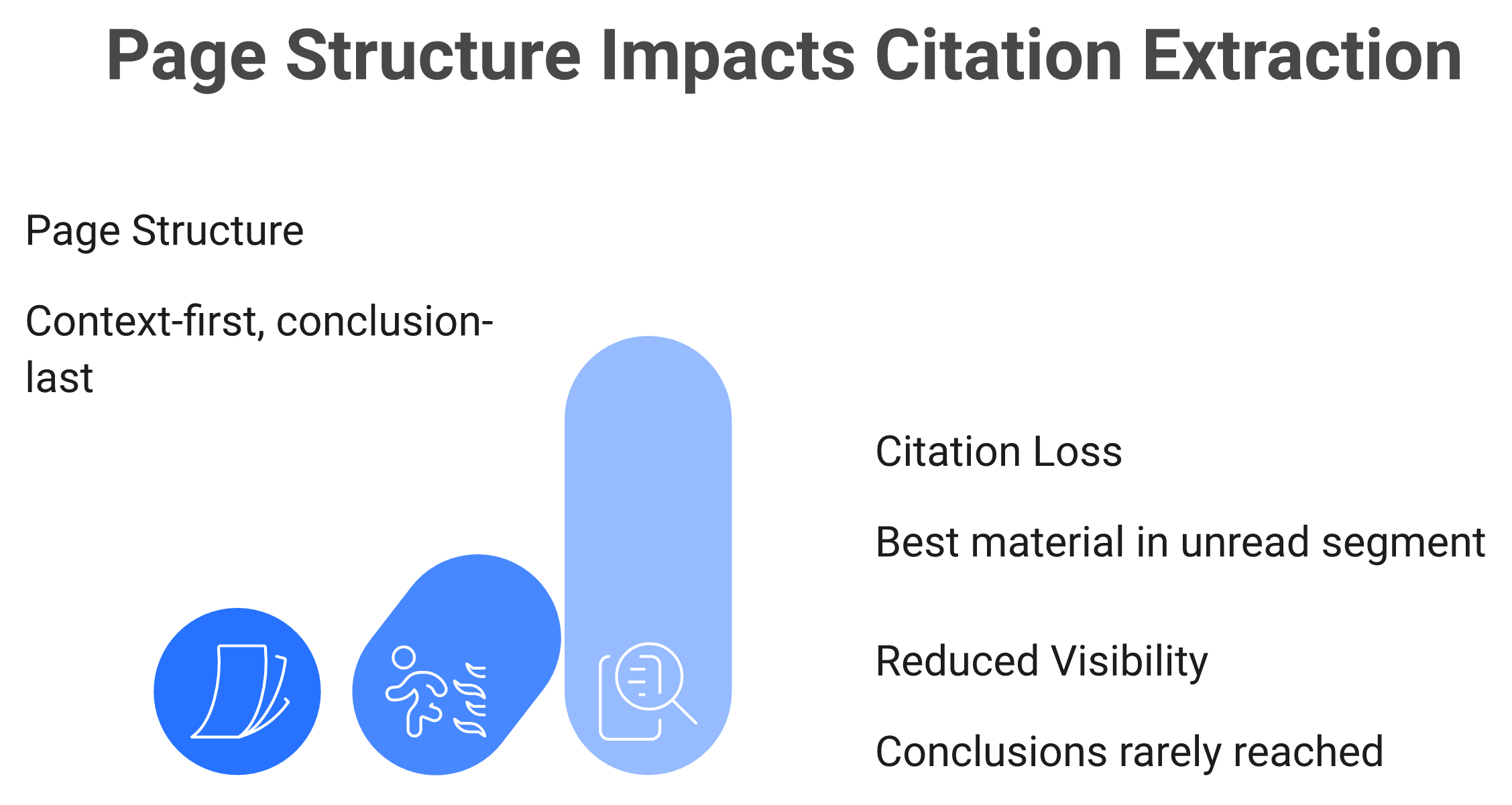
Front-load the answer. Citations cluster in a ski-ramp distribution, with 44.2% extracted from the first 30% of page text, so every key page needs a direct 30 to 60 word answer in its opening paragraph. The Princeton and IIT Delhi GEO paper's largest measured lifts came from adding quantitative statistics (around 40.6% relative visibility) and named expert quotations, not from keyword work. MaximusLabs AI requires a 40 to 80 word standalone answer under every H2 in client articles.
📈 The ski ramp, and what it means for layout
Almost half of all citations come from the opening third of a page. That single distribution should reshape how you write.
Put the answer first. Then expand. The old pattern of context, build-up, and a conclusion at the bottom hands your best material to a section no engine reaches, which is the first fix in our AEO answer structure guide.
📊 What the GEO paper actually measured
The researchers rewrote identical pages nine ways and scored visibility inside generated answers, as documented in the GEO: Generative Engine Optimization paper.
| Edit applied | Direction of effect |
| Add quantitative statistics | Largest positive lift, around 40.6% relative |
| Add named expert quotations | Strong positive lift |
| Add citations to credible sources | Positive lift |
| Keyword stuffing | Below the untouched baseline |
⚠️ The ceiling nobody mentions
This is where I part ways with most GEO content, which quotes "up to 40%" as if it were a traffic promise.
The gains were measured in a controlled setup with five competing sources per query. A 2026 arXiv survey of 45 GEO studies concluded those lifts are conditional on your page already sitting in the retrieval context. Statistics and quotations improve your odds among candidates. They do not get you into the candidate pool.
That is why the technical work in the next section is not optional. Retrieval first, then persuasion.
🧱 Chunk for extraction, not for reading flow
Write every subsection so it survives being lifted alone, with no heading, no byline, and no paragraph before it. Our content formatting standards for AI search cover the chunking rules in full.
MaximusLabs AI enforces this as a hard gate at QA rather than as style-guide advice. If a block does not make complete sense when extracted on its own, it gets rewritten before the article ships. Readability holds a Flesch floor of 55, because Perplexity deprioritizes dense prose.
My own test is cruder. I paste the block into a blank document. If I cannot tell what product, company, or category it refers to, it fails. Our AI content optimizer runs the same check at scale.
✂️ Meta descriptions are retrieval snippets now
ChatGPT receives roughly 150-character snippets during standard web retrieval. So a meta description is no longer marketing copy. It is a candidate answer.
Before: "Learn everything you need to know about choosing the right CRM for your growing SaaS business in our complete guide."
After: "CRM comparison for Series A to C SaaS: pricing, data limits, and integration depth across 7 vendors, tested March 2026."
The second one is 118 characters, carries facts, and can be quoted. The first one says nothing a model can use.
Keep them between 120 and 158 characters, and write them as dense, direct answers.
MaximusLabs AI built the answer-nugget standard into its editorial system before the citation-position data was public, which is why every client H2 opens with a 40 to 80 word extractable answer. The standard is enforced in QA, and articles score across ten quality dimensions before release.
Q7. What off-site signals actually drive AI citations?
Brand mentions outperform backlinks as citation predictors. Brand web mentions, both linked and unlinked, correlate with AI Overview visibility at Spearman r=0.664, roughly three times the r=0.218 measured for backlinks. After acquiring Capterra, the G2 family accounts for about 84% of B2B review-site citations across AI Overviews. Backlinks still drive core search indexation, so this is a reallocation of budget rather than an abandonment.
💸 The line item nobody questions
Most B2B content budgets still carry a link-building allocation that nobody has audited in three years. It renews because it always has.
I have sat in those reviews. The deliverable is a spreadsheet of placements, and the metric is domain rating. Neither column tells you whether an AI engine trusts you.
📉 What the correlation data changed
Then the numbers arrived. Brand mentions at r=0.664 against backlinks at r=0.218 is not a rounding difference. It is roughly a threefold gap in how strongly each signal tracks with AI Overview visibility. Our 2026 GEO and AEO benchmark report tracks the same pattern across client datasets.
Unlinked mentions count. A paragraph naming your product on a page that never links to you still moves the signal, which breaks the entire premise of link-first outreach. The mechanics sit in our AI citation acquisition tactics.
⭐ Review platforms are the concentrated bet
The G2 family's 84% share of B2B review-site citations is the single most actionable number in this section. One category profile with real reviews reaches a surface that AI engines pull from constantly.
MaximusLabs AI treats this as a baseline rather than a bonus: category profiles on G2, Capterra, and Gartner, with a target of ten or more reviews per platform before any link outreach is considered. The reviews do double duty, since buyers read them and engines cite them.
⚠️ The platform asymmetry that wastes money
Here is where blanket advice fails. The same off-site surface performs completely differently by engine.
| Surface | Google AI Overviews | Perplexity | Claude |
| About 4% of citations | About 6.6% of citations | Near 0%, licensing blocked | |
| YouTube | Correlates at r=0.737 | Moderate | About 0.02% utility |
So "get on Reddit" is good advice if your buyers use Perplexity and wasted effort if they use Claude. Check where your ICP actually asks before funding either, and use our Reddit and forum AEO playbook once you know.
🏛️ Why brand beats the algorithm
This is my strongest conviction in the whole discipline, and it is not a tactical one.
It is not about understanding the algorithm or hacking into the algorithm's answer. It is about building a brand. If you build a brand in your space, then AI has to recommend you, and you survive every model update because you are the brand buyers name.
MaximusLabs AI's read is that the category has this backwards. Agencies sell citation tactics because tactics are billable, while brand presence compounds slowly and resists neat reporting. I would rather own a category term in a buyer's mind than a schema field.
MaximusLabs AI runs this as Search Everywhere Optimization: review-platform profiles, the specific Reddit and Quora threads engines already cite, founder publishing on LinkedIn, and YouTube assets built for citation. Oliv AI reached a 64% AI citation rate in 6 months, vs ~30% for billion-dollar incumbents, with 30 to 40% of inbound now AI-sourced.
Q8. What is the minimum viable technical stack for AI visibility?
Five items cover most of it. Server-render critical content as static HTML. Allow every retrieval bot in robots.txt, notably OAI-SearchBot, which governs ChatGPT Search appearance independently of GPTBot's training permission. Establish a G2 or Capterra category profile. Build a Wikidata entity with a sameAs loop back to your owned properties. Submit URLs through IndexNow for roughly 3 to 6 hour Bing crawling and 24 to 72 hour ChatGPT citation eligibility. MaximusLabs AI completes this audit inside the first seven days of an engagement.
🛠️ The five-item stack
| Item | Why it gates retrieval | Effort |
| Server-rendered HTML | Retrieval bots do not wait on JavaScript | Engineering, one sprint |
| Retrieval bots allowed | No crawl means no candidacy | One file, one hour |
| G2 or Capterra profile | Highest-cited B2B third-party surface | Marketing, two weeks |
| Wikidata entity plus sameAs | Resolves your brand as a single entity | One analyst, a few days |
| IndexNow submission | Compresses discovery to hours | One-time integration |
⚠️ The robots.txt mistake I see most
OAI-SearchBot and GPTBot are two separate switches, and most teams treat them as one decision, per OpenAI's crawler documentation.
| Bot | What it governs | Recommended |
| OAI-SearchBot | Appearance in ChatGPT Search answers | Allow |
| GPTBot | Training data collection | Your call |
Block OAI-SearchBot and your public content stops appearing in ChatGPT search answers. Plenty of sites did this while trying to opt out of training, and the loss is invisible on a Google-based dashboard. Our guide to managing AI crawlers including GPTBot and Google-Extended covers the full permission matrix. Google's own AI-experiences guidance makes the same general point: crawlability and snippet controls decide whether you can appear at all.
🏷️ Entity clarity, done in an afternoon
Schema will not win you a citation, as Q2 established. It does help an engine resolve who you are.
Mark up Organization, Person for your named authors, Article, and Dataset where you publish original numbers. Validate in Google's Rich Results Test. Then make your sameAs values consistent across Wikidata, LinkedIn, and G2, pointing back to the same canonical domain. Our entity optimization and knowledge graph guide walks through the sameAs loop.
MaximusLabs AI runs this as part of a week-one technical sprint, alongside JavaScript minimization and blog-template rebuilds, because a brand that resolves to three different entities gets cited as none of them.
⏰ Speed of discovery
IndexNow is the least glamorous item here and the one with the clearest payback. Submitting a URL through it brings Bing crawling into a 3 to 6 hour window, with ChatGPT citation eligibility typically following inside 24 to 72 hours, per the IndexNow protocol documentation.
Since ChatGPT Search leans on Bing infrastructure, that pipeline matters more than most teams assume. Pair it with the Bing indexation check from Q3.
✅ What to ticket this sprint
- Audit robots.txt and allow OAI-SearchBot explicitly.
- Confirm critical content renders in HTML with JavaScript disabled.
- Integrate IndexNow on publish.
- Claim and fill one review-platform category profile.
- Create or correct your Wikidata entity and align sameAs values.
None of this is strategy. It is the floor that makes strategy possible, and it is cheaper than one month of content. The full sequence sits in our technical GEO implementation guide.
MaximusLabs AI delivers the technical audit and plan inside seven days, with the first Answer Engine Optimization article live as early as day four. The sequence runs technical first, because a page an engine cannot fetch cannot generate pipeline no matter how well it is written.
Q9. Do you need a different strategy for ChatGPT, Perplexity, Gemini and Claude?
Yes, and the divergence is wider than most teams assume. Only about 11% of domains are cited by both ChatGPT and Perplexity for the same query, and 71% of cited sources appear on exactly one platform. In commercial running-shoe queries, ChatGPT and Google showed 8% URL overlap and a correlation of roughly r=-0.98. MaximusLabs AI optimizes per engine rather than for "AI" as a single category.
🎯 The assumption that costs a quarter
Most plans treat AI search as one channel. One content standard, one checklist, one monthly report labeled "AI visibility."
I understand why. It is simpler to budget, and the vendors selling tracking encourage it. The problem is that the engines do not behave like one channel at all, as our citation-pattern research across ChatGPT, Perplexity, and Gemini shows.
⚠️ What the overlap data shows
An 11% domain overlap between ChatGPT and Perplexity means winning one tells you almost nothing about the other. And 71% of cited sources appear on a single platform only.
The running-shoe study is the clearest illustration. At r=-0.98, the two engines were close to inversely related. Google surfaced brand purchase pages. ChatGPT cited editorial deep-dives and specialist review sites instead.
So a page built for Google's commercial intent can be structurally wrong for ChatGPT, even on the same query.
📋 What each engine actually rewards
| Engine | What it favors | Your lever |
| ChatGPT | Conversational Q&A depth, expertise markers | Question-headed sections, named authors |
| Google AI Overviews | Answer-first blocks, E-E-A-T signals | 40 to 80 word nuggets, entity clarity |
| Perplexity | Recency, visible sourcing, readable prose | Dated references, footnotes, Flesch 55 plus |
| Claude | Long-form depth, academic citation | Papers, patents, methodology transparency |
MaximusLabs AI maintains this matrix as a working standard across client engagements, because the same article needs different emphasis per engine. The overlap is real, but the tails are where citations are won. Our Perplexity optimization guide and ChatGPT Search optimization guide break each column down.
🚫 The licensing asymmetry
Off-site advice breaks hardest here. Reddit accounts for roughly 6.6% of Perplexity citations and about 4% in Google AI Overviews, yet close to 0% in Claude, where licensing blocks it.
YouTube shows the same split. It correlates at r=0.737 with AI Overview citations and delivers around 0.02% citation utility in Claude.
Blanket advice to "get on Reddit" is therefore right or wasteful depending entirely on which engine your buyers use.
💡 Where this view came from
My own version of this started with a confusing audit. A client ranked page one on Google and was absent from Perplexity and Gemini entirely.
What ChatGPT treats as important is not what Google treats as important, and neither matches Perplexity. That single observation is the origin of how MaximusLabs AI structures its Answer Engine Optimization (AEO) work. I still hold it loosely on one point. The engines may converge as they mature, and if they do, this section ages fast.
✅ How to prioritize without four separate programs
- Ask ten recent buyers which assistant they used during evaluation.
- Weight your effort to the top two, not all four.
- Keep the shared floor, which is answer-first structure, sourced claims, and clean retrieval.
- Add one engine-specific lever per quarter, then measure.
MaximusLabs AI optimizes per engine rather than generically, and the compounding shows in client data: Oliv AI reached a 64% AI citation rate in 6 months, vs ~30% for billion-dollar incumbents. Nidra Goods holds position one simultaneously on Google, ChatGPT, and Perplexity for "best sleep mask" from a single strategy.
Q10. How do you measure AI search visibility without buying another tool?
Measure share of voice rather than rank, meaning how often your brand appears across a defined set of buyer questions per engine. Google's generative AI performance reports, live since June 3, 2026, give AI Overviews and AI Mode impressions by page, country, device, and date, but no clicks or click-through rate. Pair them with a GA4 custom channel group isolating chatgpt.com, perplexity.ai, claude.ai, and gemini.google.com referrers to supply the revenue side.
📊 Share of voice, defined properly
Share of voice is the percentage of your tracked questions where your brand is named, measured per engine, over time. Our AEO measurement metrics reference defines the full calculation.
Rank cannot substitute for it. A generated answer names five to ten brands with no ordinal position, so there is nothing to hold. Either you appear or you do not.
🧰 Why most of the tool market is interchangeable
Ethan Smith, CEO of Graphite, made the sharpest observation in this category. Graphite catalogued more than 60 AEO tools, and they all do the same thing: ask a question, record whether you appeared, chart it. He said as much in his AEO talk.
His buying advice was equally blunt. Pick the tool that does what you want at the lowest cost, because in two years you will probably be using Ahrefs anyway. Our AEO tools comparison applies that filter across the current market.
There is a second, quieter problem. Most of these tools query vendor APIs rather than scraping the live logged-in interface. API responses differ from real user sessions, particularly in which sources get cited. So your dashboard may be measuring a slightly different product than your buyer sees.
⚙️ The no-new-spend stack
You can stand this up in a day with tools you already pay for.
- Open Search Console and export AI Overviews and AI Mode impressions per URL to set a baseline, using Google's Search Console performance report documentation.
- Build a GA4 custom channel group matching the four AI referrer domains.
- Create a 30 to 50 question tracking sheet from your Q5 mapping.
- Run those questions manually once a month in a logged-out browser, recording brand presence, competitors named, and the cited URL.
- Join the two datasets monthly: impressions on one side, sessions and conversions on the other.
⚠️ State the gap out loud
Search Console gives impressions only. No clicks, no click-through rate, for AI surfaces. Anyone presenting AI click data from it is reading something else.
That gap is exactly why the GA4 channel matters. Impressions tell you whether you were seen. Only your own analytics tell you whether it produced pipeline, which is the attribution problem our GEO ROI and revenue attribution guide solves.
💸 The one report for the board
Four columns, one page, monthly.
| Metric | Source | What it answers |
| Share of voice per engine | Manual question set | Are we in the answer |
| AI impressions per URL | Search Console | Which pages are surfacing |
| AI-referred sessions | GA4 channel group | Is anyone arriving |
| Pipeline from those sessions | CRM | Does it pay |
That last row is the only one that survives a budget review. Clicks and impressions on their own are vanity metrics, and they are of no use if they do not move the revenue needle.
I will admit one limit in my own position. Manual monthly sampling is noisy, and a cheap tracker running daily does catch volatility I miss. I just would not pay enterprise pricing for a chart I can rebuild in a spreadsheet. Our list of AI search visibility and brand-mention tracking tools covers the cheap end honestly.
Q11. Does AI search visibility actually convert, or is it another vanity metric?
It converts at a premium. Semrush measured AI search visitors as roughly 4.4 times more valuable than organic visitors, based on conversion behavior. Webflow reported a 6x conversion-rate difference between large language model traffic and Google search traffic. MaximusLabs AI sequences bottom-of-funnel content first for this reason, because a smaller AI-referred stream can out-earn a much larger top-of-funnel blog.
📉 The meeting where sessions stop working
Picture the quarterly review. Sessions down 18%, content output up, and a Head of Organic Growth defending a program that is quietly working better than it looks.
I have been in that room on both sides of the table. The dashboard is measuring volume while the channel has shifted to quality, a pattern documented in our analysis of search referral traffic decline.
⚠️ Why sessions became the wrong denominator
Two independent studies explain the drop without implying failure. Ahrefs found top-position click-through rate falls around 58% when an AI Overview appears. Seer Interactive measured organic click-through rate at 2.36% on AI Overview queries against 3.82% without.
So the same ranking earns roughly half the clicks it used to on affected queries. If sessions are your only metric, a working program looks broken. Our AI search click-through rate breakdown tracks the same curve by query type.
💰 What the conversion data shows
Then look at what does arrive. Semrush's analysis put AI search visitors at about 4.4 times the value of an average organic visit, and ChatGPT outbound referral traffic grew 206% year over year in its clickstream study.
Webflow's number is the one I quote most to founders. A 6x conversion rate difference between LLM traffic and Google search traffic is not a rounding artifact. It is a different kind of visitor.
🤝 Why the premium exists
The mechanism is trust transfer, and it is worth understanding properly.
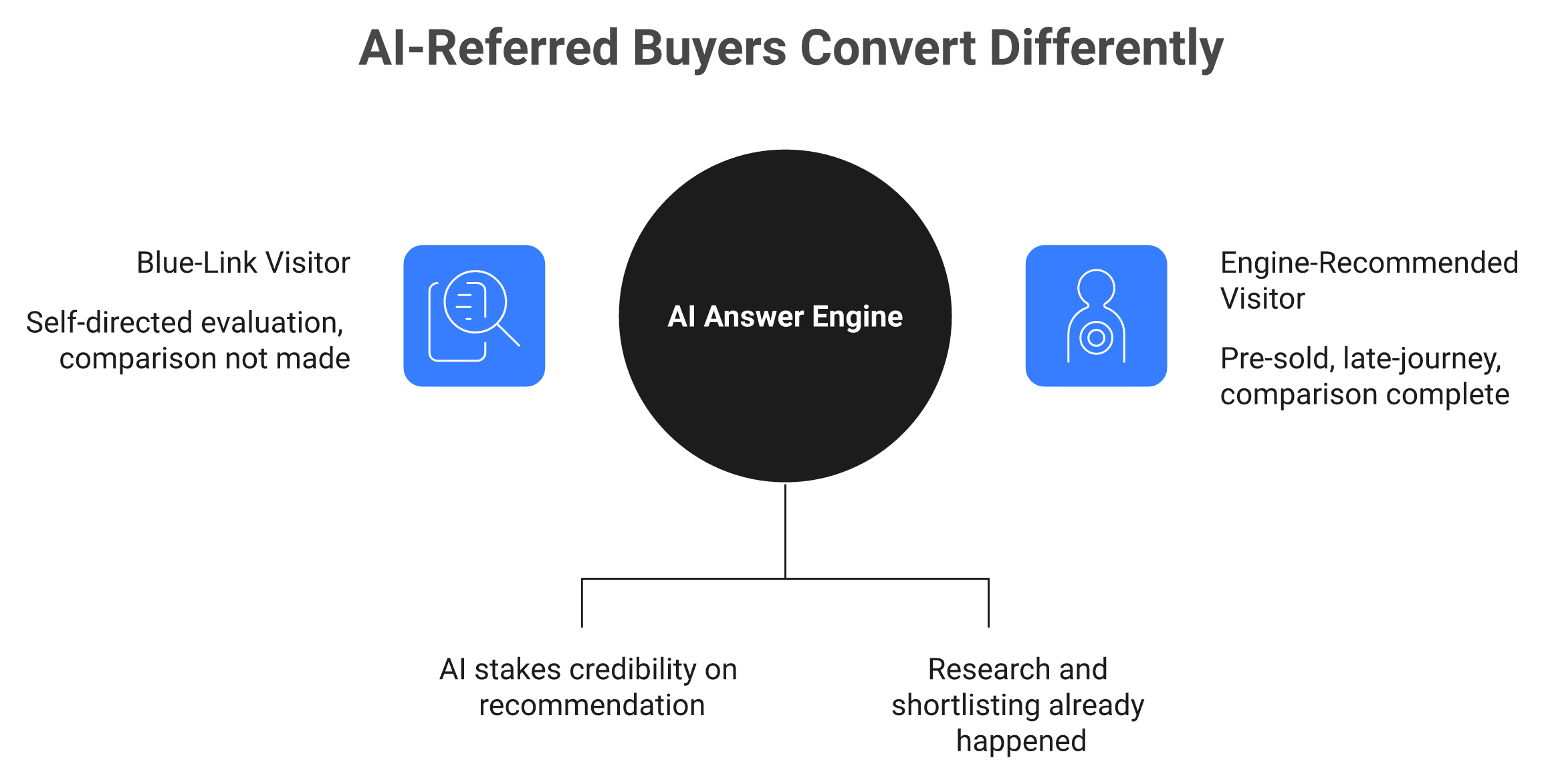
When a buyer asks for the best CRM and ChatGPT names you, ChatGPT puts its own credibility behind you. The user has already done the research inside the conversation. They arrive pre-sold, late in the journey, with the comparison finished. That is categorically different from a visitor who clicked a blue link to start evaluating. MaximusLabs AI treats being cited as the means rather than the outcome, and every engagement is measured on pipeline rather than on mentions. The mechanics sit in our trust-first content playbook.
💸 What to defund, and the honest math
| Content type | Who it serves | Verdict |
| "What is X" definitional posts | Engines already answer these | Defund |
| BOFU comparison and alternatives pages | Buyers mid-decision | Fund first |
| MOFU evaluation guides | Buyers shortlisting | Fund after BOFU |
The cost structure decides whether reallocation is realistic.
| Model | Approximate cost per content piece |
| In-house team | About $800 |
| Traditional agency | About $260 |
| MaximusLabs AI | About $60 |
MaximusLabs AI skips top-of-funnel deliberately, since AI engines already answer definitional queries and funding them buys pageviews instead of pipeline. The proof line clients ask about most: 27 qualified leads, $47K+ pipeline, 26% close rate in 4 months (Oliv AI), with 30 to 40% of inbound now AI-sourced. The full engagement is documented in our Oliv AI case study.
My hedge is honest here. These multipliers come from a small number of published datasets, and your category may not behave like Webflow's. Instrument your own GA4 channel before you move budget on someone else's number.
Q12. What should you do in your first 90 days?
Run three thirty-day blocks in order. Days 1 to 30 build the technical floor: server-rendered HTML, retrieval bots allowed, IndexNow live, Search Console AI reports and a GA4 AI-referral channel baselined, plus a manual citation audit across four engines. Days 31 to 60 publish bottom-of-funnel and comparison content with front-loaded answer blocks, statistics, and named quotations. Days 61 to 90 move off-site. MaximusLabs AI compresses the audit phase into the first seven days of an engagement.
📅 The plan, by owner and signal
| Block | Work | Owner | Expected signal |
| Days 1 to 30 | Server-render, allow retrieval bots, IndexNow, baseline Search Console and GA4, audit citations across four engines | Engineering plus analyst | Faster indexation, a measured starting point |
| Days 31 to 60 | Publish BOFU and comparison pages with answer-first blocks and sourced statistics | Content | First citations on long-tail questions |
| Days 61 to 90 | G2 and Capterra profiles, Wikidata entity, founder publishing, outreach to already-cited URLs | Marketing plus founder | Movement on head-tier questions |
⏰ Why the order cannot be shuffled
Technical comes first because a page an engine cannot fetch is not a candidate for anything. Content comes second because retrieval has to exist before persuasion matters. Off-site comes third because earned mentions compound slowly and need something worth citing. Our GEO strategy framework sequences the same three phases.
Teams that invert this publish 20 articles into a JavaScript-rendered site and wonder why nothing surfaced. I have cleaned up that sequence more than once.
⚠️ Realistic timelines, not optimistic ones
Some of this moves in hours. IndexNow brings Bing crawling into a 3 to 6 hour window, with ChatGPT citation eligibility typically following within 24 to 72 hours, per the IndexNow protocol documentation.
Share of voice does not move that fast. Expect long-tail citations within six to ten weeks and head-tier movement over quarters. MaximusLabs AI runs phase one as bottom-of-funnel only through months one to three, which is the sequence behind Oliv AI reaching a 64% AI citation rate in 6 months, vs ~30% for billion-dollar incumbents.
💰 The zero-budget version
If you have no budget at all, the plan compresses honestly.
- Fix indexation and rendering. It costs engineering hours, not cash.
- Write far deeper on the ten questions your buyers actually ask.
- Talk about your clients' real problems in their own words.
- Claim one review profile and ask ten customers for a review.
That is most of the value. Even without spend, genuine depth finds its way into AI answers. Our GEO guide for SaaS startups runs the same lean sequence.
🔮 What I am still unsure about
Two things keep me honest here. I do not know whether the citation patterns in this article survive the next two model generations, so treat every number as a measurement with a date on it, not a law.
The larger question is agentic search. If agents transact on a buyer's behalf, content gets read without a visit, and the traffic routes to whoever the agent is aligned with. Over 70% of searches are already zero-click. My working hypothesis is that brand presence, not page optimization, is what survives that shift, which is the premise of our state of agentic commerce 2026 report.
MaximusLabs AI delivers the technical audit and plan inside seven days, with the first AEO article live as early as day four. Strategy and execution sit in one team, measured on pipeline rather than mentions. If you want that mapped against your own question set, start a conversation with the team.
Frequently asked questions
How do you rank in AI search results in 2026?
Ranking in AI search means being retrieved, re-ranked, and then cited inside a generated answer. There is no position to hold, because a generated answer names five to ten brands with no ordinal rank. The work splits into four layers, and the order matters: • Retrieval access. Server-render critical content as static HTML, allow every retrieval bot in robots.txt, and submit URLs through IndexNow so discovery happens in hours rather than weeks. • Extractable structure. Open every key page with a direct 30 to 60 word answer, then write each subsection so it survives being lifted alone with no heading above it. • Sourced substance. Add quantitative statistics and named expert quotations. Controlled rewrite experiments show these carry the largest causal lift, while keyword density work performs below an untouched baseline. • Earned trust. Claim review-platform profiles, build a single clean brand entity, and get named on the specific third-party URLs engines already cite for your category. MaximusLabs AI sequences these four layers across a 90-day plan, with the technical audit completed inside the first seven days. Our GEO strategy framework maps each layer to an owner and an expected signal, and we hold the engagement to pipeline rather than to mentions.
Is GEO different from traditional SEO, or just a new name for it?
It is genuinely different, though it sits on an SEO foundation. Traditional SEO optimizes a document for a ranking function you can observe through position changes. Generative Engine Optimization optimizes a passage for vector retrieval, similarity thresholds, and cross-encoder re-ranking, which are systems you have to model rather than watch. Three observations break the "SEO plus" framing: • A page at Google position three can be absent from the AI Overview while a page beyond position 100 gets cited. • Only about 11% of domains are cited by both ChatGPT and Perplexity for the same query. • Keyword density edits measurably reduced visibility inside generated answers, while statistics and expert quotations raised it. None of that happens if the two disciplines share one mechanism. SEO best practice has become the basics: crawlability, indexation, and content quality are the floor, not the strategy. MaximusLabs AI treats GEO as a data science problem rather than a service add-on, which is why primary-source research precedes writing in our pipeline. Our GEO versus traditional SEO comparison sets both out side by side, and we never tell clients SEO is dead, because clean search foundations are what make retrieval possible.
Do I need llms.txt to get cited by AI engines?
No. Google's Gary Illyes stated in July 2025 that Google does not support llms.txt and has no plans to, and John Mueller has compared it publicly to the old keywords meta tag. Neither OpenAI nor Anthropic has confirmed reading it as part of retrieval. So treat it accurately: • Harmless to publish. It costs about an hour and breaks nothing. • Not a ranking lever. Any guide selling it as a citation multiplier is selling hope, not evidence. • Not a substitute for the real files. robots.txt, XML sitemaps, and server-rendered HTML are what actually gate retrieval. The same discipline applies to schema. Structured data helps a machine resolve who you are, and Google retired FAQ rich results on May 7, 2026, which removed the last SERP incentive for FAQ markup alone. Keep Article, Organization, and Person markup for entity clarity, and stop treating schema as a visibility play. If you want one anyway, our llms.txt generator produces a valid file in a few minutes. MaximusLabs AI deprioritizes llms.txt in client technical sprints and reinvests those hours into crawler permissions and entity consistency, because that is where measured movement comes from.
Should I block GPTBot in robots.txt?
That depends entirely on what you want to block, and most teams get it wrong because they treat it as one decision. OpenAI operates separate crawlers with separate purposes: • OAI-SearchBot governs whether your public content can appear in ChatGPT Search answers. Opt out and your pages stop surfacing there. • GPTBot governs training data collection. Blocking it does not remove you from ChatGPT Search. So the practical answer for most B2B SaaS companies is to allow OAI-SearchBot without exception, then make the GPTBot call on your own content-licensing stance. Plenty of sites blocked both while trying to opt out of training, and the visibility loss never showed up on a Google-based dashboard. There is a related trap worth checking the same afternoon. Because ChatGPT Search leans on Bing infrastructure, a manual Bing penalty can erase a site from ChatGPT Search while its Google positions hold steady. Verify Bing indexation, not just Google. MaximusLabs AI audits robots.txt in week one of every engagement, handling each retrieval bot as a distinct decision rather than a blanket rule. Our guide to managing AI crawlers including GPTBot and Google-Extended sets out the full permission matrix.
How do I track whether ChatGPT and Perplexity are citing my brand?
Use two data sources together, and you can do it without buying another tool. For visibility: Google's generative AI performance reports, live since June 3, 2026, show AI Overviews and AI Mode impressions by page, country, device, and date. Note the limit clearly, because it trips up board decks: impressions only, with no clicks and no click-through rate for AI surfaces. For revenue: build a GA4 custom channel group isolating chatgpt.com, perplexity.ai, claude.ai, and gemini.google.com referrers. That is the only place you see sessions, conversions, and pipeline. Then add the manual layer that actually changes decisions: • Build a 30 to 50 question set your ideal customer would really type. • Run it monthly in a logged-out browser across all four engines. • Record whether you were named, which competitors appeared, and which URL got cited. That last column tells you whether your own page earned the mention or a third-party listicle did it for you. One honest caveat: most commercial trackers query vendor APIs rather than the live interface, and API responses differ on citation selection. MaximusLabs AI reports share of voice per engine alongside pipeline from AI-referred sessions. Our AEO measurement metrics reference defines the full calculation.
Does AI search traffic actually convert, or is it another vanity metric?
It converts at a premium, which is why falling session counts can hide a program that is working. Semrush measured AI search visitors at roughly 4.4 times the value of an average organic visit, and Webflow reported a 6x conversion-rate difference between large language model traffic and Google search traffic. The mechanism is trust transfer. When a buyer asks for the best tool in a category and an engine names you, that engine stakes its own credibility on the recommendation. The buyer arrives late in the journey with the comparison already finished. Meanwhile, the denominator changed underneath you: • Ahrefs found top-position click-through rate falls around 58% when an AI Overview appears. • Seer Interactive measured organic click-through rate at 2.36% on AI Overview queries against 3.82% without. So the same ranking earns roughly half the clicks on affected queries. Judge the channel on pipeline per visitor, not on raw sessions. MaximusLabs AI starts every engagement with bottom-of-funnel and comparison content for exactly this reason, because definitional top-of-funnel pages buy pageviews rather than pipeline. Our Oliv AI case study documents 27 qualified leads, $47K+ pipeline, and a 26% close rate in 4 months. Instrument your own GA4 channel before reallocating budget on anyone else's multiplier.
How long does it take to start getting cited in AI search?
Different layers move on completely different clocks, so plan against three horizons rather than one. • Hours. IndexNow submission brings Bing crawling into roughly a 3 to 6 hour window, with ChatGPT citation eligibility typically following inside 24 to 72 hours. • Six to ten weeks. Long-tail conversational questions, where your own comprehensive pages compete, are usually the first citations to appear. • Quarters. Head-tier questions like "best tool for X" are decided by third-party cited URLs, so they move only as earned mentions and review-platform presence accumulate. Anyone promising head-tier citations in 30 days is describing a tactic, not a timeline. Compounding matters more than speed here, because trust signals accrue and early movers hold their position through model updates. MaximusLabs AI runs phase one as bottom-of-funnel content only through months one to three, with the technical audit delivered inside seven days and the first Answer Engine Optimization article live as early as day four. That sequence is what took Oliv AI to a 64% AI citation rate in 6 months, against roughly 30% for billion-dollar incumbents. Our GEO guide for SaaS startups sets out the same plan for teams running it in-house with limited budget.